Previous
2003 FONT Birding Tour
HighlightS
with
narratives of the tours, photos, and comments by participants
The following summaries are with the most-recent
tours first. Click link to tours that you find of interest.
In the summaries, there are further links to UPCOMING TOUR ITINERARIES,
BIRD-LISTS, and PHOTO GALLERIES
Guatemala
- December 2003/January 2004
Chile - November 2003
Brazil
(Amazonian & Atlantic Forest) - October/November 2003
Brazil (Minas Gerais) - September/October 2003
Brazil (Southeast) - August 2003
Brazil (Mato Grosso) - August 2003
Brazil (Rio Grande do Sul) - July/August 2003
Spain (Pyrenees & Ebro Delta) - June/July 2003
Spain (Extremadura & Gredos Mountains) - June 2003
Colorado (& nearby Kansas & Wyoming) - April 2003
Dominican
Republic - March 2003
Puerto Rico - March 2003
The Lesser Antilles (St. Lucia, St. Vincent, & Dominica) - March 2003
* * * * * * * * * * * * * * * * * * * * * * * * * * * * * * * * * * * * * * *
Guatemala
December 2003/January 2004
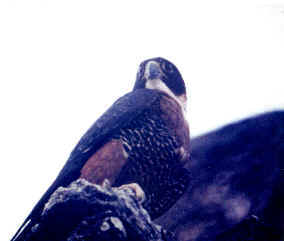
A pair of Orange-breasted
Falcons (one in photo above) were seen again during our '03-04
Guatemala Holiday Tour, at a temple at the Mayan
ruins of Tikal. This was the 3rd FONT Guatemala tour during which the
species has been seen, once previously also in January, and another time in
April.
Other notable birds at Tikal included a Pheasant Cuckoo (seen on the
ground just a few feet from us) and a Black Hawk-Eagle (perched in
a tree outside the front door of our room).
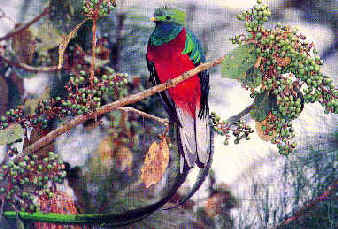
The Resplendent Quetzal, one of the most beautiful of world's birds and
the national symbol of Guatemala, was also seen well during our tour. A male is
in the photo below.
"TOP 10 BIRDS" during our recent 2003-04 Holiday Birding Tour
in Guatemala
1. Orange-breasted Falcon
2. Pheasant Cuckoo
3. Resplendent Quetzal
4. Pink-headed Warbler
5. Ocellated Turkey
6. Black Hawk-Eagle
7. Sungrebe
8. Prevost’s Ground-Sparrow
9. Crimson-collared Tanager
10. Gray-headed Piprites
Over 300 species of birds have been seen during our Guatemala Holiday Tour. And other wildlife too, in a beautiful and culturally interesting country. We'll be going again next year.
List of Birds & Other
Wildlife during previous Guatemala Tours.
Upcoming Guatemala Tours

Birds during our November '03 Chile Tour
Birds during previous Chile Tours (340 species)
Albatrosses & Other Chilean Seabirds
The following account written by Armas Hill, leader of the tour.
Chile is a great place to see TAPACULOS,
little birds that are generally skulkers. And we had the enjoyable experience to
see some exceedingly well during our tour in November
2003.
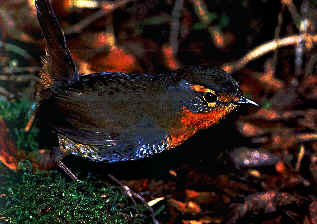
The Moustached Turca (above) was nicely observed in the Andes near
Santiago. In the moist forests of the Lake District of southern Chile, the calls
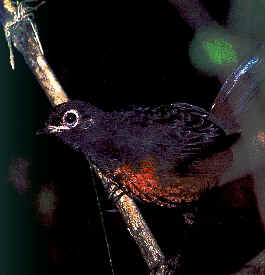
of tapaculos resound, such as the Chucao Tapaculo (lower left)
and the Black-throated Huet-Huet (lower right). We enjoyed very
good looks at both of these, as well as the Magellanic Tapaculo and the Ochre-flanked
Tapaculo, all in just about the same area of the forest. We had a 4-Tapaculo
Morning! Not only heard but seen!
As were 2 Magellanic Woodpeckers flying by
us.
Many good birds were seen during our 2003 Chile tour. From Magellanic Plovers and other specialties on Tierra del Fuego, to a group of Peruvian Thick-knees in the very far-north of Chile (just a few kilometers from Peru). A Sparkling Violet-ear was also seen in far-northern Chile, calling atop a tree, as nearby there was a brightly-cinnamon Giant Hummingbird (the largest Hummingbird in the world).
Birds in areas geographically in between included pairs of Torrent Ducks along a raging stream and Andean Condors floating in the sky.
Chile is very long country. From north to south, it is much like going along the north Pacific coast in reverse from Baja California to Alaska.
The first international FONT birding tour was conducted in Chile in November of 1990. It was so good to be there again (for the 14th time) in 2003.
As during every tour, there was
not only wonderful landbirding, but also some great seabirding. We did 2 pelagic
trips (one from Valparaiso and one from Arica in the far-north), in
addition to traveling on 2 ferries across the Strait of
Magellan. An account of our pelagics offshore from Valparaiso
and Arica follows.
Birds
during FONT Chilean pelagic trips
in November 2003
An
account written by Armas Hill.
2003
was a good year for us pelagically off the coast of Chile. While for some
species numbers were not as high as they have been on occasion in the past,
virtually all of the good variety of species this year were seen well. Off
Valparaiso, out a little further and longer than other times, we enjoyed, with
the sun behind us, good looks at the oceanic birds, including the albatrosses,
close to the boat. The "chumming" brought the birds in. Some, such as
Pink-footed Shearwaters, could nearly be touched at the edge of the boat. The
oceanic waters off Arica were filled with fish (along with sea-lions and birds).
So the "chumming" there was rather ineffective. One of the highlights
of that trip was when a Peruvian Diving-Petrel, on the water by our boat,
moved in closer & closer as it seemed to be observing us!
In the following list of oceanic birds seen during our two pelagic trips, the
red number relates to what was seen off Valparaiso (v),
the blue number off Arica (a).
Humboldt
Penguin v:8, a:6
Black-browed Albatross/Mollymawk v:15
Buller's Albatross/Mollymawk v:1 or 2
Salvin's Albatross/Mollymawk v:25,
a:1
Gray-headed Albatross/Mollymawk a: 1
Southern (or Antarctic) Giant-Petrel v:5
Southern (or Silver-grey) Fulmar v:1
Cape Petrel (or Pintado) v:8
Juan Fernandez Petrel v: 1 (possibly
more)
DeFilippi's (or MasAtierra) Petrel v:10
Thin-/Slender-billed Prion v:3
White-chinned Petrel v:35, a:8
Westland (Black-) Petrel v:4
Pink-footed Shearwater v:30, a:4
Sooty Shearwaters v:200, a:30
Wilson's Storm-Petrel v:30, a:10
(possibly more)
Elliot's (or White-vented) Storm-Petrel a: 20-plus
Markham's Storm-Petrel a:2
Peruvian Diving-Petrel v:1,
a:10
Peruvian Pelican v:100, a:many
Peruvian Booby v:50, a:many
Blue-footed Booby a:1 (rare in Chile)
Brown Booby a:1 (rare in Chile)
Guanay Cormorant v:3,
a: a few
Red-legged Cormorant v:3
Red (or Grey) Phalarope v:25, a:1
Red-necked Phalarope a:25
Chilean Skua v:4
South Polar Skua a:1
Pomarine Jaeger a:1
Parasitic Jaeger a:30
Gray Gull a:many
Belcher's (formerly Band-tailed) Gull a:50
Kelp Gull v:dozens, a:1 or 2
Franklin's Gull v:100 a:200
Laughing Gull a:1
Sabine's Gull a:1
South Amercian Tern v:10 a:2
Common Tern v:1 (possibly more)
Arctic Tern v:5 (probably more)
Elegant Tern v:3, a:30
Sandwich Tern a:1 (rare in Chile)
Inca Tern v:20, a:100-plus
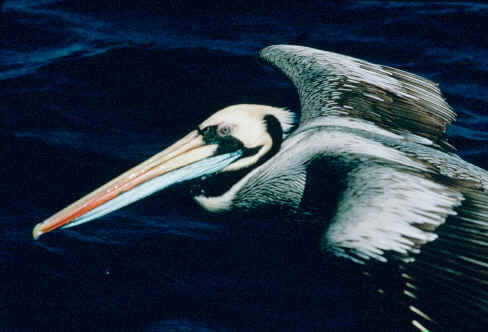
Peruvian (or Chilean) Pelican, off Valparaiso, Chile
Brazil
(Amazonian & Atlantic Forest
October-November 2003
The following account written by Armas Hill, leader of the tour.
In
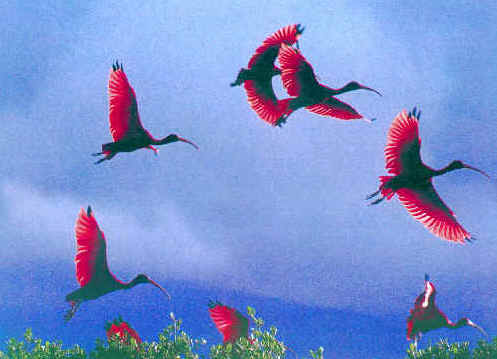
Scarlet Ibises were among
the birds enjoyed,
during our October-November '03 tour in southeastern Brazil.
Minas
Gerais, Brazil
September-October 2003
The following account written by Armas Hill, leader of the tour.
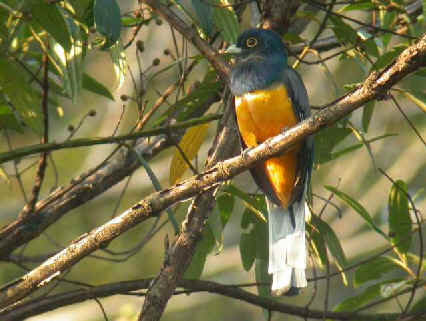
The following account written by Armas Hill, leader of the tour.
In
Mato
Grosso, Brazil
August 2003
A Plethora of Piscivorous Birds
The following account written by Armas Hill, leader of the tour.
In the Brazilian state of Mato Grosso, the region known as the Pantanal is one of the most renowned places for birding in the world (and for good reason). It is "birdy".
The region normally has pronounced wet and dry seasons. Our birding tour there in August is during the dry time. Waterbirds are concentrated at that time in the reduced areas of water. There are spectacular masses of egrets and herons of various kinds, storks (including Wood Stork and Jabiru), Spoonbills, Cormorants, and more.
Many of these birds are piscivorous, that is "fish-eating". In the ponds, and the rivers, there must be very large numbers of fish, as fish-eating birds abound. Anhingas, cormorants, herons, and egrets, terns and kingfishers at some places in tremendous numbers. And there are other creatures in the waters, ranging from caimans to capybaras.
But it's birdlife that's truly a spectacle in the Pantanal. During each day of our tour there, over a hundred species were seen.
In that area of avian superlatives, there are a number of birds that are big! Some are the largest of their kind.
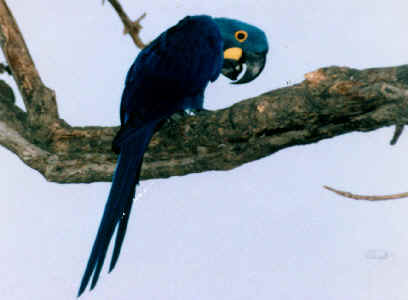
Hyacinth Macaw
The Hyacinth Macaw is the largest of the macaws.
The Toco
Toucan is the largest of its tribe.
Another bird seen during the tour, the Greater
Rhea, is the largest of all American birds.
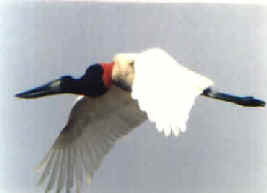
Jabiru
The huge stork, the
Jabiru, is also among the biggest. Jabirus with young were on their
nests (also big). Also with young on their nests were Plumbeous Ibis, one
of a few ibis species in the area. Making a clamor in those bulky stick nests of
the ibises and Jabirus, were groups of Monk Parakeets (noisy little
neighbors).
In a riverside forest, large Bare-faced
Curassows were seen walking about.
And yet another large bird, to add to our
cast of avian characters of the Pantanal, was one that when we saw it, during
the day, sat still in a tree, silently. It was one of the best finds of the
tour, a Great Potoo. Of course, we had looked forward to seeing birds
such as the Hyacinth Macaw and the Jabiru, but we expected to see
them. The Great Potoo, as we saw it, was unexpected.
Outside the Pantanal, during our August 2003 Mato Grosso, Brasil Tour, we enjoyed good looks at Red-legged Seriemas, in the dry habitat known as "cerrado", where also we saw a nice grouping of White Woodpeckers, and some notable Tanagers White-banded (it looks rather like a Loggerhead Shrike), White-rumped (they duet), Black-faced, and Cinnamon.
But the highlight in that dry area was one particular tree, filled with purple flowers and hummingbirds. Among the dozens of hummingbirds, there were particularly attractive Horned Sungems and Amethyst Woodstars. The males of both have long tails. The female sungem does as well.
Further north, in an Amazonian forest of Mato Grosso, a highlight indeed was a fine look at a Paradise Tanager, a beautiful bird filled with colors. Our August 2003 Mato Grosso Tour in Brazil was filled with birds!
Rio
Grande do Sul, Brazil
August 2003
The following account written by Armas Hill, leader of the tour.
Rio
Grande do Sul is the southernmost
state in the large South American country of Brazil.
It borders on Uruguay, and is as far south as parts of Argentina and Chile.
And it is a wonderful place for
birding, with nearly 600 species recorded in the Brazilian state that´s about
the same size as the American state of Colorado.
Nearly 300 of those species reach an edge of their range in Rio Grande do Sul, such as northern species at their southern limit, and southern species at their northern limit. Migration and seasonality also have much to do with the birdlife of Rio Grande do Sul.
Our tour in that state, in late July and early August 2003, was during the winter there. At about 30 degrees south latitude, it´s not a place with a cold winter. But penguins can occur along the coast.
We rode along the beach, a
portion of the state's long coastline. The pristine beach continued on for many
miles. People were few, mostly fishermen. However, birds were many, along the
surf, and on the sand, with shorebirds including oystercatchers,
stilts, plovers (mostly Collared), egrets (Snowy), gulls
and terns. Among 5 species of Terns, the most common for us was a
nicety known as the Snowy-crowned. Among the Gulls, there was the
attractive Gray-headed.
We didn't see any penguins
during our time by the sea, but we did have the good fortune of seeing rather
closely, just beyond the surf, a large bird gliding in an up-and-down flight, a Black-browed
Albatross.
Later that day, away from the ocean, in some small trees by a pond, we saw a Bananaquit. Only mentioned, as how often is it that an albatross and a bananaquit are seen during the same day. Such is birding in Rio Grande do Sul.
Returning to the seashore, by the dunes next to the beach, at a small marsh, one of the nice sights of the tour was of Scarlet-headed Blackbirds perched in a bare tree. In the marsh itself, there was a Warbling Doradito, a skulker. Not far away, a nearly all-white bird, a White Monjita, was much more obvious. (Monjitas are in the flycatcher family.)
In another part of Rio Grande do Sul, quite different, at a higher elevation, in an area of open grasslands, we saw another Monjita, the Black-and-White. And following a pair of them, there was another member of the blackbird family, one of the rarest of birds (some say headed toward extinction), the Saffron-cowled Blackbird. We saw a pair of them. Quite interesting behavior, not understood, is that Saffron-cowled Blackbirds (the few there now are) follow the Black-and-white Monjita. The monjita perches on reeds and bushes. The blackbirds walk about, feeding on the ground beneath them. Both the monjita and the blackbird are considered threatened. The blackbird, as noted, severely so.
A feature of the Rio Grande do Sul landscape, that's distinctive, and rather unusual, are the groves and forests of Araucaria trees. Araucarias are conifers. They are flat-topped, with long horizontal, upturned branches. Some species of birds are associated with these odd-looking trees, including the Araucaria Tit-Spinetail, the Azure Jay, and 2 species of parrots, both Amazons, the Vinaceous-breasted and the Red-spectacled. All of these are considered threatened, or nearly so, as the araucaria forests have been reduced. The two parrots are particularly threatened, dependent now on isolated patches of the particular tree. We enjoyed seeing all of the 4 species just mentioned. The Araucaria Tit-Spinetail was voted the "Top Bird" at the tour's end. We had some particularly good looks at this crested bird, with a long tail. It was one of a number of "nice birds" during the tour.
Spain,
Lammergeier, Wallcreeper, & a Hedgehog,
June-July 2003
The following account written by Armas Hill, leader of the tour.
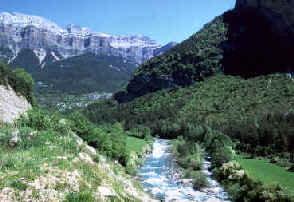
The
Pyrenees Mountains in Spain
are
spectacular, with alpine terrain and topography that's unsurpassed. Two of the
species of birds that occur there can also be said to be spectacular the Lammergeier
and the Wallcreeper.
During our June-July 2003 FONT birding tour in that region of Spain we saw both.
Both are birds of remote, wild, and of inaccessible, high country, favoring cliffs, crags, precipices, canyons and gorges.
The Lammergeier is a large bird,
also known as the Bearded Vulture. It's body is nearly 4 feet long. Its
wings about 8 and a half feet across. On the bird we saw, as it flew against a
sheer, rocky cliff-face, its orange-buff body, black wings, long tail, and black
facial mask could readily be seen. As always, seeing a Lammergeier in flight is
a thrill.
No where is it a common bird. Its range, even though large, across Eurasia and
in parts of Africa, is scattered. Lammergeiers have large territories. In the
Pyrenees, it's said that 2 pairs can have an immense home range of 100 square
kilometers.
Wallcreepers
share with the Lammergeiers the habitat of large rock faces, and the range
across Eurasia (not Africa), throughout which it too is never common. But the
Wallcreeper is not 8 feet by 4. Rather, it's only 5 inches.
Related to nuthatches, the Wallcreeper flits with a jerky gait on rockfaces.
Unlike a treecreeper, it does not use its tail for support.
The bird's a bit like a gray moth (but with burgundy butterfly wings). It flicks
those wings constantly. That behavior is adapted by juveniles as soon as they
fledge. But they are even a more uniform light-gray against rocks often much the
same coloration. We went to a place, truly beautiful in the mountains, where
Wallcreepers had just nested. With some patience, and good fortune, we saw what
was apparently one of the young birds flitting against the rocky cliff above us.
As we were lying still on the ground and looking up, waiting for the small bird to reappear, move cross the rock, and then disappear, we became ourselves items of interest for large birds circling overhead. Massive Griffon Vultures came closer and closer (until we moved). Conversely, small birds that visited us as we waited were Firecrests and Crested Tits. Choughs were acrobatically flying about. Nearby, a pair tended to a young bird in a crevice. The Choughs were vocal as they flew, as were the Ravens flying higher above us.
At another time, in the Pyrenees, we
crossed into France.
There, from a high road, we were actually able to look down upon a nice bird, a Honey-Buzzard
floating in a circle beneath us. A Red-backed Shrike perched nearby. As
we went back, over a pass, across the border into Spain,
in addition to various birds, we had nice looks at an alpine animal, a
goat-antelope, that's been known as the Chamois. Recently, Pyrenean
Chamois (along with those Cantabrican and Alpennine) have been ascribed to a
separate species Rupicapra pyrenaica, the Apennine Chamoise or Isard.
(As with birds, when nomenclature changes, there's a resistance. A "Chamois
is a Chamois", not an Isard.)
Regarding change however, and giving credit to adaptation, in the past on the Spanish side of the Pyrenees, the currency was the Peseta. On the French side, it was the Franc. Now, on both sides, it's the Euro.
Also in the Pyrenees, we birded by structures (monasteries and the like) from as far back as the 9th Century - pre-peseta.
A site south of the Pyrenees that we visited was a town (known as Belchite) that was destroyed during the Spanish Civil War (in the 1930's). As a way of commemorating how bad war can be, only the rubble of buildings is there now. No people anymore. But by the destroyed church, there are resident Black Wheatears and Blue Rock Thrushes, along with the more-common riffraff of House Sparrows. In Belchite today, birds live (and probably other creatures). But not humans.
Not far away, in an area of desert called the "Spanish Steppes", there were other birds for us to see. There was another wheatear (the Black-eared Wheatear, say that fast), and larks (some with greater short toes and some with lesser short toes, yes, to put it otherwise, both Greater Short-toed Lark and Lesser Short-toed Lark). Where also Crested, Thekla, Calandra, and Dupont's Larks reside, in a "land of larks".
The Ebro Delta by the Mediterranean Sea is far from dry. It's a vast area, with fields of rice, thus lots of water. And lots of birds. Obvious among them were herons and egrets Grey, Purple, and Squacco Herons, Little and Cattle Egrets. And Little Bittern (always nice to see). Ducks included the Red-crested Pochard. Great Crested Grebes, Moorhens, and Coots were also in the mix.
The delta juts miles into the sea, with a large amount of habitat favored by shorebirds. Those we saw included both Common and Spotted Redshanks, both Curlew and Whimbrel, both Black-tailed and Bar-tailed Godwits, Plovers mostly Kentish but also Ringed and Grey (or Black-bellied), Eurasian Oystercatcher, Pied Avocet (with young), and Black-winged Stilt.
Greater Flamingos waded in pools where also there were some notable gulls, including the rare Audouin's, Slender-billed (often with the flamingos), Mediterranean, Black-headed, Lesser Black-backed, and Yellow-legged (the last of these the most common along the beach).
As interesting as the gulls were, the terns were more so. Along the coast, in an area of a huge spit of sand, there were more terns than one could be imagine. Thousands of terns were flying over the surf, all in the same direction (toward their nesting colony). Each and every one of the terns had a small fish in its bill. Yes, there were thousands. Most were Common Terns (if ever that term for a tern were appropriate it was there). Also in numbers were Sandwich and Little Terns. And Gull-billed Terns, which wandered away from the sea inland to fields to catch insects, and Whiskered Terns. Above some rice fields there were swarms of Whiskered Terns. How nice it was to be in area where terns were so abundant!
During our last evening in the delta, we visited a place with shallows pools near the mouth of the river. More birds were added to our list. Particularly nice were Collared Pratincoles flying about, and Purple Swamphens with young. Unusual for Spain were 4 Great Egrets and some Glossy Ibis. Out of season was an Arctic Loon, or Black-throated Diver, flying over the sea by the rivermouth. You never really know what you're going to see during a birding outing in the Ebro Delta.
We then headed back, that evening, toward
our hotel. To the west, there was ahead of us a most beautiful pink and blue sky
just after sunset, with coastal mountains making a fine backdrop. We were
travelling along a road, quite narrow, in an area of fields. And then, ahead of
us, something rather odd-looking was moving across the road. It was a Hedgehog.
Not at all a hog or pig of any kind, actually a creature about a foot-long
covered with spines. And not related to Porcupines either. It's completely
different. Actually the Hedgehog is an Insectivores, most closely related to
smaller Shrews and Moles.
We stopped the vehicle, backed-up, and got out. The animal was still on the road, but oddly, it had taken the shape of a BALL. Hedgehogs do that. They "curl". When danger's perceived, it's done because of an interesting ability. The Hedgehog has a larger skin, beneath which there is powerful muscle covering the back. The large skin is more strongly developed around the edges than at the center. It's only loosely connected to the body underneath. When it contracts, like a drawstring around the opening of a bag, the contents (that is most of the animal) is forced into the "bag" as the string is drawn tighter. When a hedgehog thus "curls", two muscles pull the skin just referred to over the head and rump. So, the BALL takes form.
The most distinctive feature of the Hedgehog is its spines. An average adult has about 5,000 of them, each about an inch long, and with a needle-sharp point. When the animal "curls", the skin with spines covers everything (including the otherwise unprotected underparts). Muscles that automatically stretch erect the spines, and so the tighter a Hedgehog curls, the spinier it becomes.
With a stick, we pushed the rolled-up ball of a Hedgehog off the road. It softly hissed. The animal's protection that's evolved over the ages would have been no protection at all if another vehicle would have come along that narrow road.
Our encounter with the Hedgehog was just one of the enjoyable aspects of our 2003 tours in Spain. Nearly 200 species of birds were seen. There's a complete Upcoming FONT Spain Birding Tours
Spain
Imperial Eagles & other raptors, Eagle Owl, Great Bustard, & more
June 2003
The following account written by Armas Hill, leader of the tour.
This was our 21st FONT birding tour in
Spain, since our first there in 1991.Certainly the best birding highlight of all was when 4 Spanish Imperial Eagles appeared together in the sky
above us, as we were traveling along an Extremadura country road.
The Spanish
Imperial Eagle is one of the rarest birds in the world. The current
population estimate is just over 100 pairs in total. The 4 eagles that we saw in the sky above us were close. They
circled, and flew about in various directions, again, and again, interacting
with each other, and vocalizing as they did so. Two of the eagles were adults.
Two were immatures. Apparently it was a family grouping. On the adults the
notable white leading edge to the wing and white scapular patches were seen
well. The juveniles were a brown-red coloration overall. What a nice way it was
for us to see one of the world's rarest birds. They stayed with us for about 10
minutes before drifting off.
Actually we had already seen another Spanish Imperial Eagle (at another place) earlier that day. And the species was just one of a few eagles we saw. We enjoyed nice looks at Short-toed Eagle, and Booted Eagles (both light and dark morphs).
During the morning of the same day we saw the Imperials, we also had a tremendous look at the rare Eurasian Black Vulture, not high above us, against the clear blue sky. That species, also now called the Cinereous Vulture, is the European bird with the largest wingspan, and one of the 3 or 4 biggest raptors in the world. 4 species of Old World Vultures occur in Spain, including the Black, the Griffon, the Egyptian, and the Bearded (also called the Lammergeier). Old World Vultures are quite different from New World Vultures, in both structure and behavior. Actually, it's only the word "vulture" that they have in common. Old World Vultures are birds of more remote countryside, of which there is much in Spain. There are more vultures in Spain than in any other European country.
Spain is one of the best places, not only in Europe, but anywhere, for raptors. In addition to those just mentioned (the Spanish Imperial and other Eagles, and the Cinereous and other Vultures), there are numerous Kites (including the Black and the Red), the Montagu's Harrier, and the Hobby (just to mention a few of the species that occur in the country).
Another raptor that we enjoyed as much as any, was the Lesser Kestrel. Throughout much of its range, it has declined drastically in recent years. But in parts of Spain, large numbers still occur. The species is gregarious, and is often seen hawking for insects. Just outside the window of a castle (now a place to stay, a "parador"), we watched as we ate breakfast, Lesser Kestrels closely, coming and going from cavities in the rock wall. They perched on ledges. The male in the sunlight was beautiful, but all of the dozen or more that were seen at once, were wonderful to see.
At the end of the same day, we had another nice encounter, with a "nocturnal raptor", the Eagle Owl. It's a huge owl, with 10 times the mass of a Long-eared. Looking at a large rock cliff-face, we saw an adult quickly fly, at day's end, around a rock, out of view, as it went out to hunt. Young birds were also on the cliff-face. We could hear 2 of them begging, as their loud hissing voices echoed from the rocks. Then we saw one of the nearly-grown youngsters (already big) walking around on a ledge. In our scope, it was a nice sight, as the owl acted rather like a youngster, playing with sticks. As darkness fell, and the young owls continued their begging calls, a Red-necked Nightjar flew by between us and the cliff.
We've referred to some big birds, such as eagles, the large Black Vulture, and the Eagle Owl (large even when it's young). But there was another "biggie" that we saw well during our tour. It's the heaviest of all Europe's birds, the Great Bustard. We were so fortunate to see some of them closely. 5 males walked in a single-file procession, each keeping pace with the others, moving with an apparently bustard-style motion with their heads going back-and-forth. Another Great Bustard was seen even closer, a female, walking slowly along the edge of tall grass. A short while later, 4 young Great Bustards flew by us, somewhat high in the sky. Great Bustards fly like geese with eagle-wings. In all, we saw 11 Great Bustards.
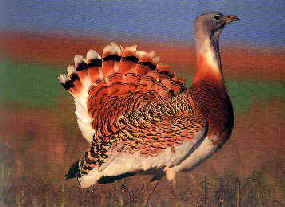
There were a number of other birds during the tour
that were wonderful to see. Among them:
A singing Bluethroat, seen well in good sunlight, in a beautiful mountain
setting.
A Black-bellied Sandgrouse on a lakeside mudflat, before taking flight
right by us.
Large numbers of White Storks at their nests on churches and other
structures.
A family of Black Storks at a nest, in a wilder place, on a riverside
cliff.
A brilliant little turquoise "jewel", called the Kingfisher.
Rollers, also with a brilliant
blue, on their wings.
Bee-eaters, colorful throughout.
Strikingly-patterned Hoopoes.
The also nicely-patterned Woodchat Shrike.
The brightly-colored Golden Oriole.
And, a namesake of Spain, the Spanish Sparrow.
Not birds, but fun to see were Spanish Ibex (over 25), walking on high rocks in the Gredos Mountains - males, females, and young.
Mentioned here have been just some of the
sightings during our 21st Spanish Birding Tour.
We plan to go to
Iceland,
Gyrfalcons & Goldeneyes,
Puffins, Phalaropes & Ptarmigan
June 2003
The following account written by Armas Hill, leader of the tour.
Beautiful, often spectacular, Iceland
is quite a
place. Clean and pristine, it's with coastlines, moors, mountains, valleys,
waterfalls, volcanos, and glaciers. Travel into the countryside of the island,
where people are few, is something enjoyed at the time, and remembered for a
long time afterwards.
We've now conducted 11 FONT tours in Iceland. Our next tour there, number 12, will be in October. The bird-life is interesting then also, but different than it was during our just-completed 11th tour, June 4-10, 2003.
In October, birds are migrating, or preparing to do so. Many of them are in flocks Golden Plovers, Redwings, Whooper Swans together in numbers. Groupings of geese of various kinds are passing through, on their way south, from Greenland. Purple Sandpipers are together along rocky shores, with Harlequin Ducks in the coastal waters. And then on clear nights in October, there are spectacular displays of "Northern Lights" or Aurora Borealis.
But in early June it's very different. Birds are breeding, and generally spread out over the countryside. As we drive along, Golden Plovers, on territories, give their plaintive songs. Whimbrels, their melodious fluting trills. Dunlin display, raising their wings. Black-tailed Godwits are on pools, the race in Iceland with a stronger red coloration than other populations. Oystercatchers can't help but be striking. Redshanks tend to get attention by alighting atop posts and calling loudly. And Snipe do more than that. Their winnowing overhead is a constant in the Icelandic countryside. There must be thousands & thousands of Icelandic Snipe. They could be heard and seen virtually anywhere we stopped, day or night.
But, oh yes, in Iceland in early June there really is "no night". Close as it is to the Arctic Circle, during our entire time, there was no actual darkness. A bit dimmer at let's say 2 o'clock in the morning, but not dark enough for stars.
Some birds during those dimmer hours seemed to rest, but not all. Arctic Terns still screeched as they flew. A Short-eared Owl hunted. In bushes in small towns, the thrush known as the Redwing, gave its flute-like song. And throughout the land, those ever-present Redshanks called, and Snipe winnowed, as much as ever.
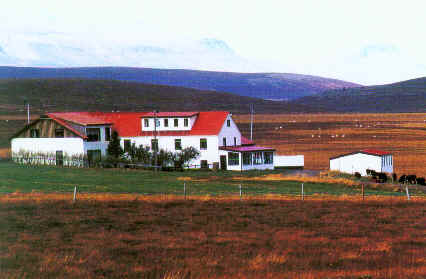
Where we stayed
near Lake Myvatn,
but really "not near anything" at the end of a 10-mile dirt road.
But a fine place for a walk, a home-cooked meal, and a thermal
bath.
Phalaropes and Ptarmigan were among the birds in the northern Icelandic countryside. The former, daintily-built but boldly-patterned, were on roadside pools, the Red-necked Phalaropes. The Ptarmigan is one of 27 or so subspecies throughout the Northern Hemisphere of Rock Ptarmigan. That species ranges, in isolated populations, in mountains such as the Pyrenees and the Japanese Alps, and on islands, often remote, from the Aleutians to Newfoundland, Greenland, and Iceland. We saw them well, on the ground and in flight, the strong fast fliers they can be. And need to be, apparently, to escape their predator, the Gyrfalcon.
As with our previous tour number #10, a week earlier, we had the very good fortune of seeing Icelandic Gyrfalcons, at their nest, on a cliff-side in a river gorge. Through a scope, from the far side of the gorge, we saw well two white baby gyrs at the nest, and the accompanying light-gray adult female. We also saw the male, flying rapidly out above the adjacent vast terrain. His role, we assumed, was to catch a meal. Her role, in the gorge, to protect the chicks. It was a wonderful experience for us, in an area of wilderness.
A turn of the telescope, there, showed us another bird on its nest. It was a Pink-footed Goose that truly blended into the tall grass. Not much more than the head of it, and its mate a few feet away, were visible. But the distinctive beaks, of those geese ever so still, could be readily seen. Many of the Pink-footed Geese of the world nest in the remote highlands of Iceland. The rest, even more remotely, in Greenland.
We spent the night at a nearby farm, with facilities for guests, where outside the door there was "nothing" for miles, other than an open countryside with some sheep and Icelandic horse, and birds!
In contrast with the Pink-footed Geese
that we saw, Greylag Geese were obvious and vocal throughout the
countryside. Often with goslings.
Some Whooper Swans were in flocks, non-breeders. But a number of them
were in pairs, some with their cygnets.
Along shorelines some of the plentiful Common Eiders had their ducklings.
And there were waterbirds of various sorts on lakes, ponds, and streams,
including colorful Horned Grebes in breeding attire, both Red-throated
and Common Loons, and many, many, ducks.
Certainly among the best in the duck department was the Harlequin. The beautiful drakes that we saw, a few times, in fast-flowing river waters, were sights not to be forgotten. And never tiring to see.
In eastern North America, birders look at
times for a single Barrow's Goldeneye in a flock of many Common
Goldeneyes. In Iceland, we did the opposite. On a still-watered lake, in a
magnificent volcanic setting, there was a large flock of Barrow's Goldeneyes.
With maybe a few more males than females (that may have been on nearby nests).
Among the big group, there were two male Common Goldeneyes, that species
not common at all in Iceland.
There's something interesting about the nomenclature of the Barrow's
Goldeneye. It's scientific name is Bucephala (as in Goldeneye) "islandica".
Thus, named after Iceland, even though the species is most common in the
American West. In Europe, the Barrow's Goldeneye occurs only in Iceland.
Regarding it's common name, the Barrow's
Goldeneye is named after Sir John Barrow, an Englishman, who lived from 1764 to
1848. He was, for many of those years, the Second Secretary to the Admiralty in
the Royal Navy, and quite instrumental, in London, for the British exploration
in the search of the North-West Passage through northern North America.
Point Barrow in Alaska and the Barrow Sound and Barrow Straits in the Arctic are
named after him.
From London, John Barrow was largely responsible for the Arctic expeditions by
James Clark Ross, Edward Sabine, and John Franklin (all of whom had gulls named
after them). But the duck, the Barrow's Goldeneye, was named after a man, back
in London, who never actually saw it in the wild. We did, nicely, in Iceland,
where it's said that about 800 pairs occur.
Of all the birds in Iceland, during the breeding season, it's the seabirds that are far and away the most plentiful. They are present in the millions.
One of our ventures, during the tour, that was most enjoyable was a walk on a cliff-top, along the north Iceland coast, on a peninsula, with a lighthouse, and Puffins. Their burrows, lined up like condos, were at our feet. Some of the comical-looking creatures flew out of the holes much like bullets as we approached. Others stood, a bit further from us, on the grass. Below, on the water of the ocean, there were hundreds and hundreds of Puffins. Some riding the waves, some diving for food, and others feebly flying about. It was for us another marvelous experience.
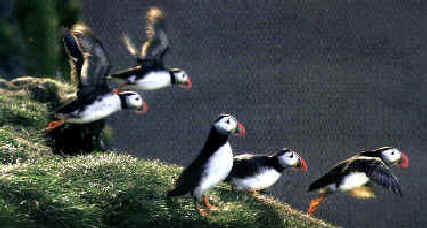
At another place along the Icelandic coast, on the south side of the island, other alcids were represented Murres (of 2 species) called Guillemots in Europe, the Black Guillemot (Americans and British agree on that name), and Razorbills. More Razorbills occur in Iceland than anywhere else in the world. Out to sea in the distance, from that spot, we could see a rocky island, called Eldey. It's reputed that on that island another alcid, now extinct, last occurred in 1844. It was the flightless Great Auk. Our tour was only a century and a half too late.
The Icelandic seabird that now seems the
most common of all, let's say abundant, is the Northern Fulmar. It is in
large numbers on cliffs throughout the island. Atop one particular cliff along
the north coast, we had eye-to-eye looks at Fulmars on their nests, although we
saw them more distantly many places. They are fun to watch in flight, with their
alternate flapping and gliding, even in stiff winds.
But oddly, back in those days when the Great Auk occurred, the Fulmar was a
rarity in Iceland, occurring in 1750 on only one offshore island (Grimsey), and
then recorded nesting on mainland Iceland for the first time about 30 years
later. Today, there are millions of Fulmars in Iceland in the summer.
Other seabirds that occur in big numbers,
that we saw during the tour, were Kittiwakes, Gannets, Arctic Terns, and Lesser
Black-backed and other Gulls including Glaucous.
And there were Parasitic Jaegers and Great Skuas.
We stayed a couple overnights in a small,
kind of out-of-the-way, village, on the northern seacoast, where the hotel,
favored by fishermen, was by the mouth of a river renowned for its salmon. The
beach and the ground by the rivermouth was dark. It was an exact match for two
dark-morph Parasitic Jaegers as they sat not far from a large noisy group
of Arctic Terns. During the tour, we had great looks at both dark and
light morph Parasitic Jaegers.
On that same dark soil, by the hotel and the river and ocean, one morning, a Great
Skua sat.
Yes, Iceland was a great place to be.
Some of the smaller birds that we saw
were notable:
Snow Buntings were in their
dapper breeding plumage. A male, giving its song, was the first bird we saw by
the parking lot at the airport.
An Icelandic version of the Winter Wren was heard giving its song in
rocks above water, along the
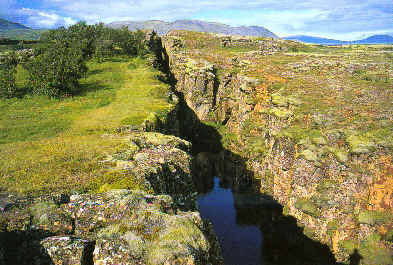
Mid-Atlantic Rift
In trees
(where they were to be found), we sometimes found Redpolls. There are
taxonomists who now tell us that those residing in Iceland are "split"
from the Common Redpoll to be the endemic Icelandic Redpoll, Carduelis
islandica.
In one Icelandic forest, in addition to Redpolls and Redwings, we found a Eurasian
Siskin, and in conifers, a pair of Goldcrests. The latter was also
seen during our tour a week earlier. The Goldcrest, the smallest of European
birds, was only recorded as an Icelandic breeder as recently as 1999.
Our "top 10 birds", as we voted them, at the end of the tour, were
1 - Atlantic Puffin
2 - Gyrfalcon
3 - Harlequin Duck
4 - Horned Grebe
5 - Pink-footed Goose
6 - Barrow's Goldeneye
7 - Red-necked Phalarope
8 - Great Skua
9 - Snow Bunting
10 - Black-tailed Godwit
In all, 20 species of birds received votes. In all, nearly 70 species were seen.
But it was not just the birds, but other aspects also, that made it a fine tour indeed, during which we had a terrific time.
As noted, our next tour in Iceland
will be later this year, October 4-8.
That tour can be done in conjunction with a very enjoyable birding tour in
southern Sweden,
September 27-October 4,
or it can be done on its own.
During the week in Sweden, there's one of the most phenomenal autumn migration of birds anywhere, with large numbers of raptors, waterbirds, shorebirds, and landbirds funneling through the southern tip of the country. It's a great birding experience.
The October
2003 tour in Iceland
would be with whole assortment of other, northerly birds. Among them shorebirds,
waterbirds, gulls, alcids, Ptarmigan, White-tailed Eagle, and hopefully Gyrfalcon,
in addition to some migrants and vagrants.
And, then, after dark, unforgettable displays of "Northern Lights",
the Aurora Borealis.
Two tours will be offered in Iceland
during the late-Spring of
2004:
May 27-June 1
June 2-8
Upcoming
FONT Birding Tours in Iceland & Sweden
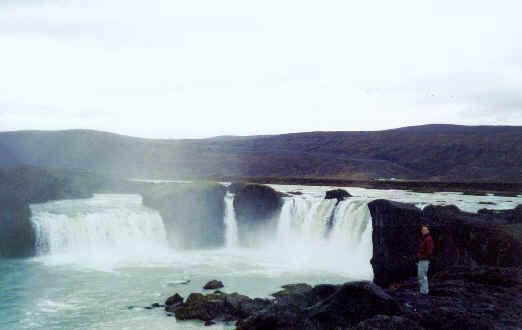
The waterfall known as
"Godafoss", one of many in Iceland.
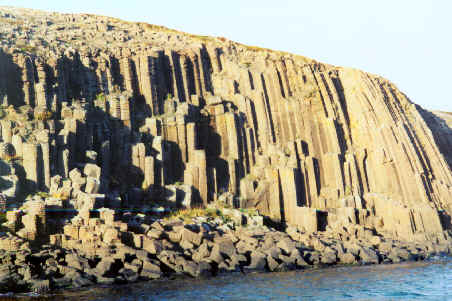
Basalt columns, one of
numerous geological formations in Iceland.
Iceland,
a Solar Eclipse, Gyrfalcons & Goldcrests
May/Jun 2003
The following account written by Armas Hill, leader of the tour.
We've just completed the 10th FONT birding tour in Iceland. It was the first of
two tours there in the late-spring of 2003.
All of the birds we hoped for were seen, and more!
The morning of the last day in May, in
one of our favorite Icelandic fishing towns, Stykkisholmur,
began with a sunrise at 330am. We were up, as it was not an ordinary sunrise
that day. As the large, orange ball near the horizon was going higher, the
shadow of the moon began to cross it. Think of an orange half, then crescent
sun.
Due to the eclipse's path being by the Arctic Circle, the moon's shadow
moved across the sun in the direction opposite that of "normal solar
eclipses". The approximately 3-minute period of totality was just after
4am. During that period, the sky was darker than it had been just after 3am.
In 2003, there would be two solar eclipses, the one that we saw over the Arctic, and another to be late in the year over the Antarctic. Our Icelandic experience was the 5th solar eclipse, during a FONT birding tour, since 1991. The others have been in Costa Rica, Bolivia, Venezuela, & Turkey.
In Iceland, during our May-June 2003 tour, not only was there nature in the sky with the eclipse, but also we visited a place where the Mid-Atlantic Rift, usually beneath the ocean floor, can be experienced at the surface of the land. It's a nearly unique occurrence. Along the Mid-Atlantic Rift, the North American and European Continents are ever so slowly drifting apart. As we were there, at a rocky, rushing stream, there was a striking male Harlequin Duck. Interesting, actually, as the Harlequin is one of 2 species of Duck, predominately American, that occur in Europe only in Iceland. The other is the Barrow's Goldeneye.
One of our most-exciting times during this Iceland tour was by another rocky stream, out in some vast open countryside. Just below a waterfall, the stream went through a deep, rocky gorge. From one side, we had a telescope view that nearly filled the frame, of a light-colored, female Gyrfalcon on a ledge, next to 2 fluffy, white Gyrfalcon fledglings. We'll never forget that sight.
Later that day, we were walking in an Icelandic forest of mostly short conifers. There are not many forests in Iceland, but there are some. In it, Icelandic Redpolls and Redwings (a European thrush) were common. But there were also the high, wispy sounds of another bird, Europe's smallest, the Goldcrest, one of the kinglets. Close to us. We saw one with the gold crest, and then another fluttering, just learning to fly. What bird is smaller than the Goldcrest? A baby Goldcrest. The species was found to breed in Iceland only as recently as 1999.
A couple days earlier, we saw Iceland's largest bird, a female White-tailed Eagle on its nest. The male stood, in the open, on a nearby ledge. The pair on a rocky island on a big bay. We saw the birds during a wonderful boat-ride during which we also saw thousands of Puffins, on clifftops, on the surface of the water, and in flight. Other North Atlantic alcids we saw comparably well during the tour.
When we were standing on a clifftop, during another sunny day, we looked down at Fulmars (many of them) sitting on their nests. Further down, on the surface of the ocean, we saw Great Skua feeding on a floating carcass, Red-throated Loons, and many, many Eiders.
A few miles further, along a dirt road, we had the best possible look at a pair of Rock Ptarmigans, the mostly-white male with bright red eyebrows. The brown female blended in with the terrain. Both were just outside the windows of our van.
Further along, during our ride, were Red-necked Phalaropes, also close, spinning around on roadside pools. After passing through one of a number of Arctic Tern colonies, we saw, in a stony area, some nice Snow Buntings in breeding plumage.
Along another road that day, in an area of meadows, we had a close encounter with a Short-eared Owl, as more Snipe than imaginable were winnowing in the sky. At one time, 14 snipe were counted above us. Ravens flew by, adding their sounds to the mix.
Over 70 species of birds breed in
Iceland. We saw nearly all.
The list of vagrants in Iceland is long, and we came across a couple Great
Crested Grebe and Grey Heron (the heron occurring more
normally in Iceland in the winter). Migrants still on their way farther
north included shorebird flocks with Turnstones, Sanderling, and Red
Knot.
Lastly, we were fortunate in May to see an Iceland Gull in Iceland. That species actually nests, not in Iceland, but further north in Greenland.
We'll be going to Iceland,
again, with such a tour (minus the eclipse, of course), next May-June
in 2004.
And, we'll be going to Iceland
with another tour, later
this year, in October 2003,
when, in addition to the resident Icelandic birds, there will be migrants on
their way south, and, in the sky, at night, the "Northern Lights",
or Aurora Borealis.
Upcoming FONT Birding Tours in Iceland
Colorado,
& adjacent Kansas & Wyoming
for Grouse & other birds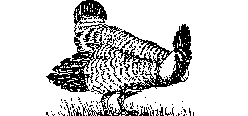
The following account written by
Armas Hill, leader of the tour.
It was very early on Easter Sunday morning. And the Sun had not yet risen. In fact, it was still dark. The stars in the clear sky above us shone very brightly. We were not near any city of appreciable size. So, without diffused light or pollution of any kind, it really was a clear, crisp early morning. We were in
Kansas, not far from Oklahoma, and not far from Colorado where most of our upcoming week would be, with other early mornings, as we'd begin most days with the performances of grouse at their leks.Before the round red sun came above the horizon on Easter morning, we were watching, during the first light of day, the round red neck-sacs of male Lesser Prairie Chickens inflate as the birds went through the postures and maneuvers of their displays. They would run about, turn around, seem to stamp their feet, and make an assortment of sounds, some with a higher pitch, and some like bubbling hoots, as they did their routine. On the natural grassland, where we sat ever so quietly in our van, we observed the birds just outside our windows. It was quite a show. There were 4 Lesser Prairie Chickens on their lek. We had heard them first, making their sounds, when it was still dark. When lightness came, they appeared, as if on queue, on the open knoll that they favored for their displaying. One of the four birds would repeatedly rise to the top of a low bush, calling as he held on with one foot. With his red neck-sac pulsating, the red sun rose into the dawn sky behind him.
We were close to the old Santa Fe Trail, a route used by the European settlers as they traveled west across America in the early 1800's. During those days, as the settlers moved across the plains, Lesser Prairie Chickens were common, even abundant, around them. In the less than 200 years since then, the species has declined substantially. That decline is thought to be over 90% since the 19th Century, and, more recently, nearly 80% since the early 1960's.
In 1980, Lesser Prairie Chickens occupied only 8% of their original range (which was historically throughout the southwest Great Plains, in southeast Colorado, southwest Kansas, western Oklahoma, northern Texas, and eastern New Mexico). Now, it is only in small, scattered populations.
There were an estimated 50,000 birds in total in 1980. About 20 years later, in 1979, the population was estimated as 10,000 to 25,000, mostly in northwest Texas and Kansas.
Western Kansas, open and flat, is what might be called an "in-between" type of place. We journeyed north the entire width of the state (as we headed toward Greater Prairie Chicken territory). In southern Kansas, we were at the western edge of the Central Time Zone, until for some reason, we crossed an invisible line, where we were, while still in Kansas, into the Mountain Time Zone (the same as that in Colorado a few miles to the west). Birds were also a blend of east-west. There were Eastern Bluebirds and Western Meadowlarks, Eastern as well as Say's Phoebes, and even Blue Jays at the western edge of their range. By a stream, in a small grove of trees, there were both "Myrtle" and "Audubon's" Yellow-rumped Warblers. And we saw Flickers fly, some with yellow and others with red underwings.
During our ride north in western Kansas, we observed Eurasian Collared-Doves, spreading northwest from as far as Florida, and Great-tailed Grackles, another species spreading north from Oklahoma and Texas.
Swainson's Hawks were numerous in the clear blue skies. They had just travelled north from Argentina in South America.
By a small woodland, we encountered a Prairie Falcon quickly flying low across our path, until it landed in one of the trees just ahead of us. From there, it continued on just as quickly.
In another group of trees, along the highway, by a stream and a small rocky hillside, close to Nebraska (in an area not as flat as most of the Kansas we saw), we noted in a large stick nest 3 heads of young Great Horned Owls, with an adult sitting in the open nearby. Our day in Kansas, that had begun with the performances of Prairie Chickens, was an interesting one.
Actually, by Easter Sunday's end, we had seen both prairie-chickens. On the private land of a vast ranch in northeastern
Colorado, our cordial hosts took us to an open grassy area where we would see the lekking activity early the next morning. During the last hour of Sunday, we enjoyed, however, a number of close looks at Greater Prairie Chickens, again just outside of our van. We were permitted to drive onto the open grassy area.Early the following morning we were there again, on that open area, with the Greater Prairie Chickens as they performed. From 20 to 30 of them, at various times, were around us. Their droning sound was continuous. (It's quite different than the vocalization of the Lesser Prairie Chicken.) During their booming displays, the Greater Prairie Chickens engaged in a complex series of postures and maneuvers, with their heads drawn, orange air-sacs inflated, their pinnae (pointed feathers on the head) erect and forward, and their tails cocked. They would quickly fan those tails open at the beginning and end of each display sequence. Also notable to us, during our morning visit with the chickens, were males facing each other, in pairs, and acting combatively.
We and the chickens were not alone on the grassy field. There was also a large herd of mostly black cattle that was, to say the least, curious about our vehicle. So much so that the cattle surrounded us for a while, rubbing against the van and some even licking mud from the bumper. It was certainly an odd experience. But as to the cattle, the prairie chickens paid little heed, continuing to engage in their activities. That was even as the cattle walked away from us, across the field, among the wild displaying chickens. To us it seemed somewhat as we imagined it would have been years ago when prairie chickens shared grasslands with the buffalo, when both were abundant.
There were 3 races of Greater Prairie Chickens. One, in eastern North America (from Boston to Washington), known as the Heath Hen, was extirpated on the mainland bout 1835. It continued to survive, later, on the offshore Massachusetts island of Martha's Vineyard, until 1932 when that race became extinct.
Now, 2 races remain, but just barely. The "Attwater's Greater Prairie Chicken" of the Texas coast declined from 8,700 birds in 1937 to 1,070 in 1967. About 30 years later (in 1998), only 56 individuals survived, in 3 isolated populations.
We were most appreciative to our Colorado hosts for allowing us onto their property to experience some of the Greater Prairie Chickens still, fortunately, common there.
Elsewhere in eastern Colorado, there's an extensive area of natural grasslands, without cattle (and without prairie-chickens), but with a number of birds that we were glad to see well. Among them were both displaying McCown's and Chestnut-collared Longspurs, a close pair of Mountain Plovers, some Brewer's Sparrows, and a duo of Burrowing Owls at home in a former prairie dog town.
We headed west toward the sage country of northwestern Colorado, not as we would have, through a Rocky Mountain pass in Colorado, but rather on an interstate in adjacent Wyoming. During a period of 9 days (5 of them overlapping with our tour), there was a total of 51 inches of snow in areas of the Rockies west of Denver.
So, we went via
Wyoming. And, off the interstate, we had a fine birding, particularly in the area of Laramie Lakes, where, yes, the sun was shinning on a good assortment of ducks, Yellow-headed Blackbirds, and White Pelicans. Our first Golden Eagle flew by.On the ground, there were McCown's Longspurs. Back in Colorado, he had anticipated them. Here, as unexpected birds, we enjoyed them all the more.
Mammals in the sunlight included Pronghorn, Beaver, Snowshoe Hare, Mule Deer, and the Wyoming Ground Squirrel.
In a forested area, higher in the mountains of Wyoming, we found a feeder with Evening Grosbeaks, Cassin's Finches, Pine Siskins, Mountain Chickadees, and "Gray-headed" Juncos. It was to be the first of three good "bird feeding areas" for us in the mountains during our tour.
It snowed during our entire first day in the high, open country of sage in northwestern
Colorado. The plowed roads attracted a number of birds, notably Horned Larks, Pipits, and various sparrows. Atop a sage, we had a good look at a Sage Thrasher. Ponds and a reservoir in the area were filled with birds, where there were Franklin's Gulls that were pink. Not because the air was cool, but because that's what some Franklin's Gulls have in the spring, a pink hue on their breast!We went a morning later than planned for the lekking, in the early hours, of the Greater Sage-Grouse, the largest grouse in North America. And we were glad we had changed our plans. Not only did we go to the "traditional" site (where most observers go) for the performing grouse, we also had been advised by a local ranch owner to go to another road nearby. At that location, the grouse came right by the edge of the road. We stayed quietly in our van, and the Sage Grouse performed all around us, just feet away. In all, that morning, we counted on the ground more than 50 grouse, mostly males, but also some females. Both, again, close to us, and seemingly oblivious to us.
What they were not oblivious to, was an adult Golden Eagle that flew in over the open countryside, toward us and the grouse. Sage Grouse that we had been observing, and others back in the sage that were out of view, flew up quickly and headed in all directions. It was quite an experience after watching the grouse as well as we did for about an hour.
In groups, male Sage Grouse, at their lekking sites, adapt a remarkable appearance. They elevate and spread their tails to become spiked fans, backed by a ball of white-spots on black undertail coverts. They draw their heads back, and inflate their chests (giving an appearance of two large eggs "over-easy"). Their stringy black filoplumes become erect, and their bare chest patches pump, along with double-hooting and pumping sounds. The birds, moving forward, produce swishing sounds, as drooped wings bush against stiff breast feathers.
It was quite a morning for us before breakfast. On our way back to town and the restaurant, a herd of elk went by us, heading up a hill.
The next morning we enjoyed yet another early-morning show of grouse, that many in our group found just as enjoyable to watch. With the help of a good local guide, we saw atop on a knoll, the amusing antics of a group of male Sharp-tailed Grouse. Amusing, as they appear rather like "wind-up dolls", strutting together in unison, stopping at once, and then, together starting up again. They do their postures and maneuvers with cocked and spread tails. They also spread their wings forward, going into their head-down synchronized "clockwork runs" with tail-rattling and some remarkable vocalizations.
That morning began for us, before dawn, with the bugling of an elk, nearby.
Also in the area, we saw an adult Bald Eagle by its nest, and Sandhill Cranes, all in pairs. One was seen on its nest.
The next morning was that of the rarest of the grouse during our tour. The Gunnison Sage-Grouse, is similar to the Greater Sage-Grouse, but about 30 per cent smaller. And it is restricted to the smallest of the ranges of the American grouse, only occurring locally in a part of southwest Colorado and adjacent Utah. The Gunnison Sage-Grouse is a newly-described species.
Formerly thought to have been more widespread (possibly in areas of New Mexico, Arizona, Kansas, and Oklahoma), now the Gunnison Sage-Grouse is only in 6 or 7 Colorado counties and one in Utah. The entire population is estimated as being less than 5,000 birds, with most in the Gunnison Basin of Colorado. Elsewhere numbers are very few. In Utah, there may only be 150.
Near Gunnison, we saw the grouse, at a site they favor, before dawn. When it was still dark, we heard there, among other sounds, the winnowing of snipe, the calling of Killdeer, and the howling of coyotes. First, the coyote howls were faint. Then they were louder. As we were watching, through our scopes, the Gunnison Sage-Grouse at their lek, they suddenly dispersed. And then through our field of view, there was a pack of 4 Coyotes moving to the left. By 6am that morning, the display of the Gunnison Sage-Grouse was over.
The previous day, on our way to Gunnison, in coniferous forest of higher country, we stopped by a small lodge with a sign that it was open all-year. In a tree, by the parking lot, there was a single bird, a Clark's Nutcracker. One of our group members had thoughtfully brought some peanuts from home. We put some onto the parking lot, and within moments there were as many as 20 birds almost at our feet, mostly Clark's Nutcrackers, but also Gray Jays, some Steller's Jays, and a Raven or two. All were corvids.
In fact, in Colorado, we did a "Corvid-Sweep". In addition to the 4 species just noted, we saw at various places Blue Jay (in northeast CO), Western Scrub-Jay (in northwest CO), what's now the American (or Black-billed) Magpie ("split" from the Eurasian bird), the American Crow, and the Chihuahuan Raven.
As we were driving east from Gunnison, through our area of pines, a blue bird flew across the road in front of us. It was a Pinyon Jay. We stopped. Around us, then there were many Pinyon Jays, including some, outside our van window, nearly "at our feet" (without peanuts).
We were heading east, and north, from Gunnison, during our last afternoon of the tour, toward the Lovelands Pass over the Continental Divide. A friend had told us that some White-tailed Ptarmigan had been seen there, a day or so previously, by skiers (who were birders). When we got there we certainly found skiers (many of them). It was a beautiful day at the Pass.
Our friend also had told us of a feeder, nearby, with birds, notably all 3 species of Rosy-Finches.
And what a visit we had there, that last sunny afternoon. At about 10,000 feet above sea-level, such a feeder can be good, and it was!Most of us, in our group, left, following that enjoyable experience at the feeder, to head back East to homes and work, departing Colorado the following morning after a great tour.
Upcoming FONT Birding Tours in Colorado
Northern
& Western Honduras
March-April 2003
The following account written by Armas Hill, leader of the tour, upon his return:
To those of us now in the northern US, and elsewhere where winter has lingered this year, it can be said that the northbound birds of spring are coming - yes, they really are!
During our March/April 2003 birding tour in the Central American country of
Honduras last week, we were, last Saturday morning, having breakfast right along the Caribbean coast, in an outside restaurant atop a bluff above the beach.As we looked out toward the sea, there was a constant stream of birds in flight, from right to left, that is heading north. Barn and other Swallows, Chimney Swifts, and Eastern Kingbirds were all in the procession. There were hundreds and hundreds, even probably thousands of birds. In the trees around the restaurant, Rose-breasted Grosbeaks and both Baltimore and Orchard Orioles came and went. They, too, heading north to the forests, pastures, and other habitats in North America. The recent weather in the North notwithstanding, the birds of spring will be there on schedule.
As we left that restaurant that morning, for the van, an oriole was singing in the tree above. We could see it was a bird that would stay in the area, not having the urge to migrate north. The fine song came from a Spot-breasted Oriole. There was a pair of them in the tree.
Honduras is a land of Orioles. And the related Oropendolas.
At the site of the Mayan city of about a thousand years ago, Copan, the trees were filled with the bright orange and black plumages of orioles. Most were the Altamira, a large oriole that used to be called Lichenstein's. The species resides as far north as the Rio Grande Valley of southern Texas. Other orioles at Copan were the Streak-backed and Spot-breasted, both Central American species, in addition to Baltimores and Orchards that were there by the temples.
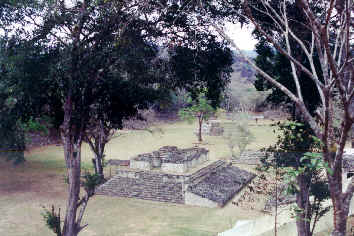
Mayan ruins of
Copan
(Photo by Marie Z. Gardner - © all rights reserved.)
During the day, at Copan, we saw an estimated couple hundred orioles. How nice for trees to be filled with such color.
Also in those trees by the temples, there were Pink-throated Becards (also common), Golden-fronted and other Woodpeckers, Tityras, and Motmots (the Turquoise-browed another splash of color!). In the trees, there were smaller splashes of color, in the form of warblers. There were many Magnolias.
At the top of the temples, we found ourselves eye-to-eye with White-fronted Parrots and Aztec (or Olive-throated) Parakeets.
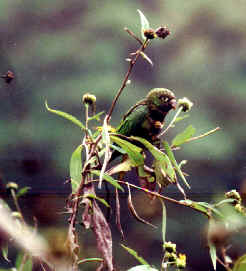
Aztec Parakeet,
during FONT's Honduras Birding Tour, March 2003.
(Photo by Marie Z. Gardner - © all rights reserved)
The next day, as we ascended a nearby dirt road higher into the mountains, we encountered yet another oriole, the Yellow-backed (overall, yellow and black), and it's all-black cousin the Yellow-billed Cacique (it, all-black except the bill). Also yellow-and-black were Black-headed Siskins and Lesser Goldfinches. In the pine trees, there were Grace's and Olive Warblers that would stay, Black-throated Greens that would go to eastern North America, and a Red-faced Warbler that would likely go north to Mexico. Overhead, that day, a flock of Chestnut-collared Swifts kettled, and a group of Broad-winged Hawks continued on their way.
Earlier I mentioned Oropendolas, large icterids related to Orioles. In the Honduran hills, we came across a flock of Chestnut-headed Oropendolas. They tamely stayed by us. Not far away there were Green Jays and Brown Jays, the latter more obvious, certainly more noisy.
In the lowlands, Montezuma Oropendolas were by their nests that dangle like stockings. At one particular place in that area, in a very large tree, there was an big, active colony of these birds, big themselves, coming and going, with their bright yellow tails. Their loud gurgling sounds were constant.
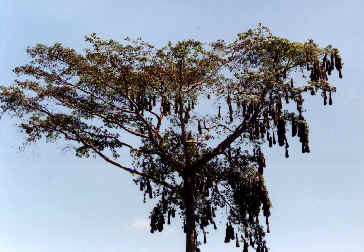

The hanging nests (left)
of the Montezume Oropendola (right).
(Photos by Marie Z. Gardner - © all rights reserved)
But even so, in the background, we could hear the Little Tinamou. And we certainly had no trouble seeing the brightly-colored Keel-billed Toucans in the air and the smaller, yet also also colorful, Golden-hooded Tanagers in the trees. Brown-crested Flycatchers were also nesting in a tree near the oropendolas, where also there were Sulphur-bellied and Piratic Flycatchers staking claims to their spots. The latter two flycatchers are migrants, that would not go to on to North America. They came from South America.
There's a city in North America, well-known to many, called "Miami". In Honduras, along the Caribbean coast. there's another place with the same name, but very different. The
Honduran "Miami", at the tip of a narrow spit of land between the sea and a large bay, is a row of wooden shacks with thatched-roofs. The people who live there, Black Caribs known as "Garifunas" are fishermen who walk out into the surf at the inlet with nets and bait in their hands. Above them, when we were there, were Royal and Sandwich Terns, attempting their catches. And Magnificent Frigatebirds, dipping to water's surface, to get theirs (As you know, frigatebirds can not get wet). It was quite a sight at the end of long white beach, otherwise devoid of people, but certainly filled with shorebirds whimbrel, plovers, sanderlings and sandpipers.Along the road between the beach and the highway (where again there were no people, only birds), we had an enjoyable end-of-a-day. As twilight fell, a lone Yellow-headed Amazon (a large parrot) flew by. A Bare-throated Tiger-Heron flew along a channel. A wild Muscovy Duck flew up and lit in a tree. Egrets, of various kinds, were in the sky, heading to their roosts. As many as 15 Lesser Nighthawks were flying about against that beautiful sky above us, just after sunset. From a nearby marsh, Gray-breasted Wood-Rails gave their raucous evening calls. Then, as it was getting dark, a half-dozen or so Pauraques gave their calls, as did one Yucatan Nightjar, from the scrubby ground not far away. The Yucatan Nightjar (yes, a bird that occurs almost entirely on the Yucatan Peninsula) was only discovered to be in Honduras about 10 years, first found not far from ours, in a similar habitat.
Other highlights of the tour included both Fulvous and Black-bellied Whistling-Ducks (at one place about a thousand of the latter together), Limpkins by a lake, and hummingbirds, of many kinds, feeding in "inga trees" in bloom.
Honduras is a land that begs to be birded. Many places, pristine and undeveloped. We'll be going there again later this year (in July) and again next spring (in March/April).
We're particularly excited about the tour planned for July of this year. It includes some good and wild places, with quests for some exciting birds. We'll be going into the largest wilderness area of Central America, known as "La Moskitia", where there are no roads (entry is by air, travel by boat or on foot), but where there are Macaws (Scarlet and Great Green) and Eagles (Harpy and Crested), and other wildlife from jaguars, anteaters and tapirs, to manatees and crocodiles. Certainly, if you don't check-out any other itineraries, you might look at this one in our web-site, where also a listing of other birds of the La Moskitia region is included.
Of the 700-plus species of birds recorded thus far in Honduras, only one is endemic to the country. It's a hummingbird called the Honduran Emerald, considered critically threatened by Birdlife International, and "re-discovered" in 1988. We'll be going for it during the July 2003 tour, in an area where also Double-striped Thick-knee, the Lesser Roadrunner, and Lesser Ground-Cuckoo occur.
Upcoming FONT Birding Tours in Honduras
The following account written by Armas Hill, leader of the tour.
Rare Ridgway's Hawks during our March 2003 Dominican Republic Tour
We had already found all the island's endemics that we had expected to see. So, we were travelling upward into the hills, on a rough road toward a larimar mine, in the southwest part of the island, to a place that's normally good for quail-doves. We were hoping for a good look at a Key West Quail-Dove, walking about on the dry forest floor, feeding on fallen wild oranges.
But the steep dirt road was not good. So, we stopped. Local people, roadside, told us it only would get worse. We decided to turn back. How fortunate it was that we did, as soon, we saw, to our left, 3 hawks soaring together in circles over a valley. We were able to view them in the telescope before they drifted off along a ridge. They were small buteos, notably smaller that Red-tails. The birds were dark above and creamy white below. Their tails were relatively short. The birds, soaring with flat wings, were juvenile Ridgway's Hawks. One appeared a bit larger than the others. So, there were 2 males and a female.
The Ridgway's is one of the world's rarest raptors. We've looked for it previously in the Dominican Republic without success. Our searches in the past were in the northeast part of the island, in supposedly the stronghold for the species. Even though there have been records, in recent years, in the southwestern Dominican Republic, we really did not anticipate seeing the phantom called the Ridgway's Hawk. Interestingly, a nest of the bird was found in 1997 in the area of the southwestern Dominican Republic, not far from our sighting, in the lower Baoruco Mountains. The hawk ranges from sea-level up to about 2,000 meters. Our encounter was not far from the coast, within that altitudinal range.
In the book "Raptors of the World" by Ferguson-Lee & Christie, it's said that the species tends to be solitary or in pairs, but that sometimes 3 or 4 may be seen soaring together, as we saw them early that clear morning.
Birdlife International indicates that the total population of the species has been estimated recently to be from 50 to 250 individuals. However, it's assumed now that the population probably does not reach three figures.How lucky we were!
Also during our recent Dominican Republic
tour, there were some other notable moments.
One of these was in another, higher area
of the Baoruco Mountains, after dark. We had already heard the calls of the Least
Poorwill (a small nightjar not known during much of the 20th Century) and
the Hispaniolan Nightjar. Then we heard, not too far away, but softly,
the distinctive notes of the Northern Potoo, a bird known in the
Dominican Republic as "Don Juan Grande" (or big Mr. John). By
the way, known in that country as just simply "Don Juan" is the
Chuck-will's-Widow, a bird that winters on the island.
When we heard the call of the potoo,
we played its call on our tape recorder. The large bird flew over us twice, and
then landed, beneath the full moon, on a snag just above us. It called a few
times. Its big yellow eyes were alert. But as time went by, those eyes seemed to
ignore us, paying much attention to insects flying by near the treetop. A few
times the potoo would sally out and catch a bug.
Then, in the distance, there was another call. Faintly, it was that of the Ashy-faced Owl, a Hispaniolan endemic similar to a Barn Owl, but with a gray (ashy) face, and more orange hue overall. We played that tape, and the owl flew in. It perched on another branch just above us, looking down, as we looked up at its ashy face. A beautiful owl it was. Both it and the potoo, were, at the same time, close together on their respective snag and branch. Both were beneath the bright full moon.
The Caribbean island of Hispaniola has a
number of endemics (about 25). Some of them are common and widespread, such as
the Hispaniolan Woodpecker and the Palmchat (the latter, unique, a
single species in a family endemic to the island). Other Hispaniolan endemics
are rare.
A number of them are considered
"threatened" by Birdlife International.
We found virtually all of the island's
endemics (except for the Gray-crowned Palm-Tanager that's mostly in Haiti).
Our encounter with the rare LaSelle's Thrush was brief. Another skulker, the Chat-Tanager, was seen ascending in a branchy tangle next to us before it disappeared. Another time, in dense cover, a Chat-Tanager was loudly singing as close to us as it could be. But it was invisible until it flew as a dart across the road in front of us. We called it the "chocolate rocket". (There have been as many as 4 regional populations of Chat-Tanagers, now split into 2 species. What we called the "chocolate rocket" is now called by taxonomists, the Western Chat-Tanager.)
Another rare endemic played hide-and-seek with us for a while, but then we saw it well. Called locally the "Cua" after its call, it's more properly known as the Bay-breasted Cuckoo. The bird is about 20 inches long, and it's odd how such a large bird can at times be so difficult to see. Once we saw it, however, it was beautiful.
Also nice to see was the colorful Hispaniolan Trogon. Among the other endemics, we saw 2 species of Todies (the Narrow-billed and the Broad-billed) , 2 species of crows (both rare), a parakeet and a parrot, the Hispaniolan Lizard-Cuckoo (with its red-rimmed eyes), a pewee, the Flat-billed Vireo (that was thought at one time to have been a flycatcher), the Ground and the White-winged Warblers (the latter can be elusive), the Black-crowned Palm-Tanager (known locally as "Cuatros Ojos" or Four Eyes), the Hispaniolan Spindalis (one of 4 Caribbean species that were once lumped as the Stripe-headed Tanager), a hummingbird known as the Hispaniolan Emerald, and also small, a piculet. It's interesting that the Antillean Piculet has a recorded history that goes back further than nearly that of any other bird, preserved as a fossil in amber. Piculets must have given their nifty calls in the Hispaniolan forest a long, long time ago.
There were a couple other experiences during our Dominican Republic tour that were particularly memorable.
One was onboard a boat, on a shallow lake near the sea, late in the afternoon. The motor was off. The boatman pushed the boat quietly in the water. The Sun was behind our backs. In front of us, in perfect light, there were groups of richly-pink flamingos walking about on long legs while with another shade of pink was in flocks of Roseate Spoonbills, feeding with their bills back and forth in the water.
All of the Reddish Egrets that we saw during the tour were the white morph. Their pink was on their thick bills. It's always entertaining to watch Reddish Egrets dance as they feed.
The other experience that we'll long remember
was our walk in Haiti. We had been at a lake, a large salty lake about 200 feet
below sea-level in the Dominican Republic. Our local guide suggested we go to
just beyond the far-western end of the lake to the Haitian border. We walked
with him , from the crossing, to another lake in Haiti, where he assured us
there would be birds. And there were. Thousands of them. Mostly Caribbean
Coots, but also a number of ducks of various species White-cheeked
Pintails, Northern Shovelers, Blue-winged Teal, Lesser Scaup, and Ruddy
Ducks (the Caribbean form with more black on the head). Shorebirds
were plentiful. Among them were many Black-necked Stilts, and a flock of Long-billed
Dowitchers (that gave their single call-notes as they flew). Belted
Kingfisher, Osprey, and various egrets were also in the mix. There
must have been fish in that lake in Haiti.
We walked back, through the border
crossing, to the Dominican Republic.
135 species of birds were found during our tour. A list of Hispaniolan birds (with local Haitian and Dominican Republic names for those we saw in each country) is in our FONT web-site.
Also in the web-site, itineraries for our future Hispaniola birding tours, with another tour in the Dominican Republic this year, May 4-11.
The following account written by Armas Hill, leader of the tour.
In March 2003, we conducted the 25th FONT birding tour in
Puerto Rico.During the first day of that tour (late in the day, near the airport, following the arrival of all of the participants), a bird not seen during any of our previous Puerto Rico tours was seen along the seacoast near San Juan, a Red Knot. That species does not commonly occur in Puerto Rico in March.
The next morning, along the coast at San Juan, near the fort in the old city, there was a group of White-tailed Tropicbirds flying about. It was to be first of two groups of White-tailed Tropicbirds for us that day. Later we had a seafood lunch at an outside restaurant atop a coastal cliff further west on the island. Over the sea by the restaurant, we tallied as many as 10 White-tailed Tropicbirds in flight.
There are 16 species of birds endemic to the Puerto Rico and the nearby Virgin Islands. Of those, today 15 occur only in Puerto Rico. We saw all of them during our tour, except the Puerto Rican Parrot (ultra-rare now in the wild, and very hard to see in the restricted area where it nests in March). But all of the other endemics were seen, nearly all of them seen very well.
Even the Elfin Wood Warbler, a denizen of dense vegetation, not even known to science until about 30 years ago, was seen well.
Among the rarest of the endemics, the Puerto Rican Nightjar was seen quickly in flight above us, but it was seen. Actually, that evening just after sunset, the experience was wonderful. We walked a trail in the dry forest, heading uphill away from the sea. As darkness was falling, diurnal bird sounds were diminishing. Bats were quickly flying by us from their diurnal roost. Then, the call was heard of the rare Puerto Rican Nightjar, a bird "re-discovered" in 1961. Prior to that year, it was only known from fossils in a cave and a single specimen taken back in 1888. As we walked along the trail, we heard maybe 10 of the nightjars, some of them close, some further away. Responding to a tape, one flew over. The species normally hunts in flight for insects low above the ground, in the dense thickets of its restricted range. Our walk that night, beneath a clear sky filled with bright stars, and with the calls around us of a bird that was thought for years to be extinct, was something to remember.
Another of the rarest of worlds, endemic only to southwestern Puerto Rico, was seen well. The Yellow-shouldered Blackbird we normally see, during our tours, in a setting that can be said to be about as comfortable as it gets, poolside, by our seaside hotel. The bird, in the morning (and other times) frequents the palm trees there.
During our March '03 tour, in addition to seeing it there (according to plan), we also encountered the Yellow-shouldered Blackbird somewhat unexpectedly along the coast at a dry and hot spot adjacent to some salt flats. As we were walking in the afternoon by the flats (looking for Snowy Plover), 2 of the rare Yellow-shouldered Blackbirds flew in front us. They were heading to a pile of let's say fruit (a feeder of sorts) by a shack. We had very close looks at the birds feeding on the ground.
A short while later that afternoon, a few miles down the coastal dirt road, by a lagoon, also on the ground was a group of birds, tamely tuckered down in the sand. There were about 30 plovers, 5 of them Semipalmated, but 25 of them Wilson's Plovers in an assortment of plumages. A nice sight.
Also in southwestern Puerto Rico, but in a completely different habitat, there were some fine waterbirds at a small fresh-water marsh. In the thick surface vegetation of the small pond, heads of male and female Masked Ducks (2 pairs) were seen. On that surface, Soras walked and fed. Around the pond's edge, there were both both Moorhens and Purple Gallinules. Also at the little aquatic oasis, there were grebes, herons of various sorts, and some shorebirds, among them a Solitary Sandpiper or two (making it not so solitary).
On the relatively small island of Puerto Rico, in addition to the endemics and other native Caribbean birds, and some migrants from North America (such as a Hooded Warbler we saw in a woods in company with a resident Adelaide's Warbler), there were some birds that have lived there in the wild for years, having come originally from some far-flung places around the world. Puerto Rico is not over-run with such exotics, but it's possible to see some birds from distant places (saving, you might say, the expense of travelling afar). Accordingly, we saw the Troupial from Venezuela, the Monk Parakeet from Argentina, the Ringed Turtle-Dove from the Middle East, the Warbling Silverbill from southern Asia, the Bronze Mannikin (brought in the 1800's) from Africa, and the Orange-cheeked Waxbill from Africa as well. The House Sparrow, in recent years, has been spreading and increasing in Puerto Rico more than any of the other introduced species just mentioned.
Of course what we aim to see during the tour is not the avian exotics, but rather the natives, including the endemics and Caribbean specialties. And that we did. Mentioning just a few more, we saw such niceties as hummingbirds known as the Antillean Mango and Green-throated Carib, in addition to the Antillean Crested Hummingbird. And also what's now called the Antillean Euphonia (it used to be called the Blue-hooded Euphonia). Names and taxonomy do change. What we now call the Puerto Rican Spindalis was once referred to as the Stripe-headed Tanager. The native oriole on Puerto Rico, once aligned with a population in Central America and called the Black-cowled Oriole, has been shown to have more affinities with the Lesser Antillean orioles, and not to be the same as the bird on Hispaniola (also formerly conspecific with the Black-cowled Oriole). New books and lists, with new names, will continue to be made.
A list of 185 species of birds found during FONT Puerto Rico tours is in our web-site along with upcoming tour itineraries in the "Caribbean section".
The
Lesser Antilles (St. Lucia, St. Vincent & Dominica)
March 2003
The following account written by Armas Hill, leader of the tour.
During our annual Caribbean birding tour in the
Lesser Antilles in 2003, islands visited were St. Lucia (our 13th tour), St. Vincent (our 7th tour), and Dominica (our 4th tour).In the Lesser Antillean Islands, birds include endemics and specialties. We saw all of those we sought.
Each of the 3 islands has its own parrot. (Actually, Dominica has 2.) Seen well, those on St. Lucia and St. Vincent were the most colorful.
The hummingbirds on the islands were great to see two species of colorful Caribs, the nifty Antillean Crested, and the beautiful Blue-headed.
Also wonderful to see and hear was the Rufous-throated Solitaire, as it sat by us on a branch in the forest, with a wide mouth as it sounded much like a flute.
Each of the three Lesser Antillean Islands we visited is attractive and picturesque in its own way, but Dominica is extraordinary, since it still has a large amount of forest. With rugged topography, the enchanting island is also so very green. In the Dominican forest, the Forest Thrush continues in fairly good numbers. (On other islands it has declined or disappeared.) One that we saw very well was one of our best birds of the tour.
One of the rarest of the specialties is the White-breasted Thrasher (it's one of the rarest of birds in the world, with just a total population of maybe a couple hundred). Usually close to the ground, it occurs in the dry forest of St. Lucia. We saw 2 together, at the base of a slanted tree trunk, close to us. These thrashers really do thrash, moving ground clutter aside as they feed.
In the trees, among the most fascinating
birds to be seen were the tremblers. And yes, they really do tremble.
That is they shake their wings, appearing nervous or neurotic. They're probably neither,
but who knows why they do it.
On St. Lucia, we watched the Gray Trembler and the St. Lucia Oriole
alternately feeding on a large fruit in a tree.
On St. Vincent and Dominica, the Brown Trembler entertained us as it
walked on tree branches, or on the ground, trembling as it went.
The forementioned tremblers and thrasher are among 5 species of thrashers
on the
Lesser Antillean Islands.
Two species of warblers are with limited ranges, the Whistling Warbler on Saint Vincent, and the Plumbeous Warbler on Dominica. We saw both well.
On Saint Lucia, an attractive warbler, now an endemic, is called the Saint Lucia Warbler. Formerly considered part of the Adelaide's Warbler of Puerto Rico. The species is now one of a few birds (that are endemic) named after the island of St. Lucia. In addition to the Saint Lucia Oriole, there's also the Saint Lucia Black Finch (at one time confused by distant taxonomists with Galapagos Finches), the Saint Lucia Pewee, a dapper nearly apricot-colored bird, and the "Saint Lucia Wren", that's been considered part of the House Wren, thought it's call different than that of the North American House Wren. All of these "Saint Lucia birds" were seen during our tour.
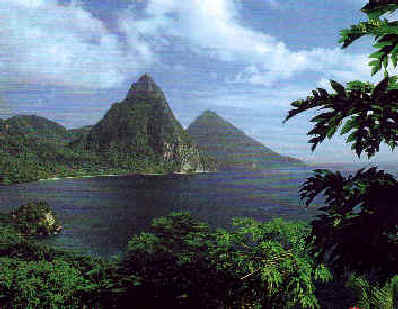
Also interesting on Saint Lucia, we
encountered, at a pond, a mixed flock of Snowy and Little Egrets.
There were 3 Little Egrets, one with the long plume of breeding plumage.
Little Egrets have been nesting on another Lesser Antillean Island, Barbados.
At the same pond , there was another interesting flock (if 2 birds is
considered
a flock). Two plovers were together, one a Black-bellied, or Grey,
the other an American Golden Plover. The 2 birds stood together in the
shallow water. They flew together, one with a white rump, the other with one
dark. One (the Golden) with a brown cap, the other without. The Black-bellied,
or Grey, Plover is common in the Caribbean in March. The Golden is
rare.
Also that day in St. Lucia, we stood atop a high coastal cliff, watching Red-billed Tropicbirds circling about below us. A few days later, on Dominica, we watched White-tailed Tropicbirds flying about by seaside cliffs above us.
From shore, as we lunched sea-side on
Dominica, Pomarine Jaegers were seen flying above the blue Caribbean.
(We've seen Pomarines there each of the last 3 years.)
A Lesser Black-backed Gull we saw last year along the Dominican coast was
there again this year.
Pelicans, Frigatebirds, and Brown
Boobies flew by.
Offshore, we had about as close an encounter as there could be with
2 Sperm Whales, an adult, and a young, floating on the water, by our boat.From shore, as a day ended, on Saint Vincent, we watched the orange ball of the sun slip below the horizon. On it, in our binoculars, we could see sunspots. As the sun dipped out of view, there was the "green flash" looking as blue as it does green (or at least a combination). During the sunset over the sea, strings of Red-footed Boobies flew by, in the distance, all heading in the direction of their nocturnal roost.
We'll be going again to the Caribbean, doing the tour in the Lesser Antilles, in 2004. Some people have already registered.
Japan
January 2003 - Winter Birding on Honshu, Hokkaido, & Kyushu,
and Amami & Okinawa
The following account written by Armas Hill, leader of the tour.
During our annual winter birding tour in Japan, January 13-25, 2003, highlights included:
4 Blakiston's Fish-Owls, 2 of them
adults, a juvenile, and a sub-adult.
The species, inhabiting the northern Japanese island of Hokkaido and eastern
Siberia, is one of the rarest of the world's owls, and one of the largest.
Also in Hokkaido, one evening, we saw a Ural Owl, well, as it sat on a
roadside branch.
Cranes are always a highlight of our Japan winter birding tours. This year, 6 species of cranes were wintering in Japan, and we saw them all the beautiful Red-crowned Cranes displaying on the snow, and the masses of Hooded and White-naped Cranes, along with a couple Common Cranes, a Sandhill Crane, and a Demoiselle Crane.
Also exciting during our Japan tours in winter are Eagles both Steller's and White-tailed, along the Hokkaido seacoast.
Waterfowl during the tour that are always great to see included exquisite Mandarin Ducks, gaudy Harlequin Ducks, attractive Smews and Falcated Ducks, and a fine male Baikal Teal. Another rarity, the Scaly-sided Merganser, was also seen.
Wonderous white Whooper Swans were along the edge of a frozen Hokkaido lake, giving their loud calls, as a couple black Ravens were calling overhead as they flew by.
From the offshore ferry from Honshu to Hokkaido, some Laysan Albatrosses were seen. Also Shearwaters (Streaked and Short-tailed), Fulmars and Kittiwakes. Alcids included both Common and Thick-billed Murres, Ancient Murrelet, and Least Auklet. The last of these, as well as Spectacled Guillemot, were also seen from shore in Hokkaido.
A couple rarities seen during the Kyushu portion of the tour were the Black-faced Spoonbill and Saunder's Gull.
The dapper Yellow-throated Bunting
was among an assortment of buntings, and other landbirds.
Bramblings, en masse, made an interesting observation. A tight flock of over
a thousand was seen swirling about in flight, and then alighting by us on the
ground.
As our second Japan tour, January
24-31, began on the southern islands of Amami and Okinawa, a pair of
striking Lidth's Jays (endemic to Amami) was observed, close at hand, as
they were gathering nesting material. Although that jay can be noisy, as they
were about us - they were absolutely silent.
Also seen well during that tour, as they gathered nesting material, were 2 Pryer's
Woodpeckers on Okinawa. That species, sometimes called the Okinawa
Woodpecker, is endemic to one region of that island, and is probably the
rarest of the world's woodpeckers (assuming that the Ivory-billed is extinct).
According to Birdlife International, in the early 1990's, the breeding
population was estimated to be less than 80 birds, and the total population
possibly as low as 150 birds. The entire range is less than 600 square
kilometers.
Other rarities in the Nansei Shoto region in southern Japan included the Okinawa
Rail (endemic to Okinawa) and the Amami Woodcock (mostly on the
island of Amami). Both were seen briefly. The rail was heard at dusk. During our
previous Okinawa tour, in May 2003, Okinawa Rails were more readily seen
(actually seen well), early
in the morning - about a dozen. The species can be notoriously difficult to see.
It was not known to science until 1981.
Seen very well in Okinawa were 2 other rarities: the Black-faced Spoonbill
and Saunder's Gull, both at a mudflat. There was one spoonbill (of a
total world population of less than 700), and about a half-dozen Saunder's
Gulls. Okinawa is a wintering site for the latter species, which breeds in
eastern China at just a few places (7 colonies in 4 provinces).
Also on the Okinawan mudflat, among other shorebirds, there was a species
"new" for our cumulative bird-list from 20 FONT Japanese tours, number
#355: Two Pied, or Eurasian, Avocets were walking and feeding on
the mud. Beautiful, striking birds!
These were some of the highlights during
our Japan winter tours in 2003.
We'll be going, again, next winter, in January 2004.
Before that, Japan tours are scheduled, as well, for the Spring of '03, including visits to places for the Pryer's Woodpecker and Okinawa Rail.
Upcoming FONT Birding Tours in Japan