
E-mail: font@focusonnature.com
Phone: Toll-free in USA 1-800-721-9986
or 302/529-1876; Fax: 302/529-1085
|
PO
Box 9021, Wilmington, DE 19809, USA E-mail: font@focusonnature.com Phone: Toll-free in USA 1-800-721-9986 or 302/529-1876; Fax: 302/529-1085 |
A Birding & Nature Tour
in SOUTHERN
ARIZONA
& in nearby
NORTHERN
SONORA, MEXICO
At some great places
in the mountains and the desert
During a great time of year for birds,
with breeders and some migrants
With numbers of Hummingbirds,
Flycatchers, Warblers,
Sparrows,
Hawks and Owls,
and a Trogon.
August 18-27, 2010
(tour: FON/AZ & MX-2, '10)
Tour
to be led by Armas Hill.
Links:
Birds of southern Arizona (with photos)
Birds
during previous FONT tours in Arizona
(with
photos)
Mammals
& Other Wildlife in Arizona (including Amphibians & Reptiles)
(with photos)
Butterflies of Arizona (with photos)
Plants of the Desert & some nearby habitats (with photos)
Mammals in Mexico (with photos)
Amphibians & Reptiles in Mexico (with photos)
Highlights of previous FONT tours in Arizona
Highlights of Previous FONT Tours in Sonora, Mexico

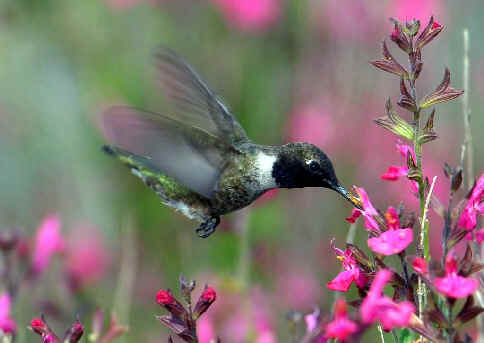
Black-chinned Hummingbird
(photo by Howard Eskin)
Itinerary:
Wed, Aug. 18: Arrival mid-day in Tucson. Afternoon birding nearby in the area of Mt. Lemon. Possibilities include: Zone-tailed Hawk, Acorn Woodpecker, Pygmy Nuthatch, Mountain Chickadee, Red-faced, Olive, and Grace's Warblers. Overnight in the Tucson area.
Thu,
Aug. 19: Early morning desert birding, near
Tucson, among the
giant Saguaro Cactus for species such as: Curve-billed Thrasher,
Gambel's Quail, Black-tailed Gnatcatcher, Gila and Ladder-backed
Woodpeckers, Verdin, and Cactus Wren. Followed by a visit to the
famous Sonoran Desert Museum, where the nature of the desert is presented
in natural settings, and there are good photographic opportunities.
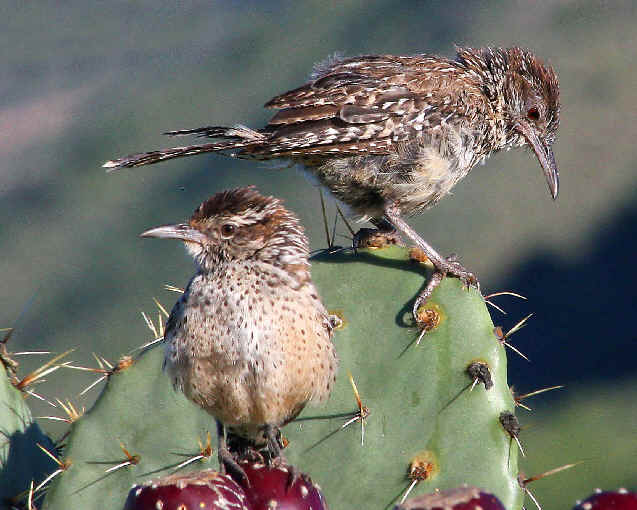
Cactus Wrens, during the FONT
Aug/Sep 2008 Tour in Arizona
(photo by Doris Potter)
Next, our Arizona journey continues as we head toward Patagonia, a good birding
area east of the Santa Rita Mountains. We'll travel through the north edge of
those mountains, birding along the way, in and near the Madera
Canyon.
Upon our arrival in Patagonia, we'll do some afternoon birding along the Sonoita Creek,
including a place that's good for
hummingbirds: maybe Violet-crowned, Costa's, and Rufous.
At the Sonoita Creek Sanctuary there can be:
Gray Hawk, Gila
Woodpecker, and Northern Beardless Tyrannulet. Overnight in Patagonia.
Fri,
Aug. 20: Much of this day
at the Ramsey, Ash, and Miller Canyons, where
Sulphur-bellied
Flycatcher and Black-throated Gray Warbler can be among the birds
we'll see. Last year, a Sinola Wren was. It was of the first of that species
ever seen north of Mexico. Among the
mammals we could see this day: the Coati.
At hummingbird feeders there can be about a dozen species of hummingbirds.
Among those we should see: the Magnificent and the Blue-throated.
Among those possible: the White-eared and the Berylline. At one
of the places we'll visit, the Lucifer Hummingbird is usually seen.
Overnight in the Sierra Vista area.
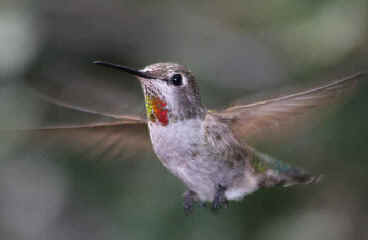
An immature Broad-tailed
Hummingbird
photographed during our August 2008 Arizona tour
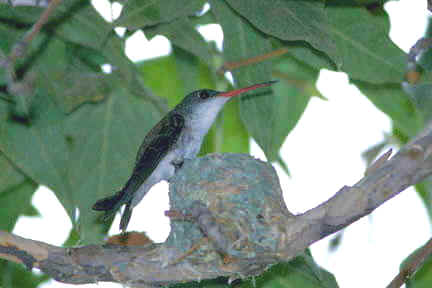
Violet-crowned
Hummingbird at its nest,
photographed during our July 2001 Arizona tour
Sat,
Aug. 21: Travel to
Portal,
with birding enroute. Along the way, at places such as the valley of the San Pedro River,
we could encounter birds such as: Abert's Towhee,
Scott's Oriole, Greater Roadrunner, Scaled Quail, and Lark Sparrow.
Overnight in Portal, at the entrance to Cave Creek
Canyon.
Sun, Aug, 22: Much of the day, birding in the highlands, but before that, some
birding at a slightly lower elevation where the Crissal Thrasher will be sought.
In the
highlands of the Chiricahua Mountains, Elegant Trogon, Mexican Chickadee,
Hepatic Tanager, Olive Warbler, Painted Redstart,
and Red-faced Warbler all occur. And all of them amid spectacular scenery.
It's some of the best
birding in the U.S., in one of the most beautiful settings.
If we're fortunate,
after dark, we could hear (and maybe see) the Flammulated Owl. And if we're
also fortunate, earlier during the day, we may find the Montezuma Quail, as
we have during our tours here in the past.
Overnight,
again, at Portal.
Mon,
Aug. 23: Another morning of
birding in the area of the Chiricahuas, including along Paradise Road where there
could be yet more birds including Black-chinned Sparrow and Juniper Titmouse.
Later in the day, we'll make a birding stop at Wilcox, where birds could
include:
Eared Grebe, White-faced Ibis, Cinnamon Teal, Long-billed Curlew,
and Black Tern, along with an assortment of shorebirds, waterfowl, herons,
of various sorts.
From Willcox, we'll travel south to the town of Douglas, located on the
Arizona-Mexican border, where we'll spend the night in an historic hotel.
Tue,
Aug. 24: In the morning, we'll
cross the border into the northern Mexican state of
Sonora, to go to a place, for birding & nature, that has been
special for us in the past. It's the property of a large ranch, about
30,000 acres, in the High Sonoran Desert.
Elevations range from about 3,300 to 7,200 feet above sea level, and the area
includes a number of habitats, from riparian woodland to desert. Additionally,
there are some spectacular canyons to be explored and in which some notable
wildlife is to be found.
Following this itinerary, a series of
photographs taken on the property, during our Sep '08 tour, show some of the marvelous
scenery, topography, and the flora & fauna to be found there.
Wildlife does abound in the area. Pumas are said to be common.
Deer and Coyote are as well. Many birds occur. During a
previous tour, both Montezuma and Elegant Quail were found. In one
of the canyons, there were Rufous-capped Warblers. A Mexican Yellow
Grosbeak was seen, as were Five-striped and Rufous-winged Sparrows.
The last of these species can be seen locally in southern Arizona, but not as
readily as it has been in the past. Overall, the global range of the Rufous-winged
Sparrow is nearly restricted to the Mexican state of Sonora.
What probably is best about where we'll be in the remote hills of Sonora is that
it IS NOW, as places such as Arizona WERE in the past - before the
"development" brought highways, agriculture, and many people. On the
property in Sonora, such things are missing. The place is "natural".
Oh, there are some cattle on the ranch, but not many. As one travels about on
the property on tracks in a four-wheel drive vehicle, one can sense for a while,
during the visit, what a "natural place" can be like - and how it was
before the highways, agriculture, and many people.
Looking at the photos just noted, that follow below, one can see that a place
that is quite similar in the United States to this special area we'll be
visiting in Sonora is Big Bend National Park.
The first of 2 nights in the Sonoran hills.
Wed, Aug. 25: A full day of birds and
other nature in the Sonoran hills. One of
the birds we should see would be the Mexican subspecies of the Wild
Turkey, known as the "Gould's Turkey". It has white in its
plumage where other wild turkeys are buffy.
Also in the region, we'll see numerous other birds at Lake
Angostura and along the Bavispe River.
Not only will there be birds, but other wildlife too.
To give again an idea of how remote and wild this area is: during our last tour,
as we stood on a hill overlooking Lake Angostura,
we could see across the way a ridge clad on its upper parts with pines. It was
there, we were told, that Geronimo had his last hangout. It was in such places
that the Imperial Woodpecker once lived, and where today the Eared
Quetzal still does.
In a nearby canyon, with steep walls, a couple years ago, a pair of Military
Macaws were seen - the most northern sighting of that species, and the
closest to the US.
Referring back to Geronimo for a second, one of the reasons why this part of
Mexico has been so unpopulated is that it was, for over 150 years, the haunt of
the aggressive, even ferocious, Apaches.
During our last tour on this Sonoran ranch, our early-morning wake-up call, just
outside our windows, was the howling of Coyotes. Throughout the day,
there were many birds, butterflies, and animals such as the Antelope
Jackrabbit and the Coue's White-tailed Deer. Following dusk, owls
called. After dark, the stars shone brightly, including a Milky Way that
nearly jumped out at us. Our second overnight in the Sonoran hills.
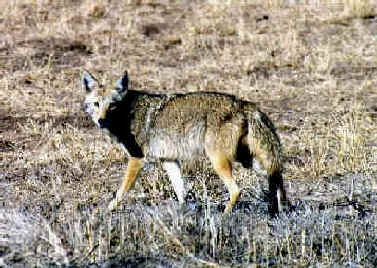
Coyote
Thu,
Aug 26: After some final birding and exploration on the vast
ranch in Sonora, that was our home for 2 days, we'll travel north to the
US-Mexico border, and then to Tucson, where we'll spend the night.
Fri, Aug. 27: Departure for home.

Tour Price: $2,395 per person (based upon double occupancy).
Single supplement: $295.
Includes: All accommodations and transportation. Services of an expert birding leader. Breakfasts & lunches Aug. 19-26.
Does not include: Transportation to/from Tucson, AZ., dinners, items of a personal nature, gratuities.
A deposit of $500 is required to register for this tour.
SOME
PHOTOS AT PLACES
WE VISIT DURING OUR FONT TOUR
IN NORTHERN SONORA, MEXICO
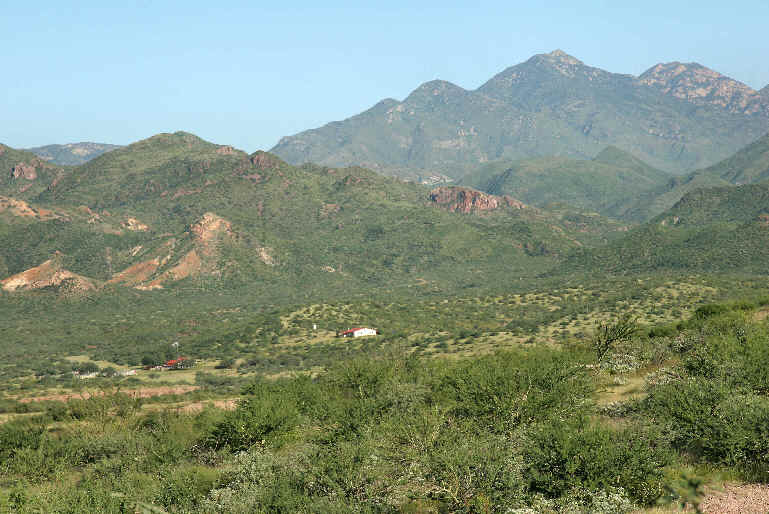
An overall view, showing the ranch where we stay
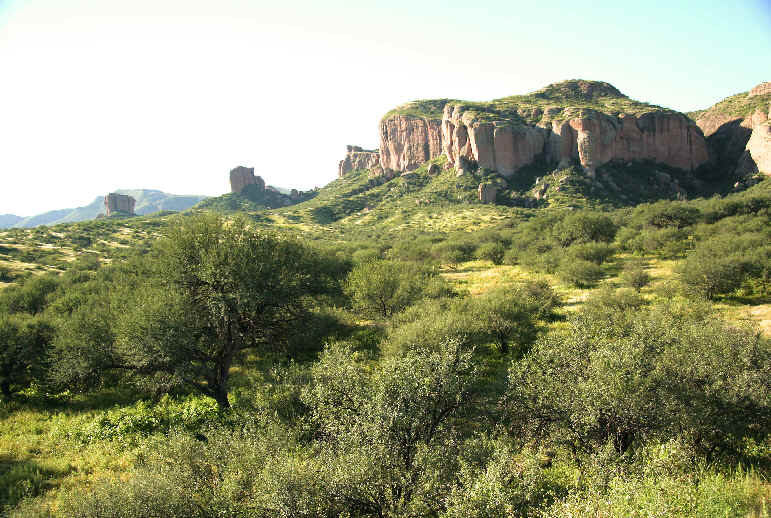
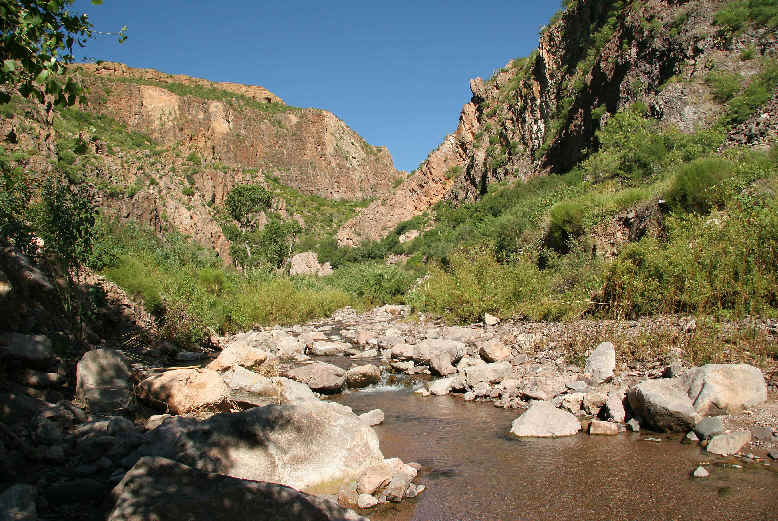
Beautiful scenery
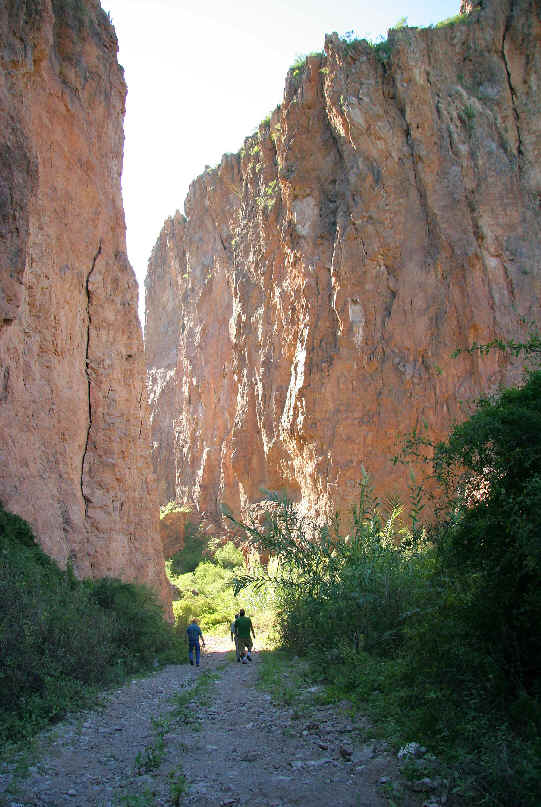
Above
& Below: A canyon,
in which we saw Rufous-capped Warbler during our last tour,
and where a couple years ago Military Macaws occurred.
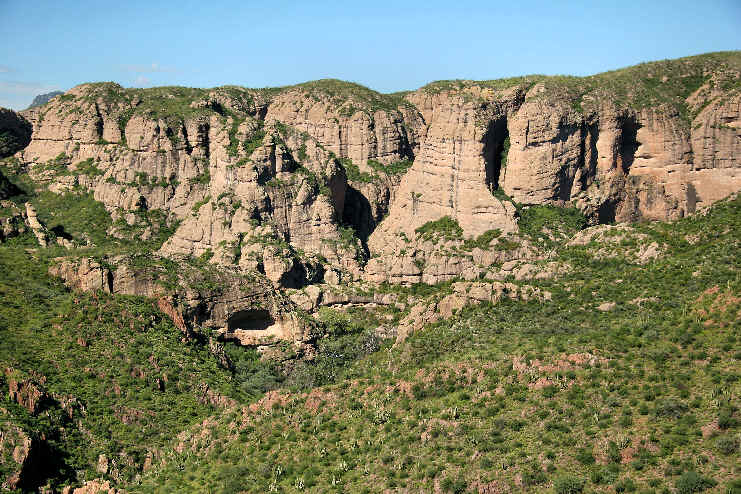
Even more, on the 30,000-acre property of the ranch
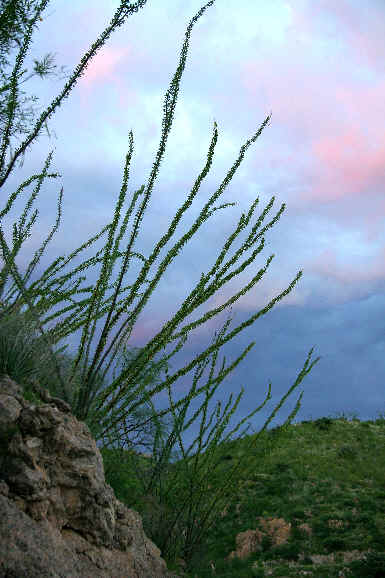
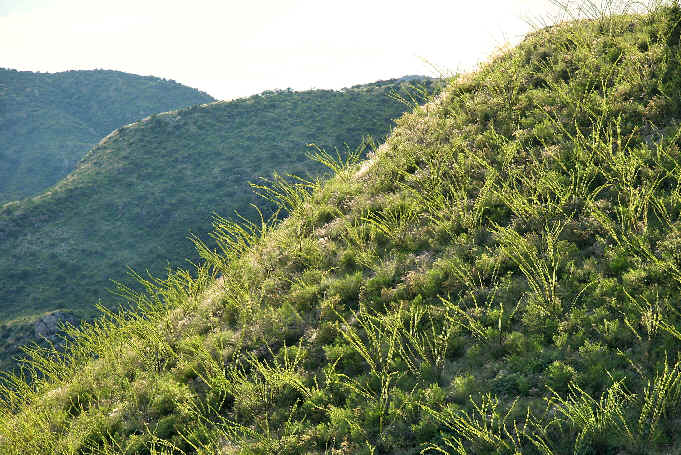
Above: The desert
plant known as Ocotillo.
Below: a hillside of it.
When in bloom, its bright red flowers attract hummingbirds.
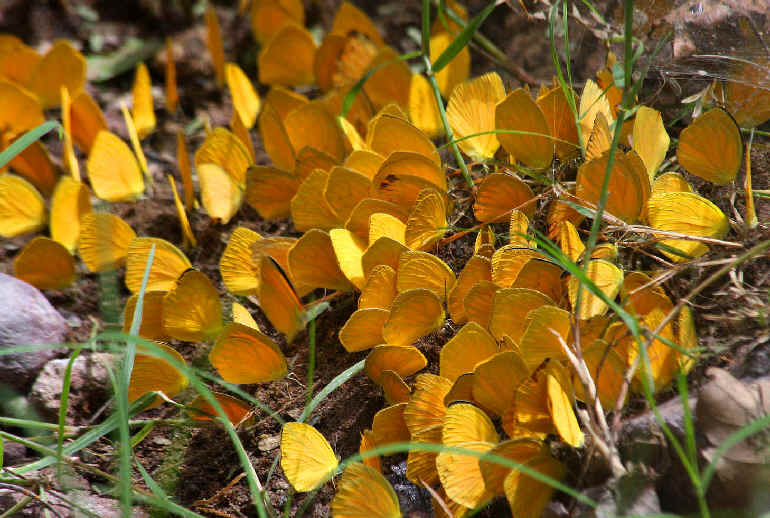
A cluster
of butterflies,
during our most-recent tour in Sonora, Mexico.
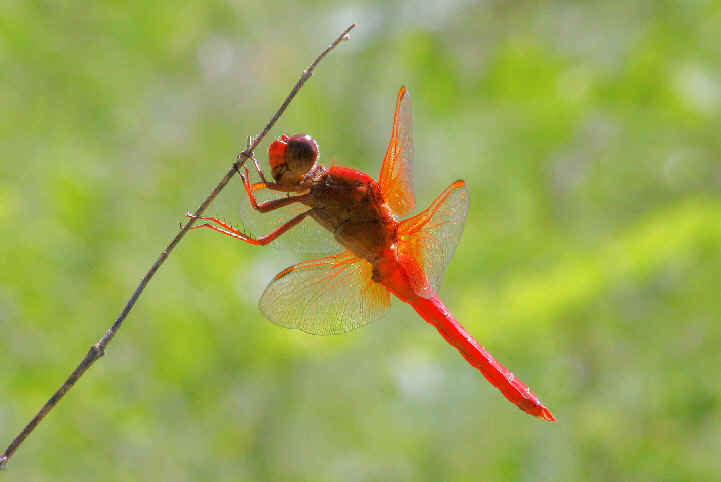
A Dragonfly known as the
Neon Skimmer
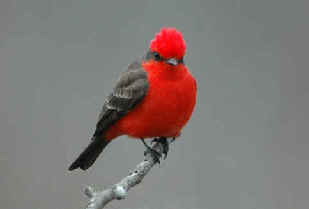
A bright male Vermilion
Flycatcher.
A Mexican name for this bird is
"Brazito del Fuego",
meaning "little ball of fire".
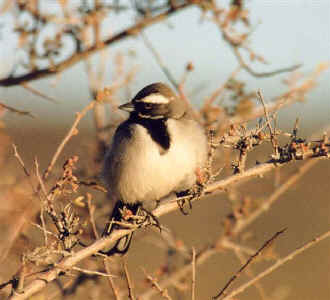
Black-throated
Sparrow
(that's also been known as the Desert Sparrow)
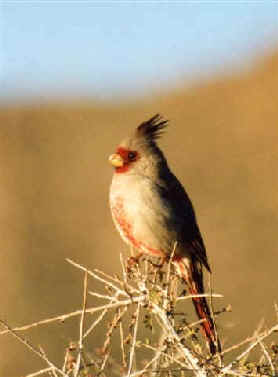
Pyrrhuloxia
(a cousin of the Cardinal)
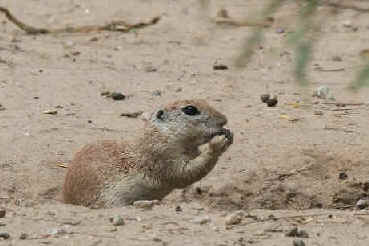
A small mammal, the Round-tailed Ground Squirrel
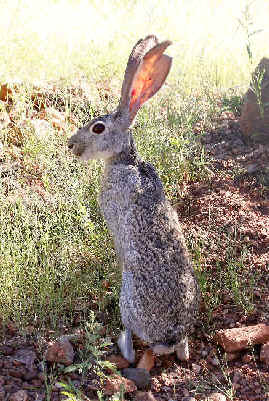
A large animal of its kind, the Antelope Jackrabbit