
E-mail: font@focusonnature.com
Phone: Toll-free in USA 1-800-721-9986
or 302/529-1876; Fax: 302/529-1085
|
PO
Box 9021, Wilmington, DE 19809, USA E-mail: font@focusonnature.com Phone: Toll-free in USA 1-800-721-9986 or 302/529-1876; Fax: 302/529-1085 |
A Birding & Nature Tour
in
ARIZONA, USA
&
SONORA, MEXICO
At some great places
in the mountains and the desert
During a great time of year for birds,
with residents and migrants
March 11-20, 2011
(tour: FON/AZ & MX-1, '11)
Tour
to be led by Armas Hill.
Links:
Birds during previous FONT Arizona tours (with
some photos)
Mammals
& Other Wildlife in Arizona (including Amphibians & Reptiles)
(with some photos)
Butterflies of Arizona
(with some photos)
Plants of the Desert & some nearby habitats (with some photos)
Birds of Sonora, Mexico (with some photos)
Mammals in Mexico (with some photos)
Amphibians & Reptiles in Mexico (with some photos)
Highlights of Previous FONT Tours in Arizona
Highlights of Previous FONT Tours in Sonora, Mexico

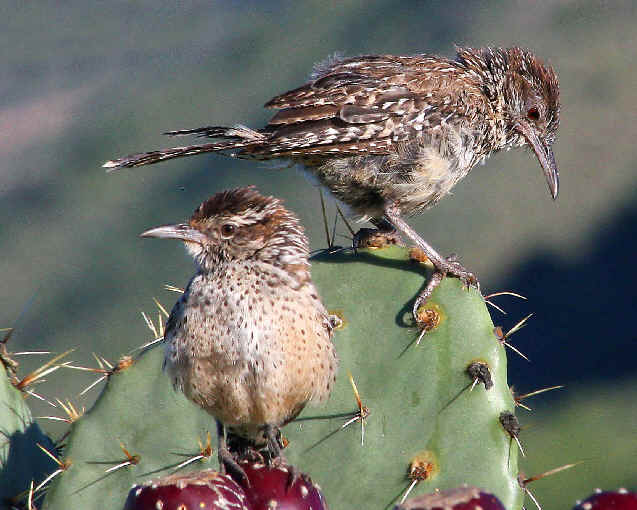
Cactus Wrens are year-round residents in deserts
in Arizona & Sonora.
(photo by Doris Potter during a FONT tour)
Itinerary:
Fri, Mar 11: Arrival in Phoenix,
Arizona. For those who arrive mid-day, birding in the afternoon at the
Desert
Botanical Garden. Overnight near the Phoenix airport.
Sat, Mar 12: A morning flight from Phoenix to Hermosillo, the capital city
of the Mexican state of Sonora. From there, a drive of an hour to Bahia
Kino, or Kino Bay, along the coast of the Gulf of
California, also known as the Sea
of Cortez.
Birds are many along that coast, including: Blue-footed and Brown Boobies, Reddish
Egret, Wilson's Plover, and Yellow-footed and Heermann's Gulls.
Over the water,
and along the coast, in addition to some marine mammals, other birds could
be Magnificent Frigatebirds, terns, shorebirds, and the Mangrove
Warbler.
The last of these was formerly considered part of the Yellow Warbler. The male,
in breeding plumage, has a brick-red head. At the day's end, we'll have our
first night by Kino Bay.
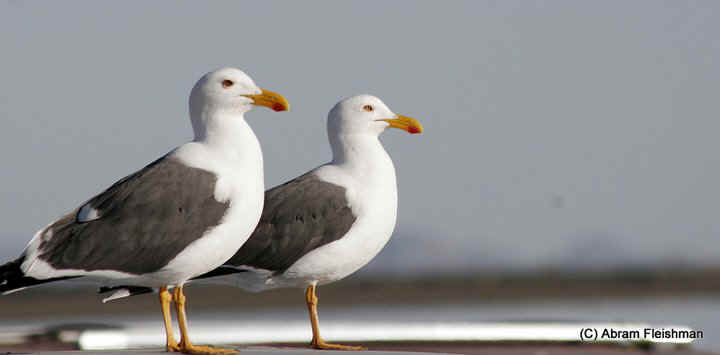
Above: Two Yellow-footed Gulls along
the coast of the Sea of Cortez
Below: The island called in the Sea of Cortez called Alcatraz
named after the Brown Pelicans & other birds that nest there in numbers.
(photos by Abram Fleishman)
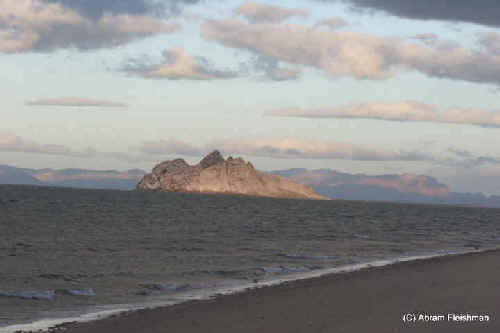
Sun, Mar 13: A full-day in the
area of Kino Bay, including a boat-trip to an island called
Alcatraz. That
Spanish word means "Pelican" (relating there to the Brown
Pelican,
Pelecanus occidentalis californicus). That island is filled with birds, not just
pelicans, but others too. Our second overnight at Kino
Bay, by the
Sea of Cortez.
Mon, Mar 14: This day, we'll
travel east from Kino Bay, ascending up into the hills of Sonora,
where in addition to some spectacular scenery there will be some fine birding.
Among the birds we've seen in this region previously have been two birds with
the adjective "elegant": the Elegant Quail and the Elegant
Trogon.
Also, for us, here in the past: Black-capped Gnatcatcher, Green Kingfisher, and
Streak-backed Oriole. Much of our birding will be in the "tropical
thornscrub" habitat - a Sonoran habitat, by the way, that does not reach
into Texas.
We'll continue further along the road through a zone of pine & oak trees,
toward Sahuaripa, where we'll spend the night. The
Colima Pygmy-Owl (a Mexican
endemic) is one of the birds in the area where we'll be.
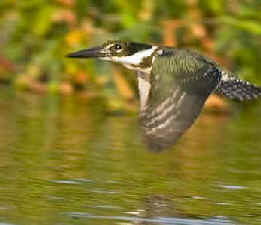
Green Kingfisher
Tue, Mar 15: Birding in the morning
along the road from Sahuaripa, west toward Hermosillo, but before the city we'll
turn to the northeast where we'll spend much of the day in the valley of the Rio
Sonora. With some agricultural fields between rocky hills, the habitats, and the
birds and other nature will be different for us. We'll be in some old villages
in the valley that go back to the early 1600s. Our overnight will be in one of
those villages, Baviacora, where the mission was founded as long ago as 1639.
Wed, Mar 16: We'll
travel south in Sonora this day, with our ultimate destination being the small, picturesque desert town of
Alamos. That area has been a center for ornithological exploration for many
years. (In the winter, it has been a place annually with a Christmas Bird Counts.)
The Alamos
area has a rich avifauna as it where habitats meet: desert, tropical (the
northern limit), and montane (in the mountains known as the Sierra Madre
Occidental).
Notable birds in the area (that generally do not occur further north) include:
Rufous-bellied Chachalaca, Mexican Parrotlet, Black-throated Magpie-Jay, and
Happy Wren. All of these species are endemic to western Mexico.
Other notables include: Plain-capped Starthroat, Purplish-backed Jay, Sinaloa
Crow, Rose-throated Becard, and Blue
Mockingbird.
Northerly "tropical birds" include: Bare-throated Tiger-Heron, Crane
Hawk, and Squirrel Cuckoo.
Our first of two overnights in Alamos.
Thu, Mar 17: A full-day of
birding in the Alamos area. Our second overnight there.
Fri, Mar 18: After our final birding in southern Sonora near Alamos,
travel north to Hermosillo. Overnight in Hermosillo.
Sat, Mar 19: Flight from Hermosillo to Phoenix,
Arizona. Some birding in
Arizona, near Phoenix, at the Gilbert's Riparian Preserve,
an excellent place
for a nice variety of bird species & other nature.
Another visit, as time permits (either the pm of Mar 27 or the am of Mar 28) at
the Desert Botanical Garden.
Overnight near the Phoenix airport.
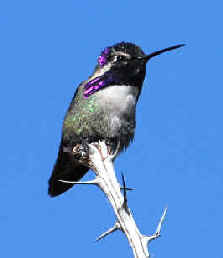
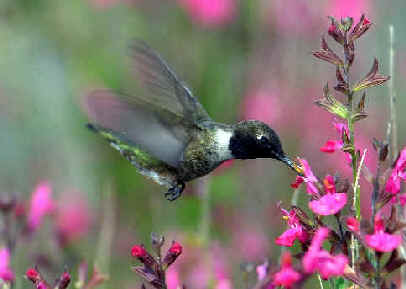
Costa's Hummingbird (above)
Black-chinned Hummingbird (below)
(photos by Howard Eskin)
Sun, Mar 20: Departure from Phoenix for home.
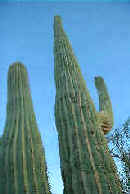
Saguaro Cactus
(photo by Doris Potter)

Tour Price: $2,495 per person (based upon double occupancy).
Single supplement: $295.
Includes: All accommodations and transportation. Services of an expert birding leader. Breakfasts & lunches Mar. 12–19.
Does not include:
Flights to/from Phoenix, AZ & between Phoenix &
Hermosillo, Mexico.
Dinners, items of a personal nature.
A deposit of $500 is required to register for this tour.