 |
PO Box 9021,
Wilmington, DE 19809, USA
E-mail: font@focusonnature.com
Phone: Toll-free in USA 1-888-721-3555
or 302/529-1876 |
Argentina
Birds
from Antshrikes to Grosbeaks
Noting those found during
Focus On Nature Tours
with an (*)
from 1992 thru 2013
during the months of
October,
November, and December
Part 2 of a List of Argentina Birds
compiled by Armas Hill
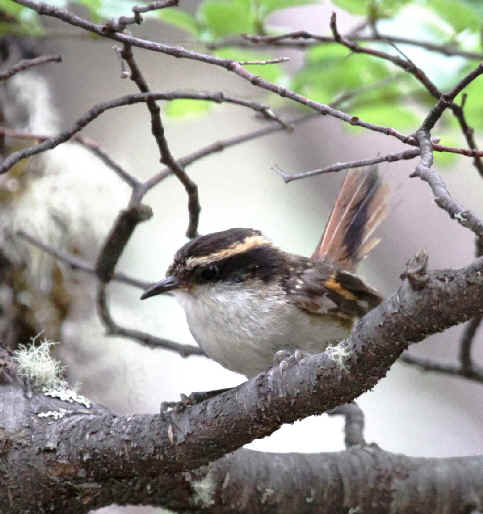
Photo at upper right: a THORN-TAILED RAYADITO
(photographed by Marie Gardner during the FONT tour
in southern Argentina in December 2013)
Links:
Part
#1 of this List of Argentina Birds: Tinamous thru Flycatchers
There have been 14 FONT
birding tours in Argentina.
693 species of birds have
cumulatively been seen during FONT Argentina tours.
The most recent taxonomy has been incorporated
into the following list, originally from the 3rd edition of "The Howard & Moore
Complete Checklist of the Birds of the World", and other changes
since.
Codes:
(ARe): endemic to Argentina
(ARqe): quasi (or nearly) endemic to Argentina
(ARi): introduced species in Argentina
(ARr): rare in Argentina
(t): a globally threatened or
rare species, designated by Birdlife International
(t1): critical (t2):
endangered (t3): vulnerable
(nt): a near-threatened
species globally
(ph): species with a photograph in the FONT web-site

ba: in
and near Buenos Aires
fs:
far-southern
Argentina, including Patagonia and Tierra del Fuego
nc:
in north-central Argentina, including areas south from Salta to Tucuman and
Cordoba
ne:
in
northeast Argentina, including the areas of Iguazu (in Misiones) and the Ibera
Marshes (in Corrientes), and in between
nw:
in
northwest Argentina (from Salta north of Jujuy), including the areas of Jujuy,
Calilegua National Park, and the Altiplano
so:
in southern Argentina, including the Valdez Peninsula, and nearby areas to the
north & south, in Chubut & Rio Negro
Links to Groupings of Birds in
this List:
Antbirds
Tapaculos Antthrushes & Antpittas
Furnariids Woodcreepers
Vireos Jays
Swallows
Wrens Gnatcatchers
Mockingbirds Thrushes
Dipper Pipits
Euphonias
Siskins
New World Warblers Icterids
Bananaquit Sparrows
Brush
Finches Cardinals
Tanagers
Conebill, Flower-piercer Grassquits, Seedeaters,
Finches Saltators, Grosbeaks
Other Links:
Upcoming
FONT Birding & Nature Tours in Argentina
Rare Birds of the Andes
& Patagonia Butterflies of Argentina, including at Iguazu
Falls
Mammals
in Argentina
Mammals
in South America
(both
of these with some photos)
Directory
of Photos in this Website

Birds:
HYPOEDALEUS
-
Spot-backed Antshrike ______
Hypoedaleus guttatus (the single member of its genus)
Hypoedaleus guttatus
is endemic to the Atlantic Forest mostly in southeastern Brazil, but
also in northeastern Argentina.
BATARA
-
Giant Antshrike (*) ______
nw
Batara cinera argentina (the single member of its genus)
MACKENZIAENA
- Large-tailed Antshrike ______ (might better
be called "Great Spotted Antshrike")
Mackenziaena leachi (monotypic)
Mackenziaena leachi
is endemic to the Atlantic Forest mostly in southeastern
Brazil, but also in northeastern Argentina.
- Tufted Antshrike (*) ______
ne
Machenziaena severa (monotypic)
Mackenziaena severa
is endemic to the Atlantic Forest mostly in southeastern
Brazil, but also in northeastern Argentina.
TARABA
-
Great Antshrike (ph) ______
Taraba major (the single member of its genus)
BIATAS
-
White-bearded Antshrike (t3) ______
Biatas nigropectus (monotypic,
and the single member of its genus)
Biatas nigropectus is classified as an endangered species
in Argentina. It is endemic to the Atlantic Forest mostly in southeastern
Brazil, but also in northeastern Argentina.
THAMNOPHILUS
- Variable Antshrike (*) ______
nc ne
Thamnophilus c. caerulescens (subspecies
in northeast Argentina)
Thamnophilus caerulescens dinelli (subspecies
in north-central Argentina)
- Rufous-capped Antshrike (*) ______
nc
Thamnophilus ruficapillus cochabambae
- Barred Antshrike (ph) ______
Thamnophilus doliatus
DYSITHAMNUS
- Spot-breasted Antvireo (nt) ______
Dysithamnus stictothorax (monotypic)
- Plain Antvireo (*) ______
ne
Dysithamnus m. mentalis
MYRMORCHILUS
-
Stripe-backed Antbird ______
Myrmorchilus strigilatus (the single member of its genus)
HERPSILOCHMUS
- Rufous-winged Antwren (*) ______
Herpsilochmus r. rufimarginatus
- Black-capped Antwren (nt) ______
Herpsilochmus atricapillus (monotypic)
DRYMOPHILA
- Bertoni's Antbird (*) ______
ne
Drymophila rubricollis (monotypic)
In 1988, evidence was published showing Drymophila
rubricollis to be distinct from the Ferruginous Antbird.
Drymophila rubricollis is endemic
to the Atlantic Forest in southeastern Brazil and northeastern
Argentina.
- Dusky-tailed Antbird ______
Drymophila malura (monotypic)
Drymophila malura is endemic to the Atlantic
Forest mostly in southeastern Brazil, but also in northeastern
Argentina.
TERENURA
- Streak-capped Antwren ______
Terenura maculata (monotypic)
Terenura maculata
is classified as a vulnerable species in
Argentina. It is endemic to the Atlantic Forest mostly in
southeastern Brazil, but also in northeastern Argentina.
PYRIGLENA
- White-shouldered
Fire-eye (*) ______ ne
Pyriglena leucoptera (monotypic)
Pyrigiena leucoptera is endemic to the Atlantic Forest
mostly in southeastern Brazil, but also in northeastern Argentina.
CONOPOPHAGA
- Rufous Gnateater (*) ______ ne
Conopophaga lineata vulgaris
Conopophaga lineata is endemic to the Atlantic Forest
mostly in southeastern Brazil, but also in northeastern Argentina.
PSILORHAMPHUS
- Spotted Bamboowren (nt) ______
Psilorhamphus guttatus (monotypic,
and the single member of its genus)
Psilohamphus guttatus
is classified as a vulnerable species in Argentina. It is endemic
to the Atlantic Forest mostly in southeastern Brazil, but also in
northeastern Argentina.
PTEROPTOCHOS
-
Black-throated Huet-huet ______
Pteroptochos tarnii
SCELORCHILUS
- Chucao Tapaculo
______
Scelorchilus rubecula
EUGRALIA
- Ochre-flanked Tapaculo
______
Eugralia paradoxa
(the single member of its genus)
SCYTALOPUS
- Planalto Tapaculo ______ (species
described in 2005)
Scytalopus pachecoi (monotypic)
Previously, the Scytalopus
tapaculo that occurs in northeast Argentina, in Misiones province, was said
to be the Mouse-colored Tapaculo, Scytalopus
speluncae. Now, that species is endemic to southeastern
Brazil, and is also called the Serra do Mar Tyrannulet.
Scytalopus pachecoi
is classified as a vulnerable species in Argentina. It is
endemic to the Atlantic Forest mostly in southeastern Brazil, but
also in northeastern Argentina.
- White-browed Tapaculo
(*) ______ nc
Scytalopus s. superciliaris
- Magellanic Tapaculo
(*)
______ fs (was part of the former Andean Tapaculo)
Scytalopus magellanicus (monotypic)
RHINOCRYPTA
- Crested Gallito (*)
______ nc
Rhinocrypta l. lanceolata (the single member of its genus)
In his "Bird Biographies" written in the late 1800s,
W. H. Hudson called Rhinocrypta lanceolata
the "Little Cock", a translation of the name "Gallito".
Hudson wrote that the name is appropriate as "ït struts and runs on
the ground with its tail erect, looking wonderfully like a miniature
domestic fowl".
TELEDROMAS
- Sandy Gallito (*) ______ nc
Teledromas fuscus (monotypic, and the single member of its genus)
MELANOPAREIA
- Olive-crowned Crescentchest ______
Melanopareia maximiliani
CHAMAEZA
- Short-tailed Antthrush (*) ______
ne
Chamaeza c. campanisona
- Rufous-tailed Antthrush ______
ne
Chamaeza
ruficauda
Chamaeza
ruficauda is classified as a vulnerable species in
Argentina. It is endemic to the Atlantic Forest mostly in
southeastern Brazil, but also in northeastern Argentina (only in Misiones
province).
GRALLARIA
- Variegated Antpitta (ph) (*) ______ ne
Grallaria varia imperator ("Imperial Antpitta")
The Variegated Antpitta photo in the FONT website is of a female on a
nest, found during a FONT tour in southeastern Brazil.
To see the photo go to: A LIST &
PHOTO GALLERY OF BRAZILIAN BIRDS, PART 3
Click the link in the file for "antpittas".
- White-throated Antpitta
(*)
______ nw
Grallaria albigula cinereiventris
HYLOPEZUS
- Speckle-breasted
Antpitta (*) ______ ne
Hylopezus (formerly Grallaria) nattereri
(monotypic)
Hylopezus nattereri
is classified as a vulnerable species in Argentina. It is endemic
to the Atlantic Forest mostly in southeastern Brazil, but also in
northeastern Argentina.
GEOSITTA
-
Common
Miner (ph) (*) ______ fs nc
nw so
Geositta c. cunicularia (subspecies
in most of Argentina)
Geositta cunicularia contrerasi (subspecies in the Cordoba area)
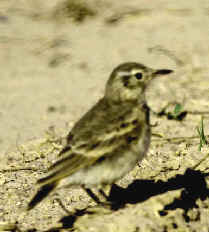
A Common Miner photographed
during a FONT tour
(photo by Marie Gardner)
-
Short-billed
Miner ______
Geositta antarctica
-
Slender-billed
Miner (*) ______ nw
Geositta t. tenuirostris
-
Puna
Miner (*) ______ nw
Geositta punensis (monotypic)
-
Rufous-banded Miner (*) ______ nc
nw
Geositta rufipennis (subspecies
in northwest Argentina)
Geositta rufipennis ottowi (subspecies in north-central Argentina)
-
Creamy-rumped Miner ______
Geositta isabellina
UPUCERTHIA
-
Scale-throated
Earthcreeper (*) ______ fs nc
so
Upucerthia dumetaria (4 subspecies in Argentina)
-
Buff-breasted
Earthcreeper (*) ______ nw
Upucerthia v. validirostris (subspecies
in northwest Argentina)
-
Chaco
Earthcreeper (*) ______ nc
Upucerthia c. certhioides
-
Rock
Earthcreeper (*) ______ nw
Upucerthia andaecola (monotypic)
-
Straight-billed
Earthcreeper ______
Upucerthia ruficauda
EREMOBIUS
-
Band-tailed
Eremobius (*) ______ fs so
Eremobius phoenicuurus (monotypic, and the single member of its genus)
The Band-tailed Eremobius has
historically been an Argentinian endemic, but it has recently discovered to
be also in far-southern Chile.
CINCLODES
-
Bar-winged
Cinclodes (*) ______ fs nc nw
Cinclodes f. fuscus (subspecies
in most of Argentina)
Cinclodes fuscus albiventris (subspecies in northwest Argentina)
-
White-winged Cinclodes (*) ______ nc
Cinclodes atacmensis schocolatinus (subspecies endemic to the Cordoba
area)
-
Dark-bellied Cinclodes (*) ______ fs
Cinclodes p. patagonicus
-
Blackish Cinclodes ______
Cinclodes antarcticus
-
Gray-flanked
Cinclodes ______
Cinclodes oustaleti
-
Olrog's
Cinclodes (ARe) (*) ______ nc
Cinclodes olrogi (monotypic, species described in 1979)
-
Cordoba Cinclodes (ARe) (*) ______ nc
Cinclodes comechingonus
(monotypic, species described in 1944)
The Cordoba Cinclodes has had some other common English names: Comechingones
Cinclodes, not truly English, Sierran Cinclodes, and Chestnut-winged
Cinclodes.
FURNARIUS
-
Rufous Hornero
(ph) (*) ______ ba nc ne
nw so (also called Common
Hornero)
Furnarius r. rufus
The Rufous Hornero is the national bird of Argentina. In that
country, and elsewhere in the bird's range, it has many common names as it
is known well by the local people.
In most of Argentina, it is often called the "Hornero" or
"Casera" (translated to the
"Ovenbird" or "Housekeeper").
In Brazil, a name for the bird is "Joao do los Barrios"
("John of the Mud-puddles", or said another way, "John
Clay")
In Paraguay, and in the Corrientes province in northern
Argentina, it goes by the name "Alonso Garcia", or an
affectionate diminutive "Alonzito".
In his "Bird Biographies" written in the late 1800s, W.
H. Hudson called Furnarius rufus the
"Oven-bird"".
About it, he wrote: "I have often been assured by the Argentine native
people that the "Hornero" is a religious bird that always
suspends his (& her) labours on a Sunday and on all holy
days".
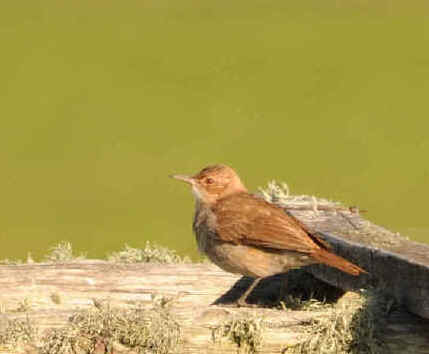
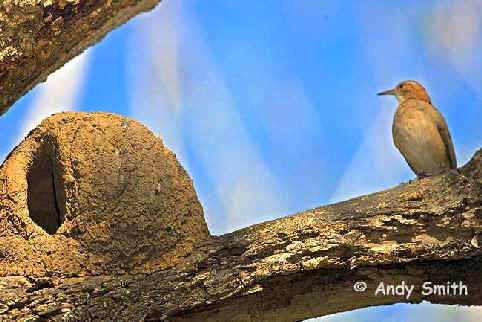
Above & below: Rufous Horneros photographed
during FONT tours
Below: next to its nest made of mud
-
Crested
Hornero (*) ______ nc
Furnarius cristatus
(monotypic)
SYLVIORTHORHYNCHUS
-
Des
Murs' Wiretail ______
Sylviorthorhynchus desmursii
APHRASTURA
-
Thorn-tailed
Rayadito (ph) (*) ______ fs
Aphrastura s. spinicauda
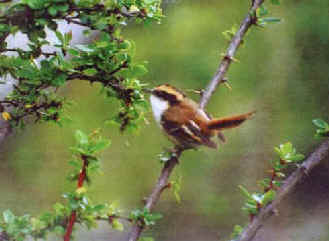
Thorn-tailed Rayadito
LEPTASTHENURA
-
Araucaria
Tit-Spinetail (nt) ______
Leptasthenura setaria (monotypic)
Leptasthenura setaria is
classified as a threatened species in Argentina. It is restricted to
forests with Araucaria trees mostly in southeastern Brazil, but also
in northeastern Argentina.
-
Tufted
Tit-Spinetail (*) ______ nc
Leptasthenura platensis (monotypic)
-
Plain-mantled Tit-Spinetail (*) ______ fs
nw
so
Leptasthenura aegithaloides berlepschi (subspecies
in northwest Argentina)
Leptasthenura aegithaloides pallida (subspecies in southern
Argentina)
-
Brown-capped
Tit-Spinetail (*) ______ nc
Leptasthenura fulginiceps paranensis
SCHOENIOPHYLAX
-
Chotoy Spinetail
(*)
______ ne
Schoeniophylax p. phryganophilus
(the single member of its genus)
ASTHENES (and PSEUDASTHENES)
-
Hudson's Canastero (nt) ______
Asthenes hudsoni
In his "Bird Biographies" written in the late 1800s, W.
H. Hudson called what was then Synallaxis
hudsoni the "Hudson's Spine-tail".
The bird was named after the Argentine/British ornithologist William
Henry Hudson by the English zoologist Philip Sclater in 1874.
-
Short-billed Canastero (*) ______ so
Asthenes b. baeri
-
Sharp-billed
Canastero (*) ______ fs so
Asthenes p. pyrrholeuca
Another name for the Sharp-billed Canastero has been the Lesser
Canastero.
-
Maquis
Canastero (nt) ______
Asthenes heterura
Another name for Asthenes heterura
is the Iquico Canastero.
-
Cordilleran Canastero (*) ______ fs
nc nw so
Asthenes m. modesta (subspecies
in northwest Argentina)
Asthenes modesta cordobae (subspecies endemic to the Cordoba area)
Asthenes modesta navasi (subspecies in southern & far-southern
Argentina)
-
Steinbach's
Canastero (ARe) (*) ______
Pseudasthenes
(formerly Asthenes) steinbachi
(monotypic)
Another name for the Steinbach's
Canastero has been the Chestnut Canastero.
Species in the new genus
Pseudasthenes are the Steinbach's Canastero and the Patagonian
Canastero (below), both endemic to Argentina, along with the Dusky-tailed
Canastero in Chile and the Cactus Canastero in
Peru.
-
Rusty-vented Canastero (*) ______ nw
Asthenes dorbignyi
The Rusty-vented Canastero was part of the Creamy-breasted
Canastero.
-
Puna Canastero
(*) ______ nc
Asthenes s. sclateri (this subspecies, endemic to the Sierra de
Cordoba, has been called
Cordoba Canastero)
-
Patagonian Canastero (ARe) (*) ______ so
Pseudasthenes (formerly
Asthenes)
patagonica (monotypic)
-
Austral
Canastero (ph) (*) ______ fs
Asthenes anthoides
(monotypic)
Until recently, the Austral Canastero has
been classified by Birdlife International as a "vulnerable
species".
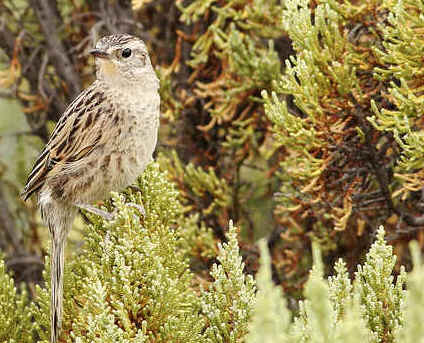
Austral Canastero
(photo by Cameron Rutt)
-
Scribble-tailed
Canastero (*) ______ nw
Asthenes maculicauda
(monotypic)
SYNALLAXIS
-
Rufous-capped Spinetail
______
Synallaxis ruficapilla (monotypic)
Synallaxis ruficapilla
is endemic to the Atlantic Forest mostly in southeastern Brazil, but
also in northeastern Argentina.
-
Sooty-fronted
Spinetail (*) ______ nw
Synallaxis f. frontalis
-
Pale-breasted Spinetail
(*)
______ nc ne
Synallaxis a. albescens (subspecies in
northeast Argentina)
Synallaxis albescens australis (subspecies in north-central
Argentina)
Spix's Spinetail
(*)
______ ne
Synallaxis spixi (monotypic)
Another name for the Spix's Spinetail has been the Chicli
Spinetail.
Gray-bellied Spinetail
(*)
______ ne
Synallaxis cinerascens (monotypic)
Ochre-cheeked Spinetail
(*)
______ nw
Synallaxis
(formerly Poecilurus) scutatus
whitii
Azara's
Spinetail (*) ______ nw
Synallaxis azarae
The Azara's Spinetail includes what was the Buff-browed
Spinetail, Synallaxis supercillosa.
Supercillosa was split from azarae
in 1990, as was S. courseni, S. elegantior,
and S. superciliosa.
Elegantior and superciliosa
were merged again with azarae in
2005, but S, courseni remains
split.
CERTHIAXIS
Yellow-chinned Spinetail
(ph) (*)
______ ne nw (has also been called Yellow-throated
Spinetail)
Certhiaxis cinnamomea russeolus
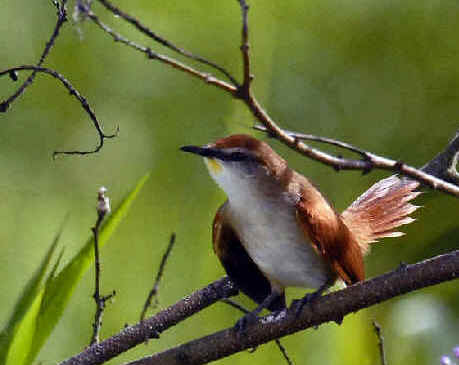
Yellow-chinned Spinetail
(photo by Leroy Tabb)
CRANIOLEUCA
Olive Spinetail
______ (closely
related to, once said to be conspecific with the Stripe-crowned
Spinetail)
Cranioleuca
obsoleta (monotypic)
Cranioleuca obsoleta is
endemic to the Atlantic Forest mostly in southeastern Brazil, but
also in northeastern Argentina.
Sulphur-throated
Spinetail (*) ______ ba (has been called Sulphur-bearded
Spinetail)
Cranioleuca sulphurifera (monotypic)
Stripe-crowned
Spinetail (*) ______ nw so
Cranioleuca p. pyrrhophia
PHACELLODOMUS
Rufous-fronted Thornbird
(ph) (*) ______ nw (has also been called Common
Thornbird)
Phacellodomus rufifrons
Greater Thornbird
(*)
______ ne
(another name has been Yellow-eyed
Thornbird)
Phacellodomus ruber
(monotypic)
Freckle-breasted
Thornbird (*) ______ ba ne
Phacellodomus
s. striaticollis
Streak-fronted
Thornbird (*) ______ nw
Phacellodomus s. striaticeps
Little
Thornbird (*) ______ nc
Phacellodomus sibilatrix (monotypic)
Spot-breasted
Thornbird ______
Phacellodomus maculipectus
CLIBANORNIS
Canebrake Groundcreeper
(t3)
_____
Clibanornis dendrocolaptoides (monotypic, and the single member of its
genus)
Clibanornis dendrocolaptoides
is classified as an endangered species in Argentina. It is endemic to
the Atlantic Forest of far-southern Brazil and adjacent
Argentina.
SPARTONOICA
Bay-capped
Wren-Spinetail (nt) (*) ______ ba
Spartonoica maluroides
(monotypic)
PHLEOCRYPTES
Wren-like Rushbird
(ph)
(*)
______ ba nc so
Phleocryptes m. melanops (the single member of its genus)
In his "Bird Biographies" written in the late 1800s, W.
H. Hudson called Phleocryptes melanops
the "Rush-loving Spine-tail".
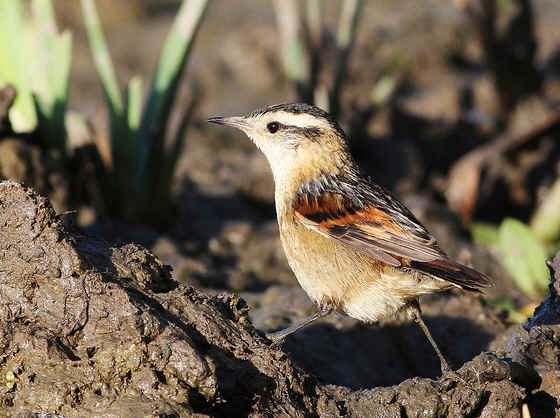
Wren-like Rushbird
(photo by Cameron Rutt)
LIMNORNIS
Curve-billed
Reedhaunter (*) ______ ba
Limnornis curvirostris (monotypic)
Straight-billed
Reedhaunter (nt) ______
Limnornis rectrostris
ANUMBIUS
Firewood-gatherer
(*)
______ ne so
Anumbius annumbi (monotypic, and the single member of its genus)
CORYPHISTERA
Lark-like
Brushrunner (*) ______ nc
Coryphistera
a. alaudina (the single member of its genus)
PSEUDOSEISURA
Brown Cachalote (*) ______ nc
Pseudoseisura lophotes argentina
White-throated Cachalote (ARe) (*) ______ so
Pseudoseisura gutturalis
In his "Bird Biographies" written in the late
1800s, W. H. Hudson called what was then Homorus
gutturalis the "Laughing Cachalote".
ANABACERTHIA
White-browed Foliage-gleaner
(nt) ______
Anabacerthia amaurotis
(monotypic)
SYNDACTYLA
Buff-browed Foliage-gleaner
(*)
______ nc nw
Syndactyla rufosuperciliata
PHILYDOR
Black-capped Foliage-gleaner
______
Philydor atricapillus
(monotypic)
Philydor aricapillus
is classified as a vulnerable species in Argentina. It
is endemic to the Atlantic Forest mostly in southeastern Brazil, but
also in northeastern Argentina.
Buff-fronted
Foliage-gleaner (*) ______ ne
Philydor r. rufum
Ochre-breasted Foliage-gleaner
(*)
______ ne
Philydor lichtensteini
(monotypic)
Philydor lichtensteini
is endemic to the Atlantic Forest of southeastern Brazil and
northeastern Argentina.
AUTOMOLUS
White-eyed Foliage-gleaner
(or Automolus) (*) ______
ne
Automolus leucophthalmus
Automolus leucophthalmus
is endemic to the Atlantic Forest mostly in southeastern Brazil,
but also in northeastern Argentina.
HELIOBLETUS
Sharp-billed Treehunter
______
Heliobletus contaminatus
Heliobletus contaminatus
is classified as a vulnerable species in Argentina. It is endemic to
the Atlantic Forest mostly in southeastern Brazil, but also in
northeastern Argentina.
XENOPS
Plain Xenops
(ph)
______
Xenops m. minutus
("Minute Xenops")
Streaked Xenops
______
Xenops r. rutilans
SCLERURUS
Rufous-breasted Leaftosser
______
Sclerurus s. scansor
Sclerurus scansor
is endemic to the Atlantic Forest mostly in southeastern Brazil,
but also in northeast Argentina.
LOCHMIAS
Sharp-tailed
Streamcreeper ______ (has also been
called Streamside Lochmias)
Lochmias nematura
PYGARRHICHAS
White-throated
Treerunner (*) ______ fs
Pygarrhichas albogularis
CAMPYLORHAMPHUS
Red-billed Scythebill (ph) (*) ______
ne
Campylorhamphus trochilirostris
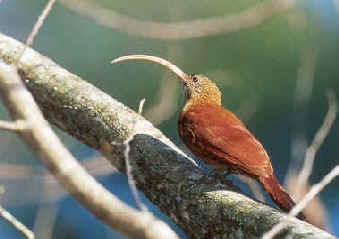
Red-billed Scythebill
Black-billed Scythebill ______
Campylorhamphus falcularius (monotypic)
Campylorhamphus falcularius is endemic to the Atlantic
Forest mostly in southeastern Brazil, but also in northeastern
Argentina.
DENDROCINCLA
Plain-winged Woodcreeper (*) ______
ne
Dendrocincla
turdina
The
Plain-winged Woodcreeper was considered conspecific with the Plain-brown
Woodcreeper. Another name for Dendrocincla
turdina has been Thrush-like Woodcreeper.
Dendrocincla turdina is endemic to
the Atlantic Forest mostly in southeastern Brazil, but also in
northeastern Argentina.
SITTASOMUS
Olivaceous Woodcreeper (*) ______
nc ne
Sittasomus griseicapillus sylviellus
DENDROCOLAPTES
Black-banded Woodcreeper ______
Dendrocolaptes picumnus
Planalto Woodcreeper (*) ______
ne
Dendrocolaptes platyrostris
XIPHOCOLAPTES
White-throated Woodcreeper (*) ______
ne
Xiphocolaptes albicollis
Great Rufous Woodcreeper (*) ______
nw
Xiphocolaptes major
XIPHORHYNCUS
Lesser Woodcreeper
______
Xiphorhyncus
(formerly
Lepidocolaptes) fuscus
Xiphorhyncus fuscus
is endemic to the Atlantic Forest mostly in southeastern Brazil,
but also in northeastern Argentina.
LEPIDOCOLAPTES
Scalloped Woodcreeper
(*)
______ ne
(has been part of Scaled
Woodcreeper)
Lepidocolaptes falcinellus (monotypic)
Lepidocolaptes falcinellus
is endemic to the Atlantic Forest in southern Brazil
and adjacent Argentina.
Narrow-billed Woodcreeper
(ph) (*) ______ ne nw
Lepidocolaptes a. angustirostris
DRYMORNIS
Scimitar-billed
Woodcreeper (*) ______ nc ne
Drymornis bridgesii (monotypic)
CYCLARHIS
Rufous-browed
Peppershrike (*) ______ ne
nw
Cyclarhis gujanensis
VIREO
Red-eyed
Vireo (*) ______ ba
nc
ne nw
Vireo olivaceus (or chivi)
("Chivi Vireo")
HYLOPHILUS
Rufous-crowned Greenlet (*) ______
ne
Hylophilus poicilotis (monotypic)
Hylophilus poicilotis is endemic to the Atlantic Forest
mostly in southeastern Brazil, but also in northeastern
Argentina.
CYANOCORAX
Purplish Jay (*) ______ ne
Cyanocorax cyanomelas
Azure Jay (nt) ______
Cyanocorax caeruleus
Cyanocorax caeruleus
is classified as a threatened species in Argentina. It is
endemic to the Atlantic Forest in southern Brazil and northeastern
Argentina.
Plush-crested Jay (ph) (*) ______ ne
nw
Cyanocorax c. chrysops
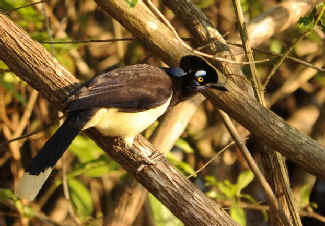
A Plush-crested Jay photographed during a FONT tour
TACHYCINETA
White-winged Swallow (*) ______
ne
Tachycineta albiventer (monotypic)
White-rumped Swallow (*) ______
ba nc ne nw
Tachycineta leucorrhoa
(monotypic)
Chilean Swallow (*) ______ fs so
Tachycineta meyeni
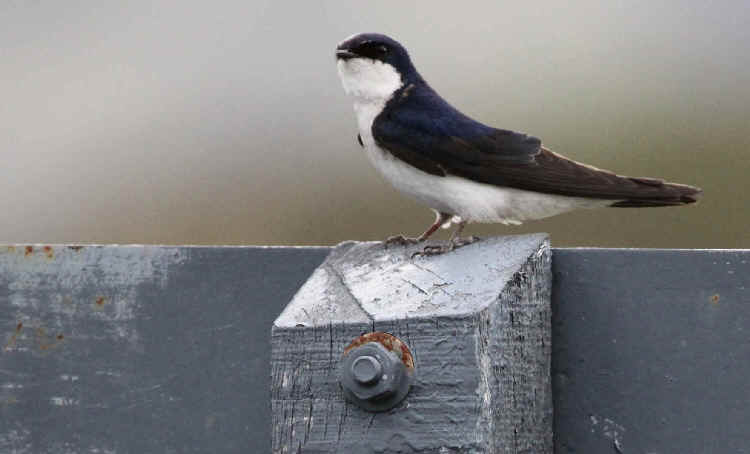
A Chilean Swallow photographed during the FONT tour
in southern Argentina in December 2013
(photo by Marie Gardner)
PROGNE
Brown-chested Martin (ph) (*) ______
ba nc ne so
Progne (formerly Phaeoprogne) tapera
Purple Martin (ph) ______
Progne s. subis
Gray-breasted Martin (*) ______
ba nc ne nw so
Progne chalybea
Southern Martin (*) ______ nc
nw so
Progne elegans (formerly P.
modesta, when this and what's now the
Galapagos Martin and the Peruvian Martin
were considered conspecific)
NOTIOCHELIDON
Blue-and-white Swallow (*) ______
ba fs nc ne nw so
Notiochelidon (or Pygochelidon) cyanoleuca patagonica
In his "Bird Biographies" written in the
late 1800s, W. H. Hudson called what was then
Atticora cyanoleuca the "Bank Martin".
ALOPOCHELIDON
Tawny-headed Swallow (*) ______
nc nw
Alopochelidon (formerly
Stelgidopteryx) fucata (monotypic)
ATTICORA
Black-collared
Swallow ______
Atticora melanoleuca
STELGIDOPTERYX
Southern Rough-winged
Swallow (*) ______ ne nw
Stelgidopteryx r. ruficollis
RIPARIA
Bank Swallow (*) ______
nc ne nw
Riparia r. riparia
Another name for Riparia riparia
is the Sand Martin.
HIRUNDO
Barn Swallow (ph) (*) ______
nc ne nw
Hirundo rustica erythrogaster
PETROCHELIDON
American Cliff Swallow (*) ______
ne
Petrochelidon (formerly Hirundo)
pyrrhonota minima
CISTOTHORUS
Sedge Wren (ph) (*) ______ ba
nc (has been called Grass Wren
in South America)
Cistothorus p. platensis
TROGLODYTES
"Southern" House Wren" (ph) (*) ______
ba fs nc ne nw so
Troglodytes aedon bonariae (subspecies
in northeastern Argentina)
Troglodytes aedon musculus (subspecies
in the Buenos Aires area & in north-central Argentina)
Troglodytes aedon rex
(subspecies in northwestern Argentina)
Troglodytes aedon chilensis (subspecies
in southern and far-southern Argentina)
The "Southern House Wren" is usually merged with the House
Wren of North America.
Mountain Wren (*) ______
nc nw
Troglodytes solstitialis auricularis
DONACOBIUS
Black-capped Donacobius (ph) (*) ______
ne
Donacobius a. atricapillus
An old name for Donacobius
atricapillus was the "Black-capped Mockingthrush".
POLIOPTILA
Masked Gnatcatcher (ph) (*) ______
ba nc ne
Polioptila d. dumicola
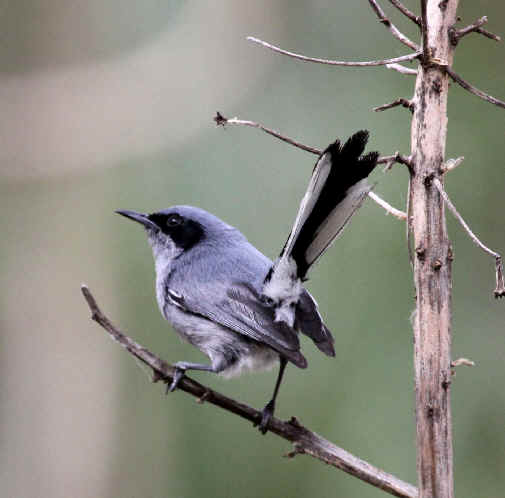
A Masked Gnatcatcher photographed during
the December 2013 FONT Argentina Tour
(photo by Marie Gardner)
Creamy-bellied
Gnatcatcher (nt) (*) ______ ne
Polioptila lactea (monotypic)
Polioptila lactea is classified as a vulnerable species
in Argentina. It is endemic to the Atlantic Forest mostly in
southeastern Brazil, but also in northeastern Argentina.
MIMUS
Chalk-browed Mockingbird (ph) (*) ______ ba
nc ne nw so
Mimus saturninus modulator
Patagonian Mockingbird
(*) ______ fs nc so
Mimus patagonicus (monotypic)
White-banded Mockingbird
(*)
______ nw so
Mimus triurus (monotypic)
Brown-backed
Mockingbird (*) ______ nw
Mimus dorsalis (monotypic)
STURNUS
Common Starling (*)
______ ba (also called European Starling)
Sturnus v. vulgaris
TURDUS
White-necked Thrush (ph) (*) ______
ne
Turdus albicollis paraguayensis
The White-necked Thrush is closely related to, and was
considered conspecifric with the White-throated Thrush of Central
America, and the recently-split Dagua Thrush of northern South
America.
Eastern Slaty Thrush (*) ______
ne
Turdus subalaris
The Eastern Slaty Thrush has been considered conspecific
with the Andean Slaty Thrush (below).
Andean Slaty Thrush
(*) ______ nc nw
Turdus nigriceps
Rufous-bellied Thrush (ph) (*) ______
ba nc ne nw so
Turdus r. rufiventris
Pale-breasted Thrush (*) ______
ne
Turdus l. leucomelas
Creamy-bellied Thrush (*) ______
ba nc ne
Turdus amaurochalinus (monotypic)
Austral Thrush (ph) (*) ______
fs so
Turdus falcklandii magellanicus
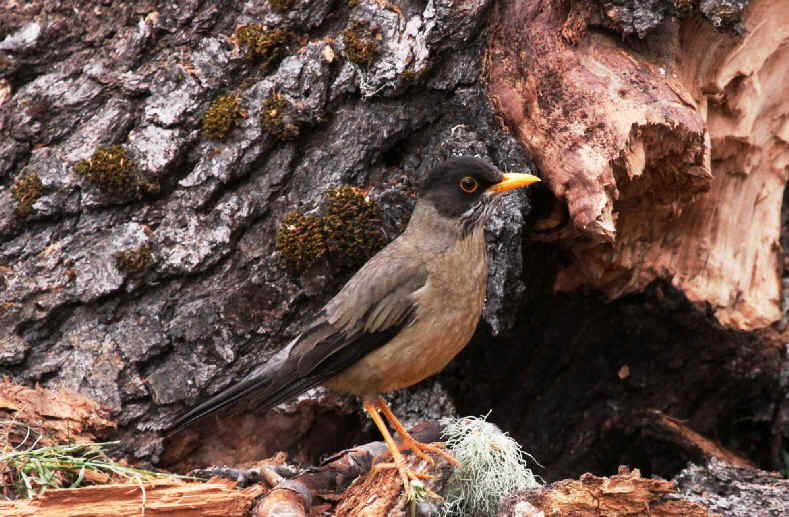
An Austral Thrush photographed during the FONT tour
in southern Argentina in December 2013
(photo by Marie Gardner)
Chiguanco Thrush (*)
______ nc nw so
Turdus chiguanco anthracinus
Glossy-black Thrush
(*)
______ nc nw
Turdus s. serranus
Yellow-legged Thrush ______
Turdus (formerly
Platycichia) flavipes
Turdus
flavipes is classified as a threatened species in
Argentina.
CATHARUS
Spotted Nightingale-Thrush ______
Catharus dryas
Swainson's Thrush
(*) ______ nw
Catharus ustulatus swainsoni
CINCLUS
Rufous-throated Dipper (t3) (*) ______ nc
Cinclus schulzi (monotypic)
PASSER
House Sparrow (i) (*)
______ ba fs nc ne nw
so
Passer domesticus
ANTHUS
Yellowish Pipit (*) ______
ba ne nw
Anthus l. lutescens
Short-billed Pipit (*) ______
nc ne nw so
Anthus f. furcatus
Hellmayr's Pipit (*) ______
fs nc nw
Anthus h. hellmayri
Ochre-breasted Pipit (t3) ______
Anthus nattereri (monotypic)
Correndera Pipit (ph)
(*) ______ fs nc so
Anthus correndera chilensis
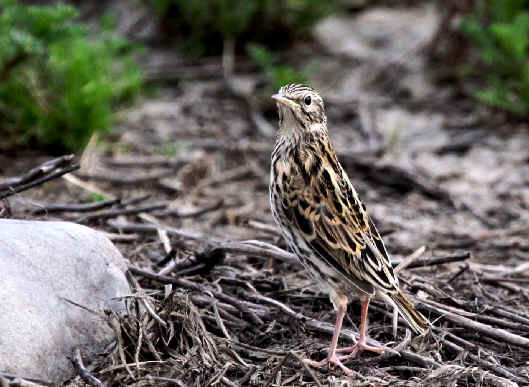
A Correndera Pipit photographed during the FONT tour
in southern Argentina in December 2013
(photo by Marie Gardner)
Campo Pipit
______ (has been called Chaco Pipit)
Anthus chacoensis
Paramo Pipit (*) ______ nw
Anthus bogotensis shiptoni
EUPHONIA
Purple-throated Euphonia (*) ______
ne
Euphonia chlorotica serrirostris
Violaceous Euphonia (*) ______
ne
Euphonia violacea auranticollis
Golden-rumped Euphonia (*) ______
nc nw
Euphonia c. cyanocephala
The Golden-rumped Euphonia was part of the former Blue-hooded
Euphonia.
Green-chinned
Euphonia (nt) ______
Euphonia chalyba (monotypic)
Euphonia chalyba
is classified as a threatened species in Argentina. It is
endemic to the Atlantic Forest in southern Brazil and northeastern
Argentina.
Chestnut-bellied
Euphonia (*) ______ ne
Euphonia pectoralis (monotypic)
Euphonia pectoralis is endemic to the Atlantic Forest
mostly in southeastern Brazil, but also in northeastern
Argentina.
CHLOROPHONIA
Blue-naped Chlorophonia (ph) (*) ______
ne
Chlorophonia c. cyanea
SPORAGRA
Hooded Siskin (ph) (*) ______
ba nc ne nw so
Sporagra (formerly Carduelis)
magellanica
Sporagra m. magellanica (subspecies
in the Buenos Aires area)
Sporagra magellanica hoyi (subspecies in northwestern Argentina)
Sporagra magellanica tucumana (subspecies in north-central
Argentina)
Sporagra magellanica alleni (subspecies in northeastern
Argentina)
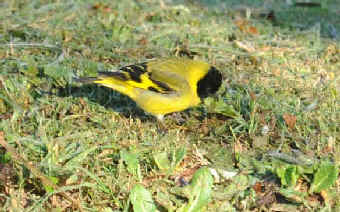
A Hooded Siskin photographed during a FONT
tour
(photo by Robert Enever)
Yellow-rumped Siskin
______
Sporagra
(formerly Carduelis) uropygialis
Black Siskin (*) ______ nw
Sporagra (formerly
Carduelis) atrata (monotypic)
Thick-billed Siskin
______
Sporagra
(formerly Carduelis) crassirostris
Black-chinned Siskin
(*)
______ fs
Sporagra (formerly
Carduelis) barbata (monotypic)
SETOPHAGA
Tropical Parula (*) ______ ne
nw
Setophaga
(formerly
Parula)
p. pitiyumi
Blackpoll Warbler ______
Setophaga
(formerly Dendroica) striata
GEOTHLYPIS
Southern Yellowthroat (ph) (*) ______
ba nc ne (was part of the now more-northerly
Masked Yellowthroat)
Geothlypis velata (monotypic)
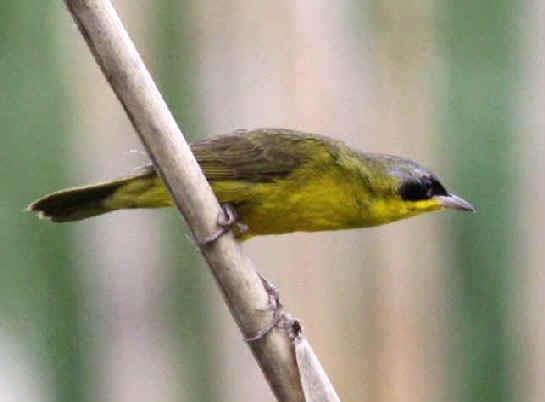
A Southern Yellowthroat photographed during
the FONT Argentina Tour in December 2013
(photo by Marie Gardner)
BASILEUTERUS
Stripe-crowned Warbler (*) ______ ne
nw (has been called
Golden-crowned Warbler)
Basileuterus culicivorus azarae
White-rimmed Warbler (*)
______ ne
(has also been called White-browed Warbler)
Basileuterus l. leucoblepharus
Two-banded Warbler (*) ______
nw
Basileuterus bivittatus argentinae
Pale-legged Warbler
(*) ______ nw
Basileuterus signatus flavovirens
PHAEOTHLYPIS
Riverbank Warbler (*) ______
ne
Phaeothlypis (formerly
Basileuterus) r. rivularis
Phaeothlypis rivularis
was called the River Warbler, but there is another species in
Euraqsia with that name, an Old World Warbler.
Phaeothlypis rivularis
has also been called the Neotropical River Warbler.
MYIOBORUS
Brown-capped Whitestart
(*) ______ nc nw (has been called Brown-capped
Redstart)
Myioborus b. brunniceps
CACICUS
Red-rumped Cacique (*) ______
ne
Cacicus haemorrhous affinis
Golden-winged Cacique (*) ______
ne nw
Cacicus chrysopterus (monotypic)
Solitary Cacique (*) ______
ne
Cacicus solitarius (monotypic)
Cacicus solitarius has
also been called the Solitary Black Cacique.
AGELAIOIDES
Baywing (ph) (*) ______ ba
nc ne so
Agelaioides (formerly Molothrus)
b. badius
Agelaioides badius
has also been called the Bay-winged Cowbird.
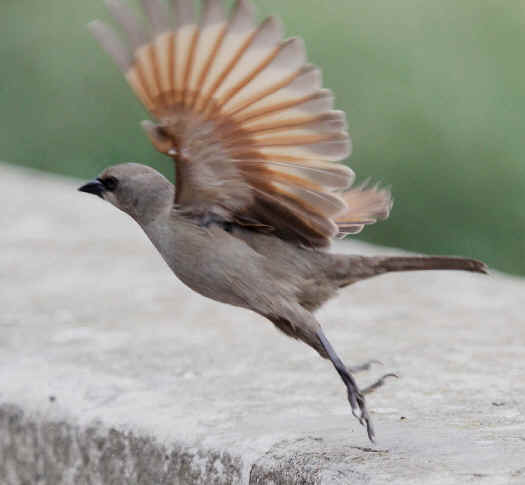
A Baywing,
or Bay-winged Cowbird, photographed
during the FONT Argentina Tour in December 2013
(photo by Marie Gardner)
MOLOTHRUS
Shiny Cowbird (*) ______ ba
nc ne nw so
Molothrus b. bonariensis
Another name for Molothrus
bonariensis has been the Glossy Cowbird.
Screaming Cowbird (*) ______
nc ne nw
Molothrus rufoaxillaris (monotypic)
Giant Cowbird (*) ______ ne
Molothrus o. oryzivora
PSAROCOLIUS
Crested Oropendola (ph) (*) ______
nw
Psarocolius decumanus maculosus
AGELAIUS
Yellow-winged Blackbird (*) ______
ba nc ne fs so
Agelaius
thilius petersii
Unicolored Blackbird
(ph) (*) ______ ba ne nw
Agelaius c. cyanopus
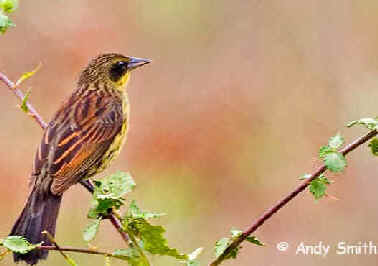
A female Unicolored Blackbird photographed during a FONT tour
(photo by Andy Smith)
CHRYSOMUS
Chestnut-capped Blackbird (ph) (*) ______
ba ne nw
Chrysomus
(formerly Agelaius) r. ruficapillus
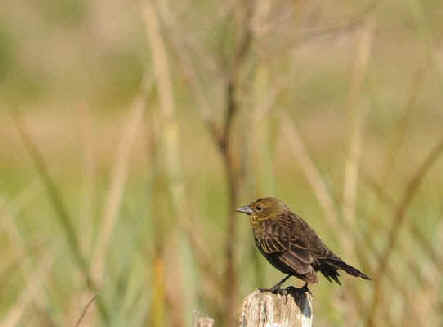
A female Chestnut-capped Blackbird
photographed during a FONT tour
(photo by Robert Enever)
GNORIMOPSAR
Chopi Blackbird (*) ______
ne
Gnorimopsar c. chopi (the single member of its genus)
CURAEUS
Austral Blackbird (*)
______ fs
Curaeus c. curaeus
Curaeus curaeus reynoldsi (subspecies
on Tierra del Fuego)
ICTERUS
Epaulet Oriole (*) ______
ba ne nw
Icterus cayanensis pyrrhopterus
Icterus cayanensis has been
said to be conspecific with the Moriche Oriole of northern South
America.
Orange-backed Troupial (ph) ______
Icterus croconotus
Icterus croconotus was part
of a more wide-ranging "Troupial", now considered to be 3
species.
AMBLYRAMPHUS
Scarlet-headed Blackbird (ph) (*) ______
ne nw
Amblyramphus holosericeus (monotypic,
and the single member of its genus)
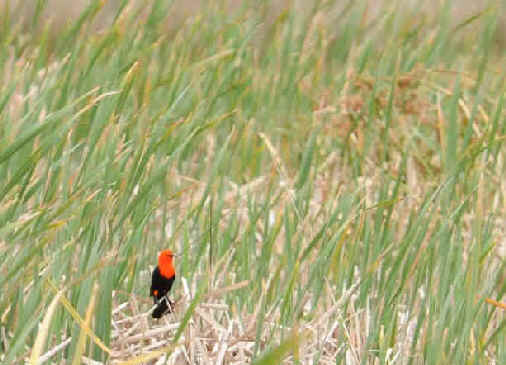
A Scarlet-headed Blackbird photographed during a FONT tour
(photo by Robert Enever)
PSEUDOLEISTES
Yellow-rumped Marshbird (ph) (*) ______
ne
Pseudoleistes guirahuro (monotypic)
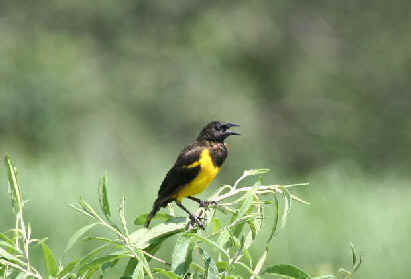
A Yellow-rumped Marshbird photographed during a FONT tour
Brown-and-yellow Marshbird (ph) (*) ______
ba nc ne
Pseudoleistes virescens (monotypic)
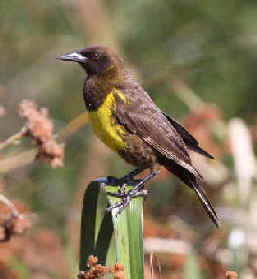
A Brown-and-yellow Marshbird photographed
during a FONT tour
(photo by Marie Gardner)
XANTHOPSAR
Saffron-cowled Blackbird (t3) (*) ______
ne
Xanthopsar (formerly
Agelaius) flavus (monotypic,
and the single member of its genus)
STURNELLA
White-browed Blackbird (ph) (*) ______
ba ne
Sturnella supercillaris (monotypic)
In his "Bird Biographies" written in the late 1800s,
W. H. Hudson called what was then Leistes
supercillaris the "Red-breasted
Marsh-bird".
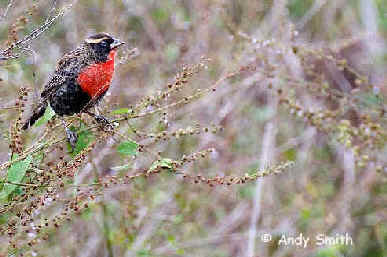
A White-browed Blackbird photographed during a FONT tour
Long-tailed
Meadowlark (ph) (*) ______ fs
nc nw so
Sturnella l. loyca (subspecies in southern & far-southern
Argentina)
Sturnella loyca obscura (subspecies in north-central Argentina)
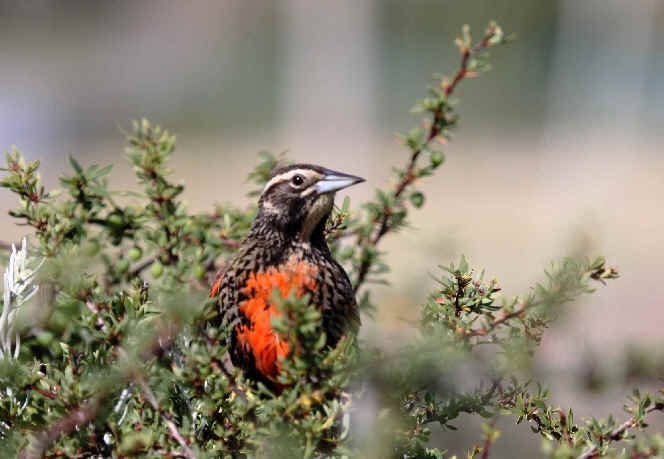
A Long-tailed Meadowlark photographed during
the FONT Argentina Tour in December 2013
(photo by Marie Gardner)
Pampas Meadowlark (t3) ______
Sturnella defilippii
Another name for Sturnella
defilippii has been the Lesser Red-breasted
Meadowlark.
In his "Bird Biographies" written in the late 1800s, W.
H. Hudson called what was then Trupialis
defilippi the "Military Starling".
DOLICHONYX
Bobolink (ph) ______
Dolichonyx oryzivorus
(monotypic, and the single member of its genus)
COEREBA
Bananaquit (ph) (*) ______
ne nw
Coereba flaveola chloropyga (the southernmost of 41 subspecies
throughout the Caribbean & Latin America)
ARREMON
Saffron-billed Sparrow (*) ______
nc nw
Arremon flavirostris polionotus
AIMOPHILA
Stripe-capped Sparrow
(*) ______ nc nw
Aimophila s. strigiceps
MYOSPIZA
Grassland Sparrow (*) ______
nc ne nw
Myospiza (formerly Ammodramus)
humeralis xanthornus
ZONOTRICHIA
Rufous-collared Sparrow (ph) (*) ______
ba fs nc ne nw so
Zonotrichia capensis hypoleuca (subspecies in northeastern
Argentina)
Zonotrichia capensis chilensis (subspecies in southern
Argentina)
Zonotrichia capensis australis (subspecies in far-southern
Argentina, north to Punta Tombo)
ATLAPETES
Stripe-headed Brush
Finch (*) ______ nw
Atlapetes torquatus borelli
Fulvous-headed Brush
Finch (*) ______ nw
Atlapetes fulviceps
(monotypic)
Yellow-striped Brush
Finch (ARe) (*) ______ nw
Atlapetes citrinellus (monotypic)
GUBERNATRIX
Yellow Cardinal (t2) (ph) (*) ______ so
Gubernatrix cristata (monotypic, and the single member of its
genus)
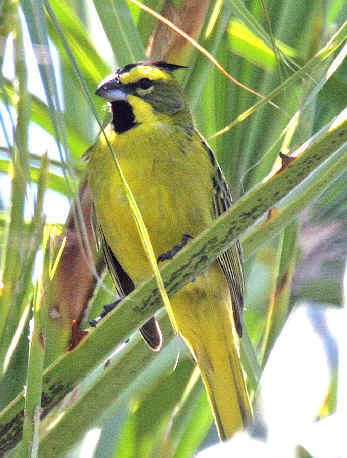
Yellow Cardinal
PAROARIA
Red-crested Cardinal (ph) (*) ______
ba ne
Paroaria coronata (monotypic)
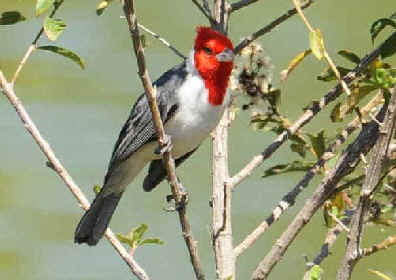
A Red-crested Cardinal photographed during a
FONT tour
Yellow-billed Cardinal (ph) (*) ______
ba ne nw
Paroaria c. capitata
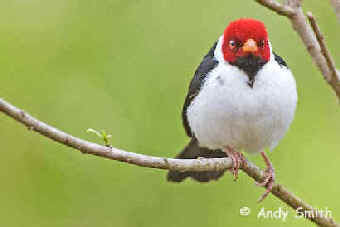
A Yellow-billed Cardinal photographed during
a FONT tour
THRAUPIS
Sayaca Tanager (ph) (*) ______
nc ne nw
Thraupis s. sayaca
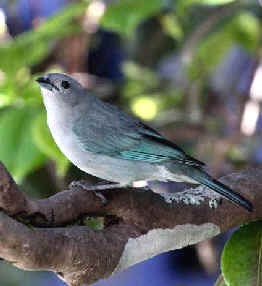
A Sayaca Tanager photographed during a FONT
tour
(photo by Marie Gardner)
Blue-and-yellow Tanager (*) ______
ba nc nw so
Thraupis b. bonariensis
RAMPHOCELUS
Brazilian Tanager (ph) ______
Ramphocelus bresilius
TANGARA
Green-headed Tanager (ph) (*) ______
ne
Tangara seledon (monotypic)
Tangara seledon is endemic to the Atlantic Forest
mostly in southeastern Brazil, but also in northeastern Argentina.
Burnished-buff Tanager (*) ______
ne
Tangara cayana chloroptera
Chestnut-backed Tanager ______
Tangara preciosa (monotypic)
STEPHANOPHURUS
Diademed Tanager ______
Stephanophurus diadematus (monotypic,
and the single member of its genus)
PIPRAEIDEA
Fawn-breasted Tanager (*) ______
nc ne nw
Pipraeidea m. melanonota (the single member of its genus)
PIRANGA
Red Tanager (*) ______ nc ne
Piranga saira (monotypic)
Piranga saira was conspecific with Piranga flava, the
Hepatic Tanager of
North America.
HABIA
Red-crowned Ant-Tanager (ph) (*) ______
ne
Habia r. rubica
TACHYPHONUS
White-lined Tanager (*) ______
ne
Tachyphonus rufus (monotypic)
Ruby-crowned Tanager (*) ______
ne
Tachyphonus coronatus (monotypic)
Tachyphonus coronatus is endemic to the Atlantic Forest
mostly in southeastern brazil, but also in northeastern
Argentina.
TRICHOTHRAUPIS
Black-goggled Tanager (*) ______
ne
Trichothraupis melanops (monotypic)
HEMITHRAUPIS
Guira Tanager (*) ______
ne
Hemithraupis guira fosteri
PYRRHOCOMA
Chestnut-headed Tanager ______
Pyrrhocoma ruficeps (monotypic,
and the single member of its genus)
Pyrrhocoma ruficeps is endemic to the area of the
Atlantic Forest mostly in southeastern Brazil, but also in northeastern
Argentina.
THLYPOPSIS
Orange-headed Tanager (*)
______ ne nw
Thlypopsis s. sordida
Rust-and-yellow
Tanager (*) ______ nc nw
Thlypopsis ruficeps
(monotypic)
NEMOSIA
Hooded Tanager (*) ______
ne
Nemosia pileata caerulea
CISSOPIS
Magpie Tanager (ph) (*) ______
ne
Cissopis leveriana major (the single member of its genus)
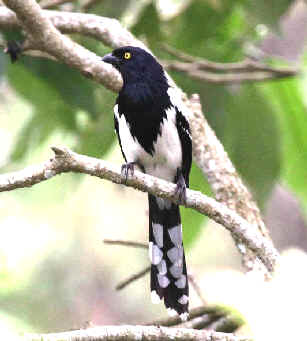
A Magpie Tanager photographed during a FONT
tour
(photo by Marie Gardner)
CHLOROSPINGUS
Common Bush Tanager
(*)
______ nw
Chlorospingus ophthalimicus argentinus
DACNIS
Blue Dacnis (ph) (*) ______
ne
Dacnis cayana paraguayensis
TERSINA
Swallow-Tanager (ph) (*) ______
ne
Tersina v. viridis (the single member of its genus)
CONIROSTRUM
Chestnut-vented Conebill (*) ______
ne nw
Conirostrum s. speciosum
DIGLOSSA
Rusty Flowerpiercer
(*) ______ nw
Diglossa s. sittoides
VOLATINIA
Blue-black Grassquit (*) ______
nc ne
Volatinia j. jacarina (the single member of its genus)
TIARIS
Dull-colored Grassquit ______
Tiaris obscura
SPOROPHILA
Plumbeous Seedeater ______
Sporophila plumbea
Lined Seedeater ______
Sporophila lineola (monotypic)
Yellow-bellied Seedeater ______
Sporophila nigricollis
Rusty-collared Seedeater (*) ______
ne
Sporophila collaris melanocephala
Double-collared
Seedeater (*) ______ ba ne
Sporophila c. caerulescens
Tawny-bellied Seedeater (*) ______
ne
Sporophila hypoxantha (monotypic)
The Tawny-bellied Seedeater is closely related to, and was
at one time considered conspecific with the Ruddy-breasted Seedeater
of Central America & northern South America.
Dark-throated Seedeater (nt) (*) ______
ne
Sporophila ruficollis (monotypic)
White-bellied Seedeater (ph) ______
Sporophila leucoptea
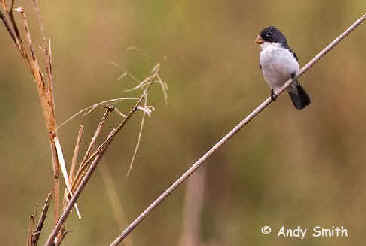
A White-bellied Seedeater photographed during a FONT tour
Capped Seedeater (*) ______
ne
Sporophila bouvreuil pileata
Buffy-fronted Seedeater (t3) ______
Sporophila frontalis (monotypic)
Marsh Seedeater (t2)
(*)
______ ne
Sporophila palustris (monotypic)
Entre Rio Seedeater
______
Sporophila zellchi
Rufous-rumped Seedeater
(nt) (*) ______ ne (also called Gray-and-chestnut
Seedeater)
(also called Gray-and-chestnut
Seedeater)
Sporophila hypochroma (monotypic)
Chestnut Seedeater (t3)
(*) ______ ne
Sporophila cinnamomea (monotypic)
The "Narosky's Seedeater" is said to be a hybrid of the Marsh and the Chestnut
Seedeaters.
AMAUROSPIZA
Blackish-blue Seedeater
(nt) ______
Amaurospiza moesta
Amaurospiza moesta is classified as a threatened species
in Argentina. It is endemic to the Atlantic Forest of southern Brazil
and northeastern Argentina.
ORYZOBORUS
Lesser Seed Finch (*) ______
ne
(considered conspecific with
the "Thick-billed Seed-Finch" of Central America)
Oryzoborus a. angolensis ("Chestnut-bellied Seed Finch")
Oryzoborus angolensis
is classified as a threatened species in Argentina.
CATAMENIA
Band-tailed Seedeater
(*) ______ nc nw
Catamenia a. analis
Plain-colored
Seedeater (*) ______ nc
Catamenia inornata cordobensis (subspecies endemic to
north-central Argentina)
SICALIS
Saffron Finch (ph) (*) ______
nc ne nw
Sicalis flaveola pelzelni
In his "Bird Biographies" written in the
late 1800s, W. H. Hudson called what was then
Sicalis pelzelni the "Yellow House
Sparrow".
Another name for Sicalis flaveola
is the Saffron Yellow Finch, as all of the other members of the genus
are "yellow finches".
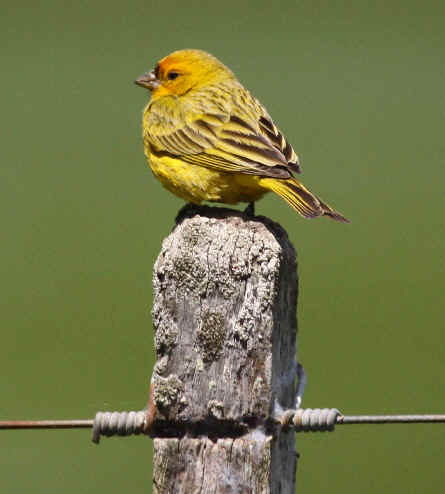
A Saffron Finch photographed during a FONT
tour
(photo by Marie Gardner)
Stripe-tailed Yellow Finch (*) ______
nc
Sicalis c. citrina
Grassland Yellow Finch (*) ______
ba nc ne so
Sicalis luteola luteiventris
Bright-rumped Yellow
Finch (*) ______ nw
Sicalis u. uropygialis
Greater Yellow Finch
(*)
______
Sicalis auriventris (monotypic)
Puna Yellow Finch (*)
______ nw
Sicalis lutea
(monotypic)
Citron-headed Yellow
Finch (*) (ARr) ______ nw
Sicalis luteocephala (monotypic)
Greenish Yellow Finch
(*)
______ nw
Sicalis o. olivascens
Patagonian Yellow
Finch (*) ______ fs so
Sicalis lebruni (monotypic)
IDIOPSAR
Short-tailed Finch
______
Idiopsa brachyurus (the single member of its genus)
HAPLOSPIZA
Uniform Finch ______
Haplospiza unicolor (monotypic)
Haplospiza unicolor
is classified as a vulnerable species in Argentina. It is
endemic to the Atlantic Forest mostly in southeastern Brazil, but
also in northern Argentina.
LOPHOSPINGUS
Gray-crested Finch (*) ______ nw
Lophospingus griseocristatus
Black-crested Finch
(*)
______ nc
Lophospingus pusillus (monotypic)
CHARITOSPIZA
Coal-crested Finch (nt) ______
Charitospiza eucosma (monotypic,
and the single member of its genus)
CORYPHOSPINGUS
Red Pileated Finch (ph) (*) ______
nc ne
Coryphospingus cucullatus rubescens
Coryphospingus cucullatus
has been called the Red-crested Finch.
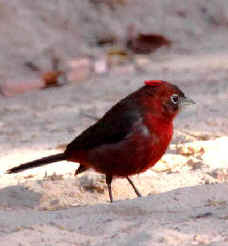
A Red Pileated Finch photographed during a FONT
tour
(photo by Marie Gardner)
SALTATRICULA
Many-colored Chaco Finch (*) ______
nc
Saltatricula multicolor (monotypic, and the single member of its genus)
EMBERNAGRA
Pampa Finch (ph) (*) ______
ba nc ne nw
Embernagra p. platensis (subspecies in northeastern Argentina
and in & near Buenos Aires)
Embernagra platensis olivascens (subspecies in northwestern
& north-central Argentina)
In his "Bird Biographies" written in the late
1800s, W. H. Hudson called Embernagra
platensis the "Red-billed Ground Finch".
More recently, the bird has been called the Great Pampa Finch.
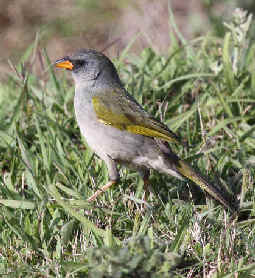
A Pampa Finch photographed during a FONT
tour
(photo by Marie Gardner)
EMBERIZOIDES
Wedge-tailed Grass Finch (ph) (*)
_____ ne
Emberizoides h. herbicola
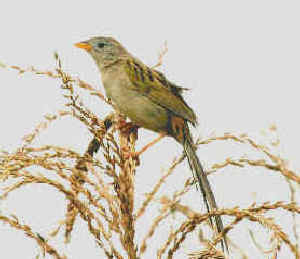
A Wedge-tailed Grass Finch photographed
during a FONT tour
Lesser Grass Finch (nt)
(*) ______ ne (another name is Gray-cheeked Grass
Finch)
Emberizoides ypiranganus (monotypic)
DONACOSPIZA
Long-tailed
Reed Finch (*) ______ ne
Donacospiza albifrons
CORYPHASPIZA
Black-masked Finch (t3) ______
Coryphaspiza melanotis (the single member of its genus)
MELANODERA
Yellow-bridled Finch ______
Melanodera xanthogramma
White-bridled Finch (nt)
(*)
______ fs (has also been called Black-throated Finch
or
Canary-winged Finch)
Melanodera melanodera princetoniana
DIUCA
Common Diuca Finch (*) ______ fs
so nw
Diuca d. diuca
White-winged Diuca Finch ______
Diuca speculifera
PHRYGILUS
Mourning Sierra Finch (ph) (*) ______ fs
so nw
Phrygilus f. fruticeti
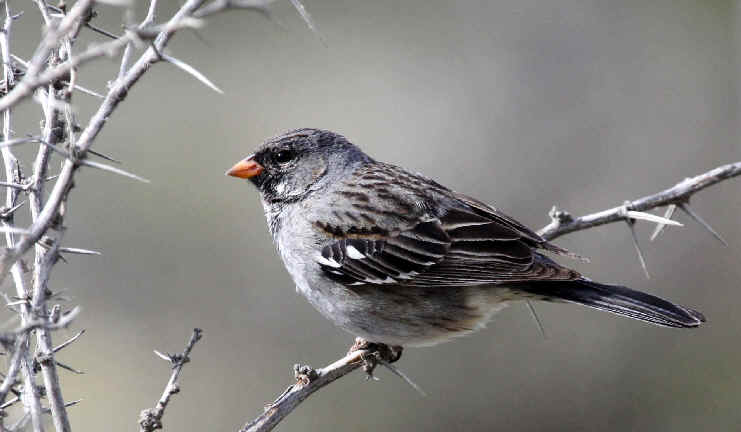
A Mourning Sierra Finch photographed during
the FONT tour in southern Argentina in December 2013
(photo by Marie Gardner)
Band-tailed Sierra Finch
(*) ______ nc nw
Phrygilus alaudinus venturii
Plumbeous Sierra Finch
(*) ______ nc nw
Phrygilus unicolor tucumanus
Ash-breasted Sierra Finch
(*) ______ nw
Phrygilus p. plebejus
Gray-hooded Sierra Finch
(*) ______ fs nw so
Phrygilus g. gayi (subspecies in northwestern Argentina)
Phrygilus gayi caniceps (subspecies in far-southern Argentina)
Patagonian Sierra Finch
(*) ______ fs
Phrygilus patagonicus (monotypic)
Black-hooded Sierra Finch (ph)
(*) ______ nw
Phrygilus atriceps
(monotypic)
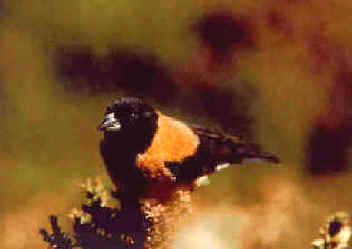
A Black-hooded Sierra Finch
photographed during a FONT tour
Red-backed Sierra Finch ______
Phrygilus dorsalis
Carbonated Sierra Finch
(ARe) (*) ______ so (a
sparkling bird indeed)
Phrygilus carbonarius (monotypic)
COMPSOSPIZA
Tucuman Mountain Finch (t3) (ARe) ______
nc
Compsospiza baeri (monotypic)
POOSPIZA
Black-and-rufous Warbling Finch (*) ______
ba
Poospiza n. nigrorufa
Black-and-chestnut Warbling
Finch (*) ______ nc
Poospiza whitii
The Black-and-chestnut Warbling
Finch has been considered conspecific with the more-easterly
Black-and-rufous Warbling Finch (above).
Red-rumped Warbling Finch ______
Poospiza lateralis cabanisi
Black-capped Warbling Finch
(*) ______ ba nc nw
Poospiza melanoleuca
(monotypic)
Cinnamon Warbling
Finch (*) ______ nc
Poospiza ornata (monotypic)
Rusty-browed Warbling
Finch (*) ______ nc nw
Poospiza e. erythrophrys
Rufous-sided Warbling
Finch (*) ______ nw
Poospiza hypochondria affinis
Ringed Warbling Finch
(*)
______ nc so
Poospiza torquata pectoralis
CATAMBLYRHYNCHUS
Plushcap ______
(was called Plush-capped Finch)
Catamblyrhynchus diadema (the single member of its genus)
The Plushcap has been called
the Plush-capped Finch.
SALTATOR
Green-winged Saltator (*) ______
Saltator s. similis
"Southern" Grayish Saltator
(*)
______ nc ne
Saltator c. coerulescens
Thick-billed Saltator (*) ______
ne
Saltator maxillosus (monotypic)
Saltator maxillosus is classified as a threatened
species in Argentina. It is endemic to the Atlantic Forest mostly
in southeastern Brazil, but also in northeastern Argentina.
Black-throated Grosbeak ______
Saltator (formerly
Pitylus) fuliginosus (monotypic)
The Black-throated Grosbeak is closely related to, and was
formerly conspecific with the Slate-colored Grosbeak.
Saltator fuliginosus is endemic to
the Atlantic Forest mostly in southeastern Brazil, but also in
northeastern Argentina.
Golden-billed Saltator
(*) ______ nc ne so
Saltator aurantiirostris parkesi (subspecies in northeastern
Argentina)
Saltator aurantiirostris nasica (subspecies in north-central
Argentina)
Rufous-bellied Saltator
(t3) (*)
______ nc
Saltator rufiventris (monotypic)
PHEUCTICUS
Black-backed Grosbeak (*) ______
nc nw
Pheucticus a. aureoventris
CYANOLOXIA
Glaucous-blue Grosbeak (ph)
______ (has been called Indigo Grosbeak)
Cyanoloxia glaucocaerulea
Cyanoloxia glaucocaerulea
is classified as a vulnerable species in Argentina.
CYANOCOMPSA
Ultramarine Grosbeak (*) ______
nc nw
Cyanocompsa brissonii argentina
To
Top of Page.