
E-mail: font@focusonnature.com
Phone: Toll-free in USA 1-888-721-3555
or 302/529-1876
|
PO
Box 9021, Wilmington, DE 19809, USA E-mail: font@focusonnature.com Phone: Toll-free in USA 1-888-721-3555 or 302/529-1876 |
Updated
in February 2013
relating to a bird during the FOCUS
ON NATURE TOUR IN CHILE
in November/December 2009
What follows here was written and compiled by Armas Hill, the leader of FONT tours in Chile
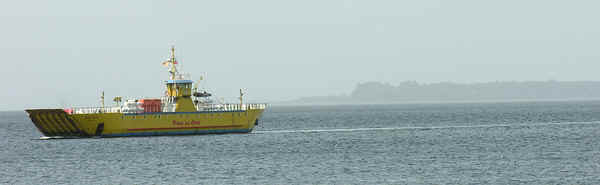
During a ferry-boat
crossing (in the photo above) to Chiloe Island, on December 1, 2009, as part of the FONT Nov/Dec '09 Tour
in Chile, some storm-petrels were noticed that appeared different.
They had more white than would normally be seen on the Wilson's Storm Petrel,
thus appearing to have more contrast, with white upper wingbars, a seemingly
pale underwing, and even, most oddly, apparently white bellies.
What we did not know at the time was that earlier that same year, another group
of birders (from Ireland: Seamus Enright, Michael O'Keefe &
friends), in waters in much that same area, also observed
such similar
storm-petrels.
Since then, this news:
In February 2011, during a five-person multi-national expedition led by British
seabird expert Peter Harrison, 12 of the "mystery storm petrels" were
captured at sea near Puerto Montt, Chile. By so doing, that team has been able
to confirm the existence of a new species.
According to Harrison, "These birds appear to be a new species, as they are
so different from any other storm petrels we know." There are 22
known species of storm petrels worldwide.
The following narrative, from the blog "Birding Abroad", relates more
about the news:
Recent sightings of unidentified storm petrels in Seno Reloncavi, south
of Puerto Montt, Chile, have been confirmed as a new species, as recently
published in "Dutch Birding" (O'Keefe et al 2010).
A team of biologists led (as noted above) by British seabird expert Peter
Harrison, has just completed an expedition to that area of Chile.
The expedition followed Harrison's earlier examination of two skins of an
Oceanites
sp.
housed in the Museo Argentino de Ciencias Naturales in Buenos Aires,
Argentina.
Those two skins had been described by Pearman as the first Argentine records
of the
Elliot's Storm Petrel,
Oceanites gracilis galapogoensis
(Pearman
2000).
On examining the specimens, Harrison concluded that the two originally collected
at El Bolson, Rio Negro province, Argentina, in February 1972 and November 1983
represented a hitherto undescribed taxon and were probably the mysterious
unidentified storm petrels of Puerto Montt, Chile, which is just 70 kilometers
west of El Bolson.
Two members of the team of biologists, Chris Gaskin and Karen Baird from New
Zealand, were both involved in at-sea captures and searches for the breeding
location of the recently rediscovered
New Zealand Storm
Petrel
(Gaskin
& Baird 2005, Stephenson et al. 2008).
The Chilean expedition spent 4 days at sea in the Seno Reloncavi area, where
they made use of chum or berley (fish scraps) to attract seabirds within range
of the specially designed net-guns. These were critical to the success of the
expedition and were developed in New Zealand for the capture of the
New
Zealand Storm Petrel.
Over the four days at sea, over 1,500 sightings of the new
Oceanites species
were recorded.
To enable the scientific description of the new species, the 12
birds (as noted above) were captured for the collection of biometric data
and samples of blood and feathers taken for genetic work.
The new species would appear to be most closely related to the
Elliot's Storm
Petrel, Oceanites gracilis. But in appearance it is intermediate between
the
Wilson's Storm Petrel and the
New Zealand Storm Petrel.
It shows a distinctive
pale upper wing crescent and a prominent white bar across the underwing coverts.
Unlike typical Elliot's Storm Petrels, the white feathering in the ventral area is
much more subdued and restricted and does not extend toward the upper breast. The
wing measurements are also very different and show no overlap with the mainland
Elliot's Storm Petrel.
The expedition team estimates a population of 5,000 to 10,000 birds in the Seno
Reloncavi area, where the new taxon appears to be the most abundant of the
resident seabirds, with flocks of several hundred individuals at chum slicks.
The timing of the expedition appears to have coincided with the fledging period
as juveniles were among the captured birds, suggesting that breeding occurs in
the Seno Reloncavi area, possibly beginning in November.
A wider search of the Seno Relanocavi and Golfo de Ancud area needs to be
undertaken in both summer and winter.
Further analysis of feather and blood samples is expected to confirm this
discovery and a full scientific publication is in preparation by the expedition
team.
That analysis has since been done, and in January
2013, the new species was described, the Pincoya
Storm Petrel, Oceaniites
pincoyae, published that month in "The
Auk", the publication of the AOU, the American
Ornithologists Union. A color illustration of the new storm petrel is on the
cover of that issue.
The name "Pincoya" commemorates a female water spirit in Chilote
mythology, a mixture of myths, legends, and beliefs of the people who live
on the island of Chiloe in southern Chile.
That mythology reflects the importance of the sea in the life of the
Chilotes (those who live on Chiloe Island).
Chilote mythology is based on a mixture of the indigenous religions of
the Chonos and Huiliches who have long been inhabitants on Chiloe, together with
legends and superstitions brought by the Spanish when they arrived there in
1567, thus beginning a fusion of elements that would form a separate mythology.
That Chilote mythology flourished, due to the isolation and remoteness of the
island culture from the more "mainstream" society of the Spanish and
other Europeans elsewhere in Chile,
In that mythology, the "Pincoya" is a female "water
spirit" of the Chilotan Seas. said to have long blond hair, and to be
of incomparable beauty, to be cheerful and sensual, and to rise from the depths
of the sea.
Naked and pure, she personifies the fertility of marine species. Through her
ritual dance she provides the residents of Chiloe with either an abundance or
deficiency of fish and seafood.
If she performs her dance facing the sea, it means that the shore will have an
abundance of fish.
When she dances facing the mountains, with her back to the sea, seafood will be
scarce.
Chilote mythology is appreciative of the "Pincoya" who is
believed to be good, beautiful, and humanitarian.
According to legend, Pincoya is the daughter of Millalobo, who was
the "king of the sea"' in Chilote mythology and a human named Huenchula.
Over the years, there have been a number of Focus On
Nature Tours to the island of Chiloe, where both the nature and the
culture have been enjoyed and appreciated.
On the island during those FONT tours, a wonderful assortment of birds
and mammals have been seen.
Birds have included colonies of penguins and other seabirds,
rafts of swans and other waterbirds, large flocks of godwits,
as well as parakeets, hummingbirds, tapaculos, and Magellanic
Woodpeckers and other birds of the fascinating Nothofogus forest.
Mammals have included the rare Marine Otter, or Chungungo,
and the diminutive deer called the Pudu.
Beneath the photos below is what was written in the FONT website in 2010, relating to the "Dutch Birding" article mentioned above.
These photos were taken in nearly the same Chilean waters
a few months before our Nov/Dec '09 FONT tour,
taken in February 2009 by Michael O'Keeffe
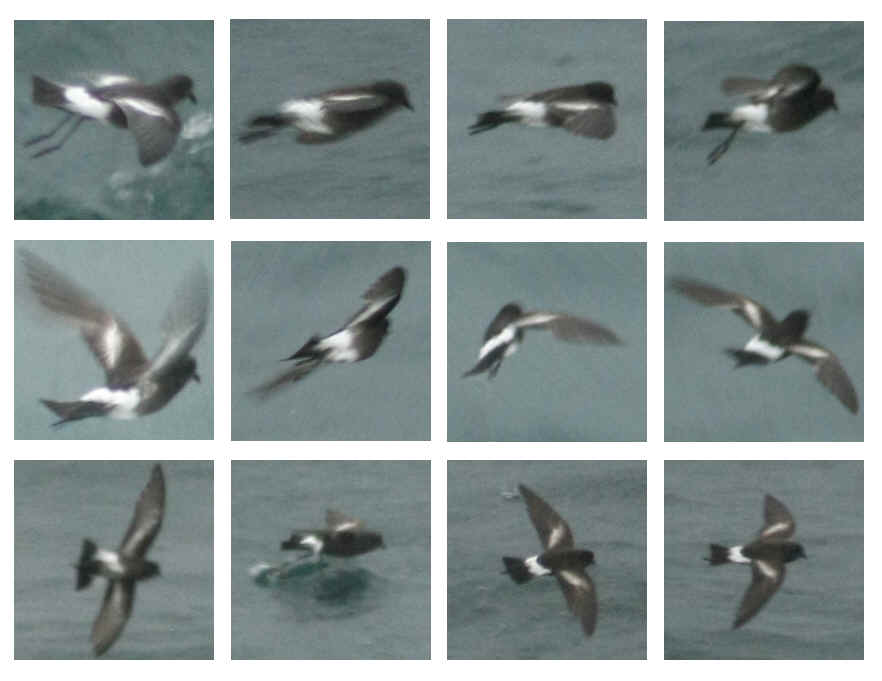
This "mystery
storm-petrel" was seen during the FONT Chile tour
on December 1, 2009 from the ferry to Chiloe Island.
It has since been described, in January 2013,
as a new species,
the Pincoya Storm Petrel.
What
follows now, regarding these storm-petrels in southern Chilean waters, is from a
paper that was authored in 2009, by Jim Dowdall, Seamus Enright, Kieran
Fahy, Jeff Gilligan, Gerard Lillie, and Michael O'Keeffe, for DUTCH BIRDING
(published in 2010):
The most striking feature of the birds was the extent of white in the
plumage underneath, suggesting initially one of the
Fregetta
storm-petrels. However, other features seemed to rule out that option, including
the extent of dark on the flanks and the prominent carpal bar.
The birds appeared to have characteristics making them
Oceanites
storm-petrels, similar but perhaps slightly stockier of the
chilensis
Wilson's
Storm Petrel. But the whitish upper-wing and under-wing panels appeared more
striking than
chilensis.
The white on the rump appeared to wrap completely
around the vent/lower belly, although from photos it is hard to rule out the
presence of perhaps some dark feathering on the sides and the center of the
vent.
Below, some answers to a
couple questions that have been asked during the years, from 2009 to 2013:
Why have these birds apparently gone undocumented until now?
Other visiting birders, in recent years, in the coastal waters south of
Puerto Montt, and from the ferry crossing to/from Chiloe Island, have noted
similar birds.
For example, Peter Harrison first encountered them while working onboard the
tour vessel M.V. Linblad Explorer, out of Puerto Montt in 1983 and 1984.
Harrison also saw the birds again in later years. On two occasions, he remarked
that he "was lucky enough to have one land on the deck during the night and
was able to give them careful scrutiny. Using his only reference (Murphy, 1936),
and based on measurements he obtained, Harrison concluded the birds to be
chilensis.
The enigmatic chilensis race of the Wilson's Storm Petrel
has had a
checkered history.
Robert Cushman Murphy in the "Oceanic Birds of South
America" (1936) described how the taxa Oceanites
oceanicus chilensis
was inadvertently first published nomen nudum by W.B. Alexander in
"Birds of the Oceans" (1928).
The taxa was later described in detail by Murphy (1936) and referred to as the "Fuegian
Petrel", a new subspecies of the Wilson's Storm Petrel.
Subsequent to that, and for reasons not quite understood, the taxa was
"dropped" as a race of the Wilson's. Until very recently, only
two races of Wilson's Storm Petrels, oceanicus and exasperates,
were recognized in the literature, including by Harrison (1983, and in
subsequent editions).
Interestingly, in relation to the Wilson's Storm Petrel, Harrison has
noted that "Cape Horn birds have pale vents", again apparently
relating to chilensis, noting also some pale mottling on the lower belly.
Onley and Scofield (2007) have recently re-established chilensis as a
race of the Wilson's Storm Petrel.
So, a conclusion could be that the storm-petrels, with the white on their
vents/bellies in the Chilean waters south of Puerto Montt were undocumented in
part due to the lack of understanding of the form chilensis also
occurring in those waters, and probably most importantly, they were undocumented
because simply not many people were aware of
them.
The storm petrels, with the white apparently more extensive than chilensis,
have been observed south of Puerto Montt, in the channel north of Chiloe island (where
they were seen during the 2009 FONT tour), and also in the Gulf of Penas,
approximately 500 kilometers south of Puerto Montt. It is therefore suggested
that these birds are relatively localized and sedentary,
Could these birds really be a new species?
The most conservative explanation was that they would simply be a previously
un-described plumage or morph of one of the species already known from the
region.
The combination of plumage features of the new storm petrel perhaps most closely matches the Elliot's
Storm Petrel. But generally that species generally has much more white on
the upper belly and generally more dark feathering on the vent, creating a
distinctive divide between the white belly and the rump.
Also, the waters south of Puerto Montt seem surely to be too far removed, so far
south of the range of the Elliot's, which is a warm-water species, and
thus not apt to occur to cold southern Chilean waters.
Very interestingly in relation to the new storm petrel, repeating here
what has already been noted earlier:
in 2000 a note was published regarding two specimens of storm petrels
that were taken (back in 1972 & 1983) from El
Bolson, in the province of Rio Negro, in southern (Patagonian) Argentina.
They
were assigned to the northerly race of the Elliot's Storm Petrel, galapogoensis.
They erroneously represented the first (and the only) records of Elliot's Storm
Petrel for Argentina (where they would have been assumed to have been from the South
Atlantic.)
The wing measurements of the new "white-bellied" storm petrels from south
of Puerto Montt in Chile (now, the Pincoya Storm Petrel, Oceanites
pincoyae) indicate those birds to be larger than gracilis
Elliot's, and within the range of chilensis or galapogoensis (with
however, as already noted, their plumage features not matching either of those taxa).
The El Bolson (Argentina) birds are only marginally longer winged than the
Puerto Montt Oceanites pincoyae birds,
as studied by Harrison in the hand.
It has been determined that the two El Bolson specimens are examples of the
Oceanites pincoyae storm petrels of the waters
south of Puerto Montt, and not the Elliot's.
Returning again to the chilensis race of the Wilson's Storm Petrel,
some observers have been of the opinion that it may in actuality be closer to the Elliot's
than to the Wilson's.
With the new "white bellied" storm petrels (Oceanites
pincoyae) from south of Puerto Montt having now received analysis, it
may be worthwhile to re-think, and thus give further
study, the entire storm-petrel taxa in the region of southern Chile.
It is hard not to draw certain parallels between this story of storm petrels in
southern Chile and that of the New Zealand Storm Petrel, Oceanites
maorianus, that was only recently, in 2003, found to be alive and well.
Indeed, the "white-bellied" Puerto Montt/Chiloe Island birds, now
Oceanites pincoyae, share a
startling similarity with that rare species that lives on the far-opposite side
of the South Pacific Ocean.