 |
PO Box 9021,
Wilmington, DE 19809, USA
E-mail: font@focusonnature.com
Phone: Toll-free in USA 1-888-721-3555
or 302/529-1876
Website: www.focusonnature.com |
 COSTA
RICA
COSTA
RICA
MAMMALS
and some
OTHER WILDLIFE
Noting those found during
Focus On Nature Tours
1991 thru 2015
noted with an (*)
Tours during the months of January, February,
March,
April, July, December.
There have been 32 FONT tours in Costa Rica.
The following list of Costa Rica Mammals
compiled by Armas Hill
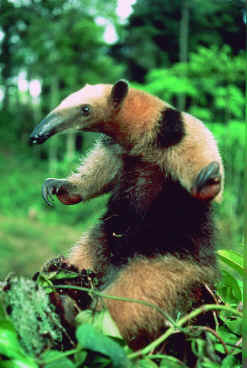
UPPER RIGHT PHOTO: a
NORTHERN TAMANDUA
Codes:
Threatened Species,
designated in CITES:
(t1): critical
(t2): endangered
(t3): vulnerable
(ti): threatened (but with status indeterminate)
(i): introduced in Costa Rica
(ph): species with a photo in the FONT website
CR(N): during
tours in northern Costa Rica
CR(S): during
tours in southern Costa Rica
Some excellent books about Central American Mammals include:
"A Field Guide to the Mammals of Central America & Southeast
Mexico" by Fiona Reid, 1997.
"The Natural History of Costa Rican Mammals" by Mark Wainwright, 2002.
Links:
Upcoming FONT Birding & Nature Tours in Central America
Costa Rica
Bird-List Panama
Bird-List
A
List & Photo Gallery of Central America Birds, in 4 Parts
A
List & Photo Gallery of Central America Butterflies & Moths, in 5 parts
Amphibians &
Reptiles of Costa Rica & Panama (with
some photos)
Miscellaneous Other Wildlife
after the Mammal-List below
Directory of Photos in this Website

List of Mammals:
AMERICAN OPOSSUMS, in the Order Didelphimorphia, Family
Didelphidae:
All Marsupials were formerly classified in the Order
Marsupialia.
However, this large group has recently been split into 7 orders.
NEW WORLD
OPOSSUMS consist of 3 orders, Australian marsupials by 4 orders.
The
Order Didelphimorphia includes
all of the Central American opossums - 13 species
-
Common
Opossum ______ (*)
CR(N)
Didelphis marsupialis
-
Virginia Opossum (ph) ______ (*) CR(N)
Didelphis virginiana
-
Gray Four-eyed Opossum ______
Philander opossum
- Water Opossum
______ (also called
Yapok)
Chironectes minimus
- Brown Four-eyed Opossum
______
Metachirus nudicaudatus
- Mexican Mouse Opossum
______
Marmosa mexicana
- Alston's Mouse Opossum
______
Micoureus alstoni
- Central American Woolly
Opossum ______
Caluromys derbianus
ANTEATERS, SLOTHS, and ARMADILLOS
in the
Order Xenarthra, formerly Edentata
ANTEATERS
in the
Family Myrmecophagidae
SLOTHS
in the
Families Bradypodidae
(3-toed) & Megalonychidae (2-toed)
ARMADILLOS
in the
Family Dasypodidae
- Giant Anteater ______
(If it still exists
in Central America, it is very rare there. There are a few recent sight
records in southern Costa Rica and Panama. This species may be the most
endangered mammal in Central America. It is common in parts of South
America.)
Myrmecophaga tridactyla
- Northern Tamandua (ph) ______ (*) CR(N,S)
(also called Banded or Vested
Anteater) (IN PHOTO AT TOP OF THIS LIST)
Tamandua mexicana
- Silky Anteater ______
Cyclopes didactylus
- Brown-throated Three-toed Sloth (ph)
______ (*) CR(N,S)
Bradypus variegatus
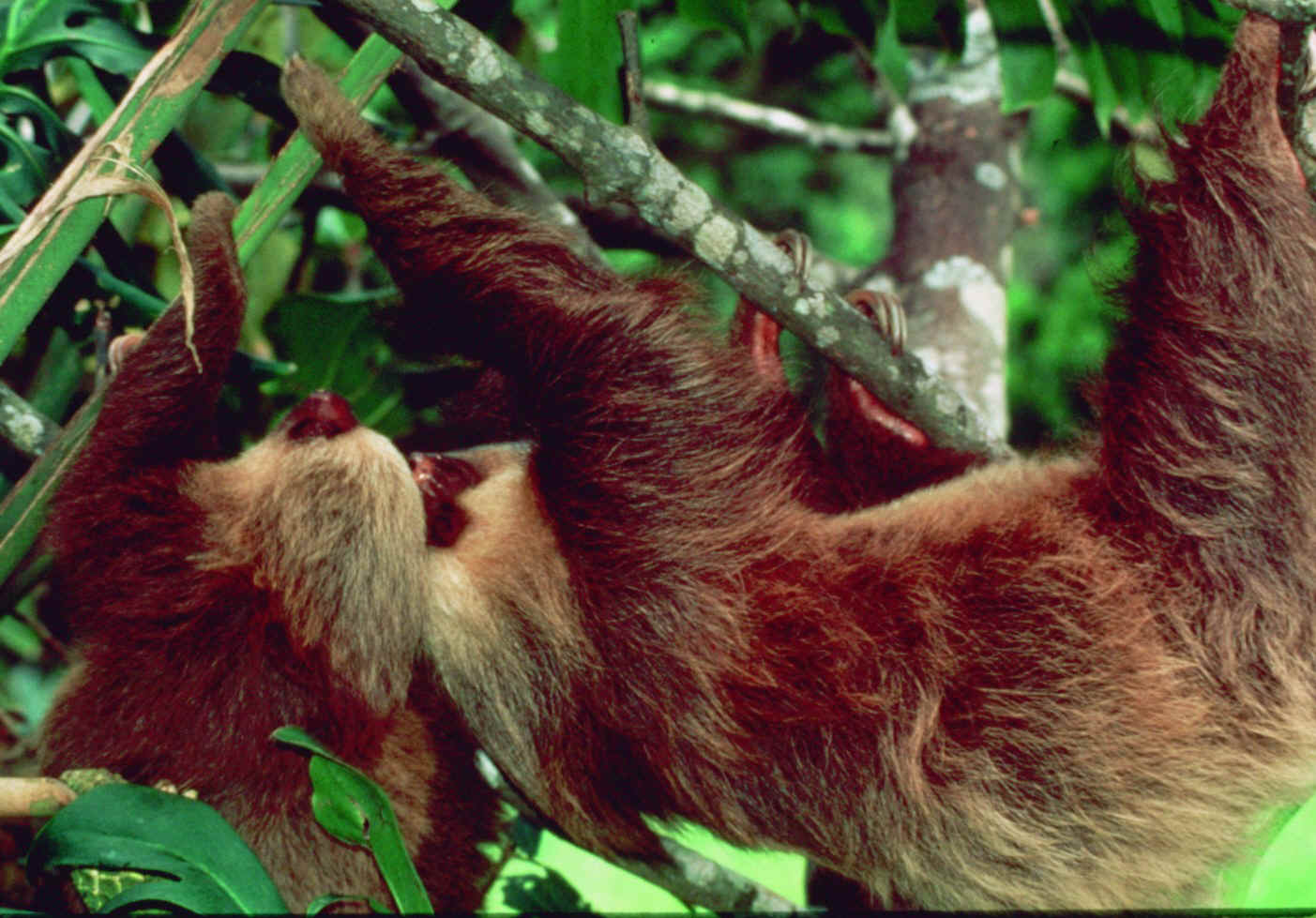
Brown-throated Three-toed Sloth
- Hoffmann's Two-toed Sloth (ph) ______ (*) CR(N,S)
Choloepus hoffmanni
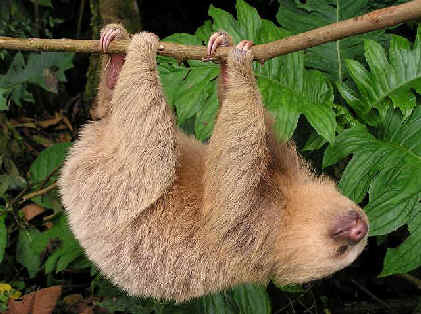
Hoffmann's Two-toed Sloth
- Nine-banded Long-nosed Armadillo
(ph) ______ (*) CR(N)
Dasypus novemcinctus
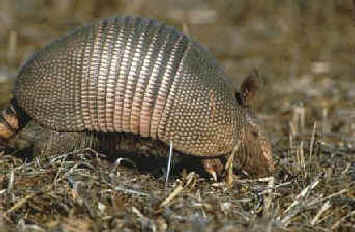
Nine-banded Long-nosed Armadillo
- Northern Naked-tailed
Armadillo ______
Cabassous centralis
INSECTIVORES , in the
Order Insectivora
SHREWS, in the Family Soricidae
- American Least Shrew ______
Cryptotis parva
- Blackish Small-eared Shrew ______
Cryptotis nigrescens
- Merriam's Small-eared Shrew ______
(in
northwest Costa Rica)
Cryptotis merriami
- Talamancan Small-eared Shrew ______
(highlands, mostly in Costa Rica)
Cryptotis gracilis
BATS, in the
Order Chiroptera
SAC-WINGED BATS, in the
Family Emballonuridae
- Long-nosed Bat (ph) ______ (*) CR(N)
Rhynchonycteris naso (the single member of its genus)
(Common in lowland forest near water: streams, rivers, mangroves, and lakes)
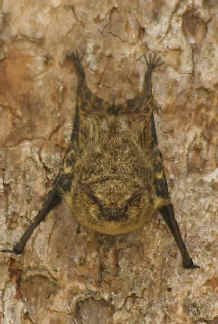
Long-nosed Bat
(photo by Doris Potter)
- Greater White-lined Bat
(or
White-lined Sac-winged Bat)
______
(*)
CR(N,S)
Saccopteryx bilineata
- Lesser White-lined Bat ______
Saccopteryx leptura
- Shaggy Bat ______
(rare, known only from a few
specimens)
Centronycteris maximiliani
- Lesser Doglike Bat ______
Peropteryx macrotis
- Greater Doglike Bat ______
Peropteryx kappleri
- Chestnut Sac-winged Bat ______
Cormura brevirostris
(In Central America, uncommon & local, usually in lowland evergreen
forest)
- Gray Sac-winged Bat ______ (*) CR(N)
Balantiopteryx plicata
- Smoky Sheath-tailed Bat ______ (rare & local, in eastern
Costa Rica; known from a few specimens taken in
humid lowland areas)
Cyttarops alecto
- Northern Ghost Bat ______
Diclidurus albus
FISHING (or
BULLDOG) BATS, in the Family Noctilionidae
- Greater Fishing Bat ______ (*) CR(N,S)
Noctilio leporinus
- Lesser Fishing Bat ______ (*) CR(N,S)
Noctilio albiventris
LEAF-CHINNED BATS , in the
Family Mormoopidae
- Common Mustached Bat ______ (*)
CR(N,S)
Pteronatus parnellii
- Lesser Mustached Bat ______
Pteronatus personatus
- Davy's Naked-backed Bat ______
Pteronatus davyi
- Big Naked-backed Bat ______
Pteronatus gymnonotus
LEAF-NOSED BATS , in the
Family Phyllostomidae
- Common Big-eared Bat ______
Micronycteris microtis
- White-bellied Big-eared Bat ______
Micronycteris minuta
- Schmidt's Big-eared Bat ______
(apparently
rare & local)
Micronycteris schmidtorum
- Hairy Big-eared Bat ______
(apparently rare
& local)
Micronycteris hirsuta
- Orange-throated Big-eared Bat ______
(uncommon &
local)
Micronycteris brachyotis
- Niceforo's Big-eared Bat ______
(In Central America,
rare & local; more common in South America)
Micronycteris nicefori
- Tricolored Big-eared Bat ______
(rare & local)
Micronycteris sylvestris
- Davies' Big-eared Bat
(also called
Bartica Bat)
______ (apparently very rare &
local; restricted to mature, evergreen forest)
Micronycteris daviesi
-
Common Sword-nosed Bat ______
Lonchorhina aurita
- Long-legged Bat ______
Macrophyllum macrophyllum
- Stripe-headed Round-eared Bat ______
(Uncommon
to rare; usually in mature evergreen forest)
Tonatia saurophils
- Pygmy Round-eared Bat ______
(lowland forest & regrowth areas)
Tonatia brasiliense
- White-throated Round-eared Bat ______
Tonatia silvicola
- Golden Bat ______
Mimon bennettii
- Striped Hairy-nosed Bat ______
(rare &
local)
Mimon crenulatum
- Pale Spear-nosed Bat ______
Phyllostomus discolor
- Greater Spear-nosed Bat ______
Phyllostomus hastatus
- Pale-faced Bat ______
(rare & local)
Phyllostomus stenops
- Fringe-lipped Bat ______
Trachops cirrhosus
- Big-eared Woolly Bat
(also called
Woolly False Vampire Bat)
______ (uncommon to
rare, but widespread)
Chrotopterus auritus
- Spectral Bat
(also called
Great False Vampire Bat)
______
(rare &
local)
Vampyrum spectrum
NECTAR-FEEDING or LONG-TONGUED BATS, in the
Subfamilies Glossophaginae & Lonchophyllinae
- Common Long-tongued Bat ______ (*)
CR(N,S)
(in forests &
clearings)
Glossophaga soricina
- Gray's Long-tongued Bat ______
(in
dry forest s & scrub on the Pacific slope)
Glossophaga leachii
- Brown Long-tongued Bat ______
Glossophaga commissarisi
- Geoffrey's Tailless Bat ______
Anoura geoffroyi
- Handley's Tailless Bat ______
Anoura cultrata
- Dark Long-tongued Bat ______
(rare)
Lichonycteris obscura
- Underwood's Long-tongued Bat ______
Hylonycteris underwoodi
- Godman's Whiskered Long-nosed Bat ______
(rare to
uncommon)
Choeronycteris godmani
- Goldman's Nectar Bat ______ (*) CR(S)
(fairly
common in the humid Pacific lowlands of southwest Costa Rica) (occurs in
evergreen forests & banana groves)
Lonchophylla mordax
- Orange-nectar Bat ______
Lonchophylla robusta
SHORT-TAILED BATS, in the Subfamily Carolliinae
- Chestnut Short-tailed Bat ______
Carollia castanea
- Gray Short-tailed Bat ______
(in
northwest Costa Rica)
Carollia subrufa
- Silky Short-tailed Bat ______
Carollia brevicauda
- Seba's Short-tailed Bat ______
Carollia perspicillata
TAILLESS BATS , in the
Subfamily Stenodermatinae
- Little Yellow-shouldered Bat ______
Sturnira lilium
- Luis' Yellow-shouldered Bat ______
(in
Costa Rica, on the Caribbean slope)
Sturnira luisi
- Highland Yellow-shouldered Bat ______
(mid-elevation forests & forest edge)
Sturnira ludovici
- Talamancan Yellow-shouldered Bat ______
(mid & high elevation forests & forest edge)
Sturnira mordax
- Great Fruit-eating Bat ______
(in
rainforests & clearings)
Artibeus lituratus
- Intermediate Fruit-eating Bat ______
Artibeus intermedius
- Jamaican Fruit-eating Bat ______
(in rainforests & plantations)
Artibeus jamaicensis
- Aztec Fruit-eating Bat ______
Artibeus aztecus
- Toltec Fruit-eating Bat ______
Artibeus toltecus
- Pygmy Fruit-eating Bat ______
Artibeus phaeotis
- Thomas' Fruit-eating Bat ______
Artibeus watsoni
- Velvety Fruit-eating Bat ______
Artibeus
(formerly
Enchisthenes)
hartii
- Common Tent-making Bat (ph) ______
Uroderma bilobatum
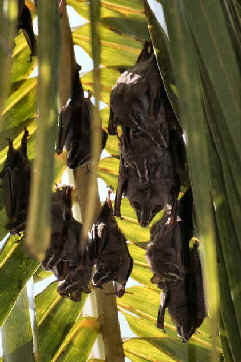
Common Tent-making Bats
(photo by Doris Potter)
- Heller's Broad-nosed Bat ______
Platyrrhinus helleri
- Greater Broad-nosed Bat ______
Platyrrhinus vittatus
- Great Stripe-faced Bat ______
(uncommon north
of Panama)
Vampyrodes caraccioli
- Hairy Big-eyed Bat ______
Chiroderma villosum
- Salvin's Big-eyed Bat ______
Chiroderma salvini
- Little Yellow-eared Bat ______
Vampyressa pusilla
- Striped Yellow-eared Bat ______
Vampyressa nymphaea
- MacConnell's Bat ______
Mesophylla maconnelli
- Honduran White Bat ______
(uncommon &
local)
Ectophylla alba
-
Wrinkle-faced Bat ______
Centurio senex
VAMPIRE BATS, in the
Subfamily Desmodontinae
- Common Vampire Bat ______
Desmodus rotundus
- White-winged Vampire Bat ______
(Primarily
South American; in Central America, rare & local.)
Diaemus youngi
- Hairy-legged Vampire Bat ______
Diphylla ecaudata
FUNNEL-EARED BATS , in the
Family Natalidae
- Mexican Funnel-eared Bat ______
Natalus stramineus
THUMBLESS BATS , in the
Family Furipteridae
- Thumbless Bat ______
(In Central America,
apparently rare & local, where known from few localities in lowland,
evergreen forests,)
Furipterus horrens
DISK-WINGED BATS, in the
Family Thyropteridae
- Spix's Disk-winged Bat ______
Thyroptera tricolor
PLAIN-NOSED BATS , in the
Family Vespertilionidae
- Black Myotis ______ (*) CR(N,S)
(in forests & built-up areas)
Myotis nigricans
- Elegant Myotis ______
Myotis elegans
- Silver-haired Myotis ______
Myotis albescens
- Riparian Myotis ______
Myotis riparius
- Hairy legged Myotis ______
Myotis keaysi
- Montane Myotis ______
Myotis oxyotus
- Big Brown Bat ______
Eptesicus fuscus
- Brazilian Brown Bat ______
Eptesicus brasiliensis
- Argentine Brown Bat ______
Eptesicus furinalis
- Central American Yellow Bat ______
Rhogeessa tumida
- Van Gelder's Bat ______
Bauerus dubiaquercus
- Western Red Bat ______
Lasiurus blossevillii
- Tacarcuna Bat ______
(Rare; known from very
few specimens in evergreen forest in Costa Rica & Panama.)
Lasiurus castaneus
- Southern Yellow Bat ______
Lasiurus ega
FREE-TAILED BATS , in the
Family Molossidae
- Greenhall's Dog-faced Bat ______
Molossops greenhalli
- Mexican
(or
Brazilian)
Free-tailed Bat ______
(locally in dry open areas &
forests)
Tadarida brasiliensis
- Black Bonneted Bat ______
Eumpos auripendulus
- Wagner's Bonneted Bat ______
Eumops glaucinus
- Sanborn's Bonneted Bat ______
Eumops hansae
- Dwarf Bonneted Bat ______
Eumops bonariensis
- Big-crested Mastiff Bat ______
Promops centralis
- Black Mastiff Bat ______
Molossus ater
- Miller's Mastiff Bat ______
Molossus prestiosus
- Sinaloan Mastiff Bat ______
Molossus sinaloae
- Pallas's Mastiff Bat ______
Molossus molossus
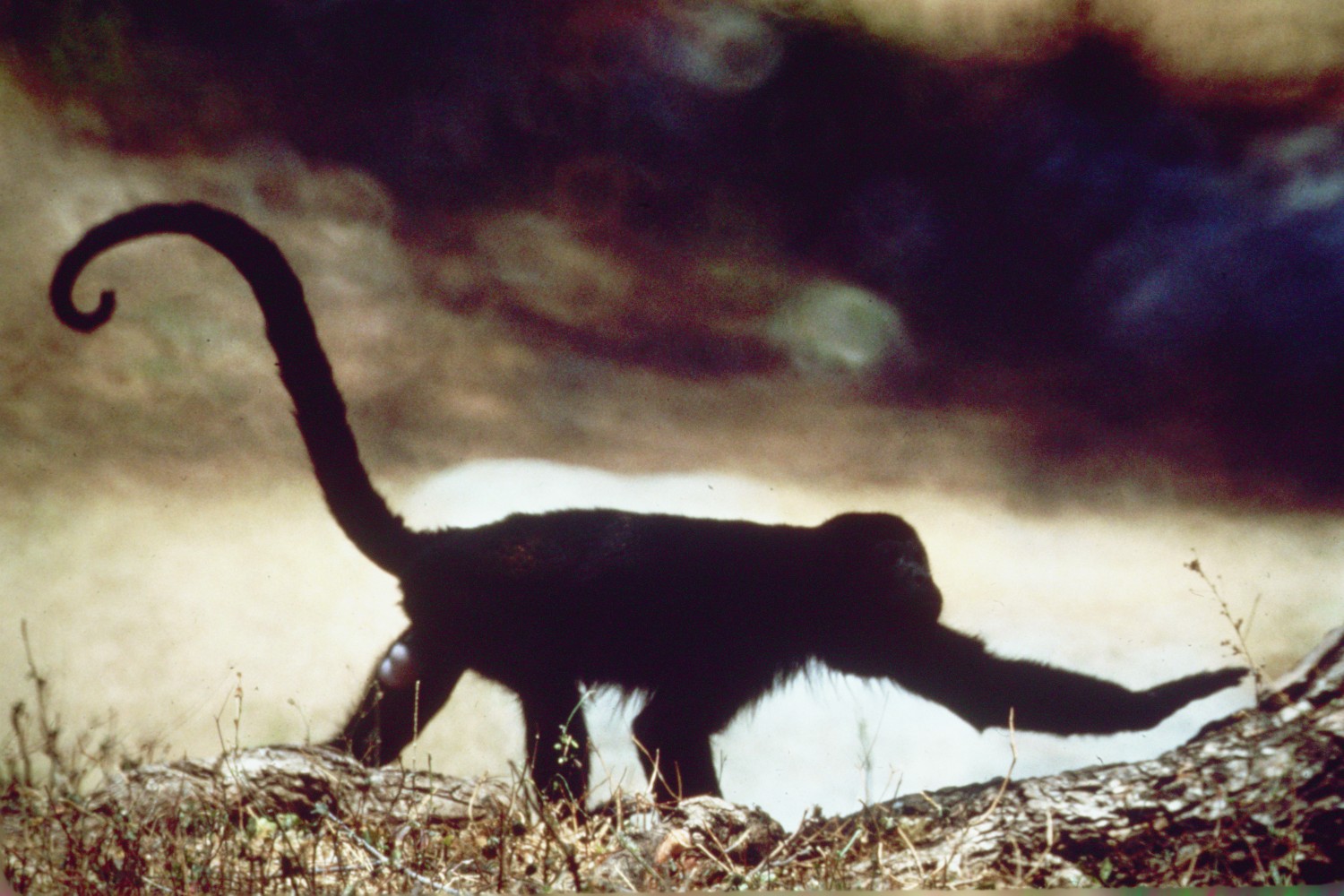
THE CEBIDS, or NEW WORLD MONKEYS,
in the Order of Primates, in the Family Atelidae:
- Mantled Howler Monkey (t3) (ph) ______ (*) CR(N,S)
Alouatta palliata
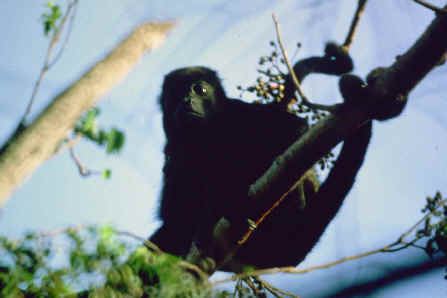
A Mantled Howler Monkey photographed during a FONT tour in Costa Rica
- White-headed Capuchin (ph) ______
CR(N,S)(*) PN(*)
Cebus capucinus
Other vernacular names for Cebus capucinus
have been White-faced Capuchin and White-throated Capuchin.
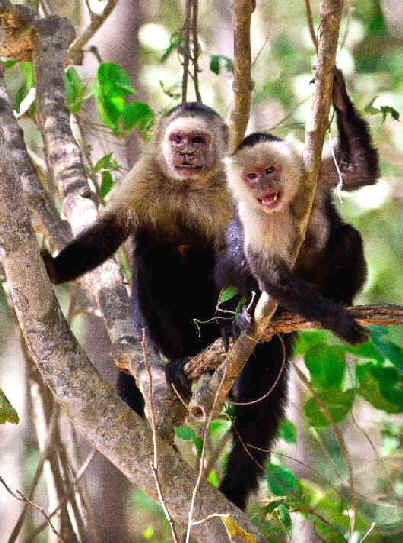
White-headed Capuchins photographed during the FONT tour
in northern Costa Rica in March 2012
(photo by Virginia Woodhouse)
- Geoffroy's Spider Monkey (t3)
(ph) ______ CR(N,S)(*)
Ateles geoffroyi
Ateles g. ornatus subspecies
in Costa Rica: the "Ornate Spider Monkey"
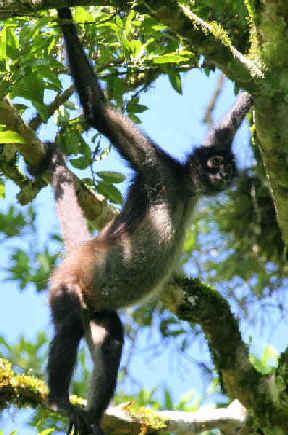
A Geoffroy's Spider Monkey photographed during a FONT tour
(photo by Marie Gardner)
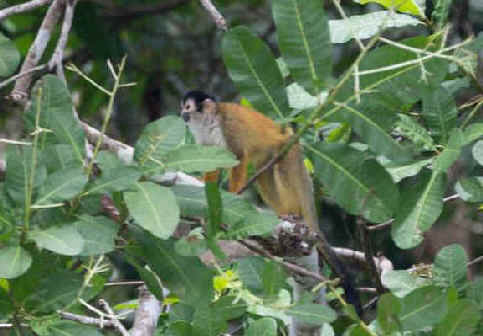
Central American Squirrel Monkey (t1)
(ph) ______
(*) CR(S)
Saimiri oerstedii
(2 subspecies: the northern
S. o. citrinellus
paler than
S. o. oerstedii
-
the latter pictured below)
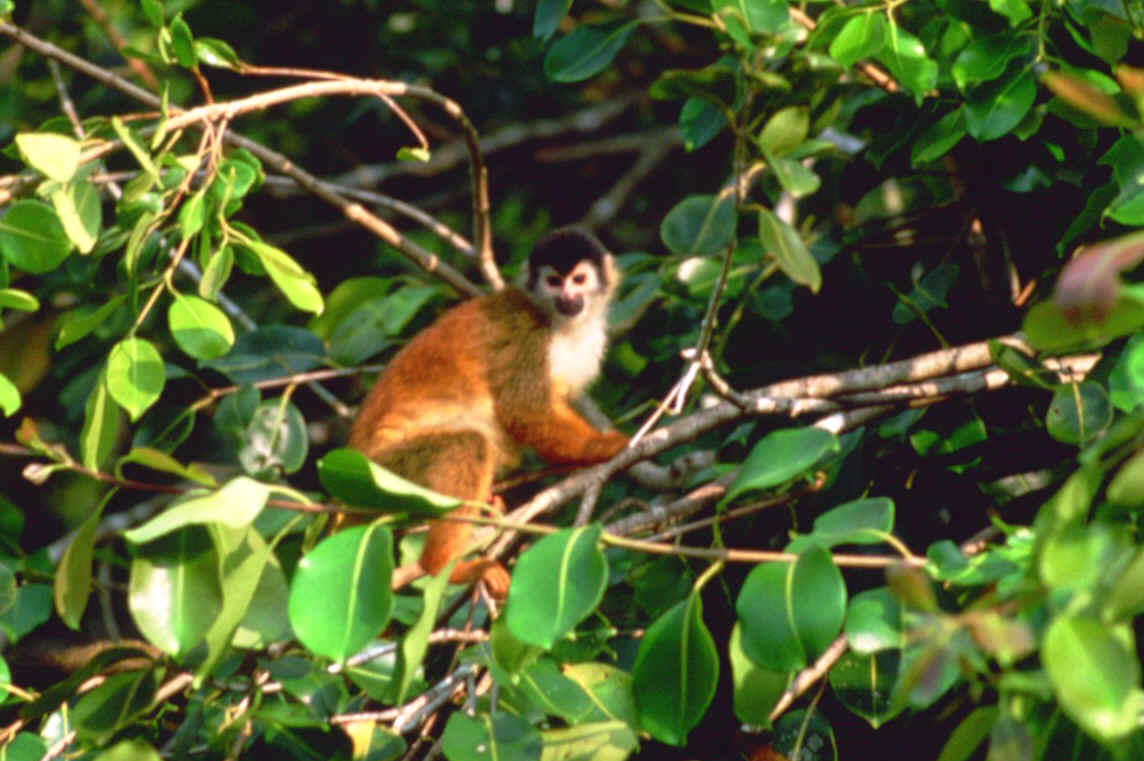
Above & below: Central American Squirrel Monkeys photographed during FONT tours in Costa
Rica
(The lower photo by Virginia Woodhouse during the
Southern Costa Rica Tour in March 2012)
Lemurine Night Monkey ______ (has also been called
Owl Monkey)
Aotus lemurinus
In Central America, Aotus lemurinus occurs in Panama. There have been
several unconfirmed reports from Costa Rica.
RODENTS:
the gnawing mammals in the
Order Rodentia,
which is the largest
order of mammals with nearly 2,000
species worldwide.
Families include:
Squirrels: Sciuridae
Mice & Rats: Muridae
New World Porcupines: Erethizontidae
SQUIRRELS, in the Family Sciuridae
Red-tailed Squirrel (ph) ______ (*) CR(N,S)
Sciurus
(formerly
Guerlinguetus)
granatensis
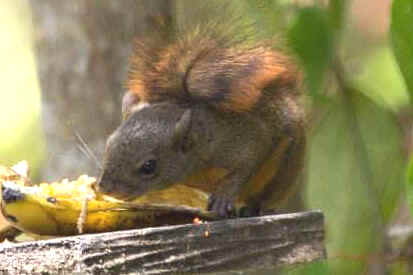
A Red-tailed Squirrel photographed during a FONT tour
in southern Costa Rica in March 2012
(photo by Virginia Woodhouse)
Variegated Squirrel ______ (*) CR(N,S)
Sciurus variegatoides
(14 named subspecies are recognized, including those below in Costa Rica)
S. v. underwoodi (*) (in
northern Costa Rica)
S. v. dorsalis (*)
(a distinctive nearly black & white subspecies
in northwest Costa Rica)
S. v. atrirufus (on the lower
Nicoya Peninsula)
S. v. thomasi (*)
(in much of Costa Rica, including all of the
Caribbean slope & lowlands)
S. v. melania (*)
(in central & southern Costa Rica in the
Pacific lowlands)
S. v. rigidus (*)
(in central Costa Rica & the lower northwest)
S. v. loweryi (*)
(in southern Costa Rica on the Pacific slope,
similar to S. v. thomasi)
Central American Dwarf Squirrel (or
"Alfari's Pygmy Squirrel")
______ (*) CR(N)
Microsciurus alfari
Montane Squirrel ______
(in the highlands of
Costa Rica & western Panama)
Sciurus
(formerly
Syntheosciurus)
brochus
POCKET GOPHERS, in the
Family Geomyidae
Variable Pocket Gopher ______ (montane
forest clearings & farmland soils in the Cordillera Central &
Cordillera de Talamanca)
Orthogeomys heterodus
Cherrie's Pocket Gopher ______ (north
& northeast Costa Rica)
Orthogeomys cherriei
Underwood's Pocket Gopher ______ (Pacific lowlands of central Costa Rica)
Orthogeomys underwoodi
Chiriqui Pocket Gopher ______
(in southern
Costa Rica & western Panama)
Orthogeomys cavator
KANGAROO RATS & POCKET MICE, in the
Family Heteromyidae
Salvin's Spiny Pocket Mouse ______ (in
northern Costa Rica)
Liomys salvini
Forest Spiny Pocket Mouse ______ (*) CR(S)
Heteromys desmarestianus
Mountain Spiny Pocket Mouse ______
(Endemic to
Costa Rica; only in the Talamanca Mountains, from 1800 to 2600 meters above
sea level.)
Heteromys oresterus
RATS & MICE, in the
Family Muridae
NEW WORLD RATS & MICE, in the
Subfamily Sigmodontinae
Coue's Rice Rat ______
Oryzomys couesi
Talamancan Rice Rat ______
Oryzomys talamancae
Alfaro's Rice Rat ______
Oryzomys alfaroi
Long-whiskered Rice Rat ______ (on the
Caribbean slope)
Oryzomys bolivaris
Dusky Rice Rat ______
Melanomys caliginosus
Big Arboreal Rice Rat ______
(in Costa Rica, in the southern part of the country)
Oecomys
(has been part of
Oryzomys)
trinitatis
Sprightly Pygmy Rice Rat ______
Oligoryzomys vegetus
Northern Pygmy Rice Rat ______ (*) CR(N)
Oligoryzomys fulvescens
Common Cane Mouse ______ (in
southeast Costa Rica)
Zygodontomys brevicauda
Hispid Cotton Rat ______ (*) CR(N)
Sigmodon hispidus
Goldman's Water Mouse ______ (by
fast-flowing streams in forested mountains)
Rheomys raptor
Underwood's Water Mouse ______ (in
central Costa Rica)
Rheomys underwoodi
Watson's Climbing Rat ______ (lowland
forests)
Tylomys watsoni
Big-eared Climbing Rat ______
Ototylomys phyllotis
Vesper Rat ______
Nyctomys sumichrasti
Alston's Singing Mouse ______ (montane
forests & forest edge)
Scotinomys teguina
Chiriqui Singing Mouse ______ (montane
forest, forest edge, and paramo)
Scotinomys xerampelinus
Sumichrast's Harvest Mouse ______
Reithrodontomys sumichrasti
Slender Harvest Mouse ______ (in
northwest Costa Rica)
Reithrodontomys gracilis
Mexican Harvest Mouse ______ (*) CR(S)
Reithrodontomys mexicanus
Short-nosed Harvest Mouse ______ (in
the Cordillera Central)
Reithrodontomys brevirostris
Nicaraguan Harvest Mouse
______ (northwest Costa Rica)
Reithrodontomys paradoxus
Rodriguez's Harvest Mouse
______ (on slopes of volcanoes in central Costa Rica)
Reithrodontomys rodriguezi
Chiriqui Harvest Mouse
______
Reithrodontomys creper
Mexican Deer Mouse ______
Peromyscus mexicanus
OLD WORLD RATS & MICE, in the Subfamily Murinae
House Rat (i) ______ (*)
(other names include
Black Rat
&
Roof Rat)
Rattus rattus
Rattus rattus
is originally from India. It is introduced worldwide.
Brown Rat (i) ______
(also called Norway Rat)
Rattus norvegicus
Rattus norvegicus is originally from southeast Siberia & northern
China. It is introduced worldwide.
Rattus norvegicus is less widespread than Rattus rattus in
Central America.
Western House Mouse (i) ______
Mus domesticus (formerly conspecific with
Mus musculus,
now the
Eastern House Mouse)
Mus domesticus is commensal with humans
in Europe, north Africa, & the Middle East. It is introduced in North
& South America, subsaharan Africa, north Australia, & oceanic
islands.
NEW WORLD PORCUPINES, in the Family Erethizontidae
More closely related to cavy-like rodents such as the Agouti and Paca,
than to the Old World Porcupines
Mexican Hairy Dwarf Porcupine
(ph) ______ (*) CR(N)
Coendou
(formerly
Sphiggurus)
mexicanus
Coendon mexicanus is a generally long-haired, prehensile-tailed
Porcupine.
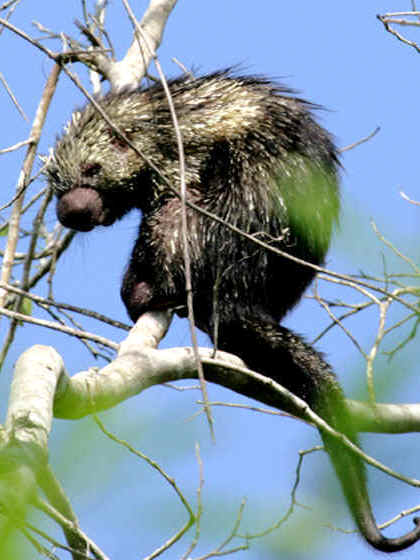
Mexican Hairy Dwarf Porcupine
(photo by Dick Tipton)
AGOUTIS, in the
Family Dasyproctidae
Central American Agouti ______ (*) CR(N,S)
Dasyprocta punctata
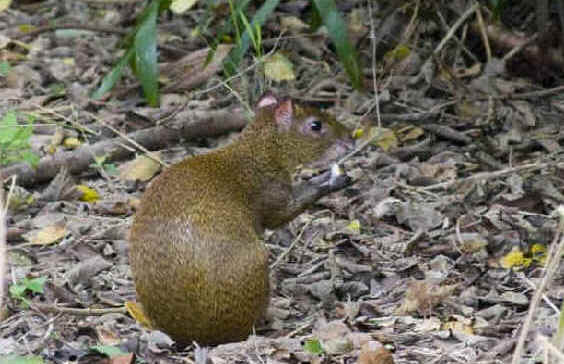
Central American Agouti
(photo by Linda Navarro)
PACAS, in the
Family Agoutidae
Lowland Paca ______ (also called
Spotted Paca)
Cuniculus
(formerly
Agouti)
paca
SPINY RATS, in the
Family Echimyidae
Tomes' Spiny Rat ______ (*) CR(N)
Proechimys semispinosus
Armored Rat ______
Hoplomys gymnurus
RABBITS, in the
Order Lagomorpha, Family Leporidae)
Eastern Cottontail (ph) ______ (*) CR(N)
Sylvilagus floridanus
Forest Rabbit ______ (*) CR(N)
(other
names: Tropical Cottontail Rabbit or Brazilian Rabbit
or Tapiti)
Sylvilagus
(formerly Tapeti) brasilensis
Dice's Rabbit ______ (*) CR(S)
(also called Mountain
Rabbit;
formerly considered a subspecies
of the Forest Rabbit)
Sylvilagus
(formerly Tapeti) dicei
CARNIVORES, in the Order Carnivora, with Families including:
Dogs & Foxes: Canidae
Cats: Felidae
Raccoons & allies: Procyonidae
Weasels, Skunks, & allies: Mustelidae
DOGS & FOXES, in the Family Canidae
Gray Fox ______
Urocyon cinereoargenteus
Coyote (ph) ______ (*) CR(N)
Canis latrans
RACCOONS & ALLIES, in the Family Procyonidae
Kinkajou (ti) (ph) ______ (*) CR(N,S)
Potos flavus (the single member of its genus)
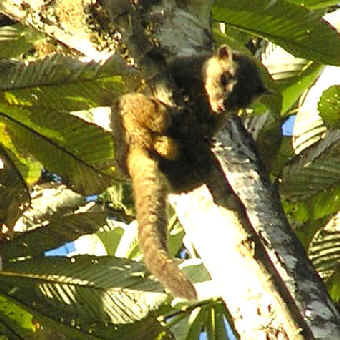
Kinkajou, photographed during a FONT tour in Costa Rica in February 2006
(photo by Rosemary Lloyd)
Bushy-tailed Olingo ______ (*) CR(N)
Bassaricyon gabbii
Harris's Olingo (t2) ______ (endemic
to Costa Rica, in the Estrella de Cartago region)
Bassaricyon lasius
Northern Raccoon (ph) ______
(*) CR(N)
Procyon lotor
Crab-eating Raccoon (ph) ______
Procyon cancrivorus
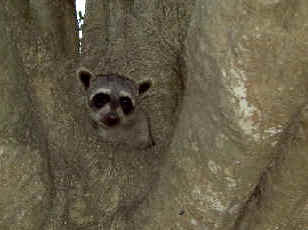
A Crab-eating Raccoon photographed during a FONT tour
White-nosed Coati (ph) ______
(*) CR(N,S)
Nasua narica
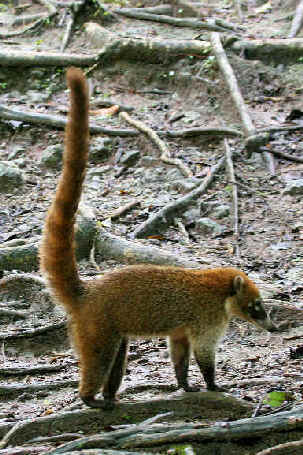
A White-nosed Coati photographed during a FONT tour
(photo by Marie Gardner)
Cacomistle ______ (*) CR(S)
Bassariscus sumichrasti
WEASELS, SKUNKS, & ALLIES, in the
Family Mustelidae
Long-tailed Weasel ______ (*) CR(N)
Mustela frenata
Greater Grison ______
Galictis vittata
Tayra ______ (*) CR(S)
Eira barbara
(the single member of its genus)
Neotropical River Otter ______
(*) CR(N,S)
Lutra
(formerly
Lontra)
longicaudis
Hooded Skunk ______ (in northwest Costa
Rica)
Mephitis macroura
Eastern Spotted Skunk ______
Spilogale putorius
Striped Hog-nosed Skunk ______ (*) CR(N,S)
Conepatus semistriatus
CATS, in the
Family Felidae
Ocelot (t2) (ph) ______
Leopardus pardalis
Margay (t2) ______ (*) CR(S)
Leopardus wiedii
Oncilla ______
Leopardus tigrinus
Jaguarundi ______ (*) CR(N)
Herpailurus yauarondi
Puma (ph) ______
(also called
Cougar,
or Mountain Lion)
Puma concolor
Jaguar (ph) ______
Panthera onca
MANATEES, in the
Order Sirenia, in the
Family Trichechidae
West Indian Manatee (t1) (ph) ______
(rare & local along the Central American Caribbean
coast)
Trichechus manatus
ODD-TOED UNGULATES, in the
Order Perissodactyla; the tapirs in the Family
Tapiridae)
Baird's Tapir (t1) (ph) ______ (*) CR(S)
Tapirus bairdii
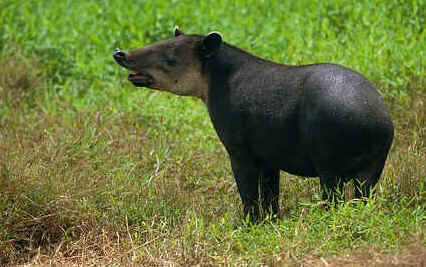
Baird's Tapir
EVEN-TOED UNGULATES, in the
Order Artiodactyla, with
Peccaries in the
Family
Tayassuidae and
Deer in the Family Cervidae
Collared Peccary ______ (*) CR(N)
Tayassu tajacu
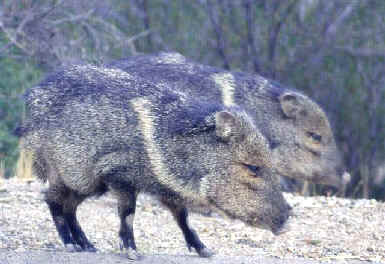
Collared Peccaries
White-lipped Peccary ______
(*) CR(S)
Dicotyles pecari
White-tailed Deer ______ (*) CR(N)
Odocoileus virginianus
Red Brocket (Deer) ______ (*) CR(S)
Mazama americana
MARINE MAMMALS, in the
Order Cetacea
TOOTHED WHALES, in the
Suborder Odontoceti
OCEAN DOLPHINS, in the
Family Delphinidae
Rough-toothed Dolphin (t3) ______
Steno bredanensis
(off Central America, in the Pacific, offshore, including Cocos Island
waters)
Tucuxi (t3) ______
Satalia fluviatilis
(along the Central American Caribbean coast, from Cahuita, Costa Rica,
south)
Pacific Spotted Dolphin ______
Stenella atrenuata
(off the Central American Pacific coast, where frequently seen)
Atlantic Spotted Dolphin (t3) ______
Stenella frontalis
(off the Central American Caribbean coast)
Long-snouted Spinner Dolphin ______ (*) CR(S)
Stenella longirostris centroamericana
(off the Central American Pacific coast, & further offshore including
Cocos Island waters)
Clymene Dolphin (t3) (ph)
______ (also called
Short-snouted
Spinner Dolphin)
Stenella clymene
(off Central America, in the Caribbean)
Striped (or
Blue-white)
Dolphin ______
Stenella coeruleoalba
(off Central America, in the Pacific, offshore, including Cocos Island
waters)
Common Dolphin (ph) ______
Delphinus delphis
(in Central America, off the Pacific coast; one of the most gregarious and
abundant of the world's
cetaceans)

A Common Dolphin photographed during a FONT tour
(photo by Andy Smith)
Bottlenose Dolphin (ph) ______ (*) CR(N)
Tursiops truncatus
(off & along the Central American Pacific & Caribbean coasts)

A Bottlenose Dolphin photographed during a FONT tour
Fraser's Dolphin (t2) (ph) ______
Lagenodelphis hosei
(off the Central American Pacific coast, & further offshore, including
waters near Cocos Island; does occur
in the Lesser Antilles & the Gulf
of Mexico)
Risso's Dolphin (t3) (ph)
______ (also called
Gray Grampus)
Grampus griseus
(off Central America, in the Pacific)
Melon-headed Whale (t3) ______
Peponocephala electra
(off Central America, in the Pacific)
Pygmy Killer Whale (t3) ______
Feresa attenuata
(in the Pacific, off the Central American coast)
False Killer Whale (t3) ______
Pseudorca crassidens
(in the Pacific, off the Central American coast, & in Cocos Island
waters)
Killer Whale (or Orca) (t3) (ph) ______
Orcinus orca
(off the Central American Pacific & Caribbean coasts)
Short-finned Pilot Whale (t3) (ph) ______
Globicephala Macrorhynchus
(off the Central American Pacific coast, & further offshore including
Cocos Island waters)
SPERM WHALE, a single species in the Family Physeteridae
Great Sperm Whale (t2) (ph) ______
Physeter catodon
(off the Central American coasts, in the Pacific and the Caribbean)
PYGMY SPERM WHALES, now in the Family Kogiidae
Pygmy Sperm Whale (t3) (ph) ______
Kogia brevicops
(off Central America, in the Pacific)
Dwarf Sperm Whale (t3) (ph) ______
Kogia simus
(off Central America, in the Pacific; & has been recorded about 150
miles south of Cocos Island)
BEAKED WHALES, in the Family Hyperoodontidae
Cuvier's Beaked Whale (t3) (ph) ______
Ziphius cavirostris
(off the Pacific coast of Central America)
Blainville's Beaked Whale
(t3) ______
Mesoplodon densirostris
(on occasion, in the Pacific off Central America; has been recorded about 50
miles southeast of Cocos Island)
Gray's Beaked Whale (t3)
______
Mesoplodon grayi
(in the Pacific, well offshore; has been recorded over a hundred miles
southwest of Cocos Island)
Southern Bottlenose Whale
(t2) ______
Hyperoodon planifrons
(off Central America, in the Pacific, including Cocos Island
waters)
RORUALS, in the Family Balaenopteridae
Blue Whale (t2) (ph) ______
Balaenoptera musculus
(in the Pacific, generally more than 200 miles off Central American coast;
reported in Cocos Island waters)
Fin Whale (t2) (ph) ______
Balaenoptera physalus
(off Central America, in the Caribbean, offshore)
Sei Whale (t2) ______
Balaenoptera borealis
(off Central America, in the Pacific, well offshore; recorded north of Cocos
Island)
Bryde's Whale (t1) ______
Balaenoptera brydei (formerly edeni)
(off Central America, in the Pacific, offshore; recorded in Cocos Island
waters)
Northern Minke Whale (t2) (ph) ______
Balaenoptera acutorostrata (formerly conspecific with what's now the
Antarctic Minke Whale,
Balaenoptera bonaerensis)
(off Central America, in the Caribbean, offshore; & may also occur in
the Pacific off Central America)
Humpback Whale (t2) (ph) ______
Megaptera novaeangliae
(in the Pacific, off Central America, mainly from July to
December)
SOME
OTHER
NATURE in COSTA RICA
and
PANAMA
during Focus On Nature Tours
Amphibians, Reptiles, Butterflies, Moths are in other lists:
- Large Forest-floot Millipede
______ CR(N)
Nyssodesmus python
UPLAND CRABS
- colorful "upland" crabs ______ CR(S)
VARIOUS CRABS OF THE SHORELINE
- Hermit Crabs ______ CR(S)
- Sally Lightfoot Crab
(ph) ______ CR(N,S)
Grapsus grapsus
- Jack-o-lantern Crab
______ CR(S)
Gercacinus quadratus
- Ghost Crab (ph) ______ CR(N
OTHER MARINE-LIFE (not
including Marine Mammals and Birds)
- Manta Ray (a) ______ CR(S)
(P)
Manta hamiltoni
Manta Rays have been seen in the water below from low-flying
airplanes during FONT tours to and from Tiskita Lodge.
-
Jellyfish ______ CR(N)
(in mangrove
area)
-
small marine creatures of coastal tidal pools
______ CR(S)
VARIOUS
INSECTS:
ANTS
OF THE RAINFOREST AND OTHER HABITATS:
-
Leaf-cutter
Ants ______
CR(N,S)
PN
Atta cephalotes
-
Army
Ants ______ CR(N,S)
Eciton burchelli
-
Dung
Beetles ______ CR(N)
-
Peanut-head
Bug ______ CR
Fulgora latenaria (in the family
Fulgoridae)
- Leaf-footed
Bug ______ PN
in the genus Leptoglossus
(in
the family Corcidae)
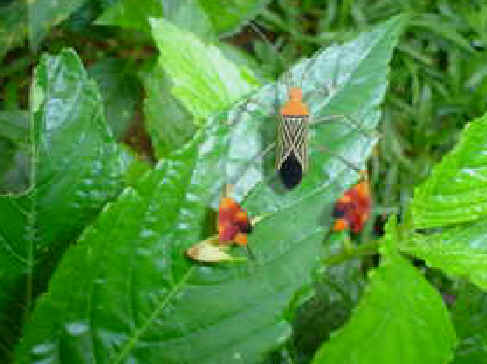
Below
is a photograph of a Leaf-footed Bug seen during a FONT tour on the Caribbean
side of Panama, at a lodge called Sierra Llorona, in hills near Colon.
Leaf-footed Bugs are in the family Coreidae, in the genus Leptoglosus.
They are large insects, with leaf-like expansions of the hind tibia and
femoraq. They have four-segmented antennae, large compound eyes, and one pair
of oceli, or simple eyes. There are a few species.
Among the favored food, are the seed pods of Catalpa trees.
These beautiful creatures can be found in the garden at Sierra Llorona. They
are perfectly harmless. Although they have stink glands, the odor is not
revolting or persistent. Only when they are grabbed, do they use that defense.
Note:
(a): sometimes (in southern CR) seen from
low-flying airplane
total eclipse of the Sun ______ CR(N)
earthquake tremors CR(N)
active volcano (by day and/or night) CR(N)
hot sulphur/volcanic springs CR(N)
magnificent rainbows CR(N)
stellar constellations, particularly brilliant in
a clear sky above a dark beach, also: meteors ("falling stars");
At other times: earthshine on the moon, Pacific
sunsets with the "green flash".