
E-mail: font@focusonnature.com
Phone: Toll-free in USA 1-800-721-9986
or 302/529-1876
Website: www.focusonnature.com
|
PO
Box 9021, Wilmington, DE 19809, USA E-mail: font@focusonnature.com Phone: Toll-free in USA 1-800-721-9986 or 302/529-1876 Website: www.focusonnature.com |
A Birding & Nature Tour
mostly
in the
highlands of
COSTA RICA
and in adjacent
PANAMA
January 30 -
February 15, 2011
(tour:
FON/CR-1, '11)
Itinerary
& price follows.
A
reason for so much diversity
in the wildlife and nature in Costa Rica
is the tremendous range of elevations
in the country.
With mountains as high
as about 10,000 feet above sea level,
and foothills and slopes on both
the Caribbean & Pacific sides of the country,
there will be much for us to see and explore.
And, as we're doing it, we'll be comfortable.
Not hot, even though in the Neotropics.
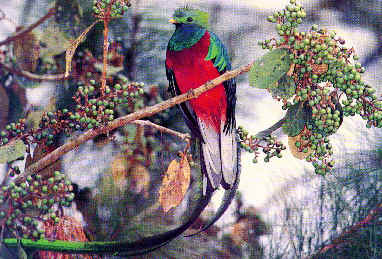
The Resplendent Quetzal,
one of the avian stars in the mountains of Costa Rica
Tour to be led
by Armas Hill, well-experienced in Costa Rica, with its places, birds, and
wildlife, having traveled & birded there numerous times, since 1978.
Links:
A List & Photo Gallery of Central American Birds, in 4 Parts:
Part #1, Tinamous to
Doves
Part #2, Macaws to
Woodpeckers
Part #3, Manakins to
Thrushes
Part #4, Thrushes to
Buntings
A List of the Birds of Costa Rica (without photos)
Costa Rica Mammals & Other Wildlife (with some photos)
Central
America Butterflies
(with some photos)
Previous FONT Costa Rica Tour Highlights
Upcoming FONT Birding & Nature Tours in Central America
Feature: "Alexander Skutch - A Naturalist in Costa Rica"
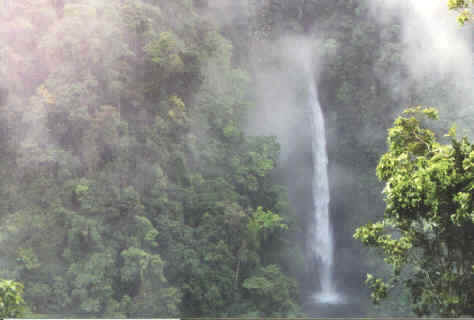
Waterfall in Costa
Rica,
photograph by Marie Gardner, during a previous FONT birding tour
Itinerary
(price
follows):
Sun: Jan. 30, '11 Arrival in Costa Rica. Overnight in San Jose.
Mon: Jan. 31 After an early morning departure from the hotel, some excellent Caribbean Slope birding at the Canyon Virgen del Socorro, a particularly good place for a fine assortment of tanagers and other colorful birds, including the Red-headed Barbet. Birding, also this day, in the area of the Poas and Barva Volcanoes, for our first cast of highland bird specialties, including our first subspecies of the Volcano Hummingbird (a species that varies on different volcanoes). There will be a nice number of hummingbirds throughout the tour. Overnight near Poas Volcano.
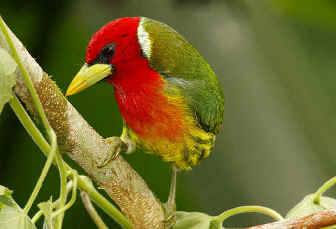
Red-headed Barbet
Tue: Feb. 1 After birding in morning, travel, in the afternoon, to the town of Fortuna de San Carlos near Arenal Volcano. Overnight near Fortuna.
Wed: Feb. 2 An excellent morning boat-ride along the River Cano Negro toward an area of marsh near the Nicaraguan border, the only haunt in Costa Rica for the Nicaraguan Grackle. A fine assortment of long-legged wadders is likely, including this time of year, the Jabiru. During this ride previously we've found Sungrebe, Boat-billed Heron, and Great Potoo. Late in the afternoon, return to Fortuna, for a second overnight.
Thu: Feb. 3
A morning with some very good birding in the area of the Arenal
Observatory Lodge, but even the most ardent
birders can be distracted by the Arenal Volcano,
when it is active. It can be spectacular. Even
though a safe distance away, it can be exciting by day, and after dark, a
thrill. Regarding the birds
in the area, there's an excellent variety, and that ardent birder could
have yet another thrill with a sighting of a spectacular male Bare-necked
Umbrellabird, as we have
here during one of our tours in the past. Also notable during our previous tours
in this area have been as many as 30 Scarlet-thighed Dacnis in one tree,
and Rufous-breasted Antthrush on the ground. Other antbirds, too,
along with an assortment of wrens, including the Northern Nightingale Wren
with its beautiful song. Overnight near Arenal.
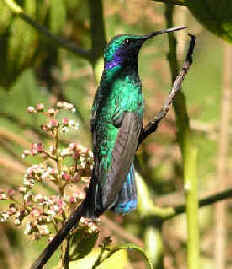
A Green Violetear
photographed during a FONT tour.
This is just one of the hummingbirds
in the highlands of Costa Rica & Panama.
Fri, Feb. 4:
During a part of this day,
travel from Arenal to Monteverde, where
we'll spend a good part of two days. Monteverde began as a Quaker settlement,
famous for its cheese. The nearby town of Santa
Elena is an attractive Tico village. The term "Tico"
is an endearing one for "Costa Rican".
In the Monteverde and Santa Elena area, we visit the cloud
forest reserve, and some places that are particularly good for hummingbirds,
and orchids and butterflies in addition to birds. Overnight in Monteverde.
Sat,
Feb. 5: A
full-day in the Monteverde area. Overnight there.
Sun, Feb. 6: Travel from Monteverde and the northern Costa Rican highlands
south to the highest mountains in the country, the
Talamanca Mountains, south of
Cartago. The slopes of these hills and mountains are covered with forests
containing tropical oaks and bromeliads, and with some interesting birds
restricted to the area. Easily reached by the Pan
American Highway will be an assortment of habitats, from the highland
forests to beautiful valleys in the mountains. We'll be spending two days and two overnights in the area.
Our hotel will be at an elevation of about 6,500 feet above sea level. Along the
Pan American Highway we'll get as high as about 10,000 feet above sea level, the
highest point of the highway from Alaska to Argentina.
Mon, Feb 7: During our time in the Talamanca
Mountains, birds will include, among others: 2 species of Silky-Flycatchers, various species of hummingbirds,
Nightingale-Thrushes, and some oddities, such as the Buffy
Tufted-cheek and the Zeledonia. Also to be seen, the
Peg-billed Finch, the
Large-footed Finch, and the
Yellow-thighed Finch.
Maybe the most famous of the birds that we'll see would be the Resplendent Quetzal, considered
to be one of the most beautiful birds in the world.
Other birds will include the Emerald Toucanet and a warbler known as the Collared
Whitestart. To Costa Ricans, it's also known as the "Amigo de
Hombre", that is "Friend of Man". Besides
being attractive, it's tame and inquisitive.
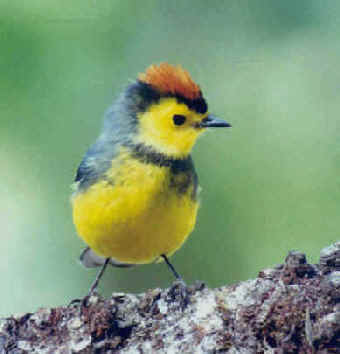
The Collared Whitestart,
a dapper bird
in the mountains of southern Costa Rica
and western Panama.
known locally as the "Amigo de Hombre",
the "Friend of Man".
We'll ascend to higher montane birding at and above the timberline. For:
Timberline Wren, Large-footed Finch, Volcano Hummingbird, Volcano
Junco, and others, among them two "stunners": the
Fiery-throated Hummingbird and the Flame-throated Warbler. Our second
overnight in the Talamanca Mountains.
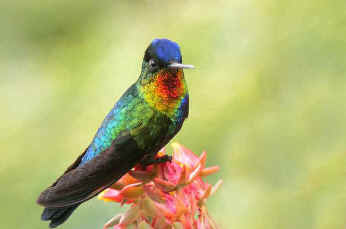
Fiery-throated Hummingbird
Tue, Feb 8:
This
day we'll go further south, getting closer to the
Panamanian border. With, of course, birding along the way. Our destination will be the town of
San Vito, inland at
mid-elevation in the Coto Brus Valley.
There's some very good birding in that area.
Near the town, for example,
there's a marsh with, among others, two notable birds: the
Masked Duck and what was the Masked Yellowthroat, the latter now
split and called the "Chiriqui Yellowthroat". Our first
overnight in San Vito.
Wed,
Feb 9:
From San Vito this day, we'll go further into the interior highlands to one of
the "wildest" areas in Costa Rica, and away from people, the La
Amistad International Park. There will be quite an assortment of
birds, among them various hummingbirds, tanagers, manakins, and more.
We'll take a ride, on a 4-wheel drive vehicle, deep into the forest. Overnight,
this night, at a lodge at the edge of La Amistad.
Thu, Feb 10: A full-day of birding at La Amistad, where a wonderful array
of birds, butterflies, and some animals may be seen. At the
day's end, we'll be back to San Vito to overnight there.
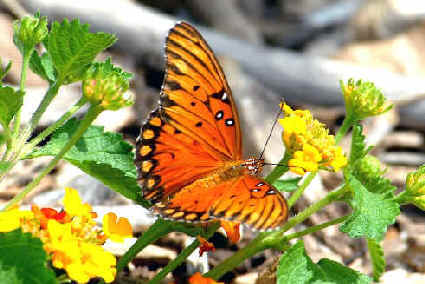
A Gulf Fritillary,
one of many butterflies in Costa Rica
Fri,
Feb 11:
From San Vito this day, we'll venture across the border into the Chiriqui
Province of Panama. In that province again, as we have in the past, we'll have
some fine birding in the highlands, particularly in the area of Boquete
and the Baru Volcano National Park.
During our tours here in the past, we've found birding to be particularly good, in that region of coffee
plantations and mountain forest, especially at places such as the Finca
Lerida. Overnight near Boquete.
Sat, Feb 12: We'll have more birding
in the highlands of far-western Panama this day, where there
will be yet more hummingbirds, and other birds too. Overnight, back in Costa
Rica, in the hills near the small city of San Isidro de General.
Sun, Feb 13:
Much of this day,
birding at a special place, "Los
Cosingos", where
the late naturalist Alexander Skutch lived for many years, and where we have
visited many times during FONT tours since the 1990's. At this special place,
during those tours, we've seen a some special birds including the Turquoise
Cotinga, Rufous Piha, various tanagers, manakins, and honeycreepers,
and the Fiery-billed Aracari. It is the last of these birds after which
Mr. Skutch's property was named. A flock of those aracaris are called "Los
Cosingos".
Other birds to be sought in the area include the Red-breasted Blackbird (a
recent arrival in Costa Rica from Panama) and the Fork-tailed Flycatcher.
Overnight again near San Isidro de General.
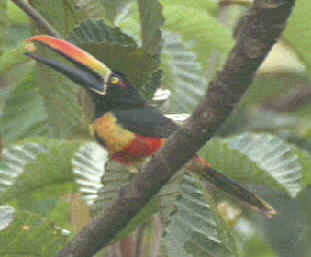
The Fierry-billed Aracari
the bird after which the Skutch property
"Los Cosingos" is named.
Mon, Feb 14: From San Isidro de General, travel back to San
Jose. Our last overnight in San Jose.
Tue, Feb
15:
Departure for home from Costa Rica.
Price: US$
2,990 per person, based upon
double-occupancy.
Single
supplement:
US$ 325
Prices include: All accommodations. All meals Jan 31-Feb 14. Transportation within Costa Rica. Services of the FONT birding guide familiar with the birds and localities.
Prices
do not include: Meals on the first & last days. Drinks and any items
of a personal nature. Air transportation to/from Costa Rica.
Airport departure tax. Gratuities.
"Focus On Nature Tours"
can arrange air travel in relation to this tour, seeking the best possible fare.
A deposit of US$
500, per person,
is required to reserve a place on the tour.
Birds
that only occur in southwestern Costa Rica
& adjacent far-western Panama:
Charming (or Beryl-crowned) Hummingbird
White-crested Coquette
Baird's Trogon
Fiery-billed Aracari
Golden-naped Woodpecker
Black-hooded Antshrike
Turquoise Cotinga
Yellow-billed (or Antonia's) Cotinga
Orange-collared Manakin
Black-bellied Wren
Riverside Wren
Scaly-breasted (or Whistling) Wren (occurs south to
southern Panama)
Spot-crowned Euphonia
Black-cheeked Ant-Tanager
(not in Panama, endemic actually to the area of the Osa Peninsula)
Black-headed Brush-Finch

