
E-mail: font@focusonnature.com
Phone: Toll-free in USA 1-888-721-3555
or 302/529-1876
|
PO Box 9021,
Wilmington, DE 19809, USA E-mail: font@focusonnature.com Phone: Toll-free in USA 1-888-721-3555 or 302/529-1876 |
HighlightS
FROM Past
FOCUS ON NATURE TOURS
in
COSTA RICA
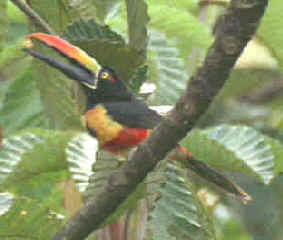
A Fiery-billed Aracari,
photographed during a FONT tour
The tour summaries
here are with the most-recent tours first.
For some tours there are links to longer narratives. Also there are links
to UPCOMING TOUR ITINERARIES, and lists (some with photos) of BIRDS, MAMMALS,
and OTHER NATURE.
Previous
Tours:
March 2012 February 2011 March 2010 February 2006
July 2005
January 2005 February 2004
March 2001
In the FONT Archives:
Some Photos of People, Places, & More during Previous FONT Tours in Costa
Rica
In all, there have been
32 FONT birding & nature tours
in Costa Rica
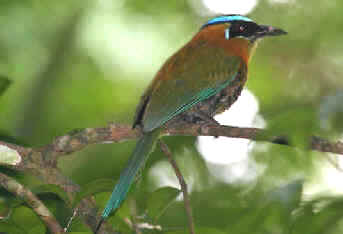
A Blue-crowned Motmot
photographed during a FONT tour
Links:
Upcoming
FONT Birding & Nature Tours in Costa
Rica
Costa
Rica Birds (a list of
867 bird species; about 700 during FONT
tours)
Birds during our: northern Costa Rica tours
(605
species)
southern Costa Rica tours
(493
species)
A Photographic Sampling of Colorful Costa Rican Birds
A List & Photo Gallery of Central America Birds, in 4 Parts
Costa Rican Mammals (with some photos)
Amphibians & Reptiles of Panama & Costa Rica (with some photos)
A List of Central America Butterflies & Moths, in 6 Parts (with some photos)
A
Feature about Alexander Skutch, a naturalist in Costa Rica
In cumulative list of Costa Rica
birds, above,
scientific names are given & subspecies are noted.

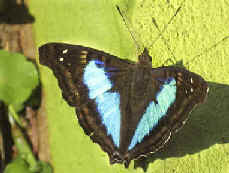
A Turquoise Emperor
photographed during a FONT tour

Costa
Rica (northern & southern) - March 2012
In March 2012,
there were two FONT tours in Costa
Rica, one in the northern
part of the country, and one in the southern.
Places that were visited were in the highlands and lowlands, up on volcanoes and
down by the seacoast, and including the dry "cattle country" near
Nicaragua and moist "rain forest" near Panama.
And these were just
some of the habitats where we were. There were others in between the dry and
wet, and the high and low.
Our March 2012 Costa Rica tours were our 31st and 32nd in that
country.
During the northern and southern Costa Rica tours combined, as many as 372
species of birds were found. All but just a few were seen. There were some that
were only heard. All were alive, except for one: a Chiriqui Quail-Dove, that had
recently died, by a dirt road on the Caribbean slope.
Among the 371 living species of birds during the tour, there were a number of
notables, including: Jabiru, King Vulture, Aplomado Falcon, Pearl Kite,
Swallow-tailed Kite, White
Hawk, Black Hawk-Eagle, Sungrebe, Southern Lapwing, Long-billed Curlew, Scarlet
Macaw, Green Thorntail (both male
& female), the Snowcap, Resplendent Quetzal, Baird's Trogon (both male &
female seen nicely), Long-tailed Manakin, Turquoise Cotinga, Three-wattled
Bellbird, both Fork-tailed and Scissor-tailed Flycatchers, Streak-chested
Antpitta, both Long-tailed and Black-and-Yellow Silky-Flycatchers, Tropical
Mockingbird (a recent arrival in Costa Rica), and the Black-cheeked Ant-Tanager
(a very localized endemic in Costa Rica - 1 of 3 endemic Costa Rican birds that
we saw - there are only
4).
Where tinamous are heard, one knows that the tropical forest is still good, as
it has been for a long time with its assortment of wildlife. We were glad to
hear Tinamous, mostly Great and Little, at a few places during the tour.
Tinamous are more often heard than seen, considerably more often, but we did
have wonderful sightings of a Thicket Tinamou walking on a forest floor, and
of two Little Tinamous (one a moment or so after another) crossing a
country road just ahead of us.
Wonderful to hear, at one of the places where we stayed in the mountains, were
the late-day and early-morning sounds of nightingale-thrushes, many of them with
their plaintive calls, near our nice cabins. We saw them as well: the
Ruddy-capped and Orange-billed Nightingale-Thrushes.
The Black-billed
Nightingale-Thrush had been "further up the
road".
It was noted here (3 paragraphs ago) that the Tropical Mockingbird is a
"recent arrival" in Costa Rica. Also in that category, during our
tour, were: the Pearl Kite (also noted above), and the Mouse-colored Tyrannulet
and both the Red-breasted and Melodious Blackbirds.
In all, there were so many birds. We saw more Double-striped Thick-knees than
usual. We had a wonderful look at Mangrove Cuckoo, and our second Black-billed
Cuckoo ever (in 32 CR tours).
We enjoyed hearing and seeing a Common Potoo at dusk (only our 3rd time in 32
tours).
The Toucans, as always, were enjoyed, both the Keel-billed and the
Chestnut-mandibled,
as were the Tanagers, as colorful as ever. Most colorful among them were the
Golden-hooded, Silver-throated, Bay-headed, and Flame-colored, along with the
frequently-seen Cherrie's Tanager. The old name of the Cherrie's, the
Scarlet-rumped Tanager, related more to its bright coloration.
Brightly-colored Euphonias that we saw included the Yellow-crowned,
Yellow-throated, Spot-crowned, Tawny-capped, Thick-billed, and Scrub - all of
them colorful.
Other brightly-colored birds included 3 species of Honeycreepers (Shining,
Green, and Red-legged) and 2 species of Dacnis (Blue and
Scarlet-thighed).
And of course, not to be omitted in the "colorful category" are the
hummingbirds. During our March 2012 Costa Rica tours, we saw 32 species of
hummingbirds.
But birds of all sorts were enjoyed, including the finches, seedeaters, and
sparrows.
Finches included the Peg-billed and the Large-footed (also known to us as
"Bigfoot").
Seedeaters included the White-collared, Variable, Yellow-bellied, and
Ruddy-breasted.
Sparrows included the Stripe-headed, Black-striped, and Orange-billed (the last
of these especially fine to see).
The Volcano Junco, a resident on only the highest mountains, was a special treat
for us.
And lastly, as brightly-colored as any of the birds categorized above as
"colorful" was the male Painted Bunting that was seen during a
boat-ride, late one afternoon, in mangroves.
The nearby male Mangrove Warbler
was not bad to see either, with its yellow body and rusty head in the late-day
sunshine.
As already said, there were "so many birds". At the end of the tours,
we all had to "narrow it down" to only ten, our Top Ten
favorites.
Here, collectively, are those favorite birds of the FONT tours in March 2012 in
Costa Rica:
1 - Resplendent Quetzal
2 - Snowcap
3 - Three-wattled Bellbird
4 - Silver-throated Tanager
5 - Long-tailed Manakin
6 - Bay-headed Tanager
7 - Golden-hooded Tanager
8 - Long-tailed Silky-Flycatcher
9 - White Hawk
10 - Gartered (formerly Violaceous) Trogon
11 - Baird's Trogon
12 - Streak-chested Antpitta
13 - Little Tinamou
14 - Sungrebe
15 - Blue-crowned Motmot
16 - Volcano Junco
17 - Olivaceous Piculet
18 - Tropical Mockingbird
19 - Pearl Kite
20 - Green Thorntail
21 - Aplomado Falcon
22 - Green Violetear
Not just birds were seen during our March 2012 Costa Rica tours.
Among the mammals, there were 3 species of monkeys, with the often-encountered
Mantled Howler Monkeys, White-faced Capuchins, and the least common of the
monkeys in Costa Rica, the attractive Squirrel Monkey. Also: Coatis and
Agoutis.
Among the reptiles, there were Crocodile and Caiman, Iguanas and
Basilisk.
Among the many and diverse butterflies, there were the Blue Morphos, that could
not ever be ignored, along with an assortment of Longwings, Leafwings, and Daggerwings, and
Sulphurs, Sisters, Crackers, and Peacocks.
In all, it was a wonderful two tours in a country that's great for nature, with
birds and otherwise, and during which we also enjoyed some wonderful places and
fine times, along with some good wit, good humor, and good eyes.
Links:
More about the FONT Costa Rica Tour in March 2012
A Gallery of Photos from the FONT March 2012 Costa Rica Tours
Lists of Birds & Other Wildlife during the FONT Costa Rica tours - March 2012
COSTA RICA (northern & southern) -
February 2011
In February 2011, it was our 30th FONT tour
in Costa Rica, in mostly the highlands of
the country.
During that tour, there were about 300 species of birds (303), as
well as mammals, butterflies, and other nature.
Among the birds during the tour: Resplendent Quetzal, Three-wattled Bellbird,
Turquoise Cotinga, and Scarlet Macaw were seen. One of the remarkable
aspects of our Feb '11 tour in Costa Rica was that with each of these species. both the male and the female birds were nicely seen.
As to the first three, there are distinctive differences between the sexes. The
male and female Scarlet Macaws appear the same, but that species
normally occurs in male-female pairs. We saw, closely, about a dozen Scarlet
Macaws one afternoon, in flight, and feeding in trees atop rocky cliffs by
the Pacific Ocean.
The female bellbird and cotinga are not seen as often as the
males. Our encounter with the bellbird was with a pair in a forest, at
times next to each other on a branch, as the male repeatedly gave its loud
call.
At times, the brilliantly blue male Turquoise Cotinga perches in the open
on a bare branch at the top of a tree, but we saw first the female cotinga,
in such a way, before we saw the male.
And that was
also the case with the quetzal. A female came to a small fruit tree to
eat. A short while later, we saw a male, in the morning sun, as it sat ever so
still at the forest edge. As always, it was wonderful to see that
spectacular species.
Other notable birds during the tour included: Southern Lapwing, White Hawk,
Chiriqui Quail-Dove, Buffy Tuftedcheek, Black-breasted Coquette, and an
array of other hummingbirds, and an assortment of colorful tanagers
and their allies.
Mammals during the tour included 3 species of monkeys, Three-toed
Sloth, and
agoutis, coatis, and an animal called an Olingo.
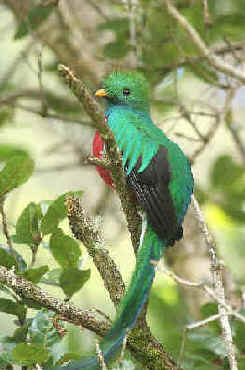
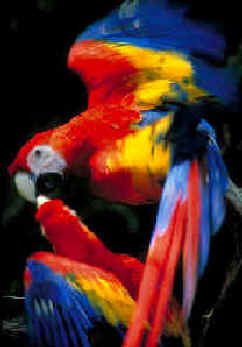
Among the highlights of the
February 2011 FONT Costa Rica Tour
were Resplendent Quetzal (above),
and Scarlet Macaw (below).
Links:
More about the FONT Costa Rica Tours in February 2011
Lists of Birds & Other Wildlife during the FONT Costa Rica tour - February 2011

COSTA
RICA (northern & southern) - March 2010
During the FONT tours in Costa
Rica in March 2010, over 400
species of birds were found.
Mammals, during the tour, included: the Northern Tamandua (or Collared Anteater), the White-nosed Coati, 3 kinds of Monkeys (the Central American Spider, the Mantled Howler, and White-faced Capuchin), and a wild cat called the Jaguarundi.
Among the more than 400 bird
species, there were many highlights.
During our Northern Costa Rica Tour, there
were both Great Green and Scarlet
Macaws, the Agami Heron, 2 Jabirus (in the large bird
department), while
in the small bird department there a number of antbirds, including
the Ocellated, Bicolored,
and the Spotted.
Some of the birds had the
adjective Great, and they were these, all seen:
Great Tinamou, Great Potoo, and Great Curassow, with both male and
female nicely seen of the
last of these.
In far-northern Costa Rica, not far from Nicaragua, 2 species of birds were seen with the adjective Nicaraguan: the Nicaraguan Grackle and the Nicaraguan Seed-Finch, with its huge pink bill.
During our Southern
Costa Rica Tour, certainly outstanding were the Resplendent
Quetzals that we saw so nicely on tree branches in the cloud forest,
when it was not cloudy or misty, but rather as the sunshine accentuated
all the more the beauty of the birds.
27 species of hummingbirds were seen during the March 2010 FONT Costa Rica
tours, mostly in the southern part of the country. Truly there was a collective
splash of color with the half-dozen or so Fiery-throated Hummingbirds, at
one time, at one feeder, in the mountains. A throat or a gorget could not be
more colorful anywhere than were those of bright red, orange, and yellow.
Elsewhere, during our Southern Costa Rica tour, another hummingbird was a
showstopping star as a solo. It was the small, brilliantly attractive, mostly
maroon-colored male hummingbird known as the Snowcap.
Also in Southern
Costa Rica, we visited the home of the renowned naturalist, Alexander
Skutch, for the first time for us since he died, after living a century.
He passed away shortly after the current century began. We visited his
place and him, during some of our previous tours, but until now, in 2010,
we did not go back after he passed away.
Three times during our previous
visits with Mr. Skutch, we enjoyed, with him,
the sight of a Turquoise Cotinga atop a tree. This time, in March 2010,
when we went to the same porch as we had in the past, there, once again,
was a Turquoise Cotinga at the top of a tree. With that, for us, the
spirit of Alexander Skutch lived
on.
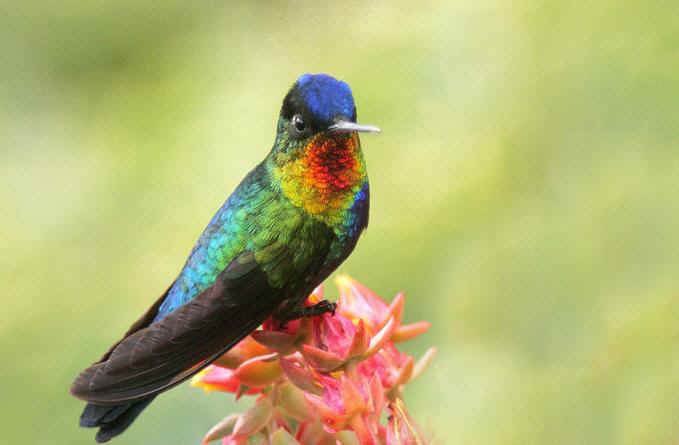
Fiery-throated Hummingbird
Links:
More about the FONT Costa Rica Tours in March 2010
Lists of Birds & Other Wildlife during the FONT Costa Rica tours - March 2010
COSTA RICA (southern) & adjacent PANAMA -
February 2006
During this
tour, in the highlands and on the Pacific side of southern Costa Rica
and in
the adjacent Chiriqui province of Panama, 267 species of birds were observed.
238 of them were found in Costa Rica.
107 were found in Panama during only 2 days in that country.
78 of the 267 species were found in both countries, while 29 species were found
in Panama alone. In the last category were: the Veragua Parakeet (an
isolated population that has been considered a subspecies of the Brown-throated
Parakeet of northern South America), the Veraguan Mango (which
was considered part of the Green-breasted Mango; we saw a female
on a nest), and the White-throated Mountain-gem (closely related
to other mountain-gems, particularly the Gray-tailed
Mountain-gem that we also saw - in Costa Rica).
This was the 27th FONT birding tour in Costa Rica. Prior to it, our cumulative
total of birds for CR was 684. During this tour, 1 new species was added to that
CR list, the Southern Lapwing. 2 of them were seen in a pasture south of
Golfito; they appeared to be on territory.
Other notable birds found during the southern Costa Rica portion of this tour
included: Masked Duck, Barred Hawk, Sunbittern, Scarlet Macaw, Baird's
Trogon, Chiriqui Yellowthroat (has been considered part what has been the
Masked Yellowthroat of South America), Zeladonia,
Black-cheeked Ant-Tanager, Red-breasted Blackbird, Volcano Junco.
Also, in all there were a number (22 species) of hummingbirds, and
some notable Finches: the Peg-footed, the Large-footed, and
the Yellow-thighed.
Nature other than birds included some mammals (notably Mantled
Howler & White-faced Capuchin Monkeys, and a Kinkajou
in the daytime - in the photo below), and Morelet's Crocodile,
Spectacled Caiman, Green Iguana, and an assortment of butterflies.
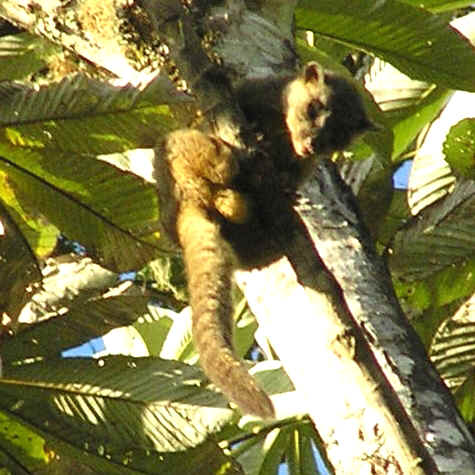
A Kinkajou photographed in
the forested mountains of southern Costa Rica
during the FONT tour in February 2006.
(Photo by Rosemary
Lloyd)
Links:
More about the FONT tour in southern Costa Rica & western Panama in February 2006
List of Birds during our Costa Rica & Panama Tours - February '06
COSTA RICA (mostly Northern) -
July 2005
This tour was our 26th in Costa
Rica, and our 3rd there in the summer, at a time when teachers and others could
go, instead of during the winter & spring when otherwise they could not.
Among the bird highlights of the tour were: Amami Heron, Jabiru, both Scarlet
and Great Green Macaws, King Vulture, Pygmy Kingfisher, Long-tailed Manakin,
and over 25 species of hummingbirds including the Snowcap.
During our July 2005 tour in Costa Rica, among the highlights, birds included two depicted below, the threatened Great Green Macaw and the attractive Long-tailed Manakin.
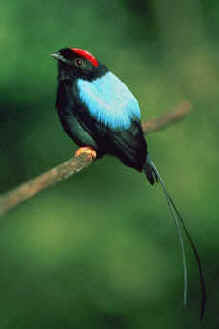
Long-tailed Manakin
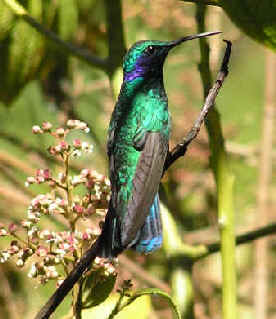
Green Violetear
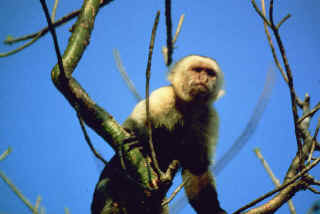
Highlights among the other wildlife included a close encounter with a group of White-throated Capuchin Monkeys (the species illustrated below)
Links:
List of Birds & Other Wildlife during our Costa Rica Tour - July 2005
Lists of Birds & Other Wildlife during our previous Costa Rica Tours in the Summer

COSTA RICA (southern) -
January 2005
Our first birding tour of
the new year, in January 2005, was in Costa
Rica. It was a very good and enjoyable tour, with motmots and
macaws,
and toucans, trogons, and tanagers (just to mention a few of the
colorful birds).
This week-long tour was in southern Costa Rica, and with a small bit in adjacent
Panama.
But, one doesn't have to go to Panama to see some of the birds from that
country that are now occurring further north, in Costa Rica. In that
category, birds that we saw in Costa Rica included: Pearl Kite, Savanna Hawk,
Red-breasted Blackbird, and Grassland Yellow-Finch.
Here's the list of our "top birds" during the January 2005 FONT Southern Costa Rica Tour as voted by the participants at the end of the tour:
1 - BLUE-CROWNED
MOTMOT
(in photo above)
2 - Scarlet Macaw
3 - Pygmy Kingfisher
4 - Pearl Kite
5 - Chestnut-mandibled Toucan
6 - Common Potoo
7 - Ocellated Piculet
8 - Fork-tailed Flycatcher
9 - Fiery-billed Aracari
10 - White-tailed Kite
11 - Green Violetear
12 - Yellow-billed Cotinga
13 - Red-legged Honeycreeper
14 - Laughing Falcon
15 - Purple Gallinule
Honorable
Mentions:
Baird's Trogon
Golden-naped Woodpecker
Black Guan
Volcano Junco
Links:
List of Birds & Other Wildlife during our Costa Rica Tour in Jan '05
Upcoming
Costa Rica Tour Itineraries

COSTA
RICA (southern) -
February 2004
The following account was written by Armas Hill, leader of
the tour.
Costa Rica
is, without a doubt, a great place to bird. It's often noted that within that
country, the size of US state of West Virginia, there are so many birds (with
more species than those regularly occurring in all of North America, north of
Mexico), in diverse habitats ranging from high mountains (about
10,000 feet) to sea-level rainforests, mangroves, and shrub. And the climate
is often about as good as it gets anywhere.
And so it is that many people are now going birding in Costa Rica. The country has become a very popular neotropical destination.
Not only for birders, but for others as well who enjoy everything that's "good" about the place. Airplanes from the US are filled with people going to beaches and cruise ships in addition to those going to explore and enjoy "the nature" they've learned of on the Discovery Channel and elsewhere.
But the group of us who went, during the FONT Costa Rica birding tour February 7-14, 2004 (the 24th FONT tour in the country), actually saw only few tourists and many birds. That's because we went to where less people go, into the southern portion of the country, mostly on the Pacific side. From the highest of the mountains, we went south along the Pacific coast to places "off the beaten path" in the hills near Panama, by the coast of the Golfo Dulce (or "Sweet Gulf"), and into the remote Osa Peninsula.
I was so very fortunate to go to Costa Rica for my first time nearly 30 years ago, with a group of birding friends from Philadelphia. Things have changed so much there since then. Many square miles of tropical forest disappeared, particularly about two decades ago. Big trucks on the highway loaded with big logs were a common sight. Also gone today are most of the huge banana plantations that once were. It's now positive that more diverse (and bird-friendly) habitats have replaced them. Also certainly different now than it was, in a word, is the "infrastructure". In most areas, 30 years ago, there were few places to stay, and they were at best basic. Today, in many parts of Costa Rica, there are wonderful lodges, where birds and other aspects of nature are just outside the door. So, while some raptors, for example, have become more difficult to find as the forest is less, other birds, notably hummingbirds, are easier than ever to see, as many lodges have an array of feeders.
30 years ago, my friends and I ventured into a wild, remote area of southern Costa Rica. We went by boat across the "Golfo Dulce", and then rode in the back of an old truck to the end of a dirt road, where a river was too wide and deep to cross. We walked along that river, or more correctly, through it, as we forded from side to side more than twenty times, entering a jungle that could only be described as "wild". There were jaguar tracks in the mud, and innumerable birds in the trees and bushes ranging from tiny hummingbirds and colorful tanagers to raucous macaws. Men were along the river with pans mining for gold. We were in the interior of the Osa Peninsula by the outer edge of the Corcovado National Park, said to be one of the wildest of world's places. I know I've used the word "wild" three times in this paragraph (sorry), but that's what the area was. We only spent part of a day there. By nightfall, we had to leave.
For some reason, I've wanted, over the years, to go back that place. And strangely, about two years ago, I learned that there's now a small lodge nestled in that same remote area - a place that accommodates guests, particularly birders. I just had to go back, to see again the river, the forest, the birds - to see how much the place has changed. And, our February 2004 FONT tour in southern Costa Rica, traveled into that part of the Osa Peninsula.
Going into that area, and then later, for a day, going from it, the experience was much as it was years ago. Travel was on a dirt road. There was little or no traffic. Along such a road, across the northern portion of the Osa, we saw various hawks, and flocks of Scarlet Macaw, parrots and parakeets in the trees. The Riverside Wren was roadside, along with the hawk that has that name. In a bush by the road, a Striped Cuckoo posed. At a small pond, whistling-ducks looked at us as we looked at them. And, again, there was virtually no traffic. At one point, it was a good thing, as a 3-toed sloth was crossing a road. And that's a slow process! We had seen sloths, where they normally are, in trees. But, looking down on one by the edge of the road was certainly a different perspective. We could see the algae on the animal's back - growing about as slowly as the odd creature moves.
We actually made it into the remote area of the Osa, with the lodge by the river, in the dark of night, after a full day's birding. Along the dirt road on the way in, we had good looks at two different Striped Owls as they perched on roadside telephone wires.
The lodge and the people who run it, Liz and Abraham, were great. Both the sleeping accommodations and the meals were wonderful. Such things, again, were not there during my first visit about 30 years ago. Nor were the sharp eyes of Abraham. I've never seen human eyes that could see so well, whether they were spotting a hummingbird deep in the brush, or a cotinga or a hawk far-away on a tree branch high up on a ridge.
In the remote Osa, we walked along the river, or again more
accurately, we forded the river (but not 20 times, and doing so in proper
boots).
One of the hummingbirds deep in
the brush was a sitting White-tipped Sicklebill.
The cotinga in the tree-top on the
ridge was the Turquoise.
The perched hawk was a Double-toothed
Kite.
Other raptors that flew overhead
included two nearly all-white the White Hawk and the King Vulture.
Also with white in their exquisite plumage, Swallow-tailed Kites could
not be ignored.
There was another cotinga-type that was
calling continuously in the ridge-top trees, a few Three-wattled Bellbirds.
Also noisy, Scarlet Macaws flew
overhead. Obvious as well were toucans and aracaris.
By a lagoon near the lodge, Boat-billed
Herons quietly sat on their nests.
Nearby, tinamous and anthrushes
could be heard calling as they walked the forest floor.
In the trees, trogons gave away
their presence with their voices. Particularly nice was a tame, perched Baird's
Trogon, a species indigenous to only that part of the world.
A bird even more restricted to that region visited the plantings by the lodge, the Black-cheeked Ant-Tanager. It is one of only very few Costa Rican endemics (just 4 out of more than the 700 bird-species in the country). Not only endemic to Costa Rica, it's virtually endemic to the Osa Peninsula.
But perhaps the most exciting of the birds of that Osa rainforest was the Orange-collared Manakin. There was a lek - that's a place where male manakins display, sometimes quite actively. With their wings, they make a loud snapping noise. They have favored perches, usually horizontal branches, and the small colorful birds bolt quickly from one to another. It was truly a marvelous experience to stand quietly at the edge of the lek, early in the morning when the birds were most active, and watch a half-dozen or more of the birds perform.
By the river at dusk, a Spectacled Owl flew along, just above the treetops. Early the next morning, an otter was swimming in the river. And, later in the day, a short distance up the river, there was one man panning for gold (as I saw it done years ago, by a few).
A few miles away from the river and the forest, closer to the coast, we saw, in a lone large tree in the middle of a field, a bird rare in Costa Rica, that's maybe a "new arrival" having spread north from Panama. The hawk-eyes of Abraham spotted it. It was a beautiful Pearl Kite. In the telescope it was all the more so, even though slightly obscured by leaves. But then those keen eyes discovered something even less obvious in that tree, the female Pearl Kite sitting on its nest. In the book by Stiles & Skutch, "A Guide to the Birds of Costa Rica" published in 1989, it's stated that the Pearl Kite "possibly resides in central Panama, and that it may be found sometime in the future in Costa Rica, maybe expanding from an isolated population in Nicaragua". The species, however, has been expanding north through Panama (although far from common there). The bird has been known to be in that part of the Osa Peninsula of southwestern Costa Rica for at least a couple years, favoring that large field just noted with the large tree.
Other birds have been expanding, with
deforestation, north into southwestern Costa Rica. During an enjoyable
afternoon, in open countryside, not far from Golfito
(a small coastal city that used to a banana port), we saw a few such
species, notably Red-breasted Blackbirds, and various seedeaters
and finches. Fork-tailed Flycatchers were rather obvious during
that afternoon ride, as were a number of parrots of parakeets (of
a few different species). The birds were different than those that were
there years ago, but the again when we were on small dirt roads and crossing a
river on a ferry that could only hold two cars, it was much like "old
times".
As the day ended, a White-tailed Kite hunted
over a field, as a pair of nearby Laughing Falcons gave a loud duet. Pauraques
began to call in the distance.
Early the next morning, in the forested hills north of Golfito, there was a quick sighting of a wild cat, a Margay. The first bird of the day was the brilliant Orange-billed Sparrow. A White-necked Puffbird was atop a tree. Parrots flew about. Toucans perched. Wrens and other birds sang.
The previous day, in those forested hills, we had one of our best finds of the tour, an absolute "bonanza". It was a particular fruiting-tree that attracted birds like a magnet. Drawn to it were colorful tanagers of a few species, three species of euphonias (also colorful of course), honeycreepers, flycatchers, woodcreepers, woodpeckers (including two particularly good the Rufous-winged and the Golden-naped, the latter a regional specialty.) In all, during the two hours or so that we stayed there, at least a hundred, probably more, individual birds came to the tree. It's been said, particularly in the tropics, that "if you find the restaurant, you find the birds". As much as there was a "bonanza" for us, with the birds, it (that is, the tree) was all the more a "bonanza" for the feeding birds. We watched the spectacle from a small (again, untraveled) road. Behind the tree was a stream, with its water hosting birds as well, from Green Kingfishers to bathing hummingbirds. An attractive male White-necked Jacobin hovered above the water. As did the Beryl-crowned Hummingbird.
Probably more than any other family of birds, it was the hummingbirds that have most characterized our tour. Until now, in this narrative, I've tried not to mention them, so that I could refer to them more collectively. Only with the wonderful White-tipped Sicklebill, I simply couldn't resist.
Also on the Osa Peninsula, of course, there were others. One that we saw, unique to coastal mangroves and called the Mangrove Hummingbird, is one of the 4 birds mentioned-earlier as endemic to Costa Rica. It was near an attractive male Mangrove Warbler, now "split" from the Yellow Warbler, as it has a rusty red head.
Going from the mangroves back to the
river, forest, and lodge, we stopped at a certain flowering tree where, in the
past, Liz had seen the White-crested Coquette. It was there. Another name
for that nice little bird is the Adorable Coquette.
Another name for the Beryl-crowned
Hummingbird, that we saw by the lodge and elsewhere, is the Charming
Hummingbird. It's not without reason that such hummingbirds are
described as adorable and charming.
I mentioned earlier that nowadays in
Costa Rica there are hummingbird feeders as never before. Sometimes, they are
frequented by masses of hummingbirds.
High in the mountains, outside the window
behind a road-side restaurant, nearly 10,000 feet above sea-level there is now
such a group of feeders accompanied by its contingent of hummers. There, at the
place called Georgina's, the spectacular Fiery-throated Hummingbird can
be seen very well. Also the Volcano Hummingbird. We had our first good
look at a male Volcano Hummingbird actually away from a feeder. It was perched,
in nice sunlight, facing us with its purplish gorget shining. The name Volcano
is ascribed to that hummer as the gorget appears like flowing lava.
Also near Georgina's, on the ground, was
"Big-Foot". That's the name that we gave to the bird properly called
the Large-footed Finch. It scratches on the ground, with those big feet,
like a Towhee.
Returning to hummingbirds, at another place in the mountains, they came in droves to feeders at a lodge where we stayed, nestled in a valley. Looks could not have been better at hummingbirds as large as the Magnificent and as small as the Scintillent. In between, were Green Violet-ears and the Gray-tailed Mountain-Gem (the last was another of the 4 Costa Rican endemic birds). Feeders enable up-close encounters with wonderful hummingbirds.
At the lodge on the Osa Peninsula, we encountered hummingbirds in another, rather exciting way. We saw them at their nests. Usually these small hummingbird-haunts are under large, hanging leaves. On their nests, we saw females of the Bronzy Hermit, Band-tailed Barbthroat, Violet-headed Hummingbird, Blue-throated Goldentail, and Beryl-crowned Hummingbird. Never during a neotropical tour do I recall so many hummingbird species at their nests. Which was wonderful, as in the lowlands, hummingbirds do not visit feeders as readily as they do in the highlands. In addition to seeing hummingbirds at their nests in the Osa, we saw others attracted to the various tropical plants by the lodge, including the Crowned Woodnymph and what's been known for years as the Long-tailed Hermit. It's now called the "Western Long-billed Hermit" (even though its tail is still just as long). Bird-names, especially those of hummingbirds, are quite something. It's too bad they can't all be named "adorable" and "charming".
This tour narrative will end now back in the highlands. Where, again honing in on names, we saw during one morning, such hot ones as the Fiery-throated Hummingbird (already mentioned), the Flame-throated Warbler, and the Flame-colored Tanager. Elsewhere during the tour, as noted, we saw the Fiery-billed Aracari. Too hot.
Mention was made earlier of the fruiting-tree that attracted so many birds. Again "if one finds the restaurant, one finds the birds". Sometimes, as during our tour, that can apply as well to restaurants where people stop to eat. Hummingbirds attracted to feeders outside the door, sometimes by mistake come in the door, as we saw during lunch. At the road-side Georgina's restaurant referred to earlier, Rufous-collared Sparrows had no inhibitions coming inside on the floor. But the best during our tour, was during another lunch in a highland restaurant where a Yellow-thighed Finch (it looks like a black Catbird with yellow thighs) came in next to us. For everyone except me, it was a "lifer" at the next table.
Another highland bird that didn't come inside, but was certainly tame and close to us outside, was the Collared Redstart (or "Whitestart" if you prefer). With whatever name, it is one of the most attractive and dapper of Costa Rican birds. It's local name is "Amigo de Hombre", that is "friend of man" (due to its tameness and inquisitive nature).
And that leads us to what turned out to be (as it often does) the "favorite bird" of the tour. It's a bird of the Central American highlands that's called "Resplendent" - the Quetzal. People back home always ask "did you see it?". Yes, we did. And, we saw it well. We saw both male and female. As if they were props, both were perched close to us, both with their brilliant shiny green, red and white coloration. Some say the Quetzal is the "most beautiful bird in the world". It may be. The male has what appears to be a "tremendously long tail", with two extraordinary bright-green streamers, more than a foot-long, extending below it when it sits, and behind it when it flies. While we were watching the male Quetzal as well as we did (again, said to be among the most beautiful of birds to see), we heard in the background one of the most beautiful of bird sounds, the song of the Black-faced Solitaire.
Both of these birds (along with many of the others that have been mentioned) were in the "top birds" as voted by the participants after the tour.
The Resplendent Quetzal was voted "number 1". 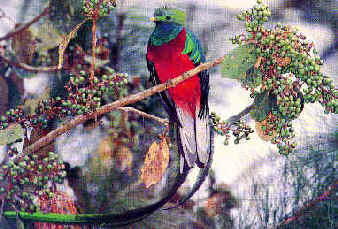
Resplendent Quetzal
Here's the list of all our "top birds" during the February 2004 FONT Southern Costa Rica Tour:
(The left number, refers to points (everyone votes 1 thru 10); the right number to ballots. No bird, even the Quetzal, received votes from everyone.)
1 - RESPLENDENT QUETZAL - 38/5
2 - Scarlet Macaw - 37/5
3 - Collared Redstart - 31/5
4 - Orange-collared Manakin - 23/4
5 - White-tipped Sicklebill - 17/3
6 - Blue-crowned Motmot - 17/2
7 - Fiery-throated Hummingbird - 16/3
8 - Chestnut-mandibled Toucan - 14/2
9 - Fiery-billed Aracari - 14/2
10 - Bay-headed Tanager - 14/2
11 - Pearl Kite - 12/2
12 - Red-breasted Blackbird - 11/2
13 - Laughing Falcon - 10/1
14 - Blue-headed Parrot - 9/1
15 - Swallow-tailed Kite - 7/1
16 - Northern Jacana - 6/1
17 - Striped Owl - 5/2
18 - Long-tailed Silky-Flycatcher - 5/2
19 - White Hawk - 5/1
20 - Turquoise Cotinga - 5/1
21 - Black-faced Solitaire - 4/2
22 - Boat-billed Heron - 4/1
23 - Flame-throated Warbler - 4/1
24 - Rufous-winged Woodpecker - 3/1
25 - Fork-tailed Flycatcher - 3/1
26 - Riverside Wren - 3/1
27 - Black-cheeked Ant-Tanager - 3/1
28 - Orange-billed Sparrow - 3/1
29 - Baird's Trogon - 2/1
30 - Magnificent Hummingbird - 2/1
31 - King Vulture - 1/1
32 - Squirrel Cuckoo - 1/1
33 - Golden-naped Woodpecker - 1/1

COSTA RICA (northern) -
March 2001
with a Potoo Wake-up Call & Great Green
Macaws
Again, in March 2001, we did a birding tour in one of our favorite destinations, Costa Rica. That tour was our 23rd birding tour in that country.
As always, there were highlights (with Costa Rica, how can there not be? - where toucans & trogons, oropendolas & orioles, and other colorful birds of the tropics are common).
In addition to those birds:
To be especially remembered were the "wake-up calls" about 5 o'clock two consecutive mornings, given by the Common Potoo outside our windows. Surely the sound is one of the most beautiful in the natural world. And it was a nice experience indeed to lie in bed and hear that melodic sound, in the dark, just prior to the explosive dawn chorus of other birds - in the tropical rainforest in the Caribbean lowlands at Laguna del Lagarto.
Later during the day, from the edge of one of the small lagunas there, we enjoyed the sight of a Sungrebe swimming along the opposite shore. The previous day, another good sight was of a Striped Owl looking at us, from a tree, by the edge of the road, on our way to Laguna del Lagarto.
In forested slopes, by other roads, earlier in the day, our birds ranged from the Barred Becard (not often seen as well as it was this time) to colorful tanagers and warblers. Among the latter, one deserving mention was the dapper Collared Redstart. And there were a number of hummingbirds (at a place we visited with feeders) - among them the Green Thorntail, Violet Sabrewing, and the Coppery-headed Emerald (the latter one of the few birds endemic to Costa Rica). All of the hummingbirds were great to watch.
But a particular highlight during the tour, in addition to the birds that we've mentioned, was certainly the pair of Great Green Macaws in a tree above us, almost oblivious to our presence. This magnificent species, the 2nd largest of the New World Psittacine, is one of the rarest of Neotropical birds, having a limited distribution in wet lowlands from eastern Honduras to western Colombia, with a very small isolated population (of less than 2 dozen birds) in western Ecuador.
In Costa Rica, it's been estimated that there are fewer than 35 pairs of Great Green Macaws breeding annually. It was really a wonderful experience for us to spend some time with one of those pairs.
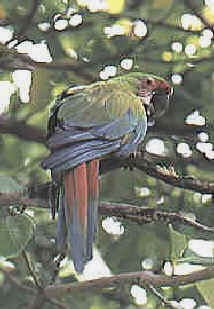
Great Green Macaw
(Photo courtesy of Kurt Schmack)
