
E-mail: font@focusonnature.com
Phone: Toll-free in USA 1-888-721-3555
or 302/529-1876
|
PO Box 9021,
Wilmington, DE 19809, USA E-mail: font@focusonnature.com Phone: Toll-free in USA 1-888-721-3555 or 302/529-1876 |
Highlights
FROM PREVIOUS
FOCUS ON NATURE TOURS
in Jamaica
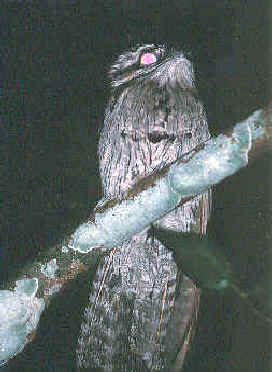
A Jamaican Potoo
photographed during a FONT tour
The
following summaries here are given with the most-recent tours first.
For some tours there are links below for longer narratives. Also there are links
to UPCOMING TOUR ITINERARIES and list (some with photos) of BIRDS, MAMMALS, and
OTHER NATURE.
Some Previous Tours:
February-March 2006 February-March 2001
Links:
Upcoming FONT Birding & Nature Tours in the Caribbean, including Jamaica
Birds during Previous FONT Tours in Jamaica
A Bird-List & Photo Gallery of Caribbean Birds, in 2 parts:
Part #1: Guineafowl to
Hummingbirds
Part #2: Trogons to Buntings
Butterflies & Moths in the West Indies of the Caribbean

During the FONT tours in February/March
2006 to these islands (that could be done
either in combination or separately), a nice number of Caribbean endemic
& specialty birds were seen.
Highlights in the Cayman Islands included well over a hundred West Indian
Whistling-Ducks and a colony of a couple thousand Red-footed Boobies
& Frigatebirds, in addition to "target birds" such as Rose-throated
Parrot, Yucatan Vireo, Cuban Bullfinch, and Vitelline Warbler.
Among the best in Jamaica, in addition to the endemics, were a pair of Masked
Ducks, a fine look at a Yellow-breasted Crake, and about 20
White-tailed Tropicbirds seen nicely as they flew close to us cliff-side.
Links:
More about the FONT tours in the Cayman Islands & Jamaica in February/March 2006
List of Birds during our tours in the Cayman Islands & Jamaica - February/March 2006
Again, in 2001, we had some very good birding during FONT tours in the Caribbean.
Just imagine - in the West Indies, sitting by a pool of water high in the pine-clad mountains of the
Dominican Republic, and watching about a dozen Hispaniolan White-winged Crossbills drinking at the waters edge. And with them, some colorful Andean Siskins.
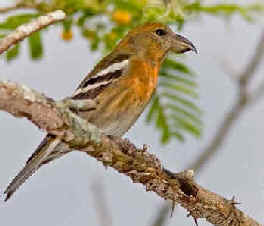
Hispaniolan White-winged
Crossbill
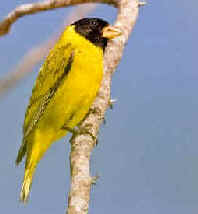
Antillean Siskin
One day earlier, from a boat floating quietly on a nearby lake, imagine being surrounded by pink flamingos walking at times, in unison, and even-pinker Roseate Spoonbills moving their bills back-and-forth in the water as they fed, in the distance, endemic White-necked Crows were going to their evening roost in the palms.
The day before that, two species of todies, both of them bright and perky, were seen from along the same road - one in dry lowland shrub, the other in highland forest. Somewhere in between, along that road, there were in one tree, parrots, parakeets, and trogons.
Also during the
Dominican Republic tour there were birds such as tiny Vervain Hummingbirds, sitting and calling atop high perches, the rare (and rarely seen) La Selle's Thrush, and the unique Palmchat.
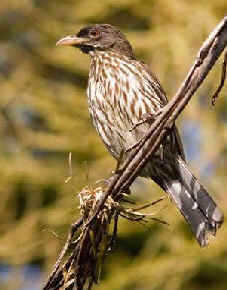
The unique
Palmchat
Not an Hispaniolan endemic bird, but
particularly memorable to see during the March 2001 tour was a pair of
Prothonotary Warblers in a city botanical garden, close at hand - the male
displaying for the female, walking on a branch above a still stream, spreading
his tail. On the water, below, there were a pair of Least Grebes, with
chicks, ever so least - small bundles of striped fluff riding on the back of one
of the adults.
On the other side of the stream, there stood a Limpkin.
Memorable to hear, at another time during the tour, in the mountain forest, were
the echoing flute-like calls of the Rufous-throated Solitaire.
The
Puerto Rico Birding Tour, the previous week, had memorable moments, as well. During that tour (the 23rd Puerto Rico tour for FONT), all but one of the island's endemic birds were found - from the skulky Elfin Woods Warbler to the sometimes boisterous Lizard-Cuckoo. Other birds found included Masked Duck, on a pond with White-cheeked Pintails, and a Key West Quail-Dove.During the
FONT Jamaica Birding Tour this year, all of the endemic birds were found, including the often-elusive Jamaican Blackbird, and the Crested Quail-Dove. The latter, known locally as the "Mountain Witch", was seen very well - on the ground just feet away from us.During our tour on the
Cayman Islands, all of the bird specialties sought were found - the parrot, warbler, vireos, and bullfinch. And more from 2 to 3 hundred "rare" West Indian Whistling-Ducks.
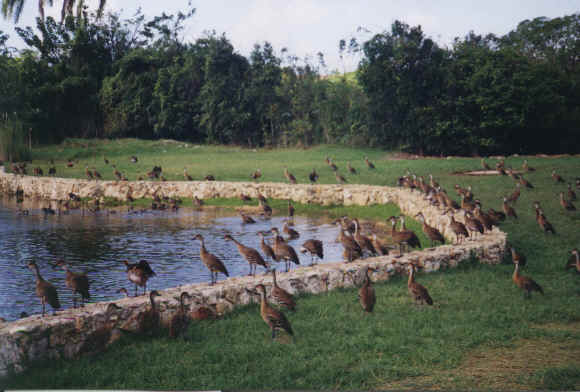
West Indian Whistling-Ducks,
many places can be hard to see,
but not here at this pool on the Cayman
Islands.
(Photo during FONT Feb. 2001 tour by Susan D'Amico)
Also seen during the FONT 2001 Cayman Islands Tour was a lone duck (actually a drake) certainly rare (more aptly, unheard of) in the Caribbean a male Baikal Teal, among many (hundreds of) Blue-winged Teal. With the Baikal behaving just as were the Blue-winged.
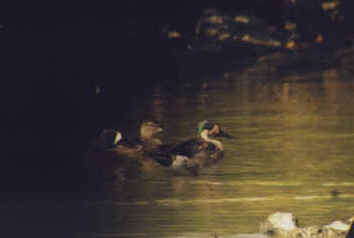
A male Baikal Teal (right)
with male & female Blue-winged Teals
thru a telescope during FONT birding tour
on Little Cayman Island in the Caribbean, Feb. 24, 2001.
(Photo courtesy of Susan D'Amico.)
Not far from the Baikal Teal, on Little Cayman Island (10 miles long and 1 mile wide), and certainly more expected there, were numerous Red-footed Boobies (of both color morphs) and Magnificent Frigatebirds at their breeding colonies. Some males with big red sacs. Elsewhere, White-tailed Tropicbirds were seen (in flight among the seacoast).
Birding in the Caribbean is fun.
Link:
Upcoming
FONT Birding & Nature Tours in the Caribbean
To
Top of Page
