
E-mail: font@focusonnature.com
Phone: Toll-free in USA 1-888-721-3555
or 302/529-1876
|
PO Box 9021,
Wilmington, DE 19809, USA E-mail: font@focusonnature.com Phone: Toll-free in USA 1-888-721-3555 or 302/529-1876 |
HighlightS
from previous
focus on nature tours
in Washington State
& central
California
the WEST COAST USA TOURS
Previously, until 2001,
including British Columbia, Canada

Yellow-billed Magpie, endemic
to California
The
following summaries here are with the most-recent tours first.
For some tours there are links below for longer narratives. Also there are links
to UPCOMING TOUR ITINERARIES, and lists of BIRDS, MAMMALS, and OTHER NATURE.
Some Previous Tours:
September
2005 September 2004
September
2001 September
2000
Links:
Birds
during FONT September West Coast USA Tours
Pelagic Birds during FONT September West
Coast USA Tours
Birds
of Washington State (with
some photos)
Birds of California
(with some photos)
Mammals & Other Wildlife during FONT West Coast USA Tours
(with some photos)
Upcoming FONT West Coast USA Birding & Nature Tours


Our WEST COAST USA TOUR
(in WASHINGTON STATE & CALIFORNIA) - September 2005
During this tour,
September 9-18, 2005, our 13th such tour since 1991, again, as has been our norm
over the years, the first half of the tour was in Washington State
and
the second half was in central California.
During the pelagic trip, as part of the
tour this year from Monterey, California, there were a couple extraordinary sightings:
one, of a rare Hawaiian Petrel, and the other an incredibly good view of
8
Baird's Beaked Whales floating together on the surface of the ocean.
In all,
nearly 200 species of birds were seen, bring our cumulative-list for this tour
up to 327.
Cumulatively, with a few additions in 2005, as many as 59 species of mammals
have been seen during our West Coast USA tours.
Links:
More about the FONT West Coast USA Tour in September 2005
List of Birds during our West Coast USA Tour - September 2005
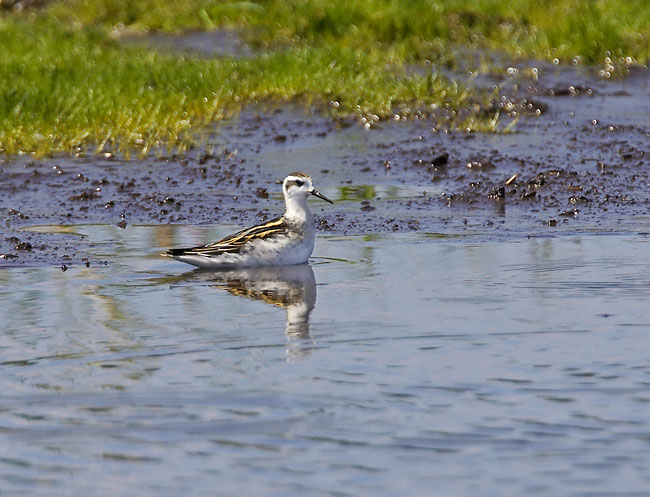
Red-necked
Phalarope,
as seen during our West Coast USA Tour in Sept 2005.
Flocks of these birds spinning on ponds at Point Reyes, California
were a fine sight to see.
Our WEST COAST USA TOUR (in WASHINGTON STATE & CALIFORNIA)
-
September
2004
During this tour, September
9-19, 2004, in Washington State &
central California, among highlights, there were these:
In Washington State:
4 species of
alcids & a pod of orcas seen well from a boat in the Puget Sound,
American Three-toed Woodpecker, Gray Jay, & Pine Grosbeak, in the
Cascade Mountains,
and further
east, the Sooty Grouse (it was considered, at that time, the Blue
Grouse).
In central California:
In two fields, there were incredible gatherings of thousands of
Long-billed
Curlews & White-faced Ibises. With their similar beaks, both were
feeding in the moist ground.
In all, exactly 200 species of birds were found during this week-long tour, the
first half of which was in Washington and the second half of which was in
California.
Link:
List of Birds during our West Coast USA Tour - Sept. '04
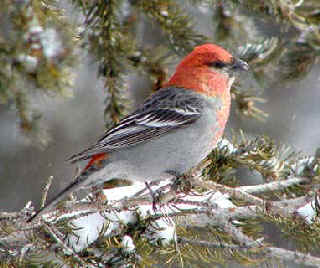
A male Pine Grosbeak
Our
Pacific Coast Tour - Washington State USA
(and adjacent British Columbia, Canada)
September 2001
This was the 11th annual FONT Pacific Coast Tour.
The
Pacific Northwest conjures images of tall majestic mountains, huge
evergreen trees, lots of moss, and tall ferns on the forest floor. That we had.
Also conjured are cool, often damp, sometimes rainy days. That we did not have.
There was no rain at all. Temperatures ranging from 70 degrees F to nearly 90
degrees farther inland.
September is an ideal month for birding in this part of North America, and this
year, even with the unusually dry and warm weather, was no exception.
On our first day, we headed from Seattle southwest to the coast. Even though we saw birds of the shore and sea, the most memorable of the birds that day was the Chestnut-backed Chickadee, as bands of them flew between the trees with perfect light hitting their backs and sides.
The next day we participated, as we do each year, on a Pacific Ocean pelagic trip from Westport. The weather conditions were wonderful, as was the birding. Calm waters and cooperative birds made this one of the best of our pelagics. Alcids, such as Cassin's Auklet, opted to stay on the surface rather dive, providing us with some fine views. Equally cooperative was the Tufted Puffin who watched us watch him (or her).
All of the jaegers were seen well and in good numbers. There were 3 South Polar Skuas, at different times, all close to the boat. There were rafts of seabirds, mostly shearwaters. Good looks were had of Buller's, Pink-footed, Sooty, and 2 Flesh-footed Shearwaters, in addition to both light and dark morphs of the Northern Fulmar. Always present and also seen well were Black-footed Albatrosses. With the placid ocean, we also enjoyed wonderful views of Sabine's Gulls, on the water and in flight.
The Westport pelagic provided more than birds. For many, the sight of a Thresher Shark flapping its sickle shaped tail on the surface was new. 4 Ocean Sunfish were viewed closely. 3 Humpback Whales were fun to watch especially when one fluked its tail. We also passed by a Northern Fur Seal floating on its back, and for a time we were joined by a pod of Pacific White-sided Dolphins.
The next 2 days our base was Bellingham, the closest city of any significant size to the Canadian border. We traveled to Anacortes, a picturesque seaport on the northwest Washington coast. Ferries depart from there for the San Juan Islands and Vancouver Island, Canada. We bordered our ferry for the 2-hour voyage to Sidney, British Columbia. While weaving through the San Juan Islands, in the upper Puget Sound, we saw Pelagic Cormorants, Pacific Loons, alcids including Common Murres and Rhinoceros Auklets, along with Bald Eagles perched on coastal snags.
Our target bird on Vancouver Island was the introduced Eurasian Sky Lark. There's been a population there for years. Our first attempt produced Savannah Sparrows. When we backtracked across a small part of the field that we had initially bypassed, 3 Sky Larks flushed up into sky, landing too far away to be seen. Another nearby field was much more productive, where we flushed over 30 birds, the most we've ever found during our annual tour. We were certainly pleased that conservation measures is paying off for the bird and bringing its population to a stable, higher number.
From Vancouver Island, we sailed on another ferry to the British Columbian mainland. Along the way, at Boundary Bay, we had close looks at Black Oystercatchers and Harlequin Ducks. Our standard location in downtown Vancouver City produced a top-notch view of an adult Crested Myna, one of the few remaining individuals of this introduced species in North America. We completed our Canadian leg of the tour on Iona Island observing waterfowl and shorebirds.
The following day we returned to Anacortes on the Washington coast. Here we had our best views ever of several pairs Marbled Murrelets. They were very close to us, and it was quite an experience to hear them calling to each other. Also up close and in good light were Pigeon Guillemot, Rhinoceros Auklet, Common Murres (parents and young), and Red-necked Grebes. All of this in front of us as a Winter Wren sang its beautiful song from the coniferous forest behind us. In view, during our time here, was the truly scenic backdrop of the Olympic Mountains.

After taking our group photo (above) in this picturesque area, we headed east to the Cascades Mountains. As we entered the foothills, numerous Violet-green Swallows used the rising warm air from the valleys to lift themselves to higher elevations, where they were joined by Vaux's Swifts soaring against a backdrop of 6,000-foot mountain peaks.
Just beyond Steve's Pass (at 4,000 feet) we were on a peaceful road in the Snoqualmie National Forest. In the mix of firs, pines, and hemlocks, typical of the west slope of the Cascades, were corvid families of Gray and Steller's Jays, and Ravens. We spotted some Golden-crowned Sparrows with more numerous White-crowned Sparrows.
As we descended into the drier eastern side of the Cascades, the habitat changed to mostly Ponderosa Pine forest with an open understory. Along the Wenatchee River, an American Dipper gave us a look before going behind a rock for the evening. It was time for our first evening in the town of Ellensburg, in central Washington.
The next morning, Tuesday, we drove east to the Columbia River to bird the nearby sagebrush county. Between tall cliffs and the river, we heard the calls of Chukars and the sweet song of the Western Meadowlark. White Pelicans were grouped along the river. Campgrounds and irrigated fruit orchards provided an oasis for migrant birds, among them Western Tanager, Willow Flycatcher, Townsend's and Orange-crowned Warblers.
It was during a stop in this area for late breakfast that we learned of the disastrous terrorist attacks on the other side of our Country. The terrible events, of course, changed what would remain of the tour. This was to have been our last day in Washington, prior to flying to California. That flight was not to be, and so we would stay longer in Washington State.
During our drive back to Ellensburg, at one stop we saw a Townsend's Solitaire, just a few feet away in a stand of trees. At another stop, we saw our most unusual raptor of the tour. With several soaring Red-tailed Hawks and Northern Harriers, a single large buteo was apparent. What initially appeared as a white rump of a harrier, was in fact the white on the upper tail of a Ferruginous Hawk. We were at the northwestern limit of its range, and it was a first for 11 years of FONT Pacific Coast tours.
The next day, as we had more time near Ellensburg, we went again for Chukar, aiming to see it. Enroute, in sagebrush, we saw 2 Sage Thrashers. Then, to the cliffs for the Chukars. But they were elusive. We saw & heard a Canyon Wren sing its beautiful descending song, and flushed a Great Horned Owl from the rocks. A Say's Phoebe pursued it, as nearby Rock Wrens chased each other.
After we crossed the Columbia River, we stopped at an overlook by the river where we could see its cut through enormous rock cliffs. At the Potholes Reservoir, we saw numerous Western Grebes, mostly with juveniles calling to be fed.
Then, in the afternoon, we saw what we had hoped to earlier - a covey of no less than 10 Chukars crossing the road in front us. We all had a good look at them climbing an arid embankment next to the road. Then, along a creek, flowing through a mostly Ponderosa Pine forest with some Aspen, we found a Blue Grouse. We heard a light tapping of a woodpecker. It was a Red-naped Sapsucker. Also with us were White-breasted and Pygmy Nuthatches and Mountain Chickadee in the pines. Several Western Bluebirds around us were showing their fly-catching skills.
As we were returning to Ellensburg we watched a Coyote, one of several spotted during the week. At a distance were 10 Wild Turkey. Near dusk, we found a Baird's Sandpiper, and a Common Nighthawk fly overhead.
The following morning, in an area of large open fields in the foothills of the eastern slope of the Cascades, we saw more Wild Turkey and a Mountain Bluebird. We continued north to a higher elevation. At about 4,000 feet, we found Clark's Nutcrackers and Hairy Woodpecker. Later, this day, we found Lincoln's Sparrow. The day was Thursday. Overhead, we saw our first commercial airliner in 3 days.
On Friday, we turned our efforts toward getting home. Four more species of birds were added: Swainson’s Hawk, Pine Siskin, Wilson’s Warbler, and Yellow-headed Blackbird. This brought the number of bird species during our 2001 Pacific Coast Tour to 158 - a tour this time during which we birded well in Washington State and adjacent British Columbia, but not California. We can look forward in 2002 to being in the West again, and finding the birds we seek in central California.
This was the 10th FONT Pacific Coast tour.
2000 was our 10th year for this tour, during a prime time for bird migration along the West Coast. Over the years, an avian rarity or two has been present at the time of the tour along with the more regular migrants.
At the beginning of our Sept 2000 tour, in Washington State, we viewed, at close range, 3 Bar-tailed Godwits amongst a large flock of Marbled Godwits. The full-day pelagic trip from Westport, Washington has always been productive for us, and was again this time. This is one of the most reliable of trips for the Fork-tailed Storm-Petrel. In addition to numerous seabirds, and some marine mammals, if the weather's clear, there's a fine natural setting of the distant mountains of the Olympic Peninsula as we're returning to shore.
There's yet more beautiful scenery, and even more good birds, during this tour, in the area of the Puget Sound. Our trip to Vancouver Island, Canada, by ferry, through the San Juan Islands provided fine views of seabirds and marine mammals. Among the seabirds, the Marbled Murrelet. On land, we saw 5 Skylarks on Vancouver Island. In the city of Vancouver, we saw another bird species introduced into North America years ago (and one that has been declining recently), the Crested Myna. Along the coast, in that area, we saw a Eurasian shorebird, the Ruff.
In the Cascade Mountains of Washington, we enjoyed a family of Gray Jays and 5 Varied Thrushes, on the wetter western slope. On the drier eastern slope, we enjoyed (as much, maybe more) a Ruffed Grouse and 5 Blue Grouse. This was our best PC tour for grouse. Red-naped Sapsuckers were again, as during other years, nice to see. A sighting rather unusual for us was a close view of a Porcupine sleeping in a tree.
During the second portion of the
tour, in California, we had an excellent
look at a pair of Golden Eagles. And we saw both Clark's and Western
Grebes at one place, and all 3 of the North American goldfinches.
There was a total of 7 White-tailed Kites, with two of them in an aerial
display. An Ash-throated Flycatcher was seen in a river valley. In all,
207 species of birds were found during our September 2000 Pacific Coast tour,
bringing the cumulative bird-list for the tour, over 10 years, to 320 species.
John Janowski, has led this tour for the past few years for FONT.
In the past, Mr. BJ Rose has
also done a fine job of leading this FONT tour.
Armas Hill led the first FONT PC birding tour in 1991. Rare birds that have been
seen during this tour, over the years, have included: Red-tailed Tropicbird
(once, during the pelagic trip we do annually out of Monterey, California), Mongolian
Plover (now called Lesser Sandplover), Little Curlew, Long-toed
Stint, and White-winged Tern. In 1998, we saw the Xantu's
Hummingbird that was visiting a feeder in British Columbia. That same year
we saw Xantu's Murrelet out of Monterey - making it a 2-Xantus
Tour!