
E-mail: font@focusonnature.com
Phone: Toll-free in USA 1-800-721-9986
or 302/529-1876; Fax: 302/529-1085
|
PO
Box 9021, Wilmington, DE 19809, USA E-mail: font@focusonnature.com Phone: Toll-free in USA 1-800-721-9986 or 302/529-1876; Fax: 302/529-1085 |
"An
A-Team of
Anhinga, Ani, Aracari, along with Agami"
The FONT Birding & Nature Tour in central & eastern
PANAMA in February 2006
Links:
Cumulative List of Birds during FONT Tours in Panama (with photos)
Upcoming FONT Birding & Nature Tours in Panama
The following narrative of the FONT Feb '06 Panama Tour was
written by Armas Hill, leader of the tour:
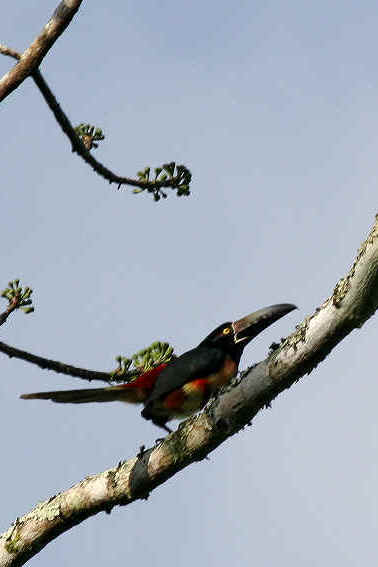
Collared Aracari
Panama is an isthmus, that is a "land
bridge" between two major continents. Birds, mammals, butterflies,
and plants of those two continents, South and North America, mesh
together in the relatively small, and certainly narrow country of Panama.
During our tour, February 3-9, 2006, we
traveled from the link between the two oceans, the
Panama Canal, east into Darien Province.
As we went east along the Pan American Highway,
toward and in Darien, we were going closer to South America. The birds we saw
reflected that.
(By the way, one can not drive on the Pan American Highway, or any road, from
Central America into South America. There's quite a gap in the highway in the
region where Panama and Colombia meet. As one drives eastward in Panama, the Pan
American highway dead-ends.)
Among the South American birds that reach their usual northern limit in Panama
are the Wattled Jacana, Southern Lapwing, Black-chested Jay, and Greater
Ani. These species, and some others, are routinely seen as far north as
(or west, depending how one views Panama) to the Canal Basin.
Some other South American species are more likely to be seen in eastern Panama
province and in that of Darien, including these:
Cocoi and Capped Herons, Red-and-green Macaw, Golden-green Woodpecker,
One-colored Becard, Pied Water-Tyrant, and Orange-crowned Oriole.
Some of the birds that we saw in eastern Panama in February '06 are restricted,
with a limited range, to only eastern Panama and adjacent Colombia. Birds in
this grouping included:
Double-banded Graytail, Black Antshrike, White-headed Wren, Black Oropendola,
and White-eared Conebill.
The last of these was one of our favorites. The species was in a small flock,
active in the trees, rather reminiscent of chickadees. Their plumage was also
somewhat similar, with their black-caps. Nearby on a treetop branch, a
black-and-white Pied Puffbird sat, as still as it could be.
One of the unique features of the Darien landscape, along the Pan American
Highway, are the large Cuipo Trees. Easily distinguished, and with huge
trunks, they are spread out across the countryside. Not only is there that big
tree in Darien, there are some big birds too, including these that we saw:
Wood Stork, Red-and-Green Macaw, King Vulture, and an assortment of other raptors,
including: Gray-headed Kite, Hook-billed Kite, Pearl Kite, Great Black Hawk,
Gray (-lined) Hawk, Roadside Hawk, Short-tailed Hawk, Crane Hawk, Yellow-headed
Caracara, American Kestrel, and one particular raptor that's quite
rare in Panama, the Bay-winged Hawk (known as the Harris' Hawk in
North America). We saw one, and had a good look at it, perched in a tree
quite close to the road.
In the book "A Guide to the Birds of Panama" by Robert Ridgely, it's
noted that the Bay-winged Hawk in Panama is "apparently rare", and
that there have been 3 "old specimens", one of which, incidentally,
was taken years ago near where we saw ours in February 2006.
Surely the best raptor (and one of the best birds) of our Feb '06
Panama Tour was the Red-throated Caracara. That species probably has the
unfortunate distinction of the being the Central American bird that has declined
the most in recent years. It's been in all of the Central American bird books,
including those for Mexico, Guatemala, Costa Rica, and Panama. But sightings in
countries north of Panama in recent years have either been very rare (in
maybe Costa Rica), or non-existent (north or west of there).
In "A Guide to the Birds of Mexico and Northern Central America" by
Steve Howell & Sophie Webb, published in 1995, it's written that there have
been "no reports (of the Red-throated Caracara) in over 20 years
west of the Sula Valley (in Honduras)". That goes back to the early 1970s.
In the "Birds of Guatemala", Hugh Land, published in 1970, it was
written that the bird was rare in the Pacific lowland of that country. Since
that time, suitable forest habitat there for the species has nearly completely
disappeared. Also, in that book, it's noted that the subspecies from Mexico to
Panama was Daptrius americanus guatemalensis.
More recent taxonomy (in "The Howard & Moore Complete Checklist of
the Birds of the World") is different. The only species still in the
genus Daptrius is the Black Caracara of the Amazonian
region of South America. The Red-throated Caracara is now the only member
of its own genus. It is Ibycter americanus, and, according to the
recent literature, there are no subspecies. If that subspecies guatemalensis
were still valid, it would be close to extinction.
In "A Guide to the Birds of Costa Rica" by F. Gary Stiles &
Alexander Skutch, published in 1989, it was written that the Red-throated
Caracara "is only in that country where forest remains intact in the
Golfo Dulce lowlands (of southwestern Costa Rica)". It had been,
according to that book, at one time, "widespread and fairly common in moist
and wet forests of both slopes from sea level locally up to 4,000 feet".
In "A Guide to the Birds of Panama" by Robert Ridgley, published in
1989, it's said that the Red-throated Caracara only "seems to remain
in Panama in any numbers in part of the eastern Panama province and in
Darien". It's also stated that the bird "disappeared from the Canal
Zone area during the 1950s and 1960s" and that it "was formerly known
to occur in the Chiriqui province of western Panama".
In South America, the Red-throated Caracara occurs where forest continues
in the Amazonian region.
Where there are Red-throated Caracaras (and they're normally in
groups), they're often heard before they're seen. They are loud and raucous.
At a distance its call can be similar to that of a macaw. The most common
call of the bird is a trumpeting and hoarse "khaaow", that is
sometimes varied to "ca-ca'-o". That's what Stiles & Skutch wrote.
Land wrote "the loud and harsh call sounds like the Spanish word 'cacao'
with the first syllable repeated several times".
During the FONT Feb '06 tour in Darien, as
we were in a boat traveling down a remote river, it was first the loud call of
the Red-throated Caracara that caught our attention (as noted, at
first sounding rather like a macaw). We continued further
along the river, and then we both heard and saw the birds (a few of them)
in trees on the west bank. At first, not everyone had the clear view that they
wanted of the species in the foliage. But it seemed as if the birds themselves
wanted to be better seen, as they stayed there, still in the trees, even as our
guide and boatman cleared away some of the lower branches that impeded the view.
After a few moments of that "clearing away" activity, a wonderful view
was miraculously had by all of that very-desired bird.
The Crane Hawks during that boat-ride, on the other hand, were seen very
easily, as they were down low on the dirt banks of the river, probing for food.
That unique hawk (the single member of its genus), with its long body and red
legs, was, of course, a treat for us to see as closely as we saw it.
Among other birds that we saw during that river boat-ride in Darien, there was
an Agami Heron (that one is always a treat to see!), both the Green-and-rufous
and the American Pygmy Kingfishers, Blue Ground Doves, a group of Purple-throated
Fruitcrows, Cinnamon Woodpecker, White-headed Wren, and both Yellow-backed
and Yellow-tailed Orioles.
In the lower foliage, Greater Anis were by the river.
In the upper branches of the trees, there were Collared Aracaris.
On branches out over the river, and in the river itself, there were Anhingas.
All 3 of the birds just mentioned, are with names (as you may have noticed)
beginning with the letter "a", (ani, aracari, and
anhinga). All of those names are from the language of the Tupi
tribe of indigenous people in Brazil. Our boatmen, along the remote
river in Darien, were indigenous people, not Tupi of course but the Embara
tribe. It was all really quite an experience for us in such a wild
area - and the "good birds" of course enhanced it
.
That Agami Heron, during our ride, that was stalking along the riverbank,
could not in any way ever be mistaken for an Anhinga, but it's true that the
long neck and the slender and angled head of the bird does bear a resemblance.
One can also wonder if the derivation of the name "Agami" for
that bird along the forest river is, like the Anhinga (and the Aracari
& Ani), from the Tupi tribe of Brazil, in the area of
the biggest of American rivers, the Amazon.
Yes, the Darien province of Panama is "wild", and seems to be just
about "everywhere". As one travels about, a good barometer of that is
when the constant calls of Tinamous (both Little and
Great) are heard, Generally, throughout Central America, it's been
that as the "wildness" of an area diminishes, those melodic calls of
tinamous decrease.
After nightfall, in the Darien countryside, there were the calls of many Pauraques.
As we went along a dirt road after dark, there were both Barn and Striped
Owls. The stars and planets shined brightly in the ever-so-clear sky
overhead.
Even though we had driven from Panama City, the noisy and bright accompaniment
of the city seemed (and really was) so very far away!
Back when we were in Panama City, by the way, earlier during the tour, we saw
two rarities for Panama: a Long-billed Curlew and a Ring-billed Gull.
Also earlier in the tour, when we in the Canal Basin, among the many birds
there, maybe our best sight was that of the strikingly attractive male Golden-collared
Manakin, as it was perched close to us. There are good birds to see and
enjoy just about anywhere in Panama!
But back again in Darien, this narrative now concludes in a small town, where
twice we spent the night.
By the road into that town, in a field, there was a Crested Bobwhite,
and in a marsh, there were Purple Gallinules. Further along the road, in
large trees, there were Black-chested Jays.
In the town, itself, in trees near the streets and houses, there always seemed
to be birds present. A number of them were common, yes, but it was nice to have
that number of them.
As we had breakfast, on a table outside by the sidewalk, among birds in view
there were:
Black-throated Mango, Streaked Flycatcher, other more-common
flycatchers, Tropical Mockingbird and Tropical Gnatcatcher, Bananaquits,
Yellow-crowned Euphonia, and an assortment of Tanagers including Blue-gray,
Palm, Plain-colored, Crimson-backed, and Lemon-rumped.
And don't let that name "Plain-colored" fool you. They're nice
to have, too, as all the other birds were.
Also, as we were having breakfast by the sidewalk in that town that morning,
with the birds about, people of the indigenous Kuna
tribe "somehow happened to came along" (after they
learned that we were there). They were in their colorful attire, selling
some also-colorful small sculptures of the more dramatic, big birds that occur
in that region of eastern Panama, away of course from the small town. Their
ceramic sculptures were of birds such as the Harpy Eagle, and toucans,
and parrots and macaws.
When we were there, in that small town, we didn't have to pinch ourselves to
realize that we were somewhere, very much away from what it is in our
"normal lives" - as we were in the remote countryside of wild Panama,
in Darien.