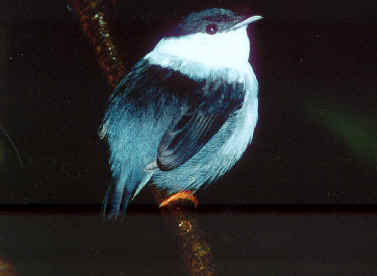
White-bearded Manakin
A Week of Neotropical Birding
in
Trinidad & tobago
September 18-26, 2004
with
an optional extension
on the Caribbean island
of Saint Lucia
until September 29
(tour: FON/TT-1)
Itinerary
(price follows):
Sat: Sep 18, '04: Arrival in Trinidad.
We'll go from the airport to the place that will be our base for 5 days, the Asa
Wright Nature Center in the Northern Range. Our first taste of the
wonderful neotropical birding that Trinidad has to offer will be there. Even
though it's an island, the avifauna of Trinidad is South American. There will be
great diversity. There are specialties, seen better in Trinidad & Tobago
than elsewhere, notably some hummingbirds such as the Tufted Coquette,
White-tailed Sabrewing, and Green-throated Mango. Our first of 5
nights at Asa Wright in the forested mountains of Trinidad, about the best of
places for one of the hummingbirds just mentioned, the coquette.
Sun:
Sep 19 thru Wed Sep 22:
Not only hummingbirds, but also other colorful tropical birds such as tanagers
and honeycreepers will be seen at Asa Wright. The Bearded
Bellbird inhabits the nearby forest. During an afternoon, we'll visit the
cave on the property with Oilbirds. Trinidad is one of the places in the
world where this nocturnal bird can be most accessibly seen (on the ledges in
the cave).
Away from Asa Wright, we'll be making some day-trips to other birding locales
with their own specialties.
Of course, among them the Caroni Swamp is
well-known, with its Scarlet Ibises, and Common Potoos, Boat-billed
Herons, Greater Anis, and passerines including Red-capped Cardinal
and Bicolored Conebill. Nearby in addition to possible Pinnated
Bittern and Rufescent Tiger-Heron, there could be Long-winged
Harrier, whistling-ducks, and maybe a crake or rail.
Also in the lowlands, in the area of the Aripo Savanna,
open-country birds should include Pearl Kite and Savanna Hawk,
along with flocks of Red-bellied Macaws and probably the beautiful Ruby-Topaz
Hummingbird.
Also in the area would be a number of flycatchers, including the Sulphury,
and the rare Moriche Oriole. In the woods of the area, there is the White-bellied
Antbird.
In the Arima Valley, another place that
we'll visit, is a bird that's a namesake of the island, the Trinidad Euphonia.
Along roads at various elevations in the mountains, there would be an assortment
of birds, including 3 species of trogons, Swallow-Tanager, other tanagers
including the Speckled, and the Lilac-tailed Parrotlet. At the
highest elevations, birds would include Blue-capped Tanager and Yellow-legged
Thrush.
There are number of nice raptors in Trinidad to be seen: Ornate Hawk-Eagle,
White Hawk, Gray-headed and Swallow-tailed Kites, and Bat Falcon,
just to name some.
There will be leks of 2 species of manakins to be enjoyed: the White-bearded
(pictured below) and the Golden-headed.
Big, obvious, and colorful Channel-billed Toucans will be in the
treetops. Lower in the forest, Black-crested and Barred Antshrikes,
Rufous-tailed Jacamars, and other tropical birds occur.
Mention has made here in this summary of just a fraction of the birds that we'll
see, and enjoy, in Trinidad.
White-bearded Manakin
Yes, there will certainly be enough in Trinidad to keep us busy for 5 days,
in a variety of places enabling each day to be different. 4 more nights
(thru Sep 22) at Asa Wright.
Thu Sep 23: A 20-minute flight in the
morning from Trinidad to the nearby smaller island of Tobago.
We'll spend two days on this island, with birding by yet another smaller nearby
island, Little Tobago. There are some birds
that are specialties of Tobago: the White-tailed Sabrewing (nearly
endemic) and the Blue-backed Manakin. The first of two nights on Tobago,
in Speyside.
Fri Sep 24: This day (and the morning of the
next), Tobago birding, with an emphasis on what's different than on Trinidad.
Birds on Tobago, and not on Trinidad, include: Rufous-vented Chachalaca,
White-fringed Antwren, and Scrub Greenlet (in addition to the White-tailed
Sabrewing and Blue-backed Manakin already mentioned). Some birds are
more readily seen on Tobago than on Trinidad, such as: Stripe-breasted
Spinetail and Venezuelan Flycatcher (the latter an isolated
population on Tobago). Notably more obvious on Tobago is the Blue-crowned
Motmot.
At Little Tobago Island, seabirds are of primary interest. Among our
objectives will be 3 species of boobies: Brown and Red-footed (that
nest) and Masked (that may roost). We'll take a boat-trip (for 2 hours)
around the island.
Back on Tobago, along Turtle Beach, where in
the morning fishermen pull their large fishing nets to shore, coastal seabirds
are also attracted in numbers. The pelicans, various terns and gulls,
and frigatebirds can be quite a spectacle.
In the forested interior of Tobago, among our birds there should be Collared
Trogon, in an area with a wholly different atmosphere, with lush, green
vegetation and clumps of bamboo. Our second night on Tobago.
Sat Sep 25: After a morning with our final
birding on Tobago, a flight back to Trinidad, where we'll spend the night near
the airport.
Sun Sep 26: Departure from Trinidad, either
for home, or on a flight to continue on the optional extension to the tour, on
the Caribbean island of Saint Lucia.
An
Optional extension with Birding for Caribbean specialty & endemic birds on
Saint Lucia:
Sun Sep 26: Arrival on the truly beautiful Caribbean island of St. Lucia, where we'll spend 3 nights.
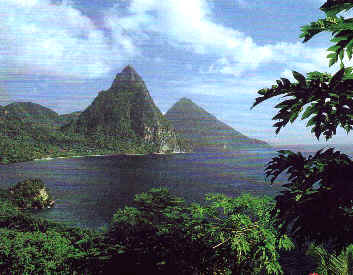
During our time on St. Lucia, we'll see some quite special birds. All of them have been seen during our previous tours there. The St. Lucia Parrot and the White-breasted Thrasher are the rarest. The newly-split Gray Trembler one of the most interesting. Endemic to St. Lucia, it's one of 5 species in the thrasher-group occurring on this one island. Other endemics include an oriole and a finch. Very attractive hummingbirds occur including 2 species of caribs. The "Saint Lucia Warbler" is another recent "split" having recently been part of the Adelaide's Warbler. The rare "Saint Lucia Wren" (a distinctive subspecies of the widespread House Wren) has been seen during our tours. Also during our past tours, we've enjoyed seeing and hearing the "St. Lucia Nightjar", now thought to be a population of the Rufous Nightjar of South America. During our visit, we'll try for all these birds again, along with whatever other birds may be there in September. We'll visit a superb forest reserve in the hills (the place for the parrot), a nice lagoon for waders (where rarities such as Little Egret have occurred), and a coastal cliff where Red-billed Tropicbirds and some tropical seabirds, such as boobies and 4 species of terns, can be seen.
Wed: Sep 29: Our final birding on Saint Lucia before departure for home.
Tour starts and ends at the airport in
Trinidad.
Flights for home from Saint Lucia could be either via Barbados or Puerto Rico
depending upon the airline used.
Prices:
For the Trinidad & Tobago tour: US$ 1,595 per person, based upon
double-occupancy. Single-supplement:
$295.
For
the Saint Lucia extension:
US$ 395 per person, based upon double-occupancy.
Single-supplement: $175
Includes:
All accommodations, all meals (in Trinidad), breakfasts & lunches
(on Tobago & St. Lucia), transportation on each of the islands, and services of the guides.
Does not include: Dinners (on Tobago & St. Lucia). Drinks & any other items of a personal nature. Gratuities. Air transportation, including flights to/from and between various islands. Airport taxes.
Tour to be led by Armas Hill, and local birding guides.
A deposit of US $400 is required to reserve a place on the tour.

A Selection of Some of the Birds of Trinidad & Tobago
Codes:
(t): classified as a globally threatened
or rare species by Birdlife International.
(t1): critical (t2): endangered (t3):
vulnerable
(nt): a near-threatened species.
Birds:
Little Tinamou
Brown Pelican
Brown Booby
Red-footed Booby
Masked Booby
Red-billed Tropicbird
Magnificent Frigatebird
Little Egret
Rufescent Tiger-Heron
Boat-billed Heron
Pinnated Bittern
Scarlet Ibis
White-cheeked Pintail
Gray-headed Kite
Swallow-tailed Kite
White-tailed Kite
Pearl Kite
Long-winged Harrier
White Hawk
Common Black-Hawk
Great Black-Hawk
Gray (-lined) Hawk
Savanna Hawk
Ornate Hawk-Eagle
Yellow-headed Caracara
Aplomado Falcon
Bat Falcon
Rufous-vented Chachalaca
Trinidad Piping-Guan (t1)
Azure Gallinule
Wattled Jacana
Southern Lapwing
Pale-vented Pigeon
Red-bellied Macaw
Lilac-tailed Parakeet
Green-rumped Parrotlet
Blue-headed Parrot
Orange-winged Parrot
Squirrel Cuckoo
Little Cuckoo
Mangrove Cuckoo
Dark-billed Cuckoo
Greater Ani
Barn Owl
Tropical Screech-Owl
Spectacled Owl
Striped Owl
Oilbird
Gray Potoo
Pauraque
White-tailed Nightjar
Nacunda Nighthawk
Chestnut-collared Swift
various hermits
Ruby-topaz Hummingbird
Black-throated Mango
Green-throated Mango
White-necked Jacobin
White-tailed Sabrewing (nt)
Tufted Coquette
Collared Trogon
White-tailed Trogon
Violaceous Trogon
Green Kingfisher
American Pygmy Kingfisher
Blue-crowned Motmot
Rufous-tailed Jacamar
Channel-billed Toucan
Chestnut Woodpecker
Straight-billed Woodcreeper
Olivaceous Woodcreeper
Yellow-chinned Spinetail
Stripe-breasted Spinetail
Pale-breasted Spinetail
Streaked Xenops
Great Antshrike
Barred Antshrike
Black-crested Antshrike
Plain Antvireo
White-fringed Antwren
White-bellied Antbird
Silvered Antbird
Black-faced Antthrush
White-headed Marsh-Tyrant
Pied Water-Tyrant
Venezuelan Flycatcher
Yellow-olive Flycatcher
Sulphury Flycatcher
Bran-colored Flycatcher
Yellow-breasted Flycatcher
Black-tailed Tityra
Bearded Bellbird
Golden-headed Manakin
White-bearded Manakin
Blue-backed Manakin
Scrub Greenlet
Rufous-breasted Wren
Long-billed Gnatwren
Yellow-legged Thrush
Golden-crowned Warbler
Masked Yellowthroat
Bicolored Conebill
Blue Dacnis
Purple Honeycreeper
Green Honeycreeper
Trinidad Euphonia
Swallow-Tanager
Speckled Tanager
Bay-headed Tanager
Turquoise Tanager
Blue-capped Tanager
Silver-beaked Tanager
White-lined Tanager
Crested Oropendola
Moriche Oriole
Yellow-rumped Cacique
Yellow-hooded Blackbird
Red-breasted Blackbird
Red-capped Cardinal
Black-faced Grassquit
