
PO Box 9021, Wilmington, DE 19809, USA
E-mail: font@focusonnature.com
Phone: Toll-free in USA, Canada, & Puerto Rico 1-800-721-9986
or 302/529-1876; Fax: 302/529-1085
PO Box 9021, Wilmington, DE
19809, USA
E-mail: font@focusonnature.com
Phone: Toll-free in USA, Canada, & Puerto Rico 1-800-721-9986
or 302/529-1876; Fax: 302/529-1085
HIGHLIGHTS
FROM OUR PAST BIRDING & NATURE TOURS in 2004
With
tour narratives, photos, comments by participants, and links to lists of birds
& other nature found during specific tours
INCLUDED
HERE ARE TOURS THAT TOOK PLACE IN:
ARGENTINA,
BRAZIL, CHILE, the CARIBBEAN (ST. Vincent & Barbados), JAPAN (late-fall),
and PANAMA.
& IN THE U.S. IN: CALIFORNIA & WASHINGTON STATE & PELAGIC TRIPS
OFFSHORE FROM NEW JERSEY & NEW YORK.
Other recent tours in: the CARIBBEAN (St. Lucia, St, Vincent, Dominica, &
Puerto Rico), GUATEMALA,
JAPAN (spring & winter), and PANAMA
& IN THE U.S. IN: COLORADO, KANSAS, NEW MEXICO, NORTH CAROLINA, TEXAS,
WYOMING, & PELAGIC TRIPS OFFSHORE FROM NEW JERSEY & NEW YORK
in:
Highlights from Past Tours in 2004 from Jun '04 back
thru Jan '04
The following tour summaries are given with the most-recent tours first. Click
the link for tours you find of interest.
In the summaries, there are further links to UPCOMING TOUR ITINERARIES,
BIRD-LISTS, and PHOTO GALLERIES
Links to particular tour highlights - from there, links to bird-lists:
The above tour with Blakiston's Fish-Owl, both
Steller's & White-tailed Eagles, 5 species of cranes, Black-faced Spoonbil,
and Copper Pheasant. Also on the island of Amami: the Amami Woodcock, Lidth's
Jay, Amami Thrush, Ryukyu Robin, and the rare Asian (or Swinhoe's) Yellow Rail.
Chile
(central: a Pacific pelagic and up to the Andes) - November 2004
In '04, a short-tour as an extension after
Argentina. With albatrosses on the Pacific and Andean condor in the mountains.
Among the endemic birds we saw, the Crag Chila & the Moustached Turca.
In '05, we'll be doing the longer, complete Chile tour again - south to Tierra
del Fuego, and north to Arica, at the Peruvian border.
Argentina (north-central & southern) - November 2004
This tour was to a land where a cardinal
is yellow and a meadowlark is red.
As many as 3 types of mockingbirds can sing at the same place. Also In that
area, there are flocks of colorful Patagonian Conures, perhaps better
known as Burrowing Parrots. Other birds during our tour were: Rusty-backed
Monjita, Carbonated Sierra-Finch (a sparkler), Cinnamon Warbling-Finch, Tucuman
Mountain-Finch, and Rufous-throated Dipper. All of these, endemic to Argentina,
except the dipper, which is nearly so.
Marine Mammals we saw along the Patagonian coast included Southern Right Whales
in the sounds, and Killer Whales (or Orcas) in the
surf.
Brazil (the far-south: Rio Grande do Sul, and Mato Grosso, and the southeast) - October 2004
During this tour, in the region of Brazil known as Mato Grosso, we saw the Harpy Eagle. That bird, the largest of the world's raptors. Also we saw the largest of the toucans, and the largest of the macaws: the Toco Toucan, and the Hyacinth Macaw. Brazil, the largest of South American countries, is a land of superlatives for birds.
West Coast USA (Washington State & central California) - September 2004
One of the highlights of this tour was a day
on a boat on the Puget Sound in Washington State, where we nicely saw 4 species of alcids &
a pod of Orcas, or Killer Whales.
Also, in the Cascade Mountains, we saw : American Three-toed Woodpecker, Gray Jay, & Pine Grosbeak. Further
east in Washington, we had a close encounter with a the Sooty Grouse (known,
when we saw it in 2004, as the Blue Grouse).
During the California portion of the tour, In central CA, on two fields, there
were incredible gatherings of thousands of Long-billed
Curlews & White-faced Ibises.
Pelagic Trip from Barnegat Light, NJ - September 2004
The above trip with 3 species of shearwaters, 2 species of jaegers (Pomarine & Long-tailed, 3 of the latter), 2 species of phalaropes, and a mammal that FLEW onto the boat! A Silver-haired Bat. (A photo of the bat is with the narrative.)
The above tour with antbirds, other birds,
& other nature on Barro Colorado Island.
Overall, a fine assortment of tropical birds: toucans & trogons, motmots
& manakins, & more.
Brazil (Iguacu Falls, Mato Grosso, & the Southeast) - July/August 2004
The above tour with Harpy Eagle in Mato Grosso. That bird, the largest of the world's raptors. Also we saw the largest of the toucans, and the largest of the macaws: the Toco Toucan, and the Hyacinth Macaw. Brazil, the largest of South American countries, is a land of superlatives for birds.
The Caribbean: St. Vincent & Barbados - July 2004
The above tour was one done in response to a
request, for some who were not able to go to the Caribbean in the spring. On St.
Vincent, we once again saw the bird endemics and specialties.
Barbados, although a small island without varied habitat, is still interesting
in that because it is the easternmost of the Antilles, shorebirds migrating from
north to south stop there during their journey. Such shorebird migration occurs
mostly in July and August. Most of the shorebirds that visit the island come, of
course, from North America. But, on a regular basis, there are strays from the
other side of the Atlantic, from Europe. During our tour, we saw 2 such species:
a Wood Sandpiper among Yellowlegs, and a Reeve (a female Ruff).
Barbados is also interesting in that another European bird has arrived there and
become established, the Little Egret. At a heronry we visited, Little &
Snowy Egrets were nesting next to each other, with about as many Littles as
there were Snowys.
North Carolina Landbirding - June 2004
This tour, an annual for years, has been a
short one, only a few days, designed for "Southern US bird
specialties", such as the Red-cockaded Woodpecker, Swainson's Warbler,
Bachman's Sparrow, Painted Bunting, and Wilson's Plover.
The link here goes to a narrative that only tells of the birds and other
wildlife during the tour, but also relates the story of birds that are "Carolinean".
Over a dozen species have Carolina in either their common or scientific names.
In relation to other nature, that also applies to a turtle, toad, anole, and
squirrel.
There are 5 species of birds (other than recent "splits", and
California's Yellow-billed Magpie and Condor) that are endemic to the
"Lower 48", We saw all of them during this tour. Read the narrative
relating to these 5 species, the 12-plus "Carolinean Birds", and an
overview of Carolinean ornithological history.
Japan,
Spring Birding - May 2004
This tour was on the main Japanese island of
Honshu, and the small, very small, offshore island of Hegura, where there's a
BIG migration of birds in the spring. During our 3 days on Hegura, thousands of
migrants came through, of numerous species. Among them, birds more normally seen
in mainland Asia than in Japan, such as: Swinhoe's Robin, Mugimaki Flycatcher,
Yellow-rumped Flycatcher, Black-naped Oriole, Chestnut Bunting, and Tristram's
Bunting. The Japanese Murrelet was seen from the ferry between Honshu and Hegura.
West Texas
& New Mexico - April/May 2004
During this tour we had excellent looks at 2
of the west Texas bird specialties, the Colima Warbler and Lucifer Hummingbird.
As we were watching the warbler sing its song in a low treetop, an animal known
as a Ringtail was, from an outcropping of rocks nearly at our feet, watching us.
Other birds that we watched during the tour included: Common Black Hawk, both
Varied & Painted Buntings, both Mountain & Western Bluebirds, both
Gambel's and Scaled Quails, and those 2 birds whose name begins with the letter
"p": Phainopepla and Pyrrhuloxia. Enjoyable during the tour were
encounters with Roadrunners, and the flowering plants that were blooming in the
desert.
Colorado & adjacent Kansas & Wyoming - April 2004
This tour is designed to see grouse at their lekking grounds, where they perform early in the morning. For us, in April '04, these included the 2 Prairie-Chickens, the Sharp-tailed, Blue, Greater Sage, and Gunnison Sage Grouse. Each species, and each morning, presented a different experience. Grouse are not the only birds during this tour, as we skirted around the beautiful state of Colorado, and dipped into some of the adjacent states. Among the other birds: Mountain Plover, McCown's & Chestnut-collared Longspurs, and Rosy-Finches. Among the mammals: Moose (we saw 10). Interesting was a spot we visited in far-eastern Colorado for Harris' Sparrow, where we also found, after some weather with strong winds, birds from the East including Worm-eating Warbler & Northern Parula (both out of range), & Cardinal, Brown Thrasher, and Red-bellied Woodpecker, not normally thought of as "Colorado birds".
During this tour, there was the Resplendent Quetzal, Three-wattled Bellbird, and an assortment of other birds in the highlands of Chiriqui.
Puerto
Rico - March 2004
&
the Lesser
Antilles (St. Lucia, St.
Vincent, Dominica) - Feb/Mar
2004
During this tour in Puerto Rico, we saw one of the rarest birds in the world, the Puerto Rican Parrot. We only saw 1, but there were, at that time, only about 30 in the wild. The parrot is 1 of 14 birds endemic to Puerto Rico. During the tour, we found all of them, plus 2 quasi-endemics, that also occur (or have occurred) in the nearby Virgin Islands: the Puerto Rican Flycatcher & Puerto Rican Screech-Owl. If the owl's still in the Virgin Islands, it's very rare there. But where we stay in the hills of Puerto Rico, it's still common, calling through the night.
Our tour in the Lesser Antilles was one not
for the "Pirates of the Caribbean", but for the "Parrots of the
Caribbean". Each of the 3 Lesser Antillean islands that we visited have
endemic Amazon parrots: St. Lucia, St. Vincent, and Dominica. The last of these
actually has two: the Red-necked & the rare Imperial Parrot, known
respectively on the island as the "Jaco" & the "Sisserou".
But there was an avian pirate observed during the tour: A frigatebird robbing
terns of fish.
At sunset, the "green flash" was seen from all 3 Lesser Antillean
islands.
Costa Rica (southern) - February 2004
During this tour, there were over 25 species of hummingbirds. 5 species of them were seen on their nests in the forest, including the White-tipped Sicklebill. Among the other birds: Resplendent Quetzal, Scarlet Macaw, Turquoise Cotinga, Pearl Kite, Striped Owl, and Orange-collared Manakins at a lek.
During this tour, highlights, among others, included the Blakiston's Fish-Owl, both White-tailed and Steller's Sea-Eagles, and among 6 species of cranes, the Siberian Crane.
During this tour, some of the highlights were a pair of Orange-breasted Falcons, a displaying Pheasant Cuckoo, Resplendent Quetzal, and Pink-headed Warbler.

Japan Late
Fall/Early Winter Birding Tour
(to Honshu, Hokkaido, Kyushu, & Amami)
December 2004
Links:
A Photo Gallery of Japanese Culture & Scenery, from our Dec '04 Tour
Upcoming Japan Tour Itineraries
This tour (our 23rd birding tour in
Japan) was a good one, with lots of nice birds, and some wonderful culture
and scenery, in a land very different for most of us. We went to the Japanese
islands of Honshu, Hokkaido, Kyushu, and Amami.
Between Honshu & Hokkaido, on the western side of the northern
Pacific Ocean, on November 30th, overnight pelagic
trip, onboard a large ferry.
During our Japanese tours, over a dozen years, we've done about 15 such ferry-pelagics,
mostly in January, but also in May, June, November, and December.
This time, there were no albatrosses (Laysan
is nearly always seen, and both Black-footed and Short-tailed have also been),
but there were a number of SEABIRDS.
The most common, this time, was the Black-legged Kittiwake. They occurred all-day. In all, there were thousands .
Other Gulls included Slaty-backed, Glaucous-winged, Black-tailed ,
and Vega.
Pomarine Jaegers were with us throughout the day.
In one area, there was a nice
number of Shearwaters, mostly Streaked, but also Short-tailed.. Other
oceanic birds were: Northern Fulmar, Fork-tailed Storm-Petrel,
Red-necked Phalarope, Pacifc Loon, and both Pelagic and Temminck's
Cormorants.
Alcids were the Rhinoceros Auklet and Ancient Murrelet.
During another pelagic trip, along that
ferry-route earlier this year, in
Such birding at sea is always with the unexpected. It's fun, and particularly pleasant, whether the ocean be either calm or rough, on such a large ferry in the western Pacific.
There is now a new, and
informative, feature elsewhere in our website entitled "Rare
Birds of Japan", relating to birds that have been mentioned
here, and others.
Whether you've seen the birds or
not (or whether or not you ever will), it's interesting reading. And
particularly so, in the "further notes" section, are the narratives
regarding the Short-tailed Albatross (a bird that came back from very
brink of extinction), the Siberian Crane (one of the most threatened of
all birds), and the Blakiston's Fish-Owl (one of the most mysterious of
birds, as it lives secretly in a remote area).
Also new in our website,
there's another feature that's really worth a look. It's a "Photographic
Sampling of Japanese Culture & Scenery", a series of photos
taken by one of the Canadian participants on our December 2004 Japan tour. The
photographs are not only beautiful, but quite interesting.
The December '04 tour was, as noted above, a very good one for birds. Some of the highlights were on the southern island of Kyushu, where between 2 and 3 thousand exquisite Mandarin Ducks were seen, and where we had a good look at the Copper Pheasant (a Japanese endemic that can be hard to see!)
During the December '04 Japan tour, many of the rarities that we had hoped to see were. Among those, with information in the file mentioned above, the "Rare Birds of Japan" were: Amami Thrush, Black-faced Spoonbill, Blakiston's Fish-Owl, Steller's Sea-Eagle, Red-crowned Crane, White-naped Crane, Hooded Crane, Amami Woodcock, Lidth's Jay, White-tailed Eagle, Copper Pheasant, and Ryukyu Robin.
A Photo Gallery of Japanese Culture & Scenery, from our Dec '04 Tour
Upcoming Japan Tour Itineraries

Chile
(central: a Pacific pelagic and up to the Andes)
November 2004
Links:
List of Birds & Other Wildlife during our Chile Tour in Nov '04
Cumulative List of Birds during our Chile Tours 1990-2004
Upcoming Chile Tour Itineraries
During our annual FONT birding tour in Chile, in November 2004, we conducted on November 15th our 15th pelagic trip to Humboldt Current waters offshore from Valparaiso.
This time, we probably saw MORE SEABIRDS during the trip than we have during any other. The vast majority of them, SOOTY SHEARWATERS.
As we left shore, there were swarms of birds ahead of us on the horizon. We headed in that direction, and soon we were among them, in masses of SOOTY SHEARWATERS all around us. Mostly they were in their swift flight. The experience was incredible. As we plowed through, there were also large flocks of PHALAROPES sitting on the water and flying (mostly RED, some RED-NECKED). Big flocks flew by FRANKLIN'S GULLS. As we continued, and the numbers of SOOTY SHEARWATERS around us began to decrease, those of PINK-FOOTED SHEARWATERS increased. There were thousands of them.
Our estimates were "a hundred
thousand" or more SOOTY SHEARWATERS,
5,000 or more PINK-FOOTED SHEARWATERS,
2,000 or more FRANKLIN'S GULLS,
and 3,000 PHALAROPES (about 10 to 1, RED to RED-NECKED)
And, there were other SEABIRDS,
particularly as we "chummed" by tossing out from the boat fish-parts
and fish oil.
We were surrounded, as we did that, by
ALBATROSSES, GIANT-PETRELS, PINTADOS (or CAPE PETRELS), WHITE-CHINNED PETRELS,
STORM-PETRELS, BOOBIES ,FULMARS, GULLS, TERNS and PELICANS.
A single PERUVIAN DIVING-PETREL flew by.
The ALBATROSSES (or MOLLYMAWKS) were
BLACK-BROWED (10) and the SALVIN'S (6).
There were 12 CAPE PETRELS, 3 SOUTHERN
FULMARS, 6 SOUTHERN GIANT-PETRELS, and 50 WHITE-CHINNED.
Attracted to the chum slick were over 30
WILSON'S STORM-PETRELS. Numbers by the boat of PERUVIAN BOOBIES and PERUVIAN (or
CHILEAN) PELICANS were also about 30 each. There were about 20 SOUTH AMERICAN
TERNS and 10 INCA TERNS. KELP GULLS were about 200 around us.
With all the birds, it was odd not to get a species less common for Chile, as we often have in the past. These would those such as the Westland Petrel, another species of albatross, a skua, or Little Shearwater.
With the ocean swells as they were, we could not go further west to a "belt" where we might have gotten the pterodromas, the Masatierra (or DeFilippi's) Petrel or the Juan Fernandez Petrel.
But even so, it was a tremendous trip (those 4 hours or so) that morning with the masses of oceanic birds. Quite an experience, for sure!
And interesting to think about how we all
came together from different places in the world.
Those of us on the boat (in addition to
the Chilean crew) were from various parts of the US and from the UK.
Among those birds around us, the SALVIN'S
ALBATROSSES were visitors from many miles across the Pacific in New Zealand
where they nest. The SOOTY SHEARWATERS had journeyed thousands miles around the
Pacific on their way back to breeding sites in the Southern Hemisphere. The
PINK-FOOTED SHEARWATERS which breed on Chilean offshore islands had also just
been far away in the Pacific. The PHALAROPES had nested earlier in the year in
the far-northern tundra of Canada and Alaska. The FRANKLIN'S GULLS did so on the
inland plains of North America.
And yet all these birds were with us,
totaling thousands of individuals, on November 15, 2004, off the coast of
central Chile!
List of Birds & Other
Wildlife during our Chile Tour in Nov '04
Upcoming Chile Tour Itineraries
List of Birds & Other Wildlife during our Argentina Tour in Nov '04
Upcoming Argentina Tour Itineraries
Links:
List of Birds & Other Wildlife during our Brazil Oct '04 Tour
Upcoming Brazil Tour Itineraries
During our October 2004 FONT birding tour in the far-southern Brazilian state of Rio Grande do Sul, some oceanic birds were seen on the South Atlantic Ocean. However, they were not seen offshore, but from shore. And from where we could walk, that's right, walk, from shore.
There's a long jetty, of rocks and concrete, that extends over 2 kilometers into the ocean, from a beach by an inlet. SOUTHERN SEA-LIONS and BOTTLE-NOSED DOLPHINS, feeding by the jetty, indicated that in the waters there were fish. Fishermen camped on the jetty indicated that as well. And so there would also be SEABIRDS.
The most common of which at the end of
the jetty were WILSON'S STORM-PETRELS, with their dangling feet behind them as
they fed on the smooth water surface. There were about 50 of them, where GREAT
GREBES were diving for fish beneath the surface.
And of course, there were GULLS, mostly KELP.
But, as we later drove along the beach, south from the jetty, there were yet
more birds, among them TERNS (7 species SOUTH AMERICAN, COMMON, SNOWY-CROWNED,
CAYENNE, ROYAL, YELLOW-BILLED, and ANTARCTIC).
And PARASITIC JAEGERS were sitting on the beach, both the dark and light morphs.
They stayed, tamely, as we watched them from the windows of our vehicle.
We drove further. We almost could have driven indefinitely, but we stopped where
just offshore, beyond the surf, there were fishing boats, and with them, soaring
BLACK-BROWED ALBATROSSES and WHITE-CHINNED PETRELS.
Certainly, not a bad oceanic day, without ever having been on a boat!
List of Birds & Other Wildlife during our Brazil Oct '04 Tour
Upcoming Brazil Tour Itineraries
List of Birds during our West Coast USA Tour - Sept. '04
Upcoming
West Coast USA Tour Itinerary for Sept. '05
Panama
August, 2004
List of Birds during our Panama Tour - August '04
Upcoming Panama Tour Itineraries
Pelagic
Trip from Barnegat Light, NJ
September 12, 2004
Links:
Upcoming East Coast Pelagic Trips
Our annual FONT
late-summer pelagic trip to the Hudson Canyon, off New
Jersey & New York, took place overnight on
September 11/12, 2004. The consensus was "a great trip".
Our thanks to the captain, his wife (for our always-appreciated food spread),
our leaders, and particularly our participants.
The water temperature out at the Hudson Canyon was about 71 degrees. It was a
beautiful day with calm waters.
Among the bird highlights were 3 juvenile LONG-TAILED JAEGERS (in close!),
including 2 together on the way back about 40 miles offshore sitting on the very
calm water where there lots of jellyfish.
There were good numbers of CORY'S SHEARWATERS around trawlers. 2 AUDUBON'S
SHEARWATERS were seen, as were 2 GREATER SHEARWATERS.
There were both RED-NECKED and RED PHALAROPES. A MERLIN was seen attacking
phalaropes on the water.
There only landbird was a female AMERICAN REDSTART which landed on the boat.
But the "star of the day", and a "life mammal" for most on
board, was a SILVER-HAIRED BAT (photo below). It was first noticed flying above
the boat at about 10:30am. It landed on the top of the cabin, and was identified
by an experienced "bat-man" as a Silver-haired. The bat then took off
only to land on the beard of one of the birders onboard. It flew again and
landed atop another participant's head, with the back of the bat's head
underneath the brim of the person's hat. "A bat in the hat!" The bat
was gently removed and placed on a gear bag on the upper deck (as in the
photograph below). The bat climbed to the inner portion of the bag and stayed
there through the remainder of the voyage. Once back on shore, it was placed on
the tire of an abandoned trailer, and seemed content.
The SILVER-HAIRED BAT was first seen about 70 miles offshore. It is one of just
a few species of bats that migrate long distances sometimes out over the ocean.
RED BATS have been seen during previous pelagic trips, but for us, this
SILVER-TAILED was a first.
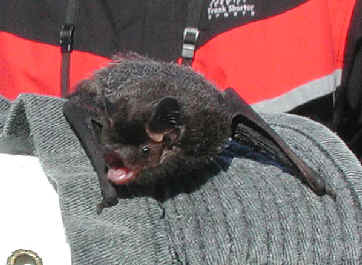
A Silver-haired Bat that
came on our boat
70 miles offshore from New Jersey on Sept. 12, 2004.
(Photograph by Jonathan Klizas)
Marine mammals
during our Sep 12 '04 trip included COMMON (or SADDLEBACK) DOLPHINS, and RISSO'S
DOLPHINS (also known as GRAY GRAMPUS).
Birds seen offshore during our Sep 12 '04 from Barnegat
Light NJ included:
Cory's Shearwaters - 150
Greater Shearwater - 2
Audubon's Shearwaters - 2
Wilson's Storm-Petrels - 300
Red-necked Phalaropes - 25
Red Phalaropes - 2
Pomarine Jaegers - 3
Long-tailed Jaegers - 3
South Polar Skua - 1
Lesser Black-backed Gulls - 2
Merlin -1
American Redstart - 1
Mammals:
Common Dolphin - 6
Risso's Dolphin - 6
Silver-haired Bat - 1
Upcoming East Coast Pelagic Trips
Brazil
(Iguacu
Falls, Mato Grosso, & the Southeast)
July/August 2004
(with some notes
regarding our subsequent tour in October '04)
Links:
List of Birds & Other Wildlife during our Brazil Jul/Aug '04 Tour
Upcoming Brazil Tour Itineraries
This July/August tour was the first
of two for us in Brazil in 2004, during which we saw the Harpy Eagle.
Actually, there was one particular young bird that we were to see two times in
the same area of a nest in a southern Mato Grosso
forest. The second tour was two months later, in October.
It was quite interesting to see how the young bird, that was already large in
August, had increased in size by October.
In August, when it stood on a branch up in a huge tree, the immature Harpy appeared
to dwarf a nearby Gray-lined Hawk standing on a branch of another tree.
The young Harpy Eagle, stayed in just about the same area, in a large tree or
two, during both of our visits, in August & October. During the August tour,
we also saw the adult female Harpy, in the top of another huge tree in nearby
forest.
During both tours, in August and in October, the young bird begged loudly for
food. We never saw the adult come to the nest, but we knew it recently had, as
during the second day of our stay in the area, the youngster was observed
tearing apart its meal and eating it. When the begged, it gave a single call,
repeatedly, that could be heard far away from the bird. At times, the bird gave
consecutively as many as 25 to 30 calls. In a telescope (or even binoculars),
during each call, the red coloration inside its mouth could be seen. Each time
it called, the big young bird elastically moved its wings, up and down. Both of
our experiences with the Harpy Eagle (in August & in October) were
tremendous.
As noted, the Harpy Eagle, when still young, was already a very big bird.
The female of the species is the largest of the world's raptors. Overall, the
species is the most powerful of birds. A massive Harpy Eagle can weigh nearly 20
pounds (about twice the weight of the Bald Eagle of North America). Prey
includes monkeys, sloths, and porcupines. For those creatures in particular, but
also in a general sense, the Harpy Eagle is undoubtedly the world's most
formidable bird.
The Harpy Eagle is seldom seen soaring high above the treetops in the
forest. It habitually enters is nest, high in the tallest trees, from below. The
short, broad wings of the bird enables almost vertical movement through the
trees. The nest is a platform of large sticks, initially about 4 feet
across and 2 feet thick. More is added to it in later years, getting it up 5
feet in diameter and 4 feet thick.
A juvenile, when between 8 and 10 months of age, enter its first immature molt,
and has a well-developed power of flight. However, at that age, (as the was bird
we saw in October), it is still entirely dependent on adults for food. Such a
young bird generally stays in its nesting territory, within a radius of 100
yards of the nest tree. That large tree is used by the youngster for its
perching.
About a half-hour after sunrise, a juvenile bird begins calling. If especially
hungry, it flaps its wings, as it calls, perhaps "signaling" to its
parent. (In the first paragraph here, this repetitive calling & signaling
was referred to.) Food is not brought by the adult every day. Sometimes, it
comes as infrequently as once in 5 days. Later, as the parent feeds the young
bird even less, the young Harpy Eagle's food-begging call changes to a
combination of a "scream" and a pathetic "whine". The long
period of dependence of a juvenile on its parents suggest that adults nest not
annually but in a cycle of a year and a half to two years. A new bird when grown
must find its own territory. As noted above, a pair of Harpy Eagles can use a
nest repeatedly.
We look forward to having a "Harpy Experience", as we did twice
in '04, repeatedly as
well.
List of Birds & Other Wildlife during our Brazil Jul/Aug '04 Tour
Upcoming Brazil Tour Itineraries
The
Caribbean: Barbados & St. Vincent
July 2004
Links:
List of Birds & Other Wildlife during our Caribbean '04 Tours
Upcoming Caribbean Tour Itineraries
North
CarolinA LANDBIRDING
June 2004
Links:
Cumulative List of Birds & Other Wildlife during our North Carolina Tours
Upcoming
North Carolina Tour Itineraries
The following account written by Armas Hill, leader of the tour.
"Nothing much Finer than Birding in Carolina"
Since 1992, during the late-spring, FONT has conducted a land-birding tour in eastern North Carolina for bird specialties. And with good reason, as it is, and has been for a long time, a great place for birds and for those who have either studied or enjoyed them.
We were there again this year, June 7-11, 2004, when we visited basically 3 regions including the river-bottom forest of the upper Neuse Valley, the pine-woods and other habitats of the central North Carolina coast, and areas of the northern Outer Banks. Roanoke Island, and the nearby mainland.
Due to the Carolinas' role in
ornithological history, a number of birds have been actually become identified
as "Carolinean". Probably more birds are in that category than
even many bird enthusiasts realize.
Obvious are the CAROLINA CHICKADEE and the CAROLINA WREN.
And such identification has normally becomes permanent. In one case, that of the
CAROLINA PARAKEET, the name has unfortunately outlived the bird.
Other birds labeled "Carolinean" may not as quickly come to mind,
particularly those with the reference in their scientific names.
Such as:
Caprimulgus carolinensis, the CHUCK-WILL'S-WIDOW,
Sitta carolinensis, the WHITE-BREASTED NUTHATCH,
Melanerpes carolinus, the RED-BELLIED WOODPECKER,
Dumetella carolinensis, the GRAY CATBIRD,
Pelecanus occidentalis carolinensis, the BROWN PELICAN,
Pandion haliaetus carolinensis, the OSPREY,
Zenaida macroura carolinensus, the MOURNING DOVE,
and one of the birds with "Carolina" in its common name also has the
reference in its scientific nomenclature the CAROLINA CHICKADEE is Parus carolinensis.
All of the birds noted here so far were seen during our June 7-11, 2004 North Carolina landbirding tour (with the exception, of course, of the CAROLINA PARAKEET).
And the above list of birds with a
Carolinean name identity is not exhaustive. There are more:
Porzana carolina, the SORA,
Euphagus carolinus, the RUSTY BLACKBIRD,
Junco hyemalis carolinensis, a subspecies of the DARK-EYED JUNCO,
and Anas crecca carolinensis, what has been the American form of the
GREEN-WINGED TEAL. If considered distinct from the Eurasian form, the separate
species would be Anas carolinensis.
And, interestingly, some forms of
wildlife other than birds that are named "Carolinean" include:
Terrapene carolina, the EASTERN BOX TURTLE,
Anolis carolinensis, the CAROLINA ANOLE,
and in the mammal-department, one that's familiar (maybe too familiar) to
all of us:
Sciurus carolinensis, the EASTERN GRAY SQUIRREL!
And yet one more creature labeled "Carolinean" was one that we heard during twilight in pinelands, where BACHMAN'S SPARROWS sang and RED-COCKADED WOODPECKERS nested. The sound was lamb-like, a nasal "baaa", that came from the EASTERN NARROWMOUTH TOAD, Gastrophyrne carolinensis.
But, regarding birds, part of the reason
why there's so much Carolinean in names is because there was so much early
exploration and bird study that took place in the beginning days of what's now
North & South Carolina.
And in the early 1700's, that was prior to the standardization, as we now know
it, of common, and particularly scientific, names.
The renowned Swedish taxonomist, Carolus Linnaenus, had much to do with that standardizing, in a global sense. His major accomplishment, the publication of his "Systema Naturae" was in 1758. In it, for example, a common bird of the Carolinas, the MOCKINGBIRD, was described. Others were later. For example, it was in 1766 that Linnaenus described the CATBIRD as Dumetella carolinensis.
Much about the early Carolinean avifauna was included in the work published in 1731 by Mark Catesby, entitled the "A Natural History of the Carolinas, Florida, & the Bahamas". Volumes sold in England at 2 guineas each.
Catesby referred to the work by two men who, when in North Carolina, contributed much to early American ornithology, John White and John Lawson.
John White was the first to draw
American birds extensively (he drew 32 species). His work was in a book by John
Lawson entitled "A New Voyage to Carolina", published in 1709.
White actually made 4 voyages to the New World. On the second, in 1587, he went
as the governor of 150 settlers at Sir Walter Raleigh's colony on Roanoke
Island, North Carolina.
(We stayed one overnight on that island during our June '04 tour.)
When John White was on Roanoke Island,
his daughter and her husband, were parents to the first English child born in
America, Virginia Dare. Thereafter, John White had to leave Roanoke Island to go
to England. When he returned to Roanoke Island in 1590, he found little trace of
the colony and none of the colonists who stayed when he left.
A listing of the 32 bird species drawn by John White is in a feature elsewhere
in this web-site: North Carolina Birds & Other Wildlife
John Lawson, the author of the book "A New Voyage to Carolina" in 1709, was, prior to that, a co-founder of North Carolina's oldest town, a place named Bath. His book was the first major attempt at a natural history in the New World. It became popular in Europe because of its vivid descriptions of the North American Indians and their customs, but in it also were good descriptions of newly-found birds and animals. Over 100 species of birds were noted in the book, and a listing of them (with names given by Lawson) are in the North Carolina feature elsewhere in this web-site, just referred to above.
In 1711, Lawson was in a party exploring,
in North Carolina, the Neuse River, determining how far inland it was navigable.
During that venture, he was killed by Indians.
(During our '04 tour, some of our best birding was in the upper Neuse River
Valley, particularly at a wonderful reserve called Howell
Woods.)
The feeders at Howell are a wonderful
place to nicely see some attractive birds indeed. Those feeders there are
somehow without Grackles, Starlings, and the like. Rather, there are (and were
for us) RED-HEADED WOODPECKERS (& 2 other woodpecker species),
EASTERN BLUEBIRDS (called BLEW BIRDS in the days of White, Lawson, and
Catesby), along with BROWN-HEADED NUTHATCH (and the WHITE-BREASTED
NUTHATCH, remember, Sitta carolinensis). Bright and
colorful AMERICAN GOLDFINCHES and CARDINALS were there in numbers, as a male
SUMMER TANAGER was not far away (called the "SUMMER RED-BIRD" by
Catesby). Added to the avian mix were CHIPPING SPARROWS and BROWN THRASHER.
A NORTHERN BOBWHITE walked through the feeder area. Nearby, GREAT CRESTED
FLYCATCHERS were nesting in a tree-hole. Maybe a dozen RUBY-THROATED
HUMMINGBIRDS were coming to the feeders, with the brilliant gorget of the male,
up close, just dazzling.
It was a nice place to sit in the shade and simply enjoy the birds.
The assortment of habitats throughout the Howell property contain a large number of birds to be enjoyed. At the edges of the woods, there were both BLUE GROSBEAKS and INDIGO BUNTINGS. In the woods, there are numerous WARBLERS (about a dozen species breed) including PROTHONOTARY, HOODED, KENTUCKY, and SWAINSON'S.
But it was a bird most apt to be seen in the sky that we sought to see, and did the MISSISSIPPI KITE, a raptor that when aerial can be acrobatic catching insects, particularly dragonflies. This area of the upper Neuse valley has been good for us for the MISSISSIPPI KITE over the years.
This year (2004), north of North Carolina, for whatever reason, MISSISSIPPI KITES have been causing enjoyment for a number of birders in places such as Maryland and New Jersey. Maybe due to the 17-year CICADA, maybe not.
During our tour in North Carolina, we encountered no 17-year CICADAS (when they were locally common to the north). But we did see at Howell, in addition to the KITES (which nest there), a large number of various DRAGONFLIES (see list elsewhere in our web-site).
An aside for a moment regarding the name MISSISSIPPI KITE it's really not as common in Mississippi as it is other places. It's most common, during the North American summer, in the Central US, in Oklahoma for example. During the Southern American summer, that's where it is.
Some other birds with common names relating to a place where the bird is not as common as it is elsewhere include the CONNECTICUT WARBLER and PHILADELPHIA VIREO.
Some of the "nice birds" that
we saw in North Carolina in June '04 seem to be getting less common overall.
That's the case with one of our best birds, the RED-COCKADED WOODPECKER.
According to Birdlife International, this bird of the pines (LONGLEAF, SHORTLEAF,
SLASH, and LOBLOLLY), declined overall during the decade 1980-90 by about 25 per
cent. It is now limited to about 30 isolated populations, with the most in South
Carolina and Florida. About 50 percent are now in just 6 of those populations.
North Carolina is now the north edge of
the RED-COCKADED'S range. We saw the species in an area where it has
traditionally nested, in the Croatan Forest.
But it was only one pair, that we encountered this year, at an active nest.
RED-COCKADED WOODPECKERS have nested as far north as Maryland in the 1960's (not
many, a few were discovered there only in the 1930's). In the 1970's,
RED-COCKADED nested in Virginia. Now, no longer, as they are not north of
southern North Carolina.
Another bird, enjoyed during our 0'4 NC
Tour, with a range that has been receding south, is the WILSON'S PLOVER.
The first specimen of the species was, in 1813, collected by Alexander Wilson,
in southern New Jersey (at present-day Cape May). The WILSON'S PLOVER,
until not that long ago, nested north of North Carolina, along the beaches of
the Delmarva Peninsula and New Jersey. It's occurrence now is as a rarity.
During our tour, a particularly enjoyable venture was an afternoon boat-ride to an offshore barrier island, where no one lives, and where there are no roads. So, no houses and no cars. Only a pristine beach and dunes, by eastern US or Carolina standards, rather unaffected by people. We walked the beach to the sandy area adjacent to one of the inlets where we saw well about 8 WILSON'S PLOVERS.
One thinks, sometimes, about birds that
appear to be (or actually are) declining.
The RED-COCKADED WOODPECKER and WILSON'S PLOVER have just been mentioned.
At another spot along the Carolina coast, we saw the RED KNOT, a long-distance
migrant in the Americas that's had a depreciable decline in recent years.
WHIP-POOR-WILLS and NIGHTHAWKS seem, on the basis of our previous experience, to
be declining.
While RED-HEADED WOODPECKERS were seen when we were in North Carolina at a few
places (particularly where we were looking for the RED-COCKADED WOODPECKER),
that species has declined (ever disappeared) from many places it has been in the
northeastern US.
Conversely, it comes to mind, that from a beach where we were watching SANDWICH and other TERNS feeding in the water, that the BROWN PELICAN is in greater numbers than it has been in the past. A few decades ago, the species was in trouble. No longer so, as its numbers have increased, and it's expanded north - that bird of the mid-Atlantic coast known as Pelecanus occidentalis carolinensis.
A Carolina bird-speciality of the pinewoods, formerly known as the "PINEWOODS SPARROW" seemed to continue in relatively stable numbers. That bird, most often known as the BACHMAN'S SPARROW, is named after a Carolinean (a South Carolinean) of the early 1800's.
The "Carolinean bird" with which we had the most contact during our evening and after-dark excursions was the CHUCK-WILL'S-WIDOW, Caprimulgus carolinensis. But our best encounter in the dark was when, as we were going along a remote dirt road, we heard in a roadside tree, a young owl. We stopped the vehicle, and within moments, there was an adult BARRED OWL, that also came on the scene. It was looking directly at us, with its big brown eyes, just a few feet away, in the shine of our headlights.
But a bird that we enjoyed as much as (if
not more than) any other during the tour was one that would come out to sing up
in a tree and atop a bush late in the afternoon, the PAINTED BUNTING. It reaches
the northern limit of its breeding range along the southern North Carolina
coast. What a nice bird, the adult male is to see, with bright blue, green, and
red.
It was a target to be seen for all of us, and we loved it!
Reading about the PAINTED BUNTING in the
historical book noted earlier, written by Mark Catesby in 1731, we learn that to
the south, the Spanish colonists called the bird the "MARIPOSA PINTADA",
the "PAINTED BUTTERFLY".
In that book, we also read that back in those days, it was commonly kept as a
popular caged bird. A governor of South Carolina at that time kept 4 or 5 of the
colorful songsters in cages.
In New Orleans, among the French inhabitants, the bird was also very popular as
a cage-bird. During a visit there, Alexander Wilson wrote of it as being the
most common of the birds kept in homes. A name given to it was 'NONPAREIL".
Of course, the brilliant adult males were favored. It became known that it took
over a year for the males to attain their colorful plumage.
During our tour, we saw a few males, some still dull, others bright.
It's nice to know that nowadays, the only way people enjoy the sight and sound
of the PAINTED BUNTING is as we did, in the wild. (Native birds in the US can
no longer be kept as caged birds.)
Referring to birds in the US, here's a
trivia question of sorts:
Other than some very localized, sometimes recently "split" species
(such as 2 of the Scrub-Jays, the Gunnison Sage-Grouse, Juniper Titmouse, the
re-introduced California Condor, and the Yellow-billed Magpie, actually endemic
to California):
What species are endemic to only the Lower 48 States?
There are not many: RED-COCKADED WOODPECKER, FISH CROW, CAROLINA CHICKADEE, BACHMAN'S SPARROW, BOAT-TAILED GRACKLE.
We saw all of these during our North Carolina tour. (This comes to mind as one of our participants was a Canadian, and for him 3 of these species were "lifers" .)
And if you think that one might have been forgotten, the BROWN-HEADED NUTHATCH also resides in the Bahamas.
The best mammal experience we had during our '04 North Carolina tour was when we came upon a group of 8 River Otters, frolicking together in a pond.
There are listings of birds, as well as the other wildlife, that have been found cumulatively during FONT North Carolina Tours, elsewhere in our web-site.
Birds & Other Wildlife during previous North Carolina Tours
Upcoming North Carolina Tour Itineraries
Links:
List of Birds & Other Wildlife during our May '04 Japan Tour
Cumulative List of Birds during our Spring Tours in Japan
Cumulative List of Birds during our Tours in Japan
Upcoming
Japan Tour Itineraries
The following account written by Armas Hill, leader of
the tour.
"Japan in the Spring, with Lots of Birds on a Little Island"
This was our 22nd FONT birding tour in Japan.
14 have been in the winter, and the tour just done was our 8th in the spring.
And it was our 3rd tour with a visit to a most intriguing place, the tiny Hegura
Island in the Sea of Japan - one
of the best places anywhere to experience and enjoy a spring migration of birds.
That island, Hegura, certainly is small. It's less than 1 kilometer wide and less than 2 kilometers long. One can walk the path around the entire coastline of the island in less than an hour.
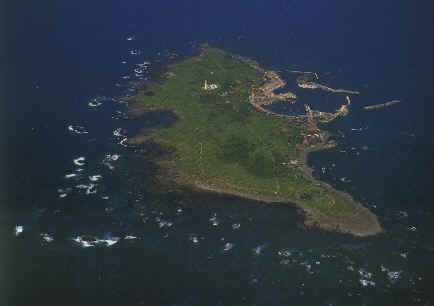
Some people live on that small island. But not many, about 50. In the morning, the women of Hegura dive for seaweed. Later in the day, if sunny, they put it out to dry. Men go out on boats to fish.
There was a small store on the island. But no longer. When I asked a young Japanese girl who spoke some English, how, for example, she would buy food or other items, she told me she would order such things on the internet, and they would be brought on the ferry, from the small city of Wajima, about two hours away by boat.
There is a school on the island, with an enrollment of 5 students.
Fortunately, something that does exist on the island is a small inn, where visitors, such as us, can sleep Japanese-style on the floor, and where meals, Japanese-style, can be eaten. Assorted seafood, along with locally-grown seaweed, locally-grown vegetables, and noodles and rice are served. But the place is great for 2 or 3 days not just to experience some rural Japanese living, but to have, virtually outside the door, some truly tremendous birding during spring migration.
A bit more can be said about the island, off the west coast of Japan, and east of Korea and south of Manchuria. Birds that pass through Hegura, arriving either at night or by day, include not only those that travel north through Japan, but also some species more common in those other lands of Korea and Manchuria.
The tallest structure on the island is a white lighthouse, located near a small woodlot, where the traveling birds stop to rest. The pines and other short trees and bushes, are for a while the haunts of migrating birds. Others occur in such places as a field of tall grass, a small garden, the playground of the school, or in the debris that may be strewn by the buildings. Birds can be anywhere. Along the path that encircles the island, there are about six shrines by the sea, near the mostly rocky coastline. Birds of various kinds are to be found in that setting, in the rocks or by the pools.
The ferry goes once a day, each direction, between Wajima and Hergura Island, in the morning to the island, late in the afternoon from it. During the ferry-rides, there can be nice seabirding. In the spring, the endemic alcid, known in English as the Japanese Murrelet, and in Japanese as the "Kanmuri-umisuzume", can be seen. "Umisuzume" is a Japanese word meaning "sea sparrow". Another alcid in those waters is the Rhinoceros Auklet. Streaked Shearwaters can be seen in large numbers from the ferry, as can Red-necked Phalaropes. On our way to Hegura this time, there was a Red Phalarope or two among the flocks of Red-necked. On our way from Hegura, we went through an area with swarms of Streaked Shearwaters. There were hundreds of them flying about near the boat.
On the island itself, during our 3-day visit that was part of the Spring '04 FONT Japanese birding tour, about a hundred species were found. In that total, there were landbirds (many), shorebirds and waterbirds. Probably more species, and more individual birds, can be found on Hegura during a good day or two in May than maybe anywhere else in Japan. And with the strong probability of rarities, there's the potential for more birding excitement in the spring on Hegura than at any other Japanese locale.
For that reason, not just the birds but Japanese birders migrate to Hegura in the spring en mass. Again of us, this time on Hegura as during our previous times, we mingled with a number of Japanese birders, even with our differences in language and culture notwithstanding. Our experience in a place so far away from our homes, and so different than where we live, will always be remembered.
Another experience that's fascinating, no matter where it is in the world, is to be in the midst of a major bird migration. It can be done at various particular spots in the world, some of which are well-known such as Point Pelee in Canada in the spring, Cape May in the eastern US and Falsterbo in southern Sweden, both in the fall. But the phenomenon on Hegura Island off Japan in the spring, with the right conditions, is about as good as it gets.
The "bird island" of Hegura can be for a birder a bit like a "fantasy island". It's a place where one can become immersed in birds. It's also a place so very far removed from our everyday lives, without hustle or bustle. Just to relate in perspective how special a place Hegura can be to a Japanese birder, we met some who found it worthwhile to travel for more than a day in each direction, between their homes and Hegura, in order to spend even just a few hours on the island between the ferry-arrival in the morning and the ferry-departure in the afternoon.
Also interesting to think about is how much time the migrating birds spend on the island. Some birds seem to stay more than a day. Others seem to be island-bound just a short time. Some Hobbies and Peregrines that appeared to arrive during an afternoon, to perch in pine trees and on a communications tower, were gone the next morning. During one day, Cuckoos heard calling were mostly Oriental. The following day, the sound of the Common Cuckoos was more predominant.
One thing that's especially good about birding on Hegura is that birds that can elsewhere be notorious skulkers are often more readily seen. In that category, on Hegura in the spring, are birds such as the shy Japanese Robin (mostly in late-April), the Siberian Blue Robin (mostly in early to mid-May), and the White's Ground Thrush (in April & May).
Routine spring-time migrants on Hegura, come from the southeast Asian tropics and continue onward to their northern breeding grounds. Hence, the adjective "Siberian" occurs more than once. Such birds include the Siberian Rubythroat, Siberian Stonechat, and the Siberian Thrush (in addition to the Siberian Blue Robin, already mentioned). Others include the Yellow-breasted Bunting and the Blue-and-white Flycatcher, with males of both bright and colorful.
Already mentioned, in regard to Hegura, has been aspect of birds occurring that are more commonly seen on the Asian mainland than they are otherwise in Japan. Birds in that category during our '04 tour included the Swinhoe's Robin, Mugimaki Flycatcher, Tricolored Flycatcher, Black-naped Oriole, Tristram's Bunting, and Chestnut Bunting. Trevor, in our group, who had migrated from Australia to join us, was lucky to see all of these. Lucky, yes, but the birds were due as much to his persistence, as he walked almost as much as one could in Australia (in order to be "at the right place at the right time").
During one of our days on Hegura in May '04, Mugimaki Flycatchers were actually common. That Japanese name notwithstanding, the species is normally a rarity in Japan.
In one area on the island, in brush by a garden, there were over a half-dozen Chestnut Buntings, with an assortment of buntings of other kinds. None of them were more attractive than the male Chestnut (its coloration chestnut and yellow). To go where the Chestnut Bunting would be seen in its attractive attire on its breeding grounds, one would go to the region of Manchuria and eastern Siberia.
Some mostly bright-yellow Black-naped Orioles were seen during our tour. They also breed in Manchuria, as well as in Korea and China.
To see such birds as the bunting and the oriole and other of Asia on the island less than a kilometer wide certainly involves a lot less travel would be required elsewhere.
Some Old World Flycatchers were particularly abundant for us on Hegura in mid-May '04. In addition to the Blue-and-white (the male when low in a bush is a beauty), and the rare Tricolored and the Mugimaki, there were others in the flycatcher tribe the Asian Brown, the Sooty (or Dark-sided), the Gray-streaked, and the Narcissus, the last of these a particularly attractive Japanese bird. They don't come much more attractive.
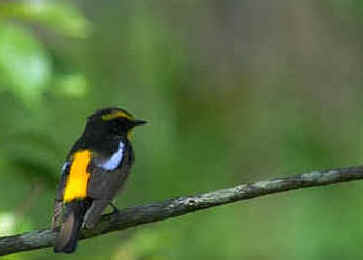
Old World Warblers are quite different than those of the New World. While the latter are considerably more colorful, the former can be more challenging to ID. But that's not as hard to do when one flies into a window of the inn where we stayed, and then stunned, it can be held in the hand - as it was in the hand of Ellen from Massachusetts. That Arctic Warbler (the borealis subspecies, with the yellowish vent) did recover. A short while after its colliding with the window, it was well to fly away - it would have a long way yet to go to the northern hinterlands of Siberia. Other migrating warblers included the Hume's (formerly Yellow-browed), the Sikhalin (formerly Pale-legged) and the Eastern Crowned. The latter was the most common, but any of them could be found in any tree or bush.
One of the 3 species of Old World Cuckoos that we saw, the Lesser, was seen sitting on a rock by the sea, as it rested before it would continue on its way.
3 species of Shrikes were seen during our '04 tour on Hegura. The Bull-headed is common throughout much of Japan, but there were also fine looks at the Tiger (or Thick-billed) Shrike, and the Brown. The latter is a much more attractive bird than its name implies.
Among the Thrushes we saw on Hegura, again the name Brown is not quite enough for that bird with a reddish breast that rather resembles an American Robin. Other thrushes during the tour included the Dusky, the Eye-browed, the Pale (another weak name), and the Japanese Grey, in addition to the Siberian and White's Ground Thrush already mentioned. All of these were migrants on the island. The Blue Rock Thrush (with a chestnut belly) is a resident.
A small group of Ashy Minivets arrived on the island, appearing in low trees by the inn, just as we were about to go for the ferry to leave the island. How good it was for such nice birds to come right to us as we had just about run out of time (and as our weary feet were about to make their one last island-walk to the dock).
One last, interesting thing about the birds of Hegura. A number of the birds most common on the main Japanese islands, such as Honshu, are absent, or nearly so, on Hegura. There are no Tree Sparrows or Grey Starlings. Bulbuls and White-eyes are few and far between. There are some crows, but not many. Woodpeckers and tits do not occur. Nor do birds such as the Japanese Wagtail (which is common only a couple hours away) or the Japanese Green Pheasant. All the birds noted in this paragraph are among the most common throughout much of Japan. For example, in virtually every Japanese city, Eurasian Tree Sparrows are abundant. (It's an interesting side-note that there are no House Sparrows anywhere in Japan. Yes, birds are different there on the other side of the world.)
Cumulatively, 127 species of birds have
been seen during the 3 FONT tours on Hegura Island. About a hundred species were
seen in May '04. A cumulative list of these Birds on Hegura is elsewhere in this
web-site.
There were also birds, of course, seen elsewhere during our May '04 Japan
Spring Birding Tour, other than on Hegura.
Among the best were these:
Along the west coast of Japan, in some trees that were budding, birds, mostly Bulbuls were feeding. But among them were some absolutely beautiful waxwings, Bohemian Waxwings, that occur in Japan as wanderers mostly in the winter. Japanese Waxwings also winter in Japan, but our birds were with red and white on the wings and yellow on the tails.
On a small pond in central Honshu, there was another species still present that's more apt to be a Japanese winter visitor. There was a pair of Smews, a red-headed female, and a brilliantly patterned black-and-white male.
Shorebirds (called waders in the Old World) were enjoyed in eastern Honshu, with many, during their northward migration, in fine breeding plumage. Particularly nice, in an area of mudflats, were Bar-tailed Godwits, Mongolian Plovers, and Great Knot.
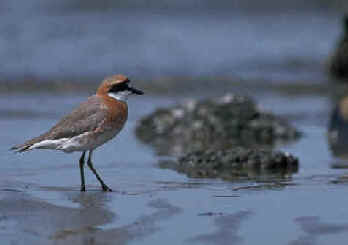
In flooded rice-fields, there were many to see including Sharp-tailed Sandpiper, Curlew Sandpiper, Red-necked Stint, Dunlin, Terek Sandpiper, Whimbrel, Pacific Golden Plover, Snipe, Ruddy Turnstone, and Grey-tailed Tattler. Such traveling shorebirds are nice to see anywhere in the world that they happen to be, especially when in their nuptial attire.
In a reedy marshland, we saw two specialties the Japanese Reed Bunting as it sang its song, and the Japanese Marsh Warbler as it did its aerial display. In the Birdlife International publication, "Threatened Birds of the World", both of these rare & localized Japanese breeders have alternate names the Ochre-rumped Bunting and the Marsh Grassbird. To Japanese birders, they're known, respectively, as ""Ko-jurin" and "O-sekka".
Nearby, another avian denizen of the Japanese marshes was making its loud racket, the Oriental Great Reed Warbler, called the "O-yoshikiri" in Japanese. Its noisy calls were incessant, in whatever language.
That should give somewhat of an image of our most-recent spring birding tour in Japan.
In 2005, from May 14 to 31, when again we'll visit that small island that's a magnet for birds, Hegura. Other islands will be visited as well Amami, Okinawa (where there's an endemic rail that's only been known to science for a couple decades, and an endemic woodpecker that may well be the rarest in the world). And also, on the island of Kyushu, we'll go for the most colorful of Japanese birds, the Fairy Pitta.
Information about this upcoming Japanese birding tour is elsewhere in this web-site.
List of Birds & Other Wildlife during our Japan Spring Tour in '04
Bird-List from previous Japan tours in the Spring
Cumulative List of Birds during our Tours in Japan
Upcoming Japan Birding Tour Itineraries
Texas
& nearby New Mexico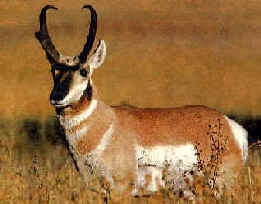
April-May 2004
Upcoming FONT Birding & Nature Tours in Texas
Birds
and Other Wildlife during FONT tours
in west Texas & New Mexico
A Complete List of Texas Birds
The following narrative was written by Armas Hill, leader of the tour. In it, in addition to birds & animals that were seen in west Texas during our present-day tour (Apr/May '04), there's a reference to life was that was in that region in days long gone by. In that regard, the largest animal now known to have ever flown is referred to - a creature called
Quetzalcoatlus. Of course, it's the largest known to have ever flown - it's Texas."Pronghorns & Longhorns, the Colima & a Ringtail"
During our tour in west Texas and nearby New Mexico, April 25 to May 3, 2004, Pronghorns and Longhorns were among the creatures seen.
Actually, there were many more Pronghorns, the graceful and attractive wild antelopes of the American West. They can move at considerable speed.
Not moving much at all, were the fascinating Longhorn Cattle that were seen. We didn't see many, but they were a sight out on the rather barren land by the Chihuahuan Desert.
The Chihuahuan Desert is the largest desert in North America. There had been some rains prior to our visit, and the plants were blooming. Flowers, some yellow, white, red, and other colors, were amopng the agave, prickly pear and other cacti, cholias, ocotillo, lechuguilla, acacia, yucca, and candelilla. Yes, the desert was a nice place to be, and we were there at a good time.
Our tour in Texas was in the
area known as the "Trans-Pecos" -
that is generally the 10% or so of the huge state west of the Pecos River.
Pecos, by the way, is one of the
west Texan towns through which we traveled. It was, at one time, a rough
frontier town. Today, times there seem a bit rough.
To give an idea of what it's like around Pecos, let's note that north of there,
along the main highway, is a town with a population of 20, that is the only
town in the least populated county in the Lower 48 States. (The
county population fluctuates, but it's about 110. There are more Turkey
Vultures in the county than
there are people.)
We traveled in this region of desert, former frontier towns, pronghorns and longhorns, actually to see birds, and other wildlife. And that we did, with 145 species of birds, along with a nice assortment of animals.
In western Texas, 3 particular regions that we visited to see birds and other nature were the Guadalupe Mountains (the highest in Texas), the more-rolling Davis Mountains, and the various habitats of Big Bend National Park including the Chisos Mountains.
In nearby New Mexico, we visited an array of habitats in a relatively small area (by "Western standards") near Carlsbad Caverns, where the caves are known for their bats. A target-bird of that region is the Cave Swallow, which was actually nesting outside the door of one of our overnight accommodations. As we slept inside, the swallows were doing so outside.
Other birds that we saw in that region of
New Mexico included:
Scissor-tailed Flycatcher, in an
agricultural area (about as far
west as the species regularly occurs),
Varied Buntings, a pair of them
that appeared to be nesting in the mountains,
a Golden Eagle, circling overhead above a mountain butte,
Common Poorwills, at dusk,
sitting on dirt roads, and adding to the sounds at dusk,
Lesser Nighthawks, many of them
together, after dark, catching insects by lights along a road.
By day, Black-chinned Hummingbirds were seen on their nests,
Canyon Wrens were both seen and
heard, with their songs echoing from cliff-sides,
and Cactus Wrens were ubiquitous.
Phainopepla and Pyrrhuloxia
were seen (easier to see than to
say).
At one place with green trees and a springs, surrounded by habitats with brown, we saw red - lots of red, with numerous Cardinals, Summer Tanagers, House Finches, and Vermilion Flycatchers (for a red bird, the adult male is about as good as it gets).
We also, in New Mexico, saw our share of yellow in the Yellow-breasted Chat, Yellow Warbler, Yellow-headed Blackbird, and Scott's Oriole. Our glimpse at the yellow of a MacGillivray's Warbler was a bit quicker.
Not just Inca Doves, but now Eurasian Collared-Dove is in the Carlsbad area.
For a tour mostly in Texas, as just noted, our New Mexico birding was not at all bad.
But there were a number of birds that, of course, we saw in Texas, that were only seen in Texas:
One of the primary avian-targets of a
west Texas tour is the Colima Warbler. The species only occurs in the
United States in the Chisos Mountains in Big Bend National Park in Texas.
Otherwise it is Mexican.
We had a wonderful encounter with this targeted-bird.
After walking a couple hours up a mountain trail, being "trailed"
ourselves by tame and seemingly-hungry Mexican Jays (how could they be
that hungry?), we were in a beautiful area with a comfortable temperature.
It was there where we enjoyed the sight and sound of the Colima, not far
in front of us, singing as it sat on a bare branch atop an oak tree.
As we were watching the warbler, we saw that we in turn were being watched. Also in front of us, in some large rocks beneath the oaks, there was first a head, and then an entire animal. It was close, and it was curious. It was a Ringtail, an animal somewhat similar to a Raccoon, but slimmer, with a long, bushy, striped tail. According to "the book", the Ringtail is "strictly nocturnal". That Ringtail did not read the book.
Those of us who went further up the mountain trail, encountered a singing Painted Redstart, another warbler most-often in Mexico.
Another bird more apt to be in Mexico than the US, and another prime avian-target of our tour was the Lucifer Hummingbird. It's another specialty of the Big Bend area, where we saw in the nicely an area of desert with flowering plants. Undoubtedly attracted to those agave stalks, male Lucifer Hummingbirds sat in good view for us to see (in a scope). The small hummingbird with a long bill, long tail, and a wonderful purple gorget, was quite a sight. Nice to see, as well, was a male doing its aerial display flight.
Some other birds in that area, also seen, but so much in the open were the Crissal Thrasher and Gray Vireo. A pair of Verdins were nicely seen at their nest.
Notable among the raptors that we saw in the Trans-Pecos region of west Texas, were Common Black-Hawk in the Davis Mountains, and Harris's Hawk in the Rio Grande Valley.
Particularly enjoyed in the Chihuahuan Desert (either in the Rio Grande Valley and/or elsewhere) were some birds that stayed close to the ground Roadrunners (we have some great looks) and both Gambel's and Scaled Quail.
In the open country of the Davis Mountains, there were Bluebirds. Mostly Western Bluebirds, but also Mountain Bluebird (a lingerer from the winter).
In the town of Fort Davis, feeders at a small lot attracted birds. At the hummingbird feeders, there were Black-chinned Hummers, both males and females. At the feeders with seeds, there were a number of Goldfinches, both Lesser and American.
In small trees and bushes of the Guadalupe Mountains, birds included Red-naped Sapsucker (apparently another lingerer from the winter), and Western Tanager and Townsend's Solitaire (these apparently resting during their migration).
Also migrating were some birds
we saw in areas of open water near Pecos. Notable among them, and quite
attractive, were many Wilson's Phalaropes. Also attractive, in their
breeding attire, were American Avocets.
Nice to see, and somewhat unexpected, were Least Terns.
Thus, this has been a summary of some of the birds we saw in West Texas and New Mexico, during our Spring '04 tour.
However, it was not only birds, and some animals, and flowers, that we saw during the tour. It was also an area with some very spectacular scenery of the Southwestern US.
In that area, one could stand and look, and with an imagination, and having read a bit about what was there historically, the mind could revert to other days there a long time ago. That's the way I'll now end this narrative
Today, it's birds that fly in the skies of west Texas. And bats and insects also. However, in days now long gone, as many as millions of years ago, in those skies of Big Bend and nearby, there were other creatures that flew.
If we'd been able to have
observed them, to us they would have been astounding. They were Pterosaurs,
or flying reptiles, in the Age of Dinosaurs.
Birds, it's commonly accepted, are said to have evolved from reptiles in that
age.
The largest animal now known to have ever flown under its own power did
so in the skies of what's now west Texas. It's wing-span was nearly 40 feet. The
name given to that amazing creature, that once was, is Quetzalcoatlus
northropi. It's named after a feathered serpent Aztec god. (Today,
further south in the Americas, from Mexico to Panama, there's a living bird also
named after that god. That bird, the Resplendent Quetzal,
has been called the most beautiful bird in the world.)
But referring again to Quetzalcoatlus
That incredible creature has only become known to science rather recently. The
first specimen of it was found in the early 1970s. It was part of a wing. Since
that initial specimen was found, a number of smaller individuals have also been
discovered, about 25 miles from where the first specimen was obtained. These
specimens in combination give a fairly good idea of what Quetzalcoatlus was
like. All of the specimens are from the end of the Cretaceous Period (of the
Mesozoic Era), about 66 million years ago.
Pterosaurs, such as Quetzalcoatus,
died out near the time of the extinction of the dinosaurs. Thus it was that
those flying dinosaurs, like Quetzalcoatus, and smaller ones (as small as
sparrows), actually overlapped with birds for about half the time they
existed.
Such are fascinating thoughts that one can have, about creatures that once were, in western Texas skies, as we look for and observe birds in that area today. Yes, fascinating it is. It can make our imaginations run wild regarding the flying dinosaurs, once there, as small as sparrows, and as large as Quetzalcoatus northropi, a giant with a 40-foot wing-span, that's now known as the largest creature that's ever flown.
List
of Birds & Other Wildlife during our Apr/May '04 tour in west Texas &
New Mexico
A Complete List of Texas Birds
Our Texas birding tour in Apr/May '05 will be crossing the state, from east to west.
Upcoming Texas Tour Itineraries
Colorado,
nearby Kansas & Wyoming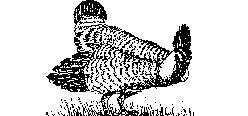
April 2004
Links:
Birds & Other Wildlife during our Colorado tour in '04
Birds & Other Wildlife during previous tours in Colorado & nearby states
Birds & Other Wildlife during previous Colorado Tours in April
A Feature - the Grouse of Colorado & Kansas
Upcoming Colorado Tour Itineraries
The following account written by Armas Hill, leader of the tour.
"Grouse, Grosbeaks, and a Worm-eating Warbler"
One of the most enjoyable of American bird-related experiences is to watch the various species of grouse in the West performing at their leks in the spring. Males display there annually as they court females.
During our April 16-25, 2004 FONT tour, mostly in Colorado, we had the good fortune to observe nicely 6 Grouse species, each doing their distinctive displays in habitats as varied as in sage country surrounded by snow-capped mountains (the Greater-Sage), in picturesque rolling open hills (the Sharp-tailed and the Blue), and in grassy prairies (the 2 Prairie Chickens). All of the species sought were seen very well (the 5 just mentioned, and the rather recently-split Gunnison's Sage Grouse).
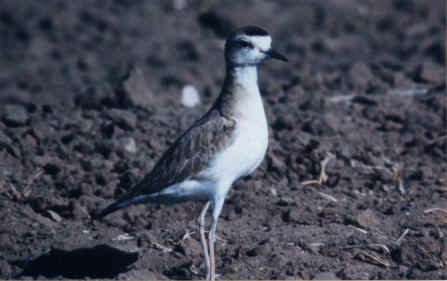
Geographically, this tour in the American West, in addition to being in Colorado, included some adjacent states. It was in Kansas where we observed an early-morning performance of the endangered Lesser Prairie-Chicken, and where, not far away, we also enjoyed a close-up and unexpected view of another threatened species, the Mountain Plover. We had stopped along a little-used road to look, to the left, at Burrowing Owls that were among a Prairie Dog colony. To the right, on the ground just a few feet away, but blending in, was the plover.
We also visited, for short periods, the
states of Oklahoma and Nebraska.
In Oklahoma, we did not spend much time. Nor
did we see any extraordinary birds, although Loggerhead Shrike and Vesper
Sparrow are always nice to see. In Nebraska,
near the northeastern Colorado border, there is a place, however, that must be
mentioned. It's the small town of Haigler, a
place that's seen, well, better days (maybe)! Last year, along the main road
near Haigler, there was a speed-trap. That's all I'll say, but this year I
wanted to take a moment in the town to see where the money went. Well, we spend
more than a moment. Not that there was a restaurant, stores, or anything to keep
us. There wasn't. But the town would be a mecca for a photographer, let's say,
with a theme of "what's become of buildings that were something back
when..." .
Actually, however, there are some people living in the town. Generally modest
homes are along the few streets. But never in one place would one find such a
hodgepodge of stuff as in Haigler. On the lawns and along the streets, there
were things and more things, decorations of all sorts and colors, statues and
woodcarvings, and the like. Another name for the town, that we thought
appropriate, would be "Tacky, Nebracky". Among all of the things,
there were bird-feeders - a plethora of bird-feeders. We surmised that with so
many there would have to be an interesting bird or two. However, each and every
one of the feeders contained what would be called "bird junk food" -
you know, that "wrong kind of seed". And so it was that the little
town was absolutely filled with House Sparrows, Starlings, Grackles, and Red-winged
Blackbirds. There were House Finches, and Goldfinches
(actually these were rather refreshing to see, as were some Chipping Sparrows).
As Eurasian Collared-Doves have spread north, they found Haigler, and
stayed there in numbers, flourishing. Also in numbers overhead, were floating Turkey
Vultures, which apparently roost along the outskirts of the little town.
Not only were there seed-feeders in Haigler, but also some hummingbird
feeders. I asked a man with a filled hummingbird feeder on his property if he
knew what kind of hummingbird would be there. He told me he had never seen one
there, but the feeder, he indicated, was ready if one were to come.
Also outside Colorado, we spent more time in Wyoming, where among some of the best birds of the tour that were not grouse, were those that were at a fine set of feeders in the high-country during a snow-fall. They included both Pine and Evening Grosbeaks, Red Crossbill, and Cassin's Finch, in addition to 3 types of juncos.
In all, 160 types of birds were observed during our week-long tour. 14 species were found outside of Colorado only; the rest were in the state.
As noted, there were birds enjoyed other than grouse. But it was the birds in that group that were the highlights. The tour was structured so that early on given mornings, we would be at the appropriate locales for particular species.
Blue Grouse
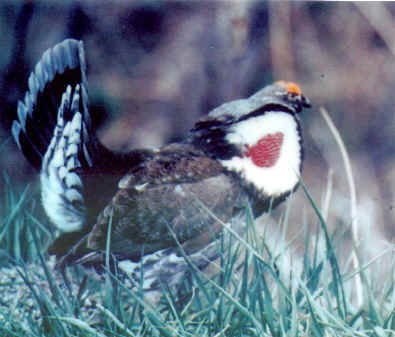
During one morning, we were able to observe 2 grouse species at virtually the same time, when there was a group of Sharp-tailed Grouse like "wind-up dolls" strutting on a bare hillside, as nearby male Blue Grouse were seen booming. Another Blue Grouse, in that area, as it walked along a dirt road, came to within feet of us. As we were watching those grouse that morning, we were hearing the calls of Sandhill Cranes that were nesting in the area.
Probably our best encounter with grouse during the tour, and the one that most of us enjoyed the most, was that with the Greater Sage-Grouse. At the end of what had already been a fine day, and after a quick dinner, we went to a particular road out in the countryside, where, from our experience during previous tours, we expected the grouse to be. And that they were! That evening, there were about 50 of them, either on the road, or close by the road. As evening turned to night, the grouse stayed. Some were directly in front of our vehicle, in the shine of the headlights, as we watched them display right in front of us. Others were so close, outside the open door of our van, that at times we thought one or two would come inside with us!
The displaying of the Sage Grouse brought to mind the traditional dances of the Native American Indians who also lived in that open sage country of the West. The male grouse spread their tails to become like spiked fans. They draw back their heads. And, as the birds did in the shine of our headlights, they inflate their chests, giving an appearance of two large eggs "over easy". As they do this, they make double-hooting and pumping sounds. Watching this is one of the most spectacular experiences an observer can have with any North American bird.
A similar bird, restricted to a range that's mostly in Colorado, and actually nearly endemic to the state, is one that was until recently considered a subspecies of the "Sage Grouse". Now, a distinct species, it's called the Gunnison Sage-Grouse, and during our '04 tour, we had our best experience with it yet. Further away from us than the Greater Sage-Grouse, but still nice in a telescope, was the display that we witnessed early in the morning, as the day brightened. Coyotes passed by the lekking site, but the birds stayed and their show was a good one. (Last year, when coyotes came, just before sunrise, the grouse flew off.)
The 2 species of Prairie-Chickens during our tour this year deserve further mention. They, like the other grouse, are great to watch doing their early-morning displays. During our '04 tour, we saw about a dozen Lesser Prairie Chickens performing at daybreak at one of their favored places to do so in the grasslands. A great show! Included were some birds that had the habit of jumping up from the ground to be atop low bushes. The 30 or so Greater Prairie Chickens that we saw this year did their displaying on a mowed portion of an alfalfa field.
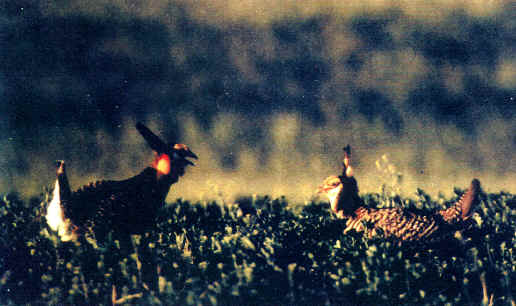
Some background information regarding each of the species of grouse that we saw during our tour in Colorado and adjacent Kansas can be found elsewhere in this website.
A Feature about the Grouse.Now, referring to some birds other than grouse that we saw and enjoyed during our tour:
In the high country of northwestern Colorado and nearby Wyoming, Mountain Bluebirds were much in evidence that they were migrating north. Against a background of snow, the blue of dozens of males was quite nice.
Also, that day in the "quite nice category", was a Golden Eagle very close to us along the side of the road. As snow was lightly falling, the eagle stayed, perched on a post. Carrion, a deer that had been hit, was nearby on the ground.
Further up the road, at a farm, on a trailer behind a parked tractor, there was hay. In it, apparently, there was something that Yellow-headed Blackbirds found favorable, as there were at least a couple dozen of them feeding on the top of the hay.
Later that day, at a bird-feeder of a
more conventional sort, at a nature center, among the birds there were a few Brown-capped
Rosy-Finches. That species, of course, is a Colorado target. Two other
Rosy-finch species that can occur there in the winter, were simply not there in
'04, the Black and Gray-crowned.
Raptors of northwestern Colorado that was particularly nice to see were the
"gray ghosts in flight", male Northern Harriers, and Rough-legged
Hawks not yet departed for further north.
On the native grasslands of northeast Colorado, two species that were great to see were the McCown's and Chestnut-collared Longspurs. They were also great to hear, as they sang and did their displays.
In southwestern Colorado, in an appropriate habitat, the Juniper Titmouse was a good find. As was, nearby, a Lucy's Warbler.
In southeastern Colorado, again in an
appropriate habitat for a particular bird, we saw that bird well. It was the Snowy
Plover. There were a few on an alkaline lake flat. Nearby, along the
shoreline where there was more water, there were both Marbled Godwit and Long-billed
Curlew, with bills upturned and downturned respectively.
Nearby, At another lake, with more water, there was a nice number of Bonaparte's
Gulls in breeding plumage.
Along a fast-flowing stream in a central Colorado canyon, we watched a Dipper, out of and in the water. Thanks, Sally, for leading us to it.
In the mountains of central Colorado, we particularly enjoyed our encounters with some corvids that liked to be fed peanuts Clark's Nutcrackers, Gray Jays, and Steller's Jays were all fond of the treats that we put out for them from the van. They came in closely.
Earlier in the tour, during the day when we traveled the entire width of Kansas from south to north, we had an interesting time in regard to weather. Nearly that entire day was in open, flat farm country. In the past, for us, a good day for numbers of Swainson's Hawks, Ferruginous Hawk, and other birds of the plains. This day, however, what we were to remember the most was the wind. There a noticeable breeze in the morning, but it was not hampering. At one spot, we got out of the van to get a better angle to see a young Great Horned Owl sitting in a nest of sticks in a lone tree, the only tree for miles. When we walked, we flushed a female Bobwhite from its nest on the ground. To do that (and we did not know we would), the bird must nearly be stepped on. Then, after an abrupt flight, it sits ever so still on the ground, blending in.
Later, within an hour, it became virtually impossible in the strong wind, to even step out of the van, let alone flush a Bobwhite or see an owl. Bunch after bunch of Tumbleweed rolled across the flat land, from west to east. Dust rose from the dirt on the ground, and actually at places became blinding as we drove north. We stopped during mid-afternoon in the small community by I-70 called Goodland, Kansas to get some gas. The wind there was so very strong that I had to literally hold on to something (anything) as I pumped the gas. Against the wind, the door of the convenience store was truly a challenge to open.
That evening, after we settled in for the night in Wray, Colorado, we saw the TV report regarding the strong winds that buffeted the open Colorado-Kansas countryside earlier that day. It was indicated that the strongest of the winds were recorded, during mid-afternoon, in that place called Goodland, Kansas. Sustained winds were 60 miles per hour. Gusts were higher. I-70, the main east-west highway, was closed that afternoon due to the blinding dust. Along that highway, during such conditions, nearly 30 vehicles were involved in a crash.
The next morning (windless, by the way), after we had seen Greater Prairie-Chickens performing at daybreak, and after breakfast, we opted to go to a farm east of Wray, where there's a small grove of trees that during each of our previous tours had produced birds. Particularly, in the brush there, I remembered seeing, during other years, Harris' Sparrows.
This year there, again, Harris' Sparrows were there. Two of them were seen nicely. And lots of other birds were there too, in the brush and in the trees. But apparent this time were birds of the East. Not just Eastern Phoebe, and Eastern Bluebird, but also much in evidence were Cardinals singing, Red-bellied Woodpeckers calling, Blue Jays scolding, and Brown Thrasher not making a sound at all. With these birds it was a bit like being somewhere in the East such as Delaware. We had to remember that we were in the West in Colorado. In addition to seeing the eastern birds just noted, there was more that morning. Totally unexpected were 2 birds out of range, both of them warblers from southeast North America. Both were found up in the trees by Richard from New York. His good eyes got us on the first surprise, a Worm-eating Warbler, and then there was a Northern Parula! The range maps for both of these show that their normal haunts are many miles away from that one grove of trees.
Also interesting in the warbler-department at that spot was that both the more-easterly Myrtle and the westerly Audubon's were present. We saw breeding-plumaged males there of both of these forms of the Yellow-rumped Warbler.
But going back for a moment to the Worm-eating Warbler that we saw in Colorado, I don't know how many records there would be for that species in the state, but there can not be many. That little bird that's less than 6 inches long, must have had, the previous day, the ride of its life in the 60 mph winds! One has to assume that rode the winds from somewhere that it would more normally be such as the Gulf Coast of far-eastern Texas. The species migrates to there in the spring from Central America.
Here, now, are the "Top Birds" of the FONT April 2004 Tour in Colorado & adjacent states, as voted by the participants following the tour:
1 - GREATER SAGE-GROUSE
2 - Lesser Prairie Chicken
3 - Greater Prairie Chicken
4 - Blue Grouse
5 - Mountain Plover
6 - Brown-capped Rosy-Finch
7 - Rough-legged Hawk
8 - Sharp-tailed Grouse
9 - Pine Grosbeak
10 - Raven (observed near us, snow off its feet)
11 - Bald Eagle (at a nest)
12 - Worm-eating Warbler
13 - Evening Grosbeak
14 - Juniper Titmouse
15 - Gunnison Sage-Grouse
16 - Snowy Plover
17 - Red-bellied Woodpecker (voted for by westerners)
18 - McCown's Longspur
19 - Harris's Sparrow
20 - Golden Eagle
21 - Long-billed Curlew
22 - Clark's Nutcracker
23 - Mountain Bluebird
24 - Yellow-headed Blackbird
A complete list of the birds that have been found during FONT tours in Colorado and nearby states is elsewhere in this website.
Wildlife other than birds were seen during our April '04 tour in Colorado and nearby states. Particularly notable was that we saw as many as 10 individual Moose during our 2 days in northwest Colorado. We also saw and heard Elk.
(Not to confuse the issue, but the Moose in Europe is called the Elk. And the animal, there, that we call the Elk is called the Red Deer. Another name for the Elk in North America is the Wapiti.)Mule Deer were commonly seen during our tour, as were Pronghorn. In the Rocky Mountains, we enjoyed seeing Bighorn Sheep. Other mammals included Yellow-bellied Marmot, 2 species of Jackrabbits, Coyote and Red Fox, Black-tailed Prairie Dog, and numerous Wyoming Ground Squirrels.
Smaller yet, but particularly enjoyed, was the Plains Pocket Mouse that we saw in Kansas, during the darkness before dawn as we were on our way to the lek of the Lesser Prairie Chicken. Particularly enjoyed as when we stopped the van on the road, and one after another ran back and forth in front of us. The little light mice with long tails were not only getting our attention, but also that of a Burrowing Owl by the side of the road.
Another aspect of nature during the tour that should be mentioned, in conclusion, is the absolutely spectacular scenery. Near the end of the tour, and near the end of a day, for example, when we were traveling east toward the Gunnison, as the sun was behind us and the snow-covered mountains of the Rockies in front us, we just had to stop and admire the beauty. It's some of the best that nature has to offer in North America, and anywhere in the world.
We'll be going to this great area of the American West again, in the quest of grouse, other birds, and other nature, in the Spring of 2005. The dates will be April 16-25.
Birds & Other Wildlife during our Colorado tour in '04
Birds & Other Wildlife during previous tours in Colorado & nearby states
Birds & Other Wildlife during previous Colorado Tours in April
A Feature - the Grouse of Colorado & Kansas
Upcoming Colorado Tour Itineraries
Links:
List of Birds during our Panama Tour - March '04
Cumulative Bird-List during FONT Tours in Panama
Upcoming Panama Tour Itineraries
The following account written by Armas Hill, leader of the tour.
"Panamanian Birds: Some Greater, Some Lesser, One Resplendent"
Panama
may well be considered a "lesser" country in terms of size, but certainly it's a "greater" one in relation to birds. In it, over 900 species have been recorded. A few of them have been so labeled (in their English names) as "lesser" or "greater". Comments about some of these birds, as well as others, will follow in this narrative about our March 22-30, 2004 FONT birding tour in Panama.But, first, a few words about the small and birdy Central American country, Panama, that's well known for the famous canal that connects the Caribbean and the Pacific. The country, on an isthmus, is actually a connection itself, a "land bridge", between the continents of North and South America. (In this regard, Central America is considered as a portion of the North American continent.)
A long time ago, where eastern Panama is today, there was a sea, and the continents were not joined. Today, in eastern Panama, by the border with Colombia (of which Panama used to be a part), the avifauna is notably South American, with macaws, hummingbirds, antbirds, furnariids, tapaculos, and tanagers representative of that continent.
One species, that's common throughout South America, and reaches its northern limit in the Americas in Panama, is the Southern Lapwing. Vagrants have recently been noted further north in northern Costa Rica and even Belize, but the Panama canal basin is the norm. During our March '04 tour, we saw a pair of Southern Lapwings, well beyond the canal area, at a small pond in the Chiriqui province, actually not all that far from the Costa Rican border. It may only be a matter of time before the species is routinely found further north yet. The bird may well be spreading as deforestation has occurred. By the way, it's odd how throughout the world Lapwings (of whatever species) are only absent on one continent - North America.
There are many birds that breed in North America during the summer and either spend the rest of the year in Panama, in various habitats, or migrate through it (twice, south in the fall & north in spring) across the narrow "land bridge". There were, for example, flocks of Broad-winged Hawks that were seen going north during our March '04 tour, circling in the sky above the Chiriqui highlands. These raptors, in the thousands, would soon be throughout the North American continent. In trees below the hawks, warblers such as Golden-winged and Blackburnian would soon be going, while other birds that were with them in March, such as colorful tanagers and euphonias, would stay.
Our March 2004 Panama birding tour was in two regions of the country the Chiriqui province (just referred to) in western Panama. (Yes, the country of Panama is more east-west than north-south), and the canal basin in central Panama (where the canal is more north-south than east-west).
In the canal basin, one afternoon, as many as 50 Eastern Kingbirds were roosting in the upper branches of a couple bare trees. They were enroute from where they "wintered" in South America to where they'll "summer" in North America, during their journey across the "land bridge" known as Panama. Also obvious during their migrations, were many Turkey Vultures in a "stream" overhead in the sky going north over the canal, and Barn Swallows in big numbers, likewise heading north, along the Pacific coast.
Those Eastern Kingbirds, just noted by the Panama Canal, that would leave, were in the same vicinity as Tropical Kingbirds and other flycatchers, and other tropical birds such as aracaris, toucans, and trogons, that would stay. Baltimore Orioles there would go. Yellow-tailed Orioles would remain.
In relation to another migration of birds having arrived from South America into Panama to breed, some in that category were there, such as Yellow-green Vireos nest-building, and Piratic Flycatchers constantly calling.
And so it was that there were birds of various sorts, from or going to various places, as we birded about in the canal basin. During our walks during one day, we saw about 115 species, as we were only on foot, never that day in a vehicle.
Some of the birds were nice to see, bright and colorful, ranging from the big toucans to the small Red-legged Honeycreepers and Golden-collared Manakins. The latter, seen at a few places, performing at their leks, were absolutely tremendous to watch! Some birds were nice to hear, such as the Song Wren and the Clay-colored Thrush, the latter with its varied repertoire.
An aside, regarding the Red-legged Honeycreeper: It's truly attractive (a bright purplish blue, with a turquoise crown and those very red legs), and the bird "must know it". In a residential area, one was on a mirror of a car in a driveway, simply staring at its reflection in the window. A British couple, who recently moved to Panama, asked us what the "beautiful bird" was on their car!
As noted a bit ago, some of the birds during our tour were big, while some were small. And that leads us to the birds so dubbed "greater" and "lesser".
One of the "Greaters" that we saw was the Ani. It's nearly 20 inches long, with a glossy bluish sheen and yellow eyes. The Greater Ani notwithstanding, there is no "Lesser Ani", but nearby there were the more-common Smooth-billed Anis, just over 12 inches long, and black (even their eyes).
By the edge of a nearby lake, we watched some Lesser Kiskadees flying about, close to us along the shore, catching insects. Even with the name "lesser", they're actually rather nice flycatchers, yellow-bellied with long slender bills. Yes, there is a more well-known Great Kiskadee, a larger, similar-looking bird, that's widespread from southern Texas south to Argentina. Actually, there are a number of such yellow-bellied flycatchers that are look-alikes to the Kiskadees. (The widespread Social Flycatcher could well be a "lesser kiskadee".) But, again, when looking at the tame flycatchers by us along the lake shore, one can think, that no matter what, the bird will be known as "lesser". (In Spanish also, it's Bienteveo Menor, meaing "lesser". The Great Kiskadee is Bienteveo Grande.)
Now, really, with the Yellowlegs, "Greater" and "Lesser" makes some sense. Greaters usually appear larger, and Lessers usually smaller. And there are both the Greater and the Lesser.
Yellowlegs were among the thousands of
shorebirds in an area of coastal mudflats in Panama City. Most were Semipalmated
and Western Sandpipers, but there were also hundreds and hundreds of Whimbrels
and Willets, and Black-bellied and Semipalmated Plovers,
Spotted Sandpipers and dowitchers, along with numerous pelicans,
egrets, herons, cormorants, gulls, terns, frigatebirds, Osprey, and Peregrine
Falcon.
The falcon, of course, was drawn into the scenario by the thousands of
shorebirds.
Nice to see among the shorebirds was another species of the tribe, the Red
Knot. It could be known as the "Lesser Knot" as the only other
knot in the world is the Great Knot (of Asia). But the "Lesser Knot"
it's not. (In various places in the world, however, particularly Europe, it is
simply "Knot".)
A bird that is "Lesser", and
probably as much as one could be is a Greenlet. (At least, it's not a
"Least" - reference to a couple of them will follow.)
But those Lesser Greenlets that we saw in Panama really were, even though
there is no such thing as a "Greater Greenlet" (if you could imagine
such a thing!).
The suffix "let" in greenlet (a small vireo) already connotes the
diminutive. Greenlets are dull, with not much to them in terms of color or
features. So, simply put, how much "lesser" can a bird be? And, lesser
than what?
Shortly before we left Panama, as we
awaited a flight, late in the day, from a small, remote airport, some Lesser
Nighthawks were foraging. We saw them well, flying not just high in the sky
but nearby close to the ground. But, again, there's no "Greater
Nighthawk".
Although, the following evening in Panama City, the local race of the Common
Nighthawk was seen, flying about and calling above the city's buildings.
That species had just arrived from where it winters somewhere in South America.
The scientific name for that subspecies is "Chordeiles minor panamensis".
The "panamensis" part is all right, but the nomenclature with
"minor" seems a bit confused, as one could say it could be better with
the Lesser Nighthawk. After all, "Lesser" than "minor" must
not be much.
Lesser yet must be the birds named
"Least". On a small pond, near the Chiriqui Pacific coast, we saw a
family of Least Grebes, with the two small adults accompanied by even
smaller young, the "least of the least" you might say.
Among the many shorebirds in the area of Panama City the last day, was the last
new bird recorded during our tour, the Least Sandpiper, last and least.
The smallest bird of our tour did not have the names "least", "lesser", or "minor". It was a Hummingbird called Scintillant, and only 2 and three-quarters inches long. A normal writing of the bird's name is just about as long as the bird. We enjoyed watching some Scintillant Hummingbirds feeding on flowers in the Chiriqui hills. We actually saw quite a number of hummingbirds in that area. Nice among them was a perched Violet Sabrewing at the edge of a coffee plantation. It's a big one, nearly 6 inches long. If there were to be "lesser" and "greater" hummingbirds, the Scintillant and the Sabrewing, respectively, would qualify.
In the jungle of the canal basin, there's a bird that used to be called the Brownish Flycatcher (not much of a name), now called the Brownish Twistwing (much better). It has the habit of frequently lifting its wings above its body, one at a time. In the trees of that same forest, there we also saw a smaller flycatcher, the Yellow-green Tyrannulet, which also has a habit of flicking its wings straight up over its back, one at a time. I couldn't help but refer to these two as the "greater" and "lesser" "wing-flickers".
But the greatest bird sighting for most of us on the tour was in another type of Panamanian forest, in the mountains. It was of a bird in an "enchanted" forest of tall trees with bromeliads, mosses, and ferns. In a beautiful place, the bird more than beautiful, was in fact the Resplendent Quetzal. We saw it perched, irridescently plumed and crested, emerald and scarlet. Its name, "quetzal" meant "precious plume" in the language of the native people known as the Nahuatl.
As we beheld the Quetzal, we heard, in
that gorgeous forest, the flute-like notes of Black-faced Solitaires, and
the lovely song (rather like that of Hermit Thrush) of the Orange-billed
Nightingale-Thrush. In the background, there was the boisterous bong of the
Bellbird. We were fortunate to a have a wonderful view of that Three-wattled
Bellbird.
One of our tour participants, told me, as we viewed it, that it was one of her
"target birds". The previous evening, at dinner, she had told of how
where she lives in far-northern Vermont, with her rifle she shoots above the
heads of bears to keep them from her porch. So, when she later said
"target", the word had meaning to me.
As we watched the Bellbird, the sun shone through the trees on its chestnut-rufous
body and white head. As it called, its three worm-like wattles shook.
Getting to that forest with the Quetzal and Bellbird was, to put it aptly, an adventure. On a very bad (virtually impassable) dirt road, we rode in a large 4-wheel drive truck. And then we walked. But It was all well worth it. Some of the other wonderful birds for us, that day in the Chiriqui highlands, included Collared Redstart, Prong-billed Barbets, and Spangled-cheeked Tanager.
Another day, in the Chiriqui lowlands,
near the Pacific, was good as well. As we approached the ocean, along a small
road by a cultivated field, suddenly the late-morning clear sky was filled with
birds. Above a large machine moving on the dirt of the field there were
apparently many insects, as in flight there were hundreds of Barn Swallows,
dozens of Swainson's Hawks, while circling and floating above, for good
measure, there were numerous Wood Storks and Turkey Vultures. The
Swainson's Hawks were mostly the light-morph, but some were dark. Some landed on
the field. Most were in the sky. With them, was one Peregrine Falcon
flying about. Most Swainson's Hawks winter in southern South America, in
Argentina, but some stay during that season in Panama. Our birds, on and over
the field, were apparently Panamanian winterers.
By the way, that large machine moving on the dirt, I was told, by one of our
tour participants, Rita, who grew up in North Dakota, was a combine. Not a
tractor, not a plow, but a combine as someone from the Dakotas would know.
The area of the field, just referred to, was dry. More dry, we were told, than usual in the area. In a ditch, not far away, there were more Wood Storks along with swarms of concentrated egrets (and tiger-herons), Purple Gallinules, and Northern Jacanas. There were, together, at least 50 each of the gallinules and jacanas. As we watched them, in the wet ditch, all of a sudden there was commotion. An animal, a Tayra, a large weasel, entered the scene, and birds scattered in all directions. When the animal saw us, it also made a quick exit.
The Tayra was just one of the animals seen during our tour. As we walked in a tropical forest of the canal basin, we encounted a family of Collared Peccaries. Elsewhere we saw troops of Mantled Howler Monkeys and a few Geoffrey's Tamarins. Agoutis were easy to see. As was a Three-toed Sloth. It certainly didn't run away.
When we were along the waterfront of Panama City, at Viejo Panama (or "Old Panama"), with its historic stone structures, after watching thousands of birds, as the day ended, there were streams of small fast-flying bats in the evening sky.
The last evening of the tour was really
one "for the sky". On the roof of the hotel in Panama City, there was
quite a nice observation area above the city. Those Common Nighthawks,
already referred to, (C.m. panamensis) flew and called. Bats of various sorts
zipped about.
In the clear sky above, there were, in a row, 5 planets. All of them were seen
in a telescope. Starting from the west, in the twlight sky, there was Mercury.
Above it, and very, very bright, was Venus. Then, there was the red
planet of Mars. (Not as bright as it was the previous year, but still
bright enough). Then, there was Saturn. Its rings were angled nicely to
be seen well in the scope. And lastly, there was Jupiter, quite bright.
In the telescope, its visible moons shone well. Such a lining of five planets,
nicely in view in the evening sky, is unusual. It won't happen again, like that,
until 2036.
But we'll be going to Panama again, to
partake in the wonderful bird-life and other nature, next year.
Whenever we go to Panama, it's a great tour.
List of Birds during our Panama Tour - March '04
Cumulative Bird-List during FONT Tours in Panama
Upcoming Panama Tour Itineraries
Puerto
Rico
March 2004
and
the
Lesser Antilles (St.
Lucia, St. Vincent, & Dominica)
February/March 2004
Links:
List of Birds & Other Wildlife during our Puerto Rico Tour in '04
Cumulative Birds during FONT Tours in Puerto Rico
Cumulative Birds during FONT tours in the Lesser Antilles
Upcoming Caribbean Birding Tours
The following account written by Armas Hill, leader of the tour.
"Parrots of the Caribbean"
Yes, it was parrots, not "pirates of the Caribbean" that were seen and enjoyed during our recent
February-March 2004 FONT West Indian birding tours in the Puerto Rico and the Lesser Antilles.Although, actually, an avian pirate was observed during the Puerto Rico tour, one afternoon, from the coast at the northeast corner of the island. On each of a series of posts, not far from shore, there was a Royal Tern. Three of the birds, one by one, flew out to the water and caught a small fish. And each time, a single Magnificent Frigatebird flew after the tern. The birds, for a short while, zigged and zagged in flight. The terns shrieked, and when doing so, dropped their catch back into the sea. Every time, the adept frigatebird swooped down and picked up the fish, three for three. Our pirate of the Caribbean was good at it, providing a show for us at eye-level just yards away.
But, regarding the parrots during the tours, we saw all of them we sought. Including, the rarest of all in the wild, the Puerto Rican Parrot. During the Lesser Antilles tour, we saw four parrots known as amazons one on Saint Lucia, one on Saint Vincent, and two on Dominica. One of them on the last of these islands is the largest and the rarest of the Lesser Antillean parrots. It's the Imperial Parrot, called by the Dominicans, the "Sisserou", in Creole.
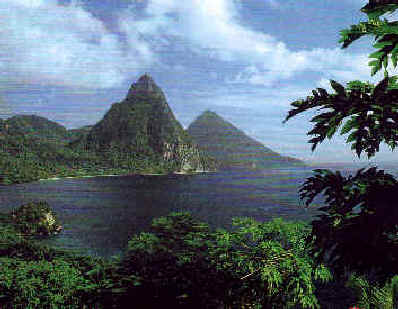
About 500 years ago, when the explorers from Spain entered the Caribbean, there were, in the West Indian islands, over 25 species of macaws, parrots, and parakeets. Since then, more than half have become extinct. The macaws, large and noisy, colorful but mostly red, were in Cuba, Hispaniola, and other islands including Guadeloupe and Dominica in the Lesser Antilles. Since the voyages of Columbus, all of the 7 or so species of Caribbean macaws have disappeared, as have 5 of the 8 native species of parakeets, and 3 of the dozen species of parrots. The last specimen of the Cuban Red Macaw was taken in 1864, but the species may have lingered remotely until the late 1800s (There are now 15 specimens in existence in museums).
The distribution of the parrots known as amazons in the Caribbean is interesting. As noted, there were prior to Columbus 12 species. Those on the larger Caribbean islands, oddly, are the smaller of the group, while those parrots on the smaller islands are the larger. Those on the Greater Antilles, mostly green, appear to have come east from Central America. Those in the Lesser Antilles, more strikingly colored, appear to have come north from South America. Formerly, there were such parrots on Guadeloupe and Martinique. They became extinct in the mid-1700s.
However, large and colorful amazon parrots continue, today, as noted, in forested mountains on 3 Lesser Antillean islands. And these birds were among the highlights of our 2004 tour.
The St. Lucia, or Versicolored, Parrot today numbers an estimated 350 to 500 birds. About 25 years ago, the population was only about 150 birds. The name "Versicolored" relates to the violet-blue and red in the plumage along with the green.
The St. Vincent Parrot was probably never very common. At one time, it was thought to be extinct. Today, it is found in only several wooded valleys, with a population of about 500 or slightly more. Some St. Vincent Parrots are predominately golden-brown, others more green. All have yellow-orange wing-patches, an orange-yellow hindcrown, and violet and yellow on the tail.
On the most rugged of the islands,
Dominica, 2 species of parrots continue, the more-common Red-necked Parrot,
and the more-rare Imperial Parrot. Over 40 per cent of Dominica is still
forested, but the parrots occur only locally on the island in the north.
Hurricanes in 1979 & 1980 annihilated the southern populations, particularly
that of the Imperial Parrot. The Imperial, among the largest and rarest of the
amazons, has the more secretive habits of the two Dominican parrots, often
staying beneath the forest canopy. Recent population estimates are 500-plus for
the Red-necked Parrot (up from 150 in 1980), and 250-plus for the Imperial.
About 10 years ago, in 1993, the Imperial Parrot population was only thought to
be about 80 individuals.
The Red-necked Parrot (known locally as the "Jaco"), is mostly
green, with, of course, a red neck (or rather a red throat), a red wing-patch,
and a blue crown, face, and chin.
The large mostly green-and-purple Imperial Parrot also has maroon-purple,
violet-blue, and reddish-brown in its plumage.
Earlier, during one of our days on Domincia, we had great looks at the Red-necked Parrot. In the mid-afternoon, we were at a lookout in the trees above a deep valley. Directly across from us, an Imperial Parrot landed, after calling as it flew over the valley. It sat in a bare treetop. When it landed there, the sun, that had been, for hours, mostly in the clouds, shone upon the colorful bird.
During an afternoon on Saint Vincent, from another lookout atop a hill in the forest, we had tremendous views of that island's colorful parrot, as pairs of them flew above and beneath us.
On St. Lucia, we enjoyed our "parrot experience" as well. During an afternoon and following morning, as they called and flew, we listened and watched.
But the rarest of all of the Carribean amazons was seen during our Puerto Rico tour, that followed our time in the Lesser Antilles. The Puerto Rican Parrot has been critically endangered for years. Formerly occurring in various areas of the island, the bird has been very localized now for years, hanging on in a small hilly area in northeastern Puerto Rico. In 1975, there were only 13 Puerto Rican Parrots in the wild. From that unlucky low, the number about 10 years later was 30. In the late 1990s, the global population was 44 in the wild and 87 in captivity.
During our March 2004 Puerto Rico tour, in the Luquillo Mountains, we saw one wild Puerto Rican Parrot. It was in the vicinity of the facility with the birds in the captive breeding program, the bird apparently drawn to the noise of the caged birds' calls in the afternoon. It appeared to be a bird preferring to forfeit its lonely wildness for companionship in captivity. (Parrots are social birds.) The Puerto Rican Parrot has now been seen during 11 FONT tours since 1990. The most was 12 in March 1996. The most-recent sighting, prior to this year, was in March 2000.
The Puerto Rican Parrot has come close to
following the fate of the parrots that once were in Guadeloupe and Martinique,
and the macaws that were in Cuba and elsewhere in the Caribbean. And, also in
Puerto Rico, a parakeet that formerly occurred, and is now extinct. It was until
about a hundred years ago that the "Puerto Rican Conure" flew about on
the island. It was a common subspecies of the Hispaniolan Parakeet, now
threatened on that island. Since that bird's demise on Puerto Rico, by the way,
resident subspecies of the Limpkin and a crow have also gone extinct there.
During our recent Puerto Rican tour, parakeets seen included some not-native,
the Monk and the White-winged (formerly Canary-winged), both indigenous to South
America.
Among the over-hundred species that were seen during our Puerto Rican tour, however, it's nice to note that among the birds endemic or nearly so to the island, there was a warbler not known to exist over 30 years ago (the Elfin Woods Warbler), a nightjar thought for many years (until about 1960) to be extinct (the Puerto Rican Nightjar), and a very-rare and localized bird, the Yellow-shouldered Blackbird. It was seen well, coming to a feeder along with a bird, recently arrived in Puerto Rico, that can cause it trouble, the Shiny Cowbird. Not exactly a Puerto Rican pirate (like the frigatebird), but a nesting parasite, the cowbird uses the nest of the blackbird. (The rare blackbird should not go the way of the birds that have been extirpated in Puerto Rico).
A complete listing of the birds that have been found during the 26 FONT birding tours that have been conducted in Puerto Rico can be found elsewhere in this web-site.
An interesting observation during our Puerto Rico tour this year related to a North American migrant. At a field, in southwestern Puerto Rico, in an area where we've always found something, we saw a sight we've never seen before. Out in a field, there were some leafless bushes with what appeared to be a large number of blue light-bulbs with a smaller number that were brown. In a scope, it was clear that they were Indigo Buntings, some in near-complete breeding plumage, some less so, but with a lighter (more lazuli-like) blue than dark indigo. A nice sighting for Bob from Minnesota who found them (and for the rest of us). The Indigo Bunting, by the way, is classified as uncommon in Puerto Rico in the winter, "in small numbers". We saw many (dozens) along with grassquits and other birds. During our previous 25 Puerto Rico tours, we've only seen 2 individual Indigo Buntings (both brown birds).
During our Lesser Antilles tour, on Dominica, a blue-brown bird appeared in tall grass along a roadside, an Indigo Bunting (found by Tom from New Jersey). It was our first-ever during a Lesser Antilles tour. The species is not even "in the book" for that island!
Also during that tour, as we were walking around some fish ponds, where we see the local Caribbean race of the Ringed Kingfisher, we turned to notice some egrets had landed on a nearby dike. All lined up, they were Cattle Egrets, except one. It was a Little Egret (our first for Dominica). It joined with the Cattle Egrets as they went to their evening roost.
We've seen Little Egrets in the past
during that tour on St Lucia (we saw 3 there last year with Snowy Egrets).
Little Egrets now breed in fair numbers on some lower Caribbean islands, such as
Barbados.
As did the Cattle Egret during the last century, Little Egrets appeared
(apparently from Africa) on lower Caribbean islands some years ago, and are now
appearing to spread. Bear in mind what has happened with the Cattle Egret
throughout the Western Hemisphere. It has spread north and south, and even as
far south as one sighting in Antarctica!
Our last "new" bird during the '04 Lesser Antilles tour was, as an odd twist, nearly our first bird on the '04 Puerto Rico tour, the White-tailed Tropicbird. We were, in Dominica, early in the morning, beneath a sea-side cliff where 10 or so were flying in, out, and about just above us. What a sight! In Puerto Rico, they were seen from the old fort, El Morro, at the entrance to San Juan Harbor.
Offshore from Dominica, during a Caribbean boat-trip as taken in the past, there were, as in the past, some nice sights. Among them, as many as 8 Sperm Whales (including a cow and a calf, and a bull), and some Pomarine Jaegers (they're there every March) and an apparent Great Skua (we seen that species one time in March in the past).
Along the Dominican coast, we only saw 3
individual gulls. The most-common was Lesser Black-backed Gull (twice as
common as last year). It was our 3rd consecutive year for Lesser Black-backed
Gull along that coast, with an adult each year at the very same place! (It's
only been there, we've been told, in the winter). But, this year, there were 2
Lesser Black-backed Gulls there, the adult and an immature with it.
The third gull, by the way, was a lone Laughing Gull.
On land during the Lesser Antilles tour, there are some particularly interesting birds, notably "thrashers that thrash" and "tremblers that tremble".
Particularly interesting it is that as many as 6 species of thrashers occur in a limited area of the Lesser Antilles the Tropical Mockingbird, the Scaly-breasted Thrasher, the Pearly-eyed Thrasher, the White-breasted Thrasher, and 2 Tremblers, the Brown and the Gray.
Of these, the "thrasher that really thrashes (on the ground like a towhee)", the White-breasted Thrasher, is one of the world's rarest birds. It only occurs in a limited area (and specific habitat) on the islands of Martinique and St. Lucia. On the latter, the total population has recently been estimated at only about 100 birds. All of us, on our tour, saw it well.
The Tremblers (the Gray on St. Lucia and the Brown on St. Vincent) are birds that we just can't stop watching. These thrasher-types have the odd habit of strongly trembling, constantly. As they do so, with their cocked long tails, and their shaking wings, and bright yellow eyes, they are quite a sight for our eyes.
Tremblers are endemic to the Lesser Antilles. A number of species, seen during our tour in that region, are endemic to either the area, or to particular islands. On Saint Lucia, for example, island endemics include the St Lucia Oriole, the St Lucia Black Finch (once thought erroneously by museum men in England to be a Galapagos Finch), and the Saint Lucia Warbler (formerly conspecific with the Adelaide's Warbler, now endemic to Puerto Rico).
On the island of St. Vincent, the endemic Whistling Warbler has become quite rare. This inhabitant of the forest has declined in recent years. But in the forest, we had the good fortune to encounter it.
All of the Lesser Antillean islands we
visit are beautiful, but an area in St. Vincent particularly so, was an
interesting botanical garden, out in the countryside, by forested slopes, mostly
green, but with trees with bright orange flowers (called by some flamboyant, but
a tree with a different name on different islands - it's a nice sight
everywhere).
Especially interesting for us were trees of various sorts filled with food
attracting many birds. In one tree, a bit like a mimosa, there were a multitude
of Bananaquits (but in that area of St. Vincent, all of them were of an
all-black subspecies, with no yellow or white, only red when they opened their
mouths).
In another tree, we saw the Lesser Antillean Tanager, a regional endemic
called the "Pawpaw Bird" or "Soursop Bird" for food that it
favors.
And yet in another tree, there were dozens of thrushes and thrashers feeding on
berries Scaly-breasted Thrashers, Bare-eyed Thrushes, and Cocoa Thrushes. The
subspecies of the Cocoa Thrush, endemic to St. Vincent, is Turdus. f.
bondi, named after James Bond, not the British private-eye, but the Philadelphia
ornithologist.
A group of birds not mentioned yet, but one that should be, is hummingbirds. Throughout the Lesser Antilles Tour, they were a constant marvel. As we listened on St. Lucia to the beautiful sound of the Rufous-throated Solitaire, we were distracted by as many as 25 or more Antillean Crested Hummingbirds feeding on flowers on a slope. Both of the hummingbirds known as Caribs were nice to see the Green-throated and the Purple-throated (wow, what color!). And on Dominica, there was the Blue-headed Hummingbird, limited in the world to that island and nearby Guadeloupe.
Also on Dominica, another bird was seen that's restricted to just a handful of Lesser Antillean islands, the Forest Thrush. Also on Guadeloupe, and previously on St. Lucia (maybe there still, but it hasn't been recorded in a while). A factor could likely be that on Dominica there are no introduced Mongooses. On St. Lucia, that predatory animal does exist.
I haven't mentioned all the birds we
encountered during our recent Caribbean tours, but if I don't stop now, I could.
As already noted regarding the birds during our Puerto Rico tours, there's also
a complete listing of birds during our Lesser Antilles Tours, elsewhere in this
FONT web-site.
In that list, there are notations regarding endemics, rarities, and subspecies.
A final item, now, not referring to a
bird, or animal, or anything on the ground or in the sea, but rather something
in the sky:
On both the islands of Saint Lucia and Dominica, in the western sky, at sunset,
we saw a phenomenon known as the "green
flash". It was visible just as the red ball of the sun dipped
below the horizon, appearing rather like a bright spark from an electric wire.
Some consider it to be fantasy, but, really, given the right circumstances, it
can be seen.
The following is an astute account of it, taken from the book "Eastward to Singapore", written by a surviving officer of a vessel named the "Electra". The "Electra" disappeared in World War II in the battle of the Java Sea in February 1942:
"In the region of the equator, the
sun sets with a jerk, and legend has it that at sunset, a "green
flash" spreads across the horizon. On the "Electra", opinion was
divided as to whether or not this was merely a fairy tale. So, as the ship was
due to cross the line at almost precisely sunset, the bridge became packed with
officers inquisitive and eager to resolve the argument.
Yet, as the sun went down, the triumphant shout of the believers, all of whom
swore they'd seen the flash "as fast as lightning", was followed by
derisive jeers from the infidels who said they hadn't.
So in the end, the test was a disappointment except that it proved that people
will only see as much or as little as they have a mind to believe in".
The magazine "Scientific American" contained an excellent article, with some tremendous photographs, entitled "The Green Flash and Other Low Sun Phenomena", but unfortunately that article was in the January 1960 edition. Does anyone know of anything more recent?
Focus On Nature Tours will be going to the Caribbean again in 2005. The itineraries for the tours, and other information, is in the web-site (if you're interested in seeing the "green flash" for yourself, along with the parrots and other birds of the Caribbean).
Parrots and hummingbirds and the like can also be seen during upcoming FONT tours in Central and South America. Info regarding those tours, as well, is in the web-site.
List of Birds & Other Wildlife during our Puerto Rico Tour in '04
Cumulative Birds during FONT Tours in Puerto Rico
Cumulative Birds during FONT tours in the Lesser Antilles
Upcoming Caribbean Birding Tours
Received by e-mail following our February 7-12,
2004 birding tour in Puerto Rico:
"We had a great time
touring Puerto Rico with you. And we'd gladly recommend FONT to others who
inquire, and look forward to your version of the tour report.
Thanks for a great trip, and best wishes."
Bob & Monica Williams,
Minneapolis, Minnesota, USA
Received by e-mail following our February 28 - March 7, 2004 birding tour in the
Lesser Antilles:
Dear Armas:
"From the White-breasted Thrasher to the Imperial Parrot -- it was a great
tour and we send you our thanks for a memorable trip.
Our hat is off to you for some super birding, and all your great efforts and
tireless energy. Your knowledge of the birds, where to find them, and your
ability to remember roads and birding spots around the islands is impressive. We
look forward to another great adventure with you!
With best wishes and, again, our thanks."
Tom & Margot Southerland
Princeton, New Jersey, USA
To Top of Page.
Southern
Costa Rica
February 2004
Links:
List of Birds & Other Wildlife during our Costa Rica Tour in Feb '04
Birds, and other Wildlife, during FONT tours in Costa Rica
Upcoming FONT Costa Rica Tour Itineraries
The following account written by Armas Hill, leader of
the tour.
Costa Rica
is, without a doubt, a great place to bird. It's often noted that within that
country, the size of US state of West Virginia, there are so many birds (with
more species than those regularly occurring in all of North America, north of
Mexico), in diverse habitats ranging from high mountains (about 10,000
feet) to sea-level rainforests, mangroves, and shrub. And the climate is
often about as good as it gets anywhere.
And so it is that many people are now going birding in Costa Rica. The country has become a very popular neotropical destination.
Not only for birders, but for others as well who enjoy everything that's "good" about the place. Airplanes from the US are filled with people going to beaches and cruise ships in addition to those going to explore and enjoy "the nature" they've learned of on the Discovery Channel and elsewhere.
But the group of us who went, during the recent FONT Costa Rica birding tour February 7-14, (the 24th FONT tour in the country), actually saw only few tourists and many birds. That's because we went to where less people go, into the southern portion of the country, mostly on the Pacific side. From the highest of the mountains, we went south along the Pacific coast to places "off the beaten path" in the hills near Panama, by the coast of the Golfo Dulce (or "Sweet Gulf"), and into the remote Osa Peninsula.
I was so very fortunate to go to Costa Rica for my first time nearly 30 years ago, with a group of birding friends from Philadelphia. Things have changed so much there since then. Many square miles of tropical forest disappeared, particularly about two decades ago. Big trucks on the highway loaded with big logs were a common sight. Also gone today are most of the huge banana plantations that once were. It's now positive that more diverse (and bird-friendly) habitats have replaced them. Also certainly different now than it was, in a word, is the "infrastructure". In most areas, 30 years ago, there were few places to stay, and they were at best basic. Today, in many parts of Costa Rica, there are wonderful lodges, where birds and other aspects of nature are just outside the door. So, while some raptors, for example, have become more difficult to find as the forest is less, other birds, notably hummingbirds, are easier than ever to see, as many lodges have an array of feeders.
30 years ago, my friends and I ventured into a wild, remote area of southern Costa Rica. We went by boat across the "Golfo Dulce", and then rode in the back of an old truck to the end of a dirt road, where a river was too wide and deep to cross. We walked along that river, or more correctly, through it, as we forded from side to side more than twenty times, entering a jungle that could only be described as "wild". There were jaguar tracks in the mud, and innumerable birds in the trees and bushes ranging from tiny hummingbirds and colorful tanagers to raucous macaws. Men were along the river with pans mining for gold. We were in the interior of the Osa Peninsula by the outer edge of the Corcovado National Park, said to be one of the wildest of world's places. I know I've used the word "wild" three times in this paragraph (sorry), but that's what the area was. We only spent part of a day there. By nightfall, we had to leave.
For some reason, I've wanted, over the years, to go back that place. And strangely, about two years ago, I learned that there's now a small lodge nestled in that same remote area - a place that accommodates guests, particularly birders. I just had to go back, to see again the river, the forest, the birds - to see how much the place has changed. And, our February 2004 FONT tour in southern Costa Rica, traveled into that part of the Osa Peninsula.
Going into that area, and then later, for a day, going from it, the experience was much as it was years ago. Travel was on a dirt road. There was little or no traffic. Along such a road, across the northern portion of the Osa, we saw various hawks, and flocks of Scarlet Macaw, parrots and parakeets in the trees. The Riverside Wren was roadside, along with the hawk that has that name. In a bush by the road, a Striped Cuckoo posed. At a small pond, whistling-ducks looked at us as we looked at them. And, again, there was virtually no traffic. At one point, it was a good thing, as a 3-toed sloth was crossing a road. And that's a slow process! We had seen sloths, where they normally are, in trees. But, looking down on one by the edge of the road was certainly a different perspective. We could see the algae on the animal's back - growing about as slowly as the odd creature moves.
We actually made it into the remote area of the Osa, with the lodge by the river, in the dark of night, after a full day's birding. Along the dirt road on the way in, we had good looks at two different Striped Owls as they perched on roadside telephone wires.
The lodge and the people who run it, Liz and Abraham, were great. Both the sleeping accommodations and the meals were wonderful. Such things, again, were not there during my first visit about 30 years ago. Nor were the sharp eyes of Abraham. I've never seen human eyes that could see so well, whether they were spotting a hummingbird deep in the brush, or a cotinga or a hawk far-away on a tree branch high up on a ridge.
We walked along the river, or again more
accurately, we forded the river (but not 20 times, and doing so in proper
boots).
One of the hummingbirds deep in the brush was a sitting White-tipped
Sicklebill.
The cotinga in the tree-top on the ridge was the Turquoise.
The perched hawk was a Double-toothed Kite.
Other raptors that flew overhead included two nearly all-white the White
Hawk and the King Vulture. Also with white in their exquisite
plumage, Swallow-tailed Kites could not be ignored.
There was another cotinga-type that was calling continuously in the ridge-top
trees, a few Three-wattled Bellbirds.
Also noisy, Scarlet Macaws flew overhead. Obvious as well were toucans
and aracaris.
By a lagoon near the lodge, Boat-billed Herons quietly sat on their
nests.
Nearby, tinamous and anthrushes could be heard calling as they
walked the forest floor.
In the trees, trogons gave away their presence with their voices.
Particularly nice was a tame, perched Baird's Trogon, a species
indigenous to only that part of the world.
A bird even more restricted to that region visited the plantings by the lodge, the Black-cheeked Ant-Tanager. It is one of only very few Costa Rican endemics (just 4 out of more than the 700 bird-species in the country). Not only endemic to Costa Rica, it's virtually endemic to the Osa Peninsula.
But perhaps the most exciting of the birds of that Osa rainforest was the Orange-collared Manakin. There was a lek - that's a place where male manakins display, sometimes quite actively. With their wings, they make a loud snapping noise. They have favored perches, usually horizontal branches, and the small colorful birds bolt quickly from one to another. It was truly a marvelous experience to stand quietly at the edge of the lek, early in the morning when the birds were most active, and watch a half-dozen or more of the birds perform.
By the river at dusk, a Spectacled Owl flew along, just above the treetops. Early the next morning, an otter was swimming in the river. And, later in the day, a short distance up the river, there was one man panning for gold (as I saw it done years ago, by a few).
A few miles away from the river and the forest, closer to the coast, we saw, in a lone large tree in the middle of a field, a bird rare in Costa Rica, that's maybe a "new arrival" having spread north from Panama. The hawk-eyes of Abraham spotted it. It was a beautiful Pearl Kite. In the telescope it was all the more so, even though slightly obscured by leaves. But then those keen eyes discovered something even less obvious in that tree, the female Pearl Kite sitting on its nest. In the book by Stiles & Skutch, "A Guide to the Birds of Costa Rica" published in 1989, it's stated that the Pearl Kite "possibly resides in central Panama, and that it may be found sometime in the future in Costa Rica, maybe expanding from an isolated population in Nicaragua". The species, however, has been expanding north through Panama (although far from common there). The bird has been known to be in that part of the Osa Peninsula of southwestern Costa Rica for at least a couple years, favoring that large field just noted with the large tree.
Other birds have been expanding, with
deforestation, north into southwestern Costa Rica. During an enjoyable
afternoon, in open countryside, not far from Golfito
(a small coastal city that used to a banana port), we saw a few such
species, notably Red-breasted Blackbirds, and various seedeaters
and finches. Fork-tailed Flycatchers were rather obvious during
that afternoon ride, as were a number of parrots of parakeets (of
a few different species). The birds were different than those that were
there years ago, but the again when we were on small dirt roads and crossing a
river on a ferry that could only hold two cars, it was much like "old
times".
As the day ended, a White-tailed Kite hunted over a field, as a pair of
nearby Laughing Falcons gave a loud duet. Pauraques began to call
in the distance.
Early the next morning, in the forested hills north of Golfito, there was a quick sighting of a wild cat, a Margay. The first bird of the day was the brilliant Orange-billed Sparrow. A White-necked Puffbird was atop a tree. Parrots flew about. Toucans perched. Wrens and other birds sang.
The previous day, in those forested hills, we had one of our best finds of the tour, an absolute "bonanza". It was a particular fruiting-tree that attracted birds like a magnet. Drawn to it were colorful tanagers of a few species, three species of euphonias (also colorful of course), honeycreepers, flycatchers, woodcreepers, woodpeckers (including two particularly good the Rufous-winged and the Golden-naped, the latter a regional specialty.) In all, during the two hours or so that we stayed there, at least a hundred, probably more, individual birds came to the tree. It's been said, particularly in the tropics, that "if you find the restaurant, you find the birds". As much as there was a "bonanza" for us, with the birds, it (that is, the tree) was all the more a "bonanza" for the feeding birds. We watched the spectacle from a small (again, untraveled) road. Behind the tree was a stream, with its water hosting birds as well, from Green Kingfishers to bathing hummingbirds. An attractive male White-necked Jacobin hovered above the water. As did the Beryl-crowned Hummingbird.
Probably more than any other family of birds, it was the hummingbirds that have most characterized our tour. Until now, in this narrative, I've tried not to mention them, so that I could refer to them more collectively. Only with the wonderful White-tipped Sicklebill, I simply couldn't resist.
Also on the Osa Peninsula, of course, there were others. One that we saw, unique to coastal mangroves and called the Mangrove Hummingbird, is one of the 4 birds mentioned-earlier as endemic to Costa Rica. It was near an attractive male Mangrove Warbler, now "split" from the Yellow Warbler, as it has a rusty red head.
Going from the mangroves back to the
river, forest, and lodge, we stopped at a certain flowering tree where, in the
past, Liz had seen the White-crested Coquette. It was there. Another name
for that nice little bird is the Adorable Coquette.
Another name for the Beryl-crowned Hummingbird, that we saw by the lodge
and elsewhere, is the Charming Hummingbird. It's not without reason that
such hummingbirds are described as adorable and charming.
I mentioned earlier that nowadays in Costa Rica there are hummingbird feeders as never before. Sometimes, they are frequented by masses of hummingbirds.
High in the mountains, outside the window
behind a road-side restaurant, nearly 10,000 feet above sea-level there is now
such a group of feeders accompanied by its contingent of hummers. There, at the
place called Georgina's, the spectacular Fiery-throated Hummingbird can
be seen very well. Also the Volcano Hummingbird. We had our first good
look at a male Volcano Hummingbird actually away from a feeder. It was perched,
in nice sunlight, facing us with its purplish gorget shining. The name Volcano
is ascribed to that hummer as the gorget appears like flowing lava.
Also near Georgina's, on the ground, was "Big-Foot". That's the name
that we gave to the bird properly called the Large-footed Finch. It
scratches on the ground, with those big feet, like a Towhee.
Returning to hummingbirds, at another place in the mountains, they came in droves to feeders at a lodge where we stayed, nestled in a valley. Looks could not have been better at hummingbirds as large as the Magnificent and as small as the Scintillent. In between, were Green Violet-ears and the Gray-tailed Mountain-Gem (the last was another of the 4 Costa Rican endemic birds). Feeders enable up-close encounters with wonderful hummingbirds.
At the lodge on the Osa Peninsula, we encountered hummingbirds in another, rather exciting way. We saw them at their nests. Usually these small hummingbird-haunts are under large, hanging leaves. On their nests, we saw females of the Bronzy Hermit, Band-tailed Barbthroat, Violet-headed Hummingbird, Blue-throated Goldentail, and Beryl-crowned Hummingbird. Never during a neotropical tour do I recall so many hummingbird species at their nests. Which was wonderful, as in the lowlands, hummingbirds do not visit feeders as readily as they do in the highlands. In addition to seeing hummingbirds at their nests in the Osa, we saw others attracted to the various tropical plants by the lodge, including the Crowned Woodnymph and what's been known for years as the Long-tailed Hermit. It's now called the "Western Long-billed Hermit" (even though its tail is still just as long). Bird-names, especially those of hummingbirds, are quite something. It's too bad they can't all be named "adorable" and "charming".
This tour narrative will end now back in the highlands. Where, again honing in on names, we saw during one morning, such hot ones as the Fiery-throated Hummingbird (already mentioned), the Flame-throated Warbler, and the Flame-colored Tanager. Elsewhere during the tour, as noted, we saw the Fiery-billed Aracari. Too hot.
Mention was made earlier of the fruiting-tree that attracted so many birds. Again "if one finds the restaurant, one finds the birds". Sometimes, as during our tour, that can apply as well to restaurants where people stop to eat. Hummingbirds attracted to feeders outside the door, sometimes by mistake come in the door, as we saw during lunch. At the road-side Georgina's restaurant referred to earlier, Rufous-collared Sparrows had no inhibitions coming inside on the floor. But the best during our tour, was during another lunch in a highland restaurant where a Yellow-thighed Finch (it looks like a black Catbird with yellow thighs) came in next to us. For everyone except me, it was a "lifer" at the next table.
Another highland bird that didn't come inside, but was certainly tame and close to us outside, was the Collared Redstart (or "Whitestart" if you prefer). With whatever name, it is one of the most attractive and dapper of Costa Rican birds. It's local name is "Amigo de Hombre", that is "friend of man" (due to its tameness and inquisitive nature).
And that leads us to what turned out to be (as it often does) the "favorite bird" of the tour. It's a bird of the Central American highlands that's called "Resplendent" - the Quetzal. People back home always ask "did you see it?". Yes, we did. And, we saw it well. We saw both male and female. As if they were props, both were perched close to us, both with their brilliant shiny green, red and white coloration. Some say the Quetzal is the "most beautiful bird in the world". It may be. The male has what appears to be a "tremendously long tail", with two extraordinary bright-green streamers, more than a foot-long, extending below it when it sits, and behind it when it flies. While we were watching the male Quetzal as well as we did (again, said to be among the most beautiful of birds to see), we heard in the background one of the most beautiful of bird sounds, the song of the Black-faced Solitaire.
Both of these birds (along with many of the others that have been mentioned) were in the "top birds" as voted by the participants after the tour.
The Resplendent Quetzal was voted "number 1".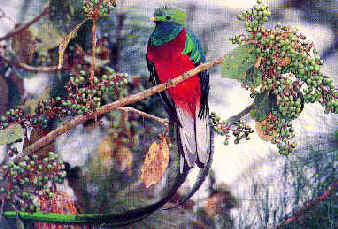
Here's the list of
all our "top birds" during the February 2004 FONT Southern Costa Rica
Tour:
(The left number, refers to points (everyone votes 1 thru 10); the right number
to ballots. No bird, even the Quetzal, received votes from everyone.)
1 - RESPLENDENT QUETZAL - 38/5
2 - Scarlet Macaw - 37/5
3 - Collared Redstart - 31/5
4 - Orange-collared Manakin - 23/4
5 - White-tipped Sicklebill - 17/3
6 - Blue-crowned Motmot - 17/2
7 - Fiery-throated Hummingbird - 16/3
8 - Chestnut-mandibled Toucan - 14/2
9 - Fiery-billed Aracari - 14/2
10 - Bay-headed Tanager - 14/2
11 - Pearl Kite - 12/2
12 - Red-breasted Blackbird - 11/2
13 - Laughing Falcon - 10/1
14 - Blue-headed Parrot - 9/1
15 - Swallow-tailed Kite - 7/1
16 - Northern Jacana - 6/1
17 - Striped Owl - 5/2
18 - Long-tailed Silky-Flycatcher - 5/2
19 - White Hawk - 5/1
20 - Turquoise Cotinga - 5/1
21 - Black-faced Solitaire - 4/2
22 - Boat-billed Heron - 4/1
23 - Flame-throated Warbler - 4/1
24 - Rufous-winged Woodpecker - 3/1
25 - Fork-tailed Flycatcher - 3/1
26 - Riverside Wren - 3/1
27 - Black-cheeked Ant-Tanager - 3/1
28 - Orange-billed Sparrow - 3/1
29 - Baird's Trogon - 2/1
30 - Magnificent Hummingbird - 2/1
31 - King Vulture - 1/1
32 - Squirrel Cuckoo - 1/1
33 - Golden-naped Woodpecker - 1/1
List of Birds & Other Wildlife during our Costa Rica Tour in Feb '04
Birds, and other Wildlife, during FONT tours in Costa Rica
Upcoming FONT Costa Rica Tour Itineraries
Received by e-mail following our February 7-15, 2004 birding tour in Costa Rica:
"I wanted to let you
know what a great time I had with you (Armas Hill, leader of the tour) and the
other participants in Costa Rica. I had high expectations (before) going on the
trip. They were exceeded. You have a knack for finding birds, but I appreciate
even more how hard you worked to be sure each participant got the best looks at
the most species possible. "Muchas gracias para todo"."
Ted Lewis,
Philadelphia, Pennsylvania, USA
"I had a great time and hope to join you on another trip".
Mike Welch,
Frederick, Maryland, USA
"Thank you for showing us so many birds".
Ed Kimmer
Rockville, Maryland, USA
Japan
January 2004 - A Summary of our Winter Birding Tour on Honshu, Hokkaido, and
Kyushu.
Links:
Birds, and other Wildlife, during FONT tours in Japan
Itineraries for upcoming FONT Japan Tours
The following account written by Armas Hill, leader of the tour.
In January 2004, we conducted out 21st birding tour in Japan. Once again, it was our annual winter birding tour
that we've been done since 1992. Each year, during the tour, there's been a pelagic trip onboard an overnight ferry on the Pacific from Honshu north to Hokkaido.Our day on the ferry this year, January 14th, was a more-than-blustery one, with gale-force winds at sea. The waves reached more than 20-feet. However, the ferry on which we rode was a very big vessel, and stable even with the conditions. Most places, to have a pelagic trip on such a day would not be possible, as the surface of that "not-so-Pacific" ocean was virtually covered with whitecaps. Thus, it was for us an interesting opportunity to observe birds over an ocean in such strong weather.
The ferry, during part of the trip, was only a couple miles offshore from the rugged, hilly northern coast of
Honshu (the main Japanese island). That region of the island is nearly unpopulated (in contrast with other places, to the south, that are filled with people).The next day we were on land, on the very wintry northern Japanese island of
Hokkaido, where our tremendous birding continued in the snowy land with cranes, eagles, and an owl.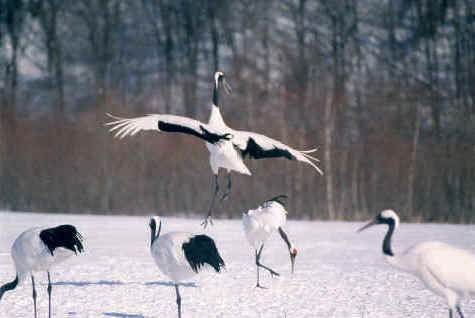
Japanese, or Red-crowned,
Cranes in Hokkaido
during the FONT tour in January 2004.
We saw as many as 120 Japanese (or
Red-crowned) Cranes at once. Some were "dancing",
jumping up from the snow. Others were calling, holding their heads up high. As
others flew against the background of a clear blue sky, they were a beautiful
sight.
Just over 50 years ago (in 1952), there were only 33 Red-crowned
Cranes in Japan. This year, there are about 900. A wonderful story, that of
the increase in the number of cranes.
At about 2 o'clock in the afternoon, a man of 73 years, who has spent nearly his
whole life tending to the cranes, walked out among them, sprinkling small
fish onto the snow. The cranes ate the fish, as did White-tailed Eagles
that swooped in from nearby trees. Black Kites and crows also came in for
a meal. It was intriguing to think that it was when that now 73 year-old man was
21, the total Japanese Crane population in Japan was 33.
The next day, during our Japan 2004 tour, we saw about a hundred eagles along the eastern Hokkaido coast. They were about evenly divided between White-tailed and Steller's Sea-Eagles. The latter, absolutely spectacular birds to see.
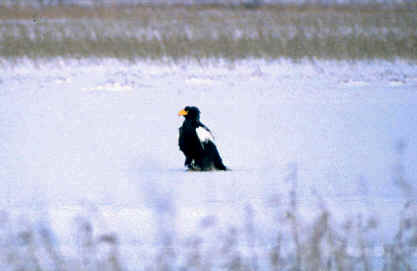
A lone adult Steller's
Sea-Eagle out on the ice
in Hokkaido, Japan, during the January '04 Japan tour.
Another bird that eats fish ended that great January day for us on Hokkaido. It was another bird spectacular to see, the Blakiston's Fish-Owl. We saw 3 of them, very well. We were looking at their orange eyes, within an hour after the orange ball of the sun was about to set. The Blakiston's Fish-Owl is among the largest and the rarest of the world's owls.
The snow in Hokkaido has already
been mentioned. During our '04 tour , scenes of snow in the trees were
exceptionally beautiful, as was, at a large mostly-frozen lake, another winter
spectacle of birds. Flocks of Whooper Swans were there, in the mist that
rose from the water. They called loudly as together they performed a variety of
gyrations.
The next day, after an airplane flight and a bullet-train ride, we were, back on
the main Japanese island of Honshu, at a
very big lake with many waterfowl. Falcated Teal, Spot-billed Ducks,
Tufted Ducks, Pintails, and Pochards were common. Eurasian Wigeon were
abundant. But the nicest flock was that of a tight group of mergansers
fishing above where there was apparently a tight school of fish beneath the
surface. Some of the flock were Goosanders (known in North America as Common
Mergansers). Others in it were Smews (a merganser
that does not normally occur in North America). Many of the Smews
were males, with their striking white-and-black plumage. As many as 50 Smews
were together, diving as they fed on the fish.
Probably the "duck of the day" was one on a small nearby pond, a drake
Baikal Teal. At that small pond, Common Teal were that. There were
hundreds. But there was only one Baikal, which was enough to make us
happy. The Baikal Teal of Asia is rare and threatened species.
A day or so later, on the
southernmost of the main Japanese islands, Kyushu,
we had, in the afternoon, yet another waterfowl spectacle. In a valley in
a particularly rugged area of the island with steep rocky gorges, there were Mandarin
Ducks by the hundreds. The water of the river was close to an emerald green.
The colorful plumages of the male Mandarins were extravagant. The wild
Mandarins were in scattered flocks along the river where it was slow-flowing. Of
all the masses of the waterfowl we saw during our '04 tour, these masses of
Mandarins in Kyushu were by far the most wary. One simply could not get close to
them, as one would, along the road, get out of the car. "City park
ducks" these were not.
When they were on the water (and we could observe them nicely in scopes),
the Mandarins were quite vocal. In this strikingly beautiful, and otherwise
quiet, setting in Japan, it was for us a wonderful experience. At the end of the
day, the Mandarins flew up high in flocks to go roost in trees (as their
counterparts in North America, Wood Ducks do.)
Along that river valley, where the water was more fast-flowing, there were Brown
(or Pallas') Dippers, Grey Wagtails, and Crested
Kingfishers. In bushes, there were Yellow-throated Buntings.
Birds have just been mentioned along one particular river in Kyushu. On every
river on that island, in '04, especially near the sea, there were many ducks
(other than Mandarins). The most numerous were Wigeon (all Eurasian,
no American).
Among gulls along the Kyushu coast during our tour, the best was the rare
Saunder's Gull, a dainty gull that breeds nearly exclusively in China (only
sporadically on the west coast of Korea). When we visit Okinawa in the
winter, we see a few. On Kyushu, over the years, we've seen less.
But it's the cranes that are the primary avian attraction on Kyushu in
the winter. Nearly the entire global population of Hooded Cranes (5,000
or so birds) winter there, as does a high proportion of the world's White-naped
Cranes (about 2,500 birds). Their congregation from late-November
thru mid-February is a true spectacle. Among them, each year, there are some
crane vagrants. In '04, we saw 3 Common, or Eurasian, Cranes, a
rare Siberian White Crane, and 1 Sandhill Crane (the last of
these in Japanese is called "Kanada-zuru", with "zuru" their
word for "crane"). (Actually, although many Sandhills
nest in Canada, some do so in Siberia. Most of them winter in North America
south to Mexico. Those seen in Japan annually, usually 1 or 2, probably come
from Siberia.) Most of the many Hooded Cranes breed in Siberia, as do
the Common Cranes (some Hooded-Common hybrids occur in
Japan in the winter). The White-naped Crane nests mostly in northern
China, with some in Mongolia. The rare Siberian White Crane nests in
far-northern Siberia, with most wintering in China.
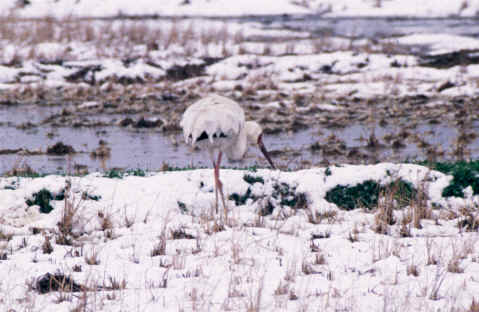
The single Siberian Crane
on the Japanese island of Kyushu
during the FONT January '04 Japan tour.
Some winters there are as many as 7 species of cranes in Japan. In 2004, there
were 6, and we saw them all: the Hooded, White-naped, Siberian, Common,
and Sandhill in Kyushu, and the Red-crowned (or Japanese) Crane,
as noted earlier, in Hokkaido.
When we first arrived in the area of the cranes in southern Kyushu, an area
where nearby there are citrus groves, there was, during January 21, '04, snow!
At first, during the blinding snow, we could not hardly see the cranes. We could
hear them. We learned through a Japanese translator with us that it was the
first such snowfall in that lowland area in 40 years (or so)! There are no
snow-plows or snow-shovels in that part of Japan. People were
"shoveling" with cardboard. A couple hours and about 4 inches of snow
after our arrival, the sun broke through for a while, and somehow, during about
an hour or so, we saw all 5 of the crane species present. We were most fortunate
to have a close and very good look at the Siberian White Crane, as it fed
in a field with the White-naped and Hooded.
During our last morning of the tour, back on Honshu,
in the area of shrines and temples in Narita (northeast of Tokyo), we
saw, during the final act before the curtain closed at the nearby airport, a
last nice assortment of Japanese birds. In the woods and by ponds and a stream,
there were: a pair of Japanese Wagtails walking on thin ice, a flock of
two of colorful Varied Tits and Japanese White-eyes, a large
flock, higher in the trees, of Long-tailed Tits, a Japanese Grey
Bunting on a stone at a shrine, and Pygmy Woodpecker and Great
Tits along with Hawfinches, Pale Thrushes, and Brown-eared Bulbuls.
To and from the shrine, we walked along narrow streets where shop-keepers and
restaurant owners were beginning their days. It was a more than interesting, a
fascinating, walk surrounded by Japanese culture. There were so many things to
be eaten, but not recognized. Among those memorable, however, were chestnuts
roasting in water in small pots. It was a nice last morning for us in Japan.
During our January 2004 Japanese Winter Birding Tour, we had some wonderful
experiences with birds and otherwise, that we'll always remember.
A total of 356 species of birds have cumulatively been seen during FONT tours in
Japan. The fore-mentioned Gyrfalcon, in '04, was number 356. A complete listing
of birds during FONT Japanese tours is in our web-site.
Birds, and other Wildlife, during FONT tours
in Japan
Itineraries for upcoming FONT Japan Tours
Guatemala:
in the highlands & lowlands, including Tikal
December 2003/January 2004
Links:
Birds during FONT Dec '03-'04 Guatemala Tour
List
of Birds & Other Wildlife during previous Guatemala Tours.
Itineraries for upcoming Guatemala
Tours
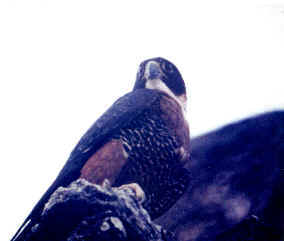
Our '03-04 Guatemala Holiday Tour, was again
a good one.
One of the highlights was a pair of Orange-breasted Falcons (one in
photo above) seen again on a temple at the Mayan
ruins of Tikal. This was the 3rd FONT Guatemala tour during which the
species has been seen, once previously also in January, and another time in
April.
Other notable birds at Tikal included a Pheasant Cuckoo (seen on the
ground just a few feet from us) and a Black Hawk-Eagle (perched in
a tree outside the front door of our room).
The Resplendent Quetzal, one of the most beautiful of world's birds and
the national symbol of Guatemala, was also seen well during our tour. A male is
in the photo below.
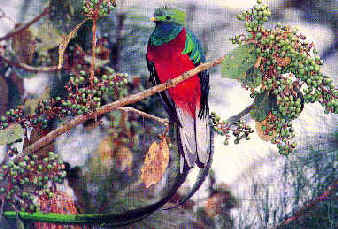
"TOP 10 BIRDS" during our recent 2003-04 Holiday Birding Tour
in Guatemala
1.
Orange-breasted Falcon
2. Pheasant Cuckoo
3. Resplendent Quetzal
4. Pink-headed Warbler
5. Ocellated Turkey
6. Black Hawk-Eagle
7. Sungrebe
8. Prevost’s Ground-Sparrow
9. Crimson-collared Tanager
10. Gray-headed Piprites
About 350 species of birds have been seen during our Guatemala Holiday Tour. And other wildlife too, in a beautiful and culturally interesting country. We'll be going again next year, December '04 - January '05.
Birds during FONT Dec '03-'04 Guatemala Tour
List
of Birds & Other Wildlife during previous Guatemala Tours.
Itineraries for upcoming Guatemala
Tours