
E-mail: font@focusonnature.com
Phone: Toll-free in USA 1-800-721-9986
or 302/529-1876; Fax: 302/529-1085
|
PO Box 9021,
Wilmington, DE 19809, USA E-mail: font@focusonnature.com Phone: Toll-free in USA 1-800-721-9986 or 302/529-1876; Fax: 302/529-1085 |
MEXICO
A Birding & Nature Tour
in the area of the Yucatan
A land of Mayas & Motmots
June 17-27, 2008
(tour:
FON/MX-1 '08)
Tour
to be led by Armas Hill,
who has birded in Central America numerous times
during the last 30 years
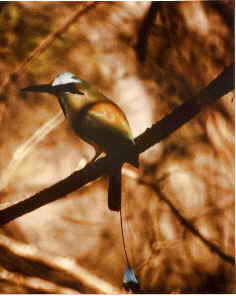
A Turquoise-browed Motmot,
called the "clock bird", "pajaro reloj",
because it moves its long tailfeaters
back and forth like a pendulum
THE UNESCO
BIOSPHERES, WHAT ARE THEY?
Of the 14 Biosphere Reserves in Mexico,
5 are in the Yucatan.
We visit 3 of them during this tour.
Established in 1968 by UNESCO
(the UN Educational, Scientific, & Cultural Organization),
the Biosphere project combines the protection of natural areas
and the conservation of the land for local people.
Each Biosphere has a CORE AREA
where human activity is kept to a bare minimum,
a BUFFER ZONE for non-destructive activities such as research,
and a TRANSITION ZONE where traditional land-use
and human settlement is permitted.
After a lull in the 1990s, Mexico's Biosphere program
has regained focus since 2000.
During this tour, the 3 Biosphere Reserves to be visited are:
Sian Ka'an, Calakmul, & Rio Lagartos.
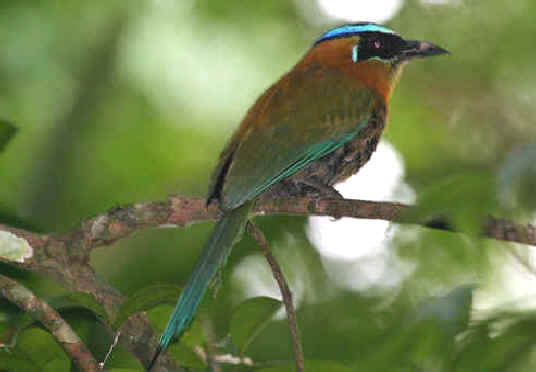
Another species of Motmot in the Yucatan,
this is the Blue-crowned Motmot.
(photo by Marie Z. Gardner)
Links:
A List of Central American Mammals
A List of Central American Butterflies
Upcoming FONT Birding & Nature Tours in Central America & Mexico
An Overview of the
Birds of the Yucatan Region
(including
Cozumel Island)
OUR TOUR ITINERARY FOLLOWS THIS SUMMARY.
Cumulatively, 537 species of
birds, belonging to 74 families, have been found in the
Yucatan region of Mexico, within the 3 states of Campeche, Quintana Roo,
and Yucatan.
Of these, 58 are considered vagrants and occasional visitors.
The total of 537 represents about 50 per cent of all the bird species that have
been found in Mexico, and 58% of the number of bird species that have been noted
in the United States and Canada.
The diverse local bird fauna of the Yucatan
is measurably enriched by the peninsula serving as a major thoroughfare for
migratory birds heading south in the fall and north in the spring. Many of those
birds spread themselves out in the winter from southern Mexico to South
America.
In all, 217 bird species from the north have found their way to the
Yucatan.
35 of them have been vagrants and occasional visitors.
128 of the 217 regularly overwinter every year. (Some of these, such as the Blue-gray
Gnatcatcher, have a year-round resident population in the Yucatan.)
Another group of northern migrants, numbering 54
species, are predominantly
transients through the peninsula. They rest and refuel before continuing on
their journey.
However, again there are a few exceptions as small populations of some of these
overwinter, while 2 species maintain a small breeding population during the
summer months.
The high number of vagrants to the region is due to the combination of tropical
storms and weather systems known as "northers" during the peak of the
fall migration in September and October. These weather conditions can, simply
put, blow some birds off their normal course.
There are also unique, but regular, summer avian visitors to the
Yucatan region
from the Caribbean area, including Sooty and Bridled Terns, Brown
Noddy, and White-crowned Pigeon. They nest on offshore islands and
atolls.
Other summer visitors include several Flycatchers (such as the Piratic
and the Sulphur-bellied), and a Vireo (the
Yellow-green), that fly north from South America
to nest during
the northern hemisphere's spring and summer months.
The Yucatan region has a nice number of endemic bird species (14, noted in
the text below) and endemic subspecies (almost 100 of them!). This
has been caused by the area's relatively late emergence from the sea and
isolation from the interior of the country.
Two more bird species are, for the most part, confined to the Yucatan
Peninsula, but have small disjunct populations elsewhere. These are
the Yucatan Bobwhite and the interesting hummingbird known as the Mexican
Sheartail. (More about these 2 species follows.)
When referring to the distribution of the Yucatan region's unique fauna, it is
sometimes necessary to include the part of the Peten region of northern
Guatemala, and parts of nearby Belize.
On Cozumel Island, 12 miles offshore from
the northeast coast of the Yucatan, there are 3 endemic species of birds,
found only on that small island:
the Cozumel Emerald (formerly part of the Fork-tailed Emerald,
with the male having the longest forked tail of the 5 former subspecies, now
species, in Central America),
the Cozumel Vireo (with its cinnamon cheeks and sides),
and the rarely-seen, and critically endangered Cozumel Thrasher.
Cozumel Island is also home to a Caribbean
species, the Western Spindalis, which is found nowhere else in Mexico.
The uncommon subspecies of that bird on Cozumel is endemic to the island.
The Smooth-billed Ani has occurred for a long time on Cozumel Island.
From there, it has recently spread to Yucatan mainland, where it is now along
the coast, south of Puerto Morelos (We saw the species, during our June '08
FONT tour, just south of Tulum.) Elsewhere in Mexico, Anis are the Groove-billed.
A number of interesting endemic subspecies of birds occur on Cozumel,
including a distinctive form of the large Great Curassow, and a small
version of the Roadside Hawk. The hawk is threatened; the curassow
is critically endangered.
Other interesting endemic subspecies on the island include:
the "Cozumel Wren" (a notably different form of the House
Wren),
the "Golden Warbler" (conspecific with the Yellow
Warbler, but with the male sporting a rufous cap),
and races of the Rufous-browed Peppershrike, and the Blue-gray
Gnatcatcher.
The last of these subspecies, duskier that others of its ilk, was described in
1926 by Ludlow Griscom, a well-known birder/ornithologist from
Massachusetts.
The local Cozumel race of the Great Curassow is also named after him, "Crax
r. griscomi". It, by the way, is the only subspecies of that curassow,
aside from the nominate in Central America.
There are yet more endemic subspecies on Cozumel including those of these:
Rose-throated Tanager (uncommon),
Golden-fronted and Yucatan Woodpeckers,
Bright-rumped Attila,
Yucatan Flycatcher,
Northern Cardinal,
and the Black Catbird.
That of the Black Catbird was only just recently described as such, a few
years ago.
The Cozumel subspecies of the Yellow-faced
Grassquit and the Bananaquit are only on that island and the nearby,
smaller Holbox Island.
That of the Bananaquit has also, in recent years, been along the
Quintana Roo coast (that is, the eastern coast of the Yucatan
Peninsula), and on northern offshore cayes in Belize,
where it was unknown prior to the 1980s.
In all, the total number of bird species known to have occurred on Cozumel
Island is well over 200. A complete listing is elsewhere in this web-site: COZUMEL
BIRDS
In addition to the 3 endemic species just referred to as being on Cozumel
Island (the Emerald, Vireo, & Thrasher),
the other 11 endemic birds of the Yucatan
region are:
Ocellated Turkey
Yucatan Amazon (or Parrot)
Yucatan Poorwill
Yucatan Nightjar
Yucatan (or Red-vented) Woodpecker
Yucatan Flycatcher (in the Myiarchus genus)
Yucatan Jay (with its bright, yellow legs)
Yucatan Wren (described as a species only as recently as 1934)
Black Catbird
Rose-throated Tanager
Orange Oriole.
To this list, the Ridgway's Rough-winged Swallow could be added, as it
is a "quasi-endemic" of the Yucatan region, being a resident that breeds
in that area, and in nearby Belize, northern Guatemala, and slightly further
west in Mexico.
Mention was made, a moment ago, to the Yucatan (or Black-throated)
Bobwhite and
to a hummingbird, endemic to Mexico, called the Mexican Sheartail.
The Bobwhite is really not an endemic bird to the Yucatan as a few disjunct
populations have been found, including one in
Honduras.
The Mexican Sheartail is another such species. Apart from being along the north
coast of the Yucatan peninsula, it is only found in central Veracruz.
The northern Yucatan population of the Mexican Sheartail is found exclusively in
a very narrow range, only about 1 kilometer wide, mainly between mangroves and
tropical deciduous forest. It has also been found to breed in gardens. That
population of the species is considered "threatened".
The smaller Veracruz population of the Mexican Sheartail occurs in undisturbed,
dry deciduous forest and overgrazed habitats at about 25 kilometers inland. That
population is critically endangered.
In the northern Yucatan, the Mexican Sheartail has been observed feeding at
flowers of Ipomoea, Justicia, and Helicteres guazumaefolia, and its diet is
supplemented by small anthropods. The bird is often close to the ground.
Just offshore from the narrow range of the Mexican Sheartail in the northern
Yucatan, there are flamingos, as many as thousands of them. They nest in the late
spring and summer in and near the Rio Lagartos Special Biosphere
Reserve. Many
of them spend the winter a couple hundred or so kilometers to the west, as the
flamingo would fly, at the Rio Celestun Special Bioshpere
Reserve.
These birds have long attracted notice. Flamingos, in all likelihood this
population, were recorded as being prominent members of the Aztec Emperor
Montezuma's menagerie.
Although there are still thousands of them, conservationists take a special
interest in the flamingos because their specialized habits make them vulnerable
to drastic population declines. Their numbers have fluctuated in recent years.
The method by which they feed, that is dredging the bottom sediment of shallow
lagoons and estuaries, makes the birds susceptible to toxics in the mud, such as
the lead from leadshot used in shotguns.
The flamingos feed only in areas with very specific water conditions, which can
change abruptly. That happened in 1988 when Hurricane Gilbert damaged some of
the flamingos' prime feeding areas, causing them to seek other sites. Many died.
Also, their nests on mudflats, are easy targets for egg and chick predators,
such as raccoons and foxes.
Yet, the Mexican flamingo population is considered fairly healthy, having risen
from a low of between 8,000 and 12,000 individuals in the 1970s (when the Rio
Lagartos & Rio Celestun Reserves were created), to about 26,000 birds in the
mid-1980s. Hurricane Gilbert (as noted, in 1988) was a setback to this
population growth, but the flamingos have since recovered.
During the FONT tour in June 2008, we saw a number of flamingos. With adults,
there were young birds.
At the edge of one flock of flamingos, a "Great White Heron"
was
walking in the shallow water. That bird is actually a white morph of the Great
Blue Heron, Ardea herodias occidentalis.
In that area of estuaries, mangroves, mudflats, and sandbars, we saw many
waterbirds. Long-legged waders, in addition to American Flamingos and
Great Blue
Herons (both dark birds & the single one), included:
Roseate Spoonbill, White Ibis, Little Blue and Tricolored Herons, Reddish Egrets
(white birds), other white egrets: the Snowy and the Great; also
Green Heron,
Yellow-crowned Night heron, Boat-billed Heron, Bare-throated Tiger Heron,
Magnificent Frigatebirds, Brown Pelicans, a flock (even in June) of
American
White Pelicans, Neotropic Cormorants, Anhinga, Laughing Gulls, and 4 species of
Terns: Gull-billed, Sandwich, Royal, and Least. Also (even In June),
we saw 10
species of shorebirds, including the Snowy Plover.
We learned that just a couple weeks prior to our being there, the Jabirus, that
nested in the area, departed. They had raised 2 young, during their 4th year of
year of nesting there. Yes, birds beget birds. Many bird species in that region
are common. Jabirus, there, and anywhere in Mexico, are rare.
On sandbars where we saw terns, we learned that at another time of the year,
there are gulls. And, among them, we were told, both Lesser Black-backed Gulls
and Kelp Gulls have been seen together during recent years. That's
interesting, of course, as Kelp Gulls are normally in the Southern Hemisphere,
and the Lesser Black-backed Gull has, over time, been primarily a European
breeding bird, wintering south to
Africa.
It's also notable that the affinity that the coastal vegetation of the Yucatan Peninsula has with the
Caribbean region provides habitat for a number of birds found nowhere
else in Mexico, These include: Zenaida Dove, White-crowned Pigeon, Caribbean
Elaenia, Yucatan Vireo, and Western Spindalis.
To that list, now, a bird that has recently arrived, can be added, the Shiny
Cowbird.
Another bird of the Yucatan with an unusual distribution is the White-lored Gnatcatcher,
found only along the north coast in the state of Yucatan. Otherwise, it inhabits
parts of the west coast of Mexico, with most of its range further south in
Central America.
Generally, most of these birds occur in areas of the Yucatan
region that are protected. There are approximately 40
natural protected areas in the region, covering
almost 9 million acres. These places include both terrestrial and
marine habitats, and include both public and private reserves.
Additionally, 24 sites on the Yucatan Peninsula have been designated as "Important
Bird Areas" (IBAs).
Also worth a mention, of course, are the 5 Biosphere
Reserves in the Yucatan that have been established by the UN
Educational, Scientific, & Cultural organization for both the protection of
the natural areas and the conservation of land for local
people.
All but 17 of the bird species that are included in the "Yucatan list"
are to be found within natural protected areas in the region. And that's a lot
of birds!
Tour Itinerary:
Tue, June 17, '08:
Arrival at
Cancun, on Mexico's Yucatan
Peninsula. In the afternoon, our first
birding will be at nearby Ceiba de Mar, where a one kilometer-long boardwalk
goes into the mangroves, and where many birds can be seen. Overnight near Puerto
Morelos.
Wed, June 18:
In the morning, we'll visit the 148-acre Marin Botanical
Garden, where there's a
path, 3 kilometers long, through native flora, and another longer trail into the
forest. Walking along these, we'll see the native fauna, and particularly a good
number of birds.
Afterwards, we'll take a ferry to the offshore 40-mile long island of Cozumel.
The word "Cozumel" is from a Mayan word meaning "Island of the
Swallows". But it's not swallows that we'll be seeking to observe there.
Rather, it'll be some birds that live on that island but no where else in the
world, each with the adjective Cozumel in their name: a Thrasher, a
Vireo, and
an Emerald (a hummingbird). There are also some other specialties of the
Caribbean coast, such as the Black Catbird, Western Spindalis, Caribbean
Elaenia,
and Yucatan Vireo. These will be nice birds to see and Cozumel Island will be a
nice place to see them. Overnight on Cozumel.
Thu, June 19:
More Cozumel birding in the morning, in case we would have missed a target-bird
or two the previous day. If we did see all of those objectives the day before,
there still would surely be during the good morning hours something else to be
found.
After the ferry crossing back to the Yucatan mainland, we'll travel south about
60 kilometers to the town of Tulum. Located near the town are the Mayan ruins of
Tulum, considered one of the most picturesque of all Mayan sites, situated on
the top of 15 meter-high cliffs above the brilliantly blue Caribbean Sea. During
numerous FONT tours, over the years, at Mayan sites, we've had good birding
experiences, and we will here too.
This will be the first of 4 overnights in the town of Tulum, but this will be
the only day when we plan to visit the ruins.
Fri, June 20:
The town of Tulum will also be our base for visiting the nearby Sian Ka'an
Biosphere Reserve, where we will bird both on foot and from a boat. Sian Ka'an
is a wonderful place. It's a large nature reserve, covering 1.3 million acres.
Created in 1986 and made a World Heritage Site in 1987, Sian Ka'an is one of the
largest protected areas in Mexico. It contains all of the principal ecosystems
found in the Yucatan. About one-third of it is tropical forest. Another third is
composed of both fresh and salt water marshes. The remaining third would be
classified as marine environment, including a portion of the Mesoamerican
Barrier Reef.
The variety of flora & fauna at Sian Ka'an is wonderful. To give an idea of
how "natural" the place is, it can be noted that all 5 species of
Mexican wild cats occur: Jaguar, Puma, Ocelot, Margay, and Jaguarundi. Other
larger mammals include: Tapir, Deer, and Monkeys.
More than 300 species of birds have been recorded in the reserve. Of course,
during our two days or so there we won't see every one of those species, but we
will see a lot of them. Some of the birds will be small. Some of them will be
large. Actually, the largest of all the wading birds that breed in the Americas
is there. It's a stork known as the Jabiru.
Four endangered species of Sea Turtles nest at night on the beaches. July &
August is a prime time for such activity.
In lagoons, there are both manatees and crocodiles. (One of these is known for
being "gentle"; the other not always so.)
Not many people live in this region. There are only about a thousand permanent
inhabitants, mainly fishermen and subsistence farmers, who dwell in and near the
village of Punta Allen.
We'll dwell, again this night, back in the town of Tulum.
Sat, June 21:
But we'll spend two days in the Sian Ka'an Reserve, observing the birds and
other nature. This will be our second day doing so. Again, overnight in Tulum.
Sun, June 22:
This day, we'll go 50 kilometers inland from Tulum to a place called Coba, a
Mayan site in the forest, that's been, for many, a favorite place for birding.
The ruins are spread out in a "tropical forest" in which numerous
birds reside (obvious among them are some that would also be described as
"tropical", such as toucans, parrots, and oropendolas). Among the
"tropical animals" would be agoutis and coatis. One of the
"tropical butterflies" would be the big, and brightly iridescent Blue
Morphos.
The Mayan city at Coba was occupied from about 100 A.D. until the arrival of the
Spanish. Its zenith was around 800 A.D. when most of the pyramids were built.
The tallest of these is the looming Noboch Mul, resembling some of the temples
at Tikal in Guatemala. It is taller than the highest structure in the renowned
ruins of Chichen Itza, one of the more famous sites in the Yucatan. From the top
of Noboch Mul, the forest can be seen stretching uninterrupted to the
horizon.
Also to be seen from the temple-top are some of the nearby lakes. By one of
them, there's a nature reserve called in Spanish "Reserva de Monos Aranas
de Punta Laguna". The "monos", or monkeys, referred to are
Spider Monkeys, at the north end of their
range.
We'll spend a full day observing the birds, and experiencing the nature, at Coba.
Overnight again, our last overnight, in Tulum.
Mon, June 23:
From Tulum, we'll be traveling, this day, west into the interior of the Yucatan
Peninsula. We'll be going along roads along which there are just a few
settlements. Most of our ride will be in the wilderness of Quintana
Roo. Of
course, we'll stop along the way, wherever & whenever we'd see something of
interest. Progressively, as we head west toward the border with the state of
Campeche the forest will become thicker. By that border, it's the densest
"jungle" of the Yucatan, at the area that is our destination, the
Calakmul Biosphere Reserve.
The ruins, there, with the same name, are the largest and most remote in the
Yucatan. While the best known of the Mayan sites in the Yucatan (places such as
Chichen Itza and Uxmal), can, nowadays, be crowded with visitors, our experience
at Calakmul will be very much the opposite, due to the remoteness of the place.
In regard to birds in particular, and nature in general, there will be much for
us to see.
The Calakmul Biosphere Reserve encompasses 1.7 million acres of
"jungle", or tropical forest. We'll be staying, for 2 nights, just
inside the park entrance, at a hotel with cabins decorated with
"nature-inspired touches".
If we were to travel along the road from the entrance gate to the ruins without
stopping, it would take an hour to get there. But we won't (go without stopping
that is). There will be much to see. Among the large creatures residing in the
area, there are Ocellated Turkeys, Deer, Peccaries, Guans, and Currasows.
Obvious in the trees should be Toucans and Trogons; in the sky, or perched,
there should be an ample assortment of Raptors. After dark, when the Jaguars
would roam, various Owls and Nightjars will be out & about.
The ruins themselves (or at least some of them) were first uncovered in the
1930s. But it has been during the last decade or so that some excavation has
been going on. Every year, recently, new discoveries have yielded more
revelations about the city's former significance. Calakmul was designated a
World Heritage Site in 2002. It is probably the biggest archeological zone in
Mesoamerica (about 70 square kilometers). The site, although huge, is, of
course, only partially restored. It will be a perfect area to us to explore and
to bird, and that we will do.
Tue, June 24:
A full-day of the exploration and birding just referred to, in the remote Yucatan
region of Calakmul.
Wed, June 25:
After our last morning at the Calakmul Reserve, we'll start our journey back
toward Cancun. But, not to be concerned, we won't ever get there - Cancun that
is. We'll overnight, one last time, at Tulum.
Thu, June 26:
From Tulum, via Coba (where we'll bird again in the morning), we'll continue to
Rio Lagartos, where there is yet another Biosphere Reserve. We'll spend the
afternoon birding there, along the north coast of the Yucatan Peninsula. Along
that coast, there's a long barrier island, with an inlet, lagoons, and marshes.
Again, another birdy spot. The most famous of the birds there is the
American Flamingo. During the time of year when we will be there, a large number
of the flamingoes should be present - tens of thousands. Of course, the
flamingoes won't be the only birds of interest in the area. As the habitat is
different than many places where we would have been earlier in the tour, there
will be some "new birds of the tour" for us. Such targets would be
the hummingbird known as the Mexican Sheartail and the Yucatan Wren
(both endemics to Mexico restricted
to this coast). During our visit to this area, there will be a boat-ride to get
to places that we otherwise would not be able to reach. Overnight near Rio
Lagartos.
Fri, June 27:
Our birding of the tour as we travel back toward the Cancun airport. Departure
for home, in the afternoon.
Price: $2,395,
per person, based upon double-occupancy. Single
supplement (when applicable): $225
Includes:
All overnight accommodations.
All meals June 17 pm to June 27 am.
Drinks (other than alcoholic).
Transportation on land & water within Mexico.
A FONT birding guide familiar with the birds and localities.
Does not
include:
International air fare to/from Mexico.
Airport departure tax.
Alcoholic drinks.
Any items of a personal nature. Gratuities.
A COUPLE NOTES ABOUT NATURE IN THE YUCATAN:
Regarding the JAGUAR: It’s the biggest predator in the New World, and needs a lot of space to roam. In the Yucatan, there's a good number of Jaguars.
Regarding some of the LIFE in the SEA: The MESOAMERICAN CORAL REEF is 250 kilometers long, in the Yucatan of Mexico and to the south in Belize. It is the most extensive reef in the New World.
Some of the FISH of the REEF include: Atlantic Spadefish, Banded Butterfly Fish, Bar Jack, Blue-striped Grunt, Blue Tang, Dog Snapper, Foureye Butterfly Fish, French Grunt, Green Moray, Honey Damselfish, Nurse Shark, Queen Triggerfish, Schoolmaster, Sergeant Major, Smallmouth Grunt, Southern Stingray, Spanish Grunt, Spotfin Butterfly Fish, Spotted Drum, Trunkfish, White Grunt, Yellow Jack, Yellowtail Damselfish, Yellowtail Snapper.
