 |
PO Box 9021,
Wilmington, DE 19809, USA
E-mail: font@focusonnature.com
Phone: Toll-free in USA 1-800-721-9986
or 302/529-1876; Fax: 302/529-1085 |
CHILE
BIRDS
Noting those found during
Focus On Nature Tours
with an (*).
from 1990 thru 2009
(during the months
of October,
November, December)
A list of Chile Birds compiled by Armas Hill
with some photos

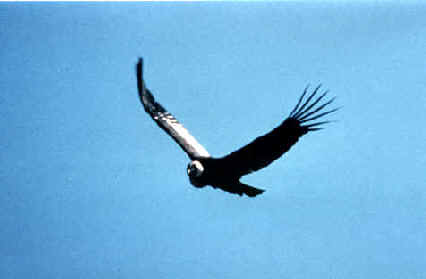
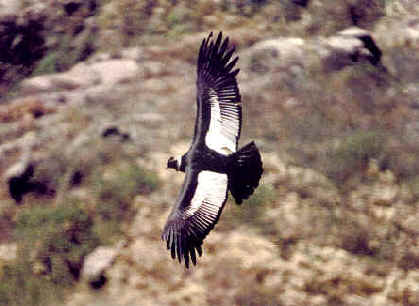
Upper right photo: ANDEAN CONDOR
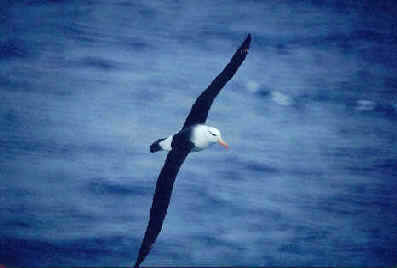
Lower right photo: BLACK-BROWED ALBATROSS
(Both photos by Alan Brady)
342 species of birds have been found
during 18 FONT birding
tours in Chile.
(3 additional subspecies brings the following list to 345.)
6 of our Chilean tours included only
the areas east of Santiago (in the Andes),
and west to the coast
(Vina del Mar & Valparaiso): these tours either followed
the FONT Argentina
tour, or were before/after tours to Antarctica.
17 of our Chilean tours have included
offshore pelagic trips from Valparaiso.
12 of the tours included: the south
(lake district); 2 of those included Chiloe Island.
10 of the tours included the far-south (Punta Arenas & Tierra del Fuego).
10 tours
included: the far-north (Arica, Putre, & Lauca Natl Park). With tours in the
far-north, there have been (with the exception of 1 time), pelagic trips from Arica.
There have been 2 tours only in far-southern
Chile (Tierra del Fuego) in conjunction with the FONT Argentina
tour.
Codes:
fno: during
far-northern extension only
pnp: in the area of Paine National Park only (in far-southern Chile)
(t): a globally threatened, or
rare, species as designated by Birdlife International
(t1): critical (t2): endangered
(t3): vulnerable
(nt): a near-threatened species
globally
(CHe): endemic to Chile
(CHqe): quasi (nearly) endemic to Chile
(CHr): rare in Chile
(CHvr): very rare in Chile
(CHi): introduced in Chile
(p): during pelagic trips, either from Valparaiso, from Arica, or on a ferry
across the Strait of Magellan or to Chiloe Island
(ph): species with a photo in the FONT website
Links:
Upcoming
FONT Birding & Nature Tours in Chile
Chilean Albatrosses & Other Seabirds, Photos & More (with photos)
South American Mammals (with
photos)
Directory of Photos in this Website

Birds:
- Ornate Tinamou (*) ______ fno
Nothoprocta ornata
rostrata
- Chilean Tinamou (CHe) (*) ______
Nothoprocta p. perdicaria
- Andean Tinamou ______
Nothoprocta pentlandii
- Puna Tinamou (*) ______ fno
Tinamotis pentlandii
(monotypic)
- Patagonian Tinamou (*) ______
Tinamotis ingoufi (monotypic)
- Elegant-crested Tinamou ______
(in
Chile a very restricted range in Aysen)
Eudromias elegans
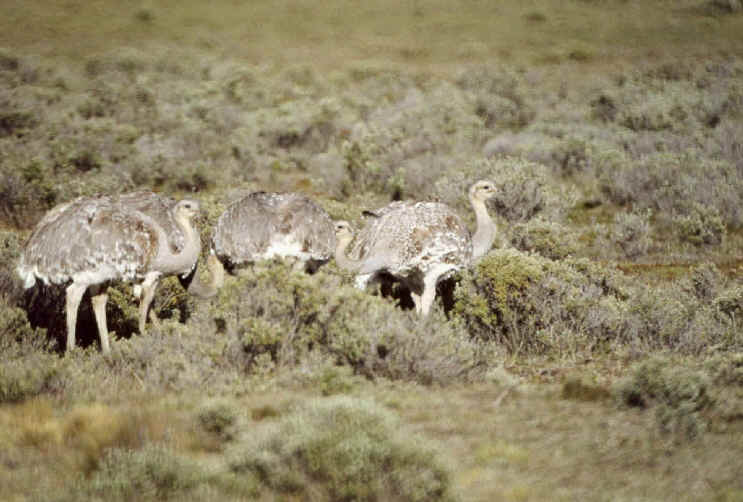
- Lesser Rhea (*) ______ (the subspecies in far-southern
Chile, called "Darwin's Rhea")
Pterocnemia p. pennata (the
single member of its genus)
Lesser Rhea (nt) (*) ______ fno (the subspecies in far-northern Chile,
called the "Puna
Rhea")
Pterocnemia pennata tarapacensis
(the Darwin's Rhea is the single member of its genus)
California Quail (CHi) (*) ______
Callipepla californica
Fulvous Whistling Duck (CHvr)
______
Dendrocygna bicolor
White-faced Whistling Duck (CHvr)
______
Dendrocygna viduata
Black-bellied Whistling Duck (CHvr)
______ (a single Chilean record near La Union, in X Region)
Dendrocygna autumnalis
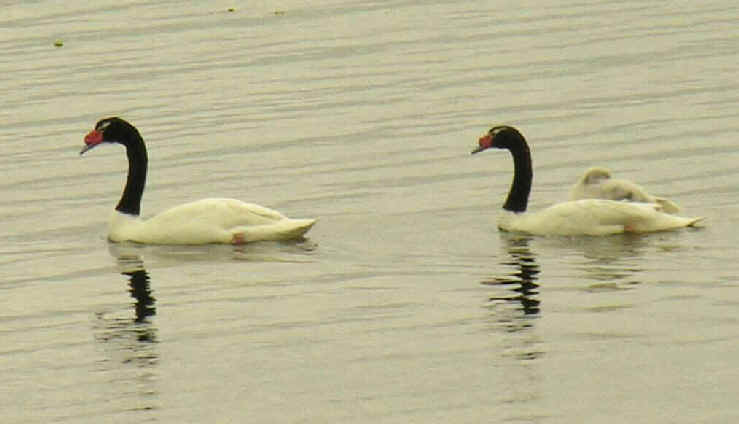
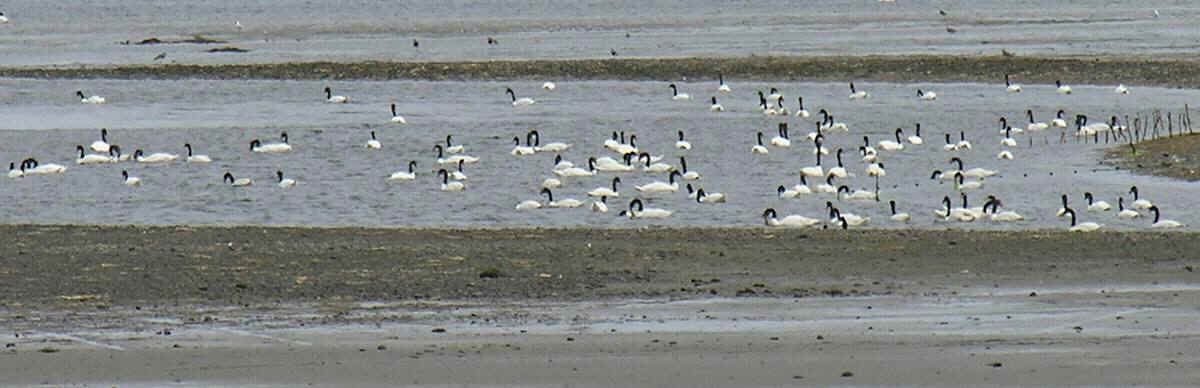
Black-necked Swan (*) ______
Cygnus melancoryphus (monotypic)
Coscoroba Swan (*) ______
Coscoroba coscoroba (monotypic, and the single
member of its genus)
Andean Goose (*) ______ fno
Chloephaga melanoptera (monotypic)
Upland Goose (*) ______ (has also been
called the Magellan Goose) (endemic to Patagonia & the Falkland Islands)
Chloephaga p. picta

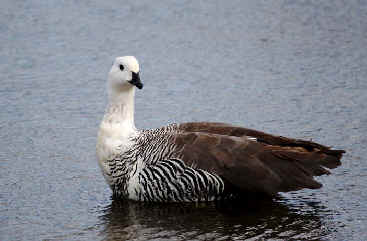
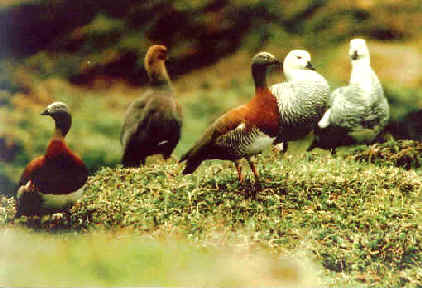
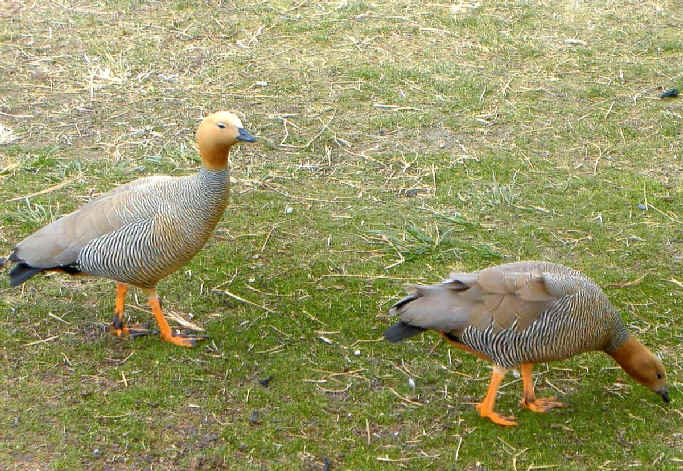
2 Ashy-headed Geese (foreground) with 3 Upland Geese (background)
The male & female Ashy-headed Geese are similar.
The male has a chestnut breast; that of the female is a finely-barred
reddish-brown.
Male & female Upland Geese are quite different, with the male mostly
white and the female mostly brown.
Ashy-headed Goose (*) ______
(endemic to Patagonia)
Chloephaga poliocephala
(monotypic)
Ruddy-headed Goose (nt) (*) ______
(endemic to eastern Patagonia & the Falkland Islands)
Chloephaga rubidiceps
(monotypic)
Kelp Goose (*) ______ (endemic to
Patagonia & the Falkland Islands)
Chloephaga h. hybrida
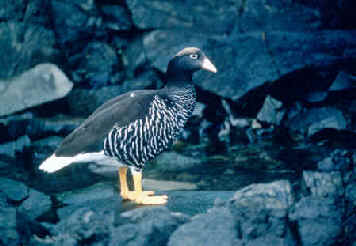
A female Kelp Goose
Flying Steamer Duck (*) ______ (endemic to
Patagonia & the Falkland Islands)
Tachyeres patachonicus

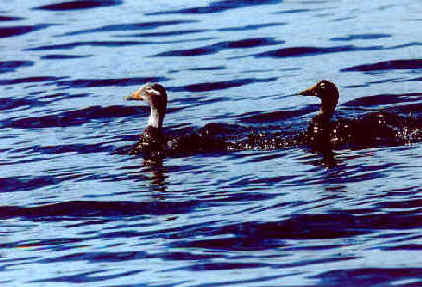
A pair of Flying Steamer Ducks
(swimming, not flying); male (left), female
(right)
Fuegian Steamer Duck (*) ______ (has been
called the Flightless Steamer Duck) (endemic to western Patagonian coasts & Tierra del
Fuego) (exclusively marine)
Tachyeres pteneres (monotypic)

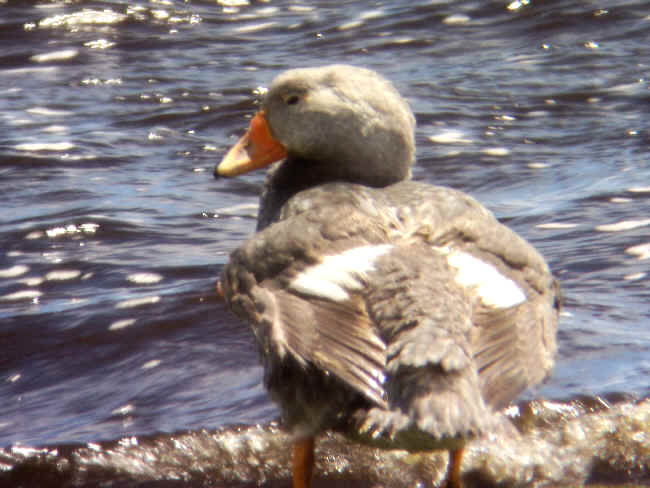
A Fuegian Steamer Duck photographed during
the FONT tour in Chile in November 2009
(photo by Robert Hinz)
Torrent Duck (*) ______
Merganetta a. armata (the single member
of its genus)

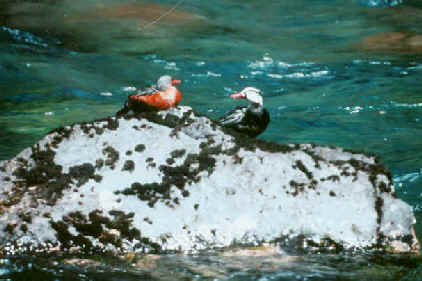
A pair of Torrent Ducks; female
(left),
male
(right)
(photo by Alan Brady)
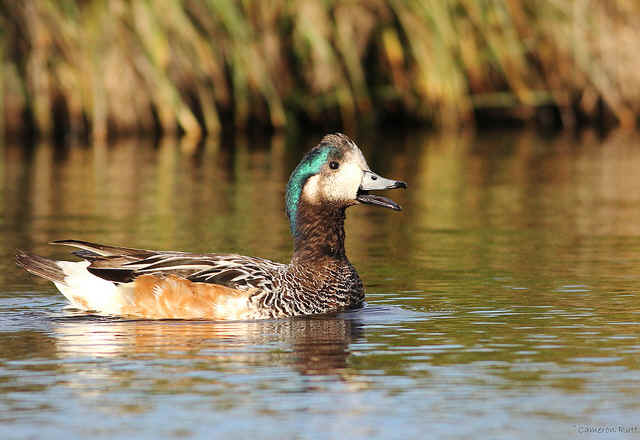
Chiloe Wigeon (*) ______ (has also been
called the Southern Wigeon)
Anas sibilatrix (monotypic)
Speckled Teal (*) ______
Anas flavirostris (2 subspecies in Chile)
Anas f. flavirostris (central & south CH)
Anas flavirostris oxyptera
(north CH)
Bronze-winged Duck (nt) (*) ______
(has also been called Spectacled Duck)
Speculanas
(formerly Anas) specularis (monotypic, and the single member
of its genus)
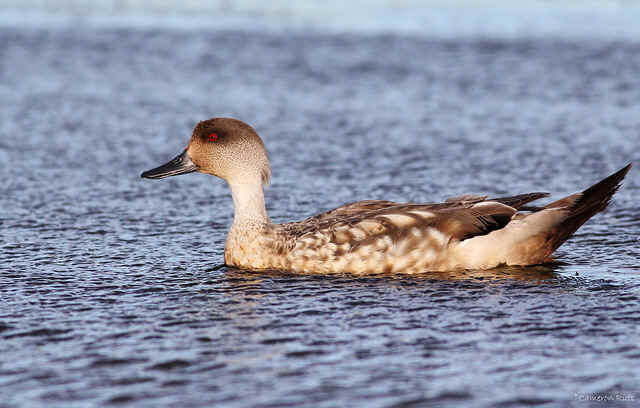
Crested Duck (*) ______
Lophonetta specilarioides (the single member
of its genus) (2 subspecies in Chile)
Lophonetta s. specularioides (central &
south CH)
(w/red iris)
Lophonetta specularioides alticola (north CH) (w/yellow iris)
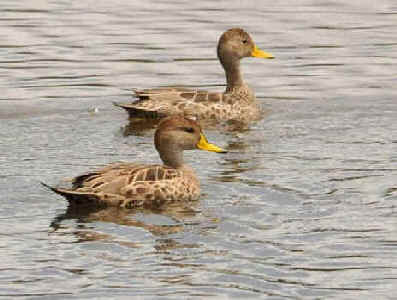
Yellow-billed Pintail (*) ______ (has
also been called Brown Pintail)
Anas georgica spinicauda
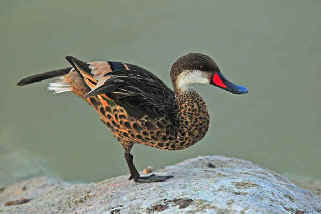
White-cheeked Pintail (*) ______
Anas bahamensis rubrirostris
Puna Teal (*) ______ fno
(was considered part of the Silver
Teal)
Anas puna
Silver Teal (*) ______
Anas versicolor (2 subspecies in
Chile)
Anas v. versicolor (in most of CH)
Anas versicolor fretensis (in only far-southern Chile)
Cinnamon Teal (*) ______
Anas c. cyanoptera
Blue-winged Teal (CHvr) ______
Anas discors
Red Shoveler (*) ______
Anas platalea (monotypic)
Rosy-billed Pochard (*) ______ (another
name has been Rosybill)
Netta peposaca (monotypic)
Black-headed Duck (nt) (*) ______ (the
only brood-parasitic duck in the world)
Heteronetta atricapilla (monotypic, and the single
member of its genus)
Andean Duck (*) ______ fno
(was, at one time, considered conspecific with the Ruddy Duck, Oxyura
jamaicensis)
Oxyura ferruginea (monotypic)
Lake Duck (*) ______
Oxyura vittata (monotypic)
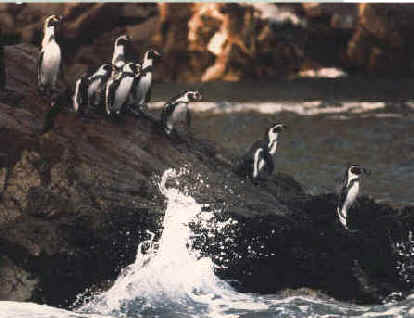
Humboldt Penguin (t3) (*) ______
(endemic to the Humboldt Current)
Spheniscus humboldti
(monotypic)

Humboldt Penguins
(photo by Armas Hill)
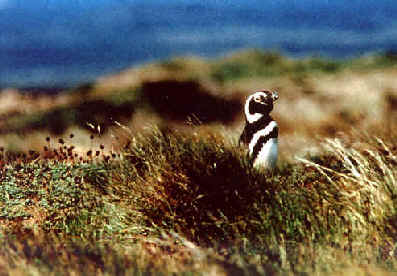
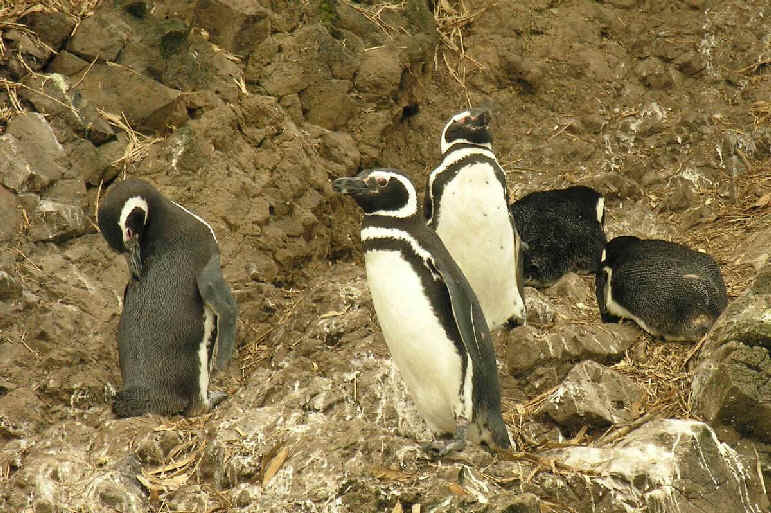
Magellanic Penguin (nt) (p) (*) ______
Spheniscus magellanicus (monotypic)

A Magellanic Penguin photographed during a FONT tour in Chile
Rockhopper Penguin ______
Eudyptes chrysocome
Macaroni Penguin ______
Eudyptes chrysolophus
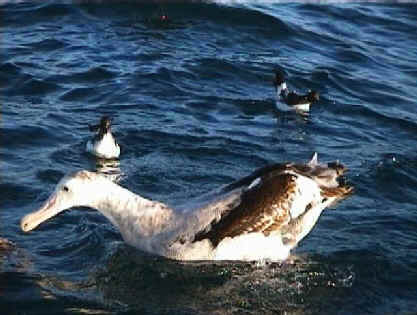
Wandering Albatross ______
Diomedea exulans

A Wandering Albatross on the water dwarfing Cape
Petrels
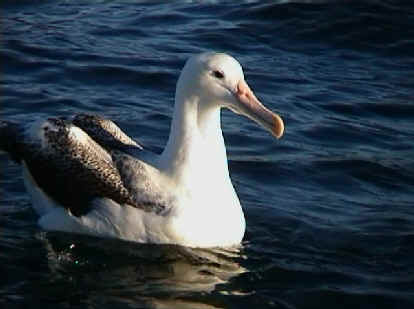
Northern Royal Albatross (t2) (p) (*) ______
(considered distinct from the Southern Royal
Albatross;
when combined was called the "Royal
Albatross")
Diomedea sanfordi
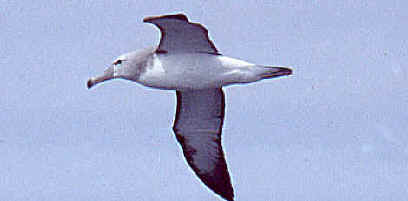
Southern Royal Albatross (t3) (p) (*) ______
(considered distinct from the Northern Royal Albatross;
when combined was called the "Royal Albatross")
Diomedea epomophora
A Southern Royal Albatross photographed during a FONT tour.
Seen during the pelagic trip off Valparaiso, Chile.
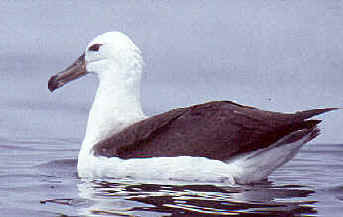
Black-browed Albatross (nt)
(p) (*) ______ (another name has been "Black-browed Mollymawk")
Thalassarche (was Diomedea) m. melanophrys

A Black-browed Albatross photographed during a pelagic trip off
Valparaiso
that was part of a FONT tour in Chile
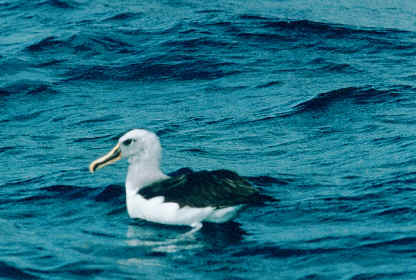
Buller's Albatross (t3) (p) (*) ______
(another name has been "Buller's Mollymawk")
Thalassarche (was Diomedea) b. bulleri

A Buller's Albatross photographed during a pelagic trip off Valparaiso
that was part of FONT tour in Chile
Salvin's Albatross (t3) (p) (*) ______
(another name has been "Salvin's Mollymawk")
Thalassarche salvini (was
Diomedea cauta salvini)

A Salvin's Albatross photographed during a pelagic trip off Valparaiso
that was part of a FONT tour in Chile
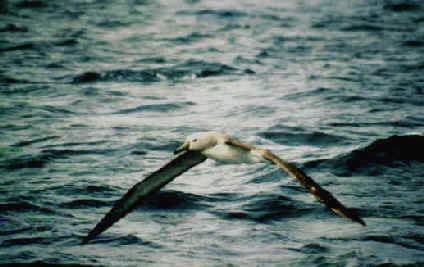
Shy Albatross (nt) (p) (*) ______
(another
name has been "Shy Mollymawk")
Thalassarche c. cauta (was
Diomedea c. cauta) (this race has been called the:
"Tasmanian
Albatross")

A Shy Albatross photographed during a pelagic trip off Valparaiso
that was part of a FONT tour in Chile
Chatham Islands Albatross (t1)
(p) (*) ______ (another name has been "Chatham Islands
Mollymawk")
Thalassarche eremita (has been Diomedea cauta eremita)
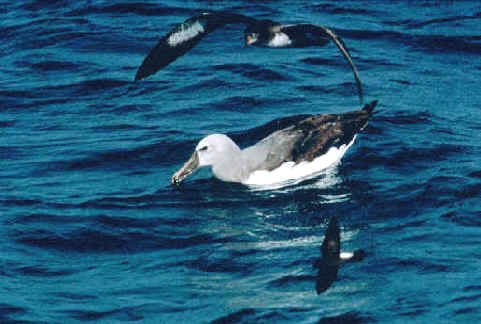
Gray-headed Albatross (t3)
(p) (*) ______ (another name has been "Gray-headed
Mollymawk")
Thalassarche
(has been Diomedea) chrysostoma

A Gray-headed Albatross photographed during a pelagic trip off Valparaiso
that was part of a FONT tour in Chile.
Also in the photo: A Pink-footed Shearwater
(above) & a Wilson's Storm
Petrel
(below).
Waved Albatross (t3) (CHr)
(p) (*) ______ fno
(has
also been called "Galapagos
Albatross")
Phoebastria (has been Diomedea)
irrorata (monotypic)
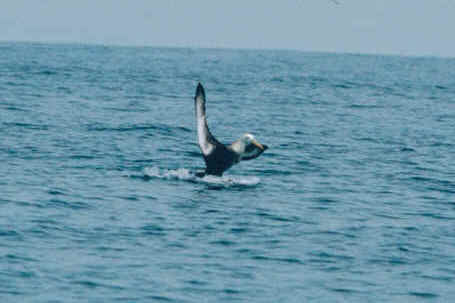
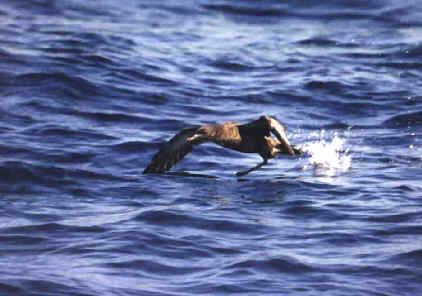
A Waved Albatross lifting from the water
(photo taken during a pelagic trip off Arica during a FONT tour in Chile)
Light-mantled Albatross ______
Phoebetria palpebrata
Southern Giant Petrel (t3)
(p) (*) ______
Macronectes giganteus
(monotypic)

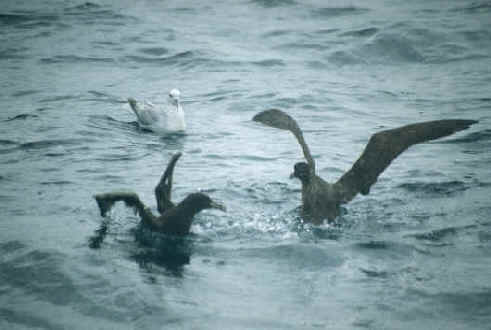
Two Southern Giant Petrels photographed during a pelagic trip that was part
of a FONT tour in Chile.
A Southern Fulmar is in the background.
(photo by Alan Brady)
Northern Giant Petrel (nt) (p) (*) ______
Macronectes halli
(monotypic)

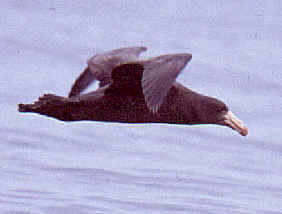
A Northern Giant Petrel photographed during a pelagic trip off Valparaiso
that was part of a FONT tour in Chile
Southern Fulmar (p) (*) ______
Fulmarus glacialoides (monotypic)

A Southern Fulmar and a Cape Petrel, with a Wilson's Storm Petrel
during a pelagic trip off Valparaiso that was part of a FONT tour.
Cape Petrel (p) (*) ______
(has also been called "Pintado")
Daption c. capense (the single member of its
genus)

A Cape Petrel, during a pelagic trip that was part of a FONT tour in Chile
(photo by Alan Brady)
De Filippi's Petrel (t3) (p) (*) ______ (has also been called Mas a Tierra Petrel;
was, at one time, considered wrongly a subspecies of the Cook's
Petrel)
Pterodroma defilippiana (monotypic)

A De Filippi's Petrel, during a pelagic trip that was part of
a FONT tour in Chile
(photo by Alan Brady)
Juan Fernandez Petrel (t3) (p) (*) ______ (was
considered conspecific with the White-necked Petrel which breeds north of New
Zealand)
Pterodroma externa (monotypic)
Cook's Petrel ______
Pterodroma cooki
Stejneger's Petrel ______
Pterodroma longirostris
Kermadec Petrel ______
Pterodroma neglecta
White-headed Petrel ______
Pterodroma lessoni
Herald Petrel ______ (in Chile
only at Easter Island where it is a winter breeder)
Pterodroma arminjoniana
Blue Petrel ______
Halobaena caerulea
Slender-billed Prion (*) ______
(also called Thin-billed Prion)
Pachyptila belcheri (monotypic)
Antarctic Prion ______
Pachyptila desolata
Kerguelen Petrel ______
Aphrodroma brevirostris
White-chinned Petrel (t3) (p) (*) ______ (has
also been called "Shoemaker")
Procellaria a. aequinoctialis
Westland Petrel (t3) (p) (*) ______
Procellaria westlandica (monotypic)
Gray Petrel (nt) (p) (*) ______ (has
also been called "Pediunker")
Procellaria cinerea (monotypic)
Pink-footed Shearwater (t3) (p) (*) ______
Puffinus creatopus
(monotypic)

A Pink-footed Shearwater photographed during a pelagic trip
that was part of a FONT tour in Chile
Sooty Shearwater (p) (*) ______
Puffinus griseus
(monotypic)

A Sooty Shearwater photographed during a FONT tour
Subantarctic Little Shearwater (p) (*) ______
(has been considered conspecific with the Little Shearwater, Puffinus
assimilis, now said to be restricted to waters near Australia, east to New
Zealand, and west into the Indian Ocean)
Puffinus elegans
Buller's Shearwater ______
Puffinus bulleri
Manx-type (probably
Townsend's)
Shearwater (t1) (p) (*) ______ fno
Puffinus a. auricularis
Christmas Shearwater ______
Puffinus nativitatis
Wilson's Storm Petrel (p) (*) ______
Oceanites oceanicus chilensis

A Wilson's Storm Petrel photographed
during a FONT tour
White-vented Storm Petrel (nt) (p) (*) ______ fno
(has also been called Elliot's Storm Petrel)
Oceanites g. gracilis
White-bellied Storm Petrel (p) (*) ______
Fregetta grallaria segethi
Black-bellied Storm Petrel (p) (*) ______
Fregatta t. tropica
Markham's Storm Petrel
(p) (*) ______ fno (has also been called Sooty Storm Petrel)
Oceanodroma markhami (monotypic)
Wedge-rumped Storm Petrel ______
Oceanodroma tethys
Hornby's Storm Petrel ______ (also called
Ringed Storm Petrel)
Oceandroma hornbyi
Gray-backed Storm Petrel ______
Garrodia nereis
Polynesian Storm Petrel ______ (also called
White-throated Storm Petrel)
Nesofregetta fuliginosa
Peruvian Diving Petrel (t2) (p) (*) ______
(endemic to the Humboldt Current)
Pelecanoides garnotii (monotypic)
Magellanic Diving Petrel (p) (*) ______
(endemic to Patagonian waters)
Pelecanoides magellani (monotypic)
Common Diving Petrel (*) ______
Pelecanoides urinatrix copperingeri
(subspecies
endemic to so. Chile) ("Coppinger's Diving
Petrel")
A Common Diving Petrel photographed during a FONT tour
in far-southern Chile, in the Fitzroy Channel
(photo by Alan Brady)
Pied-billed Grebe (*) ______
Podilymbus podiceps antarcticus
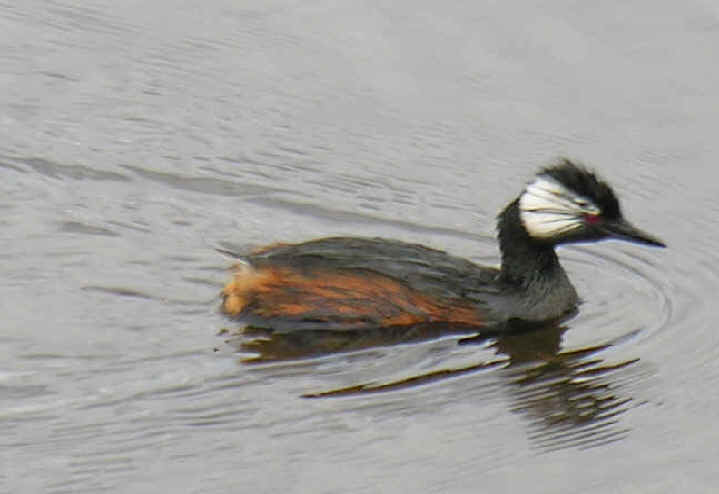
White-tufted Grebe (*) ______
Rollandia (formerly Podiceps) rolland chilensis
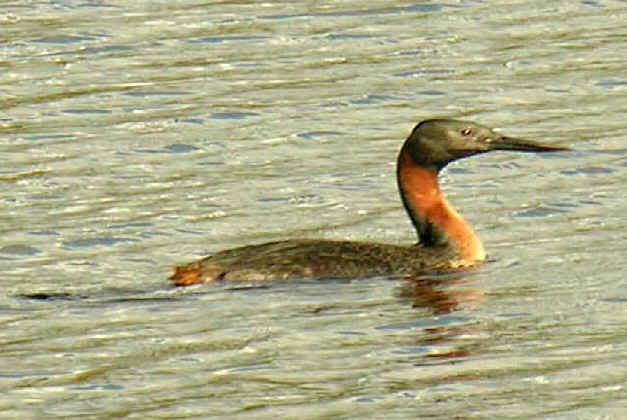
Great Grebe (*) ______
Podiceps major
(2 subspecies in Chile)
Podiceps major navasi (south CH)
Podiceps m. major (elsewhere in CH)
Silvery Grebe (*) ______
Podiceps occipitalis
(2 subspecies in Chile)
Podiceps o. occipitalis (central & south CH)
Podiceps occipitalis juninensis
(north
CH)
Hooded Grebe (nt) ______
Podiceps gallardoi
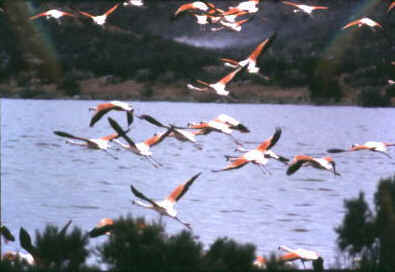
Chilean Flamingo (nt) (*) ______
Phoenicopterus chilensis (monotypic)

Chilean Flamingos
Andean Flamingo (t3) (*) ______ fno
Phoenicoparrus andinus
(monotypic)
James's Flamingo (nt) (*) ______ fno (has also been called Puna
Flamingo)
Phoenicoparrus jamesi (monotypic)
Maguari Stork (CHvr) (ph)
______ (no recent records)
Ciconia
(or Euxenura) magguari
Wood Stork (CHvr) (ph) ______
Mycteria americna
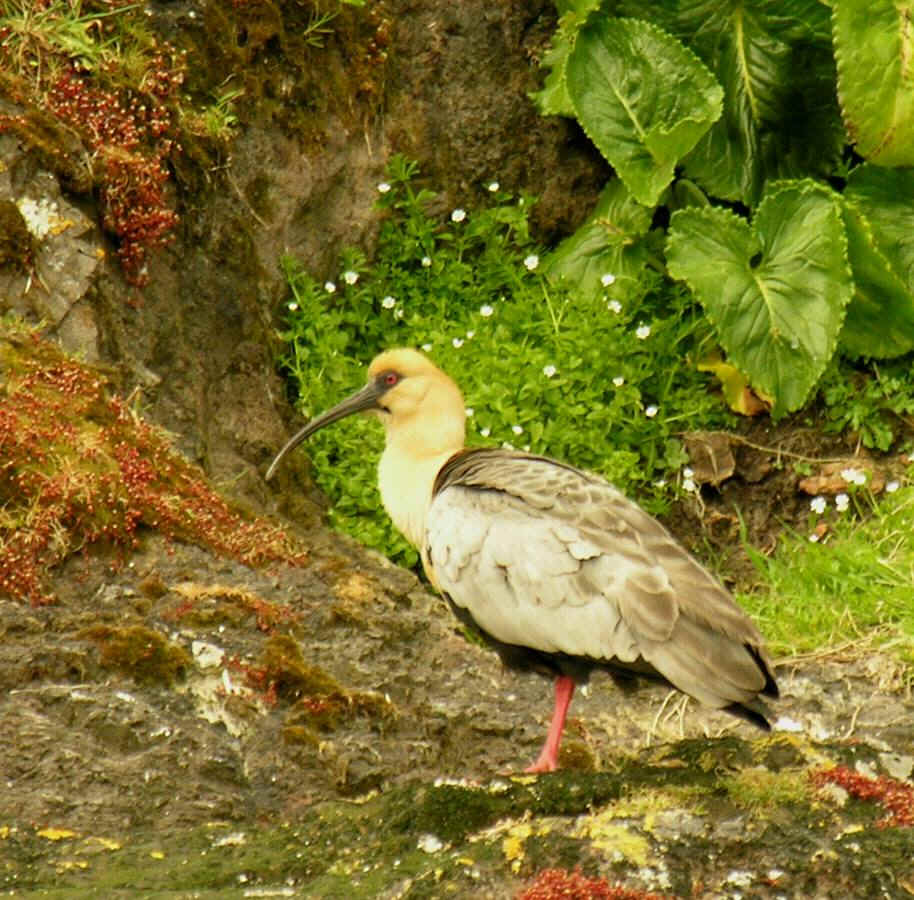
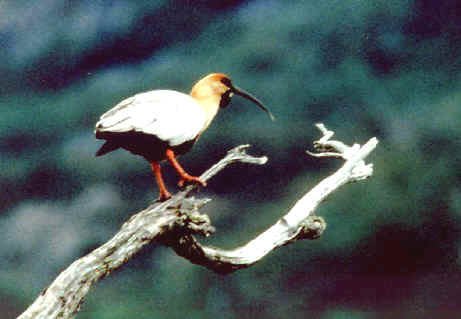
Black-faced Ibis (*) ______ (was at one
time conspecific with the more-northerly Buff-necked Ibis, Theristicus
caudatus)
Theristicus m. melanopis

A Black-faced Ibis photographed during a FONT tour
Puna Ibis (*) ______ fno
Plegadis ridgwayi
(monotypic)
White-faced Ibis (*) ______
Plegadis chihi (monotypic)
Roseate Spoonbill (CHvr)
______ (very few recent records)
Platalea ajaja
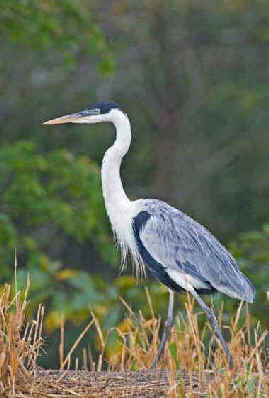
Cocoi Heron (*) ______
Ardea cocoi

A Cocoi Heron photographed during a FONT tour.
This species is not as common in Chile as it is
in other countries of South America.
During our Chile tour in November 2007,
4 were seen near Santiago.
(photo by Andy Smith)
Great Egret (*) ______
Casmerodius
(has been Ardea) alba egretta
Snowy Egret (*) ______
Egretta thula brewsteri
Little Blue Heron (*) ______ fno
Egretta caerulea
(monotypic)
Tricolored Heron (CHvr) ______
Egretta tricolor
Pacific Reef Heron (CHvr)
______ (a vagrant that has occurred on Easter Island)
Egretta sacra
Western Cattle Egret (*) ______
Bubulcus ibis
Striated Heron (CHvr) ______
Butorides striatus
Black-crowned Night-Heron (*) ______
Nycticorax nycticorax (2 subspecies in Chile)
Nycticorax nycticorax hoactii (northern CH)
Nycticorax nycticorax obscurus (central & south CH)
Stripe-backed Bittern (*) ______
Ixobrychus involucris (monotypic)
Red-billed Tropicbird ______ (the most common tropicbird in Chilean waters; a small colony Oct-Apr on
Chanaral Island in Region III; regularly encountered in warmer waters in the
north)
Phaethon aethereus
Red-tailed Tropicbird ______ (nests Oct-Apr on Sala & Gomez Islands; also Easter Island)
Phaethon rubricauda
White-tailed Tropicbird ______
(visitor to Juan Fernandez archipelago & Easter Island; does not breed)
Phaethon lepturus
Great Frigatebird ______
(the
only frigatebird likely to occur in Chile; breeds on Sala & Gomez
Islands, also occurs at Easter Island)
Fregata minor
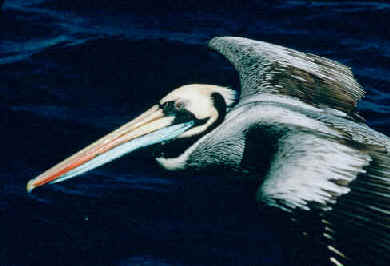
Peruvian Pelican (p) (*) ______
Pelecanus thagus (was at
one time considered a subspecies
of the Brown Pelican, Pelecanus occidentalis)

A Peruvian Pelican photographed during a FONT tour in Chile
Peruvian Booby (p) (*) ______
Sula variegata (monotypic)
Blue-footed Booby (CHr) (*) ______ fno
Sula n. nebouxii
Brown Booby (CHr) (p) (*) ______ fno
Sula leucogaster etesiaca
Masked Booby ______ (the common breeding booby on Sala & Gomez Islands, also
breeds on Easter Island; a visitor to Robinson Crusoe Island) (the
closely-related Nazca Booby, that was conspecific with it, occurs to the
north of Chile)
Sula dactylatra
Red-footed Booby (CHvr)
______ (only a single record at Sala & Gomez Islands)
Sula sula
Neotropic Cormorant (*) ______ (was at
one time called Olivaceous Cormorant)
Phalacrocorax b. brasilianus
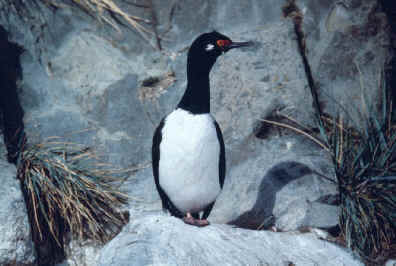
Rock Shag (*) ______ (has been
called Rock Cormorant) (endemic to Patagonia)
Phalacrocorax magellanicus (monotypic)
Rock Shag, photographed during a FONT tour
Guanay Cormorant (p) (*) ______
Phalacrocorax bougainvillii (monotypic)
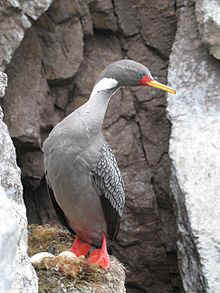
Red-legged Shag (nt) (*) ______ (has
been called Red-legged Cormorant)
Phalacrocorax gaimardi (monotypic)
Imperial Shag (*) ______ (was considered conspecific
with the King Shag; another name has been the Blue-eyed Cormorant) (endemic
to Patagonia)
Phalacrocorax atriceps
King Shag (*) ______ (was
considered conspecific with the Imperial Shag) (endemic to
Patagonia & the Falkland Islands)
Phalacrocorax albiventer
Andean Condor (nt) (*) ______
Vultur gryphus
(monotypic, and the single member of
its genus)

Andean Condor
Turkey Vulture (*) ______
Cathartes aura falklandicus (or by some considered
C. a. jota)
Black Vulture (*) ______
Coragyps atratus (foetens) (but said by some to
be
monotypic)
Osprey ______
Pandion halietus
White-tailed Kite (*) ______
Elanus l. leucurus
Chilean Hawk (*) ______ (has
been part of the Bicolored Hawk, Accipiter
bicolor)
Accipiter chilensis
Black-chested Buzzard-Eagle (*) ______
Geranoaetus melanoleucus australis
An immature Black-chested Buzzard-Eagle photographed during a FONT
tour
Long-winged Harrier (CHvr) (ph)
______ (no recent records)
Circus buffoni
Cinereous Harrier (*) ______
Circus cinereus (monotypic)
White-throated Hawk (*) ______
Buteo albigula (monotypic)
Variable Hawk (*) ______ (includes both
"Red-backed" and "Puna" Hawks; the
"Red-backed Hawk" is
Buteo p. polyosoma & the "Puna Hawk"
is
Buteo polyosoma poecilochrous)
Buteo polyosoma (both forms in Chile)
Buteo p. poecilochrous (most of CH)
Buteo polyosoma poecilochrous (in far-north CH at high elevations)
Rufous-tailed Hawk (*) ______
Buteo ventralis (monotypic)
Bay-winged Hawk (*) ______ (called Harris's Hawk
in North America)
Parabuteo u. unicinctus (the single member of its genus)
Mountain Caracara (*) ______
Phalcoboenus megalopterus (monotypic)
Southern Crested Caracara (*) ______
(was considered conspecific with the Northern Crested Caracara,
Caracara cheriway, of so. North America, Central America, and South America
north of the Amazon)
Caracara plancus (monotypic)
Chimango Caracara (*) ______
Milvago chimango (2 subspecies in Chile)
Milvago c. chimago
(north & central CH)
Milvago chimango temucoensis (south CH, but not Tierra del Fuego)
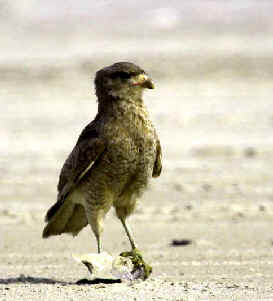
A Chimango Caracara photographed during a
FONT tour
(photo by Marie Gardner)
Striated Caracara ______
Phalcoboenus australis
American Kestrel (*) ______
Falco sparvrius cinnamoninus
Aplomado Falcon (*) ______
Falco f. femoralis (in far-southern Chile)
Peregrine Falcon (*) ______
Falco peregrinus
(2 subspecies in Chile)
Falco peregrinus tundrius (visitor from Northern Hemisphere)
(north CH)
Falco peregrinus cassini (resident in south CH)
Plumbeous Rail (*) ______
Pardirallus
(formerly Rallus) sanguinolentus
(2 subspecies in Chile)
Pardirallus sanguinolentus landbecki (central CH)
Paridirallus sanguinolentus luridus (far-southern CH)
Spotted Rail (CHvr)
______ (a single record on Robinson Crusoe Island)
Pardirallus maculatus
Austral Rail ______
Rallus antarcticus
Black Rail ______
Laterallus jamaicensis salinasi
Purple Gallinule (CHvr)
______ (all of the very few Chilean records in the far-north)
Porphyrula martinica
Spot-flanked Gallinule (*) ______
Gallinula (formerly Porphyriops) melanops crassirostris
Common Gallinule (or
Moorhen) (*) _____ fno
Gallinula chloropus garmani
Andean Coot (*) ______ fno (was
called Slate-colored Coot, but what coot is not that
color? Was said, by some, to be conspecific with the American Coot of
mostly North America, Fulica americana)
Fulica a. ardesiaca
White-winged Coot (*) ______
Fulica leucoptera (monotypic)
Red-gartered Coot (*) ______
Fulica armillata (monotypic)
Red-fronted Coot (*) ______
Fulica rufifrons
(monotypic)
Giant Coot (*) ______ fno
Fulica gigantea (monotypic)
Horned Coot ______
Fulica cornuta
Peruvian Thick-knee (*) ______ fno
Burhinus superciliaris (monotypic)
Snowy Sheathbill (*) ______
Chionis alba
(monotypic)
Magellanic Plover (nt) (*) ______ (endemic to Patagonia)
Pluvianellus socialis
(the single member of
its genus)
(not a plover
at all, in fact more closely related to the sheathbills;
in the same family as sheathbills)
American Oystercatcher (*) ______
Haematopus p. palliatus
Magellanic Oystercatcher (*) ______ (endemic to Patagonia)
Haematopus leucopodus
(monotypic)

A Magellanic Oystercatcher photographed during a FONT tour
(photo by Armas Hill)
Blackish Oystercatcher (*) ______
Haematopus ater
(monotypic)

Blackish Oystercatchers photographed during
the FONT tour in Chile in November 2009
(photo by Robert Hinz)
Black-necked Stilt (*) ______ fno (was
considered by some conspecific
with the Black-winged Stilt
of the Old World, Himantopus himantopus)
Himantopus mexicanus
White-backed
Stilt (*) ______ (was considered by some conspecific with the Black-winged
Stilt of the Old World, Himantopus himantopus)
Himantopus melanurus
Andean Avocet (*) ______ fno
Recurvirostra andina
(monotypic)
Southern Lapwing (*) ______
Vanellus chilensis (2 subspecies in Chile)
Vanellus c. chilensis
(north & central CH)
Vanellus chilensis fretensis (south CH)
Andean Lapwing (*) ______
Vanellus resplendens (monotypic)
American Golden Plover (*) ______ fno
Pluvialis dominica (monotypic)
Grey (or Black-bellied) Plover (*) ______ fno
Pluvialis squatarola
cynosurae
Killdeer (CHr) (*) ______ fno
Charadrius vociferus
"Peruvian" Snowy
Plover (*) ______ fno
(The Snowy
Plover of the Americas was considered conspecific with the Kentish Plover
of
Old World.
Charadrius nivosus occidentalis
Semipalmated Plover (*) ______ fno
Charadrius semipalmatus
(monotypic)
Collared Plover (*) ______
Charadrius collaris (monotypic)
Puna Plover (*) ______ fno
Charadrius alticola
(monotypic)
Two-banded Plover (*) ______
Charadrius falklandicus
(monotypic)

Two-banded Plover
Rufous-chested Plover (*) ______
(has been called Rufous-chested Dotterel)
Charadrius (formerly Zonibyx) modestus
(monotypic)
Tawny-throated Dotterel (*) ______
Oreopholus r. ruficollis (the single member
of its genus)
Diademed Plover (nt) (*) ______ (was
called Diademed Sandpiper-Plover; a former name was "Mitchell's Plover")
Phegornis mitchellii (monotypic, and the
single member of its genus)

A Diademed Plover photographed during the FONT Chile Tour in November 2009
(photo by Robert Hinz)

Another Diademed Plover photographed during a previous FONT tour in Chile
South American Painted Snipe (*) ______
Nycticryphes semicollaris (monotypic, and the
single member of its genus)
Wattled Jacana (CHvr)
______ (has occurred in northern Chile at Arica & Los Nogales,
Aconcagua)
Jacana jacana
Rufous-bellied Seedsnipe (*) ______ fno
Attagis gayi simonsi
White-bellied Seedsnipe ______
Attagis malouinus
Gray-breasted Seedsnipe (*) ______
Thinocurus o. orbignyianus
Least Seedsnipe (*) ______
Thinocurus r. rumicivorus
Marbled Godwit (CHvr) (*) ______
(this Chilean rarity has been seen, once, in the country during a FONT
tour)
Limosa fedoa

A single Marbled Godwit seen during a FONT
tour
along the Chilean Pacific coast north of Vina del Mar
was about as far south as the species has ever been seen.
(photo by Abram Fleishman)
Hudsonian Godwit (*) ______ fno
(a large proportion of the species' population winters on Chiloe
Island)
Limosa haemastica (monotypic)
"American" Whimbrel (*) ______
Numenius phaeopus hudsonicus

An "American" Whimbrel
(photo by Abram Fleishman)
Bristle-thighed Curlew (t3) (CHvr)
______ (has occurred on Easter Island)
Numenius tahitiensis
Eskimo Curlew ______ (now
believed to be extinct; there are historical Chilean specimens, from Arica
& Chiloe Island; last sighting in Chile was in 1913)
Numenius phaeopus
Upland Sandpiper (CHvr) ______
Bartramia longicauda (the single member of its genus)
Greater Yellowlegs (*) ______
Tringa melanoleuca (monotypic)
Lesser Yellowlegs (*) ______
Tringa flavipes (monotypic)
Solitary Sandpiper (CHvr)
______ (has occurred in far-northern Chile, near Arica)
Tringa solitaria
"Western" Willet (*) ______
fno
Tringa (or
Catoptrophorus) semipalmatus
inornatus
Wandering Tattler (CHvr) ______
Heteroscelus incanus
Spotted Sandpiper (*) ______ fno
Actitis macularius
(monotypic)
Ruddy Turnstone (*) ______
Arenaria interpres morinella
Surfbird (*) ______
Aphriza virgata (monotypic, and the single member
of its genus)
Sanderling (*) ______
Calidris alba rubida
Red Knot ______
Calidris canutus
White-rumped Sandpiper (*) ______
Calidris fuscicollis (monotypic)
Least Sandpiper (CHr) (*) ______ fno
Calidris minutilla (monotypic)
Baird's Sandpiper (*) ______
Calidris bairdii (monotypic)
Pectoral Sandpiper (*) ______
Calidris melanotos (monotypic)
Semipalmated Sandpiper (CHr)
______ (seems to occur sporadically in far-northern Chile)
Calidris pusilla
Western Sandpiper (CHvr)
______ (has occurred in far-northern Chile)
Calidris mauri
Stilt Sandpiper (CHvr) (*) ______ fno
(this Chilean rarity has been seen once during a FONT Chile tour, near Arica)
Calidris (formerly Micropalama)
himantopus
Short-billed Dowitcher (CHvr)
______ (a Chilean record at Tongoy)
Limnodromus griseus
South American Snipe (*) ______
(was considered by some to be conspecific with the Common, or
now the Wilson's, Snipe of
North America, Gallinago delicata, that itself
was considered conspecific
with Gallinago gallinago of the Old World)
Gallinago paraguaiae magellanica ("Magellanic
Snipe")
Puna Snipe (*) ______ fno
(was considered by some conspecific with the South American Snipe)
Gallinago andina (monotypic)

A Puna Snipe photographed during a FONT tour in Chile
Fuegian Snipe ______ (one of
the least known Chilean birds; inhabits windswept grasslands in southern
Chile, particularly on islands & thick muddy bogs in Nothofagus
forest)
Gallinago stricklandii
Wilson's Phalarope (*) ______
Phalaropus tricolor (monotypic)
Red-necked Phalarope (*) ______
Phalaropus lobatus (monotypic)
Red Phalarope (*) ______ (has
also, in Europe, been called
Grey Phalarope)
Phalaropus fulicaria (monotypic)
South Polar Skua (p) (*) ______ (at
one time was considered conspecific with the Great Skua of the Northern Hemisphere)
Stercorarius (formerly
Catharacta)
maccormicki

A South Polar Skua during a FONT tour
(photo by Andy Ednie)
Chilean Skua (p) (*) ______ (at one
time was considered conspecific with the Great Skua of the Northern Hemisphere)
Stercoraius
(formerly
Catharacta)
chilensis


Two photographs of Chilean Skuas, photographed during pelagic trips
that were part of FONT tours in Chile
Subantarctic Skua (p) (*) ______ (has
also been called
Brown Skua; at one time was considered conspecific with the
Great Skua of the Northern Hemisphere)
Stercoraius (formerly
Catharacta) antarcticus lonnbergi
Stercoraius (formerly Catharacta) a. antarcticus: "Falkland Skua"
Pomarine Skua (p) (*) ______ fno (has
also been called Pomarine Jaeger, in North America)
Stercorarius pomarinus (monotypic)

A Pomarine Skua, or Pomarine Jaeger, during a FONT tour
Parasitic Jaeger (p) (*) ______ (has
also been called Arctic Skua, in Europe)
Stercorarius parasiticus (monotypic)

An immature Parasitic Jaeger
(photo by Jens Bruun)
Long-tailed Jaeger (p) (*) ______ fno
(has also been called Long-tailed Skua, in Europe)
Stercorarius longicaudus pallescens
An immature Long-tailed Jaeger photographed during a FONT tour
(photo by Alan Brady)
Dolphin Gull (*) ______
(endemic to Patagonia & the Falkland Islands)
Leucophaeus
(formerly Larus)
scoresbii (monotypic, and the single
member of its genus)

A Dolphin Gull, photographed during a FONT tour
Gray Gull (*) ______
(endemic to the Humboldt Current)
Larus modestus (monotypic)

Gray Gulls photographed during a FONT tour in Chile
Band-tailed Gull (*) ______ (endemic to
the Humboldt Current) (has also been called "Belcher's
Gull"; at one time, was considered conspecific with the Olrog's Gull
of the Atlantic coast of
southeastern South America)
Larus belcheri (monotypic)
Kelp Gull (*) ______ (has been
called "Dominican Gull"
in
Australia, New Zealand, and South Africa)
Larus d. dominicanus

A Kelp Gull photographed during the FONT tour in Chile in November 2009
(photo by Robert Hinz)
Andean Gull (*) ______ fno
Larus serranus
(monotypic)
Franklin's Gull (p) (*) ______
Leucophaeus (formerly Larus) pipixcan (monotypic)

A Franklin's Gull photographed during a pelagic trip
that was part of a FONT tour in Chile
Laughing Gull (CHvr) (*) ______ fno
(this Chilean rarity has been
found during 2 FONT tours in Arica)
Leucophaeus (formerly
Larus) atricilla megalopterus
Brown-hooded Gull (*) ______
Chroicocephalus (formerly Larus) maculipennis
(monotypic)
Sabine's Gull (p) (*) ______
Xema sabini (monotypic, and the single member of its genus)
Swallow-tailed Gull (*) ______ fno (this species feeds on the ocean
at night on squid)
Creagrus furcatus
(monotypic, and the single member of its
genus)

Swallow-tailed Gull
South American Tern (*) ______
Sterna hirundinacea
(monotypic)

South American Terns
(photo by Armas Hill)
Arctic Tern (p) (*) ______
Sterna paradisaea (monotypic)
Common Tern (*) ______
Sterna h. hirundo
Snowy-crowned Tern (*) ______ (has also been called "Trudeau's
Tern)
Sterna trudeaui (monotypic)
Peruvian Tern ______
Sternula
(formerly Sterna) lorata
Elegant Tern (nt) (*) ______
Thalasseus (formerly Sterna) elegans
(monotypic)
Sandwich Tern (CHr) (*) ______ fno
Thalasseus (formerly Sterna) sandvicensis acuflavidus
Inca Tern (*) ______
(endemic to the Humboldt Current)
Larosterna inca (monotypic, and the single member of its genus)

An Inca Tern, photographed during a FONT tour
Sooty Tern ______ (breeds on
Easter Island and Sala & Gomez Islands; otherwise pelagic in warm waters
offshore from the Humboldt Current)
Onychoprion
(formerly Sterna) fuscata
Spectacled Tern ______ (has
also been called Gray-backed Tern) (at Easter Island, as a visitor,
possibly a breeder)
Onychoprion
(formerly Sterna) lunatus
Bridled Tern (CHvr)
______ (normally a bird of warm waters; there was an extraordinary
record of 1 between Cape Horn & Isla Diego Raminez)
Onychoprion
(formerly Sterna) anaethetus
Gray Noddy ______ (also called
Gray Ternlet) (breeds on Easter Island and Sala & Gomez Islands;
has visited the Juan Fernandez islands)
Procelsterna caerulea
Brown Noddy ______ (breeds on
Easter Island and Sala & Gomez Islands)
Anous stolidus
Black Noddy (CHvr) ______
(1 record of 2 adults at the Sala & Gomez Islands)
Anous minutus
Black Tern (CHvr) ______ (a record near Santiago)
Chilodonias niger
Angel Tern (CHvr) ______ (has also been called
Fairy Tern
or White Tern) (breeds, or
historically did so, on Easter Island; has also occurred at the Sal &
Gomez Islands)
Gygis alba (the single member of its genus)
Black Skimmer (*) ______
Rhynchops niger (2 subspecies in
Chile; the species does not breed in Chile)
Rhynchops niger cinerascens (mostly)
Rhynchops niger intercedens (rarely) (with white underwings & a mostly
white tail)

Black Skimmer
(photo by Howard Eskin)
Feral Pigeon (CHi) (*) ______
Columba livia
Chilean Pigeon (nt) (CHqe) (*) ______ (in
Nothofagus & Araucaria forests)
Patagioenas (formerly Columba) araucana
(monotypic)
Eared Dove (*) ______
Zenaida a. auriculata
West Peruvian Dove (*) ______ fno
(was part of the more-northerly White-winged
Dove; another name has been Pacific Dove)
Zenaida meloda (monotypic)
Picui Ground Dove (*) ______
Columbina p. picui
Croaking Ground Dove (*) ______ fno
Columbina cruziana (monotypic)
Ruddy Ground Dove (CHvr) ______
Columbina talpacoti
Bare-faced Ground Dove (*) ______ fno
Metriopelia ceciliae zimmeri
Golden-spotted Ground Dove (*) ______ fno
Metriopelia aymara (monotypic)
Black-winged Ground Dove (*) ______
Metriopelia m. melanoptera
Burrowing Parakeet (CHr) (*)
______
Cyanoliseus patagonus bloxami
Austral Parakeet (*) ______ (endemic to Patagonia)
Enicognathus ferrugineus (2 subspecies in Chile)
Enicognathus ferruginous minor (southern CH)
Enicognathus f. ferrugineus (far-southern CH)
Slender-billed Parakeet (nt) (CHe) (*) ______
(endemic to southern Chile)
Enicognathus leptorhynchus (monotypic)
Mountain Parakeet (*) ______
Psilopsiagon aurifrons rubrirostris
Monk Parakeet (CHi) (*) ______ (has colonized in the Santiago area)
Myiopsitta monachus
Groove-billed Ani (*) ______ fno
Crotophaga suicirostris (monotypic)
Dark-billed Cuckoo (CHvr)
______ (has occurred in the valleys near Arica)
Coccyzus melacoryphus
Barn Owl (*) ______
Tyto alba hauchecorni
Lesser Horned Owl (*) ______
(has been considered part of Great Horned
Owl; and has also been called Magellanic Horned Owl)
Bubo magellanicus

A Lesser Horned Owl that was photographed during a FONT tour in Chile
Burrowing Owl (*) ______
Athene c. cunicularia
Austral Pygmy-Owl (*) ______ (was
at one time
considered part of the Ferruginous Pygmy-Owl, Glaucidium
brasilianum)
Glaucidium namum (monotypic)
(Note: the pygmy owl in far-north Chile is the recently-described
Pacific Pygmy-Owl,
Glaucidium peruanum)
Pacific Pygmy Owl ______ (another name is Peruvian Pygmy
Owl)
Glaucidium peruanum
Rufous-legged Owl (*) ______
Strix r. rufipes
Short-eared Owl (*) ______
Asio flammeus suinda
Lesser Nighthawk (CHvr)
______ (has occurred in northern Chile, near Arica & at Quillagua
in II region)
Chordeiles acutipennis
Band-winged Nightjar (*) ______
Caprimulgus longirostris bifasciatus
Chimney Swift (*) ______ fno
Chaetura pelagica (monotypic)
Andean Swift (*) ______ fno
Aeronautes andecolus parvulus
Andean Hillstar (*) ______ fno
Oreotrochilus e. estella
White-sided Hillstar (*) ______
Oreotrochilus leucopleurus (monotypic)
Giant Hummingbird (*) ______
Patagona gigas (2 subspecies in Chile)
Patagona g. gigas (central CH)
Patagona gigas peruviana (far-northern CH)
Sparkling Violetear (CHr) (*) ______ fno (has recently been confirmed to
be resident in far-northern Chile)
Colibri c. coruscans

The Sparkling Violetear is a rarity in Chile. It is common in countries to
the north,
in Ecuador and Peru.
But it's been seen a few times during FONT tours in far-northern
Chile.
Green-backed Firecrown (*) ______
Sephanoides galeritus (now monotypic)
Juan Fernandez Firecrown (CHe)
______ (restricted to the Juan Fernandez Islands)
Sephanoides fernandensis
Peruvian Sheartail (*) ______ fno
Thaumastura cora (monotypic, and the single member of its genus)
Oasis Hummingbird (*) ______ fno
Rhodopis v. vesper
(another subspecies also in north Chile, R. v.
atacamensis)

An Oasis Hummingbird at its nest, photographed during a FONT tour
in far-northern Chile
Chilean Woodstar (t2) (CHqe) (*) ______ fno (Probably now endemic to Chile. Has not
been recorded recently in adjacent Peru. Population has been
declining.)
Eulidia yarrellii (monotypic, and the single member of its genus)
Ringed Kingfisher (*) ______
Megaceryle (formerly Ceryle) torquata stellata
Green Kingfisher (CHr)
______ (has occurred in far-northern Chile near Arica)
Chloroceryle americana
Andean Flicker (*) ______ fno
Colaptes r. rupicola

An Andean Flicker, photographed during a FONT tour in far-northern Chile.
It's a woodpecker that gets along "very well, thank you", without
trees.
Chilean Flicker (CHqe) (*) ______
Colaptes pitius
(now monotypic)

A Young Chilean Flicker photographed during the FONT Chile Tour in November
2009
(photo by Robert Hinz)
Striped Woodpecker (CHqe) (*) ______
Picoides lignarius (monotypic)
Magellanic Woodpecker (*) ______ (endemic
to Patagonia)
Campephilus magellanicus
(monotypic)

A female Magellanic Woodpecker photographed
during the FONT tour in Chile in December 2009
(photo by Robert Hinz)
Rufous-tailed Plantcutter (*) ______
Phytotoma rara (monotypic)
Rufous-webbed Tyrant (CHr)
______ (recently discovered in Chile; very local in the altiplano in
the I region)
Polioxolmis rufipennis
Great Shrike-Tyrant (*) ______
Agriornis lividus (2 subspecies in Chile)
Agriornis l. lividus (central CH)
Agriornis lividus fortis (south CH)
Black-billed Shrike-Tyrant (*) ______
Agriornis montanus (2 subspecies in Chile)
Agriornis montanus maritimus (north-central CH)
Agriornis montanus leucurus (central CH)
White-tailed Shrike-Tyrant
______ (rare in northern Chile in the altiplano; never common &
always outnumbered by the Black-billed Shrike-Tyrant)
Agriornis andicola
Gray-bellied Shrike-Tyrant ______
Agriornis microptera
Chocolate-vented Tyrant (*) ______
(endemic Patagonian breeder)
Neoxolmis rufiventris (monotypic, and the single member of its genus)
Fire-eyed Diucon (*) ______
Pyrope p. pyrope
(2 subspecies in Chile, the other on a Chilean
island, Chiloe)

With its red eye, this is a Fire-eyed Diucon.
("A far-eyed what ??")
This bird was photographed during a FONT tour in Chile.
Rufous-naped Ground Tyrant (*) ______
Muscisaxicola rufivertex (2 subspecies in Chile)
Muscisaxicola rufivertex pallidiceps (north CH)
Muscisaxicola r. rufivertex (south CH)
White-browed Ground Tyrant (*) ______
Muscisaxicola albilora (monotypic)
Puna Ground Tyrant (*) ______ fno
Muscisaxicola juninensis (monotypic)
Ochre-naped Ground Tyrant (*) ______
Muscisaxicola flavinucha (2 subspecies in Chile)
Muscisaxicola f. flavinucha (north CH)
Muscisaxicola flavinucha brevirostris (south CH)
Cinnamon-bellied Ground Tyrant (*) ______
(endemic Patagonian breeder)
Muscisaxicola capistrata (monotypic)
Black-fronted Ground Tyrant (*) ______
Muscisaxicola frontalis (monotypic)
White-fronted Ground Tyrant (*) ______ fno
Muscisaxicola albifrons (monotypic)
Cinereous Ground Tyrant (*) ______ (formerly
conspecific with the now more-northerly Plain-capped Ground-Tyrant)
Muscisaxicola c. cinerea
Dark-faced Ground Tyrant (*) ______
Muscisaxicola macloviana mentalis
Spot-billed Ground Tyrant (*) ______
Muscisaxicola m. maculirostris
Patagonian Negrito (*) ______ (has
also been called Austral Negrito, and prior to that was called Rufous-backed Negrito
when the 2
Negritos, this species & the next, were considered conspecific.)
Lessonia rufa (monotypic)

Patagonian Negrito
No matter what it's name, it still has a rufous back.
This bird was photographed during a FONT tour.
Andean Negrito (*) ______ fno
(was called
White-winged Negrito; this & the preceding species were at one
time considered conspecific.)
Lessonia oreas (monotypic)
d'Orbigny's Chat-Tyrant (*) ______ fno
Ochthoeca o. oaenanthoides
White-browed Chat-Tyrant (*) ______ fno
Ochthoeca leucophrys leucmetopa
Patagonian Tyrant (*) ______
Coloramphus parvirostris (monotypic, and the
single member of its genus)
Short-tailed Field Tyrant
______ (has occurred on the coastal flats north of Arica, but no
recent records)
Muscigralla brevicauda (the single member of its genus)
Spectacled Tyrant (*) (ph) ______
Hymenops perspicillata andinus
(the single
member of its genus)

A male Spectacled Tyrant photographed during
a FONT Tour.
(photo by Marie Gardner)
White-winged Black Tyrant (CHvr)
______ (has occurred in the VII Region)
Knipolegus aterrimus
Vermilion Flycatcher (*) ______ no
Pyrocephalus rubinus cocachacrae
(was the single member of its genus, prior to the splitting of the
Darwin's
Flycatcher
of the Galapagos Islands)
Warbling Doradito (*) ______
Pseudocolopteryx flaviventris (monotypic)
Many-colored Rush-Tyrant (*) ______
Tachuris rubrigastra (the single member of
its genus) (2 subspecies in Chile)
Tachuris rubrigastra loaensis (north CH)
Tachuris r. rubrigastra (elsewhere in CH)
Bran-colored Flycatcher (CHr)
______ (not well known in Chile; occurs in far-northern Chile in
desert oases & valleys)
Myiophobus fasciatus rufescens
(this subspecies: the "Rufescent
Flycatcher")
Tufted Tit-Tyrant (*) ______
Anairetes p. parulus
Yellow-billed Tit-Tyrant (*) ______ fno
Anairetes flavirostris
(2 subspecies in Chile, A. f. arequipae & A. f.
flavirostris)
Pied-crested Tit-Tyrant (*) ______ fno
Anairetes r. reguloides
Juan Fernandez Tit-Tyrant (CHe)
______ (endemic to Robinson Crusoe Island in the Juan Fernandez
archipelago)
Anairetes fernandezianus
"Chilean" White-crested Elaenia
(*) ______
Elaenia albiceps chilensis
"Peruvian" White-crested
Elaenia (*) ______ fno
Elaenia albiceps modesta
Cliff Flycatcher (CHvr) ______
Hirundinea ferruginea bellicosa
Tropical Kingbird (CHvr) ______
Tyrannus melancholicus
Eastern Kingbird (CHvr) ______
Tyrannus tyrannus
Fork-tailed Flycatcher (CHvr)
______
Tyrannus savana
Streaked Flycatcher (CHvr)
______
Myodynastes maculatus
Crowned Slaty Flycatcher (CHvr)
______
Empidonomus aurantioatrocristatus
Great Kiskadee (CHvr) ______
Pitangus sulphuratus
Black-throated Huet-Huet (CHqe) (*) ______
(endemic to Patagonia)
Pteroptochos tarnii (monotypic)
Chestnut-throated Huet-Huet (CHe) (*) ______
Pteroptochos castaneus (monotypic)
Moustached Turca (CHe) (*) ______
Pteroptochos megapodius (2 subspecies in Chile)
Pteroptochos megapodius atacamae (north CH)
Pteroptochos m. megapodius (central CH)

A Moustached Turca photographed during a FONT tour in Chile
Chucao Tapaculo (CHqe) (*) ______
(endemic to Patagonia)
Scelorchilus r. reubecula (2 subspecies in Chile, the other on a
Chilean island, Mocha)
White-throated Tapaculo (CHe) (*) ______
Scelorchilus albicollis
(2 subspecies in Chile)
Scelorchilus albicollis atacamae (north CH)
Scelorchilus a. albicollis (central CH)
Ochre-flanked Tapaculo (*) ______ (endemic to Patagonia)
Eugralla paradoxa (monotypic, and the single member of its genus)
Magellanic Tapaculo (*) ______ (endemic
to Patagonia) (formerly considered
part of the more-northerly Andean Tapaculo that's now
Scytalopus griseicollis)
Scytalopus magellanicus (monotypic)
Dusky
Tapaculo (*) ______ (considered distinct from the more-northerly Andean
Tapaculo, and from
what's now the more-southerly Magellanic Tapaculo)
Scytalopus fuscus (monotypic)
Common Miner (*) ______
Geositta cunicularia (2 subspecies in Chile)
Geositta cunicularia fissirostris (central CH)
Geositta c. cunicularia (south CH, migrates north, east of CH)
Puna Miner (*) ______ fno
Geositta punensis (monotypic)
Grayish Miner (*) ______ fno
Geositta maritima
(monotypic)
Creamy-rumped Miner (*) ______
Geositta isabellina (monotypic)
Short-billed Miner (*) ______ (endemic to
southern Patagonia)
Geositta antarctica
(monotypic)
Slender-billed Miner (CHvr)
______ (has occurred in far-northern Chile in Lauca National Park)
Geositta tenuirostris
Rufous-banded Miner (*) ______
Geositta rufipennis
(3 subspecies in Chile)
Geositta rufipennis fasciata (north & central CH)
Geositta rufipennis harrisoni (north CH, sw Antofagasta)
Geositta rufipennis hoyi (south CH)
Straight-billed Earthcreeper (*) ______
Upucerthia r. ruficaudus
Rock Earthcreeper (*) ______ fno
Upucerthia andaecola
(monotypic)
Scaly-throated Earthcreeper (*) ______
Upucerthia dumetaria (4 subspecies in Chile)
Upucerthia dumetaria peruana (north CH)
Upucerthia dumetaria saturatior (central CH)
Upucerthia dumetaria hypoleuca (north CH)
Upucerthia d. dumetaria (south CH, migrates north into Argentina)
White-throated Earthcreeper (*) ______ fno
Upucerthia albigula
(monotypic)
Plain-breasted Earthcreeper (*) ______ fno
Upucerthia jetskii pallida
Band-tailed Eremobius (*) ______ (has
been called Band-tailed Eathcreeper) (endemic to Patagonia)
Eremobius phoenicurus (monotypic, and the single member of its genus)
(in
Chile, only in far-south)
Bar-winged Cinclodes (*) ______
Cinclodes fuscus
(2 subspecies in Chile)
Cinclodes fuscus albiventris (north CH)
Cinclodes f. fuscus (central & south CH, southern birds migrate
north)
White-winged Cinclodes (*) ______ fno
Cinclodes a. atacamensis
Gray-flanked Cinclodes (*) ______
(has also been called Oustalet's Cinclodes)
Cinclodes o. oustaleti
Dark-bellied Cinclodes (*) ______
Cinclodes patagonicus
(2 subspecies in Chile)
Cinclodes patagonicus chilensis (central CH)
Cinclodes p. patagonicus (south
CH)
Chilean Seaside Cinclodes (CHe) (*) ______ (was
part of the Surf Cinclodes,
Cinclodes taczanowskii, when it was conspecific with
what's now more-northerly Peruvian Seaside Cinclodes)
Cinclodes nigrofumosus
Blackish Cinclodes ______ (restricted to far-southern Chile)
Cinclodes antarcticus
Crag Chilia (CHe) (*) ______
Chilia melanura
(the single member of its genus) (2 subspecies in
Chile)
Chilia m. melanura (central CH)
Chilia melanura atacamae (north CH)
Des Murs' Wiretail (CHqe) (*) ______
(endemic to Patagonia)
Sylviorthorhynchus desmursii (monotypic, and the single member of its
genus)
Thorn-tailed Rayadito (*) ______
Aphrastura s. spinicauda (2 other subspecies are on 2 Chilean islands,
and the other member of the genus is a species endemic to an offshore
Chilean island, the Masafuera Rayadito)

Thorn-tailed Rayadito
Masafuera Rayadito (CHe)
______ (restricted to Alejandro Selkirk Island in the Juan Fernandez
archipelago)
Aphrastura masafuerae
Plain-mantled Tit-Spinetail (*) ______
Leptasthenura aegithaloides (4 subspecies in Chile)
Leptasthenura aegithaloides grisescens (north CH)
Leptasthenura aegithaloides berlepschi (north CH)
Leptasthenura a. aegithaloides (central CH)
Leptasthenura aegithaloides pallida (south CH)
Streak-backed Tit-Spinetail (*) ______ fno (has been called Streaked
Tit-Spinetail)
Leptasthenura s. striata
Sharp-billed Canastero (*) ______ (was
called Lesser Canastero)
Asthenes
(formerly Thripophaga) pyrrholeuca sordida
Cordilleran Canastero (*) ______
Asthenes
(formerly Thripophaga) modesta
(3
subspecies in Chile)
Asthenes m. modesta (north CH)
Asthenes modesta australis (central CH, Andes)
Asthenes modesta navasi (south CH)
Dark-winged Canastero (*) ______ fno (was called
Creamy-breasted Canastero, when it was conspecific with what's now the Rusty-vented
Canastero, Asthenes dorbignyi)
Asthenes arequipae
Canyon Canastero ______ (recently discovered to be common in far-northern Chile in the area of
Putre)
Asthenes pudibunda
Dusky-tailed Canastero (CHe) (*) ______
Asthenes
(formerly Thripophaga) humicola
(3
subspecies in Chile)
Asthenes humicola goodalli (north CH)
Asthenes h. humicola (north & central CH)
Asthenes humicola polysticta (south CH)
Austral Canastero (nt) (*) ______ (endemic to Patagonia)
Asthenes
(formerly Thripophaga) anthoides
(monotypic)
Wren-like Rushbird (*) ______
Phleocryptes melanops
(the single member of its genus) (2
subspecies in Chile)
Phleocryptes melanops loaensis (north CH)
Phleocryptes m. melanops (central CH)
White-throated Treerunner (*) ______ (endemic to Patagonia)
Pygarrhichas albogularis
(monotypic, and the single member of its
genus)
Red-eyed Vireo (CHvr) (*) ______ fno
(this Chilean rarity was found once during a FONT Chile tour in the
far-northern part of the country)
Vireo olivaceus
Peruvian Martin (*) ______ fno
(was part of the Southern Martin, Progne
modesta)
Progne murphyi
Purple Martin (CHvr)
______ (either this species or the similar Southern Martin is said to
have historically occurred as a vagrant in Chile)
Progne modesta
Brown-chested Martin (CHvr)
______ (has been said to occur very rarely near Arica)
Progne tapera
Chilean Swallow (*) ______
Tachycineta meyeni (formerly leucopyga)
(monotypic)
Blue-and-white Swallow (*) ______
Pygochelidon cyanoleuca patagonica
Bank Swallow (or Sand Martin) (*)
______
Riparia r. riparia
Barn Swallow (*) ______
Hirundo rustica erythrogaster
Andean Swallow (*) ______ fno
Haplochelidon a. andecola
(the single member of its genus)
American Cliff Swallow (*) ______ fno
Petrochelidon (has
been Hirundo) pyrrhonota
Sedge Wren (*) ______ (in South
America has been called Grass Wren)
Cistothorus platensis hornensis

Sedge Wren (has been called
"Grass Wren" in South
America)
"Southern" House Wren (*) ______ (has
been usually merged with the House Wren of North America)
Troglodytes aedon (3 subspecies in Chile)
Troglodytes aedon tecellatus (north CH)
Troglodytes aedon atacamensis (north & central CH)
Troglodytes aedon chilensis (south CH)
Chilean Mockingbird (CHe) (*) ______
Mimus thenca (monotypic)
Patagonian Mockingbird (*) ______
Mimus patagonicus (monotypic)
White-banded Mockingbird (CHvr)
______
Mimus triurus
Chiguanco Thrush (*) ______ fno
Turdus chiguanco
anthracinus
Austral Thrush (*) ______
Turdus falcklandii magellanicus
Creamy-bellied Thrush (CHvr)
______ (1 record from Vallenar in III Region)
Turdus amaurochalinus
Veery (CHvr) ______ (a
specimen from the Lluta Valley)
Catharus fuscescens
Correndera Pipit (*) ______
Anthus correndera (2 subspecies in Chile)
Anthus correndera chilensis (central CH)
Anthus correndera catamarcae (far-north CH)
Yellowish Pipit ______ (in
Chile restricted to the coastal plain north of Arica)
Anthus lutescens peruviensis
Hellmayr's Pipit (CHvr) ______
Anthus hellmayri dabbenei
House Sparrow (i) (*) ______
Passer domesticus
Thick-billed Siskin (*) ______ fno
Carduelis c. crassirostris
Hooded Siskin (*) ______ fno
Carduelis megellanica urubambensis
Black-chinned Siskin (*) ______
Carduelis barbata (monotypic)
Black Siskin (*) ______ fno
Carduelis atrata
(monotypic)
Yellow-rumped Siskin (*) ______
Carduelis uropygialis
(monotypic)
Blackpoll Warbler (CHvr)
______
Dendroica striata
American Redstart (CHvr) (*) ______ fno (this Chilean rarity was seen
during a FONT tour in the far-northern part of the country in Putre)
Setophaga ruticilla
(in Chile, a vagrant
having migrated from North America)
Baywing (CHvr) ______ (no
recent records)
Agelaioides badius
Shiny (or Glossy) Cowbird (*) ______
Molothrus b. bonariensis
Austral Blackbird (*) ______
Curaeus curaeus
(3 subspecies in Chile)
Curaeus c. curaeus (in much of Chile)
Curaeus curaeus reynoldsi (far-southern CH, Tierra del Fuego)
Curaeus curaeus recurvirostris (far-southern CH, Magellanes)
Yellow-winged Blackbird (*) ______
Chrysomus
(formerly Agelaius) t. thilius
Peruvian Meadowlark (*) ______ fno
Sturnella bellicosa albipes
Long-tailed Meadowlark (*) ______
Sturnella l. loyca
White-browed Blackbird (CHvr)
______
Sturnella superciliaris
Bobolink (CHvr) ______
Dolichonyx oryzivorus (the single member of its genus)
Rufous-collared Sparrow (*) ______
Zonotrichia capensis (at least 4 subspecies in Chile)
Zonotrichia capensis antofagastae (northwest CH)
Zonotrichia capensis sanborni (in Andes & north CH)
Zonotrichia capensis chilensis (central
CH)
Zonotrichia capensis australis (south CH & in Andes north to
central CH)
Blue-and-yellow Tanager (*) ______ fno
Thraupis bonariensis
darwinii
Summer Tanager (CHvr)
______ (a specimen from northern Chile near Antofagasta in II Region)
Piranga rubra
Cinereous Conebill (*) ______ fno
Conirostrum cinereum littorale
Tamarugo Conebill (t3) (*) ______ fno (recently
described in 1972)
Conirostrum tamarugense (monotypic)
Giant Conebill (CHr)
______ (recently discovered in Chile, and now known to be a breeder
there; occurs in far-northern Chile exclusively in Polylepis woodlands)
Oreomanes fraseri (the single member of its genus)
Black-throated Flowerpiercer (*) ______ fno
(was conspecific with the more-northerly Black
Flowerpiercer, Diglossa humeralis) (The former Carbonated Flowerpiercer now includes these Flowerpiercers: Black, Black-throated, Merida
(of Venezuela), and Gray-bellied (of
Bolivia).)
Diglossa b. brunneiventris
Patagonian Sierra Finch (*) ______
(endemic to Patagonia)
Phrygilus patagonicus (monotypic)
Gray-hooded Sierra Finch (*) ______
Phygilus gayi (3 subspecies in Chile)
Phygilus g. gayi (north CH)
Phygilus gayi minor (central CH)
Phygilus gayi caniceps (south CH)
Black-hooded Sierra Finch (*) ______ fno
Phrygilus atriceps
(monotypic)

A Black-hooded Sierra Finch photographed during
a FONT tour in Chile
Mourning Sierra Finch (*) ______
Phrygilus fruticeti
(2 subspecies in Chile)
Phrygilus fruticeti coracinus (north CH)
Phrygilus f. fruticeti (south CH)
Plumbeous Sierra Finch (*) ______
Phrygilus u. unicolor
White-throated Sierra Finch (*) ______ fno
Phrygilus erythronotus (monotypic)
Ash-breasted Sierra Finch (*) ______ fno
Phrygilus p. plebejus
Band-tailed Sierra Finch (*) ______
Phrygilus a. alaudinus
Red-backed Sierra Finch ______
(found at borders of bofedales adjacent to rocky slopes; some birds found at
Lauca National park may be hybrids with White-throated Sierra
Finches)
Phrygilus dorsalis
White-bridled Finch (*) ______ (has been
called Black-throated Finch & Canary-winged Finch;
whatever
its name, it's endemic
to southern Patagonia & the Falkland Islands)
Melanodera melanodera
princetoniana
Yellow-bridled Finch (*) ______ pnp
Melanodera xanthogramma barrosi
Slender-billed Finch (t3) (*) ______ fno
Xenospingus concolor (monotypic, and the single member of its genus)
Blue-black Grassquit (*) ______ fno
Volatinia jacarina peruviensis
(the single member of its genus)
Chestnut-throated Seedeater (*) ______ fno
Sporophila telasco
(monotypic)
Band-tailed Seedeater (*) ______ fno
Catamenia a. analis
Plain-colored Seedeater (*) ______ fno
Catamenia i. inornata
Saffron Finch (i) (*) ______
Sicalis flaveola
Bright-rumped Yellow Finch (*) ______ fno
Sicalis u. uropygialis
Greater Yellow Finch (*) ______
Sicalis auriventris
(monotypic)
Greenish Yellow Finch (*) ______ fno
Sicalis olivascens chloris
Puna Yellow Finch (CHr)
______ (recently discovered in Chile; known to be mainly in the area
of Visviri in I Region)
Sicalis lutea
Patagonian Yellow Finch (*) ______
(endemic to Patagonia)
Sicalis lebruni
(monotypic)
Grassland Yellow Finch (*) ______
Sicalis luteola luteiventris
Common Diuca Finch (*) ______
Diuca diuca (3 subspecies in Chile)
Diuca diuca crassirostris (north CH)
Diuca d. diuca (north-central CH)
Diuca diuca chiloensis (south-central CH)
White-winged Diuca Finch (*) ______ fno
Diuca s. speculifera
Golden-billed Saltator (*) ______ fno
Saltator aurantiirostris albociliaris
Notes:
2 Northern Royal Albatrosses were
seen closely during our 2007 pelagic trip from Valparaiso. A few years
previously, the similar Southern Royal Albatross
was seen, also closely to the boat, a single bird, during our 1999 Valparaiso
pelagic trip. A Royal Albatross (either Northern or Southern) had been seen during
our Valparaiso pelagic the previous year, at a
distance.
The 15 Waved (or
Galapagos) Albatrosses seen during the Nov 27, 1997 pelagic
trip off Arica represented the first firm record of that species
off Chile. The species was photographed that day.
Not confirmed by a photograph, but
the probable Townsend's Shearwater off Arica Nov 27, 1997
would a first-sighting for Chile.

The (Chestnut-throated)
Huet-Huet and White-throated Tapaculo were found
following our 1997 tour by those who took a couple extra days to
do so. They were at localities south of Santiago. The White-throated Tapaculo
was again seen in 2003.
The Dusky (or
"Andean") Tapaculo: during most tours seen, during
a few heard only; but in 1998, it was seen so very well walking at
tour participant's feet.
The American Redstart (an
immature male) in Nov 1997, in Putre, was the 3rd record for
Chile, the others being in 1986 and 1989.
To Top of Page