PO Box 9021, Wilmington, DE 19809, USA
E-mail: font@focusonnature.com
Phone: Toll-free in USA 1-800-721-9986
 or 302/529-1876; Fax: 302/529-1085


Cayman Island Birds
during Focus On Nature Tours

1999 thru 2010

(during the months of February, 
April, May, and June)

A Cayman Island bird list compiled by Armas Hill


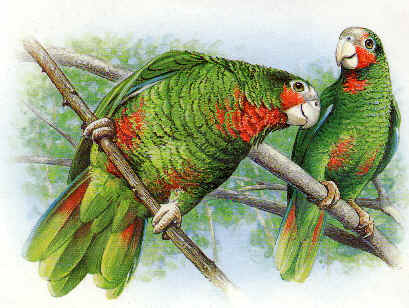
In the upper right illustration is the "CAYMAN PARROT", Amazona leucocphala caymanensis, one of two subspecies in the Caymans. There are also other subspecies in Cuba and the Bahamas.
This parrot, also known now as the Rose-throated Parrot, is 1 of 87 species of birds cumulatively found during FONT tours in the Cayman Islands.   


Codes:

GC: on Grand Cayman Island
LC
: on Little Cayman Island

(i): introduced species
(t): a globally threatened or rare species, designated by Birdlife International
(t1): critical (t2): endangered (t3): vulnerable
(nt): a near-threatened species globally

(WIe): West Indian endemic to the Cayman Islands & Swan Island
(WIo): in the West Indies only in the Cayman Islands


Some local bird-names of the Cayman Islands follow the English names in the list.

Links:

A Bird-List & Photo Gallery of Caribbean Birds, Part #1: Guineafowl to Hummingbirds

A Bird-List & Photo Gallery of Caribbean Birds, Part #2: Trogons to Buntings

Rare Birds of the Caribbean today & those that have gone extinct 

Upcoming FONT Birding & Nature Tours in the Caribbean


Bird-List:

  1. Pied-billed Grebe  ("Diving Dapper")  _____GC feb,apr/may,jun
    Podilymbus podiceps antillarum

  2. White-tailed Tropicbird  ("Boatswain Bird") ______ GC LC  feb,apr/may
    Phaethon lepturus catesbyi

  3. Brown Pelican ______ GC  feb
    Pelecanus o. occidentalis

  4. Red-footed Booby ______ GC LC  feb
    Sula sula  (monotypic)
    (both light & dark morphs at colony, adults & young)

  5. Magnificent Frigatebird ______ GC,LC feb,apr/may,jun
    Fregata magnificens 
    (now said to be monotypic)
    (including males with inflated red sacs at breeding colony)

  6. Green Heron  ("Mary Perk")______ GC,LC  feb,apr/may,jun  (was for a time considered conspecific with the nearly-cosmopolitan Striated Heron, and was then called Green-backed Heron
    Butorides virescens maculata

  7. Western Cattle Egret ______ GC,LC  feb,apr/may
    Bubulcus ibis 
    (the single member of its genus)

  8. Great Blue Heron ______ GC,LC  feb,jun
    Ardea h. herodias

  9. Great Egret ______ GC,LC feb,apr/may,jun
    Casmerodius (has beenr Ardea) alba egretta

  10. Snowy Egret  ("White Gauldin") ______ GC,LC feb,apr/may,jun
    Egretta
    (formerly Leucophoyx) thula brewsteri

  11. Little Blue Heron ______ GC,LC  feb,apr/may,jun
    Egretta
    (formerly Florida) caerulea  (monotypic)

  12. Tricolored Heron ______ GC,LC  feb,apr/may,jun
    Egretta
    (formely Hydranassa) tricolor ruficollis

  13. Black-crowned Night-Heron  ______  GC  feb
    Nycticorax nycticorax hoactli

     
  14. Yellow-crowned Night-Heron  ("Crab-catcher")______ GC,LC  feb,jun
    Nyctanassa violacea bancrofti 
    (the single member of its genus)

  15. Least Bittern ______ GC apr/may,jun
    Ixobrychus e. exilis

  16. White Ibis ______ GC  jun
    Eudocimus albus 
    (monotypic)

  17. West Indian (or Black-billed) Whistling-Duck (t1)  ("Whistler")______ GC  feb,apr/may,jun  (has also been called West Indian Tree Duck)
    Dendrocygna arborea  (monotypic)
    (an incredible 250 birds in Jun 2000, then even more, over 300 birds, in Feb 2001; nearly 200 birds in Feb 2006)

  18. Blue-winged Teal ______ GC,LC  feb,apr/may
    Anas discors 
    (monotypic)
    (many (hundreds) on ponds on both Grand & Little Cayman Is. in Feb 2001)

  19. Baikal Teal ______ LC  feb
    Anas formosa 
    (monotypic)
    (monotypic)
    (Inexplicably one male was in a flock of Blue-winged Teal, on Feb 24, 2001, on a pond on Little Cayman Island, a small, remote place with few people. The behavior of the Baikal Teal was the same as that of the Blue-winged Teal (as a wary, wild bird). The Feb 2001 Baikal Teal was not banded. It was photographed. As far as we know, there was no previous record of this species in the West Indies. The species in Asia has been known to wander on occasion to the south beyond its normal range. It has occurred in North America, particularly Alaska, casually. The Feb 2001 Little Cayman bird may have joined with Blue-winged Teal in western North America and migrated south with them. Conversely, it should be noted, as well, that Baikal Teals have occurred in North America as escapes.)  

  20. Osprey  ("Fish Hawk") ______ GC LC  feb
    Pandion haliaetus 
    (the single member of its genus)
    2 subspecies occur in the Caribbean: P. h. ridgwayi & P. h. carolinensis 

  21. Merlin ______ GC,LC  feb,apr/may
    Falco c. columbarius

  22. American Kestrel  ("Killyhawk") ______GC,LC  feb
    Falco sparverius sparveroides 
    (this subspecies is also a resident of Cuba & the southern Bahamas) 

  23. Purple Gallinule ______ GC  apr/may,jun
    Porphyrula martinica 
    (monotypic)

  24. Common Gallinule (or Moorhen)  ("Red Seal Coot") ______ GC,LC  feb,apr/may,jun
    Gallinula chloropus cerceris

  25. American Coot ______ GC LC  feb,apr/may,jun
    Fulica a. americana 

  26. Black-bellied Plover ______ GC feb,jun  (also called Grey Plover
    Pluvialis squatarola cynosurae

  27. Semipalmated Plover ______ GC feb,jun
    Charadrius semipalmatus 
    (monotypic)

  28. Wilson's (or Thick-billed) Plover ______ GC  feb
    Charadrius wilsonia rufinucha 
    (resident subspecies in the Caribbean)
    (this species uncommon in the Caymans)

     
  29. Killdeer ______  LC  feb
    Charadrius v. vociferus 
    (breeder in North America that winters in the Caribbean) 

     
  30. Black-necked Stilt  ("Telltale") ______ GC,LC feb,apr/may,jun  (by some said to be conspecific with the Black-winged Stilt of the Old World)
    Himantopus (himantopus) mexicanus

  31. Greater Yellowlegs ______ GC LC  feb
    Tringa melanoleuca 
    (monotypic)

  32. Lesser Yellowlegs ______ GC,LC feb
    Tringa flavipes 
    (monotypic)

  33. Solitary Sandpiper ______ GC feb,apr/may
    Tringa s. solitaria

  34. Spotted Sandpiper ______ GC LC  feb,apr/may
    Actitis macularia 
    (monotypic)

  35. Willet ("Laughing Jack") ______ GC  feb
    Catoptrophorus s. semipalmatus

  36. Ruddy Turnstone ______ GC,LC  feb,apr/may
    Arenaria interpres morinella

  37. Wilson's Snipe ______ GC  feb  (until recently considered part of the Common Snipe of the Palearctic, Gallinago gallinago
    Gallinago delicata  (monotypic)

  38. Semipalmated Sandpiper ______ LC  feb
    Calidris pusilla 
    (monotypic)

  39. Least Sandpiper ______ GC,LC  feb
    Calidris minutilla 
    (monotypic)

  40. Laughing Gull ______ GC  jun
    Leucophaeus
    (formerly Larus) a. atricilla

  41. Least Tern  ("Egg Bird") ______ GC  apr/may,jun
    Sternula
    (formerly Sterna) a. antillarum

  42. Royal Tern ______ GC  feb,apr/may,jun
    Thalasseus
    (formerly Sterna) m. maxima

  43. Feral (or Rock) Pigeon (i) ______ GC  feb,apr/may,jun
    Columba livea

  44. White-crowned Pigeon ______ GC  feb,apr/may,jun
    Patagioenas
    (formerly Columba) leucocephala  (monotypic)

  45. Zenaida Dove ______ GC LC  feb,apr/may,jun
    Zenaida aurita zenaida 
    (resident subspecies of the northern Caribbean)

  46. White-winged Dove ______ GC feb,apr/may,jun
    Zenaida a. asiatica

  47. Common Ground Dove ______ GC,LC  feb,apr/may,jun
    Columbina passerina insularis 
    (this subspecies of the Caymans, Cuba, and Hispaniola)

  48. Caribbean (or White-fronted) Dove ______ GC  feb,apr/may
    Leptotila jamaicensis collaris 
    (this subspecies endemic to the Cayman Islands)

     
  49. Rose-throated Parrot (nt) ______ GC  feb,apr/may,jun  (also called Cuban Parrot, or Bahama Parrot)
    Amazona leucocephala caymanensis 
    (on Grand Cayman Is., where it's an endemic subspecies) (Another subspecies occurs in the Caymans, A. l. hesterna, endemic to Cayman Brac Island.) 

  50. Monk Parakeet (i) ______ GC  feb
    Myiopsitta monachus

  51. Mangrove Cuckoo  ("Rain Bird") ______ GC feb,apr/may,jun
    Coccyzus minor 
    (now said to be monotypic)

  52. Smooth-billed Ani  ("Old Black Arnold")______ GC,LC  feb,apr/may,jun
    Crotophaga ani 
    (monotypic)

  53. Barn Owl ______ GC  apr/may
    Tyto alba furcata 
    (this subspecies of the Caymans, Cuba, and Jamaica)

  54. Antillean Nighthawk  ("Rickery-Dick") ______ GC apr/may,jun
    Chordeiles g. gundlachii

  55. Belted Kingfisher  ("Kingfisherman") ______ GC,LC feb 
    Megaceryle (formerly Ceryle) alcyon  (monotypic)

  56. "Yellow-shafted " Northern Flicker ("Black-Heart") ______ GC  feb,apr/may,jun
    Colaptes auratus gundlachi 
    (on Grand Cayman Is., where it's an endemic subspecies)

  57. West Indian Woodpecker  ("Red-Head") ______ GC  feb,apr/may,jun
    Melanerpes superciliaris caymanensis 
    (on Grand Cayman Is., where it's an endemic subspecies)

  58. Yellow-bellied Sapsucker ______ GC  feb 
    Sphyrapicus varius 
    (monotypic)

  59. Gray Kingbird ______ GC,LC  feb,apr/may,jun
    Tyrannus d. dominicensis 
    (one seen on Little Cayman Is. Feb 24, 2001 - an early arrival)

  60. Loggerhead Kingbird  ("Tom Fighter") ______ GC  feb,apr/may,jun
    Tyrannus caudifasciatus caymanensis 
    (this subspecies endemic to the Cayman Islands)

  61. LaSagra's Flycatcher  ("Tom Fool") ______ GC feb,apr/may,jun
    Myiarchus s. sagrae 
    (this subspecies of the Caymans & Cuba)

  62. Eastern Wood-Pewee ______ GC  apr/may
    Contopus virens 
    (monotypic)

  63. Caribbean Elaenia  ("Top Knot Judas") ______ GC,LC feb,apr/may,jun
    Elaenia martinica caymanensis 
    (this subspecies endemic to the Cayman Islands)

  64. Purple (or possibly Cuban) Martin ______ GC  apr/may  (both species could migrate thru the Caymans in the spring)   
    Progne s. subis

  65. Barn Swallow ______ GC LC   feb,apr/may,jun
    Hirundo rustica erythrogaster

  66. Northern Mockingbird  ("Nightingale") ______ GC,LC feb,apr/may,jun
    Mimus polyglottos orpheus 
    (resident subspecies of the Caribbean)

  67. Gray Catbird  ______ GC  feb
    Dumetella carolinensis 
    (monotypic, and the single member of its genus)

  68. Thick-billed Vireo  ("Shear-Bark") ______ GC  feb,apr/may,jun
    Vireo crassirostris alleni 
    (this subspecies endemic to the Cayman Islands)

  69. Black-whiskered Vireo ______ GC  feb
    Vireo a. altiloquus

    (one bird, heard & seen, at the north end of Grand Cayman Is. Feb 25, 2001; this species rare in the Caymans)  

  70. Yucatan Vireo (WIo)  ("Sweet Bridget") ______ GC  feb,apr/may,jun
    Vireo magister caymanensis 
    (on Grand Cayman Is., where it's an endemic subspecies; the only subspecies on an West Indian island, although 2 subspecies occur on islands off Belize & Honduras)

  71. Bananaquit ______ GC,LC  feb,apr/may,jun
    Coereba flaveola sharpei
      (subspecies endemic to the Caymans) (In all, there are 41 subspecies throughout Latin America & the Caribbean. 24 of those subspecies are on islands in the Caribbean including some off the coasts of Mexico & Venezuela, & on Trinidad & Tobago.)  

  72. Black-and-white Warbler ______ GC LC  feb,apr/may
    Mniotilta varia 
    (monotypic, and the single member of its genus)

  73. Northern Parula (Warbler) ______ GC LC  feb
    Parula americana 
    (monotypic)

  74. Golden Warbler ______ GC,LC  feb,apr/may,jun  (considered distinct by some from the migratory Yellow Warbler, which breeds in North America & winters in the Caribbean, Dendroica aestiva)   
    Dendroica petechia eoa 
    (this resident subspecies in the Caymans & Jamaica)

  75. Yellow Warbler ______ GC,LC  feb
    Dendroica aestiva

  76. Black-throated Blue Warbler ______ GC  feb
    Dendroica caerulescens cairnsi 

  77. Yellow-throated Warbler ______ GC LC  feb
    Dendroica dominica
     (3 subspecies occur in the Caribbean)

  78. Prairie Warbler ______ GC,LC  feb
    Dendroica discolor  
    (2 subspecies occur in the Caribbean) 

  79. Vitelline Warbler (nt) (WIe)  ("Chip Chip") ______ GC,LC  feb,apr/may,jun
    Dendroica v. vitellina
    (on Grand Cayman Is., where it's an endemic subspecies)
    Dendroica vitellina crawfordi
    (on Little Cayman Is., where it's am endemic subspecies)
     

  80. Palm Warbler ______ GC,LC  feb
    Dendroica p. palmarum
    (apparently the most common bird on the Caymans in February) 

  81. Northern Waterthrush ______  GC,LC  feb
    Seiurus noveboracensis 
    (now said to be monotypic) 

  82. Common Yellowthroat ______ LC
    Geothlypis t. trichas

     
  83. American Redstart ______ LC feb,apr/may
    Setophaga ruticilla 
    (monotypic, and the single member of its genus) 

  84. Greater Antillean Grackle  ("Ching Ching") ______ GC,LC  feb,apr/may,jun
    Quiscalus niger caymanensis 
    (on Grand Cayman Is., where it's an endemic subspecies)
    Quiscalus niger bangsi
    (on Little Cayman Is., where it's an endemic subspecies)

  85. Western Spindalis ______ GC,LC  feb,apr/may,jun  (formerly called (Western) Stripe-headed Tanager)
    Spindalis zena salvini  (on Grand Cayman Is., where it's an endemic subspecies)  (Other subspecies occur in the Bahamas, Cuba, and Cozumel Is., Mexico; in all, there are 5 subspecies.)

  86. Cuban Bullfinch  ("Black Sparrow") ______ GC  feb,apr/may,jun
    Melopyrrha nigra taylori 
    (on Grand Cayman Is., where it's an endemic subspecies)

  87. Yellow-faced Grassquit ______  GC,LC  feb,jun
    Tiaris o. olivaceus 
    (this subspecies of the Caymans, Cuba, and Jamaica)

Birds of the Caymans that are otherwise found in the West Indies exclusively (or primarily) in Cuba (and the Bahamas):

Cuban/Rose-throated Parrot

Northern (Yellow-shafted) Flicker

West Indian Woodpecker

LaSagra's Flycatcher

Thick-billed Vireo

Western Stripe-headed Tanager

Cuban Bullfinch