 |
PO Box 9021,
Wilmington, DE 19809, USA
E-mail: font@focusonnature.com
Phone: Toll-free in USA 1-800-721-9986
or 302/529-1876; Fax: 302/529-1085 |
Belize
Birds
during FONT Birding
& Nature Tours
thru 2007
(during the months of February
& March)
A Belize bird list compiled by Armas Hill
with photos
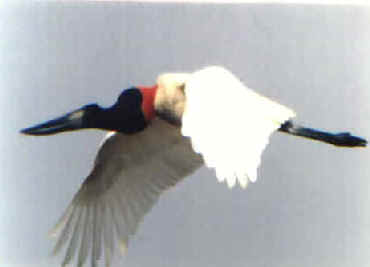
P
hoto at right: a JABIRU in
flight
During FONT birding tours in Belize, 260 species of birds have cumulatively been found.
Codes:
ah:
near the Mayan ruins of Altun Ha
bb:
Banana Bank
bi:
on &
near Bird Island
cb: Cockscomb Basin Wildlife Sanctuary & the nearby Maya
Centre
cc:
the offshore island of Caye Caulker
ct:
vicinity of Crooked Tree
cy: the Cayo District near San Ignacio including the Macal
River valley & the farming area near Spanish Lookout
gp: near Gale's Point (Manatee Lodge)
hh: along the Hummingbird Highway
mp: Mountain Pine Ridge
pc:
the coastal area in & near Placencia
(t): a globally
threatened or rare species, designated by Birdlife International.
(t1): critical (t2): endangered (t3): vulnerable
(nt): a near-threatened species globally.
(i): an introduced species.
(
BZr): rare in Belize
(BZu): uncommon in Belize
A fine
book, "Jungle of the Maya" has recently been published (in 2006) by
the University of Texas Press. In it, there some very good photographs of
wildlife in Belize, and in nearby Guatemala & Mexico. In the following
lists, pages in that book with photos of particular species are referred to with
a (p. xx)
Links:
Mammals
&
Other Wildlife in Central America
Butterflies
in Central America
Highlights
from previous FONT tours in Belize
Upcoming
FONT Birding & Nature Tours in Central America
A
Feature of Photos from the FONT Belize Tour in March 2007

Bird-List:
- Great Tinamou ______ cy,cb
Tinamus major percautus
Little Tinamou ______ cy,cb
Crypturellus soui meserythrus
Thicket Tinamou ______ cy
Crypturellus cinnamomeus goldmani
Slaty-breasted Tinamou ______ cy
Crypturellus b. boucardi
Plain Chachalaca ______ cy,cb,gp
Ortalis vetula intermedia
Yucatan Bobwhite ______
Colinus n. nigrogularis
Black-bellied Whistling-Duck ______ ah
(at
one time was called
Black-bellied Tree-Duck)
Dendrocygna a. autumnalis
Fulvous Whistling-Duck ______ (at one time was
called Fulvous Tree Duck)
Dendrocygna bicolor (although on 3 continents, monotypic)
Muscovy Duck ______ bi,cc
Cairina moschata (monotypic, and the single member of its genus)
Blue-winged Teal ______ ct,ah,cy
Anas discors (monotypic)
Pied-billed Grebe ______ ct
Podilymbus p. podiceps
Jabiru ______ cy
Jabiru mycteria (monotypic, and the single member of its genus)

Jabirus at their nest were seen during
the FONT Belize Tour in March 2007
Wood Stork ______ ct,ah,cy
Mycteria americana (monotypic)
American White Ibis ______ ah,bi
Eudocimus albus (monotypic)
Glossy Ibis ______ ct
Plegadis falcinellus (monotypic)
Roseate Spoonbill ______
Platalea ajaja (monotypic)
Cattle Egret ______ ct,ah,cy,hh,pc,cb,cc (p.
74-75)
Bubulcus i. ibis (the single member of its genus)
Green Heron ______ cy,bb,pc,cc (was at one time
considered conspecific with the nearly-cosmopolitan Striated Heron, and was
then called Green-backed Heron)
Butorides v. virescens
Reddish Egret ______
Egretta r. rufescens
Little Blue Heron ______ ct,ah,cy,bi,cc (p.
64)
Egretta caerulea (monotypic)
Tricolored Heron ______ ct,bi,cc
(was
called Louisiana Heron)
Egretta tricolor ruficollis
Snowy Egret ______ ct,ah,cy,bi,cc
Egretta t. thula
Great Egret ______ ct,ah,cy,bi,cc (p. 71)
Ardea (formerly Casmerodius) alba egretta
Great Blue Heron ______ ct,cy,bi
Ardea h. herodias
Bare-throated Tiger-Heron ______ cy (p. 70)
Tigrisoma mexicanum (monotypic)
Black-crowned Night-Heron ______ ct,bi
Nyctocorax nyctocorax hoactii
Yellow-crowned Night-Heron ______ cc (p. 70)
Nyctanassa v. violacea (the single member of its genus)
Boat-billed Heron ______ bi
Cochlearius cochlearius phillipsi (the single member of its genus)
Magnificent Frigatebird ______ pc,bi,cc
Fregata magnificens (now said to be monotypic)
Two Magnificent Frigatebirds photographed during the FONT Belize tour
in March 2007 (photo by Alan Brady)
Brown Pelican ______ pc,bi,cc
Pelecanus occidentalis carolinensis
Neotropic Cormorant ______
ct,cy (was called
Olivaceous Cormorant)
Phalacrocorax brasilianus mexicanus
(formerly P. olivaceous)

A Neotropic Cormorant photographed during the FONT Belize tour
in March 2007, at the fresh-water Crooked Tree Lagoon.
Along the seacoast, the Cormorants were Double-crested.
(photo by Alan Brady)
Double-crested Cormorant ______ cc
Phalacrocorax auritus floridanus
Anhinga ______ ah,cy,pc
Anhinga anhinga leucogaster
King Vulture ______ bb,gp (p. 105)
Sarcoramphus papa (monotypic, and the single member of its genus)
Turkey Vulture ______ ct,ah,cy,mp,bb,cb,bi
Cathartes a. aura (another subspecies, C. a. meridionalis, from
central North America migrates thru Honduras, sometimes in large
flocks)
Lesser Yellow-headed Vulture ______ ct
Cathartes burrovianus (monotypic)
Black Vulture ______ ct,ah,cy,mp,bb,cb,bi
Coragyps atratus (now said to be monotypic) (the single member of its
genus)
Northern Crested Caracara (BZr) ______ hc,cc
(formerly
conspecific with what's now the
Southern Crested Caracara, Caracara plancus, of South
America, generally south of the Amazon)
Caracara cheriway (monotypic)
Laughing Falcon ______ cy,bb,cb (p. 23)
Herpetotheres cachinnans (the single member of its genus)
American Kestrel ______ cy,bb,pc
Falco sparverius tropicalis
Merlin ______ bb
Falco c. columbarius
Bat Falcon ______ ah,cy,cb (p. 99)
Falco rufigularis petoensis
Peregrine Falcon ______ bi
Falco peregrinus anatum (subspecies that breeds further
north in North America) (Another subspecies that breeds further north in North
America occurs in Honduras as a migrant, F. p. tundrius)
Osprey ______ ct,bi,cc
Pandion haliaetus carolinensis (the single member of its genus)
(another
subspecies, P.h. ridgwayi, also in eastern Honduras near the Caribbean)
Gray-headed Kite ______ (has also been called
Cayenne Kite)
Leptodon c. cayanensis
White-tailed Kite ______ ct,cy,pc
Elanus leucurus majusculus
Swallow-tailed Kite ______ mp
Elanoides forficatus (2 subspecies occur in Belize: E. f.
forficatus & E. f. yetapa)
Plumbeous Kite ______ mp,cb
Ictinia plumbea (monotypic)
Snail Kite ______ ct,cy
Rostrhamus s. sociabilis

A female Snail Kite photographed during a FONT tour
Black-collared Hawk ______ ct,cy
Busarellus n. nigricollis
A Black-collared Hawk photographed during a FONT tour
Northern Harrier ______
Circus cyaneus hudsonius
Sharp-shinned Hawk ______
Accipiter striatus chionogaster
Cooper's Hawk ______ cy
Accipiter cooperii (monotypic)
White Hawk ______ cb (p. 99)
Leucopternis albicollis ghiebreghti
Common Black Hawk ______ pc
Buteogallus a. anthracinus

A Common Black Hawk photographed during the March 2007
FONT Tour in Belize
(photo by Alan Brady)
Great Black Hawk ______ ct
Buteogallus urubitinga ridgwayi
Gray-lined Hawk ______ cy (p. 23)
(in
northern part of its range, has been called Gray Hawk)
Buteo nitida plagiata

A Gray-lined Hawk photographed during the March 2007 FONT tour in Belize
(photo by Alan Brady)
Roadside Hawk ______ ct,ah,cy,bb,pc,cb (p.23)
Buteo magnirostris griseocauda
White-tailed Hawk ______ cy
Buteo albicaudatus hypospodius
Gray-necked Wood-Rail ______ ct,cy (p. 70)
Aramides cajanea albiventris

A Gray-necked Wood Rail photographed during a FONT tour
(photo by Marie Gardner)
Ruddy Crake ______ cy
(has also been called
"Red Rail")
Laterallus ruber (monotypic)
Common Gallinule (or Moorhen) ______ cy
Gallinula chloropus cachinnans
Purple Gallinule ______ ct,cy
Porphyrula martinica (monotypic)
A Purple Gallinule photographed during a FONT tour
(photo by Marie Gardner)
American Coot ______
Fulica a. americana
Sungrebe ______
Heliornis fulica (monotypic)
Limpkin ______ ct,cy
Aramus guarauna dolosus
(the single member of its genus &
family)
A Limpkin photographed during a FONT tour
Southern Lapwing (BZr) ______ ct
Vanellus chilensis cayennensis
Southern Lapwings have been spreading north.
One was seen during the FONT tour in Belize
in March 2007.
Black-bellied (or Grey) Plover ______cc
Pluvialis squatarola cynosurae
Semipalmated Plover ______ cc
Charadrius semipalmatus (monotypic)
Killdeer ______ cy
Charadrius v. vociferus
Northern Jacana ______ ct,ah,cy (p. 15 &
66)
Jacana s. spinosa
A Northern Jacana during the March 2007 FONT tour in Belize
"American" Whimbrel ______ cc
Numenius phaeopus hudsonicus
Greater Yellowlegs ______ cc
Tringa melanoleuca (monotypic)
Lesser Yellowlegs ______ ah
Tringa flavipes (monotypic)
Solitary Sandpiper ______ ah,cy
Tringa solitaria
Spotted Sandpiper ______ ct,cy,pc,gp,cc
Actitis macularia (monotypic)
Ruddy Turnstone ______ cc
Arenaria interpres morinella
Sanderling ______ cc
Calidris alba rubida
Semipalmated Sandpiper ______ cy
Calidris pusilla (monotypic)
Least Sandpiper ______
Calidris minutilla
Short-billed Dowitcher ______ cc
Limnodromus griseus
Laughing Gull ______ ct,pc,gp,cc
Larus atricilla megalopterus
Gull-billed Tern ______ ct,gp,cc
Gelochelidon (formerly
Sterna)
nilotica aranea
Caspian Tern ______ cc
Hydroprogne (formerly
Sterna)
caspia (monotypic)
Royal Tern ______ pc,cc
Thalasseus (formerly
Sterna)
m. maxima
Sandwich Tern ______ pc,cc
Thalasseus (formerly
Sterna)
sandvicensis acuflavidus
Common Tern ______ cc
Sterna h. hirundo
Forster's Tern ______ ct
Sterna forsteri (monotypic)
Black Tern ______
Chlidonias niger
Common (or Feral) Pigeon (i) ______ cy,cc
Columba livia
Pale-vented Pigeon ______ cy,gp.bi
Patagioenas (formerly
Columba)
cayennensis pallidicrissa
White-crowned Pigeon ______ cc
Patagioenas (formerly
Columba)
leucocephala
Red-billed Pigeon ______ cy
Patagioenas (formerly
Columba)
f. flavirostris
Short-billed Pigeon ______ cy,cb
Patagioenas (formerly
Columba)
nigrirostris
Mourning Dove ______ ct,pc
Zenaida macroura marginella
White-winged Dove ______ pc,cc
Zenaida a. asiatica
Common Ground-Dove ______
Columbina passerina pallescens
Plain-breasted Ground-Dove ______ cy,bb
Columbina minuta interrupta
Ruddy Ground-Dove ______ ct,ah,cy,bb,pc,cb,gp
Columbina taipacoti rufipennis
Blue Ground-Dove ______ cy,cb
Claravis pretiosa
White-tipped Dove ______ ah,cy (was called
White-fronted Dove)
Leptotila verreauxi bangsi
Gray-fronted (including
Gray-headed)
Dove ______ ah
Leptotila rufaxilla
Gray-chested Dove ______ cb
Leptotila cassinii cerviniventris
Ruddy Quail-Dove ______ cb
Geotrygon montana
Aztec Parakeet ______ ah,cy,bb,pc,cb (was
considered conspecific
with what's now the Jamaican Parakeet of the
West Indies; when merged, was known as the Olive-throated Parakeet)
Aratinga a. astec
White-fronted Amazon ______ ct,cy,bb
Amazona albifrons nana
Red-lored Amazon ______
ct,cb (p. 17) (has also been called Yellow-cheeked Amazon)
Amazona a. autumnalis
Squirrel Cuckoo ______ cy,gb
Piaya cayana thermophila
Groove-billed Ani ______ cy
Crotophaga sulciroxtris (now monotypic, as a "second form"
in Mexico has become extinct)
Barn Owl ______ cy
Tyto alba

During one evening, as we drove along a road in Belize in March 2007,
we saw 6 Barn Owls on fence posts.
"Ridgway's" Ferruginous Pygmy-Owl ______ (considered part of
Ferruginous Pygmy Owl of South America)
Glaucicium r. ridgwayi

Ferruginous Pygmy Owl
(photo by Alan Brady)
Mottled Owl ______ cb
Ciccaba virgata
Lesser Nighthawk ______
Chordeiles acutipennis
Pauraque ______ cy,cb
Nyctidromus albicollis intercedens
Yucatan Poorwill ______ cy
Nyctiphrynus yucatanicus
Northern Potoo ______ cy
Nyctibius jamaicensis
A Northern Potoo at rest during the day,
photographed during the FONT March '07 Belize Tour
White-collared Swift ______ mp
Streptoprocne zonaris mexicanus
"Dusky-backed" Vaux's Swift ______ cy,bb
Chaetura vauxi richmondi
Lesser Swallow-tailed Swift ______
Panyptila cayennensis
Long-billed Hermit ______ (p. 30)
(formerly part of a wider-ranging
Long-tailed Hermit; that species now
restricted to South America)
Phaethornis l. longirostris
White-necked Jacobin ______ cy
Florisuga m. mellivora
Green-breasted Mango ______ cc
Anthracothorax p. prevostii
White-bellied Emerald ______ cb (p. 31)
Amazilia c. candida
Cinnamon Hummingbird ______ cc
Amazilia rutila corallirostris
Rufous-tailed Hummingbird ______ cy,cb (p. 31)
Amazilia t. tzacatl

Rufous-tailed Hummingbird
Slaty-tailed Trogon ______ cb (p. 13)
Trogon m. massena
Black-headed Trogon ______ ah,cy
(was
considered conspecific with the Citreoline Trogon of Mexico)
Trogon melanocephalus (now monotypic)

Black-headed Trogon
Violaceous Trogon ______ ah,cy (p. 46)
Trogon violaceus
braccatus
Ringed Kingfisher ______ ct,cy,gp (p. 68)
Megaceryle
(formerly
Ceryle)
t. torquata
Belted Kingfisher ______ gp
Megaceryle
(formerly
Ceryle)
alcyon (monotypic)
Amazon Kingfisher ______
Chloroceryle amazona (now monotypic)
Green Kingfisher ______ cy,gp (p. 69)
Chloroceryle americana septentrionalis

A Green Kingfisher photographed during a FONT tour
(photo by Andy Smith)
Blue-crowned Motmot ______ cy,cb (p. 13)
Momotus momota lessonii
A Blue-crowned Motmot photographed during a FONT tour
(photo by Marie Gardner)
Collared Aracari ______ ct,bb (p. 16)
Pteroglossus t. torquatus
A Collared Aracari photographed during a FONT tour
(photographed by Marie Gardner)
Keel-billed Toucan ______ ah,cy,cb (p. v)
Ramphastos s. sulfuratus

Keel-billed Toucan (the "national bird" of Belize)
(photo by Sally Brady)
Acorn Woodpecker ______ ct,ah,mp
Melanerpes formicivorus lineatus
Golden-fronted Woodpecker ______ct,cy,bb,cb,gp,cc
Melanerpes
(formerly
Centurus)
aurifrons santacruzi
Black-cheeked Woodpecker ______ (p. 27)
Melanerpes
(formerly
Centurus
or
Tripsurus)
pucherani (monotypic)
Golden-olive Woodpecker ______ cy
Piculus rubiginosus maximus
Smoky-brown Woodpecker ______ cb
Veniliornis fumigatus
Lineated Woodpecker ______ ct,ah,cy,bb (p. 5)
Dryocopus lineatus similis
Pale-billed Woodpecker ______ cb
Campephilus g. guatemalensis
White-collared Manakin ______ cb (p. 19: male
& female, & 132)
Manacus candei
Thrushlike Schiffornis ______ cb
(has
been called
Thrushlike Manakin &
Thrushlike Mourner)
Schiffornis turdinus veraepacis
Masked Tityra ______ cy
Tityra semifasciata personata
Rose-throated Becard ______ cy,cb
Pachyramphus aglaiae sumichrasti
Cinnamon Becard ______ bb
Pachyramphus cinnamomeus fulvidior
Gray-collared Becard ______ bb
Pachyramphus major
Fork-tailed Flycatcher ______ ct,cy,pc
Tyrannus savana monachus

A Fork-tailed Flycatcher photographed
during the March 2007 FONT tour in Belize
(photo by Alan Brady)
Tropical Kingbird ______ ct,ah,cy,bb,cb,gp,cc
(p. 48 & 126)
Tyrannus melancholicus satrapa
Couch's Kingbird ______ ct
Tyrannus couchii
Piratic Flycatcher ______ cy,bb,cb
Legatus leucophaius
Streaked Flycatcher ______ cb
Myiodynastes maculatus insolens
Boat-billed Flycatcher ______ ah,gp
Megarynchus pitangua
Social Flycatcher ______ ct,ah,cy,mp,cb,gp
Myiozetetes similis texensis
Great Kiskadee ______ ct,ah,cy,bb,cb,gp
Pitangus sulphuratus guatimalensis
Brown-crested Flycatcher ______ cy
Myiarchus tyrannulus cooperi
Great Crested Flycatcher ______ bb
Myiarchus crinitus (monotypic)
Dusky-capped Flycatcher ______ bb,cb
Myiarchus tuberculifer connectens
Vermilion Flycatcher ______ ct,ah,cy
Pyrocephalus rubinus
Black Phoebe ______ gp
Sayornis nigricans aquaticus
Tropical Pewee ______ ah,cy,cb
Contopus cinereus brachytarsus
Yellow-bellied Flycatcher ______ cy
Empidonax flaviventis (monotypic)
Least Flycatcher ______ cy
Empidonax minimus (monotypic)
Northern Royal Flycatcher ______ bb (p.
20) (was
conspecific with these related South American species: the
Amazonian
Royal Flycatcher, Pacific Royal Flycatcher, and
Atlantic Royal Flycatcher)
Onychorhynchus mexicanus
Common Tody-Flycatcher ______ cb
Todirostrum cinereum finitimum
Yellow-bellied Elaenia ______ cy,cb (p. 20)
Elaenia flavogaster subpagana
Sepia-capped Flycatcher ______
Leptopogon amaurocephalus
Great Antshrike ______
Taraba major
Barred Antshrike ______ cy,cb
Thamnophilus doliatus intermedius
Dusky Antbird ______ cb
Cercomacra tyrannina
"Mexican" Black-faced Antthrush ______
Formicarius analis
Ivory-billed (or Laughing) Woodcreeper ______ cy,cb
Xiphorhynchus flavigaster eburneirostris
Streak-headed Woodcreeper ______ cb
Lepidocolaptes souleyetii insignis
White-eyed Vireo ______
Vireo griseus
Mangrove Vireo ______
Vireo pallens
Yellow-throated Vireo ______
Vireo flavifrons (monotypic)
Yellow-green Vireo ______ cy,cb
Vireo f. flavoviridis (cb)
Vireo flavoviridis perplexa (cy)
Yucatan Vireo ______ cc
Vireo magister decoloratus
"Gray-headed" Lesser Greenlet ______
Hylophilus d. decurtatus
Brown Jay ______ ah,cy,bbcb,gp
Cyanocorax m. morio
Green Jay ______ cy
Cyanocorax yncas centralis
Gray-breasted Martin ______ ct
Progne c. chalybea
Mangrove Swallow ______ ct,cy,pc,gp
Tachycineta bicolor (monotypic)
Northern Rough-winged Swallow ______ mp,cb,gp
Stelgidopteryx serripennis
Ridgway's Rough-winged Swallow ______ cy
Stelgidopteryx ridgwayi
Barn Swallow ______ cy,gp,bi,cc
Hirundo rustica
Band-backed Wren ______ cy
Campylorhynchus zonatus
Spot-breasted Wren ______ cb (closely related
to the
Speckle-breasted Wren
of South America)
Thryothous maculipectus
"Southern" House Wren ______ ct,ah,bb,cb
Troglodytes (aedon?) musculus intermedius
White-breasted Wood-Wren ______ ah,cb
Henicorhina leucosticta prostheleuca
Blue-gray Gnatcatcher ______
Polioptila caerulea
Tropical Mockingbird ______ ct,ah,bb,pc,gp,cc
Mimus gilvus gracils
Gray Catbird ______ cy,cc
Dumetella carolinensis (monotypic, and the single member of its
genus)
Black Catbird ______ cc
Melanoptila glabrirostris (monotypic, and the single member of its
genus)
Wood Thrush ______ cy
Hylocichia (formerly Catharus) mustelinus (monotypic, and now the
single member of its genus)
Clay-colored Thrush ______ ct,cy,cb
(has
been called
Clay-colored Robin)
Turdus grayi megas
House Sparrow (i) ______
Passer domesticus
Scrub Euphonia ______ cc
Euphonia a. affinis
Yellow-throated Euphonia ______ cy,bb
Euphonia hirundinacea
Olive-backed Euphonia ______ cb
(p. 20)
Euphonia gouldi
Black-headed Siskin ______ mp
Carduelis notata forreri
Black-and-white Warbler ______ cy
Mniotilta varia (monotypic, and the single member of its genus)
Prothonotary Warbler ______ cy
Protonotaria citrea (monotypic, and the single member of its
genus)
Worm-eating Warbler ______
Helmitheros vermivorus
Blue-winged Warbler ______ cy
Vermivora pinus (monotypic)
Nashville Warbler ______
Vermivora ruficapilla
Northern Parula ______
Parula pitiayumi nigrilora
Yellow Warbler ______ ct,ah,cy,bb,pc,cb,gp,cc
Dendroica aestiva (was Dendroica petechia when Mangrove Warbler
not
split)
Mangrove Warbler ______ cc
Dendroica erithachorides
Magnolia Warbler ______ ah,cy,cb
Dendroica magnolia
Grace's Warbler ______ mp
Dendroica graciae remota
Yellow-throated Warbler ______ ct,cc
Dendroica dominica

A Yellow-throated Warbler
One joined us every morning at breakfast at Crooked Tree
during our Belize tour in March 2007
Palm Warbler ______
Dendroica palmarum
"Myrtle" Yellow-rumped Warbler ______ ct,ah,mp
Dendroica c. coronata
Northern Waterthrush ______ ah,cy
Seiurus noveboracensis (now said to be monotypic)
Louisiana Waterthrush ______ (p. 67)
Seiurus motacilla
Common Yellowthroat ______
Geothlypis trichas (2 subspecies winter in Central America)
Kentucky Warbler ______ (p. 67)
Oporornis formosus (monotypic)
Hooded Warbler ______ bb
Wilsonia citrina (monotypic)
American Redstart ______ ct,cy,cc (p. 67)
Setophaga ruticilla
(now said to be monotypic; the single member of its
genus)
Yellow-breasted Chat ______ cy
Icteria v. virens
Montezuma Oropendola ______ ah,cb,gp (p. 18)
Psarocolius montezuma (monotypic)
A Montezuma Oropendola photographed during a FONT tour
(photo by Marie Gardner)
Black-cowled Oriole ______ ah,cb,gp
Icterus prosthemelas
Altamira Oriole ______
Icterus gularis gigas
Hooded Oriole ______ ct,bb
Icterus cucullatus
Yellow-tailed Oriole ______ mp,hh,cp
Icterus mesomelas
Baltimore Oriole ______ ct,bb,hh,cb
Icterus galbula
(monotypic)
Orchard Oriole ______ cy,cb
Icterus s. spurius
Red-winged Blackbird ______ ct
Agelaius phoeniceus richmondi
Melodious Blackbird ______ ct,ah,cy,bb,cb
Dives dives (monotypic)
Great-tailed Grackle ______ ct,ah,cy,bb,pc,cb,gp,cc
Quiscalus m. mexicanus
Bronzed Cowbird ______ bb,cb
(has also been
called
"Red-eyed Cowbird")
Molothrus a. aeneus
Shiny Cowbird (BZr) ______ pc
Molothrus bonariensis
Eastern Meadowlark ______ cy
Sturnella magna alticola
The resident race of the Eastern Meadowlark in the farmland of Belize
(photographed by Alan Brady during the March 2007 FONT tour)
Bananaquit ______ cc
Coereba flaveola caboti
Red-crowned Ant-Tanager ______ cs
Habia rubica rubicoides
Red-throated Ant-Tanager ______ cy
Habia fuscicauda salvini
Hepatic Tanager ______ mp
Piranga hepatica
Summer Tanager ______ cb
Piranga r. rubra
Crimson-collared Tanager ______ cb
Phlogothraupis s. sanguinolenta
Passerini's Tanager ______ cb
(was called Scarlet-rumped Tanager when it was
conspecific with what's now the more-southerly Cherrie's Tanager)
Ramphocelus passerinii (monotypic)
Blue-gray Tanager ______ ct,ah,cy,bb,pc,cb
(p. 20)
Thraupis episcopus cana
Yellow-winged Tanager ______ ah,cy,cb (p. 20)
Thraupis abbas (monotypic)
Golden-hooded Tanager ______ cy,cb (p. 26)
(closely related
to the Masked Tanager
of South America)
Tangara l. larvata
Red-legged Honeycreeper ______ cy,cb
Cyanerpes cyaneus carneipes
"Yucatan" Olive Sparrow ______
Arremonops rufivirgatus
Green-backed Sparrow ______ (closely related to
Black-striped Sparrow of southern Central America)
Arremonops chloronotus
Rusty Sparrow ______ mp
Aimophila rufescens
"Black" Variable Seedeater ______ cy,cb
Sporophila aurita corvina

The nearly all-black race of the Variable Seedeater,
photographed during the March 2007 FONT tour in Belize
(photo by Alan Brady)
White-collared Seedeater ______ ct,ah,cy,bb,cb,gp
(p. 20)
Sporophila torqueola morelleti
Yellow-faced Grassquit ______ cy,mp,cb
Tiaris olivacea pusilla
Blue-black Grassquit ______ cy,bb,pc,cb
Volatinia jacarina splendens (the single member of its genus)
Black-headed Saltator ______ ah,cy
Saltator a. atriceps
Buff-throated Saltator ______
Saltator maximus magnoides
"Northern" Grayish Saltator ______ cy
Saltator coerulescens grandis
Northern Cardinal ______ ah
Cardinalis cardinalis
Rose-breasted Grosbeak ______ cc
Pheucticus ludovicianus
Blue Grosbeak ______ cy,cb
Passerina (formerly
Guiraca)
caerulea
Indigo Bunting ______ cy,mp,bb
Passerina cyanea
(montoypic)