PO Box 9021, Wilmington, DE 19809, USA
E-mail: font@focusonnature.com
Phone: Toll-free in USA 1-800-721-9986
 or 302/529-1876


CENTRAL AMERICA
BIRDS

Thrushes to Buntings


Noting those found during 
Focus On Nature Tours
with an (*).  

1991 thru 2011 

(during the months of January, 
 February, March, April, July, December)


Part 4 of a Central America bird list compiled by Armas Hill, 
with photos 


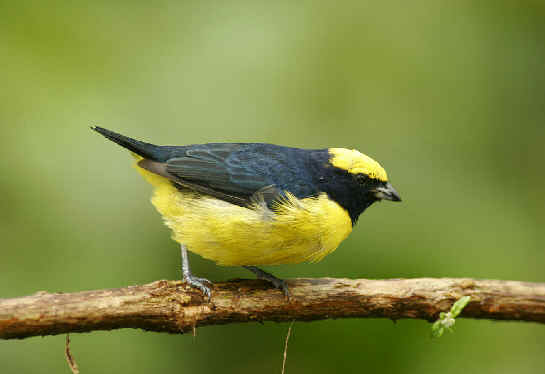
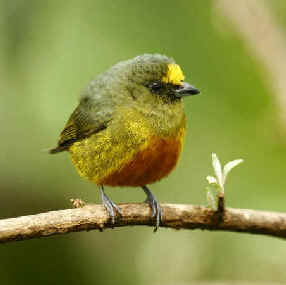
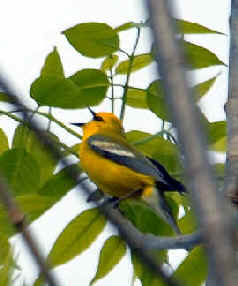
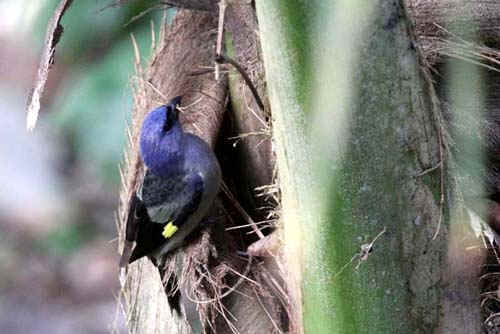
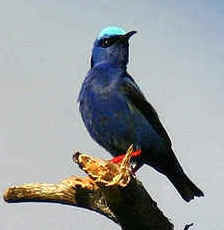
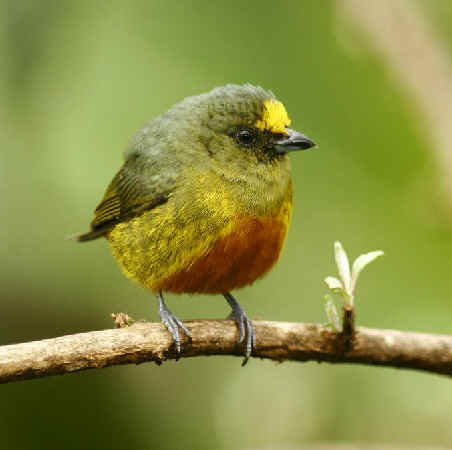
Photo at upper right: OLIVE-BACKED EUPHONIA

Codes:

(t): a globally threatened or rare species, designated by Birdlife International
 (t1): critical
 (t2): endangered
 (t3): vulnerable
(nt): a near-threatened species globally

In the list that follows, relating to sightings during FONT tours, the country & the months are noted.
BZ:
    Belize
CR:   Costa Rica    
GU:   Guatemala
HN:    Honduras
PN:    Panama

(CAi): introduced species

(ph):  species with a photo in the FONT web-site 

Links:

Part #1 of this list of Central America Birds: Tinamous to Doves

Part #2 of this list of Central America Birds: Macaws to Woodpeckers

Part #3 of this list of Central America Birds: Manakins to Thrashers

Birds during FONT Tours in:   Belize  Costa Rica   Guatemala   Honduras    Panama

Mammals in Central America (with photos)

Butterflies in Central America, a list in 5 parts  (with some photos)  

Amphibians & Reptiles in Costa Rica & Panama 
(with some photos) 

Upcoming FONT Birding & Nature Tours in Central America

Directory of Photos in this Website


 Birds:

  1. Brown-backed Solitaire  (*)  ______  GU:jan,feb,mar,apr,jun,jul,dec  PN:feb,mar
    Myadestes occidentalis oberholseri

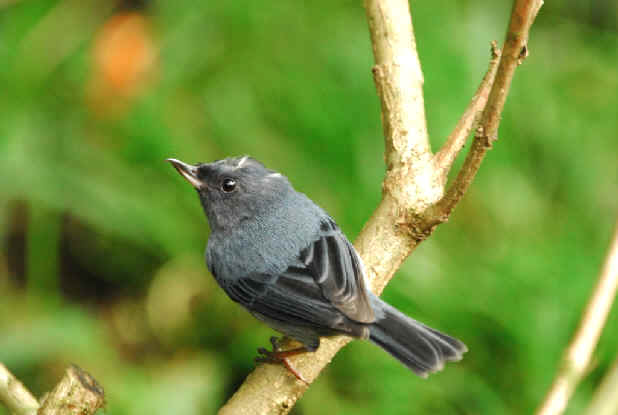
  2. Slate-colored Solitaire  (*)  ______  GU:jan,feb,apr,jun  HN:feb
    Myadestes u. unicolor  

  3. Black-faced Solitaire (*) ______  CR:feb,mar,apr,jul,dec/jan (total range limited to Costa Rica & western Panama)
    Myadestes melanops 
    (monotypic)

  4. Black-billed Nightingale-Thrush (*) ______  CR:jan,feb,mar,jul  (total range limited to Costa Rica & western Panama)
    Catharus g. gracilirostris

  5. Spotted Nightingale-Thrush  (*)  ______  GU:apr,jul  HN:feb
    Catharus d, dryas

  6. Orange-billed Nightingale-Thrush (*) ______  CR:feb,mar,jul,dec/jan  GU:mar,apr,jun.dec  HN:dec  PN:mar
    Catharus aurantiirostris 

    Catharus aurantiirostris costaricensis
    (most of CR)
    Catharus aurantiirostris russatus (southwest CR) 


  7. Slaty-backed Nightingale-Thrush (*) ______  CR:apr,dec'jan  PN:mar
    Catharus fuscater hellmayri

  8. Ruddy-capped Nightingale-Thrush (*) ______  CR:feb,mar,apr,jul  GU:apr,jun,jul,dec  PN:feb
    Catharus f. frantzii

  9. Black-headed Nightingale-Thrush (*) ______  CR:mar  GU:apr
    Catharus mexicanus carrikeri

  10. Gray-cheeked Thrush (*) ______  CR:apr  GU:apr
    Catharus minimus 
    (2 subspecies migrate south from North America)

  11. Swainson's Thrush (*) ______  BZ:apr  CR:mar,apr,dec/jan  GU:jan,feb,apr,dec  PN:mar,oct
    Catharus ustulatus 
    (4 of 6 subspecies migrate as far south as Costa Rica) 

  12. Veery (*) ______  CR:apr
    Catharus fuscescens 
    (4 subspecies migrate south from North America)

  13. Wood Thrush (*) ______  BZ:mar  CR:mar,dec/jan  GU:jan,feb,mar,apr,dec  HN:feb,apr,dec
    Hylocichla
    (formerly Catharus) mustelinus  (monotypic, and the single member of its genus)

  14. Rufous-collared Thrush  (*)  ______  GU:feb,mar,apr,jun,dec
    Turdus rufitorques

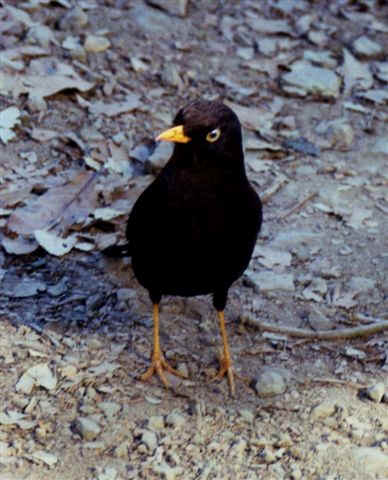
  15. Black Thrush  (*)  ______  GU:feb,mar,apr,jun,dec
    Turdus infuscatus

  16. Sooty Thrush (*) ______  CR:jan,feb,mar,jul,dec  PN:feb  (has been called Sooty Robin) (total range limited to Costa Rica & western Panama)
    Turdus nigrescens 
    (monotypic)


    A Sooty Thrush photographed during a FONT tour in Costa Rica
    (photo by Marie Z. Gardner)


  17. Mountain Thrush (*) _______  CR:feb,mar,apr,jul,dec/jan  GU:jan,feb,mar,apr,jun,dec  PN:feb,mar  (has been called Mountain Robin)
    Turdus p. plebejus

  18. Pale-vented Thrush (*) ______  CR:mar,apr  PN:feb  (has been called Pale-vented Robin; and has been said, at various times, to be conspecific with the Cocoa and Hauxwell's Thrushes of South America)
    Turdus o. obsoletus

  19. Clay-colored Thrush (*) ______  BZ:feb,mar,apr  CR:jan,feb,mar,apr,jul,dec  GU:jan,feb,mar,apr,jun,jul,dec  HN:feb,mar,apr,dec  PN:jan,feb,mar,aug,oct,nov  (has been called Clay-colored Robin) (the national bird of Costa Rica)
    Turdus grayi casius

  20. White-throated Thrush (*) ______  CR:feb,mar,jul,dec/jan  GU:mar,apr,jun,jul,dec  PN:mar  (has been called White-throated Robin; closely related to, previously conspecific with the White-necked Thrush of South America)
    Turdus assimilis cnephosus

  21. Eastern Bluebird  (*)  ______  GU:jan,feb,mar,apr,jun,dec
    Sialia sialis guatemalae 
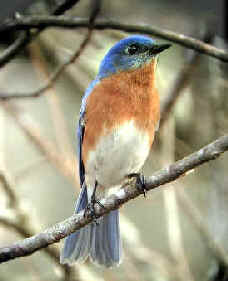


    Eastern Bluebird
    (photo by Howard Eskin)

  22. American Dipper (*) ______  CR:mar,dec/jan
    Cinclus mexicanus ardesiacus

  23. House Sparrow (CAi) (*) ______  BZ:feb  CR:jan,feb,mar,apr,jul,dec  GU:feb,mar,apr,jun,jul,dec  HN:mar,apr  PN:feb,nov
    Passer domesticus


  24. Black-headed Munia (CAi) ______  (also called Tricolored Munia)
    Lonchura malacca 

    In 1999, a small population of Black-headed Munias was discovered in Costa Rica east of Filadelfia, in Guanacaste.

  25. Olive Warbler  (*)  ______  GU:jan,feb,mar,apr,jun,dec  HN:apr
    Peucedramus t. taeniatus 
    (the single member of its family & genus)

  26. Scrub Euphonia (*) ______  BZ:mar  CR:mar,jul,dec/jan  GU:mar,apr,jun,dec  HN:feb,dec
    Euphonia a. affinis

  27. Yellow-crowned Euphonia (*) ______  CR:jan,feb,mar,apr,dec  PN:feb,mar,aug  (total range from Nicaragua to Panama)
    Euphonia luteicapilla  (monotypic)


    Yellow-crowned Euphonia
    (photo by Ruben Campos)

  28. Thick-billed Euphonia (*) ______  CR:jan,feb,mar,dec  PN:feb,mar,aug,nov
    Euphonia laniirostris crassirostris

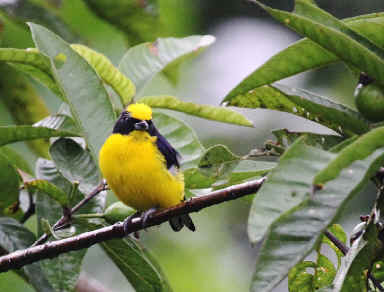
  29. Yellow-throated Euphonia (*) (ph) ______  BZ:feb,mar,apr  CR:mar,apr,jul,dec/jan  GU:jan,feb,mar,apr,jun,jul,dec  HN:apr,dec
    Euphonia hirundinacea gnatho


    Yellow-throated Euphonia
    (photo by Marie Gardner)

  30. Olive-backed Euphonia (*) ______  BZ:mar  CR:mar,apr,jul,dec/jan  GU:jan,feb,mar,apr,jun,jul  HN:dec  PN:feb
    Euphonia gouldi praetermissa


    Olive-backed Euphonia
    (photo by Ruben Campos) 

  31. White-vented Euphonia (*) ______  CR:feb,mar,dec/jan
    Euphonia minuta humilis

  32. Spot-crowned Euphonia (*) ______  CR:feb,mar  PN:feb  (total range limited to Costa Rica & western Panama)
    Euphonia imitans 
    (monotypic)

  33. Tawny-capped Euphonia (*) ______  CR:mar,apr,dec/jan  PN:feb  (total range from Costa Rica to northwestern Colombia)
    Euphonia a. anneae

  34. Elegant Euphonia (*) ______  CR:mar,jul,dec/jan  GU:feb,mar,apr,jun,dec  PN:feb,mar  (was called the Blue-hooded Euphonia when the expanded species included the Antillean Euphonia of the West Indies and the Golden-rumped Euphonia of South America)
    Euphonia e. elegantissma

  35. Fulvous-vented Euphonia (*) ______  PN:aug
    Euphonia f. fulvicrissa 

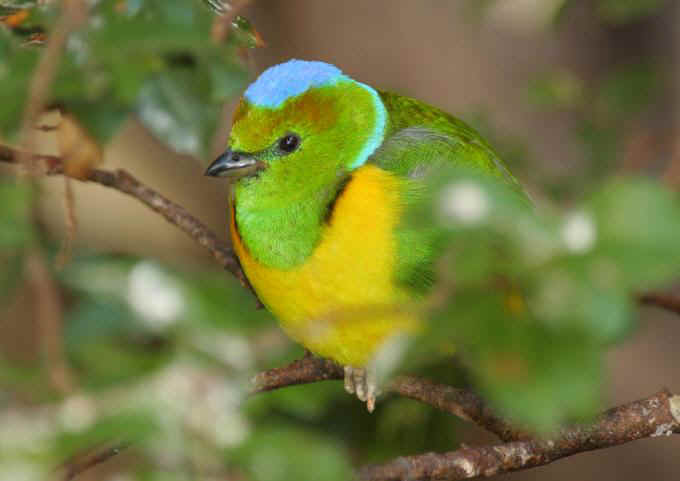
  36. Blue-crowned Chlorophonia  (*)  ______  GU:apr,jun,jul  HN:feb
    Chlorophonia occipitalis 
    (monotypic)

  37. Golden-browed Chlorophonia (*) ______  CR:mar,apr,dec/jan  PN:feb  (was at one time considered conspecifc with the Blue-crowned Chlorophonia of northern Central America)  (total range limited to Costa Rica & western Panama) 
    Chlorophonia callophrys 
    (monotypic)


    Golden-browed Chlorophonia
    (photo by Ruben Campos) 

  38. Yellowish Pipit  (*) ______  PN:feb
    Anthus  lutescens parvus

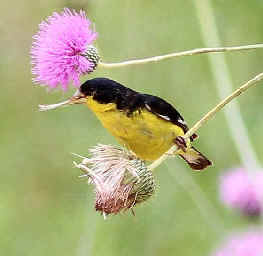
  39. Lesser Goldfinch (*) ______  CR:feb,mar,dec/jan  GU:feb,mar,apr,jun,jul,dec  HN:apr  PN:feb,mar
    Carduelis psaltria colombiana

  40. Black-headed Siskin  (*) ______  BZ:mar  GU:jan,feb,mar,apr,jun,dec  HN:apr
    Carduelis notata 

  41. Black-capped Siskin  (nt)  ______  GU:feb,dec
    Carduelis atriceps

  42. Yellow-bellied Siskin (*) ______  CR:mar,jul  PN:feb,mar
    Carduelis x. xanthogastra

  43. Hooded Grosbeak  (*)  ______  GU:feb,mar,apr,jul,dec
    Hesperiphona (formerly Coccothraustes) abeillei cobanensis

  44. Red Crossbill (*)  ______  GU:jan  HN:feb
    Loxia curvirostra mesoamericana

  45. Black-and-white Warbler (*) ______  BZ:feb,mar,apr  CR:jan,feb,mar,dec  GU:jan,feb,mar,apr,may,dec  HN:feb,mar,apr,dec  PN:jan,feb,mar,aug
    Mniotilta varia 
    (monotypic, and the single member of its genus) 

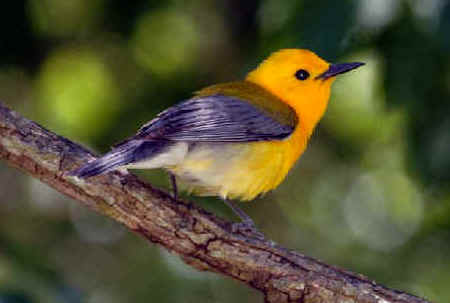
  46. Prothonotary Warbler (*) (ph) ______  BZ:mar  CR:feb,mar,dec/jan  GU:mar  HN:feb  PN:feb,aug,nov
    Protonotaria citrea 
    (monotypic, and the single member of its genus)


    Prothonotary Warbler
    (photo by Howard Eskin)

  47. Worm-eating Warbler (*) ______  CBZ:feb  CR:mar,apr  GU:jan,feb,mar,apr  HN:dec
    Helmitheros vermivorus 
    (monotypic, and the single member of its genus)

  48. Golden-winged Warbler (*) ______  CR:mar,dec/jan  GU:jan,feb,mar,apr  HN:dec  PN:feb,mar
    Vermivora chrysoptera

  49. Blue-winged Warbler (*) (ph) ______  BZ:feb,mar  CR:mar(rare)  GU:jan,feb,mar,apr,dec  HN:feb,mar,dec  PN:feb(rare)
    Vermivora pinus


    Blue-winged Warbler
    (photo by Howard Eskin)

  50. Tennessee Warbler (*) (ph) ______  CR:jan,feb,mar,dec  GU:jan,feb,mar,apr,dec  HN:feb,mar,dec  PN:jan,feb,mar,nov
    Oreothlypis
    (formerly Vermivora) peregrina

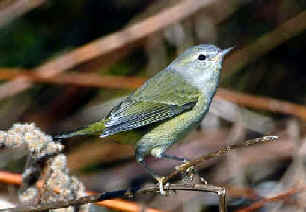
  51. Orange-crowned Warbler (CRr) (*) (ph) ______  CR:mar  GU:feb,apr,dec
    Oreothlypis
    (formerly Vermivora) celata  

    In Costa Rica, there are only a few records of the Orange-crowned Warbler. 

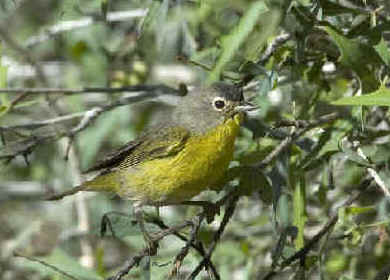
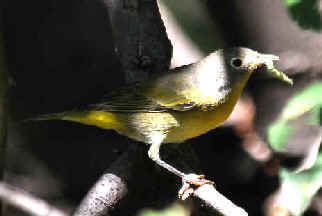
  52. Nashville Warbler  (CRr) (ph) ______  BZ:feb  GU:feb,mar,apr,dec
    Oreothlypis
    (formerly Vermivora) ruficapilla

    In Costa Rica, the Nashville Warbler is an uncommon migrant from North America.

  53. Crescent-chested Warbler  (*)  ______  GU:feb,mar,apr,jun,dec
    Oreothlypis
    (formerly Parula) s. superciliosa 

  54. Flame-throated Warbler (*) ______  CR:feb,mar,jul,dec/jan  PN:feb,mar  (total range limited to Costa Rica & western Panama)
    Oreothlypis
    (formerly Parula) gutturalis

  55. Northern Parula (*) (ph) ______  BZ:feb  CR:mar  GU:jan,mar,apr
    Parula americana 
    (monotypic)

  56. Tropical Parula (*) ______  CR:mar,apr,jul,dec/jan  HN:apr,dec  PN:feb,mar
    Parula pitiayumi speciosa

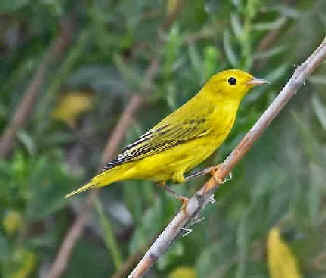
  57. Yellow Warbler (*) (ph) ______  BZ:feb,mar,apr  CR:jan,feb,mar,apr.dec  GU:jan,feb,mar,apr,dec  HN:feb,mar,apr,dec  PN;feb,mar,aug,nov
    Dendroica
    petechia 

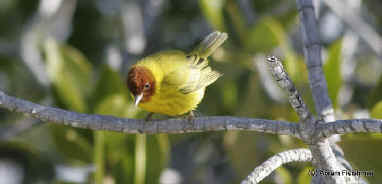
  58. Mangrove Warbler (*) (ph) ______  BZ:feb,mar  CR:feb,mar,apr,jul,dec/jan  GU:mar  PN:feb,aug,nov  (was considered part of the Yellow Warbler)
    Dendroica erithachorides


    Mangrove Warbler
    (photo by Abram Fleishman)

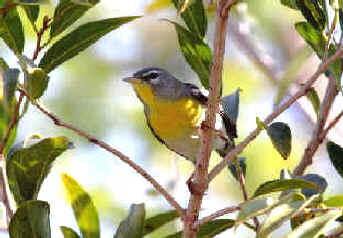
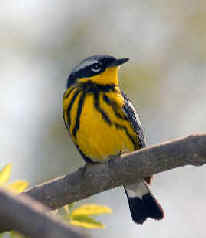
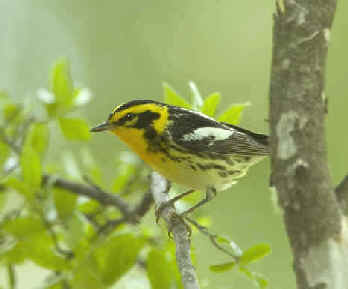
  59. Magnolia Warbler (*) (ph) ______  BZ:feb,mar,apr  CR:feb,mar,dec/jan  GU:jan,feb,mar,apr,may,dec  HN:feb,mar,apr,dec  PN:feb,mar,oct
    Dendroica magnolia


    Magnolia Warbler
    (photo by Howard Eskin)

  60. Cape May Warbler (CRr) (*) ______  CR:dec/jan
    Dendroica tigrina 
    (monotypic) 

    In Costa Rica, the Cape May Warbler is a rare migrant from North America, occurring from late November until mid-May.  

  61. Black-throated Blue Warbler (CRr) (*) ______  CR:mar,dec/jan  GU:dec
    Dendroica caerulescens  


    In Costa Rica, the Black-throated Blue Warbler is a rare North American migrant occurring from October to March. 
     
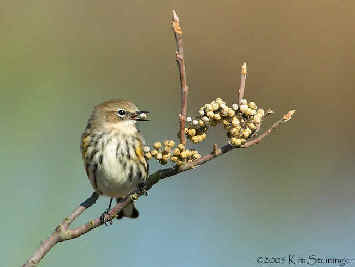
  62. "Myrtle" Yellow-rumped Warbler (*) (ph) ______  BZ:mar  CR:dec/jan  GU:mar,apr  HN:feb,apr
    Dendroica c. coronata

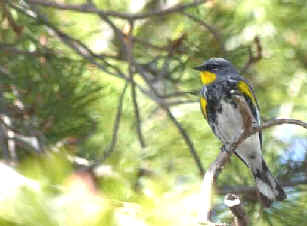
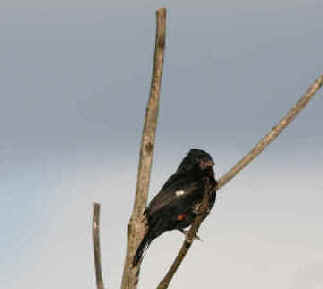
  63. "Audubon's" Yellow-rumped Warbler ______  GU:jan,dec  HN:apr
    Dendroica coronata auduboni

  64. "Goldman's" Yellow-rumped Warbler  (*)  ______  GU:feb,mar,apr,jun,dec
    Dendroica coronata goldmani

  65. Black-throated Gray Warbler  (GUr) (*)  ______  GU:apr
    Dendroica nigrescens

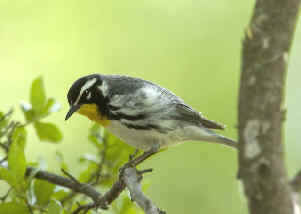
  66. Yellow-throated Warbler (*) (ph) ______  BZ:feb,mar  CR:apr  HN:dec  PN:feb
    Dendroica dominica albilora


    A Yellow-throated Warbler
    One joined us every morning at breakfast at Crooked Tree
    during our Belize tour in March 2007
     

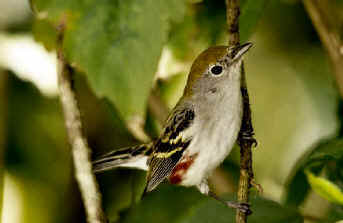
  67. Chestnut-sided Warbler (*) (ph) ______  BZ:apr  CR:jan,feb,mar,apr,dec  GU:jan,mar,apr,may,dec  HN:feb,apr,dec  PN:jan,feb,mar,nov
    Dendroica pensylvanica

  68. Hermit Warbler (CRr) (*) ______  CR:mar  GU:jan,feb,mar,apr,dec
    Dendroica occidentalis

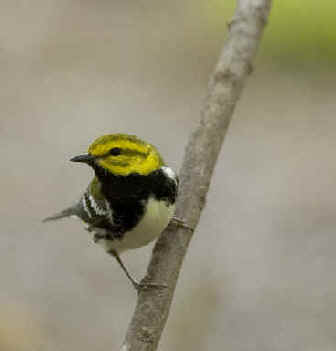
  69. Black-throated Green Warbler (*) (ph) ______  CR:feb,mar,apr,dec/jan  GU:jan,feb,mar,apr,dec  HN:feb,apr,dec  PN:feb,mar
    Dendroica v. virens

  70. Townsend's Warbler (CRr) (*) ______  CR:mar,apr  GU:jan,feb,mar,apr,dec
    Dendroica townsendi

  71. Golden-cheeked Warbler (t2) (CRr) (*)  ______ GU:dec  HN:feb
    Dendroica chrysoparia  (monotypic)

    The endangered Golden-cheeked Warbler is a recent addition to the Cost Rica bird-list. There have been 4 recent records, scattered throughout the central part of the country from 1500 to1850 meters above sea level. Those records were in September 2002, April 2003, December 2004, & October 2005. These sightings were both in forests and in agricultural areas with scattered trees. Previously, this migrant from Texas was known to winter as far south as Nicaragua. 


  72. Prairie Warbler (*) (ph) ______  CR:dec/jan  GU:mar,apr
    Dendroica discolor  


    In Costa Rica, the Prairie Warbler is a very rare North American migrant, occurring from late August to March.

  73. Cerulean Warbler (t3) (*) ______  CR:apr  GU:apr
    Dendroica cerulea

  74. Blackburnian Warbler (*) (ph) ______  CR:feb,mar,apr,dec/jan  GU:apr  PN:feb,mar
    Dendroica fusca

  75. Bay-breasted Warbler (*) ______  CR:feb,mar,dec/jan  GU:apr  PN:feb,mar,nov
    Dendroica castanea

  76. Blackpoll Warbler  (ph) ______  GU:apr,may
    Dendroica striata

    In Costa Rica, the Blackpoll Warbler is a very rare migrant from North America, occurring from mid-October to late March.   

  77. Pine Warbler  (ph) ______
    Dendroica pinus  

    In Costa Rica, the Pine Warbler a very rare migrant from North America, with records from late August to mid-November along the Caribbean coast and in the Central Valley.

  78. Grace's Warbler  (*)  ______  BZ:mar,apr  GU:feb,apr,jun,dec  HN:feb,apr,dec
    Dendroica graciae remota

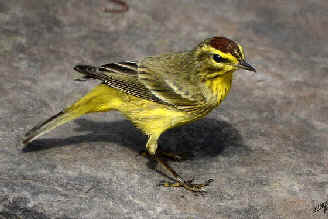
  79. Palm Warbler ______  BZ:feb
    Dendroica palmarum

    In Costa Rica, the Palm Warbler is a rare North American migrant, occurring from mid-October to April, up to 800 meters above sea level. 

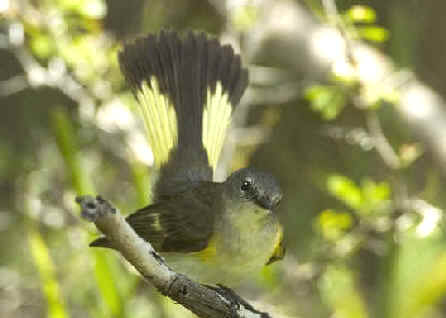
  80. American Redstart (*) (ph) ______  BZ:feb,mar,apr  CR:feb,mar,apr,dec/jan  GU:jan,feb,mar,apr,dec  HN:feb,mar,apr,dec  PN:feb
    Setophaga ruticilla 
    (now said to be monotypic)  (the single member of its genus)

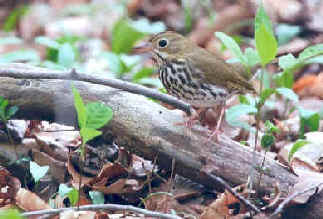
  81. Ovenbird (*) (ph) ______  BR:apr  CR:dec/jan  GU:jan,feb,mar,apr,dec  HN:feb,mar,apr,dec
    Seiurus aurocapillus


    Ovenbird
    (photo by Marie Gardner)

  82. Northern Waterthrush (*) ______  BZ:feb,mar,apr  CR:jan,feb,mar,apr,dec  GU:jan,feb,mar,apr,may,dec  HN:feb,apr,dec  PN:feb,mar,oct
    Parkesia
    (formerly Seiurus) noveboracensis

  83. Louisiana Waterthrush (*) ______  BZ:feb  CR:jan,feb,mar  GU:jan,feb,mar,dec  HN:mar,dec  PN:feb
    Parkesia
    (formerly Seiurus) motacilla

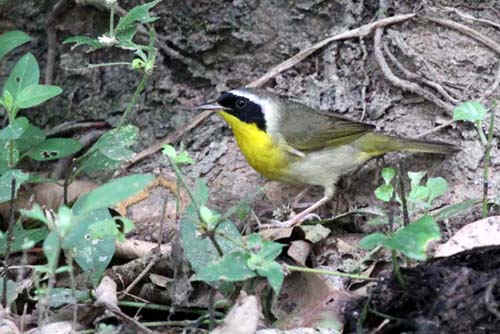
  84. Common Yellowthroat (*) (ph) ______  BZ:feb,apr  CR:mar,dec/jan  GU:jan,feb,mar,apr,dec  HN:feb,mar,apr,dec
    Geothlypis trichas


    A Common Yellowthroat during the FONT tour in Belize in April 2011
    (photo by Marie Gardner)

  85. Olive-crowned Yellowthroat (*) ______  CR:mar,apr,jul,dec/jan  PN:feb
    Geothlypis semiflava

  86. Gray-crowned Yellowthroat (*) ______  BZ:apr  CR:mar,jul,dec/jan  GU:jan,mar,dec  (other names have been "Ground Chat" and "Meadow Warbler")
    Chamaethlypis poliocephala 

    Chamaethlypis poliocephala palpebralis 
    (north CR)
    Chamaethlypis poliocephala icterotis 
    (west CR)
    Chamaethlypis poliocephala ridgwayi 
    (southwest CR)

  87. Chiriqui Yellowthroat (*) ______  CR:feb,mar,apr  (closely related to the Masked Yellowthroat of South America, Geothlypis aequinoctialis, from which 2 other species on that continent have recently been split)
    Geothlypis chiriquensis 
    (monotypic)

  88. Kentucky Warbler (*) ______  BZ:feb  CR:mar,dec/jan  GU:jan,feb,mar,apr,dec  HN:feb,dec
    Oporornis formosus

  89. Mourning Warbler (*) (ph) ______  CR:jan,feb,mar,apr,dec  GU:apr  PN:feb
    Oporornis philadelphia

  90. MacGillivrays' Warbler (*) (ph) ______  CR:apr  GU:feb,apr,dec
    Oporornis tolmiei

  91. Connecticut Warbler ______
    Oporornis agilis

    In Costa Rica, the Connecticut Warbler is an uncommon to rare North American migrant, occurring from October to March, up to about 800 meters above sea level.    

  92. Wilson's Warbler (*) ______  CR:jan,feb,mar,apr,dec  GU:jan,feb,mar,apr,dec  HN:feb,mar,apr,dec  PN:feb,mar
    Wilsonia pusilla

  93. Hooded Warbler  (*)  ______  BZ:feb,mar GU:jan,feb,mar,apr  HN:feb,apr,dec
    Wilsonia citrina

  94. Canada Warbler (*) (ph) ______  CR:feb,apr,dec/jan
    Wilsonia canadensis

  95. Red-faced Warbler  (*)  ______  GU:feb,mar,dec  HN:apr
    Cardellina rubrifrons 
    (monotypic, and the single member of its genus) 

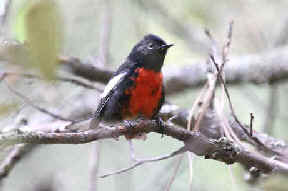
  96. Painted Whitestart  (*)  ______  GU:jan,apr,dec  HN:apr,dec
    Myioborus pictus guatemalae


    Painted Whitestart

  97. Slate-throated Whitestart (*)  ______  CR:jan,feb,mar,apr,dec  GU:jan,feb,mar,apr,jun,jul,dec  HN:feb,dec  PN:feb,mar  (has been called Slate-throated Redstart)
    Myioborus miniatus 

    Myioborus miniatus comptus 
    (west CR)
    Myioborus miniatus aurantiacus 
    (east CR)


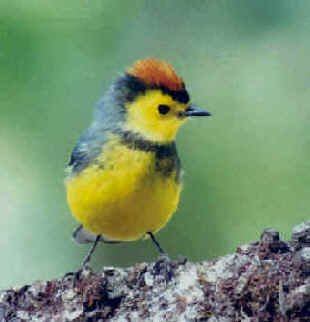
  98. Collared Whitestart (*) (ph)  ______  CR:feb,mar,apr,dec/jan  PN:feb,mar  (has been called Collared Redstart) (total range limited to Costa Rica & western Panama) 
    Myioborus torquatus 
    (monotypic)


    A Collared Whitestart  photographed during a FONT Costa Rica tour
    (photo by Marie Gardner)

  99. Pink-headed Warbler (nt) (*) ______  GU:feb,mar,apr,jun,dec
    Ergaticus versicolor
     
  100. Fan-tailed Warbler (*) ______  GU:apr
    Basileuterus l. lachrymosa   

  101. Stripe-crowned Warbler (*) ______ CR:mar,jul,dec/jan  GU:jan,feb,mar,apr,jun,jul  HN:dec  PN:mar  (has been called Golden-crowned Warbler)
    Basileuterus culcivorus 

    Basileuterus c. culcivorus 
    (north CR)
    Basileuterus culcivorus godmani 
    (south CR)


  102. Golden-browed Warbler (*) ______  GU:jan,feb,mar,apr,jun,jul,dec
    Basileuterus belli scitulus

  103. Rufous-capped Warbler (*) ______  GU:jan,feb,mar,apr,jun,dec
    Basileuterus rufifrons

  104. Chestnut-capped Warbler (*) ______  CR:mar,apr,jul,dec/jan  GU  HN:feb,mar,dec  PN:mar,aug  (has been said by some to be conspecific with the Rufous-capped Warbler of northern Central America)
    Basileuterus delattrii 

    Basileuterus d. delattrii 
    (northern CR)
    Basileuterus delattrii mesochrysus 
    (southern CR) 

  105. Black-cheeked Warbler (*) ______  CR:feb,mar,jul,dec/jan  PN:feb,mar  (total range limited to Costa Rica & western Panama)
    Basileuterus m. melanogernys

  106. Three-striped Warbler (*) ______  CR:mar,jul,dec/jan  PN:feb
    Basileuterus tristriatus chitrensis

  107. Buff-rumped Warbler (*) ______  CR:feb,mar,apr,jul,dec/jan  PN:feb  (closely related to the Riverbank Warbler of South America)
    Phaeothlypis fulvicauda 

    Phaeothlypis fulvicauda leucopygia 
    (most of CR)
    Phaeothlypis fulvicauda veraguensis 
    (southwest CR)

  108. Wrenthrush (*) ______  CR:feb,mar,jul  PN:feb  (has also been called Zeledonia)
    Zeledonia coronata 
    (monotypic)

  109. Yellow-breasted Chat  (ph) ______  BZ:mar  GU:jan,mar,apr  HN:dec
    Icteria virens

  110. Gray-throated Chat  (*) (ph)  ______  BZ:apr  GU:feb,mar,apr,jun
    Granatellus sallaei boucardi


    An immature Gray-throated Chat photographed during a FONT tour
    (photo by Marie Gardner)  

  111. Chestnut-headed Oropendola (*) ______  CR:jan,feb,mar,jul,dec  GU:feb,apr,jun  HN:feb,apr,dec  PN:feb,mar,aug,oct
    Zarhynchus wagleri ridgwayi

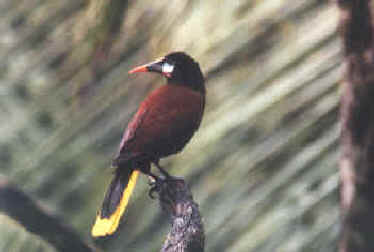
  112. Montezuma Oropendola (*) (ph) ______  BZ:mar,apr  CR:feb,mar,apr,jul,dec/jan  GU:jan,feb,mar,apr,may,jun,jul  HN:feb,apr,dec  PN:feb
    Psarocolius montezuma 
    (monotypic)


    A Montezuma Oropendola photographed during a FONT tour.
    (photo by Marie Gardner)


  113. Crested Oropendola  (CRr) (*) (ph) ______  PN:nov
    Psarocolius decumanus

    The Crested Oropendola, a bird in Panama and throughout South America, was first found in Costa Rica in 1999, and seems to be expanding its range northward. The initial sightings in Costa Rica were on the far-southern Pacific slope. 

  114. Black Oropendola  (*)  ______  PN:feb  (species restricted to eastern Panama & northwestern Colombia)
    Psarocolius guatimozinus

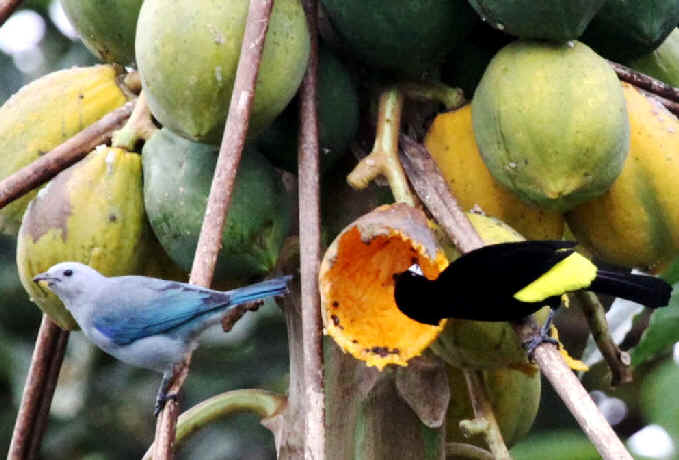
  115. Yellow-winged Cacique (*)  ______  GU:mar,apr  PN:feb,mar,aug
    Cacicus melanicterus 

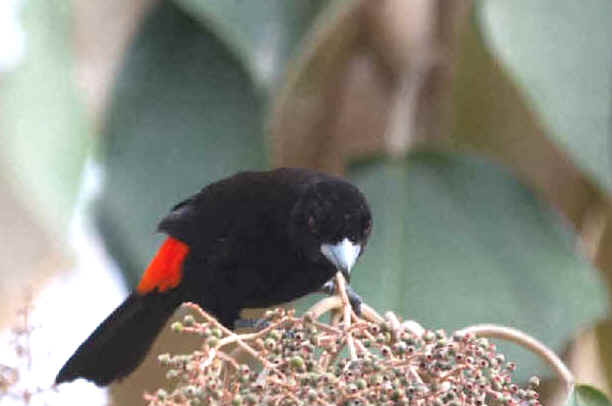
  116. Scarlet-rumped Cacique (*) ______  CR:jan,mar,jul,dec  PN:feb,mar,aug,oct,nov
    Cacicus microrhynchus microrhynchus

  117. "Western" Yellow-rumped Cacique  (*)  ______  PN:feb,mar,oct,nov
    Cacicus cela vitellinus

  118. Yellow-billed Cacique (*) ______  BZ:apr  CR:feb,apr,dec/jan  GU:jan,mar,apr,jul  HN:apr
    Amblycercus
    (formerly Cacicus) h. holosericeus

  119. Hooded Oriole  (*)  ______  BZ:feb,mar,apr
    Icterus cucullatus

  120. Altamira Oriole  (*)  ______  BZ:feb  GU:jan,feb,mar,apr,jun,jul,dec  HN:feb,mar,dec  (at one time was called Lichtenstein's Oriole)
    Icterus gularis

  121. Bar-winged Oriole (*)  ______  GU:feb,apr,jun
    Icterus maculialatus
     
  122. Black-vented Oriole (*)  ______  GU:feb,mar,apr,jun,dec  (another name has been Wagler's Oriole)
    Icterus w. wagleri

  123. Yellow-backed Oriole (*)  ______  GU:jan,feb,mar,apr,jul  HN:apr  PN:feb,mar,aug,nov
    Icterus chrysater

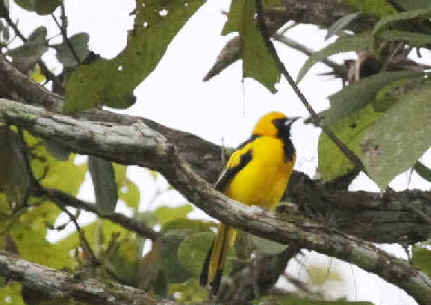
  124. Yellow-tailed Oriole (*) ______  BZ:feb,mar  CR:dec/jan  GU:jan,mar,apr,jun  PN:feb,mar,aug,nov
    Icterus mesomelas salvinii

  125. Spot-breasted Oriole (*) (ph) ______  CR:mar,jul,dec/jan  GU:mar,dec  HN:feb,mar,apr,dec
    Icterus pectoralis espinachi


    A Spot-breasted Oriole photographed during a FONT tour in Guatemala. 
    (photo by Marie Gardner)

  126. Streak-backed Oriole (*) ______  CR:mar,apr,jul,dec/jan  GU:mar,dec  HN:mar,dec
    Icteus pustulatus sclateri

  127. Baltimore Oriole (*) (ph) ______  BZ:feb,mar,apr  CR:jan,feb,mar,apr,dec  GU:jan,feb,mar,apr,dec  HN:feb,mar,apr,dec  PN:feb,mar  (was merged for a while with the Bullock's Oriole and was then called the Northern Oriole)
    Icterus galbula 
    (monotypic)

  128. Bullock's Oriole (*) (ph) ______  CR:dec/jan  GU:feb,mar,dec  (was merged for a while with the Baltimore Oriole and was then called the Northern Oriole)
    Icteus bullockii 
    (monotypic)

  129. Orchard Oriole (*) (ph) ______  BZ:feb,mar,apr  CR:jan,feb,mar,dec  GU:jan,feb,mar,apr,dec  HN:feb,mar,apr,dec  PN:feb,mar,aug,nov
    Icterus s. spurius

  130. Black-cowled Oriole (*) ______  BZ:feb,mar  CR:mar,apr,jul,dec/jan  GU:jan,feb,mar,apr,may,jun  PN:feb  (formerly conspecific with Caribbean population that is now called Greater Antillean Oriole, Icterus dominicensis) 
    Icterus prosthemelas

  131. Orange-crowned Oriole (*) ______  PN:feb  (occurs from eastern Panama to northern Venezuela)
    Icterus auricapillus 
    (monotypic)
      
  132. Red-winged Blackbird (*) (ph) ______  BZ:feb,mar,apr  CR:mar,apr,jul,dec/jan  GU:jan,mar,apr,jun,jul  HN:apr,dec
    Agelaius phoeniceus grinnelli

  133. Yellow-headed Blackbird  (CRr) (ph) ______
    Xanthocephalus xanthocephalus 
    (the single member of its genus)

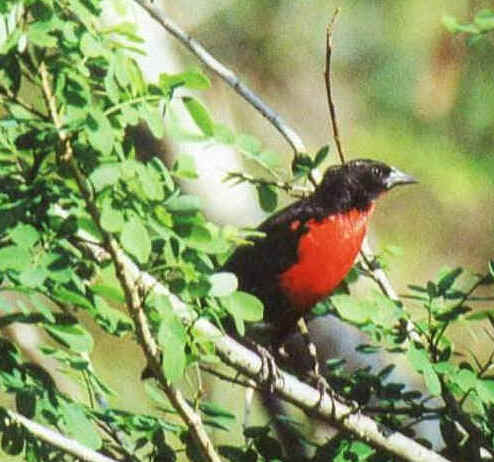
  134. Red-breasted Blackbird (*) ______  CR:jan,feb  PN:feb,mar,aug,nov  (a recent arrival in Costa Rica; now fairly common in the southern Pacific lowlands & quite uncommon in the Caribbean lowlands)  
    Sturnella
    (formerly Leistes) militaris  (monotypic)

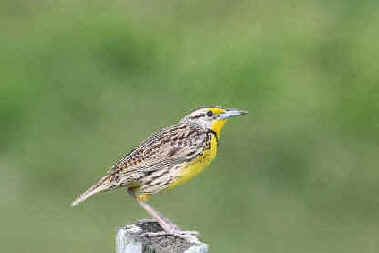
  135. Eastern Meadowlark (*) (ph) ______  BZ:feb,mar  CR:jan,feb,mar,apr,jul,dec  GU:mar,apr,jun,jul,dec  HN:feb  PN:feb,mar,aug
    Sturnella magna subulata


    The resident race of the Eastern Meadowlark in the farmland of Belize
    (photographed by Alan Brady during a FONT tour in March 2007)
      

  136. Melodious Blackbird (*) ______  BZ:feb,mar,apr  CR:mar  GU:jan,feb,mar,apr,may,jun,jul,dec  HN:feb,mar,apr,dec  
    Dives dives 
    (monotypic)

    In Costa Rica, the Melodious Blackbird was first found in Costa Rica in 1987. It is now widespread and fairly common in the country. The bird has been a species of northern Central America.
      
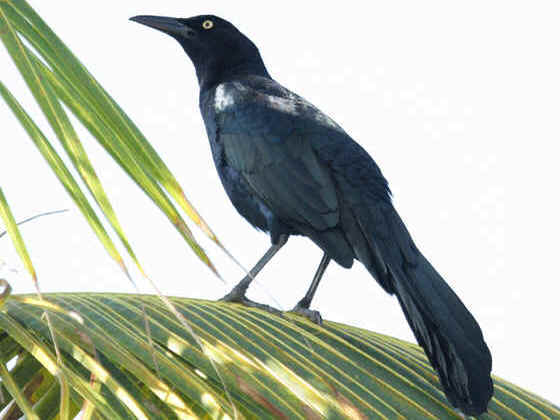
  137. Great-tailed Grackle (*) (ph) ______  BZ:feb,mar,apr  CR:jan,feb,mar,apr,jul,dec  GU:jan,feb,mar,apr,may,jun,jul,dec  HN:feb,mar,apr,dec  PN:jan,feb,mar,aug,oct,nov
    Quiscalus mexicanus peruvianus


    Great-tailed Grackle
    (photo by Dick Tipton)

  138. Nicaraguan Grackle (nt) (*) ______  CR:mar,jul  (total range limited to southern Nicaragua & northern Costa Rica)
    Quiscalus nicaraguensis 
    (monotypic)

  139. Bronzed Cowbird (*) ______  BZ:mar,apr  CR:jan,feb,mar,apr,jul,dec  GU:feb,mar,apr,jun,jul,dec  HN:feb,mar,apr,dec  PN:feb,mar
    Molothrus a. aeneus

  140. Giant Cowbird (*) ______  CR:mar,jul  GU:jan,feb,mar,apr,may,jul  HN:feb,apr  PN:feb
    Molothrus
    (formerly Scaphidura) oryzivorus impacifa

  141. Shiny Cowbird  (BZr,CRr) ______  BZ:mar
    Molothrus bonariensis

    The Shiny Cowbird is a recent addition to the Costa Rica bird-list. It was first noted in the country in April 2004 south of Cahuita, and since then sightings have continued in that area of the southern Caribbean lowlands. 

  142. Bobolink (ph) ______
    Dolichonyx oryzivorus 
    (the single member of its genus)

  143. Bananaquit (*) (ph) ______  BZ:feb,mar  CR:jan,feb,mar,apr,jul,dec  PN:jan,feb,mar,oct,nov
    Coereba flaveola mexicana

  144. Orange-billed Sparrow (*) ______  CR:feb,mar,dec/jan  GU:apr  PN:feb,mar
    Arremon aurantiirostris 

    Arremon a. aurantiirostris 
    (west CR)
    Arremon aurantiirostris rufidorsalis 
    (otherwise in CR)

  145. "Pacific" Olive Sparrow (*) ______  CR:mar,jul,dec/jan  (3 forms of Olive Sparrow are closely related. May be conspecific. May not be.)
    Arremonops rufivirgatus superciliosus

  146. "Yucatan" Olive Sparrow  (*)  ______  BZ:feb,apr
    Arremonops rufivirgatus verticalis

  147. Green-backed Sparrow  (*) ______  BZ:feb  GU:jan,feb,mar,apr,jun,jul  HN:dec
    Arremonops c. chloronotus

  148. Black-striped Sparrow (*) ______  CR:jan,feb,mar,apr,jul,dec  PN:feb,mar,aug,oct  (has been considered conspecific with Green-backed Sparrow)
    Arremonops conirostris richmondi  

  149. White-eared Ground Sparrow (*) (ph) ______  CR:apr,jul,dec/jan  GU:jun,jul
    Melozone l. leucotis (in Costa Rica)
    Melozone leucotis occipitalis (n Guatemala) 


    White-eared Ground Sparrow
    (photo by Ruben Campos)

  150. Prevost's Ground Sparrow  (*)  ______  GU:feb,mar,apr,jun,dec  (was previously considered conspecific with the Cabanis's Ground Sparrow, M. cabanisi, of southern Central America & the Rusty-crowned Ground Sparrow, M. kieneri, of Mexico)  
    Melozone biarcuata  (monotypic) 


    A Prevost's Ground Sparrow photographed during a FONT tour in Guatemala 
    (photo by Marie Gardner)

  151. Cabanis's Ground Sparrow (*) ______  CR  (considered distinct from the more-northerly Prevost's Ground Sparrow)
    Melozone cabanisi  

  152. Spotted Towhee (*)  ______  GU:feb,apr,jun,dec
    Pipilo maculatus

  153. Lincoln's Sparrow  (CRr) ______  GU:mar
    Melospiza lincolnii

  154. Grasshopper Sparrow (*) (ph) ______  CR:jul
    Ammodramus savannarum bimaculatus

  155. Chipping Sparrow  (CRr) (ph) ______  BZ:apr  GU:apr,jun
    Spizella passerina

  156. Lark Sparrow  (CRr) (ph) ______
    Chondestes grammacus 
    (the single member of its genus) 

  157. Rusty Sparrow (*) ______  BZ:mar  CR:apr  GU:mar,apr,jun,jul,dec  HN:feb,apr,dec
    Aimophila rufescens hypaethrus

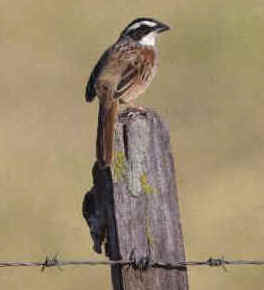
  158. Stripe-headed Sparrow (*) ______  CR:mar,apr,jul,dec/jan  GU:feb,mar,apr,jun,jul,dec  (has also been called Russet-tailed Sparrow)
    Aimophila r. ruficauda

  159. Botteri's Sparrow  (*)  ______  GU:apr
    Aimophila botterii

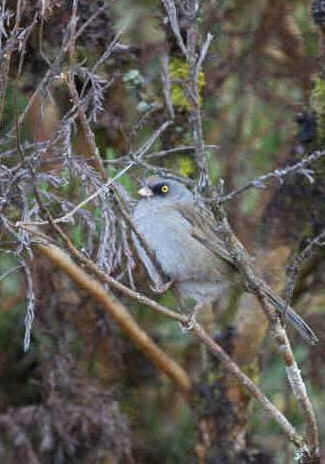
  160. "Guatemalan" Yellow-eyed Junco  (*)  ______  GU:mar,apr,jun
    Junco phaeonotus alticola

  161. Volcano Junco (*) ______  CR:jan,feb,mar,jul,dec  PN:feb  (total range limited to Costa Rica & western Panama) 
    Junco vulcani 
    (monotypic)

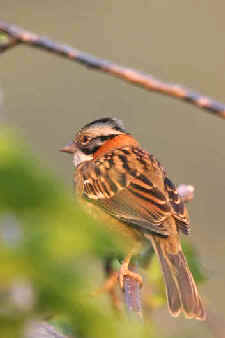
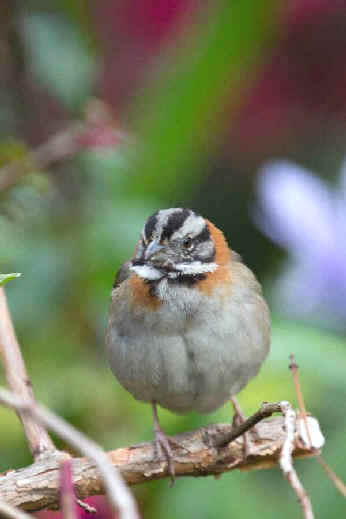
  162. Rufous-collared Sparrow (*) (ph) ______  CR:jan,feb,mar,apr,jul,dec  GU:jan,feb,mar,apr,jun,jul,dec  PN:feb,mar
    Zonotrichia capensis 
    Zonotrichia capensis septentrionalis 
    (in Guatemala; the northernmost of 20 subspecies)
    Zonotrichia capensis costaricensis 
    (in Costa Rica & Panama)


    A Rufous-collared Sparrow photographed during a FONT tour in Guatemala
    (photo by Marie Gardner)


  163. Common Bush Tanager (*) ______  CR:jan,feb,mar,apr,jul,dec  GU:jan,feb,mar,apr,jun,jul,dec  HN:feb  PN:feb,mar
    Chlorospingus ophthalmicus 
    (throughout the extensive range in Central & South America, there are said to be 27 subspecies)
    Chlorospingus ophthalmicus regionalis  (in eastern Costa Rica & western Panama)
    Chlorospingus ophthalmicus novicius 
    (southwest Costa Rica & the in the Chiriqui Province of Panama)


  164. Sooty-capped Bush Tanager (*) ______  CR:jan,feb,mar,apr,jul,dec  PN:feb  (total range limited to Costa Rica & western Panama)
    Chlorospingus p. pileatus

  165. Ashy-throated Bush Tanager (*) ______  CR
    Chlorospingus canigularis olivaceiceps

  166. Yellow-throated Bush-Tanager  (*)  ______  PN:feb
    Chlorospingus flavigularis hypophaeus

  167. Black-and-yellow Tanager (*) ______  CR:mar,apr,jul,dec/jan  PN:feb  (total range limited to Costa Rica & Panama)
    Chrysothlypis chrysomelas titanota

  168. Dusky-faced Tanager (*) ______  CR:feb,mar,dec/jan  PN:feb
    Mitrospingus cassinii costaridensis

  169. Gray-headed Tanager (*) ______  CR:feb,mar,dec/jan  GU:jan,feb,mar,jun  PN:mar,aug
    Eucometis penicillata
    (the single member of its genus) 
    Eucometis penicillata spodocephala 
    (west CR)
    Eucometis penicillata stictohorax 
    (southwest CR)

  170. White-throated Shrike-Tanager (*) _____  CR:mar,dec/jan  (total range from eastern Honduras to Panama)
    Lanio leucothorax 

    Lanio l. leucothorax 
    (east CR)
    Lanio leucothorax reversus 
    (northwest CR)
    Lanio leucothorax melanopygius 
    (southwest CR)

  171. Black-throated Shrike-Tanager  (*) ______  GU:jan,feb,mar,apr,jun
    Lanio aurantius 
    (monotypic)

  172. White-shouldered Tanager (*) ______  CR:feb,mar,dec/jan  PN:feb,mar,aug,nov
    Tachyphonus luctuosus axillaris

  173. Tawny-crested Tanager (*) ______  CR:mar,jul  PN:aug
    Tachyphonus delatrii 
    (monotypic)

  174. White-lined Tanager (*) ______  CR:feb,mar,jul,dec/jan  PN:feb,maar,aug
    Tachyphonus rufus 
    (monotypic)

  175. Carmiol's Tanager (*) ______  CR:jul  (was considered conspecific with Olive Tanager of South America)
    Chlorothraupis c. carmioli

  176. Red-crowned Ant Tanager (*) (ph) ______  BZ:feb  CR:feb,mar  GU:jan,feb,mar,apr,jun,jul  HN:feb  PN:feb,mar,aug
    Habia rubica
    Habia rubica alfaroana  (in northwest Costa Rica)
    Habia rubica vinacea 
    (in south & west Costa Rica) 

  177. Red-throated Ant Tanager (*) (ph) ______  BZ:feb,mar,apr  CR:dec/jan  GU:jan,feb,mar,apr,jun,jul  HN:feb,apr,dec  PN:feb,mar,aug,oct
    Habia f. fuscicauda

  178. Black-cheeked Ant Tanager (t2) (CRe) (*) ______  CR:feb,dec/jan  (total range restricted to a limited area of southern Costa Rica)  
    Habia atrimaxillaris 
    (monotypic)

  179. Hepatic Tanager  (*) ______  BZ:mar  GU:apr  HN:apr,dec
    Piranga hepatica

  180. Tooth-billed Tanager (*) ______  CR:mar,apr,jul,dec/jan  PN:feb  (has been part of the more-northerly Hepatic Tanager, Piranga hepatica, and what's now the more-southerly Red Tanager, Piranga flava, in South America) 
    Piranga lutea testacea

  181. Summer Tanager (*) (ph)  ______  BZ:feb,mar,apr  CR:jan,feb,mar,apr,dec  GU:jan,feb,mar,apr,dec  HN:feb,mar,apr,dec  PN:feb,mar,nov
    Piranga r. rubra

  182. Scarlet Tanager (*) (ph) ______  CR:apr  GU:apr  HN:apr  PN:mar,nov
    Piranga olivacea 
    (monotypic)

  183. Western Tanager (*) (ph) ______  CR:jan,feb,mar,dec  GU:feb,mar,apr,dec
    Piranga ludoviciana 
    (monotypic)

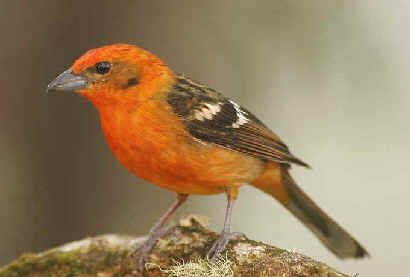
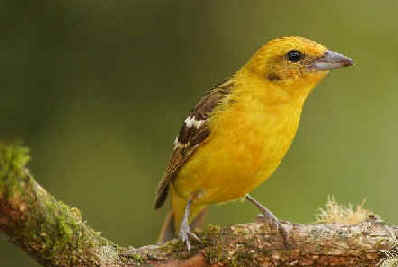
  184. Flame-colored Tanager (*) ______  CR:feb,mar,apr,jul,dec/jan  GU:feb,apr,dec  PN:feb,mar  (another name has been Streak-backed Tanager)
    Piranga bidentata citrea


    Flame-colored Tanagers. Male, above; female below.
    (photos by Ruben Campos)


  185. White-winged Tanager (*) ______  CR:mar,apr  GU:mar,apr,jun,jul,dec  PN:feb,mar
    Piranga leucoptera latifasciata

  186. Crimson-collared Tanager (*) ______  BZ:mar  CR:mar,apr,jul,dec/jan  GU:jan,apr  HN:apr,dec  PN:feb
    Phlogothraupis sanguinolenta 
    (the single member of its genus, although has been said to be the genus Ramphocelus)

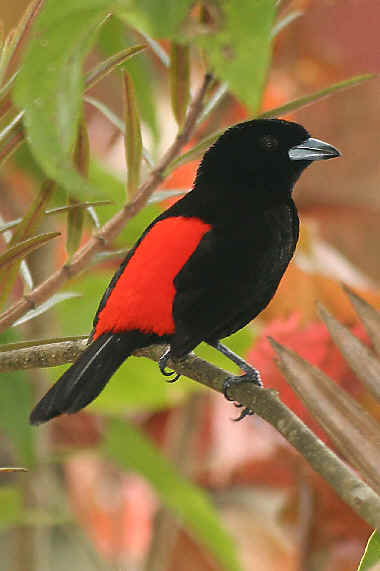
  187. Passerini's Tanager (*) (ph) ______  BZ:mar,apr  CR:mar,apr,jul,dec/jan  HN:feb,apr,dec  (when conspecific with the Cherrie's Tanager, was called Scarlet-rumped Tanager)
    Ramphocelus passerini


    Passerini's Tanager
    (photo courtesy of Doris Potter)

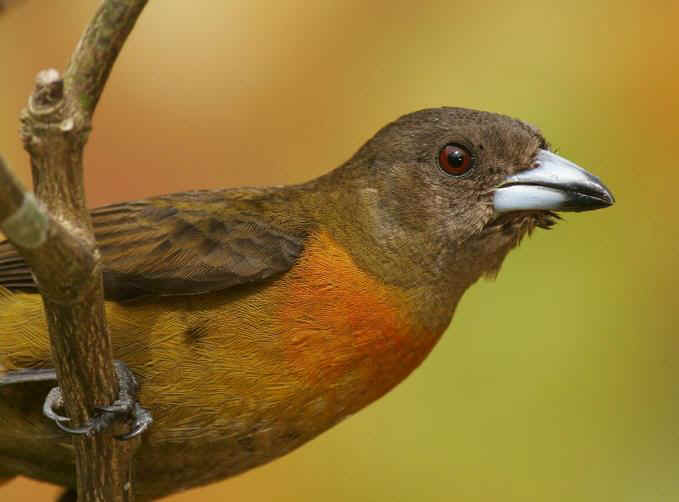
  188. Cherrie's Tanager (*) ______  CR:jan,feb,mar,jul,dec  PN:feb,mar,apr  (when conspecific with the Passerini's Tanager, was called Scarlet-rumped Tanager) (total range limited to Costa Rica & western Panama)
    Ramphocelus costaricensis


    A female Cherrie's Tanager
    (photo courtesy of Ruben Campos)

  189. Crimson-backed Tanager (*) ______  PN:feb,mar,aug,oct,nov
    Ramphocelus d. dimidiatus
     
  190. Lemon-rumped Tanager (*)  ______  PN:feb,mar,aug,oct  (was conspecific with the Flame-rumped Tanager of South America) 
    Ramphoceelus icteonotus
     
  191. Blue-gray Tanager (*) ______  BZ:feb,mar,apr  CR:jan,feb,mar,apr,jul,dec  GU:jan,feb,mar,apr,jun,jul,dec  HN:feb,mar,apr,dec  PN:jan,feb,mar,aug,oct,nov
    Thraupis episcopus cana

  192. Yellow-winged Tanager  (*) ______  BZ:feb,mar,apr  GU:jan,feb,mar,apr,jun,jul,dec  HN:feb,mar,apr,dec
    Thraupis abbas 
    (monotypic)


    A Yellow-winged Tanager during a FONT tour in Belize in April 2011
    (photo by Marie Gardner)

  193. Palm Tanager (*) ______  CR:jan,feb,mar,apr,jul,dec  PN:feb,mar,aug,oct,nov
    Thraupis palmarum atripennis

  194. Blue-and-gold Tanager (nt) (*) ______  CR:feb,mar,apr,jul  PN:feb  (total range limited to Costa Rica & Panama)
    Bangsia
    (formerly Buthraupis) arcaei careruleigularis

  195. Azure-rumped Tanager  (t2) (*)  ______  GU:feb,apr,jun,jul  (another name has been Cabanis's Tanager)
    Tangara cabanis 
    (monotypic)

  196. Plain-colored Tanager (*) ______  CR:feb,mar  PN:feb,mar,aug,nov  (total range from Costa Rica to northern Colombia) 
    Tangara inornata rava

  197. Emerald Tanager (*) ______  CR:mar,dec/jan  PN:feb
    Tangara f. florida

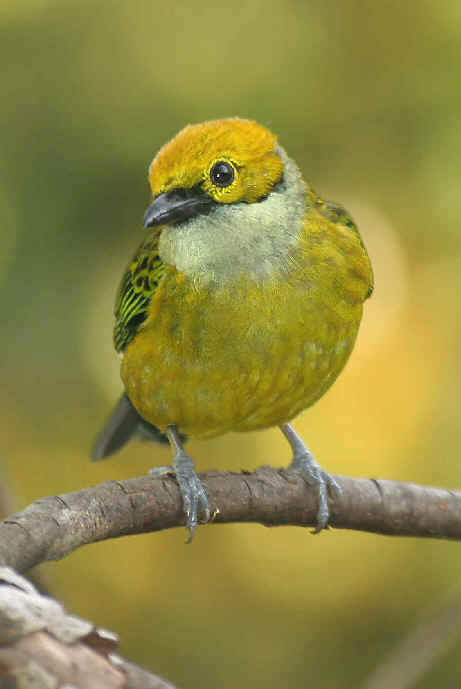
  198. Silver-throated Tanager (*) (ph) ______  CR:jan,feb,mar,apr,jul,dec  PN:feb,mar
    Tangara icterocephala frantzii


    Silver-throated Tanager
    (photo courtesy of Doris Potter)

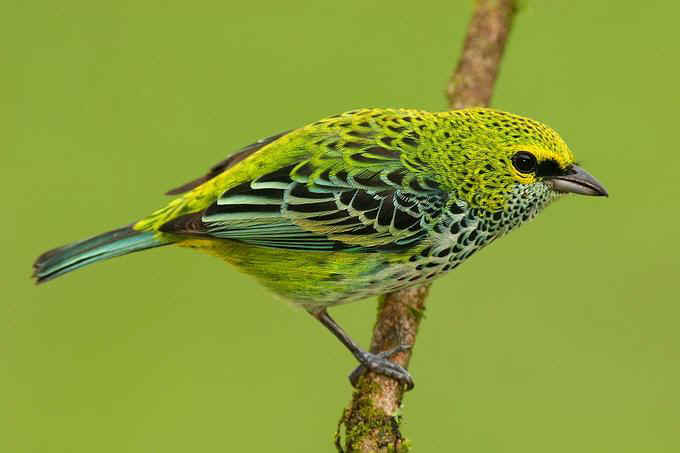
  199. Speckled Tanager (*) (ph) ______  CR:feb,mar,jul,dec/jan  PN:feb
    Tangara guttata eusticta


    Speckled Tanager
    (photo by Ruben Campos)

  200. Bay-headed Tanager (*) (ph) ______  CR:jan,feb,mar,apr,jul,dec  PN:feb,mar
    Tangara gyrola bangsi


    Bay-headed Tanager

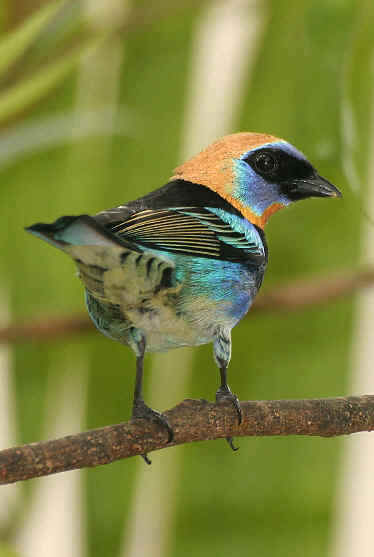
  201. Golden-hooded Tanager (*) (ph) ______  BZ:mar,apr  CR:jan,feb,mar,apr,jul,dec  GU:feb,mar,apr  HN:feb,apr,dec  PN:feb,mar,aug,nov  (an alternate name of "Golden-masked Tanager" is inappropriate; closely related, however, to the Masked Tanager of South America)
    Tangara larvata 

    Tangara l. larvata 
    (in northern Costa Rica)
    Tangara larvata centralis 
    (in eastern Costa Rica)
    Tangara larvata franciscae 
    (in western Costa Rica) 


    Golden-hooded Tanager
    (photo courtesy of Doris Potter)


  202. Spangle-cheeked Tanager (*) ______  CR:feb,mar,jul  PN:mar  (total range limited to Costa Rica & western Panama)
    Tangara dowii 
    (monotypic)

  203. Rufous-winged Tanager ______
    Tangara lavinia 

  204. Sulphur-rumped Tanager (*)  ______  PN:aug   (total range restricted to Costa Rica & Panama)
    Heterospingus rubrifrons

  205. Rosy Thrush-Tanager (*)  ______  PN:feb,mar,aug
    Rhodinocichla rosea

    An uncommon skulker, the Rosy Thrush-Tanager can be an extremely difficult bird to see. In Costa Rica, it has a limited range in the Terraba River watershed. It forages in leaf litter in dense second growth. Even though difficult to see, its rich, liquid voice can readily be heard.    

  206. Scarlet-thighed Dacnis (*) ______  CR:feb,mar,apr,jul,dec/jan  PN:feb,mar
    Dacnis v. venusta 

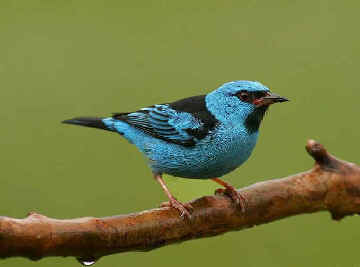
  207. Blue Dacnis (*) ______  CR:feb,mar,dec/jan  PN:feb,mar,aug,nov
    Dacnis cayana callaina


    Blue Dacnis
    (photo by Ruben Campos)

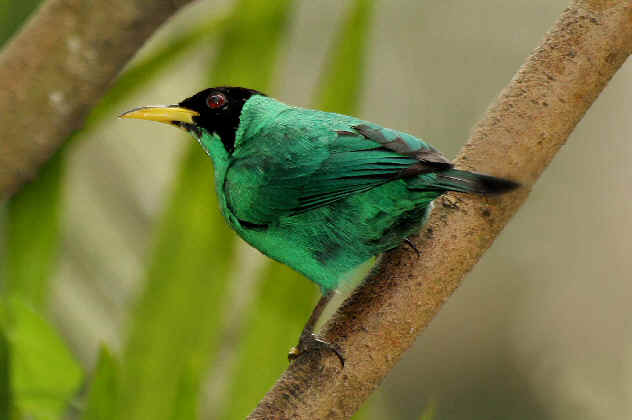
  208. Green Honeycreeper (*) (ph) ______  CR:jan,feb,mar,apr,jul,dec  GU:mar,jun  HN:feb,apr,dec  PN:feb,mar,aug
    Chlorophanes spiza arguta


    Green Honeycreepers
    (above: a male; below: a female)
    (photos by Doris Potter)

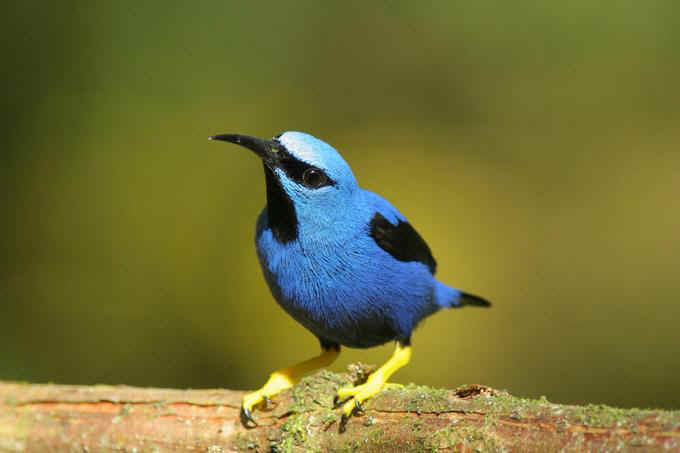
  209. Shining Honeycreeper (*) ______  CR:feb,mar,apr,jul,dec/jan  HN:feb,dec  PN:feb,aug
    Cyanerpes lucidus isthmicus


    A male Shining Honeycreeper
    (photo by Ruben Campos)

  210. Red-legged Honeycreeper (*) (ph) ______  BZ:feb,mar  CR:jan,feb,mar,apr,jul,dec  GU:jan,feb,mar,apr,jun,jul,dec  HN:feb,apr,dec  PN:feb,mar,aug,oct,nov
    Cyanerpes cyaneus carneipes


    Red-legged Honeycreeper

  211. White-eared Conebill  (*)  ______  PN:feb  (a species of eastern Panama, Colombia, and northern Venezuela)
    Conirostrum leucogenys panamense

  212. Cinnamon-bellied Flower-piercer  (*)  ______  GU:feb,apr,jun,dec
    Diglossa baritula 

  213. Slaty Flower-piercer (*) ______  CR:feb,mar,apr,jul,dec/jan  PN:feb,mar  (closely related to Rusty Flower-Piercer of South America) (total range limited to Costa Rica & western Panama)
    Diglossa p. plumbea

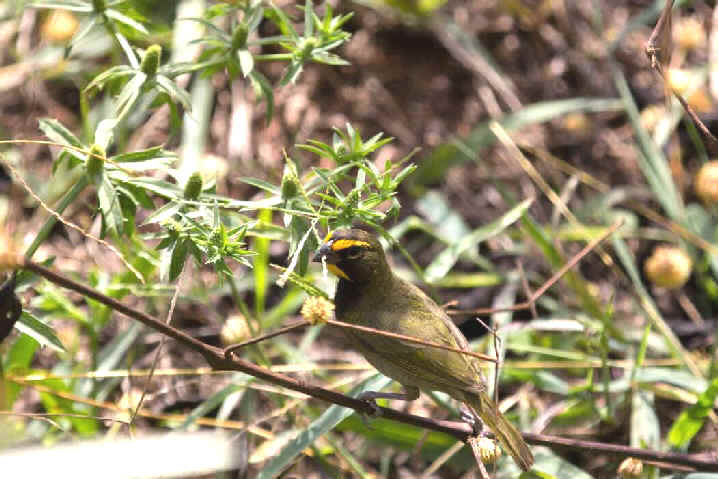
  214. Yellow-faced Grassquit (*) ______  BZ:mar  CR:jan,feb,mar,apr,jul,dec  GU:apr,jun  HN:feb,apr  PN:jan,feb,mar,aug
    Tiuaris olivacea pusillus

  215. White-collared Seedeater (*) ______  BZ:feb,mar,apr  CR:feb,mar,apr,jul,dec/jan  GU:jan,feb,mar,apr,may,jun,jul,dec  HN:feb,mar,apr,dec  PN:feb,mar
    Sporophila torqueola morelleti


    A male White-collared Seedeater during a FONT tour in Belize in April 2011
    (photo by Marie Gardner)

  216. Variable Seedeater (*) (ph) ______  BZ:feb,mar,apr  CR:jan,feb,mar,apr,jul,dec  GU:jan  HN:feb,apr,dec  PN:feb,mar,aug,oct,nov  (including the "Black" Variable Seedeater, on the Caribbean side of Costa Rica, once considered a distinct species)  
    Sporophila corvina 
    (formerly Sporophila aurita)


    The nearly all-black race of the Variable Seedeater,
    photographed during the March 2007 FONT tour in Belize
    (photo by Alan Brady)

  217. Yellow-bellied Seedeater (*) ______  CR:jan,feb,mar  PN:mar,aug,nov
    Sporophila n. nigricollis

  218. Ruddy-breasted Seedeater (*) (ph) ______  CR:jan,feb,mar  GU:apr,jun,jul  PN:feb,mar,aug
    Sporophila minuta 

    Sporophila minuta parva 
    (in northern Costa Rica)
    Sporophila minuta centralis 
    (in southwest Costa Rica & Panama)


    A Ruddy-breasted Seedeater photographed during a FONT tour
    (photo by Marie Gardner)


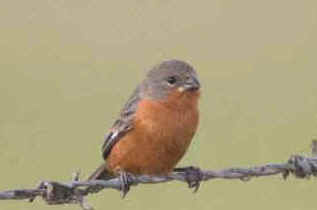
  219. Slate-colored Seedeater ______
    Sporophila schistacea

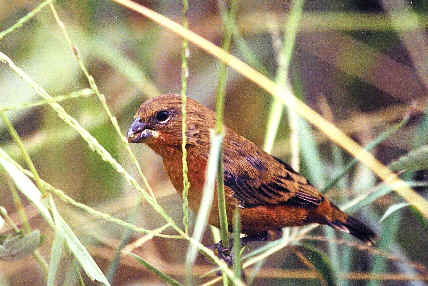
  220. Thick-billed Seed Finch (*) ______  CR:jan,feb,mar,apr,jul,dec  GU:jan,apr  PN:feb,mar,aug,nov  (was conspecific with what's now the Chestnut-bellied Seed-Finch of South America, Oryzoborus angolensis, and was then called the Lesser Seed Finch
    Oryzoborus funereus 

    Oryzoborus funereus salvini 
    (most of CR)
    Oryzoborus funereus ochrogyne 
    (southwest CR)

  221. Nicaraguan Seed Finch  (*)  ______  CR:mar  (total range from Nicaragua to western Panama) 
    Oryzoborus nuttingi

  222. Blue-black Grassquit  (*) ______  BZ:feb,mar,apr  CR:jan,feb,mar,apr,jul,dec  GU:feb,mar,apr,jun,jul,dec  HN:feb,apr,dec  PN:jan,feb,mar,aug,nov
    Volatinia jacarina splendens 
    (the single member of its genus)

  223. Blue Seedeater ______
    Amaurospiza concolor 
    (this genus now in the family Cardinalidae from Thraupidae)

    In Costa Rica, the Blue Seedeater is rare in middle elevations and highlands, between 1,000 & 2,200 meters above sea level on both the Pacific and Caribbean slopes. It favors bamboo clusters by the edge of the cloud forest.    

  224. Slaty Finch (*) ______  CR
    Haplospiza rustica barrilesensis

  225. Peg-billed Finch (nt) (*) ______  CR:feb,mar  (total range limited to Costa Rica & western Panama)
    Acanthidops bairdi 
    (monotypic)

  226. Grassland Yellow Finch (*) ______  CR:jan,feb  PN:aug  (found during recent FONT Costa Rica tours in open country in the Pacific lowlands south of Golfito) 
    Sicalis luteola eisenmanni

  227. Saffron Finch (*) (ph) ______  PN:feb,aug,nov
    Sicalis f. flaveola

  228. Wedge-tailed Grass Finch  (ph) ______
    Emberizoides herbicola

  229. Large-footed Finch (*) ______  CR:feb,mar,jul,dec/jan  (total range limited to Costa Rica & western Panama) 
    Pezopetes capitalis 
    (monotypic, and the single member of its genus)

  230. Yellow-thighed Finch (*) ______  CR:feb,mar,apr,jul,dec/jan  PN:feb  (total range limited to Costa Rica & western Panama)
    Pselliophorrus tibialis 
    (monotypic)

  231. Yellow-throated Brush Finch (*) ______  CR:apr,dec/jan  GU:feb,apr,jun,dec  PN:mar  (has been merged by some with the more-southerly White-naped Brush Finch, Atlapetes albinucha)
    Atlapetes gutturalis

  232. Chestnut-capped Brush Finch (*) ______  CR:mar,apr  GU:feb,apr,jun,jul,dec  HN:feb
    Buarremon
    (formerly Atlapetes) brunneinucha  

  233. Black-headed Brush Finch (*) ______  CR:mar  (has been merged by some with the more-southerly Stripe-headed Brush-Finch, Buarremon torquatus)
    Buarremon (formerly Atlapetes) atricapillus  

  234. Sooty-faced Finch (*) ______  CR:jul  (total range is Costa Rica & Panama)
    Lysurus crassirostris 
    (monotypic, and the single member of its genus)

  235. Cocos Finch  ______  (endemic to the Cocos Islands, well offshore from mainland Costa Rica, in the Pacific)
    Pinaroloxias inornata 
    (the single member of its genus)

    The Cocos Finch is closely related to the Galapagos Finches.  

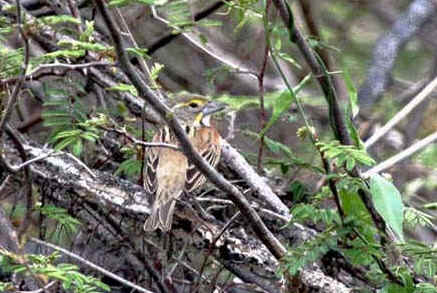
  236. Dickcissel  (*)  ______  BZ:apr
    Spiza americana
      (the single member of its genus)


    A Dickcissel in migration, during the FONT tour in Belize in April 2011
    (photo by Marie Gardner)

  237. Black-headed Saltator (*) ______  BZ:feb,mar,apr  CR:mar,apr,jul,dec/jan  GU:jan,feb,mar,apr,jun,jul  H:feb,mar,apr,dec  PN:feb,aug
    Saltator a. atriceps 
    (1 of 2 subspecies in Costa Rica)

  238. Buff-throated Saltator (*) ______  BZ:feb,apr  CR:jan,feb,mar,apr,jul,dec  GU:mar,apr  HN:apr,dec  PN:feb,mar,aug,oct,nov
    Saltator maximus 

    Saltator maximus magnoides 
    (in most of Costa Rica)
    Saltator maximus intermedius 
    (in southwest Costa Rica & Panama) 


    Buff-throated Saltator
    (photo by Ruben Campos)

  239. "Northern" Grayish Saltator (*)  ______  BZ:feb,mar  CR:jan,feb,mar,apr,jul,dec  GU:jan,mar,apr,jun,dec  HN:feb,apr
    Saltator coerulescens brevicaudus

  240. Streaked Saltator (*) (ph)  ______  CR:feb,mar  PN:feb,mar,aug
    Saltator striatipectus furax 
    (formerly Saltator albicollis, now the scientific name for the Lesser Antillean Saltator


    Streaked Saltator
    (photo by Ruben Campos)


  241. Black-faced Grosbeak (*) ______  CR:mar,apr,dec/jan  GU:jan,apr  PN:feb
    Caryothraustes poliogaster scapularis

  242. Slate-colored Grosbeak (*) ______  CR:dec/jan
    Saltator
    (formerly Pitylus) grossus  

  243. Mexican Yellow Grosbeak  (*) ______  GU:apr
    Pheucticus chrysopeplus aurantiacus

  244. Black-thighed Grosbeak (*) ______  CR:mar,apr,jul,dec/jan  PN:feb,mar  (closely related to the more-northerly  Mexican Yellow Grosbeak, Pheucticus chrysopeplus, and the more-southerly Southern Yellow Grosbeak, Pheuticus chrysogaster, of South America) (total range limited to Costa Rica & western Panama)
    Pheucticus tibialis 
    (monotypic)

  245. Rose-breasted Grosbeak (*) (ph) ______  BZ:mar  CR:jan,feb,mar,dec  GU:jan,feb,mar,apr,dec  HN:feb,apr,dec  PN:feb,mar
    Pheucticus ludovicianus 
    (monotypic)


    Many Rose-breasted Grosbeaks spend the winter in Central America.
    The males only look like this when they're ready to leave in the spring.  
    (photo by Howard Eskin)

  246. Black-headed Grosbeak   ______
    Pheucticus melanocephalus 

  247. Northern Cardinal  (*) (ph)  ______  BZ:mar,apr
    Cardinalis cardinalis 
     
  248. Blue Grosbeak (*) (ph) ______  BZ:feb,mar  CR:jul,dec/jan  GU:jan,mar,apr,dec  HN:feb  PN:feb,nov
    Passerina
    (formerly Guiraca) caerulea lazula


    A male Blue Grosbeak
    (photo by Howard Eskin) 


  249. Blue-black Grosbeak (*) ______  CR:feb,mar,dec/jan  GU:jan,mar  PN:feb,mar,aug
    Cyanocompsa cyanoides caerulescens

  250. Blue Bunting  (*) (ph)  ______  BZ:apr  GU:jan,feb,mar,apr,jun,jul 
    Cyanocompsa p. parellina


    A Blue Bunting during the FONT tour in Belize in April 2011
    (photo by Marie Gardner)

  251. Indigo Bunting (*) (ph) ______  BZ:feb,mar,apr  CR:mar,dec/jan  GU:feb,mar,apr,dec  HN:feb  PN:mar,nov
    Passerina cyanea 
    (monotypic)

  252. Varied Bunting  (*)  ______  GU;apr,jun
    Passerina versicolor 

  253. Painted Bunting (*) (ph) ______  CR:mar,dec/jan  GU:feb,mar,apr,dec
    Passerina ciris pallidior
     

    To Top of Page