 NATURE
in the
Dominican Republic
including:
MAMMALS
AMPHIBIANS
REPTILES
SNAILS
CRABS
BUTTERFLIES &
MOTHS DRAGONFLIES & DAMSELFLIES
OTHER INSECTS &
CREATURES including TARANTULAS
and SPIDERS
Most of the Hispaniolan nature listed here in the Dominican
Republic, but some, notably amphibians, only known to be in
Haiti.
The following lists
compiled by Armas Hill.
Codes:
(t1): a critically
threatened, or endangered,
species
(t2): a threatened, or endangered species
(t3): a vulnerable species
(nt): a near-threatened species
(He): endemic to Hispaniola
(DRe); endemic to the Dominican Republic
(Hi): introduced in Hispaniola
(ph): species with a photo in the FONT website
Species found during FONT Dominican Republic tours noted with an
(*).
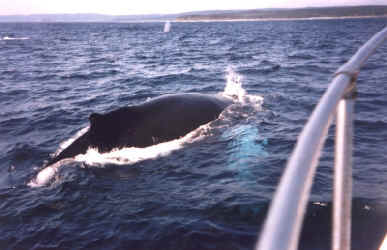
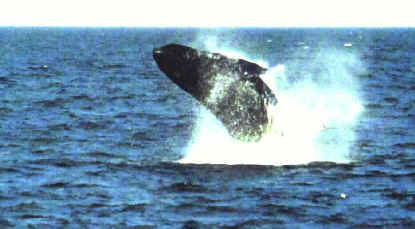
Photo at upper right:
a breaching HUMPBACK WHALE, off the northern coast of the Dominican
Republic
An excellent new book entitled
"Hispaniola, a Photographic Journey through
Island Biodiversity", by Eladio Fernandez,
was published (by Harvard
University Press, in 2007.
In the book, there are some superb photographs of the nature of the Dominican
Republic. In the following list, pages in that book with photos of particular species
are noted with a (photo: xx).
Not included in the following list, there are a number of photographs of plants.
Also, there's an interesting essay regarding the many mushrooms that occur on
the island.
Links:
Upcoming
FONT Birding & Nature Tours in the Caribbean
Birds of the
Dominican Republic Rare Birds of the Caribbean
A Complete List & a Photo Gallery of Caribbean Birds, in 2 Parts:
Part #1: Guineafowl to Hummingbirds
Part #2: Trogons to Buntings
Butterflies of the Caribbean, including
the Dominican Republic (with some photos)
Moths
of the Caribbean, including the Dominican Republic
updated, now with over 1700 moths in the list - hundreds of them in the
Dominican Republic
Amphibians & Reptiles of the Caribbean (with some photos)
Marine Life of the Caribbean
(including sea turtles, fish, corals, jellyfish, mollusks (shells), and
arthropods: crustaceans & echinoderms) (with some photos)
Directory of Photos in this Website

Mammals:
-
Hispaniolan Hutia (t3) (He) (ph) (*) _____ (photo: 132-133)
Plagiodontia aedium
The Hispaniolan Hutia is the only surviving native rodent on
Hispaniola. At least two larger-bodied species of Plagiodontia
(P. araeum and P.
ipnaeum) also lived on Hispaniola until humans came into the
Caribbean region, and may have survived until European arrival in the 1500s,
but both of those species are now extinct.
The Hispaniolan Hutia is a member of the family CAPROMYIDAE.
That hystricognath rodent family is restricted to West Indian islands. Other
living hutias are still found in Cuba, Jamaica, and the Bahamas, in
the genera Capromys and Geocapromys.
Genetic studies suggest that Plagiodontia
is the oldest living lineage within CAPROMYIDAE, with other hutias
possibly diverging about 20 million years ago.
Plagiodontia aedium was described
in 1836 by the famous French naturalist Georges Cuvier, the first scientist
to demonstrate that extinction was a real process.
The scientific name "aedium"
refers to the local 19th century Haitian name for the species, "Rat-Cayes",
or "house rat", so-called because hutias were
apparently known for frequenting human habitations.
Cuvier also noted that the hutia was very good to eat. Already, by
the early 19th century, it had become very rare - making it an early species
to be recognized as being in danger of extinction.
By the early 20th century, the species was thought to be possibly extinct,
until its rediscovery in the Samana Bay region of the Dominican Republic in
1923, by Dr. W. L. Abbott, a collector for the Smithsonian Institution.
Confusion regarding morphological differences shown by Cuvier's hutia
specimen, and fossil hutia remains collected in the early 20th
century, and the animals found in 1923 at Samana Bay, led to the thought
that there might have been a second living species of hutia on
Hispaniola, described as Plagiodonia hylaeum.
Subsequent research has suggested that there are probably no consistent
morphological differences between living hutia populations on
Hispaniola. But, still, the identity and relationship of living Plagiodontia
populations is unclear.
The Hispaniolan Hutia resembles a giant guinea pig, with a scaly,
naked tail.
It takes 2 years to reach sexual maturity, and birth is given to only one or
two young at a time.
The species does have a wide diet that includes leaves, shoots, bark, and
roots. It lives in either tree cavities or in limstone crevices.
The Hispaniolan Hutia has been seen during some FONT tours in the
Dominican Republic, in the southwestern part of the country.
For more information about the Hispaniolan Hutia, and the Hispaniolan Solenodon
(below), and mammals that have gone extinct in the West Indies, go to the website "The Last Survivors" in the link
below:
http://www.thelastsurvivors.org/
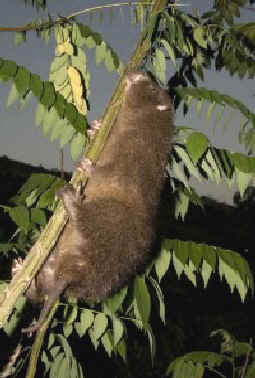
Hispaniolan Hutia
(photo by Jorge Brocca)
-
Hispaniolan Solenodon (t2) (He) (ph) (*) _____ (photo: 136-139)
Solenodon paradoxus
The two species of solenodons in the world, in the family SOLENODONTIDAE,
are in the order SORICOMORPHA, along with the shrews.
The other species of solenodon is in Cuba. It, Solenodon
cubana, is smaller than the Hispaniolan Solenodon.
The two solenodons are the only surviving insectivorous mammals in
the Caribbean.
The endangered Hispaniolan Solenodon is one of the most unusual and
ancient mammals on Earth. The species is thought to resemble ancient mammals
that existed toward the end of the age of dinosaurs, over 65 million years
ago.
Also, the Hispaniolan Solenodon is one of the only two remaining
endemic terrestrial mammal species on Hispaniola. The other is the Hispaniolan
Hutia (above).
So unlike most of the other endemic land mammals that formerly occurred on
Hispaniola, solenodons have managed to survive until now.
The species was described to science in 1833. Still, even today, knowledge
of its ecology and biology is fairly limited due to the animal's secretive
nocturnal habits.
Much of what is known about the Hispaniolan Solenodon is due to the
research done by Dr. Jose Ottenwalder in the 1970s and
1980s.
An unusual characteristic of the Hispaniolan Solenodon is that it is
one of the few mammals that can secrete a toxic saliva in a manner similar
to snakes. The ability to do so is from a mandibular gland along a grooved
lower incisor.
The distinctive elongated snout of the Hispaniolan Solenodon is
joined to the skull by a unique ball-and-socket joint which provides
considerable flexibility.
The Hispaniolan Solenodon appears to have a rather widespread
distribution across Hispaniola, occurring in a variety of forest habitats,
from the lowland dry forest up to highland pine forest.
However, in its range, populations of solenodons are highly
fragmented, and, as noted above, the species is classified as
endangered.
There is evidence that some of the populations of the Hispaniolan
Solenodon are quite distinctive from others.
As noted, solenodons are nocturnal animals. The spend the day in a
den located in a rocky outcrop, a burrow, or a hollow tree.
At night, they forage for invertebrates, primarily arthropods in the dirt,
although they may also scavenge in rotten wood. During their nightly
searches, they leave distinctive conical excavations in the soil. Called "nose
pokes", they are almost 3 inches wide and almost 3 inches deep.
Their main prey seem to be millipedes, ground beetles, crickets, katydid,
cockroaches, earthworms, and snails.
As to its native predators, the solenodon's size and nocturnal
activity seems to suggest that it has only a few:
the Barn Owl (and maybe the closely-related Ashy-faced Owl),
the Stygian Owl (rare in highland Hispaniola), and the Hispaniolan
Boa.
Also, the solenodon is now killed, rather often, by dogs, both
domesticated and feral.
The Hispaniolan Solenodon has been seen on a few occasions during FONT
tours in the Dominican Republic, particularly during nocturnal tour outings
for owls and other nightbirds.
When seen, solenodons have been seen walking with their characteristic
side-to-side waddle.
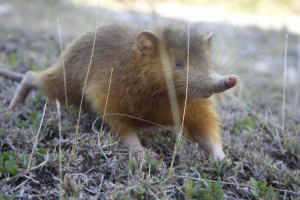
Hispaniolan Solenodon
(photo by Jorge Brocca)
______________________________________________
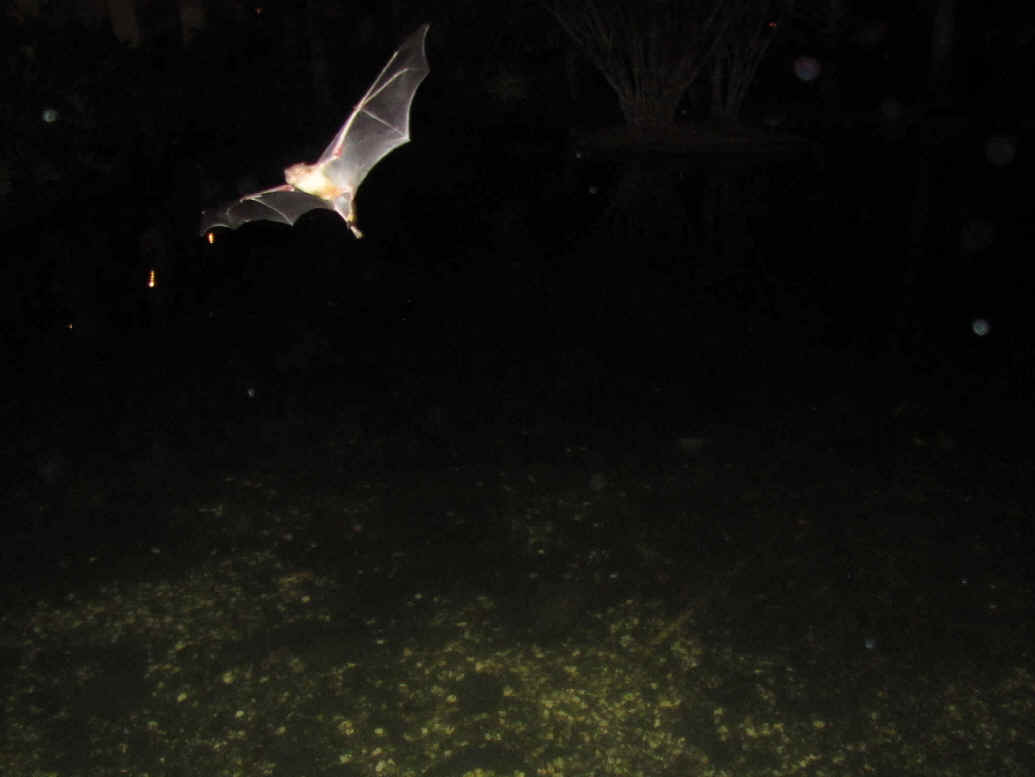
It has been said that as many as 22 species of bats have been known to occur on Hispaniola.
3 of them have become extinct or extirpated from the island:
1) a large unnamed Pteronotus
2) Mormoops megalophylla
3) Lasiurus intermedius
Only 1 of the surviving bats in Hispaniola has been recognized as
endemic to the island.
18 species are included here in this list.
9 of the species of bats in Hispaniola feed exclusively on insects.