PO Box 9021, Wilmington, DE 19809, USA
E-mail: font@focusonnature.com
Phone: Toll-free in USA 1-800-721-9986
 or 302/529-1876


Part 1 of a List of selected

South America
Butterflies 
and Moths


noting those during 
Focus On Nature Tours


in
Argentina
Brazil
Chile 
Ecuador
Venezuela


List of South America Butterflies in 5 Parts, compiled by Armas Hill


In the following Part #1: Swallowtails (Papilionidae)  

Links to other Butterfly groupings:

Part #2 - Whites, Yellows, Sulphurs, Marbles (Pieridae)

Part #3 - Hairstreaks, Blues (Lycaenidae) & Metalmarks (Riodinidae) 

Part #4 - Brushfoots (Nymphalidae)

Part #5 - Skippers (Hesperiidae)


Codes relating to illustrations in various books: 

Numbers noted as (AZ:xx) refer to pages in "Butterflies of Arizona - A Photographic Guide", by Bob Stewart, Priscilla Brodkin, & Hank Brodkin (with fine photographs).

Numbers noted as (BB:xx) refer to pages in "Butterflies of Buenos Aires (Argentina)", by Gustavo Canals

Numbers noted as (C:xx) refer to pages in "A World of Butterflies", with text by Brian Cassie, and photographs (superb) by Kjell Sandved

Numbers noted as (D1:xx) refer to plates in "The Butterflies of Costa Rica and their Natural History (Volume 1): Papilionidae, Pieridae, Nymphalidae", by Philip J. DeVries   

Numbers noted as (DV:xx) refer to pages in "Butterflies Of South America", by Bernard D'Abrera    

Numbers noted as (F:xx) refer to pages in "The Illustrated Encyclopedia of Butterflies", by Dr. John Feltwell  

Numbers noted as (K:xx) refer to pages in the "Kaufman Focus Guide to Butterflies of North America", by Jim Brock & Kenn Kaufman

Numbers noted as (MM:xx) refer to pages in "Mariposas (Butterflies) of Missiones (Argentina)", by Gustavo Canals  

Numbers noted as (PE:xx) refer to plates in the "Peterson Field Guides to Eastern Butterflies", by Paul Opler & Vichai Malikul, 1998 edition. Those noted as (PEp:xx) refer to a page with a photograph.

Numbers noted as (PW:xx) refer to plates in the "Peterson Field Guide to Western Butterflies", by Paul Opler & illustrated by Amy Bartlett Wright, 1999 edition. Those noted as (PWp:xx) refer to a page with a photograph. 

Numbers noted as (RG:xx) refer to pages in "Butterflies of the Lower Rio Grande Valley" by Roland Wauer.

Numbers noted as (S:xx) refer to pages in the "Smithsonian Handbook, Butterflies & Moths", by David Carter.


Country Codes:


AR: in Argentina
BR: in Brazil
CH: in Chile
EC: in Ecuador
VE: in Venezuela

BUTTERFLIES OBSERVED DURING FONT TOURS NOTED BY AN (*) AFTER THE 2-LETTER COUNTRY CODE.

(ph): species with a photo in the FONT website 


Other Links:

Upcoming FONT Birding & Nature Tours in South America in Brazil

Upcoming FONT Birding & Nature Tours in South America in Argentina & Chile

Lists & Photo Galleries of Birds, including those during FONT Tours in South America

Lists & Photo Galleries of Mammals & Other Wildlife, relating to FONT Tours in South America

Lists of Photo Galleries of Amphibians & Reptiles, including those during FONT Tours in South America


Directory of Photos in this Website, in this list & others


List of Butterflies, Part #1:

         Family PAPILIONIDAE: SWALLOWTAILS (and allies)


Worldwide, there are totally about 700 known species of SWALLOWTAILS.

         Genus BATTUS: PIPEVINE SWALLOWTAILS: 
Totally 15 species 


  1. Battus polydamas  (ph)  ______  (DA:19) (DV1:1) (F:38) (K:37) (MM:140) (PE:5) (S:55)
    Battus polydamas polydamas  ______  ARne 
    (subspecies in the mainland Americas)
    Battus polydamas archidamas  ______  CH 
    (subspecies in Chile) 
    Polydamas Swallowtail
    (also called The Gold Rim, or Black Page) (Note Polydamas was a Trojan prince.)
    CH name: Papilio Negro (and Aristolochia Swallowtail, referring to the scientific name of the subspecies)
    (Range: throughout the Americas & the Antilles) 

    In the tropics, Battus polydamas is continuously brooded. Butterflies live about a week.


    Polydamas (or Gold Rim) Swallowtail

  2. Battus polystictus polystictus ______ ARne  (MM:141)
    AR common name: Polysticto

  3. Battus belus  ______ (DA:21)
    Battus belus belus  ______ 
    (subspecies from eastern Peru to the Guianas) 
    (Range: Mexico to Bolivia)  

  4. Battus lycidas ______ (DV1:1)
    Yellow-trailed Swallowtail
    (Range: Mexico to Bolivia)

  5. Battus crassus ______ (DV1:1)
    (Range: Costa Rica to Brazil & Argentina) 

  6. Battus madyes ______ (DA:19)
    (Range: Ecuador to Bolivia & northern Argentina)


    Genus PARIDES: CATTLEHEARTS

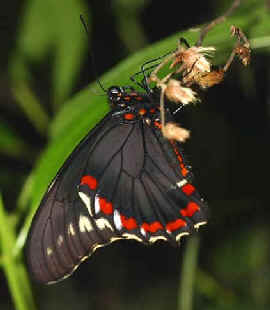
  7. Parides eurimedes  ______ (F:68) (PE:text)
    Pink-checked Cattleheart
    (Range: southern Mexico to northern South America)

    Parides eurimedes occurs In open forested areas. It breeds on Aristolochia species.

  8. Parides sesostris  ______ (DV1:2) (F:70)
    Parides sesostris sesostris ______ (DA:27) 
    (subspecies in Amazonas)
    Emerald-patched Cattleheart 
    (has been called Southern Cattleheart)
    (Range: Mexico to Bolivia, possibly north-central Argentina, in Misiones)  

  9. Parides childrenae childrenae  ______  (DA:28) (DV1:2)
    Green-celled Cattleheart 
    (Range: Mexico to Ecuador) 

    In southern races of Parides childrenae, the white spot on the upper forewing is reduced or absent.   

  10. Parides lycimenes  ______ (DV1:2)
    (Range: Mexico to Ecuador) 

  11. Parides erithalion ______ (DV1:2)
    Variable Cattleheart
    (Range: Mexico to Venezuela) 

  12. Parides iphidamas iphidamas ______ (DV1:2)
    Transandean Cattleheart
    (Range: Mexico to Ecuador & Peru) 

  13. Parides agavus ______ ARne  (DA:23) (MM:142)
    Agavus Cattleheart
    AR common name: Agavo
    (Range: central Brazil to northeast Argentina & Paraguay)


    An Agavus Cattleheart photographed during the FONT Brazil Tour in May 2011
    (photo by Pat Yoder)

  14. Parides bunichus perrhebus ______ ARne  (MM:143)  (subspecies in northeast Argentina)
    AR common name: Vuidita del Norte
    (translates to "Northern Widow")    

  15. Parides anchises nephalion ______ ARne  (MM:144)  (subspecies in northeast Argentina)
    AR common name: Prudente (translates to "Prudent")
      (scientific name relates to nephalios, Greek for prudent) 

  16. Parides neophilus eurybates ______ ARne  (MM:145)  (subspecies in northeast Argentina)
    AR common name: Escama Roja
    (translates to "Red Scale")


  17. Parides hahneli ______ (DA:23)
    (Range: eastern Amazonas to the foot of the Andes)

  18. Parides quadratus ______ (DA:24)
    (Range: Amazonas, in Brazil, Peru, Ecuador)

  19. Parides aeneas  ______ (DA:25)
    Parides aeneas damas  ______ 
    (subspecies in Colombia & Peru)
    Parides aeneas bolivar ______ 
    (subspecies in the upper Amazon & upper Orinoco)
    (Range: eastern Peru & sw Colombia to the Guianas)  

    There are 6 described subspecies of Parides aeneas.  

  20. Parides orellana ______  (DA:26)
    (Range: Amazonas, Brazil & Peru)

  21. Parides erlaces  ______ (DA:29)
    Parides erlaces erlaces  ______ 
    (subspecies from southern Peru to northern Argentina) 
    Parides erlaces lacydes ______ 
    (subspecies in eastern Ecuador) 
    Parides erlaces xanthias ______ 
    (subspecies in northeast Peru)
    (Range: Ecuador & Peru to northern Argentina)   

  22. Parides echemon echemon ______  (DA:30)
    (Range: Brazil, in the lower Amazon, to the Guianas)

  23. Parides arcas  ______  (DA:31) (DV1:2)
    Parides arcas antheas  ______ 
    (subspecies in Colombia)
    (Range: Mexico to Ecuador, Venezuela & the Guianas) 


    Genus EURYADES: 2 species, both confined to middle latitudes of South America. Apparently "primitive" butterflies, closely related to the Australian CRESSIDA.

  24. Euryades duponcheli ______ (DA:32) 
    (Range: southern Brazil to northern Argentina, Paraguay, & Uruguay)


    Genus EURYTIDES (or MIMOIDES or PROTESILAUS):  the KITE SWALLOWTAILS: 
    About 50 species confined to the New World. 

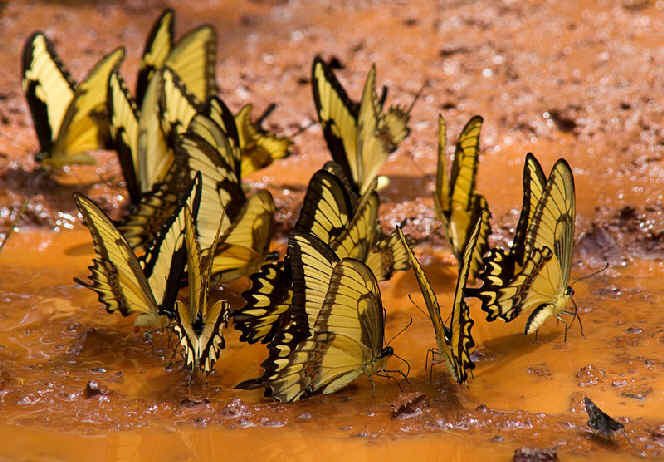
    Some mimic PARIDES and HELICONIUS butterflies. Others have long tails, hence the name "KITE SWALLOWTAILS". Fast-fliers. Engage in mud-puddling. 

  25. Mimodes (or Eurytides) ilus ______ (DV1:2)
    Dual-spotted Swallowtail
    (Range: Panama to Venezuela)

  26. Eurytides euryleon  ______ (DV1:2)
    (Range: Mexico to Ecuador) 

  27. Mimodes (or Eurytides) phaon ______ (DV1:2)
    Mimodes phaon phaon ______ (DA:39)
    Red-sided Swallowtail
    (Range: Mexico to Ecuador & Brazil)

    Mimodes phaon is a miniature copy of the larger species Papilio birchall of Costa Rica to Colombia. 

  28. Eurytides pausanias ______ (DV1:3) (F:41)
    Eurytides pausanias pausanias ______ (DA:39)
    (Range: Costa Rica to southern Brazil & Bolivia, in western Ecuador & the Guianas) 

    Mimicry of heliconid butterflies (Heliconius clytia & Heliconius wallacei) has been perfected by this swallowtail, Eurytides pausanias, which shares the same habitats - rainforest glades and other open areas. Not common.). 

  29. Eurytides agesilaus eimeri ______ (DV1:3)
    (Range: Mexico to South America) 

  30. Eurytides (or Protesilaus) stenodesmus  ______  ARne  (MM:148)
    AR common name: Espadachin Comun 
    (translates to "Common Swordsman")
    BR common names: Veleiro, Argonauta, Pandorga

  31. Eurytides (or Protesilaus) protesilaus ______  (DV1:3)
    Eurytides  protesilaus nigricornis ______ ARne  (MM:149)
    (subspecies in northeast Argentina)
    Kite Swallowtail 
    (also called Swordsman)
    AR common name: Espadachin (translates to "Swordsman")
    BR common name: Veleiro, Argonauta, Pandorga
    (Range: Mexico to Paraguay & northern Argentina)   

  32. Eurytides (or Protesilaus) helios  ______  ARne  (MM:150)
    AR common name: Helios 
    (Helios, in Greek mythology, was the god of the sun.) 

  33. Eurytides marchandi panamensis ______  (DA:43) (DV1:3) (F:41)
    (Range: Mexico to Ecuador) 


    Eurytides marchandi Inhabits rainforest up to about 3,500 feet above sea level. The sexes are similar. The southern populations are a paler yellow.  

  34. Eurytides lacandones ______ (DV1:3)
    (Range: Mexico to Bolivia) 

  35. Eurytides bellerophon ______ (DA:38)
    (Range: southern Brazil to northwest Argentina)

  36. Eurytides ariarathes gayi ______ (DA:40)
    (Range: Colombia to the Guianas, Brazil, Peru)

  37. Eurytides (has been Mimoides) lysithous  ______ 
    Eurytides lysithous platydesma ______  (DA:41)
    Eurytides lysithous harrisianus ______  (DA:41)
    Eurytides lysithous rurik  ______  ARne  (MM:146)
    (subspecies in northeast Argentina)
    AR common name: Rurik  (Rurik was the Scandinavian founder of the Russian Empire, who became the Prince of Novgorod in 862.) 
    (Range: Brazil & eastern Paraguay) 

    The subspecies Eurytides lysithous platydesma appears to be threatened.

  38. Eurytides (has been Mimoides) protodamas  ______  ARne  (MM:147)
    AR common name: Falso Polysticto  ("False Polysticto")
    (referring to the butterfly's similarity with Battus polystictus, commonly called Polysticto)

  39. Eurytides molops ______  (DA:42)
    (Range: Colombia to the Guianas, Brazil, & Bolivia)
     

    Genus: PAPILIO (or HERACLIDES): the FLUTED SWALLOWTAILS: 
    One of the most widespread of genera, with over 200 species. 
    Most are tropical. Most have tails. Many are migratory. 

  40. Papilio (or Heraclides) thoas  ______ (C:295) (DV1:4) (K:38 text) (PE:6)
    Papilio thoas cinyras ______  (DA:34)
    Papilio thoas nealces  ______ 
    (subspecies from Nicaragua to Brazil & Ecuador)
    Papilio thoas brasiliensis ______   ARne  (MM:151) 
    (subspecies in northeast Argentina)
    Thoas Swallowtail 
    AR common name: Toas Grande 
    (Toas in mythology was a Trojan hero.) 
    (Range: southern US thru Central & South America, also: Cuba, Jamaica, Trinidad) 


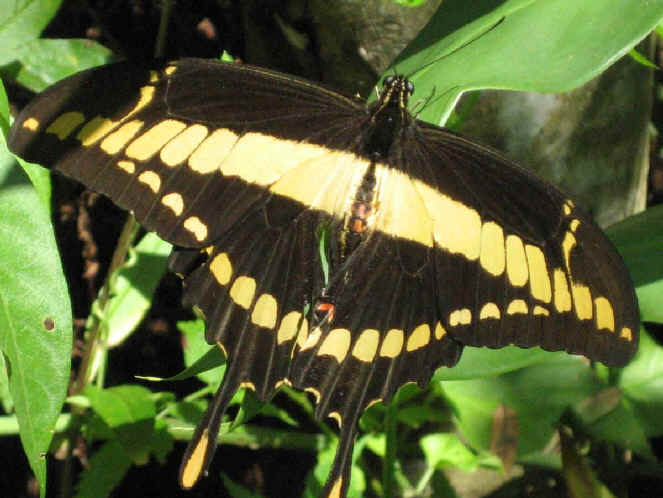
    A Thoas Swallowtail photographed during a FONT tour in Brazil

  41. Papilio (or Heraclides) astyalus ______ (C:299) (DV1:4) (F:54) (K:43) (PE:6)
    Broad-banded Swallowtail
    (also called Astyalus or Lycophron Swallowtail)
    AR common name: Astyalos  (Astyalos in mythology was the name of a Trojan.)
    BR common names: male: Pequeno Caixao de Deunto; female: Viuva 
    (Range: southern US to Argentina)  

    Papilio astyalus is found in areas forested with tropical hardwoods. As with many Papilio, the caterpillars breed on citrus.

  42. Papilio (or Heraclides) androgeus  (ph)  ______  (DV1:4) (F:52) (K:41) (PE:6)
    Papilio androgeus androgeus ______  (DA:33)
    Androgeus Swallowtail
    (or Queen Page)
    AR common name: Androgeo
    (Range: Mexico to Argentina, also West Indies) 

    The female of Papilio androgeus tends to be reclusive, not often seen. The male is much of the time in the forest canopy, occasionally coming down to mud-puddle.


    Androgeus Swallowtail (or Queen Page)

  43. Papilio (or Heraclides) hectorides  ______  ARne  (MM:154)
    AR common name: Hector 
    (Hector, in mythology, was a Trojan hero.)
    BR common name of the dark female: Viuvinha

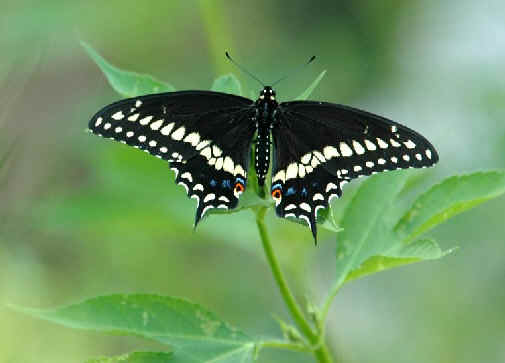
  44. Papilio polyxenes  (ph)  ______ (C:203) (DV1:4) (K:29) (PE:5) (F:65)
    Black Swallowtail
    (Range: Canada thru Central & South America)  

    Papilio polyxednes can defoliate vegetables such as carrot, celery and parsnip, hence a name of "Parsnip Swallowtail".


    Black Swallowtail
    (photo by Howard Eskin)


  45. Papilio (or Heraclides) torquatus ______ (DV1:4)
    Papilio torquatus torquatus ______ (DA:35)
    Papilio torquatus theras ______ (DA:35) 
    Papilio torquatus polybius ______  ARne  (MM:155)
    (subspecies in northeast Argentina)
    Band-gapped Swallowtail 
    AR common name: Polibio 
    (Polibio, who lived from 206-122 B.C. was a Greek historian and politician.)
    (Range: Mexico to Bolivia, Paraguay, & northeast Argentina) 

    The female of Papilio torquatus is polymorphic, with the white spot on the forewing & the shape and color of the pink patch on the hindwing variable.

  46. Papilio cleotas ______ (DV1:5)
    Papilio cleotas cleotas ______ (DA:37)
    (Range: Costa Rica to Brazil, Paraguay, & northeast Argentina) 

  47. Papilio rhodostictus ______ (DV1:6)
    (Range: Costa Rica to Ecuador) 

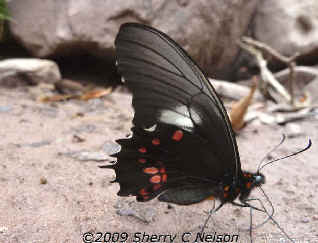
  48. Papilio anchisiades ______ (DV1:6) (F:52) (K:43) (PE:5) (S:48)
    Ruby- spotted Swallowtail 
    (also called Anchisiades Swallowtail)
    AR common name: Mancha Rubi  (translates to "Ruby-spotted"
    (Range: Texas to Argentina)  

    Papilio anchisiades is often found at citrus trees.

  49. Papilio ascolius ______ (DA:36)
    (Range: Costa Rica to the Guianas, Colombia, & western Ecuador)  

    There are 3 other species of butterflies similar in shape and coloring to Papilio ascolius from Venezuela to Amazonas.