 |
PO
Box 9021, Wilmington, DE 19809, USA
E-mail: font@focusonnature.com
Phone: Toll-free in USA 1-800-721-9986
or 302/529-1876 |

Desert
Plants
& some others in
nearby habitats
in the Western US
& Northern Mexico
with those during
FONT Birding & Nature Tours
thru 2011
noted with an (*)
during the months of January, July,
August, & September
The following list compiled by Armas Hill
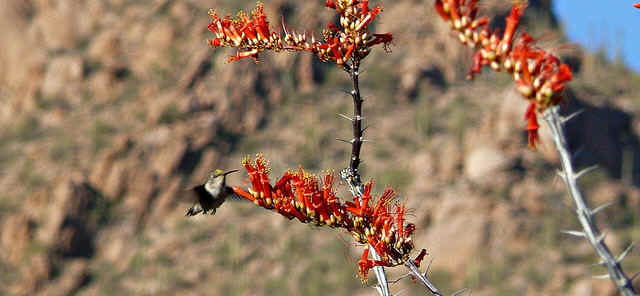
Photo at right:
OCOTILLO, Fouquieria splendens
during a FONT tour in Sonora, Mexico
(photograph by Doris
Potter)
FONT tours in the deserts of the
western US & northern Mexico have been in Arizona, California, Colorado, New
Mexico, & Texas in the US, and in Sonora in Mexico.
In the list that follows, below the scientific names are names in English (E:)
& Spanish (S:)
The families in the list are given (mostly) in alphabetical order, and genera
within them are given alphabetically as well.
Families that are "break-offs" from other families follow them,
may be out of alphabetical order.
Links to some Plant Families in this List
Agave & Yucca Family - Agavaceae
(said to be part of the Lily Family - Liliaceae)
Aster &
Sunflower Family - Asteraceae (or Compositae)
Cacti Family - Cactaceae
Evening
Primrose Family - Onagraceae
Legume,
or Pea Family - Fabaceae (including, among others, Acacias, Lupines,
Palo Verdes, Mesquites, Mimosas)
Lily Family - Liliaceae
Milkweed
Family - Asciepiadaceae
Morning Glory Family - Convolvulaceae
Poppy Family -
Papaveraceae
Snapdragon,
or Figwort Family - Scrophulariaceae
Vervain (Verbana) Family -
Verbenaceae
Codes:
(T): categorized as a tree
(S): categorized as a shrub
(W): categorized as a wildflower
CD: in the Chihuahuan Desert (in Mexico & the US)
GD: in the Great Basin Desert (in the US)
PD: in the Painted Desert (in the US)
(said by some to be a southern part of the Great Basin Desert)
MD: in the Mohave Desert (in the US)
SD: in the Sonoran Desert (in the US & Mexico)
(ph): species with a photo in the FONT web-site
FOLLOWING THIS LIST ARE OTHERS OF
TREES, FLOWERS, & OTHER PLANTS IN HIGHER COUNTRY NEAR THE DESERTS:
THE FLORA
OF "ISLANDS IN THE SKY"
AND
DESERT GRASSES
Other Links:
Information about
Upcoming FONT Birding & Nature Tours:
in North America
by month in: 2012
2013
or: by geographic locations worldwide
Noting those found during FONT Birding & Nature Tours:
Birds in: Arizona
California Colorado
Texas Sonora, Mexico
Mammals: Arizona
California Colorado
Texas Mexico
Amphibians & Reptiles
in: Arizona
Texas
Mexico
Butterflies
in: Arizona
Texas Mexico
Directory of Photos in this Website

A List of Desert Plants
of the western US & northern Mexico:
Family
ACANTHACEAE (Acanthus)
Genus ANISACANTHUS
- Anisacanthus thurberi ______
E: Desert Honeysuckle
Anisacanthus thurberi
is a host plant for the butterfly: TEXOLA ELADA, Elada Checkerspot.
Genus JUSTICIA
- Justicia californica
______
E: Chuparosa, Beleperone (also called
"Hummingbird Bush")
S: Chuparosa, Beleperone
Justicia californica
is a host plant for the butterfly: DYMASIA DYMAS, Tiny Checkerspot.
Genus STENANDRIUM
- Stenandrium barbatum
______
E: Shaggy Tuft
Family AGAVACEAE (Agaves)
Genus AGAVE
- Agave deserti
______ SD
E: Desert Agave
S: Amul
- Agave havardiana ______ CD
E: Havard Agave (also called Big Bend Agave, or Century Plant)
- Agave lecheguilla ______ CD
E: Lechuguilla
S: Lechuguilla (a Spanish diminutive for lettuce)
- Agave murpheyi
______ SD
E: Hohokam Agave, Murphey's Agave
S: Maguey (a general name for many agaves)
:
- Agave palmeri ______
E: Palmer's Century Plant (or Mescal)
- Agave parryi ______ CD
E: Parry Agave
- Agave schottii
______ SD
E: Shindagger
S: Amole, Maguey, Amolillo
- Agave pelona ______ SD
E: none
S: Mescal Pelon ("Bald Agave")
- Agave utahensis ______ GD
E: Utah Agave
The Utah Agave is found in dense populations where Utah, Arizona,
and Nevada come together.
- Agave zebra
______ SD
E: Zebra Agave
S: none
Genus YUCCA (& HESPEROYUCCA) (T/W)

Yucca
(photo by Doris Potter)
- Yucca angustissima ______ GD,
MD
Narrow-leaved Yucca (resembles the Navajo Yucca)
- Yucca arizonica (formerly Yucca
baccata arizonica)
______ SD
E: Blue Yucca, Spanish Bayonet
S: Datil ("date"), Palma Criolla ("creole or native
palm")
- Yucca baccata ______
E: Banana Yucca, Blue Yucca, Datil
- Yucca brevifolia ______ MD
E: Joshua Tree
- Yucca carnerosana ______ CD
E: Giant Dagger
- Yucca elata ______
CD,SD
E: Soaptree Yucca
S: Palmilla, Palmito, Soyate, Cortadillo
- Yucca harrimaniae ______
E: Harriman Yucca
- Yucca navajoa (or Y. baileyi)
______ PD
E: Navajo Yucca
- Yucca rostrata ______ CD
E: Beaked Yucca
- Yucca schidigera
______ MD
E: Mohave Yucca (or Spanish Dagger)
- Yucca torreyi ______ CD
E: Torrey Yucca
- Hesperoyucca (or Yucca)
whipplei
______ SD
E: Whipple Yucca (or Spanish Bayonet, Our Lord's Candle, Chaparral
Yucca)
S: Sotolillo, Lechugilla, Quiote
Family NOLINACEAE (formerly AGAVACEAE
and LILIACEAE) (Nolinas)
Genus DASYLIRION
- Dasylirion leiophyllum ______ CD
E: Chihuahuan Sotol
- Dasylirion wheeleri ______
SD
E: Desert Spoon
S: Sotol ("Sotole" is a palm), Sano
Genus NOLINA (with a total of 25 species, in the southwest US
& northwest Mexico)
- Nolina bigelovii
______ SD
E: Nolina, Bear Grass
S: Yuca, Sotol, Palmita
- Nolina erumpens ______ CD
E: Foothill Basket
Grass
S: Mesa Sacahuista
- Nolina microcarpa ______
E: Bear Grass (a common name also had by other members of this
genus)
- Nolina parryi
______ (on dry brushy slopes in southern California)
E: Parry's Nolina
Family AIZOACEAE (Fig
Marigolds, or Carpet-weeds)
Genus SESUVIUM
- Sesvium verrucosum
______ CD MD SD (scattered throughout the hot
deserts of North America)
E: Western Sea Purslane
Sesvium verrucosum is a host plant
for the butterfly: BREPHIDIUM EXILE, Western Pygmy Blue.
Family AMARANTHACEAE
(S) (closely related to CHENOPODIACEAE, the Goosefoots)
Genus KRASCHENINNIKOVIA
- Krascheninnikovia (has been Ceratoides
& Eurotia) lanata (ph)
______ GD
E: Winterfat,
Lamb's Tail, "Sweet-sage" or "White-sage"
(although
neither a sage nor a sagebrush)

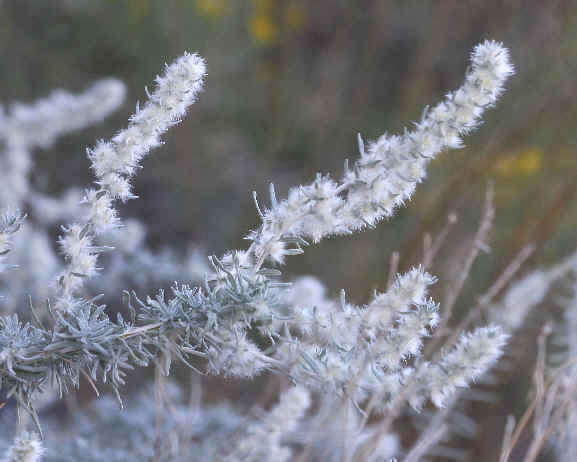
Winterfat, Krascheninnikovia lanata
(photo by Doris Potter)
The genus name honors the Russian
botanist S. P. Krasscheninnikov. Winterfat occurs in Eurasia and in western
North America.
It is a woody shrub recognized by its whitish gray foliage and a
characteristic wooly appearance in the late summer.
The plant is a nutritious winter browse for wildlife. It is cold hardy to 0
degrees F, and very drought tolerant, and it is especially suited to growing
at higher elevations , since it must have cool nights to thrive.
Genus TIDESTROMIA
- Tidestromia lanuginosa ______ (an
annual)
E: Honeysweet
- Tidestromia oblongifolia ______
(a perennial)
E: Honeysweet
Family
ANACARDIACEAE (Sumacs)
Genus RHUS
- Rhus chlorophylla ______
E: Evergreen Sumac
- Rhus trilobata ______
E: Skunkbush
- Rhus virens ______
E: Tobacco Sumac
Family APOCYNACEAE (Dogbanes)
Genus AMSONIA
- Amsonia tomentosa
______
E: Blue-Star
Genus MACROSIPHONIA
-
Macrosiphonia macrosiphon ______ CD
E: Rock-Trumpet
Family ARACACEAE (PALMAE) (Palms) (T)
Genus BRABEA
- Brabea (spp.) ______ SD
E: Hesper Palm
S: Palma Ceniza ("Ashy Palm")
- Brabea armata ______ SD
E: Blue Palm
S: Palma Azul ("Blue Palm")
Genus WASHINGTONIA
- Washingtonia filifera ______ SD
E: Desert Palm (or California Fan Palm)
S: Palma de Castilla, Palma de Abanico ("Fan Palm")
Washington filifera is a desert species only in the
sense that it grows within desert boundaries. It is a relict species from a
time when what is now a desert was an area receiving abundant rain and was
covered by a tropical forest. Today, the Desert Palm grows only
around springs and along streams.
- Washingtonia robusta
______ SD
E: Mexican Fan Palm
S: Palma Colorada ("Red-brown Palm"), Palma Blanca ("White
Palm")
Family AMARYLLIDACEAE
Genus ZEPHYRANTHES
-
Zephyranthes longifolia
______
E: Rain Lily
"Zephyranthes"
means "flowers of the west wind". Flowers
appear very soon after substantial rains.
Family APIACEAE (Parsleys)
Genus CYMOPTERIS
- Cymopteris acaulis
______ CD GD PD
E: Plains Spring-Parsley
- Cymopteris montanum
______ CD
E: Mountain Spring-Parsley
- Cymopteris purpurascens
______ GD MD PD SD
E: Widespring Spring-Parsley
Genus ERYNGIUM
- Eryngium heterophyllum
______
E: Mexican Thistle
Genus LOMATIUM
- Lomatium mohavense
______ (similar to the Mountain Spring-Parsley)
(similar to the Mountain Spring-Parsley)
E: Mojave Desert-Parsley
Family ASCLEPIADACEAE (Milkweeds)
Genus ASCLEPIAS
- Asclepias albicans
______ (dry rocky places in deserts)
E: White-stemmed Milkweed, Wax Milkweed
Asciepias albicans is a host plant for the butterfly: DANAUS
GILIPPUS, Queen.
- Asclepias brachystephana ______
CD
E: Short-crowned Milkweed
- Asclepias cryptocerax ______
E: Pallid Milkweed
- Asclepias erosa ______ MD
SD
E: Desert Milkweed
Asciepias erosa is a host plant for the butterflies: DANAUS GILIPPUS,
Queen, DANAUS PLEXIPPUS, Monarch.
- Asclepias nyctaginifolia ______
MD
E: Mojave Milkweed
- Asclepias rusbyi ______ PD
E: Rusby Milkweed
- Asclepias subverticillata
______
E: Poison Milkweed, Horsetail Milkweed
Asciepias subverticillata is a host plant for the butterfly: DANAUS
PLEXIPPUS, Monarch.
- Asclepias tuberosa
______
E: Butterfly Weed, Orange Milkweed, Chiggerflower
Asciepias tuberosa is a host plant for the butterflies: DANAUS
GILIPPUS, Queen, DANAUS PLEXIPPUS, Monarch.
Genus SARCOSTEMMA
- Sarcostemma cynanchoides
______
E: Climbing Milkweed
Sarcostemma cynanchoides is a
host plant for the butterfly: DANAUS GILIPPUS, Queen.
Family ARISTOLOCHIACEAE (Pipevines)
Genus ARISTOLOCHIA
- Aristolochia watsonii ______
SD (from southern Arizona &
adjacent Mexico south to the tip of Baja California)
E: Southwestern Pipevine (also
called Indian Root, Snakeroot, Birthwort)
S: Hierba del Indio ("Indian Herb"), Guaco
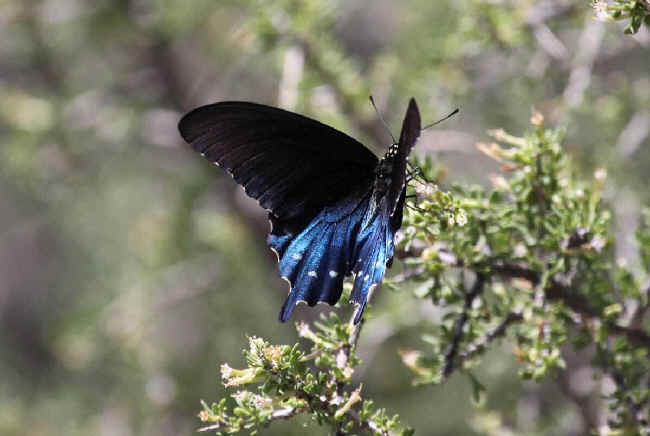
Aristolochia watsonii is a host plant for the butterfly: BATTUS
PHILENOR, Pipevine Swallowtail.

A Pipevine Swallowtail photographed during the
August 2010 FONT tour in Arizona
(photo by Marie Gardner)
Family ASTERACEAE (or COMPOSITAE) (Asters, Sunflowers)
With
about 1,100 genera & 20,000 species in this large, worldwide family;
making this and the Orchid Family (ORCHIDACEAE) the two largest plant
families.
Various species in the ASTER family are host plants for
the butterflies: PHYCIODES BATESII, Tawny Crescent, PHYCIODES SELENIS,
North Crescent.
Genus ACAMPTOPAPPUS
- Acamptopappus shockleyi
______ MD GD
(in rocky mesas and mountain slopes)
E: Goldenhead
- Acamptopappus
sphaerocephalus ______
MD SD
(in rocky mesas
and mountain slopes)
E: Rayless Goldenhead
Genus ACHILLEA
-
Achillea millefolium ______
E: Yarrow, Milfoil
Genus ADENOPHYLLUM (or DYSSODIA)
- Adenophyllum cooperi
______ MD SD
(abundant in sandy flats and washes)
E: Orange Glandweed
- Adenophyllum porophylloides
______ SD
(abundant in sandy flats and washes)
E: Sonoran Glandweed
Genus AMBROSIA
- Ambrosia ambrosioides
______ SD
E: Bursage, Canyon Ragweed
S: Chicura
- Ambrosia deltoidea ______
SD
E: Triangleleaf Bursage, Burrobush, Rabbitbush
S: Estafiate
- Ambrosia dumosa
______ SD
E: White Bursage, Burrobush
S: Chicurilla, Hierba del Burro ("Burro Herb"), Huizapol
Genus ANISOCOMA
- Anisocoma acaulis
______ MD SD
(widely distributed; prefers sandy soils,
especially washes)
E: Scale-Bud
Genus ARTEMISIA
- Artemisia spinescens
______ GD MD PD
E: Budsage (or Spiny Sagebrush)
- Artemisia tridentata
______ GD
E: Sagebrush (or Tall Sagebrush)
Genus ASTER
- Aster spinosus ______ CD
E: Mexican Devilweed
Genus ATRICHOSERIS
- Atrichoseris platyphylla
______ (in sandy, desert washes)
E: Tobacco Weed, Parachute Plant (also called Gravel Ghost)
Genus BACCHARIS
- Baccharis sarothroides
______ SD
E: Desert Broom (or Broom Baccharis)
S: Romerillo ("Rosemary"), Escoba Amarga ("Bitter
Broom"), Hierba del Pasmo
Genus BAILEYA
- Baileya multiradiata
______ CD SD
E: Desert Marigold
S: Hierba Amarilla ("Yellow Herb")
Genus BEBBIA
- Bebbia juncea
______ SD
E: Chuckwalla's Delight (or
"Sweetbush")
S: Chuparosa ("sucked" by insects for nectar), Junco (generic name
for "rushes")
Genus BERLANDIERA
- Berlandiera lyrata
______ (in grassy areas in gravelly or rocky soil; common along
roadsides)
E: Greeneyes, Chocolate Flower
Genus BRICKELLIA
- Brickellia grandiflora
______
E:
Large-flowered Brickelbush
Genus CALYCOSERIS
- Calycoseris wrightii
______ CD MD SD
E: White Tack-Stem
Genus CHAENACTIS
- Chaenactis carphoclinia ______
E: Pebble Pincushion
- Chaenactis douglasii ______ GD
E: Douglas Pincushion
- Chaenactis fremontii ______ MD SD
E: Desert Pincushion
- Chaenactis steviodes
______ GD
E: Stevia Pincushion, Esteve's Pincushion (other common names are:
False Yarrow, Broad-leaved Chaenactis)
Chaenactis steviodes is closely related to the
Desert Pincushion, and often goes by the same name.
There are several Chaenactis species with white flowers.
Genus CHRYSACTINIA
- Chrysactinia mexicana
______ CD (especially in Mexico)
S: Damianita
Genus CHRYSOTHAMNUS (S)
- Chrysothamnus albidus ______ GD
MD PD (in alkaline flats)
E: Alkali Rabbitbrush
- Chrysothamnus greeniii ______ PD
E: Green Rabbitbrush
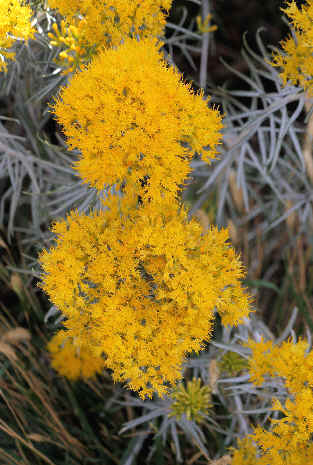
- Chrysothamnus nauseosus (ph)
______ GD (in dry open areas with sagebrush)
E: Rubber Rabbit Brush

Rubber Rabbit Brush
(photo by Doris Potter)
Some races of the Rubber Rabbit Brush are light green; others have silvery
hairs. The Navajos obtained a yellow dye from the flower
heads.
Including all the subspecies and varieties, perhaps as many as 20, the Rubber
Rabbit Brush ranges from Canada to Mexico, inhabiting all the arid and
semiarid ecosystems of western North America.
- Chrysothamnus panicularus
______ MD SD (in washes and on gravelly slopes)
E: Desert Rabbitbrush
- Chrysothamnus visciciflorus
______ GD
E: Sticky Rabbitbrush
Genus CIRSIUM
Species in the CIRSIUM genus are host plants for the butterfly: PHYCIODES
PALLIDA, Pale Crescent.
- Cirsium mohavense
______ MD
E: Mojave Thistle
- Cirsium neomexicanum
______ GD MD PD
SD
E: Desert Thistle
Cirsium neomexicanum is a host plant for the butterfly: VANESSA
CANDUI, Painted Lady.
- Cirsium ochrocentrum
______
E: Yellow-spine Thistle
- Cirsium texanum
______ CD
E: Texas Thistle
Genus COREOPSIS
- Coreopsis bigelovii
______ (in California deserts)
E: Bigelow Tickseed
- Coreopsis californica
______ MD
E: California
Tickseed
- Coreopsis calliopsidea
______
E: Showy Tickseed
Genus ENCELIA
- Encelia farinosa
______ SD
E: Brittlebush
S: Incienso, Rama Blanca ("White Branch"), Hierba de las Animas (Herb of the
Souls")
In full flower, Brittlebushes seems a solid mass of brilliant yellow. The
stems exude a fragrant resin that was chewed by Native Americans and used as
incense in churches in Baja California, hence the name "Incienso".
- Encelia frutescens
______
E: Rayless Encelia
Genus ENCELIOPSIS
- Enceliopsis nudicaulis
______ GD MD PD (found among desert brush)
E: Naked-stem Sunray
- Enceliopsis nutans
______ PD
E:
Painted Desert Sunray
Genus ERICAMERIA (or HAPLOPAPPUS)
- Ericameria
lineaarifolia ______
E: Mojave Goldenbush
Genus ERIGERON
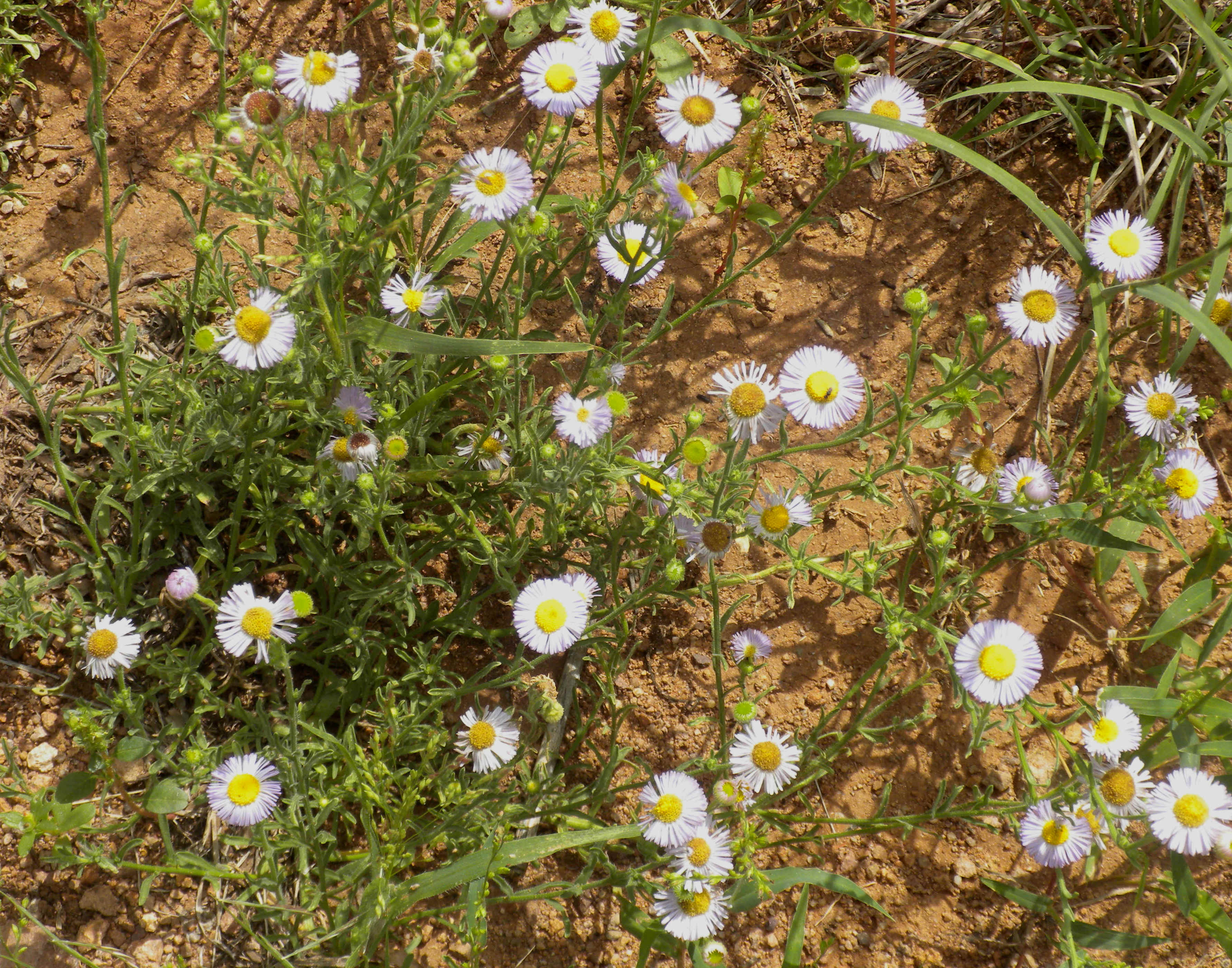
- Erigeron divergens
______ (in open, sandy areas in deserts; one of a number of similar
species)
E: Spreading Fleabane
Spreading Fleabane
(photographed by Rise Hill during a FONT tour in Arizona)
- Erigeron modestus
______ CD
E: Plains Fleabane
- Erigeron utahensis
______ PD
E: Utah Daisy
Genus ERIOPHYLLUM
- Eriophyllum ambiguum ______ MD
E: Yellow Frocks
- Eriophyllum lanosum ______
E: White-ray Woolly Sunflower
- Eriophyllum pringlei ______ MD
E: Pringle Woolly Sunflower
- Eriophyllum wallacei
______ (in sandy deserts)
E: Wallace
Woolly Sunflower (has also been called Desert-Gold or Woolly
Daisy)

Wallace Woolly Sunflower, photographed during the August 2010 tour
in southern Arizona
(photo by Risė Hill)
Genus GAILLARDIA
- Gaillardia arizonica ______
E: Arizona Blanketflower
- Gaillardia pulchella
______ (in sandy plains and deserts; common along roadsides)
E: Texas Indian Blanket (or "Blanket Flower", or
"Firewheel")
Gaillardia pulchella is a host
plant for the butterfly: CLOSYNE LACINIA, Bordered Patch.
- Gaillardia spathulata
______
E: Utah Blanketflower
Genus GERAEA
- Geraea canescens
______ (in sandy, barren, flat deserts)
E: Desert Sunflower
Genus GLYPTOPLEURA
- Glyptopleura marginata
______ GD MD
E: Crustleaf
Genus GRINDELIA
- Grindelia squarrosa
______
E: Curly Gumweed (or Curlycup Gumweed, or Stickyheads)
Genus GUTIERREZIA
- Gutierrezia sarothrae
______
E: Snakeweed, Marchweed, Marchbush
Genus HELIANTHUS
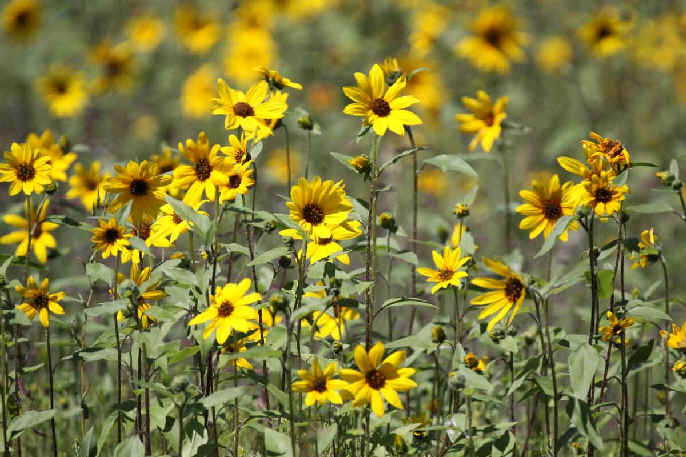
- Helianthus annuus
______
E: Common Sunflower
S: Mirasol ("looks at the sun") (the flowers follow
the sun each day, facing east in the morning and west at sunset)
Helianthus annuus is a host plant
for the butterflies: CHLOSYNE CALIFORNICA, California Patch, CHLOSYNE
LACINIA, Bordered Patch, VANESSA CARDUI, Painted Lady.

Common Sunflowers photographed during the FONT
tour in northern Arizona in August 2010
(photo by Marie Gardner)
- Helianthus petiolaris
______ PD
E: Prairie Sunflower
Genus HETEROTHECA
- Heterotheca villosa
______
E: Golden Aster
Genus HYMENOCLEA
- Hymenoclea salsola
______
E: Cheese Bush (or Burro Bush)
Genus HYMENOPAPPUS
- Hymenopappus filifolius
______
E: Hyaline Herb
Genus HYMENOXYS
- Hymenoxys acaulis
______ CD GD MD PD SD
E: Stemless Bitterweed
- Hymenoxys depressa
______ (in high desert in central Utah)
E: Cushion Bitterweed
Genus ISOCOMA
- Isocoma wrightii (or
Haplopappus heterophyllus)
E: Jimmyweed
Genus LAYIA
- Layia glandulosa
______
E: White Tidytips
Genus LASTHENIA
- Lasthenia californica
______
E: Goldfields
Genus LEUCELENE
- Leucelene ericoides
______
E: Rose Heath
Genus LIATRIS
- Liatris punctata
______ (in dry open places, and among pinons and junipers; often in
sandy soil)
E: Dotted Gayfeather
Genus MACHAERANTHERA
- Machaeranthera
bigelovii (ph) ______ (in plains & openings in coniferous forest)
E: Bigelow Aster
(or
Sticky Aster)

Bigelow Aster
(photo by
Doris Potter)
The Sticky Aster is a wildflower of the late summer, often coloring entire
banks and roadsides with vibrant purple. In the afternoon, as flower heads
become shaded, the rays fold upward in the "sleep position".
The Sticky Aster resembles true asters (Aster), but has spiny or divided
leaves.
- Machaernathera canescens
______
E: Hoary Aster
- Machaeranthera
gracilis ______
E: Slender Goldenweed
Machaeranthera gracilis has the lowest chromosome number known in plants,
with only 4 chromosomes in each cell. Most plants have 14 to 30.
- Machaeranthera grindelioides
______ GD PD
E: Gumweed Aster
- Machaeranthera pinnatifida
______ (was once known as Haplopappus spinulosus; this plant has
perplexed botantists, Haplopappus is, more strictly, a South
American genus)
E: Cut-leaf Goldenweed (has been called Yellow Spiny Daisy)
- Machaeranthera
tanacetifolia ______
E: Tansy-Leaf Aster (has been called Tahoka Daisy)
Genus MADIA ("Madia" is a Chilean name for a species once
grown for the oil in its seeds)
- Madia elegans
______
E: Common Madia
Genus MALACOTHRIX
- Malacothrix
coulteri ______ MD
E: Snake's-Head
- Malacothrix glabrata
______
E: Desert Dandelion
- Malacothrix torreyi
______ GD
E: Torrey Malacothrix
Genus MELAMPODIUM
- Melampodium leucanthemum
______ CD SD
E: Blackfoot Daisy (or Plains Blackfoot)
Genus MONOPTILON
- Monoptilon bellioides
______ MD
E: Desert Star
- Monoptilon bellidiforme
______
E: Daisy Desert Star
Genus PALAFOXIA
- Palafoxia arida
______ MD SD
E: Spanish Needle
-
Palafoxia sphacelata ______ CD
E: Chihuahuan Palafoxia (or Showy Palafoxia)
Genus PECTIS
- Pectis papposa
______
E: Chinchweed
- Pectis angustifolia ______ CD
S: Limincillo
Genus PLUCHEA
- Pluchea sericea
______ CD GD MD PD SD
(grows in springs
and along waterways, often forming dense thickets)
E: Arrowweed
Genus PSATHYROTES
- Psathyrotes
ramosissima ______ MD SD
E: Desert Velvet (or "Turtle-back")
Genus PSILOSTROPHE
- Psilostrophe
cooperi ______
E: White-stemmed Paperflower
Genus RAFINESQUIA
- Rafinesquia
neomexicana ______
E: Desert Chicory (or Plumeseed)
Genus RATIBIDA
- Ratibida columnifera
______ (primarily a prairie species that ranges westward
into the
deserts)
E: Prairie Coneflower (or "Mexican Hat")
Genus SENECIO (nearly 100 species in this genus occur in the western
US)
- Senecio bigelovii
______
E: Nodding Groundsel
- Senecio douglasii ______ CD PD
E: Thread-leaf Groundset
Senecio douglasii is sometimes placed in the species S. flaccidus. it is a
distinctive plant with bright yellow heads and white-woolly leaves and
stems.
- Senecio flaccidus
______
E: Thread-leaf Groundsel
- Senecio multilobatus
______ GD PD
E: Great Basin Groundset
Genus STEPHANOMERIA
- Stephanomeria exigua
______ CD GD MD PD SD
E: Annual Wire-Lettuce
Genus SYNTRICHOPAPPUS
- Syntrichopappus fremontii
______ MD SD
E: Fremont Xerasid
Genus TAGETES
- Tagetes lemmonii
______ (in the desert mountains of southern Arizona)
E: Lemmon Marigold
Genus TETRADYMIA
- Tetradymia glabrata
______ GD MD PD
E: Little-leaf Horsebrush
- Tetradymia spinosa
______ GD MD PD
E: Thorny Horsebrush
Genus THELESPERMA
- Thelesperma subnudum
______ PD
E: Navajo Tea
Genus THYMOPHYLLA
- Thymophylla (formerly
Dyssodia) pentachaeta ______
E: Five-needle Fetid Marigold
S: Parralena
Five-needle Fetid Marigold frequently grows near Creosote Bush (Larrea
tridentata) and Snakeweed (Gutierrezia sarothrae), or among pinon
and juniper.
- Thymophyila (formerly
Dyssodia) acerosa ______
E: Prickly Fetid Marigold
Genus TOWNSENDIA
- Townsendia florifer
______ GD
- Townsendia incana
______ PD
E: Hoary Ground Daisy
Genus TRICHOPTILIUM
- Trichoptilium incisum
______ MD SD
E: Yellow-head
Genus TRIXIS
- Trixis californica
______ CD SD (on rocky desert slopes)
E: Trixis
S: Plumilla ("Little Feather"), Arnica
Genus VERBESINA
- Verbesina encelioides (ph)
______ CD GD
E: Golden Crownbeard (or Cowpen Daisy)
Verbesina encelioides is a host plant for the butterfly: CLOSYNE
LACINIA, Bordered Patch.

Golden Crownbeard, or Cowpen Daisy
(photo by
Doris Potter)

Bordered Patch on a Cowpen Daisy
(photo by Doris Potter)
Genus VIGUIERA
- Viguiera parishii
______ MD SD (most abundant in the Yuma Desert of southwest
Arizona)
E: Parish Goldeneye
Genus WYETHIA
- Wyethia scabra ______
E: Rough Mule's-Ears
Genus XYLORHIZA (with a woody base, "Xylorhiza" means
"woody base")
- Xylorhiza tortifolia
______ MD
E: Mohave Woody Aster
- Xylorhiza venusta ______ PD
(endemic to the Painted Desert)
E: Cisco Woody Aster
- Xylorhiza wrightii
______ CD
E: Big Bend Aster
Genus ZINNIA (the genus is named for Johann Zinn, an 18th-century
German professor who collected seeds in Mexico of Zinnia elegans, from which
the Golden Zinnia descends)
- Zinnia acerosa ______ CD
(ranges westward into Arizona)
E: Desert Zinnia
- Zinnia grandiflora
______
E: Showy Zinnia
(or Little Golden Zinnia)
Family BERBERIDACEAE (Barberries)
Genus BERBERIS
-
Berberis fremontii ______
E: Desert Barberry
- Berberis haematocarpa
______ CD SD
E: Red Barberry
Family BIGNONIACEAE (Trumpet Creepers, Bigonias)
Genus CHILOPSIS (T)
- Chilopsis linearis
______ SD (along desert washes)
E: Desert Willow (or "Desert
Catalpa")
S: Mimbre ("wicker"), Jano
The habitat and resemblance of the leaves of Chilopsis linearis to those of the
willows, gives the
Desert Willow it common name, but there is no taxonomic relationship between
them.
Genus TECOMA
- Tecoma stans
______ (ranges from southeast Arizona into Texas, but seldom
abundant)
E: Yellow Trumpet Flower
Family BORAGINACEAE (Borages)
Genus AMSINCKIA (Fiddlenecks)
- Amsinckia
menziesii ______
E: Rancher's Fireweed
-
Amsinckia tessellata ______
E: Devil's Lettuce
Genus CRYPTANTHA
- Cryptantha sp. ______
E: "White Cryptantha"
Numerous "White Cryptantha" grow in North American
deserts, separable only by technical characteristics. Many are dinky plants
with small flowers and go unnoticed, but a few are showy.
- Cryptantha confertiflora ______
MD PD
E: Golden Cryptantha
- Cryptantha flava
______
E: Yellow Cryptantha
Genus HELIOTROPIUM
- Heliotropium
convulvulaceum ______
E: Sweet-scented Heliotrope
- Heliotropium
curassavicum ______ (grows in saline areas, with greasewood and
other salt-tolerant shrubs)
E: Salt Heliotrope (or "Quail Plant")
S: Cola de Mico (means "monkey tail", describing the coiled
flower cluster)
The Quail Plant is so-called after the birds that feed on its
fruit.
- Heliotropium greggii ______ CD
E: Gregg's Heliotrope
Genus LITHOSPERMUM
- Lithospermum
incisum ______
E: Fringed Gromwell, Fringed Puccoon
"Puccoon"
is a Native American word for plants that yield dye.
Genus MACROMERIA
- Macromeria viridiflora
______
E: Green-flowered Macromeria
Genus PLAGIOBOTHRYS
- Plagiobothrys
nothofulvus ______
E; Popcorn Flower
Genus TIQUILIA (or COLDENIA)
- Tiquilia greggii
______ CD
E: Gregg's Coldenia (or Shrubby Tiquilia)
Family BRASSICACEAE (CRUCIFERAE) (Mustards)
Genus ARABIS
- Arabis pulchra ______ GD
MD PD SD
E: Prince's Rockcress
Genus CAULANTHUS
- Caulanthus inflatus
______ MD
E: Desert Candle
Caulanthus inflatus is an interesting cabbage-like plant. In the
past, it was gathered and eaten by native Americans.
- Caulanthus pilosus ______ GD
E: Chocolate Drops
Genus DIMORPHOCARPA (or DITHYREA)
- Dimorphocarpa californica
______ SD (in California)
E: California Spectacle Pod
- Dimorphocarpa wislizenii
______ CD GD PD
E: Spectacle Pod
Genus ERYSIMUM
- Erysimum capitatum
______
E: Western Wallflower
The Western Wallflower is one of western North America's most striking
wildflowers. It is also one of the most variable species, with a wide
ecological tolerance.
- Erysimum asperum
______
E: Plains Wallflower
Genus LEPIDIUM
- Lepidum flavum
______
E: Yellow Peppergrass
- Lepidum fremonti
______ SD
E: Fremont's Peppergrass
The Fremont's Peppergrass is the most showy of its kind, with white flowers
resembling broad hearts.
- Lepidum montanum ______ (occurs
in dry open areas, among Creosote Bush, sagebrush, pinon, and
juniper)
E: Western
Peppergrass
There are at least 15 races of Western
Peppergrass, but any perennial, rather than bushy mustard with small
white flowers is likely to be this species.
- Lepidum thurberi ______ MD SD
E: Thurber's Peppergrass
Genus LESQUERELLA
- Lesquerella fendleri
______
E: Fendler's Bladderpod
- Lesquerella tenella ______
E: Slender Bladderpod
Genus NERISYRENIA
- Nerisyrenia camporum
______ (on limestone in deserts and arid grasslands)
E: Velvety Nerisyrenia
The Velvety Nerisyrenia is the most common species of Mustard with large
white flowers.
Genus PHYSARIA
- Physaria acutifolia ______ PD
- Physaria chambersii ______ (grows
in desert mountains of Nevada, northeast California, & northern Arizona)
Genus SCHOENCRAMBE (or SISYMBRIUM)
- Schoencrambe linearifolia
______
E: Linear-leaf Sisymbrium
Genus STANLEYA
- Stanleya elata ______ GD
MD
E: Desert Plume
- Stanleya pinnata
______ GD MD PD (in deserts and on plains, often in sagebrush)
E: Golden Prince's Plume
Genus STREPTANTHELLA
- Streptanthella longirostris
______ MD PD SD (most abundant in the Painted
Desert)
E: Long-beaked Twist-Flower
Genus THELYPODIOPSIS
- Thelypodiopsis divaricata ______
E: Yellow Thelypody
- Thelypodiopsis howellii ______
E: Howell's Thelypody
Family BURSERACEAE (Torchwoods)
Genus BURSERA
- Bursera microphylla
______ SD
E: Elephant Tree
S: Torote Blanco, Copal, Palo Colorado ("Red Stick")
Family CACTACEAE (Cacti)
With about 140 genera and 2,000
species, nearly all found in warm arid parts of the Americas
Genus ARIOCARPUS
- Ariocarpus fissuratus ______ CD
E: Living Rock Cactus
Genus ASTROPHYTUM
- Astrophytum asterias ______
(in south Texas and in Mexico in Nuevo Leon and Tamaulipas) (US endangered;
Texas endangered)
E: Sea Urchin
Cactus (or "Sand Dollar" or "Star Cactus")
Genus BERGEROCACTUS
- Bergerocactus emoryi ______ (in
southern California & on some of the Channel Islands and in northwestern
Baja Califonria)
E: Velvet Cactus (or "Golden Torch")
Genus CARNEGIEA
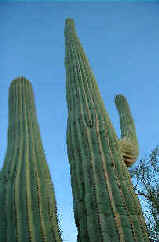
- Carnegiea gigantea (ph) (*)
______ SD
E: Saguaro
S: Saguaro

Saguaro, photographed during a FONT tour in Arizona
(photo by Doris Potter)
The White-winged Dove is a major pollinator of the flowers of the Saguaro.
Genus CORYPHANTHA
- Coryphantha
missouriensis ______
E: Nipple Cactus
- Coryphantha r. ramillosa ______
(US threatened; Texas threatened)
E: Bunched Cory Cactus
- Coryphantha recurvata ______ SD
E: Santa Cruz Beehive Cactus
- Coryphantha robustispina ______
SD
E: Pineapple Cactus (or Pima Pineapple Cactus)
- Coryphantha vivipara ______
GD
E: Pincushion
Cactus
Genus CYLINDROPUNTIA (included in OPUNTIA)
Genus ECHINOCACTUS
- Echinocactus conoideus (or Neolloydia
texensis) ______ CD
E: Texas Cactus
- Echinocactus erectocentrus
______ CD
E: White-flowered
Cactus
- Echinocactus hamatacanthus
______ CD
E: Turk's Head (or
Turk's head Cactus) (also called Eagle Claw or Blue Barrel)
- Echinocactus horizonthalonius
______ CD
E: Devil's Head
- Echinocactus intertextus ______
CD
E: Woven-spine
Pineapple Cactus
- Echinocactus mariposensis
______ CD
E: Mariposa Cactus
- Echinocactus polycephalus
______ SD
E: Many-headed Barrel
- Echinocactus texensis ______ CD
E: Devil's Claw
(also called Horse Crippler)
- Echinocactus tobuschii ______ CD
E: Tobusch Cactus
- Echinocactus unicinatus ______ CD
E: Catclaw Cactus
- Echinocactus wislizeni ______ CD
E: Southwestern Barrel
Cactus
- Echinocactus warnocki ______ CD
E: Warnock's Cactus
Genus ECHINOCEREUS (Hedgehog Cacti, Strawberry Cacti)
- Echinocereus bonkerae ______ SD
E: Bonker Hedgehog Cactus
- Echinocereus brandegeei ______
SD
E: none
- Echinocereus c. chisosensis ______
CD (US threatened; Texas threatened)
E: Chisos Mountain Hedgehog Cactus (or Chisos Pitaya)
- Echinocereus
chloranthus ______ CD
E: Brown-flowered Cactus, Yellow-flowered
Cactus (two different subspecies)
- Echinocereus davisii (or Echinocereus
viridiflorus davisii) ______ (US endangered; Texas endangered)
E: Davis's Green Pitaya
- Echinocereus engelmannii ______
SD
E: Englemann's Hedgehog Cactus (has also been called
Calico Cactus, Strawberry Hedgehog)
- Echinocereus enneacanthus
______ CD
E: Strawberry
Hedgehog Cactus
(has also been called Warty Hedgehog,
Strawberry Cactus) (various subspecies)
- Echinocereus fasciculatus ______
SD
E: Robust Hedgehog Cactus
- Echinocereus fendleri ______ SD
E: Fendler's Hedgehog Cactus
- Echinocereus ledingii ______ SD
E: Leding's Hedgehog Cactus
- Echinocereus lloydii ______
(was US endangered; was Texas endangered)
E: Lloyd's Hedgehog Cactus
- Echinocereus mojavensis ______
E: Mojave Hedgehog Cactus
- Echinocereus nicholii ______ SD
E: Golden Hedgehog Cactus
- Echinocereus pectinatus ______ CD
E: Comb Hedgehog
Cactus,
Rainbow Cactus, Ashy-white Pitaya,
Slender-spined Pitaya, Rio Grande Pitaya, Texas Rainbow Pitaya, Big Bend
Pitaya (various subspecies)
- Echinocereus reichenbachii albertii
______ (US endangered; Texas endangered)
E: Black Lace Cactus
- Echinocereus triglochidiatus
______ CD
E: Claret-cup Cactus, Little Claret-Cup, Southwest Claret-Cup, Texas
Claret-Cup, King's Cup (various subspecies)

Claret-cup Cactus, photographed in September,
2 months after the bright red flowers were in bloom
(photo by Doris Potter)
- Echinocereus virdiflorus ______
CD
E: Green-flowered
Cactus, Green Pitaya, Hen-and-Chickens Cactus
Genus EPITHELANTHA
- Epithelantha bokei ______ CD
E: Boquillas Button Cactus
- Epithelantha micromeris ______ CD
E: Button Cactus
Genus ESCOBARIA
- Escobaria minima ______ (US
endangered; Texas endangered)
E: Nellie's Cory Cactus
- Escobaria s. sneedii ______ (US
endangered; Texas endangered)
E: Sneed's Pincushion
Cactus
Genus FEROCACTUS (Barrel Cacti)
- Ferocactus cylindraceus (or F.
acanthodes) ______ SD
E: Spiny Barrel, California Barrel
Cactus
- Ferocactus emoryi (or F. covillei) ______ SD
E: Emory's Barrel, Coville Barrel

Emory's Barrel Cactus photographed during the August 2010 tour in Arizona
(photo by Marie Gardner)
- Ferocactus emoryi rectispinus
______ SD
E: Straight-spined Barrel
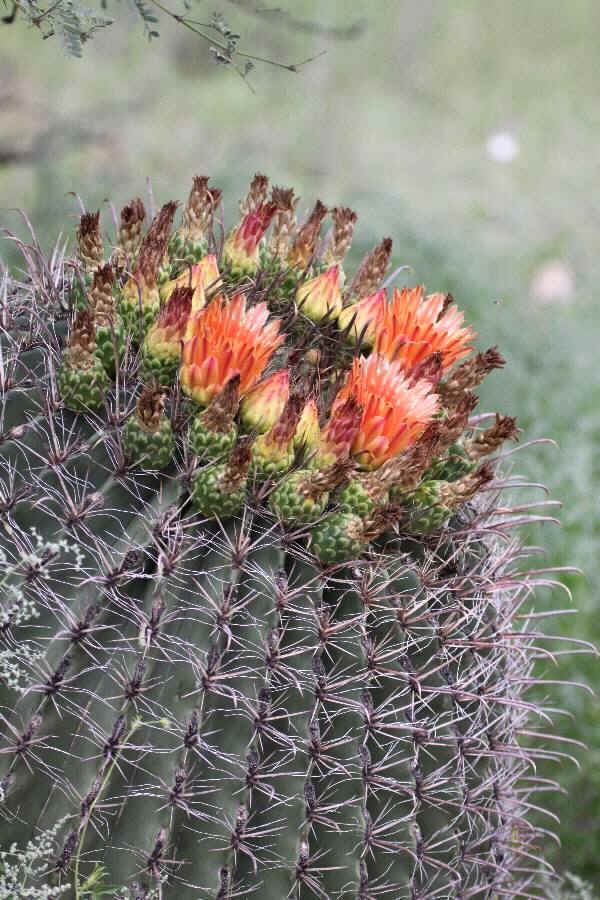
- Ferocactus wislizeni ______ SD
E: Fishhook Barrel, Candy Barrel Cactus

Fishhook Barrel Cactus photographed during the August 2010 tour in
Arizona
(photo by Marie Gardner)
Genus LOPHOCEREUS
- Lophocereus (or Pachycereus)
schotii
______ SD
E: Senita (taken from the Spanish name)
(another name is Garambullo)
Senita is extremely common in desert flats and
thornscrub habitats throughout much of the Sonoran Desert.
Genus LOPHOPHORA (Peyotes)
- Lophophora williamsii ______ CD
E: Peyote
Genus MAMMILLARIA (Nipple Cacti)
- Mammallaria grahamii (or M.
microcarpa, M. milleri) ______ SD
E: Fishhook Pincushion, Fishhook Cactus
- Mammallaria echinus ______ CD
E: Sea-Urchin Cactus
- Mammallaria ramillosa ______ CD
E: Big Bend Mammalleria
- Mammallaria macromeris ______ CD
E: Long Mamma
- Mammallaria
vivipara ______ CD
E: Bisquit Cactus
- Mammallaria fragrans ______ CD
E: Fragrant Cactus
- Mammallaria tuberculosa ______ CD
E: Cob Cactus
- Mammallaria dasyacantha ______ CD
E: Mountain Cob Cactus
- Mammallaria albicolumnaria
______ CD
E: White-spined Cob
Cactus
- Mammallaria varicolor ______ CD
E: Varicolor Cactus
- Mammallaria duncanii ______ CD
E: Duncan's Cactus
- Mammallaria pottsii ______ CD
E: Foxtail Cactus
- Mammallaria lasiacantha ______ CD
E: Golf-ball Cactus
- Mammallaria heyderi ______ CD
E: Pancake Pincushion
- Mammallaria meiacantha ______
CD
E: Nipple Cactus
Genus OPUNTIA (includes CYLINDROPUNTIA, GRUSONIA, and CORYNOPUNTIA)
(Wildflowers)
- Opuntia (or Cylindropuntia) acanthocarpa
______ SD
E: Buckhorn Cholla
- Opuntia
(or Cylindropuntia) arbuscula
______ SD
E: Pencil Cholla
- Opuntia atrispina
______ CD
E: Dark-spined Prickly Pear
- Opuntia basilaris
______ GD MD PD SD
E: Beavertail Cactus (or Cholla)
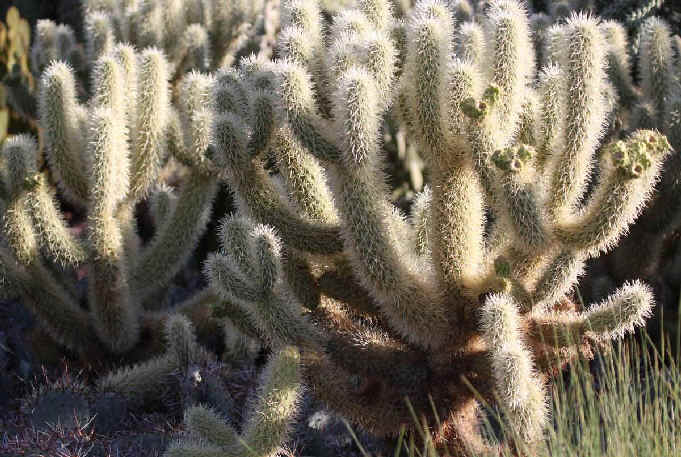
- Opuntia (or Cylindropuntia) biglovii ______
SD
E: Teddy Bear Cholla

Teddy Bear Cholla
(photo by Marie Gardner)
- Opuntia echinocarpa ______
E: Silver Cholla
- Opuntia engelmanni (or Opuntia
phaeacantha discata)
______ CD SD
E: Engelmann Prickly Pear (or Texas
Prickly Pear)
- Opuntia erinacea ______ GD
MD PD SD (a variable and taxonomically confusing species)
E: Mojave Prickly Pear
- Opuntia fragilis
______ CD
E: Fragile Prickly Pear, Brittle Cactus
- Opuntia (or Cylindropuntia)
fulgida
______ SD
E: Jumping Cholla
- Opuntia grahamii ______ CD
(a smaller version of Opuntia schottii)
E: Dog Cholla
- Opuntia imbricata ______ CD
E: Cane Cholla, Tree Cholla
- Opuntia kleiniae ______ CD
(flowers are greenish)
E: Candle Cholla
- Opuntia leptocaulus
______ CD SD (flowers are yellow)
E: Christmas Cholla, Desert Christmas Cactus
S: Tasajillo
- Opuntia lindheimeri ______ CD
E: Chisos Prickly Pear
- Opuntia linguiformis ______ CD
E: Cow's Tingue
Prickly Pear
- Opuntia macrocentra ______ CD
E: Purple-tinged
Prickly Pear
- Opuntia macrorhiza
______ CD
E: Grassland Prickly Pear
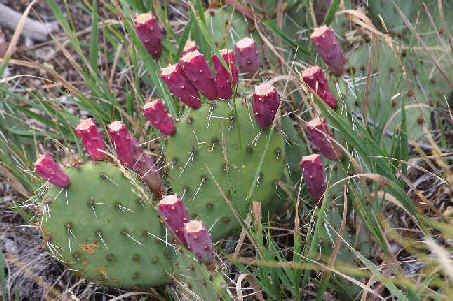
- Opuntia phaecantha major (ph)
(*) ______ SD
E: Sprawling Prickly Pear (also called Dusky
Prickly Pear and Brownspine Prickly Pear)

Sprawling Prickly Pear
(photo by Doris Potter)
- Opuntia polyacantha
______ GD PD
E: Plains Prickly Pear
- Opuntia
(or Cylindropuntia) prolifera
______
E: Coastal Cholla
- Opuntia
(or Cylindropuntia) ramosissima
______
E: Diamond Cholla
- Opuntia rufida
______ CD (one of the few cacti entirely without spines)
E: Blind Prickly Pear
- Opuntia schottii ______ CD
E: Devil Cholla
- Opuntia spinosibacca ______ CD
(described as recently as 1956)
E: Spinyfruit
Prickly Pear
- Opuntia
(or Cylindropuntia) spinosior
______
E: Cane Cholla
- Opuntia vaseyi ______ (a
formerly described species now thought to be a hybrid)
E: Vasey Prickly Pear
- Opuntia (or Cylindropuntia) versicolor
______ SD
E: Staghorn Cholla
- Opuntia violacea ______ CD
E: Purple Prickly Pear
Genus PACHYCEREUS
- Pachycereus pecten-aboriginum
______ SD (in Mexico in Baja California Sur, Sinaloa, and
Sonora)
E: Hairbrush Cactus
S: Hecho
- Pachycereus pringlei (ph) ______
SD (in Mexico along the coast of the Gulf of California
in Sonora & on the Baja Peninsula)
E: Elephant Cactus
S: Cardon
Pachycereus pringlei is the largest columnar cactus in the Sonoran
Desert.

Cardon, or Elephant Cactus, during the FONT tour
in Sonora, Mexico in August 2010
(photo by Risė Hill; in the photo Armas Hill)
Genus PEDIOCACTUS
- Pediocactus simpsonii
______
E: Simpson's Hedgehog Cactus
Genus PENIOCEREUS (or CEREUS)
- Peniocereus (or Cereus) greggii
______ CD SD (in desert flats & washes)
E: Desert Night-blooming Cereus, Queen-of-the-Night
Inconspicuous most of the year, but when in bloom, the Night-blooming Cereus
is easily spotted only in the evening and early morning when its spectacular
night-blooming flowers are open. It is very popular in desert rock gardens
and in the cactus trade; when a population is found, all too often, the
large, turnip-like roots are quickly dug up.
Genus SCLEROCACTUS (or ANCISTROCACTUS)
- Sclerocactus brevihamatus tobuschii
______ (US endangered; Texas endangered)
E: Tobusch Fishhook Cactus
- Sclerocactus mariposensis
______ (US threatened; Texas threatened)
E: Lloyd's Mariposa Cactus
- Sclerocactus uncinatus ______ CD
E: Chihuahua Fish-hook Cactus (or Cat
Claw Cactus)
- Sclerocactus johnsonii ______ MD
E: Johnson Devil-Claw
- Sclerocactus whipplei ______ PD
E: Whipple Fishhook
Cactus
Genus STENOCEREUS
- Stenocereus eruca
______ SD (found only on sandy soils on the central Pacific coast of Baja
California Sur, in Mexico)
E: Creeping Devil
- Stenocereus gummosus ______
SD
E: none
S: Pitahaya Agria
- Stenocereus thuberi
______ SD
E: Organ Pipe Cactus
S: Pitahaya Dulce
Genus THELOCACTUS
- Thelocactus bicolor ______ CD
E: Straw Spine Cactus (or "Glory of Texas")
Family CAPPARACEAE (Capers)
Genus CLEOME
- Cleome lutea
______ GD MD PD SD
(occurs on desert plains)
E: Yellow Bee Plant
-
Cleonme serrulata ______ GD PD
E: Rocky Mountain Bee Plant
Genus CLEOMELLA
- Cleomella obtusifolia
______ MD SD
E: Blunt-leaf Stinkweed
- Cleomella hillmanii
______ GD
E: Hillman Stinkweed
Genus ISOMERIS
- Isomeris arborea
______ MD SD (in California)
E: Bladderpod
Genus POLANISIA
- Polanisia dodecandra
______
E: Clammyweed
Genus WISLIZENIA
- Wislizenia refracta
______
E: Jackass Clover
Family CARYOPHYLLACEAE (Carnations)
Genus ARENARIA
- Arenaria fendleri
______
E: Fendler's Sandwort
Genus CERASTIUM
- Cerastium arvense
______
E: Meadow Chickweed
Family CHENOPODIACEAE (Goosefoots)
Genus ATRIPLEX
- Atriplex canescens
______ SD
E: Fourwing Saltbush
Atriplex canescens is a host
plant for the butterfly: BREPHIDIUM EXILE, Western Pygmy Blue.
- Atriplex corrugata ______
E: Mat Saltbush
- Atriplex confertifolia ______
E: Shadscale
- Atriplex hymenelytra ______
E: Desert Holly
Atriplex hymenelytra is a host
plant for the butterfly: BREPHIDIUM EXILE, Western Pygmy Blue.
Genus GRAYIA
- Grayia spinosa ______
E: Hopsage
Genus SALICORNIA
- Salicornia bigelovii ______
SD
E: Pickleweed
Genus SALSOLA
- Salsola tragus (Salsola iberica, Salsola
kali) (ph) (*) ______ SD
E: Tumbleweed, Russian Thistle
Salsola tragus is a host plant for the butterfly: BREPHIDIUM
EXLE, Western Pygmy Blue.

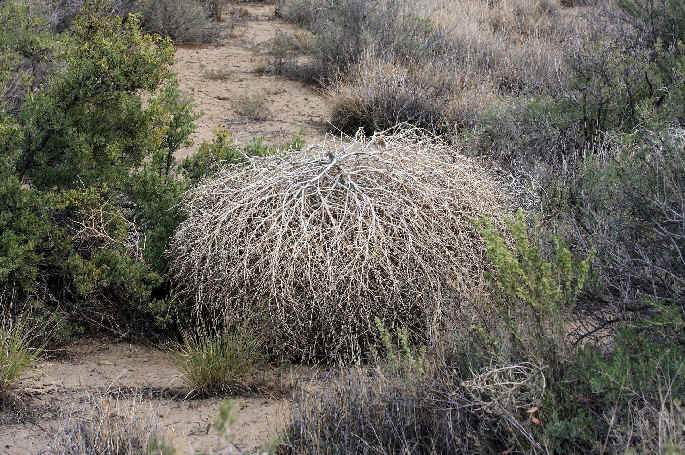
Tumbleweed
(photo by Doris Potter)
Genus SARCOBATUS
- Sarcobatus vermiculatus ______
E: Greasewood
Genus SALICORNIA
- Salicornia utahensis ______
E: Utah Pickleweed
Family CISTACEAE (Rockroses)
Genus HELIANTHEMUM
- Helianthemum scopium
______ (occurs on dray sandy flats and on rocky slopes)
E: Peak Rushrose
Family CONVOLVULACEAE (Morning Glories) (W)
Genus EVOLVULUS
- Evolvulus arizonicus
______ (with beautiful sky-blue flowers)
E: Arizona Blue-eyes, False Flax
-
Evolvulus nuttallianus ______ CD PD
- Evolvulus sericeus ______ CD
E: Silky Evolvulus
Genus IPOMOEA
- Ipomoea cristulata ______ (on
brushy hillsides & in canyons)
E: Scarlet
Creeper, Star Glory
- Ipomoea hederacea ______
(in the southwest US)
E: Ivyleaf Morning
Glory
- Ipomoea leptophylla ______
E: Bush Morning Glory
- Ipomoea nil ______ (in
the southwest US)
E:
Morning Glory
- Ipomoea purpurea ______
E: Common Morning
Glory
Family CRASSULACEAE
(Stonecrops)
Genus DUDLEYA
- Dudleya saxosa ______
E: Rock Dudleya
Family CUCURBITACEAE (Cucumbers)
Genus APODANTHERA
- Apodanthera undulata ______
E: Melon Loco
S: Melon Loco (Plants with the word "loco" in their common
names are usually poisonous to some degree; several contain
behavior-altering toxins.)
Genus CUCURBITA
- Cucurbita digitata ______
SD
E: Coyote Gourd
- Cucurbita foetidissima
______ SD (in
open areas of deserts)
E: Buffalo
Gourd
S: Calabacilla Loca
The Buffalo Gourd fruit is easily dried and
often brightly painted for decorative use. It is foul-tasting, inedible, and
somewhat poisonous when mature.
Genus IBERVILLEA
- Ibervillea tenuisecta ______ (along
shallow gullies & on rocky slopes in deserts)
E: Globe
Berry (or Cut-leaved
Globe Berry)
Genus TUMAMOC
- Tumamoca macdougalii
______ SD
E: Tumamoc Globe Berry
Family EPHEDRACEAE (Ephedras)
Various species have been used extensively as a medicinal tea, a tonic.
Genus EPHEDRA
- Ephedra fasciculata ______ MD SD
E: Mojave Ephedra
- Ephedra nevadensis ______ CD GD MD PD SD
E: Nevada Tea (or Nevada Ephedra)
- Ephedra torreyama ______
E: Mormon Tea
- Ephedra viridis
______ GD PD
E: Green Ephedra
Family EUPHORBIACEAE (Spurges)
Genus BERNARDIA
- Bernardia myricifolia ______
E: Mouse-eye
Genus CHAMAESYCE
- Chamaesyce albomarginata ______
E: Rattlesnake Weed
Rattlesnake Weed is one of the
showiest of the low spurges. It was once thought useful for the treatment of
snakebite, hence its common name.
Genus CROTON
- Croton californicus ______
E: Desert Croton
- Croton pottsii ______ CD
E: Leatherleaf
Genus EUPHORBIA
- Euphorbia antisyphilitica
______ CD
E: Candelilia
- Euphorbia melanodenia ______
E: Black-gland Spurge
- Euphorbia polycarpa ______
E: Small-seeded Spurge
Genus JATROPHA
- Jatropha cardiophylla ______
SD
E: Limberbush, Dragon's Blood (both names
also applied to several other species)
- Jatropha dioica
______ CD
E: Leather Stem
S: Sangre de Grabo
Family FABACEAE (Legumes. or Peas)
In the FABACEAE family, 3 genera of spiny desert shrubs (ACACIA, MIMOSA, and
PROSOPSIS, the mesquites) resemble each other and can easily be
confused.
Genus ACACIA (Acacias) (T)
- Acacia angustissima ______
E: Fern Acacia
Acacia angustissima is a host plant for the butterflies: EUREMA
MEXICANA, Mexican Yellow, HEMIARGUS CERANUS, Ceraunus Blue, HEMIARGUS ISOLA,
Reakirt's Blue, HEMIARGUS CERAUNUS, Ceraunus Blue.
- Acacia constricta ______ SD
E: Whitethorn Acacia
Acacia constricta is a host plant for the butterflies: EUREMA
NICE, Mimosa Yellow, HEMIARGUS ISOLA, Reakirt's Blue.
- Acacia farnesiana ______ CD
(native
to high deserts in Arizona, Texas, and Mexico; introduced in
California)
S: Huisache
- Acacia greggii ______ CD
SD
E: Catclaw Acacia
Acacia greggi is a host plant for the butterfly: LEPTOTES
MARINA, Marine Blue.
- Acacia rigidula ______ CD
E: Black Brush
S: Chaparro Brieto
Genus ASTRAGALUS
- Astragalus amphioxys ______ (in
sand or gravelly soil in deserts)
(in
sand or gravelly soil in deserts)
E: Crescent
Milkvetch
- Astragalus argillosus ______
E: Clay Locoweed
- Astragalus coccineus ______
E: Scarlet Milkvetch (or Scarlet
Locoweed) (also called
Crimson Wooly Pod)
Red flowers, a rare color in the genus, makes Astragalus coccineus
favorable to
hummingbirds.
- Astragalus insularis ______
E: Sand-flat Locoweed
- Astragalus layneae ______ MD
E: Layne Locoweed
- Astragalus lentiginosus ______ (in deserts & on salt flats; but also higher on open slopes in
mountains)
E: Freckled
Milkvetch
The Freckled Milkvetch is
the most widespread and variable species of Astragalus, with more
than 20 recognized varieties.
Astragalus lentiginosus
is a host plant for the butterfly: COLIAS ALEXANDRA, Queen
Alexander's Sulphur.
- Astragalus mollissimus ______
E: Woolly Locoweed
- Astragalus praelongus ______
E: Stinky Milk Vetch
- Astragalus preussii ______
E: Desert Milk Vetch
- Astragalus purshii ______
E: Pursh Locoweed
Genus CALLIANDRA
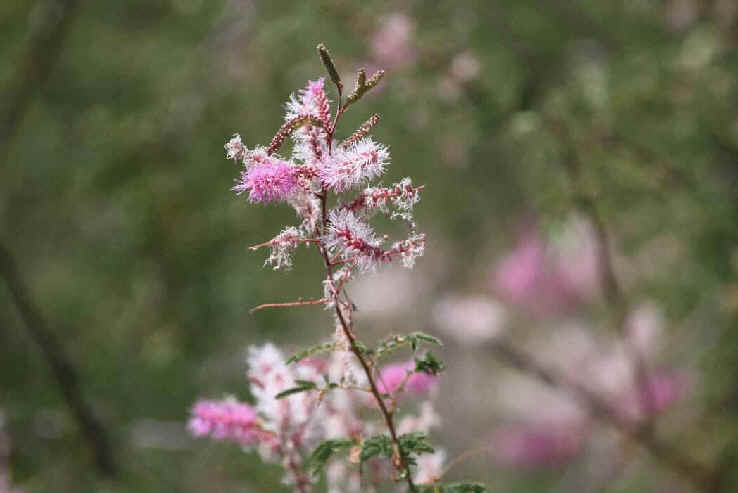
- Calliandra eriophylla
______ SD
E: Fairy Duster
Genus CASSIA (see SENNA)
Genus CERCIDIUM (Palo Verdes) (T)
- Cercidium floridum (or Parkinsonia
torreyana, Cercidium peninsulare) ______ SD
E: Blue Palo Verde
"Palo Verde" is Spanish for "green tree'. Even
when leafless, CERCIDIUM species are conspicuously green in the brown
desert, Photosynthesis occurs mostly in the bark rather than in the leaves,
which conserve water through the reduction of surface area.
- Cercidium microphyllum (or
Parkinsonia microphyllum) ______ SD
E: Foothill Palo Verde, Little-leaved Palo
Verde, Yellow Palo Verde
- Cercidium texanum ______ CD
E: Texas Palo Verde
S: Retoma China
Genus CERCIS
- Cercis occidentalis (or Cercis
canadensis orbiculata) ______
E: Western Redbud
Western Redbud
is one of the handsomest shrubs in the foothills of the
western US. It is commonly used as an ornamental, enjoyed for its masses of
rose-pink flowers and its dense dark-green foliage that turns reddish in the
fall.
Native Americans made baskets from the shredded bark, and extracts from the
bark have been used medicinally.
Genus DALEA
- Dalea
(formerly Petalostemon) candida
______
E: White Prairie Clover
- Dalea albiflora ______
E: White Dalea
Dalea albiflora is a host
plant for the butterfly: COLIAS CESONIA, Southern Dogface.
- Dalea flavescens ______ PD
E: Navajo Prairie Clover
- Dalea formosa ______
E: Feather
Peabus, Feather Plume
- Dalaea mollis ______
E: Silk Dalea
- Dalaea purpurea ______ CD
E: Purple Prairie Clover
Genus ERYTHRINA
- Erythrina flabelliformis ______
E: Western Coral Bean, Indian Bean
S: Chilicote
Erythrina flabelliformis
is leafless and rather unattractive throughout the
winter and into the early spring. It usually flowers on bare stems in early
spring, and the leaves emerge in late spring.
The bright seeds, often used in Mexican necklaces, are deadly poisonous.
Genus HOFFMANSEGGIA
- Hoffmanseggia glauca ______
E: Hog Potato,
Pig Nut
S: Camote de Raton (means :mouse's sweet potato")
- Hoffmanseggia repens ______
E: Creeping Rush-Pea
Genus LOTUS
- Lotus rigidux ______
E: Bush Trefoil
Genus LUPINUS (Bluebonnets)
- Lupinus argenteus ______
E: Silvery Lupine
Lupinus argenteus is a host plant for the butterflies: STRYMON MELINUS,
Gray Hairstreak, LYCAEIDES MELISSA, Melissa Blue, GLAUCOPSYCHE LYGDAMUS,
Silvery Blue, VANESSA CARDUI, Painted Lady.
- Lupinus arizonicus ______
E: Arizona Lupine
- Lupinus bicolor ______
E: Miniature Lupine
Lupinus bicolor is a host plant for the butterflies: COLIAS EURYTHEME,
Orange Sulphur, EVERES COMYNTAS, Eastern Tailed-Blue.
- Lupinus brevicaulis ______
E: Short-stem Lupine
- Lupinus havardii ______ CD
(occurs only in the Big Bend region of west Texas)
E: Chisos Bluebonnet
- Lupinus hirsutissimus ______
SD
E: Stinging Lupine
In a genus of lovely wildflowers, the Stinging Lupine is an
unpleasant exception. Its stiff yellow hairs sting like nettles.
- Lupinus pusillus ______
E: Dwarf Lupine
- Lupinus sparsiflorus ______ SD
E: Mojave Lupine
(or Coulter's Lupine)
In a year with ample fall and
winter rains, Coulter's Lupine carpets the floor of the southern Arizona
desert, combining with Desert Marigold (Baileya multiradiata) for mile after
mile of blue-violet, brick red, and brilliant yellow.
Genus MIMOSA
- Mimosa biuncifera (ph)
______ CD SD
E: Cat's-Claw Mimosa

Cats-claw Mimosa photographed during the FONT tour in Sonora in August
2010
(photo by
Marie Gardner)
- Mimosa dysocarpa ______
E: Velvet-pod Mimosa
Genus OLNEYA
- Olneya tesota _______ SD
E: Ironwood (or Desert Ironweed)
Genus PARKINSONIA
- Parkinsonia aculeata ______ SD
E: Mexican Palo Verde, Jerusalem Thorn,
Retama
Genus PROSOPIS (Mesquites) (T)
Plants of the PROSOPIS genus are host plants for the butterflies: LEPTOTES
MARINA, Marine Blue. APODEMIA PALMERI, Palmer's Metalmark.
- Prosopis glandulosa (or Prosopis
juliflora torreyana) ______ CD,SD
E: Honey Mesquite
Prosopis glandulosa is a host plant for the butterfly: HEMIARGUS
CERAUNUS, Ceraunus Blue.
- Prosopis pubescens ______ CD
E: Screwbean
S: Tornillo
Prosopis pubescens
is a host plant for the butterfly: HEMIARGUS CERAUNUS, Ceraunus
Blue.
- Prosopis velutina (or Prosopis
juliflora velutina) ______ SD
E: Velvet Mesquite
Prosopis velutina
is a host plant for the butterfly: MINISTRYMON LEDA, Leda
Ministreak.
Genus PSOROTHAMNUS
- Psorothamnus arborescens ______
E: Mohave Indigobush
- Psorothamnus emoryi ______
E: White Indigobush
- Psorothamnus fremontii ______
E: Fremont Indigobush
- Psorothamnus polydenius ______
E: Nevada Indigobush
- Psorothamnus schottii ______
E: Mesa Indigobush
- Psorothamnus scoparius ______
E: Broom Indigobush
Psorothamnus scoparius is a host plant for the butterrfy: HEMIARGUS
ISOLA, Reakirt's Blue.
- Psorothamnus spinosus ______
E: Smoke Tree
From a distance, a Smoke Tree
looks gray and fluffy, like a puff of smoke.
Genus SENNA (or CASSIA)
- Senna armata ______
E: Spiny Senna
- Senna bauhinioides ______
E: Two-leaved Senna (or "Twinleaf")
- Senna covesii
______ SD
E: Desert Senna (also called Coue's
Senna)
Senna covesii is a host plant for the butterflies: PHOEBIS SENNAE,
Cloudless Sulphur, EUREMA NICIPPE, Sleepy Orange.
- Senna durangensis ______
E: Two-leaved Senna
- Senna lindheimeriana ______
E: Chihuahua Senna
Senna lindheimeriana is a host
plant for the butterflies: PHOEBIS SENNAE, Cloudless Sulphur, EUREMA
NICIPPE, Sleepy Orange.
- Senna roemeriana ______
E: Texas Senna
Family FONQUIERIACEAE (Ocotillos) (S)
Genus FOUQUIERIA
- Fouquieria columnaris (or Idria
columnaris) ______ SD (grows up to 60 feet
tall; endemic to central Baja California, Mexico)
E: Boojum
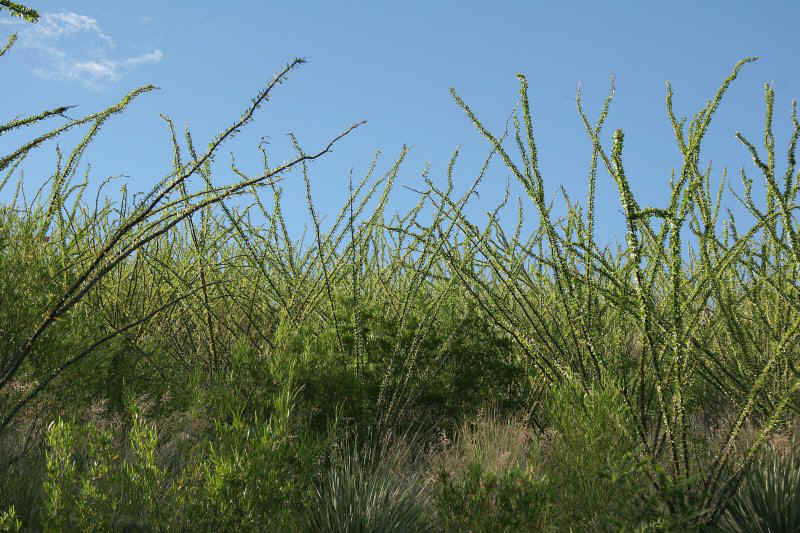
- Fouquieria splendens (ph) (*)
______ CD,SD (the most widespread species in its family)
E: Ocotillo, Coachwhip (because it looks like many
buggywhips stuck into the ground)

A "forest" of Ocotillo, photographed during a FONT tour in the
Sonoran Desert
(photo by Doris Potter)
When Ocotillos are in full bloom, they have brilliant red flowers on the top
of each stalk.
Family GENTIANACEAE (Gentians)
Genus CENTAURIUM
- Centaurium calycosum ______
E: Centaury
S: Rosita
The brilliant pink corolla of Centaurium
calycosum resembles
that in the PHLOX species.
Family GERANIACEAE
Genus ERODIUM
-
Erodium cicutarium ______
E: Filaree
- Erodium texanum ______
E: Texas Storksbill
Family HYDROPHYLLACEAE (Waterleaves)
Genus EMMENANTHE
- Emmenanthe penduliflora ______
MD SD (in foothills)
E: Whispering Bells
The dried-up corolla of Emmenanthe
penduliflora remains on the plant as a tissue-paper-like bell that rustles
in gentle breezes.
Genus HESPEROCHIRON
- Hesperochiron pumilus ______
E: Dwarf Hesperochiron
Genus NAMA
- Nama arctioides ______
E: Great Basin Nama
- Nama demissum ______
E: Desert
Mat (or Purple Mat)
- Nama havardii
______
E: Havard Nama
Genus NEMOPHILA
- Nemophila menziesii
______
E: Baby Blue-eyes
Genus PHACELIA (a large, mostly western American, genus distinguished
by bluish or purplish flowers in coils, usually with protruding
stamens)
- Phacelia calthifolia ______
E: Caltha-leaved Phacelia
- Phacelia campanularia ______
E: Bluebell Phacelia
(or Desert Bell)
In a spring following a wet winter,
thousands of Desert Bells bloom, forming masses of deep rich blue.
- Phacelia crenulata ______
E: Notch-leaved
Phacelia
- Phacelia distans ______
E: Lace-leaved
Phacelia (or Common Phacelia, or Wild Heliotrope)
- Phacelia fremontii ______
E: Fremont's Phacelia
- Phacelia integrifolia ______
(rocky & sandy places in deserts and among pinyons & junipers)
E; Scalloped Phacelia
- Phacelia minor
______ (occurs in southern California & northern Baja California)
E: California Bell
- Phacelia robusta
______
E: Robust Phacelia
- Phacelia rotundifolia
______
E: Round-leaved Phacelia
- Phacelia tanacetifolia
______
E: Tansy-leaved Phacelia
Family KRAMERACEAE (Ratanies)
Genus KRAMERIA
- Krameria grayi ______ CD
MD SD
E: White Ratany
- Krameria erecta
______ SD
E: Pima Ratany, Purple Heather
Family LAMIACEAE (Mints)
Genus HYPTIS
- Hyptis emoryi ______
E: Desert Lavender
Genus MONARDELLA
-
Monardella macrantha ______ (in
southern California & Baja California)
E: Red Monardella
Genus POLIOMINTHA
- Poliomintha incana
______ CD MD PD (common in Painted Desert; isolated
populations in Chihuahuan &
Mohave Deserts)
E: Bush Mint
Genus SALAZARIA
- Salazaria mexicana
______ GD (in deserts, commonly in washes)
E: Bladder Sage
Genus SALVIA
- Salvia carduacea
______ SD (in southern California & Baja California)
E: Thistle Sage
- Salvia columbariae
______
E: Chia (a common name for several SALVIA species)
From Chia, Native Americans made pinole, a meal ground from parched seeds.
The seeds were also steeped in water to produce a thick sticky drink.
- Salvia dorrii
______ GD
E: Purple Sage (or Gray-ball Sage. or Desert Sage)
It is Gray-ball, or Desert, Sage, not sagebrush, that is referred to in Zane
Grey's classic western "Riders of the Purple Sage". It is a
handsome plant, attractive in leaf as well as in flower.
- Salvia funerea
______ SD (in hills & mountains around Death Valley,
California & in adjacent Nevada)
E: Death Valley Sage
- Salvia greggi
______ CD
E: Autumn Sage
The bright, vibrant, nearly red flowers of the Autumn Sage make it a
favorite in the Big Bend region in western Texas.
The species is also popular in the Southwest US in cultivation, as its
nectar-laden flowers attract hummingbirds into yards to feed.
- Salvia henryi
______
E: Crimson Sage
- Salvia lemmonii
______
E: Lemmon's Sage
Genus STACHYS
- Stachys coccinea
______
E: Texas Betony, Scarlet Hedge Nettle
Family LILIACEAE (Lilies) (Agaves, Nolinas, and Yuccas
have been included in this family.)
Genus ALLIUM
- Allium macropetalum
______
E: Desert Wild Onion
Genus ANDROSTEPHIUM
- Androstephium breviflorum
______
E: Small-flowered Hyacinth
Genus CALOCHORTUS
- Calochortus kennedyi ______
SD (in open or brushy areas from Creosote Bush deserts to places
with pinyons and junipers)
E: Desert Mariposa Lily
Genus DICHELOSTEMMA (or BRODIAEA)
- Dichelostemma capitatum ______
E: Desert Hyacinth
- Dichelostemma pauciflorum ______
E: Few-flowered Hyacinth
Genus EREMOCRINUM
- Eremocrinum
albomarginatum ______ (found in sandy soil, this plant occurs in
some of the most sparsely populated parts of North America)
E: Sand Lily (or Lonely Lily)
Genus HESPEROCALLIs (this genus name means "western beauty")
- Hesperocallis undulata ______ SD
E: Desert Lily, Ajo Lily
The Desert Lily resembles a small commercial Easter Lily, and grows in harsh
arid environments in the Southwest US.
These plants are conspicuous and easily seen as one drives along roads in
the desert. the bulbs were once used by native Americans for food.
The Desert Lily is the only member in its genus.
Family LINACEAE (Flaxes)
Genus LINUM
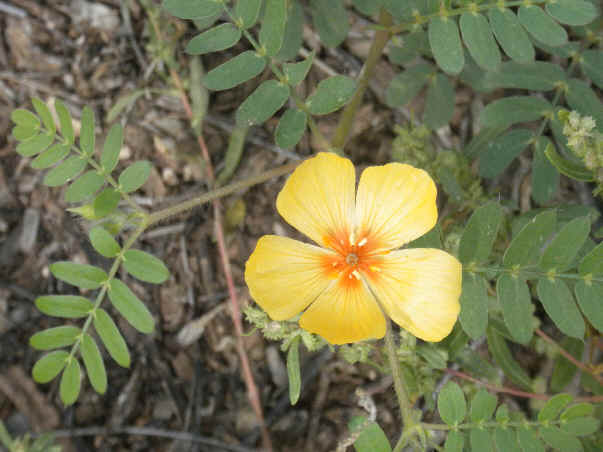
- Linum aristatum ______
E: Broom Flax
- Linum perenne ______
E: Blue Flax
- Linum puberulum ______
E: Orange Flax
- Linum vernale
______ CD (in rocky, limestone soil in deserts)
(in rocky, limestone soil in deserts)
E: Chihuahua Flax
The Chihuahua Flax is a common species in parts of the Chihuahuan Desert.
Only the very bases of the petals are joined, and when the corolla falls
from the flower, breezes blow it across the ground like a fragile saucer.
This species is one of a number of western yellow-flowered species, most
slender and wiry, and many without maroon centers in the flowers.
Family LOASACEAE (Stickleaves)
Genus CEVALLIA
- Cevallia sinuata
______
E: Cevallia
Genus EUCNIDE
- Eucnide urens
______ MD
E: Desert Rock Nettle
Genus MENTZELIA
- Mentzelia albicaulis ______
E: White-stemmed Blazing Star
- Mentzelia desertorum ______
E: Desert Blazing Star
- Mentzelia involucrata
______
E: Sand Blazing Star (has also been called White-bracted
Stickleaf)
- Mentzelia nitens
______ (sometimes included in Mentzelia albicaulis)
(sometimes included in Mentzelia albicaulis)
E: Venus Blazing Star
- Mentzelia tricuspis
______
E: Spiny-haired Blazing Star
- Mentzelia veatchiana
______
E: Small-flowered Blazing Star
Genus PETALONYX
- Petalonyx thurberi
______
E: Sandpaper Plant
Family KOEBERLINIACEAE
Genus KOEBERLINIA
- Koeberlinia spinosa
______ CD SD
E: Allthorn
Family MALVACEAE (Mallows) (W)
Genus ERIMALCHE
- Erimalche rotundifolium
______ MD SD ("Erimalche" means "lonely mallow",
referring to the desert habitat)
E: Desert Five Spot
Genus HIBISCUS (Rose Mallows)
- Hibiscus coulteri ______ SD
E: Desert Rose Mallow
- Hibiscus denudatus
______ SD
E: Rock Rose Mallow, Rock Hibiscus, Pale
Face
- Hibiscus trionum
______ (a non-native, from central Africa)
E: Flower-of-an-hour
Genus SPHAERALCEA (Approximately 60 species of Sphaeralcea
globemallows are common on ranges in the western US. As a genus, they are
easy to identify with their five commonly bright orange-red petals. But
identification of particular species can be another matter.)
- Sphaeralcea ambigua ______ SD
E: Apricot Globemallow (or Desert
Globemallow)
Sphaeralcea ambigua
is a host plant for the butterfly: VANESSA CARDUI, Painted Lady.
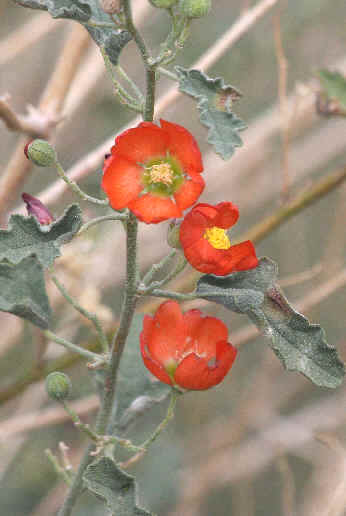
- Sphaeralcea coccinea (ph)
______ GD
E: Scarlet Globemallow

Scarlet Globemallow
(photo by
Doris Potter)
- Sphaeraicea leptophylla
______
E: Scaly Globemallow
- Sphaeraicea polychroma
______
E: Polychrome Globemallow
- Sphaeraicea coulteri
______ (on sandy desert flats)
E: Coulter's Globemallow
Family MARTYNIACEAE (Unicorn Plants)
Genus PROBOSCIDEA (There are several species in the Southwest US, some
with pink or magenta colored flowers)
- Proboscidea althaeifolia
(or altheaiefolia) ______ CD
SD
E: Desert Unicorn Plant (also called "Devil's Claw"
and "Elephant Tusks")
As the plump fruit
matures, it divides into halves, and its outer, fleshy layer peels off,
revealing the hard inner portion of the fruit, the single horn of which
splits into two "devil's claws".
- Proboscidea louisianica ______
(NOT common west of Texas)
E: Common Unicorn Plant
- Proboscidea parviflora
______ SD
E: Devil's Claw, Unicorn Plant
Family NYCTAGINACEAE (Four O'Clocks) (W)
Genus ABRONIA
- Abronia carnea ______
E: Winged Sand Verbena
- Abronia elliptica
______
E: Snowball, Sweet Sand Verbena
- Abronia villosa
______
E: Sticky Sand Verbena (or Desert Sand Verbena)
- Abronia fragrans
______
E: Fragrant Sand Verbena (pr "Heart's Delight")
Genus ACLEISANTHES
- Acleisanthes longiflora
______ (in dry rocky soil, sand, deserts)
E: Angel Trumpets
Genus ALLIONIA
- Allionia incarnata
______ CD
E: Trailing Four O'Clock, Trailing Windmills, Trailing Allionia, Umbrella-wort
Genus ANULOCAULIS
- Anulocaulis leiosolenus
______
E: Southwestern Ringstem
Genus MIRIBILIS
- Miribilis bigelovii ______
E: Wishbone Four O'Clock
- Miribilis coccinea
______
E: Red Four O'Clock
- Miribilis froebelii ______ (in
desert scrub, dry grasslands, & pinyon woods)
E: Desert Four O'Clock
- Miribilis longiflora
______
E: Sweet Four O'Clock
S: Maravilla (meaning "marvelous", which the flowers
certainly are)
- Miribilis melanotricha
______
E: Mountain Four O'Clock
- Miribilis mulitflora
______
E: Large Four O'Clock (or Desert Four O'Clock, Colorado Four O'Clock)
S: Maravilla (meaning "marvelous" as also noted above for
Miribilis longiflora)
Genus NYCTAGINIA
- Nyctaginia capitata ______
E: Scarlet Muskflower
Family OLEACEAE (Olives)
Genus MENODORA
- Menodora scabra
______ CD MD SD
E: Broom Menodora (or Rough Menodora)
\
- Mendora spinescens ______
E: Ground-Thorn
Family ONAGRACEAE (Evening Primroses)
Genus CALYLOPHUS
- Calylophus hartwegii
______ CD
E: Calylophus
Genus CAMISSONIA
- Camissonia brevipes
______
E: Desert Primrose (or Suncup)
- Camissonia boothii
______
E: Booth Evening Primrose
- Camissonia claviformis
______ GD MD PD SD
E: Club-fruited Evening Primrose
- Camissionia eastwoodiae
______ PD (often grows with Mat Saltbush)
E: Painted Desert Evening Primrose
- Camissionia graciliflora
______ GD MD (on upper slopes of hills)
E: Hill Suncap
- Camissionia refracta
______ MD (mostly in the northern part of the Mohave Desert)
E: Narrow-leaved Evening Primrose
- Camissionia strigulosa (dentata)
______ MD SD
E: Tooth-leaved Evening Primrose
Genus EPILOBIUM
- Epilobium (formerly
Zauschneria) canum ______
E: California Fuschsia, Hummingbird's Trumpet, California Fire Chalice
Genus GAURA
- Gaura coccinea
______
E: Scarlet Gaura
- Gaura lindheimeri
______ CD
E: Prairie Gaura
Genus OENOTHERA (Recent studies have shown that many of the species in
the once-larger OENOTHERA genus are better placed in smaller closely-related
genera. Thus, some are now in CAMISSONIA. Those plants with four style
branches forming a cross remain in OENOTHERA.)
Flowers of most OENOTHERA species are fragrant and open in the late
afternoon, remaining open through the night. Nocturnal HAWKMOTHS are
attracted by the sweet fragrance and hover over the flowers while probing
for the abundant nectar concealed at the base of the long floral tube. Only
the HAWKMOTH with its long proboscis can reach the
nectar.
- Oenothera albicaulis ______ CD PD
E: White-stemmed Evening Primrose
- Oenothera caespitosa ______
E: Fragrant Evening Primrose
- Oenothera californica ______ MD(mostly)
SD
E: California Evening Primrose
- Oenothera deltoides
______ MD SD (in sandy deserts)
E: Dune Evening Primrose (or Basket Evening Primrose, Birdcage Evening Primrose, Devil's Lantern,
"Lion-in-a-Cage")
- Oenothera pallida
______ GD
E: Pale Evening Primrose
- Oenothera primiveris
______
E: Early Evening Primrose
Family OROBANCHACEAE (Broomrapes)
Genus OROBANCHE
- Orobanche cooperi
______
E: Cooper's Spike Broomrape
Family PAPAVERACEAE (Poppies) (W)
Genus ARCTOMECON
- Arctomecon merriamii
______ (with 6 white petals; many yellow stamens)
E: Great Desert Poppy, Great Bear Poppy, White Bear Poppy
- Arctomecon humilis
______ (in southwest Utah & northwest Arizona) (with 4 white
petals)
E: Little Desert Poppy
- Arctomecon californica
______ (in south Nevada & northwest Arizona) (with 6 yellow
petals)
E: Yellow Desert Poppy
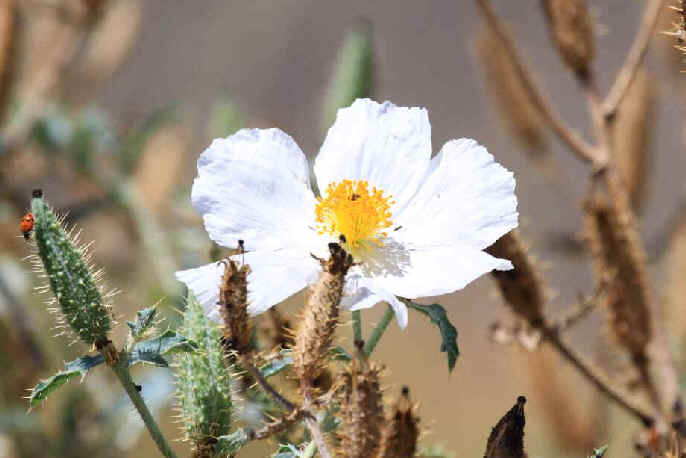
Genus ARGEMONE
- Argemone munita ______ GD
MD PD SD
E: Prickly Poppy (or White Prickly
Poppy)
S: Chiclote

Prickly Poppy photographed during a FONT tour in
Arizona in August 2010
(photo by
Marie Gardner)
- Argemone polyanthemos
______
E: Prickly Poppy
- Argemone sanguinea
______ (blooms Feb-Apr)
E: Red Prickly Poppy
- Argemone squarrosa
______ CD
E: Rough Prickly Poppy
Genus ESCHSCHOLZIA
- Eschscholzia californica
mexicana ______
E: California Poppy
- Eschscholzia mexicana
______
E: Mexican Poppy
S: Amapola del Campo (means "poppy of the countryside")
Once considered a subspecies of the California Poppy, the Mexican
Poppy is now recognized as a
desert-inhabiting species. The two subspecies are
exceedingly similar.
When there are ample winter rains in the desert, the Mexican Poppy
grows in profusion, covering gravelly outwash fans and arid flats with a
golden carpet.

Mexican Poppy, photographed during the August
2010 FONT tour
in southern Arizona
(photo by Risė Hill)
- Eschscholzia parishii
______
E: Parish Poppy
Genus PLATYSTEMON (only 1 species)
- Platystemon californicus
______ GD MD SD (in fine, gravelly soils of desert
mountains)
E: Cream Cup
Family PASSIFLORACEAE
Genus PASSIFLORA
Some members of the PASSIFLORA
genus are host plants for the butterfly: AGRAULIS VANILLAE, Gulf
Fritillary.
- Passiflora tenuiloba
______
E: Green Passionflower
The Green Passionflower is a vine that climbs over shrubs and grasses on
hillsides. Its stems reach 7 feet in length.
Family PEDALIACEAE (Sesames)
Family PLANTAGINACEAE (Plantains)
Genus PLANTAGO
- Plantago patagonica (purshii) ______
E: Pursh Plantain
Family POLEMONIACEAE (Phloxes)
Genus ERIASTRUM
-
Eriastrum diffusum ______
E: Diffuse Eriastrum
- Eriastrum eremicum
______
E: Desert Eriastrum
- Eriastrum pluriflorum
______
E: Many-flowered Eriastrum
Genus GILIA
- Gilia brecciarum
______
E: Great Basin Gilia
- Gilia cana ______
E: Mohave Gilia
- Gilia gunnisonii ______
E: Gunnison Gilia
- Gilia latiflora ______
E: Broad-flowered Gilia
- Gilia latifolia ______
E: Broad-leaved Gilia
- Gilia scopulorum ______
E: Rock Gilia
- Gilia subnuda ______
E: Carmine Gilia
Genus IPOMOPSIS (or GILIA)
- Ipomopsis longiflora (ph)
______ GD (flowers from March to October)
E: Pale Trumpets (or
Long-flowered Gilia)

Pale Trumpets
(photo by Doris
Potter)
Genus LANGLOISIA
- Langloisia punctata ______ MD
E: Lilac Sunbonnet
- Langloisia setoissima
punctata ______
E: Spotted Langloisia, Lilac Sunbonnet (or Bristly Gilia)
Genus LEPTODACTYLON
- Leptodactylon
californicum ______ (in southern California)
E: Prickly Phlox
Genus LINANTHUS

- Linanthus aurens
______ CD GD MD SD (on desert floors & sandy slopes)
E: Desert Gold (or Golden Gilia)
- Linanthus demissus ______
E: Humble Gilia
Genus LOESELIASTRUM (or LANGLOISIA)
- Loeseliastrum matthewsii
______ MD SD
E: Desert Calico
- Loeseliastrum schottii ______
E: Schott's Gilia
Genus PHLOX
- Phlox longifolia ______
E: Long-leaved Phlox
- Phlox nana ______
E: Dwarf Phlox
- Phlox tennifolia ______
E: Slender-leaved
Phlox
Family POLYGALACEAE (Milkworts)
Genus POLYGALA
- Polygala alba
______
E: White Milkwort
- Polygala macradenia
______ CD (on rocky slopes)
E: Gland-spotted Milkwort
- Polygala subspinosa
______ GD PD
E: Spiny Milkwort
Family POLYGONACEAE (Buckwheats)
Genus CHORIZANTHE ("Spine-Flowers")
- Chorizanthe brevicornu ______
E: Brittle Spineflower
Genus ERIOGONUM
- Eriogonum annum ______ CD
(the showiest of the Eriogonum species; in the Chihuahuan Desert, replaces
the Desert Trumpet)
E: Annual Buckwheat
- Eriogonum bicolor ______ PD
E: Bicolored Buckwheat
- Eriogonum deflexum ______ SD
E: Flat-topped Buckwheat
- Eriogonum fasciculatum ______
SD
E: Mohave Buckwheat (also called California Buckwheat or
Flat-top Buckwheat)
Eriogonum fasciculatum
is a host plant for the butterflies: EUPHILOTES BATTOIDES CENTRALIS,
Square-spotted Blue, LYCAENA HETERONEA, Blue Copper, APODEMIA MORMO
MEJICANA, Mormon Metalmark.
- Eriogonum inflatum ______ GD
MD PD SD (the best known of the Eriogonum species)
E: Desert Trumpet (Other names are: Bladder Stem, Indianpipe
Weed, Skeleton Weed)
Eriogonum inflatum is a host plant for the butterfly: APODEMIA
MORMO MEJICANA, Mormon Metalmark.
- Eriogonum ovalifolium ______ GD
E: Cushion
Buckwheat
Genus RUMEX
- Rumex hymenosepalus ______ CD
GD MD PD SD (most abundant in the Painted Desert)
E: Canaigre (or "Wild Rhubarb")
Rumex hymenosepalus is a host plant for the butterflies: LYCAENA
RUBIDUS, Ruddy Copper, LYCAENA HELLOIDES, PURPLISH COPPER.
Family PORTULACACEAE (Purslanes)
Genus PORTULACA
- Portulaca mundula
______ CD (very similar to the Western Sea Purslane, Sesuvium
verrucosum, in the Purslane Family, PORTULACACEAE)
E: Chisme
Genus TALINUM
- Talinum aurantiacum
______
E: Flame Flower
- Talinum brevifolium
______
E: Pygmy Talinum
Family RANUNCULACEAE (Buttercups)
Genus ANEMONE
- Anemone tuberosa
______
E: Desert Anemone
Genus AQUILEGIA
- Aquilegia chrysantha
______
E: Golden Columbine
Genus CLEMATIS
- Clematis hirsutissima
______
E: Vase Flower, Sugar Bowls, Leather Flower
- Clematis ligusticifolia
______
E: White Virgin's Bower, Pipestems, Traveler's Joy
Genus DELPHINIUM
- Delphinium a. andersonii ______
GD
Delphinium abdersonii
scaposum ______ MD PD SD
E: Anderson Larkspur
- Delphinium parishii ______
E: Desert Larkspur
Family RHAMNACEAE (Buckthorns)
Genus CEANOTHUS
- Ceanothus greggi ______ PD
E: Desert Mountain Lilac
Ceanothus greggi is a host plant for the butterfly: SATYRIUM
SAEPIUM, Hedgerow Hairstreak.
- Ceanothus intergerrimus
______ (on dry slopes in chaparral and open forests)
E: Deer Brush
Ceanothus intergerrimus is a host plant for the butterflies: CELASTRINA
LADON, Spring Azure, NYMPHALIS CALIFORNICA, California Tortoiseshell.
Genus CONDALIA
- Condalia warnockii ______ CD SD
E: Mexican Crucillo
S: Abrojo
Genus ZIZIPHUS (closely related to CONDALIA)
- Ziziphus obtusifolia ______ CD MD SD
E: Graythorn
Family ROSACEAE
(Roses)
Genus CERCOCARPUS
- Cercocarpus intricatus ______
E: Dwarf Mountain
Mahogony
Genus COLEOGYNE
- Coleogyne ramosissima ______ PD
E: Blackbrush
Genus FALLUGIA
- Fallugia paradoxa
______
E: Apache Plume
Genus PURSHIA (or Cowania)
-
Purshia mexicana ______
E: Cliff Rose
Family RUBIACEAE (Madders)
Genus BOUVARDIA
- Bouvardia ternifolia
______
E: Scarlet Trumpet
Genus HEDYOTIS (or HOUSTONIA)
- Hedyotis acerosa
______
E: Needle-leaf Hedyotis
Family RUTACEAE (Citrus)
Genus THAMNOSMA
- Thamnosma montana ______
E: Turpentine Broom
Family SAURURACEAE (Lizard Tails)
Genus ANEMOPSIS
- Anemopsis californica
______ (in low, moist, saline, or alkaline places)
E: Yerba Mansa (taken from the Spanish name)
S: Yerba Mansa
The aromatic Yerba Mansa root has been put to many medicinal uses: treatment
of abrasions, cut, and burns; a cure for a variety of gastrointestinal
upsets; a poultice for rheumatism; and a tonic for blood purification.
Family SAPINDACEAE (Soapberries)
Genus DODONAEA
- Dodonaea viscosa angustifolia (or Dodonaea
angustifolia) ______ SD
E: Hopbush
Genus SAPINDUS (T)
- Sapindus
drummondii ______ CD (in canyons, along streambanks, &
on dry limestone outcrops)
E: Western Soapberry
Family SCROPHULARIACEAE (Snapdragons, or Figworts)
Genus ANTIRRHINUM
- Antirrhinum coulterianum
______ (found on brushy flats and on slopes with loose soil)
E: White Snapdragon
- Antirrhinum filipes
______ (in sandy deserts)
E: Yellow Twining Snapdragon
Genus CASTILLEJA (Paintbrushes)
Most Paintbrushes are partial parasites on other plants, their roots
connecting with roots of other species. For this reason, they usually cannot
be transplanted and are difficult to grow from seeds.
Most Paintbrushes are bright red, but a few are yellow.
- Castilleja angustifolia (by some combined
with Castilleja chromosa)
______ GD (in dry, open soil, often in
sagebrush)
E: Narrow-leaf Paintbrush
- Castilleja chromosa ______ GD
MD PD SD
E: Desert Paintbrush
Castilleja chromosa
is a host plant for the butterfly: EUPHYDRYAS CHALCEDRONA, Variable
Checkerspot.
- Castilleja exserta (or Orthocarpus
purpurascens) ______ SD
(in fields, deserts, and open, wooded areas)
E: Purple Owl's Clover (or Common Owl's
Clover)
S: Escobita (means "little broom", describing the flower
cluster)
- Castilleja lanata ______
E: White-felted Paintbrush (or Indian
Paintbrush)
Castilleja lanata is a host plant for the butterflies: EUPHYDRYAS
CHALCEDRONA, Variable Checkerspot, THESSALIA, Theona Checkerspot, THESSALIA
FULVIA, Fulvia Checkerspot, THESSALIA LEANIRA, Leanira Checkerspot.
- Castilleja sessiliflora
______
E: Great Plains Paintbrush
Genus COLLINSIA (There are about 20 species in this genus.)
- Collinsia
heterophylla ______ (occurs in sandy soil on shaded flats or
slopes)
E: Purple Chinese Houses, Innocence
Few of California's spectacular wildflowers are as charming as the Purple
Chinese Houses. The flowers grow in perfect rings around the stem, together
forming a fairy-tale pagoda, the "Chinese
Houses".
Genus CORDYLANTHUS
- Cordylanthus wrightii
______ PD
E: Wright Bird's -beak
Genus KECKIELLA
-
Keckiella antirrhinoides ______ SD
E: Bush Beardtongue (has been called Bush Penstemon)
Keckiella antirrhinoides
is a host plant for the butterfly: EUPHYDRYAS CHALCEDONA, Variable
Checkerspot.
Genus LEUCOPHYLLUM
- Leucophyllum frutescens
______ (in rocky, limestone plains, brushlands, and deserts)
E: Texas Silver Leaf, Purple Sage
S: Cenizo
As one travels across Texas near the Mexican border, the olive-green of the
Creosote Bush gives way to the gray of the Texas Silver Leaf, with its
display of bright pink-lavender flowers. They burst into bloom for only a
few days at a time, in the summer and fall, depending on
rainfall.
- Leucophyllum unius
______ CD
E: Big Bend Silver Leaf
Genus MAURANDYA (a member of this genus, the Little Snapdragon Vine,
that occurs in or near desert areas is in the list that follows of Trees,
Shrubs, & Plants at Higher Places, "Islands in the Sky")
- Maurandya antirrhiniflora ______
E: Violet Snapdragon-vine
- Maurandya
wislizenii ______ CD (ranging west into Arizona)
(among shrubs & on dunes)
E: Dune Snapdragon Vine (or Net-cup Snapdragon Vine)
Genus MIMULUS
-
Mimulus bigelovii ______
E: Bigelow Monkey Flower
- Mimulus parryi ______
E: Parry Monkey Flower
Genus MOHAVEA
- Mohavea breviflora ______ MD
E: Short-flowered Mohavea
- Mohavea confertiflora
______ MD (in desert washes & on rocky slopes)
E: Ghost Flower, Mohave Flower
Genus NUTTALLANTHUS
- Nuttallanthus canadensis
______
E: Blue Toadflax, Old-field Toadflax
- Nuttallanthus texanus
______
E: Texas Toadflax
The Texas Toadflax is similar to the Blue Toadflax, but it is less common in
the Southwest US.
Its flowers and seeds are larger.
Genus PENSTEMON
- Penstemon accuminatus ______
E: Sand-dune Penstemon
- Penstemon clevelandii ______
E: Cleveland Penstemon
- Penstemon confusus ______
E: Mistaken Penstemon
- Penstemon eatonii ______
E: Firecracker Penstemon
- Penstemon palmeri ______
E: Scented Penstemon
- Penstemon parryi
______ SD (found on grassy pr brushy slopes and flats)
E: Parry Penstemon
The Parry Penstemon, a handsome species, is commonly included in highway
seeding mixes. And so, its range has expanded. Along highways, it's possible
to see spectacular splashes of color from this species, against grasses
still brown from winter.
- Penstemon pseudospectabilis
______
E: High-Desert Penstemon
- Penstemon speciisus ______
E: Showy Penstemon
- Penstemon utahensis
______
E: Utah Penstemon
Family SIMMONDSIACEAE (Jojobas)
Genus SIMMONDSIA
- Simmondsia chinensis
______ SD
E: Jojoba
S: Jojoba
Family SOLANACEAE (Nightshades)
Genus CHAMAESARACHA
- Chamaesarachia coronopus ______
E: False Nightshade
- Chamaesaracha sordida
______ (This & other species in the genus are common but not
conspicuous. The corollas are dull, and the foliage often has an earthen
hue.)
E: Dingy Chamaesaracha
Genus DATURA (Thornapples) (W)
- Datura wrightii (or Datura meteloides)
(ph) ______ GD,SD
(unusual in the genus in that it is a perennial)
E: Southwestern Thornapple

Two photographs of the Southwestern Thornapple. Below, in bloom.
(both photos by Doris Potter)

- Datura innoxia ______
E: Thornapple
Some botanists consider Datura innoxia as part of Datura wrightii. Extracts
from both of these plants, and their other relatives, are narcotic and, when
improperly prepared, lethal. The narcotic properties have been recorded
throughout history. They once figured importantly in religious ceremonies of
Native Americans in the Southwest US.
- Datura discolor
______ SD (an annual)
E: Desert Thornapple
- Datura stramonium ______ SD
(an
annual)
E: Jimson Weed (This common name is a corruption of "Jamestown
Weed", so named because the plant grew near the homes of the Jamestown
(Virginia) colonists.)
The Jimson Weed is originally from Mexico. The plant was carried throughout
much of the world for medicinal use.
The fruit has many small spines and does not hang. The corolla is only about
3 inches long.
Genus LYCIUM
- Lycium andersonii ______
E: Anderson Wolfberry
- Lycium fremontii
______ SD
E; Fremont Desert-Thorn (or Wolfberry, Boxthorn)
- Lycium p. pallidum ______ CD GD PD SD
Lycium pallidum oligospermum
______ MD
E: Pale Desert-Thorn
- Lycium torreyi ______
E: Torrey Wolfberry
S: Tomatilla
Genus NICOTIANA (All of these "Tobaccos" are poisonous. They
are so strong-smelling and distasteful that livestock, and other animals,
usually avoid them.)
- Nicotiana glauca
______
E: Tree Tobacco
The Tree Tobacco is a native plant of South America; now widespread in parts
of the western US & into Mexico.
- Nicotiana obtusifolia
______
E: Desert Tobacco
S: Tabaquillo (meaning "little tobacco"), also called Punche
("a punch")
The Desert Tobacco smoked, still to this day, by Native Americans in
traditional ceremonies.
- Nicotiana attenuata
______
E: Coyote Tobacco
Genus PHYSALIS (Ground Cherries) (W)
- Physalis crassifolia ______
E: Thick-leaf Groundcherry
- Physalis hederifolia
______
E: Ivyleaf Groundcherry
- Physalis lobata
______
E: Lobed Groundcherry
Genus QUINCULA (formerly PHYSALIS, but the purple flower and the flat,
scale-like hairs on the leaves are considered distinctive)
- Quincula lobata
______
E: Purple Groundcherry
The berry of the Purple Groundcherry is edible, but caution is advised, for
the flower resembles some of those in the genus that follows here, SOLANIUM
with both edible and deadly berries.
Genus SOLANUM (Potatoes & Eggplants are among the nonpoisonous and
economically important plants in this huge genus.) (W)
- Solanum elaeagnifolium (ph)
______ GD
E: Silverleaf Nightshade

Silverleaf Nightshade
(photo by
Doris Potter)
The Silverleaf Nightshade has also had the common English names of Silver
Horsenettle and White Horsenettle.
The star-like flowers of the plant are bluish-violet, violet, or lavender in
color. Large patches of it, when in full bloom, are striking.
However, the. plant is an aggressive poisonous weed, that spreads steadily
from deep rootstocks. In some US states, it is classified as a "noxious
weed".
- Solanum carolinense (ph) ______
GD
E: Horsenettle

Horsenettle
(photo by Doris Potter)
- Solanum rostratum
______
E: Buffalo Bar
Abundant prickles help to discourage livestock from grazing on Buffalo
Bar,
which is a highly toxic plant.
- Solanum dulcamara ______
E: Bittersweet Nightshade
- Solanum americanum ______
E: Black Nightshade
Family VERBENACEAE (Vervains, Verbenas)
Genus ALOYSIA
- Aloysia gratissima ______
E: Common Bee Bush
- Aloysia wrightii ______ SD
S: Oreganillo
Genus GLANDULARIA
-
Glandularia hipinnatifida ______ (in
open fields & weedy areas)
E: Western Pink Vervain
S: Moradilla (coming from "morado"
meaning
"purple", this Spanish name means "little purple
one")
Genus VERBENA
- Verbena gooddingii ______
E: Southwestern Verbena
- Verbena neomexicana ______
E: Hillside Vervain
- Verbena perennis ______
E: Pinleaf Vervain
- Verbena wrightii ______
E: Desert Verbena
Family VISCACEAE (or LORANTHACEAE) (Mistletoes)
Genus PHORADENDRON
Some members of the PHORADENDRON genus are host plants for
the butterflies: ATLIDES HALESUS, Great Purple Hairstreak,
CALLOPHRYS SPINETORUM, Thicket Hairstreak.
- Phoradendron californicum
______ SD (in the desert from Nevada & southern California
south to central Baja California & southern Sonora in Mexico)
E: Desert Mistletoe
- Phoradendron macrophyllum (ph) (*) ______
GD,SD
E: Big-leaf Mistletoe

Big-leaf Mistletoe
(photo by Doris Potter)
Family ZYGOPHYLLACEAE (Caltrops)
Genus FAGONIA
- Fagonia laevis ______ MD SD
(on rocky slopes & in washes in deserts)
E: Fagonia
Genus KALLSTROEMIA
- Kallstroemia grandiflora
______ SD (open sandy areas in deserts)
E: Desert Poppy, Summer Poppy, Arizona Poppy
The Desert Poppy, and other species in the same genus, are not true poppies,
nor even are they close relatives. But they resemblance is there. Large
patches provide a display as brilliant and spectacular as those of the California Poppy
(ESCHSCHOLZIA californica).
- Kallstroemia parviflora
______ SD (with
smaller flowers than K. grandiflora,
that are orange)
E: Small-flowered Carpetweed
- Kallstroemia californica ______
SD (with smaller flowers than K.
grandiflora, that are yellow)
E: California Carpetweed
Genus LARREA (S)
- Larrea tridentata (was conspecific
with Larrea divaricata of South America) ______ CD
MD SD
(the most common & widespread shrub in 3 of the 4 North American
deserts; cold winters exclude it from the Great Basin Desert; especially
common in well-drained soils of "bajadas" or alluvial fans, and on
flats.)
E: Creosote Bush
S: Gobernadora
Creosote Bushes are adapted to desert living. Where they are the dominant
plants, they often grow in evenly spaced rows - a "self-imposed"
method of rationing water. A strong-smelling resin coats the leaves,
reducing moisture loss.
___________________________________________________________________________________
Trees, Flowers, & Other Plants in Higher Country near the Deserts:
THE FLORA OF "ISLANDS IN THE SKY"
Family APIACEAE (Carrots)
Genus ERYNGIUM
- Eryngium heterophyllum
______ (in sandy soil in grasslands, open woods, and along
watercourse, usually in mountains)
E: Mexican Thistle
Family BERBERIDACEAE (Barberries)
Genus BERBERIS
- Berberis aquifolium
______ (in open pine forests)
E: Oregon Grape
Family BRASSICACEAE (Mustards)
Genus DRABA
- Draba oligoperma
______
E: Comb Draba
Family CAMPANULACEAE (Bellflowers)
Genus LOBELIA
- Lobelia anatina
______
E: Southwestern Blue Lobelia
- Lobelia cardinalis
______ CD
E: Scarlet Lobelia, Cardinal Flower
The Scarlet Lobelia attracts hummingbirds, that feed on the insects and
pollinate the flowers.
Family COMMELINACEAE (Spiderworts)
Genus COMMELINA
- Commelina dianthifolia
______ (occurs among pinon, other pines, and junipers)
E: Western Dayflower
- Commelina erecta
______
E: Slender Dayflower
S: Hierba de Pollo (means "herb of the chicken")
Genus TRADESCANTIA
- Tradescantia pinetorium
______
E: Pine Spiderwort
Family CUPRESSACEAE (T)
Genus CUPRESSUS (Cypresses)
- Cupressus arizonica ______ CD,SD
E: Arizona
Cypress
Genus JUNIPERUS (Junipers)
- Juniperus flaccida
______ CD
E: Drooping Juniper
(also called Weeping
Juniper)
- Juniperus deppeana
______ CD
E: Alligator Juniper
- Juniperus pinchotii ______
CD
E:
Redberry Juniper
- Juniperus osteosperma _____ GD
E: Utah Juniper,
Bigberry Juniper
- Juniperus communis (ph) (*) ______
GD
E:
Common Juniper, Dwarf Juniper

Common Juniper
(photo by Doris Potter)
Family FABACEAE
(Legumes, Peas)
Genus LOTUS
- Lotus wrightii ______ GD (found
mainly among Ponderosa Pine and among pinyon and
juniper)
E: Wright's
Deer Vetch
Wright's Deer Vetch is a favored
browse for deer and domestic livestock.
As with many species in the pea family, it has an intricate method of
pollination that generally requires the aid of insects.
Genus THERMOPSIS
- Thermopsis rhombifolia montana
______ (in meadows and coniferous forest openings)
E: Yellow Pea,
Golden Pea, Buck Bean
Genus TRIFOLIUM
- Trifolium wormskioldii ______
E: Cow Clover
Family FAGACEAE (Beeches) (T)
Genus QUERCUS (Oaks)
- Quercus grisea ______ CD
E: Gray Oak
- Quercus emoryi ______ CD
E: Emory Oak
- Quercus gravesii ______ CD
E: Graves
Oak
- Quercus intricata ______ CD
(in
the US known only in the Eagle & Chisos Mountains of west
Texas)
E: Coahuila
Scrub Oak
- Quercus pungens vaseyana ______
CD
E: Vasey
Oak
- Quercus graciliformis ______ CD
(endemic to Chisos Mountains of west Texas)
E: Chisos Oak
- Quercus tardifolia ______ CD
(occurs only locally in the Chisos Mountains of west Texas)
E: Lateleaf
Oak
Family GENTIANACEAE
- Gentianella amarella ______ (in
meadows and moist areas in mountains)
E: North
Gentian
Genus SWERTIA
(this genus has been merged with FRASERA)
- Swertia radiata (formerly Frasera
speciosa) ______
E: Monument
Plant, Deer's Ears
Family IRIDACEAE
(Irises)
Genus SISYRINCHIUM
- Sisyrinchum cernuum ______
E: Yellow-eyed (or
Golden-eyed) Grass
- Sisrinchum longipes ______
E: Yellow-eyed (or
Golden-eyed) Grass
- Sisrinchum arizonicum ______
E: Arizona
Golden-eyed Grass
Family LILIACEAE (Lilies)
Genus ALLIUM
- Allium acuminaum
______ (in open country, often on rocky slopes among brush and pines)
E: Hooker's Onion
- Allium cernuum
______ (in moist soil in sagebrush and woods)
E: Nodding Onion
Genus CALOCHORTUS
- Calochortus nuttallii
______ (in dry soil in sagebrush and in open pine woods)
E: Sego Lily
Family LINACEAE (Flaxes)
Genus LINUM
- Linum perenne
______ (found in prairies and meadows, and on open mountain
slopes)
E: Wild Blue Flax, Western Blue Flax
Several Native American tribes used Wild Blue Flax to make rope.
Family MALVACEAE (Mallows)
Genus SIDALCEA
- Sidalcea neomexicana
______
E; Checkermallow
Family MONOTROPACEAE
Genus MONOTROPA
- Monotropa uniflora
______
E: Indian Pipe
Genus PTEROSPORA
- Pterospora andromedea
______ (especially common in the western US under Ponderosa
Pines)
E: Pinedrops
Family ONAGRACEAE (Evening Primroses)
Genus CHAMERION
- Chamerion angustifolium
______ (in disturbed and cool areas; frequently along highways, and in
burned areas)
E: Fireweed
Genus GAUREA
- Gaurea coccinea
______ (in sandy soil among pinyons and junipers)
E: Scarler Gaura
Family ORCHIDACEAE (Orchids)
Genus HEXALECTRIS
- Hexalectris warnockii
______ CD (the most common Hexalectris in Big Bend National
Park; also occurs in southeastern Arizona)
E: Texas Purple Spike
The Texas Purple Spike is one of 5 Hexalectris orchids in the Southwest US.
Genus LISTERA
- Listera convallarioides
______ (in southern Arizona, in addition to other places in much of
North America; also in Asia)
E: Broad-leafed Twayblade
Genus SPIRANTHES
- Spiranthes romanzoffiana
______
E: Hooded Ladies' Tresses
Family OXALIDACEAE (Wood Sorrels)
Genus OXALIS
- Oxalis violacea
______
E: Violet Wood Sorrel
- Oxalis alpina
______ (from northern New Mexico & central Arizona south to
Guatemala)
E: Mountain Wood Sorrel
- Oxalis decaphylla
______ (in the Southwest US & Mexico)
E: Ten-leaved Wood Sorrel
Family PINACEAE (T)
Genus PINUS (Pines & Pinyons)
- Pinus ponderosa ______
CD
E: Ponderosa Pine
- Pinus cembroides
______ CD
E: Mexican Pinyon
Family POLEMONIACEAE (Phloxes)
Genus GILIA
- Gilia rigidula
______
E: Blue Gilia
Genus LINANTHUS
- Linanthus nuttallii
______
E: Nuttall's Linanthus
Family POLYGONACEAE (Buckwheats)
Genus POLYGONUM
- Polygonum bistortoides
______ (moist mountain meadows & streamsides)
E: Western Bistort, Smokeweed
Family PRIMULACEAE (Primroses)
Genus DODECATHEON
- Dodecatheon alpinum
______
E: Alpine Shooting Star
- Dodecatheon dentatum
______
E: White Shooting Star, Dentate Shooting Star
- Dodecatheon pulchellum
______
E: Few-flowered Shooting Star
Family ROSACEAE
Genus POTENTILLA
- Potentilla thurberi
______ (in rich soil in coniferous forests, damp meadows, and along
streams)
E: Red Cinquefoil
Family RUBIACEAE (Madders)
Genus BOUVARDIA
- Bouvarddia ternifolia
______
E: Scarlet Bouvardia
S: Trompetilla (means "little trumpet", referring to the
shape of the corolla)
The spectacular red corolla of the Scarlet Bouvardia attracts, and provides
nectar for, hummingbirds.
Family SAXIFRAGACEAE (Saxifrages)
Genus HENCHERA
- Henchera sanguinea
______ (found in moist, shaded, rocky places)
E: Coral Bells
Genus SAXIFRAGA
- Saxifraga rhomboidea
______ (moist places in hills with sagebrush)
E: Diamondleaf Saxifrage
Family SCROPHULARIACEAE (Snapdragons, or Figworts)
Genus CORDYLANTHUS (Birdbeaks - nearly 40 species occur in the western
US)
- Cordylanthus wrightii
______ (on open sandy areas on plains & in pine forests)
E: Wright's Birdbeak
Genus MAURANDYA
- Maurandya
antirrhiniflora ______ (in sandy and gravelly soil in deserts,
at times on rock walls and among pinyons & junipers)
E: Little Snapdragon Vine, Violet Twining
Genus PENSTEMON (a huge genus, with several having beautiful
blue-violet flowers and narrow leaves)
- Penstemon barbatus
______ (on dry rocky slopes in open forests)
E: Goldenbeard Penstemon
- Penstemon linarioides
______ (in open, often rocky soil at moderate elevations)
E: Narrowleaf Penstemon
The Narrowleaf Penstemon is a common member of the genus in dry open
woodlands in the Southwest US.
- Penstemon palmeri
______ (in open, rocky areas among sagebrush, pinyons & junipers,
and pinewoods)
E: Balloon Flower
Family STERCULIACEAE (Cacaos)
Genus FREMONTODENDRON
- Fremontodendron
californicum ______ (on dry slopes in brush or pine forests)
E: Flannel Brush, Fremontia
- Fremontodendron
mexicanum ______
E: Mexican Fremontia
Family VERBENACEAE (Verbenas)
Genus VERBENA
There are several species in the VERBANA genus that are tall and with either
thick or slender spikes of flowers.
These Vervains are not easy to distinguis from one another.
- Verbena macdougalii
______
E: New Mexico Vervain
The New Mexico Vervain resembles members of the Mint Family (LAMIACEAE), but
it lacks the aromatic odor.
It has relatively thick spikes.
Family VIOLACEAE (Violets)
In this family totally, there are
about 16 genera and 800 species, found nearly throughout the world.
Genus VIOLA
- Viola adunca
______ (in meadows & on open slopes from sea level to the
timberline)
E: Blue Violet
_____________________________________________________________________________________
DESERT GRASSES
(native)
Genus MUHLENBERGIA
- Muhlenbergia emersleyi ______ SD
E: Bull Grass
Genus BOTHRIOCHLOA
- Bothriochloa (formerly
Andropogon)
barbinodis ______ SD
E: Cane
Beardgrass
Genus BOUTELOUA (HILARIA)
- Bouteloua chondrosioides
Bouteloua eriopoda
Bouteloua gracilis
Bouteloua hirsuta
Hilaria belangeri ______
SD
E: Curly
Mesquite Grasses, Gramas
- Bouteloua breviseta ______ CD
- Bouteloua eriopoda ______ CD
E: Black Grama
Genus SETARIA
- Setaria macrostachya ______ SD
E: Plains Bristlegrass
Genus ERAGROSTIS
- Eragrostis intermedia ______ SD
E: Plains Lovegrass
Genus ELYMUS
- Elymus elymoides (formerly Sitanion
hystrix) ______ SD
E: Squirrel Tail
Genus DIGITARIA
- Digitaria californica ______ SD
E: Arizona Cottontop
Genus STIPA
- Stipa speciosa ______ SD
E: Desert Needlegrass
Genus HETEROPOGON
- Heteropogon contortus ______ SD
E: Tanglehead
Genus ARISTIDA (Threeawns)
- Aristida purpurea ______ SD
E: Purple Threeawn
- Aristida parishii ______
SD
E:
- Aristida ternipes ______ SD
E:
- Aristida californica ______ SD
E:
Genus CENCHRUS (Sandburs)
- X ______
X
To
Top of Page