 Costa
Rica Birds
Costa
Rica Birds
Noting those found during
Focus On Nature Tours
with an (*).
1991 thru 2015
during the months
of January, February,
March, April, June, July, December
A Costa Rica Bird List compiled by Armas Hill
720 species of birds have
cumulatively been found
during 32 FONT birding and nature tours in Costa Rica.
In the list that follows, the number indicates during how many FONT tours the bird has been found (out of
32).
The months when the birds have been found follow the numbers.
dec/jan relate to the annual Costa Rica Holiday Tours that were conducted for
years in the 1990s.
Not all of the tours have been to exactly the same areas, so individual tour-lists have varied.
In the following list, the latest taxonomy is incorporated noting subspecies in
Costa Rica.
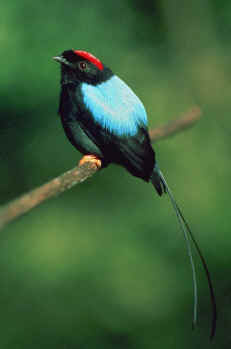
Photo at upper right: LONG-TAILED MANAKIN
Codes:
(t): a globally threatened or
rare species, designated by Birdlife International
(t1): critical
(t2): endangered
(t3): vulnerable
(nt): a near-threatened species
globally
(i): introduced species
(CRe): endemic in Costa Rica
(CRr): rare in Costa Rica
(ph): species with a photo in the FONT web-site
N: Northern CR
Birding Tours (in February, March, April, July, December-January)
S: Southern CR
Birding Tours (in January, February, March, July)
P: in Panama (adjacent to southern Costa Rica)
Links:
A List & Photo Gallery of Central American Birds, in 4 parts:
Part
#1: Tinamous to Doves
Part
#2: Macaws to Woodpeckers
Part
#3: Manakins to
Thrashers Part
#4: Thrushes to Buntings
Birds & Other Wildlife during FONT Tours in:
Northern Costa Rica Southern Costa Rica
Mammals
in Costa Rica (with some photos)
A
List & Photo Gallery of Butterflies
& Moths in Central America, in 6 Parts
Amphibians & Reptiles in Costa Rica & Panama
(with some photos)
Highlights
of some previous FONT Costa Rica Tours
UPCOMING
FONT TOURS in Central America, including Costa Rica
Directory of Photos in this Website

A recent & updated source of some information in the following list is
"The Birds of Costa Rica" by Richard Garrigues & Robert Dean,
published in 2007.
Another fine book, filled with interesting info, is "A Guide to the Birds
of Costa Rica" by F. Gary Stiles and Alexander Skutch. During our early
tours in Costa Rica we birded with Gary Stiles, and during a number of our
tours, over the years, we visited with Alexander Skutch at his Costa Rican home.
In this web-site, there is a feature about Mr. Skutch:
Alexander
Skutch - A Naturalist in Costa Rica
And another excellent book, deserving note here, is the "Hummingbirds of
Costa Rica" by Michael & Patricia Fogden, containing both good photos
and text.
Birds:
- Great Tinamou (*) ______ N S 26 feb,mar,apr,jul,dec/jan
Tinamus major fuscipennis
- Highland Tinamou (*) ______ N 3 mar
Nothocercus bonapartei frantzii
- Slaty-breasted Tinamou (*) ______ N 3 mar,dec/jan (another name has been
"Boucard's Tinamou")
Crypturellus boucardi costaricensis
- Little Tinamou (*) ______ N S 12 jan,feb,mar,jul,dec/jan
Crypturellus soui modestus
- Thicket Tinamou (*) ______ N 6 jul,dec/jan
(another name has been
"Rufescent Tinamou")
Crypturellus cinnamomeus praepes
- Gray-headed Chachalaca (*) ______ N S 18 jan,feb,apr,jul,dec/jan
Ortalis cinereiceps (monotypic)
- Plain Chachalaca (ph) ______
Ortalis vetula
The Plain Chachalacas
in Costa Rica is very rare in the northwestern lowlands
and more common in the hills of the Nicoya Peninsula.
- Crested Guan (*) (ph) ______ N S 19
jan,feb,mar,apr,jun,jul,dec/jan
Penelope purpurascens aequatorialis
- Black Guan (nt) (*) ______ N S 12
jan,feb,mar,apr,jul,dec/jan (total range limited
to Costa Rica & western Panama)
Chamaepetes unicolor (monotypic)
- Great Curassow (t3) (*) ______ N S 8 mar,jul
Crax r. rubra
- Buffy-crowned Wood Partridge (*) ______ N 1
jul
(another name has been Buff-fronted Wood Partridge)
Dendrotyx leucophrys hypospodius
- Spot-bellied Bobwhite (*) ______ N 14 mar,apr,jun,jul,dec/jan (has
been considered conspecific with the Crested Bobwhite, Colinus cristatus, of northern South America &
southern Central America)
Colinus leucopogon dickeyi
- Crested Bobwhite ______
Colinus cristatus
- Spotted Wood Quail (*) ______ S 4 mar
Odontophorus guttatus
- Marbled Wood Quail (*) ______ S 6 jan,feb,mar
Odontophorus gujanensis
- Black-eared Wood Quail (*) ______ N 3 jul
(was conspecific with the Rufous-fronted Wood-Quail of South America)
Odontophorus m. melanotis
- Black-breasted Wood Quail (nt) (*) ______ N
4 feb,mar
(total
range limited to Costa Rica & western Panama)
Odontophorus leucolaemus (monotypic)
- Tawny-faced Quail ______
Rhynchortyx cinctus
- Black-bellied Whistling Duck (*) (ph) ______
N S P 17
jan,feb,mar,jun,jul,dec/jan
Dendrocygna a. autumnalis
- Fulvous Whistling Duck (*) ______ N 2 jul
Dendrocygna bicolor (monotypic)
- White-faced Whistling Duck (ph)
______
Dendrocygna viduata
The White-faced Whistling Duck formerly occurred in Costa Rica. It has not
been seen there in nearly two decades.
- Muscovy Duck (*) (ph) ______ N 13 mar,jun,jul,dec/jan
Cairina moschata (monotypic, and single member of its genus)
- American Wigeon (ph) ______
Anas americana
- Northern Shoveler (*) (ph)
_____ N 1 mar
Anas clypeata
- Northern Pintail (ph) _____
Anas acuta
- Blue-winged Teal (*) (ph) ______ N S P 20 jan,feb,mar,dec/jan
Anas discors (monotypic)
- Cinnamon Teal ______
Anas cyanoptera
In Costa Rica, the Cinnamon Teal is a very rare winter visitor in the Palo Verde region
of Guanacaste, from November to March.
- Green-winged Teal (ph) ______
Anas carolinensis
In Costa Rica, the Green-winged Teal is a rare winter visitor.
- Ring-necked Duck (*) (ph) ______ S 1 mar
Aythya collaris (monotypic)
- Lesser Scaup (ph) ______
Aythya affinis
- Greater Scaup ______
Aythya marila
In Costa Rica, there was a sighting of 3 Greater Scaup in October 1974 in the Gulf of
Papagayo.
- Masked Duck (*) ______ S 5 feb,mar
Nomoyx dominicus (monotypic, and the single member of its
genus)
- Black-capped Petrel (t2) (CRr) (ph) ______
Pterodroma hasitata
The Black-capped Petrel rarely occurs off the Caribbean coast of Costa
Rica, more so further offshore.
- Galapagos Petrel (t1) ______ (was
conspecific with the Hawaiian Petrel, and was then called the Dark-rumped
Petrel)
Pterodroma phaeopygia
The Galapagos Petrel is probably a regular, but uncommon, visitor
off the Pacific coast of Costa Rica, including the vicinity of the Cocos
Islands. Sightings in Costa Rican waters have been from February to
September.
- Black Petrel (t3) ______ (another name
has been Parkinson's Petrel)
Procellaria parkinsoni
The Black Petrel is probably a regular, but uncommon, visitor off the
Pacific coast of Costa Rica, generally well offshore. Most records in
Central American waters have been in March & April.
- Sooty Shearwater (*) (ph) ______ N 1 jul
Puffinus griseus (monotypic)
The Sooty Shearwater occurs off the Costa Rican Pacific coast between May
& October.
- Pink-footed Shearwater (t3) (ph) ______
Puffinus creatopus
The Pink-footed Shearwater migrates offshore from the Pacific coast of
Costa Rica in May & June and in September & October.
- Wedge-tailed Shearwater ______
Puffinus pacifiicus
The Wedge-tailed Shearwater is a common to abundant visitor, occurring in
large flocks, off the Pacific coast of Costa Rica, mostly from January to
March.
- Short-tailed Shearwater (CRr) (ph) ______
Puffinus tenuirostris
There was a sighting, in optimum conditions, of a single Short-tailed
Shearwater 40 miles off the Pacific coast of Costa Rica in July 1978.
- Audubon's Shearwater (ph) ______
Puffinus lherminieri
The Audubon's Shearwater is rare, but probably regular, off the Caribbean
coast of Costa Rica.
- Galapagos Shearwater ______ (was
part of the Audubon's Shearwater)
Puffinus subalaris
The Galapagos Shearwater is uncommon throughout the year off the Pacific
coast of Costa Rica, with most sightings at the mouth of the Gulf of
Nicoya.
- Wilson's Storm Petrel (ph) ______
Oceanites oceanicus
The Wilson's Storm-Petrel sometimes occurs in good numbers off the Pacific
coast of Costa Rica, from April to August.
- Leach's Storm Petrel ______
Oceanodroma leucorhoa
The Leach's Storm Petrel occurs well off the Pacific coast of Costa Rica,
with sightings mostly from May to August,
- Black Storm Petrel ______
Oceanodroma melania
The Black Storm Petrel ranges from being uncommon to locally common off
the Pacific coast of Costa Rica. It is most numerous from October through
April. Notable wintering concentrations occur in the Gulf of Nicoya.
- Wedge-rumped Storm Petrel ______
Oceanodroma tethys
The race of the Wedge-rumped Storm Petrel that breeds in Peru is a regular
visitor to the Pacific coastal waters of Costa Rica, being most numerous
from July to November. During that time, it is the most common white-rumped
storm petrel in those Costa Rican waters.
- Band-rumped Storm Petrel ______
Oceanodroma castro
The Band-rumped Storm Petrel is probably a sporadic, perhaps seasonal,
visitor to Pacific waters off Costa Rica. It's generally well offshore,
unless storm-blown closer to the coast.
- Least Storm Petrel ______
Oceanodroma microsoma
The Least Storm Petrel breeds on islands off Baja California and winters
south to Ecuador. It occurs in Costa Rican waters, off the Pacific coast,
commonly from April to June and uncommonly from July to November. In the
Golf of Nicoya, it has been said to be common from December to
June.
- Markham's Storm Petrel (CRr) ______
Oceanodroma markhami
The Markham's Storm Petrel is probably a seasonal visitor to Pacific
waters well offshore from the Costa Rican coast, including the area of the
Cocos Islands.
- White-faced Storm Petrel (CRr) (ph) ______
Pelagodroma marina (the single member of its genus)
The White-faced Storm Petrel is probably a rare visitor to the Pacific
waters around the Cocos Islands, well offshore from the Costa Rican
mainland. It seems to be more regular further south, toward the Galapagos
Islands, in July & August.
- Pied-billed Grebe (*) ______ N P 9 jan,feb,mar,dec/jan
Podilymbus p. podiceps
- Least Grebe (*) (ph) ______ N S P 12 feb,mar,jul,dec/jan
Tachybaptus
(formerly Podiceps) dominicus brachypterus
- Eared Grebe (ph) ______ (also called
Black-necked Grebe)
Podiceps nigricollis
2 Eared Grebes in breeding plumage were on a glacial lake on Mount
Chirripo in April 1987.
- Wood Stork (*) (ph) ______ N S P 20
jan,feb,mar,apr,jul,dec/jan
Myceteria americana
(monotypic)
- Jabiru (CRr) (*) (ph) ______ N 6 mar,jul,dec/jan
Jabiru mycteria (monotypic, and the single member of its genus)
- Green Ibis (*) ______ N 11 mar,apr,jul,dec/jan
Mesembrinibis cayennensis
(monotypic, and the single member of its
genus)
- American White Ibis (*) (ph) ______ N S P 23 jan,feb,mar,apr,jul,dec/jan
Eudocimus albus
(monotypic)
- Glossy Ibis (*) (ph) ______ N 4 mar,jul,dec/jan
Plegadis falcinellus
(has been called monotypic)
- Roseate Spoonbill (*) (ph) ______ N 20 mar,apr,jun,jul,dec/jan
Platalea
(formerly Ajaia) ajaja (monotypic)
- Western Cattle Egret (*) (ph) ______ N S P 30
jan,feb,mar,apr,jun,jul,dec/jan
Bubulcus ibis
The Western Cattle Egret is in Europe, Africa, and the Americas.
The Eastern Cattle Egret, Bubulcus coromandus, is in eastern
Asia.
- Green Heron (*) ______ N S P 30
jan,feb,mar,apr,jun,jul,dec/jan
(was at one time
considered conspecific with the nearly cosmopolitan Striated Heron,
and
was then called Green-backed Heron)
Butorides v. virescens
- Striated Heron (ph) ______
Butorides striata
There were 2 recent sightings of Striated Herons in Costa Rica at Palo
Verde in October 2003 & February 2004.
- Little Blue Heron (*) (ph) ______ N S P 29
jan,feb,mar,apr,jun,jul,dec/jan
Egretta caerulea (monotypic)
- Tricolored Heron (*) (ph) ______ N S 23
jan,feb,mar,apr,jun,jul,dec/jan (a former name was
Louisiana Heron)
Egretta tricolor ruficollis
- Reddish Egret (*) (ph) ______ N 1 dec/jan
Egretta r. rufescens
- Snowy Egret (*) (ph) ______ N S P 28 jan,feb,mar,apr,jul,dec/jan
Egretta t. thula
- Great Egret (*) (ph) ______ N S P 29
jan,feb,mar,apr,jun,jul,dec/jan
Casmerodius (has been Ardea) alba egretta
- Great Blue Heron (*) ______ N S P 24 jan,feb,mar,apr,jul,dec/jan
Ardea h. herodias
- Agami Heron (nt) (CRr) (*) ______ N 4 mar,apr,jul (another name has been
Chestnut-bellied Heron)
Agamia agami (monotypic, and the single member of its genus)
- Rufescent Tiger Heron (*) (ph) ______ N 1 dec/jan
Tigrisoma l. lineatum
- Fasciated Tiger Heron (nt) (*) ______ N 3 mar,apr
Tigrisoma fasiatum salmoni
- Bare-throated Tiger-Heron (*) (ph) ______ N S 18 feb,mar,apr,jul,dec/jan
Tigrisoma mexicanum (monotypic)
- Black-crowned Night Heron (*) ______ N S P 13 jan,feb,mar,jul,dec/jan
Nycticorax nycticorax hoactli
- Yellow-crowned Night Heron (*) (ph) ______ N
16 mar,jun,jul,dec/jan
Nyctanassa v. violacea
(the single member of its genus)
- Boat-billed Heron (*) (ph) ______ N S 20 feb,mar,apr,jun,jul,dec/jan
Cochlearius cochlearius (the single member of its genus) (2 subspecies
in Costa Rica)
Cochlearius cochlearius phillipsi (north CR)
Cochlearius cochlearius panamensis (south CR)
- Pinnated Bittern (ph) ______
Botaurus pinnatus
- American Bittern ______
Botaurus lentiginosus
There were 2 separate sight records of American Bitterns in marshes along
the central Pacific coast in November 2003 & January 2004. Prior to
that, the species was unreported in Costa Rica for nearly a
century.
- Least Bittern (*) (ph) ______
N 1 mar
Ixobrychus exilis
- Red-billed Tropicbird (ph) ______
Phaethon aethereus
The Red-billed Tropicbird is a regular visitor in small numbers off the
Pacific coast of Costa Rica.
- Magnificent Frigatebird (*) (ph) ______ N S P
27
jan,feb,mar,apr,jun,jul,dec/jan
Fregata magnificens (now said to be monotypic)
- Great Frigatebird ______
Fregata minor
Great Frigatebirds
breed on Cocos Island, and occur rarely off the Pacific
coast of mainland Costa Rica.
- Brown Pelican (*) (ph) ______ N S P 25
jan,feb,mar,apr,jun,jul,dec/jan
Pelecanus occidentalis carolinensis
- American White Pelican (ph) ______
Pelecanus erythrorhynchos
- Brown Booby (*) ______ N S 6 feb,mar,jul
Sula l. leucogaster
- Blue-footed Booby (ph) ______
Sula nebouxii
- Red-footed Booby (ph) ______
Sula sula
- Masked Booby ______
Sula dactylatra
- Nazca Booby (ph) ______
Sula granti
- Neotropic Cormorant (*) (ph) ______ N S P 25 jan,feb,mar,apr,jun,jul,dec/jan (was called Olivaceous Cormorant)
Phalacrocorax brasilianus
(2 subspecies in Costa Rica)
Phalacrocorax brasilianus mexicanus (north CR)
Phalacrocorax b. brasilianus (south CR)
- Anhinga (*) (ph) ______ N P 16 feb,mar,apr,jul,dec/jan
Anhinga anhinga leucogaster
- Turkey Vulture (*) (ph) ______ N S P 30
jan,feb,mar,apr,jun,jul,dec/jan
Cathartes a. aura (another subspecies, C. a. meridionalis, from
central North America, migrates
thru Costa Rica, sometimes in large flocks)
- Lesser Yellow-headed
Vulture (*) (ph) ______ N
3 mar,jul
Cathartes burrovianus
(monotypic)
- Black Vulture (*) (ph) ______ N S P 30
jan,feb,mar,apr,jun,jul,dec/jan
Coragyps atratus
(now said to be monotypic) (the only member of its
genus)
- King Vulture (*) (ph) ______ N S P 21 feb,mar,apr,jul,dec/jan
Sarcoramphus papa (monotypic, and the single member of its genus)
- Northern Crested Caracara (*) (ph) ______ N S P 25
jan,feb,mar,apr,jun,jul,dec/jan
Caracara cheriway (monotypic)
- Yellow-headed Caracara (*) (ph) ______ N S P 15 jan,feb,mar,jun,jul
Milvago chimachima cordata
- Red-throated Caracara ______
Ibycter americanus
- Laughing Falcon (*) (ph) ______ N S 27 jan,feb,apr,jun,jul,dec/jan
Herpetotheres c. cachinnans
(the single member of its genus)
- Barred Forest Falcon (*) ______ N 4 mar,apr,jul,dec/jan
Micrastur ruficollis interstes
- Collared Forest Falcon (*) ______ N 10 mar,jul,dec/jan
Micrastur semitorquatus naso
- Slaty-backed Forest Falcon ______
Micrastur mirandollei
- American Kestrel (*) (ph) ______ N S 13 mar,jul,dec/jan
Falco s. sparverius
(subspecies from further north in North America
that winters in Costa Rica)
- Merlin (*) (ph) ______ S 1 mar
Falco c. columbarius
- Bat Falcon (*) (ph) ______ N S P 18 jan,feb,mar,jul,dec/jan
Falco rufigularis petoensis
- Aplomado Falcon (CRr) (*) (ph) ______ N 1 dec/jan (known only from a very
few Costa Rican reports during recent decades, all in the Palo Verde area of
the northwest part of the country - and that's where we saw ours)
Falco f. femoralis
According to "The Birds of Costa Rica" by Garrigues & Dean
(published in 2007), there have only been 3 reports of Aplomado Falcons in
Costa Rica in the last few decades, all of them in Guanacaste.
- Peregrine Falcon (*) (ph) ______ N S P 12 feb,mar,dec/jan
Falco peregrinus anatum (subspecies
from further north in North America that winters in Costa Rica)
- Orange-breasted Falcon (ph) ______
Falco deiroleucus
There were a few early Costa Rican records of the Orange-breasted Falcon
on the Caribbean slope, but there have not been any sighted in the country
since the 1950s.
- Osprey (*) (ph) ______ N S P 24 jan,feb,mar,apr,jul,dec/jan
Pandion haliaetus carolinensis
(the single member of its genus)
- Gray-headed Kite (*) ______ N S 8 feb,mar,jul,dec/jan
(another name has been
"Cayenne Kite")
Leptodon c. cayanensis
- Hook-billed Kite (*) ______ N 3 mar,dec/jan
Chondrohierax u. uncinatus
- Swallow-tailed Kite (*) (ph) ______ N S 23
jan,feb,mar,apr,mar,jun,jul
Elanoides forficatus (the single member of its genus) (2 subspecies
in Costa Rica, E. f. forficatus, & E. f. yetapa)
- Pearl Kite (*) ______ S
2 jan,feb (first reported in Costa Rica in the
mid-1990's; has since occurred along the entire Pacific slope)
Gampsonyx swainsonii leonae
During the FONT tour in southern Costa Rica in February 2004,
a pair of Pearl Kites were seen at their nest.
- White-tailed Kite (*) (ph) ______ N S P 29
jan,feb,mar,apr,jun,jul,dec/jan
Elanus leucurus majusculus
- Double-toothed Kite (*) ______ N S 11 feb,mar,apr,jul,dec/jan
Harpagus bidentatus fasciatus
- Plumbeous Kite (*) ______ N 9 mar,apr,jul
Ictinia plumbea (monotypic)
- Mississippi Kite (*) ______ N
1 mar
Ictinia mississippiensis
- Snail Kite (*) (ph) ______ N P 6 feb,mar,jul,dec/jan
Rostrhamus s. sociabilis
-
Crane Hawk (*) (ph) ______ N S 5 feb,jul,dec/jan
Geranospiza caerulesens nigra
(the single member of its genus)
- Northern Harrier (*) (ph) ______ N S 2 mar (in
Eurasia this species called Hen Harrier)
Circus cyaneus hudsonius
- Sharp-shinned Hawk (*) (ph) ______ N S 10 mar,dec/jan
Accipiter striatus velox
(subspecies from further north in North
America that winters in Costa Rica)
- Bicolored Hawk (*) ______ N S 6 feb,mar,dec/jan
Accipiter b. bicolor
- Cooper's Hawk (ph) ______
Accipiter cooperii
- Tiny Hawk (*) ______ N
1 mar
Accipiter superciliosus
- Barred Hawk (*) ______ N
9 feb,mar,apr,mar,jul (other names have been
"Black-chested
Hawk" &
"Prince Hawk")
Morphnarchus
(formerly
Leucopternis)
princeps
(monotypic)