
E-mail: font@focusonnature.com
Phone: Toll-free in USA 1-800-721-9986
or 302/529-1876
|
PO Box 9021,
Wilmington, DE 19809, USA E-mail: font@focusonnature.com Phone: Toll-free in USA 1-800-721-9986 or 302/529-1876 |
Highlights
FROM PREVIOUS
FOCUS ON NATURE TOURS
in the Dominican
Republic
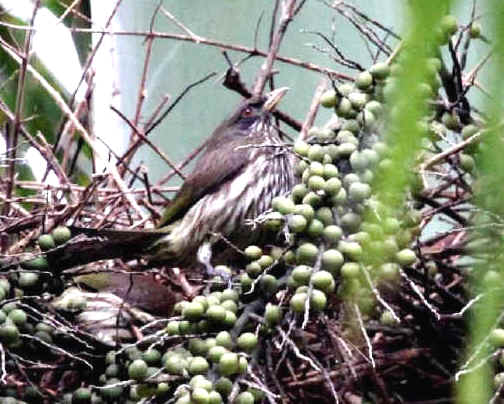
A Palmchat photographed during
the
FONT Dominican Republic Tour in February 2012
The
following summaries here are given with the most-recent tours first.
For some tours there are links below for longer narratives. Also there are links
to UPCOMING TOUR ITINERARIES and lists (some with photos) of BIRDS,
MAMMALS, and OTHER NATURE.
Previous Tours:
April 2012 February 2012 April 2008 April 2007 February-March 2007
April
2006
March
2003
February-March
2001
In all, there have been
19 FONT tours in the Dominican Republic.
Links:
A
Cumulative List of Dominican Republic Birds
A List & Photo Gallery of Caribbean Birds, in 2 Parts:
Part #1: Guineafowl to
Hummingbirds
Part #2: Trogons to Buntings
Mammals of the West Indies (with some photos)
Butterflies of the West Indies (with some photos)
Marine Life of the Caribbean_(including sea turtles, fish, corals, jellyfish, mollusks, & arthropods)
Upcoming FONT Birding & Nature Tours in the West Indies including the Dominican Republic
Dominican
Republic - April 2012
The following account written by Armas Hill, leader of
the tour:
In the Dominican Republic,
on the Caribbean island of Hispaniola, there
are some most interesting birds and other nature to see and enjoy.
And that we did during our tour there in April 2012.
A number of the birds (about 30 species) are endemic to that island of
Hispaniola. A number of them are rare. And others are simply good to see, such
as these during the tour: the White-tailed Tropicbird, West Indian Whistling
Duck, and the American Flamingo, Reddish Egret, Roseate Spoonbill.
Wilson's Plover, and Mangrove Cuckoo.
Among the birds that we saw both endemic to Hispaniola and rare was the Bay-breasted
Cuckoo. Also, the White-necked Crow, and the Golden Swallow.
Earlier, in the 20th Century, neither the crow nor the swallow
were Hispaniolan endemics. Now they are. The White-necked Crow was last
known in Puerto Rico in the 1960s. The Golden Swallow was formerly in
Jamaica.
There are two species of todies endemic to Hispaniola, the Broad-billed
Tody and the Narrow-billed Tody. Both were seen nicely during the
tour as was the Hispaniolan Lizard Cuckoo, the Hispaniolan Oriole and
the Hispaniolan Spindalis.
Neither the oriole nor the spindalis were Hispaniolan endemics
when we did the first FONT tour in the Dominican Republic about 20 years ago.
The oriole was then part of the Black-cowled Oriole in Central America,
and since then part of what was for a while the Greater Antillean Oriole.
The Hispaniolan Spindalis was part of the Stripe-headed Tanager
that was also in Jamaica, Puerto Rico, the Bahamas, the Caymans, and Cozumel
Island in Mexico.
A species that's endemic to Hispaniola, is also in a genus and even a family
endemic to the island. It is the only species in that Hispaniolan endemic genus
& family. It is the unique Palmchat.
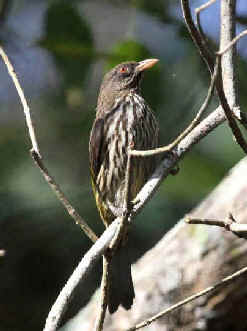
A Palmchat during the April
2012 Dominican Republic Tour
These birds, mentioned here, were just some of the interesting birds during our April 2012 Dominican Republic Tour. In all, we found 116 species of birds.
The Dominican Republic is also a wonderful
place in which to see butterflies. Nearly 200 species occur on the
island, and many of them are either species or subspecies that are endemic.
A most interesting group is one of satyrs known as calistos.
Radiating throughout Hispaniola are 35 species in the genus that have spread to
different parts of the island. 5 other species have become established on other
Caribbean islands.
During our April 2012 tour in the Dominican
Republic we saw about 30 species of butterflies. Notable among
them were 4 of the 8 species of swallowtails that occur on the island (4
are endemic), some swarms of Brephidium exilis isophthalma (the smallest
butterfly in North America), as well as these:
the Mosaic, Orion Cecropian, Pale Cracker, the
Two-spotted Prepona (with its beautiful pale blue coloration), the Malachite,
Julia, Zebra, and the Tiger Mimic-Queen.
Both the resident Monarch and the similar Soldier were seen.
Skippers included the Drury's Broken Dash, and we saw two members of
that interesting calisto genus: the Godart's and the Obscure
Calistos.
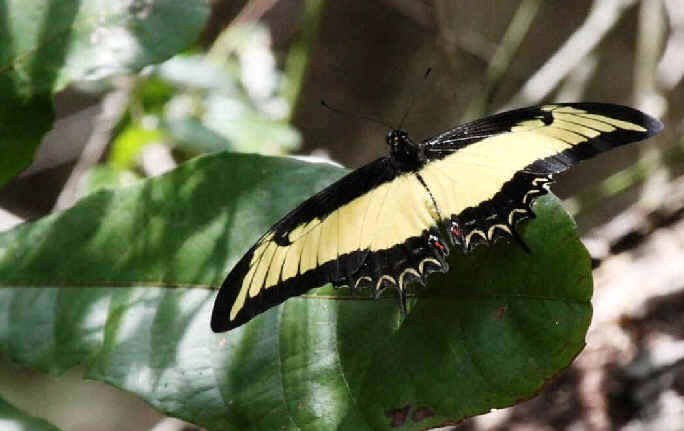
An Androgeus Swallowtail
during the April 2012 Dominican Republic Tour
There are a tremendous number of species of
amphibians and reptiles in the Dominican Republic. As many as about
170 species
of amphibians and reptiles occur.
Of those an incredible 120 species are reptiles, with most, in fact nearly all,
endemic to the island of Hispaniola.
And among those, over 40 species of Hispaniolan reptiles have been described to
science since the mid 20th Century.
During our April 2012 tour, a good number of Hispaniolan reptiles were seen,
mostly lizards, including various anoles, an ameiva, curlytails, and a rare
iguana.
Especially nice were the Red-fanned Stout Anole (a localized species described
as recently as 1975), the Hispaniolan Pale-bellied Curlytail, the Southern
Hispaniolan GreenAnole, the Hispaniolan Stout (or Large-headed)
Anole, and the
Hispaniolan Gracile (or Bark) Anole.
Some photos of these creatures, from the tour, can be seen in the link below,
referring to "Other Nature in the Dominican
Republic".
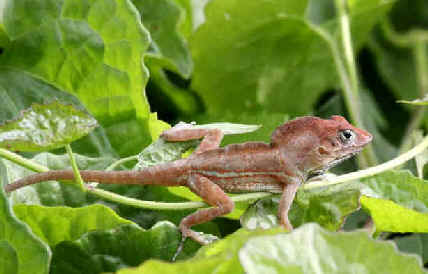
A Hispaniolan Stout (or
Large-headed) Anole
during our April 2012 Dominican Republic Tour
Links:
A
Photo Gallery of Dominican Republic Nature, Scenery, & Culture
during our April 2012 FONT Tour
Birds during FONT Dominican Republic Tours - February & April 2012
Dominican
Republic - February 2012
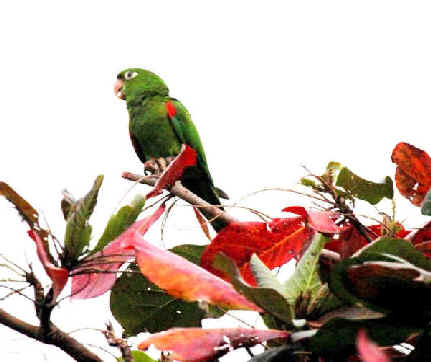
The Hispaniolan
Parakeet was one of the birds endemic to Hispaniola
that we saw during our February 2012 tour in the Dominican Republic
(photo by Marie Gardner)
The following account written by Armas Hill, leader of
the tour:
Among the birds during
the 18th FONT tour in the Dominican Republic,
in February 2012, was one that we've never
encountered previously, the Eastern Chat-Tanager, a skulker and a rarity,
and one of the least observed of Hispaniolan endemic birds.
Actually, the bird is 1 of only 3 of the over 30 Hispaniolan endemic birds that
is endemic to the Dominican Republic,
not occurring in Haiti, the other country on the island of Hispaniola.
The other 2 Dominican Republic endemics are the rare Ridgway's Hawk and
the Bay-breasted Cuckoo.
The Eastern Chat-Tanager was seen during our February
2012 tour as we spent some more time than usual in the high mountains
in the middle of the country known as the Cordillera Central. We birded
there mostly at an altitude of about 7,500 to 8,000 feet above sea level. The
highest peak in the entire Caribbean is in that area, at 10,319 feet above sea
level.
Another avian denizen that we encountered there was another bird that
does not lend itself to much observation, the secretive Bicknell's Thrush.
Nearly the entire population of that species winters on the island of Hispaniola, in
mountainous forests composed of pines and other highland plants.
Also in that area is the only populations of the Rufous-collared Sparrow
outside Central and South
America, as well as a very isolated resident population of the Pine Warbler,
a species otherwise in North America and in the nearby Bahamas.
In the Dominican Republic, on Hispaniola,
in the central mountains and elsewhere, there are a number of interesting birds,
including endemic species and subspecies, with rarities among them, that we
enjoyed during our tour, along with some other nature also endemic and rare.
Links:
A Photo Gallery of Dominican Republic Nature, Scenery, & Culture
during the February 2012 FONT Tour

Dominican
Republic - March/April 2008
The following account written by Armas Hill, leader of
the tour:
During this, the 17th FONT birding & nature tour on the Caribbean
island of Hispaniola, we had the best look we've ever had of the Western
Chat-Tanager - a wonderful look of a bird that's normally a skulker, very
hard to see. Another nice sight for us a line of about a dozen Hispaniolan
Crossbills, drinking at the edge of a pool of water in a pine forest. These
2 rare species were among about 120 different birds that we saw during our tour.
Many of them were interesting in not only being rarities, but also as either
endemic species or subspecies found nowhere else in the world other than on that
single Caribbean island. Our travel, and our quest for birds, on the island took
us from the sea coast, and a desert even below sea level, to an elevation as
high as 7,000 feet up in the mountains, including the area in the pines where we
watched the crossbills.
The "Top
Birds" of our March/April 2008 Dominican Republic Tour, as voted for by the
participants after the tour, were:
1 - Western Chat-Tanager
2 - Broad-billed Tody
3 - White-tailed Tropicbird
4 - Hispaniolan Trogon
5 - Golden Swallow
6 - Hispaniolan Crossbill
7 - American Flamingo
8 - Northern Potoo
9 - Antillean Piculet
10 - Least Poorwill
11 - Hispaniolan Lizard Cuckoo
Links:
List of Birds during the FONT Dominican Republic Tour - March/April 2008
DOMINICAN REPUBLIC (& adjacent Haiti) -
April 2007
The following account written by Armas Hill, leader of the tour:
This was the second FONT tour in the Dominican Republic in 2007, and our 16th
tour there in all.
During this tour, we found 124 species of birds,
including most of the endemics, rarities, and specialties.
Among them were: the
LaSelle Thrush, Hispaniolan Crossbill, and Golden Swallow.
Always good to see,
as they were again, in the Dominican Republic were: the Hispaniolan Trogon, both
of the Todies (the Broad-billed & the Narrow-billed), the
Antillean Piculet,
and the Flat-billed Vireo.
At dusk, one evening, we encountered both the Least
Poorwill and the Hispaniolan Nightjar.
In April, some birds that had wintered in
South America had arrived such as the Antillean Nighthawk and the Least
Tern.
Additionally, there were migrants, and the resident breeding birds were in song
on territory.
At the shore of the large lake, Lago Enriquillo, about 200 feet
below sea-level, in addition to American Flamingos and other waterbirds, there
was, on land, the rare Rhinoceros Iguana.
Link:
List of Birds during the FONT Dominican Republic Tour - April 2007
DOMINICAN REPUBLIC (& adjacent Haiti) - February/March 2007
The following account written by Armas Hill, leader of the tours:
This was the 15th
FONT birding & nature tour on the Caribbean Island of Hispaniola, where a
number of rare & endemic birds occur, along with various Caribbean
specialties.
Over 100 species of birds were found during this tour, including
most of the endemics. 2 species during this tour were "new" for our
cumulative Dominican Republic list, bringing it up to 185. Those 2 species were Brown
Booby and Wilson's Phalarope (the latter a vagrant on Hispaniola).
As
we've done in the past, we visited the Haitian border where we saw some birds in
that country.
In addition to birds during the tour, we saw the rare Rhinoceros
Iguana (endemic to Hispaniola), the Buffy Flower Bat, and a fine
assortment of butterflies. (Another FONT tour Dominican Republic tour took place
later in 2007 in April.)
Link:
Birds & Other Wildlife during the FONT Dominican Republic Tour - February/March 2007
DOMINICAN REPUBLIC (& adjacent Haiti) - April 2006
During
this, our 14th tour on the Caribbean island of Hispaniola,
we did well with the interesting rare
& endemic birds of the island, including a number of them with the adjective
"Hispaniolan".
Notable among them was the Hispaniolan Quail-Dove
(1 of 3 quail-doves during the tour).
On the rare Golden Swallow, a fine sight was its golden sheen in the
sunlight.
As the sun was setting one day, from a small boat with the motor off, on a lake,
we looked at nicely-lit Caribbean Flamingos walking in shallow water.
After dark, another day, we saw an Ashy-faced Owl, and then, moments
later, a rarely-seen creature also endemic to Hispaniola, an odd mammal called
the Hispaniolan Solenodon (over a foot-long, with a long snout &
long tail, as it passed in front of our vehicle)!
Links:
More
about the FONT Dominican Republic Tour in April 2006
List
of Birds during our Dominican Republic Tour - April '06
To
Top of Page
Our
CARIBBEAN TOURS - February-March 2001
in
Again, in 2001, we had some very good birding during FONT tours in the Caribbean.
Just imagine - in the West Indies, sitting by a pool of water high in the pine-clad mountains of the
Dominican Republic, and watching about a dozen Hispaniolan White-winged Crossbills drinking at the waters edge. And with them, some colorful Andean Siskins.One day earlier, from a boat floating quietly on a nearby lake, imagine being surrounded by pink flamingos walking at times, in unison, and even-pinker Roseate Spoonbills moving their bills back-and-forth in the water as they fed, in the distance, endemic White-necked Crows were going to their evening roost in the palms.
The day before that, two species of todies, both of them bright and perky, were seen from along the same road - one in dry lowland shrub, the other in highland forest. Somewhere in between, along that road, there were in one tree, parrots, parakeets, and trogons.
Also during the
Dominican Republic tour there were birds such as tiny Vervain Hummingbirds, sitting and calling atop high perches, the rare (and rarely seen) La Selle's Thrush, and the unique Palmchat.
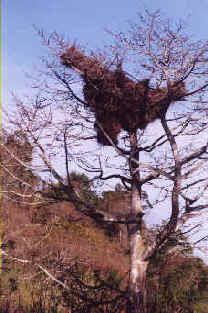
A huge,
abandoned nest of a colony of Palmchats,
in the Dominican Republic, near the
Haitian border.
The bird is endemic to Hispaniola.
(Photo by Jennie Gaitskill,
during FONT birding tour, March 2001.)
Not an Hispaniolan endemic bird, but
particularly memorable to see during the March 2001 tour was a pair of
Prothonotary Warblers in a city botanical garden, close at hand - the male
displaying for the female, walking on a branch above a still stream, spreading
his tail. On the water, below, there were a pair of Least Grebes, with
chicks, ever so least - small bundles of striped fluff riding on the back of one
of the adults.
On the other side of the stream, there stood a Limpkin.
Memorable to hear, at another time during the tour, in the mountain forest, were
the echoing flute-like calls of the Rufous-throated Solitaire.
The
Puerto Rico Birding Tour, the previous week, had memorable moments, as well. During that tour (the 23rd Puerto Rico tour for FONT), all but one of the island's endemic birds were found - from the skulky Elfin Woods Warbler to the sometimes boisterous Lizard-Cuckoo. Other birds found included Masked Duck, on a pond with White-cheeked Pintails, and a Key West Quail-Dove.During the
FONT Jamaica Birding Tour this year, all of the endemic birds were found, including the often-elusive Jamaican Blackbird, and the Crested Quail-Dove. The latter, known locally as the "Mountain Witch", was seen very well - on the ground just feet away from us.During our tour on the
Cayman Islands, all of the bird specialties sought were found - the parrot, warbler, vireos, and bullfinch. And more from 2 to 3 hundred "rare" West Indian Whistling-Ducks.
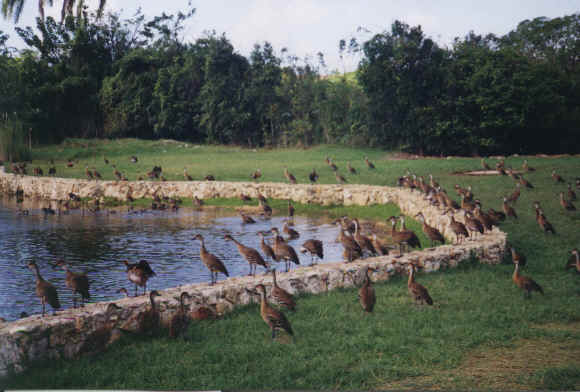
West Indian Whistling-Ducks,
many places can be hard to see,
but not here at this pool on the Cayman
Islands.
(Photo during FONT Feb. 2001 tour by Susan D'Amico)
Also seen during the FONT 2001 Cayman Islands Tour was a lone duck (actually a drake) certainly rare (more aptly, unheard of) in the Caribbean a male Baikal Teal, among many (hundreds of) Blue-winged Teal. With the Baikal behaving just as were the Blue-winged.
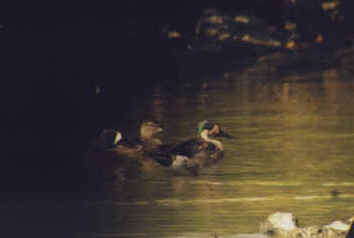
A male Baikal Teal (right)
with male & female Blue-winged Teals
thru a telescope during FONT birding tour
on Little Cayman Island in the Caribbean, Feb. 24, 2001.
(Photo courtesy of Susan D'Amico.)
Not far from the Baikal Teal, on Little Cayman Island (10 miles long and 1 mile wide), and certainly more expected there, were numerous Red-footed Boobies (of both color morphs) and Magnificent Frigatebirds at their breeding colonies. Some males with big red sacs. Elsewhere, White-tailed Tropicbirds were seen (in flight among the seacoast).
Birding in the Caribbean is fun.
Upcoming
FONT Birding & Nature Tours in the Caribbean
To
Top of Page
