PO Box 9021, Wilmington, DE 19809, USA
E-mail: font@focusonnature.com
Phone: Toll-free in USA, Canada, & Puerto Rico 1-800-721-9986
or 302/529-1876; Fax: 302/529-1085
PO Box 9021, Wilmington, DE
19809, USA
E-mail: font@focusonnature.com
Phone: Toll-free in USA, Canada, & Puerto Rico 1-800-721-9986
or 302/529-1876; Fax: 302/529-1085
HIGHLIGHTS
FROM FOCUS ON NATURE TOURS in 2005
With
tour narratives, photos, comments by participants, and links to lists of birds
& other nature during the tours.
INCLUDED
HERE ARE BIRDING & NATURE TOURS THAT WERE CONDUCTED IN:
BRAZIL (2 tours in Aug/Sep
'05), CHILE, COSTA
RICA (2 tours: winter & spring), GUATEMALA (2 tours: spring &
winter), JAPAN
(2 tours: winter & spring), and SPAIN.
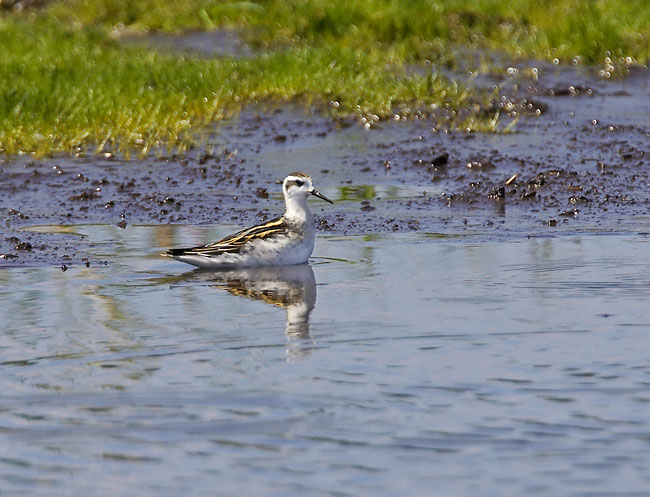
Red-necked Phalarope,
as seen during our West Coast USA Tour in Sept 2005.
Flocks of these birds spinning on ponds at Point Reyes, California
were a fine sight to see.

The tour summaries here are given with the most-recent tours first.
For some tours there are links below for longer NARRATIVES. Also there are links
to UPCOMING TOUR ITINERARIES, and LISTS relating to BIRDS, MAMMALS, & OTHER
NATURE.
Links to tours:
GUATEMALA (December 2005/January 2006)
SPAIN (& Portugal) (September/October 2005)
WEST COAST USA (Washington State & central California) (September
2005)

Guatemala
- December 2005/January 2006
Our annual Holiday Tour in
December 2005/January 2006 was again in the highlands
& lowlands of Guatemala, at again a wonderful time of year to be in that
part of world.
A
couple months earlier, in Oct 05, particularly in the highlands, there had been
some destruction due to severe weather (Hurricane Stan). But during our tour, the
weather could not have been better.
And the birds were fine too.
In the
highlands, among the best were the adult male Sparkling-tailed Woodstar, the
Prevost's Ground Sparrow, and the Pink-headed Warbler, a perennial favorite.
In
the area of the Mayan ruins of Tikal, birds ranged from the large, such as the
Great Curassow (great looks!) to the small & colorful, such as the
Manakins.
The males of the White-collared & the Red-capped were favorites.
Links:
List of Birds during our Guatemala Holiday Tour - December '05-January '06
List of Birds during FONT Tours in Guatemala (with photos)
Upcoming FONT Birding & Nature
Tours in Guatemala
Chile
- November 2005
During our 16th birding
tour in Chile, in November 2005, well over 200 species of birds were found.
Among them were some
large ones:
a Northern Royal Albatross (with a very large nearly 12-foot
wingspan),
the Andean Condor (the largest American flying bird),
the Giant
Hummingbird (the largest of the hummingbirds),
and a Cocoi Heron (the largest of
the American herons).
Again, as always, we did a pelagic trip from Valparaiso
(during which the Northern Royal was 1 of the Albatrosses
seen).
Areas visited
included the Andes in central Chile and far-northern Chile, and in the south,
the Lake District and Chiloe Island, where we enjoyed 2 species of penguins and
other maritime birds.
Links:
List of Birds during our Chile Tour - November '05
Cumulative list of Birds during our previous Chile Tours
Upcoming
FONT Birding & Nature Torus in Chile
Spain
(and adjacent Portugal) - September/October 2005
During this tour, mostly
for birds and other nature on earth, we also saw in the sky an annular eclipse
of the Sun. A good show. It was the 7th solar eclipse during a FONT tour, since
1991.
Birds during the tour (about 150 species of them) included migrants
& residents, ranging from Dunnock, Dunlin, Dipper, & Dotterel, to
Chaffinch, Chiffchaff, & Chough.
Links:
List of Birds during our Spain Tour - Sept./Oct. '05
Birds during our FONT tours in Spain & the Canary Islands
Solar Eclipses during FONT Tours
Upcoming
FONT Birding & Nature Tours in Spain
West
Coast USA (Washington State & California) - September 2005
During our West Coast
USA tour in September 2005, our 13th since 1991, again, as it had been done in
the past, the first half of the tour was in Washington State and the second half
was in central
California.
During the pelagic trip as part of the tour this year from Monterey,
CA, there were a couple extraordinary sightings: one, of a rare Hawaiian
Petrel,
and the other an incredibly good view of 8 Baird's Beaked Whales floating
together on the surface of the ocean.
In all, nearly 200 species of birds were
seen, which brought our cumulative-list for this tour up to 327.
Cumulatively, with
a few additions in 2005, 59 species of mammals have been seen during our
West Coast USA tours.
Links:
More about the FONT West Coast US Tour in September 2005
List of Birds during our West Coast USA Tour - Sept. '05
Cumulative list of Birds during our previous West Coast USA Tours
Mammals
during our West Coast USA Tours
Upcoming FONT Birding & Nature Tours in North America
An East Coast USA Pelagic Trip from Barnegat Light, New Jersey - September,
2005
During this trip, 25 Audubon's Shearwaters
and
2 Long-tailed Jaegers, in addition to a number of marine mammals, were seen.
Brazil (the
Atlantic & Amazonian Forests) -
August/September 2005
During our FONT 38th tour in
Brazil, in August/September 2005, areas of the Atlantic Forest in southeast Brazil and
the Amazonian Forest near
Manaus were visited.
In the latter, we made 3 visits atop tall towers in the
forest to view birds of the canopy. There were boat-trips in both the light
water of the Amazon channels and in those with dark water of the Rio Negro.
Avian highlights of this tour included fine looks at Guianian Cock-of-the
Rocks, the large, beautiful hummingbird known as the Crimson Topaz, and the
Pompadour Cotinga.
During the combination
of this and our August 05 tour in Mato Grosso & in SE Brazil, over 500
species of birds were found, along with interesting mammals and other
nature
too.
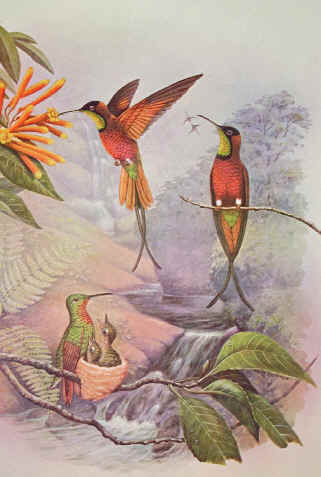
Crimson Topaz
Brazil
(Mato
Grosso & SE Brazil) - August 2005
During this tour, there
were some large flocks of birds, including:
hundreds of Jabirus in one morning, big groups
of Ducks including Whistling (3 species), Comb, Southern
Pochard, and Masked, and there were some exciting specialties such as
Hyacinth Macaw in the Pantanal, and a colorful
assortment of tanagers, euphonia, and chlorophonia at feeders at Itatiaia
National Park in southeast Brazil.
Mammals were good also with as many as 8 Giant Anteaters and a wonderful look at
an Ocelot.
Arizona
- July 2005
This tour was at a prime time of the
year for Hummingbirds, and we saw many, including some "good ones" for
the US, such as: the Lucifer, White-eared, and Violet-crowned.
In all, over a
dozen species of hummingbirds were seen, as were other birds including the Elegant
Trogon, Five-striped Sparrow, and even the distinctive race of the Bobwhite, known as the
"Masked
Bobwhite", that's very rare where it continues locally in Mexico and where it has
been re-introduced in the US only in far-southern Arizona.
Costa Rica (mostly northern) - July 2005
This tour was our 26th in Costa Rica, and
our 3rd there in the summer, at a time when teachers and others could go,
instead of during the winter & spring when otherwise they could
not.
Among the bird highlights of the tour were: Amami Heron, Jabiru, both Scarlet
and Great Green Macaws, King Vulture, Pygmy Kingfisher, Long-tailed Manakin, and
over 25 species of hummingbirds including the Snowcap.
During May 2005, we did our 25th
FONT tour in Japan, which was our
Spring Birding Tour including visits to a number of small islands, that are most interesting
for birds.
The smallest of these islands, Hegura, is with the most birds.
Other
islands, Okinawa and Amami, each has some extraordinary specialties.
Also there
was birding on 2 of the main Japanese islands, Honshu and Kyushu, the latter
with the beautiful Fairy Pitta.
During this tour we traveled across the big state
of Texas, with its many birds (the most birds of any US state, of course - it's
Texas!). We began by the Gulf of Mexico and went all the west to Big Bend
National Park and El
Paso.
In all, 266 species of birds were found during the tour, with good flights of
migrating warblers and other birds by the Gulf, and the Colima Warbler as other
specialties in the Chisos Mountains at Big Bend.
In between we had wonderful looks at the two foremost avian specialties of
Texas: the Golden-cheeked Warbler and the Black-capped Vireo.
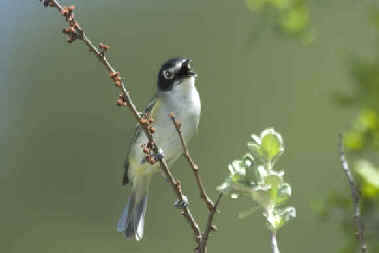
Black-capped
Vireo
Colorado
(& adjacent states) - April 2005
This tour is designed to see grouse
at
their lekking grounds, where they perform early in the morning.
For us, in April 2005, these included the 2 Prairie-Chickens, the Sharp-tailed, Blue, Greater
Sage, and Gunnison Sage Grouse. Each species, and each morning, presented a
different experience.
Grouse are not the only birds during this tour, as we
skirted around the beautiful state of Colorado, and dipped into some of the
adjacent states.
Among the other birds: Mountain Plover, McCown's &
Chestnut-collared Longspurs, and Brown-capped Rosy-Finch. Among the 28 species
of mammals: Badger, Moose (including a mother & adolescent),
and another
creature with Gunnison in its name, the Gunnison Prairie Dog.
This tour was in the highlands &
lowlands of the country.
There were many birds, ranging from the large to the
small, for example, from the Great Curassow to the Stub-tailed Spadebill.
Birds
included both residents & migrants. On Temple IV at the Mayan ruins of Tikal,
there was a pair of Orange-breasted Falcons. Next to the temple, a bare tree was
filled with more than a dozen smaller birds with orange breasts. Like ornaments,
they were Baltimore Orioles, resting before they would continue on their
northward journey. Over 300 species
of birds found during the
tour.
Our Winter 2005 Japan Tour was with
Blakiston's Fish-Owl, both
Steller's & White-tailed Eagles, and 6 species of cranes, Black-faced
Spoonbill, and an Okinawa Rail seen well.
And more, from Gyrfalcon in the north
to the rare Pryer's Woodpecker in the south.
Costa Rica (southern) - January 2005
This tour with tropical birds as large as
the Scarlet Macaw, as small as the Pygmy Kingfisher, as rare as the
Yellow-billed Cotinga, and as common as the Cherrie's Tanager.
Also: Pearl Kite, Red-breasted Blackbird, Savanna Hawk, and some others more
common in adjacent Panama than in Costa Rica.
Among the mammals, the Red-backed (or Central
American) Squirrel Monkey.
CHILE -
November 2005
Links:
List of Birds & Other Wildlife during the FONT Chile Tour - November 2005
Birds
of Chile (with
photos)
Mammals of Chile (with
photos)
Albatrosses & Other Seabirds during FONT Chile Tours (with photos)
Upcoming
FONT Birding & Nature Tours in Chile
The following account was written by Armas Hill, leader
of the tour:
As part of the November 12-25, 2005 FONT Chile Birding & Nature Tour, there was, on
November 14, a half-day pelagic Trip from Valparaiso. It was the 16th such pelagic trip for FONT. During most years, since 1990, this pelagic trip has been in November.Over the years, many seabirds have been seen during this
Valparaiso pelagic. Some years, the number of birds has been quite high, when there have been thousands of Sooty Shearwaters and thousands of phalaropes. This year, that was not the case, as the number of Sooty Shearwaters was small, and no phalaropes were seen. Some years, the waters of the Humboldt Current off Chile have been filled with seabirds that reside there exclusively. Species in that category include Guanay Cormorant and Peruvian Boobies. This year, numbers of both of those species seemed to be lower than usual.The ocean off the Chilean coast can have not just high numbers of birds, but also a good variety of species. During our trip this year, there was an excellent variety, even though, as noted, some of the numbers, that given day, were down.
Seabirds come to that area of the Pacific Ocean, off Chile, from various places far away. Some of the Albatrosses (including the Salvin's and the Buller's) come from New Zealand, on the opposite side of the Southern Pacific. Other birds also come from there, including the rare Westland Petrel.
During our Chile Valparaiso pelagic this year, the bird that was the highlight came from New Zealand, where the species breeds. It was the Northern Royal Albatross. We've previously seen the Southern Royal Albatross during our trips over the years (at least once, maybe twice), but this was the first time for the Northern. What an exciting bird our Northern Royal Albatross was to see. It's big, very big. Its wingspan is as much as 138 inches. That's 11-feet, 6-inches, meaning that each wing is as much as 5-feet, 9-inches, the height of many people.
We saw the Northern Royal Albatross well, with those long wings in flight, and also as it was resting near us on the water. When the bird would take off from the water to fly, each time we watched its feet patter along the surface for 2 or 3 seconds, before the bird would become airborne. Our Northern Royal Albatross on Nov. 14, '05 was an immature bird.
When it was resting on the water near us, next to the Salvin's Albatross, the Northern Royal dwarfed that species, which is no small bird itself. The wingspan of the Salvin's Albatross is as much as 98-inches, or about 8-feet, or 4-feet per wing. We saw a few Salvin's Albatrosses, during our trip. And, there was yet another Southern Albatross, the Black-Browed.
During our Chile Pelagic Trips, since
1990, we've seen 9 species of Albatrosses:
Northern Royal
Southern Royal
Black-browed
Salvin's
Shy (or White-capped)
Chatham
Buller's
Gray-headed,
and Waved.
Other seabirds during our Nov. 14, 2005
pelagic, from Valparaiso, Chile were:
the Westland Black Petrel (as noted, from New Zealand), the White-chinned,
and Cape Petrels (the latter known as the Pintado), the DeFilippi's
Petrel (a pterodroma very similar to the Cook's Petrel), the Southern
Giant-Petrel (one followed us nearly all the way back to shore), the Southern
Fulmar, the Pink-footed and Sooty Shearwaters, the Humboldt
Penguin, Peruvian Booby and Peruvian Pelican, Guanay and Red-legged
Cormorants.
Gulls
included the Kelp, and this year many Franklin's Gulls. It's
interesting how Franklin's Gulls can be on the ocean off the Chilean
coast, revising their life-style in the Southern Hemisphere. In the Northern
Hemisphere, of course, they breed far from the sea, in the interior of the
United States and Canada. A Sabine's Gull was also with the seabirds
around our boat off the Chilean coast, where we also saw an astonishing 6
species of Terns Common, Arctic, South American, Trudeau's, Elegant, and Inca.
It was a good day at sea. And the rest of our tour, on land, throughout Chile,
was good too.
During the tour, actually a number of large birds were seen, in addition to the
Northern Royal and Salvin's Albatrosses just mentioned. The Peruvian Pelican
(also called the Chilean Pelican) is large. Its wingspan is 90 inches,
or just
under 8 feet. (As a comparison, the closely-related Brown Pelican of mostly North
America has a wingspan of 84 inches; but the American White Pelican is larger,
with a wingspan of 108 inches.)
During our Chile tour, again in '05, the largest of all American flying birds
was seen, the Andean Condor. Its wingspan is as much as 122 inches, or just over
10 feet. We enjoyed watching condors in the mountains as they soared seemingly
without effort in the sky, and as one landed on a cliff-ledge not too far away. We
watched that bird there through a telescope.
Also large in their categories, during our tour, were two birds named
"Giant". The Giant Coot, on the high-altitude Andean lakes of
far-northern Chile, is aptly the largest of the coots (and it has big
"over-sized" red-legs and feet). And the largest of all of the over 300 species of hummingbirds in the Americas, was sought & seen, the
Giant Hummingbird. That big hummingbird is as long as 8 to 9 inches, nearly as
long as an American Robin (or other comparable thrushes throughout the
world).
Yet another notable large bird was seen, in the northern part of the Lake
District of southern Chile. It was a Cocoi Heron, the largest of the American
herons. That bird was also a first - the first of that species ever seen by us
in Chile, during our 16th tour in that
country.
We had another "first" during '05 Chile Tour (in addition to the fore-mentioned Northern Royal Albatross and the Cocoi
Heron). Among a flock of
Whimbrel, along the seacoast north of Valparaiso, we saw our first Marbled
Godwit in Chile. That's rather far south for that species. It occurs sparingly
as far south as along the Pacific coast of northern South America. According to
"the book" (the "Birds of Chile" field guide by Alvaro
Jaramillo), the Marbled Godwit is a vagrant in Chile, with about 5 previous
records.
There were some other birds during our tour that may well have been the
"furthest south" for the species at the time. They were in
far-northern Chile. In Putre, a town high in the Andes, a Sparkling Violetear was where we've seen it in
previous years. In Arica, we saw 2 Killdeer. That species certainly does not get
much further south (if at all). In that same river valley, near Arica, we saw a
lone Groove-billed Ani sitting near the top of a bush. It was unusual in
that it was by itself (anis are usually in flocks), and also
because it may have been the "southernmost ani" as it sat there much
like a partially-hidden sentinel.
A bird that was south of where it belongs (again according to "the book",
Jaramillo's guide to the "Birds of Chile") was a Spectacled
Tyrant that we saw on Chiloe Island in southern Chile. There was no mystery as
to the identity of the bird as it sat, continuously, in clear view on the top of
a shrub.
Seeing that tyrant was just one of the nice
aspects of our visit to Chiloe Island. It was our first time to that rural,
pastoral island, along the southern Chilean coast. For much of that day, the sky was a clear
blue, and the fields and pastures were as green as Ireland. From the ferry to
the island (that's the only way to get there), penguins were propelling in the
water close to the boat. Sea-lions came in and began to do the same. Sooty
Shearwaters, White-chinned Petrel, Peruvian Pelicans, and various gulls and
terns were flying above the surface of the water. On the water, we had good
looks at Imperial Shags (beautiful black-and-white cormorants). Along the
shoreline as we approached the island, there were dozens of swans that were also
black-and-white. In the bright sunlight on the water, those Black-necked Swans
were a wonderful sight.
On the island, we visited, in a spectacular setting along the seacoast, an
interesting penguin colony where 2 species breed. It was fun to watch both the
Magellanic and the Humboldt's Penguins, on the slopes of the islands, on the
rocks, and particularly as they were leaping from the surf of the sea to the
rocks. Also nice to see, at that site, were Rock Cormorants, Flightless
Steamer-Ducks, and Kelp Geese, including a family of the last of
these with the all-white male, the
attractive dark-brown & white female, and the small all-white goslings.
During our visit to Chiloe Island, we had a "full-deck" of Oystercatchers, 3 species:
Magellanic, Blackish, and American. And, it was also
nice to see, on Chiloe Island, the Chiloe Wigeon. That's a name of a duck also
known as the Southern Wigeon. But something seems special about seeing it on the
island, as it's the only bird so-named (although there are a few birds, of
various kinds, with distinctive subspecies on Chiloe). Wherever that wigeon is
seen, it should noted, however, that in the sunlight the male is beautiful with
its pattern of black, white, and tan, and the shining green on its head.
For our future visits to Chiloe Island, there are yet other experiences to be
had. Along the seacoast, there's a rare animal, the Marine Otter, a
close relative of
the Sea Otter of the Northern Hemisphere. And, from the Northern Hemisphere,
about 25% of the world's Hudsonian Godwits winter on Chiloe Island. Also,
there's a national park with verdant forest in which birds such as the
Magellanic Woodpecker and Black-throated Huet-Huet (a tapaculo) reside.
Where one arrives by ferry on Chiloe Island, there's a town named Chucao. That's
also the name of a tapaculo in southern Chile. We didn't see a tapaculo in that
town (one wouldn't), but we did have some tremendous looks at the Chucao
Tapaculo, in the forest of the Lake District. Other highlights in that area
included the Torrent Duck along a rushing river, and in the more-open country,
flocks (numbering hundreds) of Slender-billed Parakeets in the trees, and a very
large flock of Chilean Pigeons (ruddy with their white collars) on the ground.
Both of these species, the parrot and the pigeon, are endemic to Chile, and both
are classified as being globally "near-threatened" species.
Chile is certainly a land of contrasts. In that long, narrow country, it's like
an inverted trip from British Columbia to Baja
California. As green as Chiloe is in the south, Arica,
in the far-north is brown. In the nearby Atacama Desert,
it's said that it never rains. In parts there, it's just dirt. As one ascends
into the higher elevations of the Andes, the vegetation increases, first with only a
few cacti, then with more shrubs and alpine plants. On those plants, the
Guanacos and Vicunas feed. At the high-altitude lakes, there are flamingoes,
grebes, ducks, and shorebirds of various kinds. Smaller landbirds are
a cast of characters only in the high country, including various cinclodes and canasteros,
along with sierra-finches and others. Another animal there is the odd
Viscacha, with the ears of a rabbit, and the tail of a squirrel.
Back down at Arica, at virtually sea level, Gray Gulls in numbers,
noisily made their presence known along the coast. When them, also in large
numbers, were Elegant Terns and Franklin's Gulls. On coastal
jetties, there were Turnstones and Surfbirds. Birds such as the Franklin's
Gulls and Surfbirds came from North America where they nested. In
contrast, the Gray Gulls only came from their nearby breeding sites in
the rainless, treeless, Atacama Desert. They are the only birds to nest there.
Near brown Arica, there's one place,
visited during our last day, that's filled with colorful flowers - and
"filled with" hummingbirds. 3 species were there: the
most-common of them the Oasis Hummingbird; also the Chilean Woodstar and
the Peruvian Sheartail (the male of the last of these is quite a sight!).
It's interesting that the little Chilean Woodstar is probably endemic not only to Chile, but
to Arica! It's just one of the wonderful birds to be found in Chile, where, as
noted, it's like going from British Columbia to Baja California in reverse, with
also some high Andean mountains and some albatrosses on the ocean thrown in for good
measure.
Chile was the first far-away place to be visited during a FONT tour, back in November
1990. Now, 15 years later, it was great to be there again in 2005.
Here are "Top Birds" of the November 2005
Chile Tour, as voted after the tour:
1 - Northern Royal Albatross
2 - Penguins (both species: swimming, standing, jumping, whatever
they were doing)
3 - Striped Woodpecker
4 - Spectacled Tyrant
5 - Many-colored Rush-Tyrant
6 - Torrent Duck
7 - Silvery Grebe
8 - Chucao Tapaculo
9 - Inca Tern
10 - Andean Condor
First runner-up: the family of Kelp Geese

SPAIN -
September/October 2005
The following account written by Armas Hill, leader of the tour:
Spain has been, for years, one of our favorite FONT destinations. As we travel throughout the country, there's so much to experience. In addition to the nature, and the birds (of which there are many, the most to be seen in Europe), there's also the culture, the history, and the cuisine. And there's the varied topography, as well, with mountains, rolling plains, desert, and even, along the Mediterranean coast, a delta with rice paddies. Our September/October '05 Tour was the 23rd FONT tour in Spain. Each tour there, during the past 15 years, has been a good experience. In the narrative relating to our '05 tour, that follows, we'll allude to the aspects of the culture, history, and cuisine, but the emphasis will be on the nature and the birds.
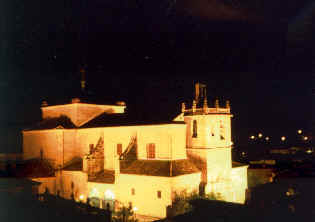
The castle in Oropesa at
night
Our first night in Spain was
spent in a castle, in Oropesa, a town atop a
hill in the Castilla-La Mancha region west of Madrid. We often reside in that
castle (now a parador) our first night. Also residing there in either the
holes in the stone walls, or on the roofs and towers of the castle and other
buildings nearby, are many birds, especially during the warmer months. These
birds include Jackdaws, Lesser Kestrels, White Storks, Common Swifts, Crag
Martins, and Barn Owl.
As we had our first breakfast of the tour (a wonderful one at the parador), with
an assortment of hams, cheeses, fruits, and the regional specialty known as
"churros", outside the window, some Black Storks flew by. Black
Storks are not as common in Spain as White Storks. Both are migratory,
with most heading south to Africa for the winter. That sighting of the storks
outside the breakfast window was fortuitous. They were the only Black Storks
to be seen during the tour. Most of the Spanish storks (both Black &
White) had already, in late September, departed. So, it was,
for us that morning, a good beginning.
From Oropesa, we continued further west, into the vast, open region of Extremadura.
That word in Spanish connotates "extreme, outlying, furthest out". In
that area, and in nearby Portugal, we got the feel for that distinctive region,
of rolling hills with oak and cork trees. It's a region without many people.
Over the years, it's been a region that people have left. When the Spaniards
went as explorers to the Americas, most of those whose names we know from the
history books, came from Extremadura. Many came from the one city in the region,
Caceres. We had a fine dinner there one evening. But in most of Extremadura,
there are either small villages with few people (we spent 2 nights in one), or
areas with no people at all. In those areas, there are, however, birds,
and notably some "good birds" that we saw and enjoyed. Among them were
the rare Spanish Imperial Eagle, and the also-rare Eurasian Black
Vulture. The latter is also known now as either the Monk or the Cinereous
Vulture. Whatever it's called, it's rare. It's also the largest flying bird
in Europe.
Rare many places in Europe, but not in Spain, is the Griffon Vulture. We
went to top of a ridge, near where we stayed in Extremadura, and watched Griffons,
nearly eye to eye, as they floated in the sky by us.
One morning we went, early, to a place with big open fields of grain. We
traveled, in our vehicle mostly on tracks. Our objective was to see big and shy birds
known as bustards. We did. We saw some Great Bustards, standing
and in flight, and we saw a Little Bustard. Great Bustards are
bigger than geese, and appear a bit overweight (even though they eat the
grain of the field, and not the "churros", the breakfast item
mentioned earlier that are rather like fried donuts). Little Bustards,
although called "Little", are really not small birds. Our experience
with the Little Bustard that morning was quite fun. After we spotted it,
standing on a dirt field, it walked to the one stringy bush around (actually
but a twig), and stood motionless behind it, "thinking" that it
was invisible to us. In our vehicle, however, we were having a wonderful look.
Nearby, on a small pile of rocks, another bird was looking at us (or at least at
our vehicle). It was a Little Owl. Again, that's a bird that's relatively
"little". Another Spanish owl, the Scops Owl, is smaller.
One evening in Extremadura, conversely, we had our encounter with the largest of
the Spanish owls, in fact the largest of the European owls. An Eagle Owl
was on a cliff-side, on the other side of a river. At twilight, it called
continuously.
Extremadura is an area that's often quite hot in the summer. And that part of
Spain is often quite dry. The "rain in Spain" doesn't mainly fall
"on that plain". During the summer, prior to our tour, the area was
even drier than usual, with quite a drought. So, as we traveled about, places
with water, such as ponds and streams, were those with the most birds. But, the
particular place that was actually the best for us in that regard was one with
just a drip. It was a spring. A few people would come, on occasion, to fill up
their bottles. But, otherwise, it was a place for us to sit quietly and watch
the procession of birds that would come to drink. There were Blue Tits
and Robins (both dapper little birds), Blackbirds (actually
thrushes, like all-black American Robins), but the best were
the warblers. We had good looks at Sardinian, Subalpine, and Melodious
Warblers, and another called the Blackcap, as they all came in to the
dripping water from the spring.
As much as we enjoyed watching those warblers, probably the bird that we enjoyed
the most during the tour was the Hoopoe. Every one was fun.
A part of Spain that one can not help but like is the region of the Gredos
Mountains. It' a great place to walk, up high in the hills. Above the
treeline, where we saw the animal known as the Ibex, the birds included Linnets
and Pipits. There were also wheatears and wagtails. Further
down the road, along a stream, one of our nicest encounters was with a Dipper.
The European Dipper is not gray as is the American. Rather, it has a
white throat, and a brown back and belly.
Overhead, in the Gredos, we looked up at some fine raptors. Buzzards (buteos,
somewhat analogous with Red-tailed Hawks in North America) were joined one
morning with a soaring adult Golden Eagle (nice, on whatever continent
it is seen), and some beautiful Red Kites (raptors, anywhere,
don't get much better). Some Hobbies flew about over the pines. In
the pines, there were Crossbills. Again, one can not help but like the
Gredos.
As we traveled throughout Spain in late-September and early-October, there was
an apparent bird migration. In the Gredos, there were flocks of Mistle
Thrushes. Throughout Spain, there were Pied Flycatchers and
warblers called Chiffchaffs. Along the Mediterranean coast, in the
area of the Ebro Delta, shorebirds
were on their way south. We saw, among others, Little Stints, Curlew
Sandpiper, Ruffs and Reeves, Greenshanks, 2 species of Redshanks
(the Common and the Spotted), 2 species of Godwits
(Bar-tailed and Black-tailed), and Whimbrels and Curlews.
Not bad things to see.
But the favorite at the Ebro
were the flocks of flamingos. Those partly pale, and partly bright pink
birds, were great to see either walking in the lagoons, or flying in the sky
above. Also favorites were two birds with the adjective Purple: the Purple
Heron and the Purple Swamphen. Two of the gulls of the area
were also notable, the rare Audouin's and the distinctive Slender-billed.
In all, 9 species of gulls were seen there. The others were: Black-headed,
Mediterranean, Little, Herring, Yellow-legged, Lesser Black-backed, and Great
Black-backed.
Among the ducks there were Red-crested Pochards. Other birds the marshes
and lagoons included patrolling Marsh Harriers, striking Pied Avocets,
and the little bright turquoise jewel known as the Kingfisher.
The Ebro Delta, as you can tell here, has water. A place further inland that
doesn't (or doesn't have much) is an apparently barren region known as
the "Spanish Steppes". But there
are birds there too, including a rather special "shorebird"
that favors such an area. We were treated, there, to a good, close look at a
flock of Eurasian Dotterels. Also on that high, windy plateau were Red-billed
Choughs and a large flock of Calandra Larks. Such birds can make a
place seem not barren at all.
Our last place in Spain to mention here is referred to primarily because of the
place itself. It's called Albarracin, and
it's a town in the region of Aragon, that's spectacular in terms of its setting
and its character. Located in a natural amphitheater, with high cliffs on 3
sides above a winding river, the town is actually perched on the sides of the
cliffs. Renowned for its "hanging houses", it was once a Roman town,
well protected by the features of the land. Later, it was, during the Moorish
occupation in the 11th Century that the town gained more significance. Today, as
one looks out from the balcony of the hotel, or from the plaza, the history is
in evidence. Still today, in the town, most of the streets are too narrow and
steep for cars. There are elaborate iron window gratings and door knockers and
handles that are the shapes of lizards and serpents. Houses are simple but often
multipurpose, for example, for the sheltering of animals, and the storing of
wine. Near the town, there are caves in which there are "prehistoric"
drawings.
As noted earlier, Spain is not only place for nature and birds (as it good as
it is), but also one for history, culture, and cuisine. Again, as during our
previous tours, Spain in '05 was a good place to be, and we look forward, in the
future, to touring there again.
Something that won't happen for us again during a future tour in Spain, did
happen during the last day of our '05 tour, on October 3rd. In an absolutely
clear sky over Madrid, in the late morning, there was an Annular Solar
Eclipse. We watched (through protective glasses) as the form of the
Moon, smaller than the Sun, passed in front of it, creating a "ring
of fire" that lasted for 4 minutes and 11 seconds. It was the first
such annular eclipse in the Iberian peninsula since April 1, 1764. The next one
there won't be until the year 2028. The eclipse that we were fortunate to
experience in October 2005 was certainly great to see, and especially as well as
we did.
An East Coast USA Pelagic Trip from Barnegat Light, New Jersey
- September
11,
2005
The following account written by Armas Hill, based on input by Fred Lesser,
one of the leaders onboard the boat:
Our annual FONT
late-summer pelagic trip to the Hudson Canyon, off New
Jersey & New York, took place overnight on
September 11, 2005.
Our thanks to all: the captains and others with the boat (including those who
provided the food), our leaders & spotters, and to all who joined us as
participants.
We left the dock in the middle of the night (after midnight), and we were at the
Hudson Canyon at daybreak.
The water temperature was somewhat warmer that it usually is for this trip, at
about 74 to 76 degrees. Thus, there were warm-water birds such as AUDUBON'S
SHEARWATERS, with about 25 of them seen.
Among other birds were 2 juvenile LONG-TAILED JAEGERS, that were seen close to
the boat.
There were also CORY'S SHEARWATERS (about 20). And RED-NECKED PHALAROPES (6).
All of the birds just-mentioned were seen at the Hudson Canyon, thus in NY
waters (and about 90 miles east of Long Beach Island, New Jersey).
Landbirds were a PALM WARBLER and BLACK& WHITE WARBLER way offshore.
Marine mammals during our Sep 11 '05 trip included: a large FIN WHALE, a MINKE
WHALE, 2 CUVIER'S BEAKED WHALES (usually denizens of rather warm water), RISSO'S
DOLPHINS (also known as GRAY GRAMPUS), over 40 of them, and OFFSHORE BOTTLENOSE
DOLPHIN (12), and SHORT-BEAKED COMMON DOLPHIN (2).
Other marine life during the trip included: a fish known as the Wahoo, Oceanic
Sunfish (Mola Mola), Loggerhead Sea Turtle (3), Stinging Sea Nettle, and
creatures in the Sargassum Weed: crabs, shrimp, and fish.
In all, it was a nice day at sea.
Birds seen offshore during our Sep 11 '05 from Barnegat Light NJ included:
Cory's Shearwaters - 20
Audubon's Shearwaters - 25
Wilson's Storm-Petrels - 200
Red-necked Phalaropes - 6
Long-tailed Jaegers - 2
"Comic" (either Common or Arctic) Terns - 3 (some or all likely
Arctic)
Herring Gull - 4 (1 way offshore, at the canyon)
Great Blue Heron - 2
Northern Gannet - 4
Common Loon - 1
Black-and-white Warbler - 1
Palm Warbler - 1
Mammals:
Fin Whale - 1
Minke Whale - 1
Cuvier's Beaked Whale - 2
Risso's Dolphin - 40+
Offshore Bottenose Dolphin - 12
(Short-beaked) Common Dolphin - 2
To
Top of Page.
BRAZIL
BIRDING & NATURE TOUR (in the Atlantic & Amazonian Forests) -
August/September 2005
Links:
Birds & Other Wildlife during our Brazil Tours in Aug/Sept '05
Upcoming
Brazil Tour Itineraries
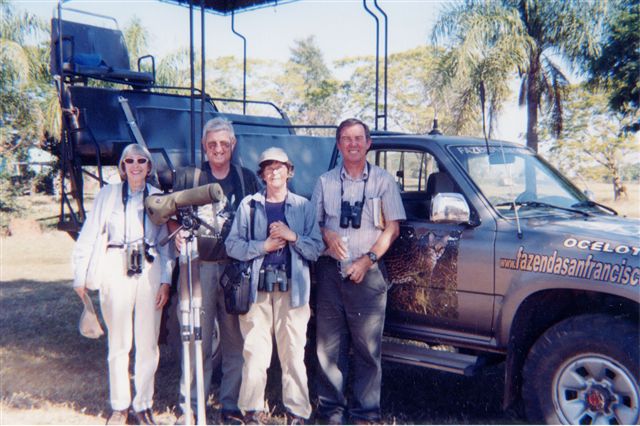
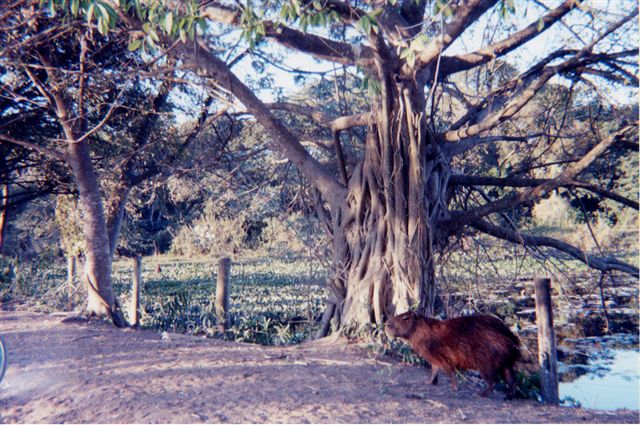
Above: Some of
our August 05 Brazil Tour Group
in the Pantanal in front of the vehicle from which the previous night
we had a wonderful look at an Ocelot.
Below: A Capybara in the Pantanal during the
day.
ARIZONA
Birding & Nature Tour -
jULY 2005
Links:
Birds & Other Wildlife during our Arizona tour in July '05
Upcoming
Arizona Tour Itineraries
The following account written by Armas Hill, leader of the tour:
Southern
Arizona is known to be one of the best places for birding in the US.
Not only with some species that spill over from nearby Mexico, but also the
birding is good with a variety of habitats and a diversity of plant-life in the
warm region. Prior to our late-July 2005 tour,
southern Arizona was more than warm. It was downright hot. For over 30 days, in
the lower elevations, the temperature there was more than 100 degrees F. Also,
in 2005, there were fires, some of which were extensive, such as one in the
Santa Rita Mountains, near Madeira Canyon. But even so, our '05 Tour in Southern
Arizona was again a good one indeed!
A group of birds that's notable for spilling into southern Arizona from Mexico,
in late July, are the hummingbirds. During our '05 tour, we saw 12
species of them: Lucifer, Violet-crowned, White-eared (these 3
"more Mexican" than the others), Broad-billed, Blue-throated,
Magnificent (or Rivoli's), Black-chinned, Anna's,
Costa's, Broad-tailed, Rufous, and Allen's. Seeing all of these
hummers was great!
Some other birds during our tour that we saw in Arizona that are more-common in
Mexico included:
Least Grebe, Brown Pelican, Zone-tailed Hawk, Elegant Trogon, Sulphur-bellied
and Dusky-capped Flycatchers, Tropical and Thick-billed Kingbirds,
Rose-throated Becard, Mexican Chickadee, and Painted Redstart.
The Pelican, a lone bird in Tuscon, could have come, of course, from
California. But, at any rate, Brown Pelicans are normally not common in
Arizona.
Seeing the Zone-tailed Hawk as we did was especially fun. It mimics by
flight, and by plumage, the Turkey Vulture. So when we did see one, after
looking at more than a few vultures, wow! And we saw it nicely, at nearly
eye-level as we were ascending the road up above Carr
Canyon.
It was in the Chiricahua Mountains that we
saw our Elegant Trogon. We were taking a morning walk in a woods where we
also had a good look at an Arizona Woodpecker, and where we heard, early
that morning, a Flammulated Owl. Those two flycatchers that come from
Mexico for the Arizona summer, the Dusky-capped and the Sulphur-bellied,
were also much in evidence.
The Rose-throated Becard we saw by its nest. That species occurs very few
other places, if anywhere else, north of Mexico.
During our '05 tour, we saw many Mexican Chickadees in the Chiricahua
Mountains, where it's the only chickadee.
And, in '05, we found Painted Redstarts to be our companions in the woods
of many of the forested areas in which we walked. But no matter how many we saw,
it was hard not to look at them, as they're such colorful, and spirited birds,
and something that none of us had at home.
A Chiricahua highlight for us was the Short-tailed Hawk. In the US, that
species has traditionally been seen only locally in south Florida. But in recent
years, some birds of this species have begun to stray north from Mexico into
Arizona. In the Chiricahua Mountains, in '05, we had heard reports of 1 or 2
sometimes seen in flight in a particular area. But we did not see any there high
in the sky over the mountains. We had also heard that the species could be
nesting. Then, one afternoon, as we were walking along a high mountain road,
(looking for something else of course!), we encountered a hawk, near
the road, sitting not too high in a tree. The disturbance calls of other birds
drew our attention to it. We could see it well. With all its fieldmarks, there
it was, a young Short-tailed Hawk! In all, at that spot, there were 3
hawks in trees in the woods (2 young & an adult), and we saw
one (an adult) fly by, low over the forest. We had stumbled into the
place with the Short-tailed Hawk nest.
Another highlight of the tour occurred away from the mountains, and near the
Mexican border, close to the city of Nogales.
At a small pond, surrounded by reeds, we found buntings - many Buntings of
4 species: Lazuli (most of them), Indigo, Varied,
and Painted! Whatever food those reeds provided, the buntings
certainly liked it.
We had gone to that place originally to see Black-bellied Whistling-Duck,
Tropical Kingbird, and Gray Hawk. And that we did. Abert's Towhee
was also there.
One afternoon we explored a number of small, mostly untraveled roads northeast
of Nogales. In assorted habitats we saw various birds from Grasshopper
Sparrows calling in the grasslands, to the resident Eastern Bluebirds
in pines and oaks. That Eastern Bluebird, a bird paler than that of the
eastern US, is a Mexican race sometimes called the "Azure Bluebird".
Later, as twilight ensued, we saw and heard both Common and Lesser
Nighthawks. As it got darker yet, nightjars began to call. We
encountered two kinds, either on or by the road, the Common Poorwill and
one of the forms of the "Mexican Whip-poor-will",
Caprimulgus vociferus arizonae. (4 other subspecies occur further
south in Mexico, and as far south in Central America as Honduras.)
Another day, west of Nogales, we entered the terrain of another primarily
Mexican bird, the grasslands with the "Masked Bobwhite". That
distinctively-colored race of the Northern Bobwhite is very rare where it
still occurs, in a limited range in Mexico. Where it occurred in the US, in
southern Arizona, it was extirpated. It has since been re-introduced there,
within the bounds of an extensive wildlife refuge, where we saw one.
Another sighting worth noting occurred another day in far-southern Arizona, not
far from the border with Mexico. On a dirt road, we had just seen a rattlesnake.
Then, a bird flew across in front of us, and landed roadside under a bush. It
was a thrasher, a Bendire's Thrasher. Having just seen the rattlesnake,
and then the thrasher named after Mr. Bendire, it came to mind that at one time (and
relatively not that long ago), he was in danger not far from there. Mr.
Bendire was a U.S. Army officer, a first-class field ornithologist, and a
collector. One day he was collecting an egg from a Zone-tailed Hawk nest
up in a tree. When he looked down, he noticed, out of the corner of his eye,
several Apache Indians, that he perceived as hostile, crouched down in a canyon
not far away. They were watching him. He slowly slid down the tree so as not to
indicate that he knew they were there. In his mouth was the egg of the
Zone-tailed Hawk. Both he, and the egg, made it away from the scene without
a scratch. Birding, nowadays, in the American West, is all the more interesting
when one can think of such tales from the past.
Among the common birds of our Southern Arizona Tour, in July 2005, still others
that were favorites included the Greater Roadrunner and the Vermilion
Flycatcher. The Phainopepla certainly was a favorite too, and the
Pyrrhuloxia was close to being one. It would have been if its name were more
easily pronounced!
Earlier in this narrative, it was noted that late- July is a good time in
southern Arizona for hummingbirds. It's also a good time there for Sparrows.
Those that we saw, in addition to the Grasshopper already mentioned,
were: Botteri's, Cassin's, Rufous-winged, Rufous-crowned, Chipping, Lark,
Song, Black-throated, and Five-striped, in addition to the Lark
Bunting and the Yellow-eyed Junco. That junco is yet another
primarily Mexican bird. As is the Five-striped Sparrow, which in the US
only occurs in far-southern Arizona, at just a few places that require some
effort to visit. Seeing that bird was just one of the avian highlights of our
tour, a number of which have been noted here.
Aside from birds, other nature was to be seen in southern Arizona, with the
assortments of plants and butterflies, and some mammals
too. Among those mammals were: Black Bear, Coati, Coyote, the Mexican
(or Apache) Fox Squirrel (restricted in
the US to the Chiricahua Mountains), Pronghorn, the White-sided
(or Antelope) Jackrabbit, Black-tailed Jackrabbit, Desert
Cottontail, both Striped and Spotted Skunks, both Mule and
White-tailed Deer, and some other smaller animals. Yet another creature
that we enjoyed seeing was the tarantula.
Overall, there was a lot that we saw, and enjoyed, in Arizona during our tour in
July '05.
Costa
Rica Birding & Nature Tour (in
mostly Northern Costa Rica) - July 2005
Links:
List of Birds & Other Wildlife during our Costa Rica Tour in Jul '05
Lists of Birds & Other Wildlife during our previous Costa Rica Tours in the Summer
Cumulative
list of Birds during our previous Costa Rica Tours
In cumulative list of birds,
scientific names are given & subspecies are noted.
Upcoming Costa Rica Tour Itineraries
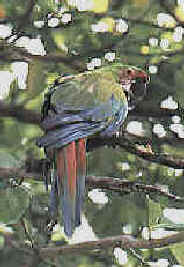
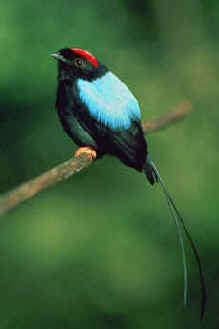
During our July 2005 tour in
Costa Rica, among the highlights, birds included two depicted below, the
threatened Great Green Macaw and the attractive Long-tailed Manakin.
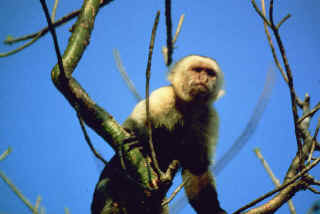
Highlights among the other wildlife included a close encounter with a group of White-throated Capuchin Monkeys (the species illustrated below)
Japan SPRING Birding Tour
(to Honshu, including Hegura Island, Amami, Okinawa, & Kyushu)
May
2005
Links:
List of Birds & Other Wildlife during our Japan Spring Tour in '05
Upcoming
Japan Tour Itineraries
The following account written by Armas Hill, leader of the tour:
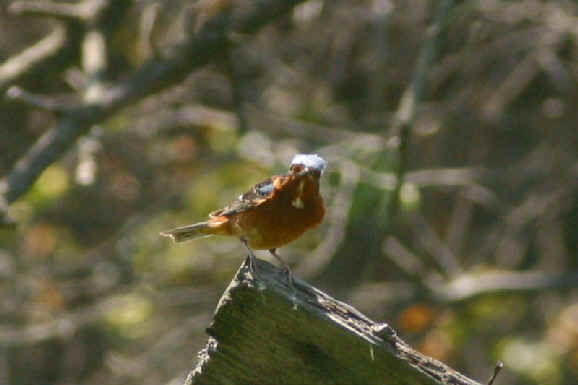
White-throated Rock
Thrush, Monticola gularis,
during FONT tour on Hegura Island, Japan, May 21, 2005.
This species is quite a rarity in Japan. It is normally on mainland
Asia,
breeding mostly in Manchuria and eastern Siberia, and wintering in southern
China, and further south in Southeast Asia.
Note in this photo the white patch on the throat.
(photograph by Iwasaki Shohgo)
Other birds we saw on Hegura Island in '05, normally found on mainland Asia,
included: Mugimaki Flycatcher (the Japanese name notwithstanding,
this species does not occur throughout Japan), Black-naped Oriole,
and Hoopoe.
When we visit Hegura, during the season when birds migrate, there's also a
migration to and from the island of Japanese birders. Many of them criss-cross
the small island, with their binoculars, scopes, and cameras (often big
cameras). When an avian rarity appears, somewhere on the island, word
spreads (quickly, now often on cellular phones and pagers).
During recent years, a number of bird species that were first records for
Japan, have occurred on Hegura Island. The day before we arrived in '05, a
Japanese first had been there for two days. That bird was an attractive Rufous-bellied
Woodpecker, from China, not in any Japanese bird book. There's a notable
bird migration on Hegura in the fall also. In the autumn of 2004, two Japanese
firsts there included Common Redstart from Europe, and Gray-cheeked
Thrush from North America.
It's very interesting how the bird migration on Hegura Island changes
throughout the day. During one of our days there, in the morning, the
islands seemed to be covered with cuckoos - in particular, at that time,
Common Cuckoos. They really were common. As we walked around the island, they
were in nearly every bush. There was the constant calling of the "Kak-ku".
That's how the bird says its name in Japanese. Nearly all of those we saw were
the gray morph. But, there was a cuckoo that we saw, of the rufous morph, that
was exhausted, as it sat on stones on the ground right in front of us! Those
stones were by the sea. The bird had apparently just come in to the
island.
After lunch that day, as we walked, there were no cuckoos. But instead,
flycatchers of a few species, seemed to be "everywhere". Mostly,
they were Asian Brown Flycatchers, but also present were: Dark-sided
(or Siberian), Gray-streaked, Narcissus, and Mugimaki, and a rarity - a single
Red-throated Flycatcher, feeding on a big rock. Over all of the fields and at
the pools along the rocky shoreline, there were flycatchers sallying for
insects. At the end of the day, flycatchers were flying into the air catching
bugs from nearly all of the small pine trees on the island. As the sun set
below the horizon of the Pacific Ocean, the "green flash"
was
visible. Then, in one of those pine trees where flycatchers perched, a
Japanese Scops-Owl
called.
A complete listing of the now 141 bird
species we've found on Hegura Island in the Sea of Japan is elsewhere in
this web-site.
On the southern Japanese island of Okinawa,
during our May '05 tour, we did very well with our 2 primary target-birds of
the island: the very rare Okinawa Woodpecker and the Okinawa Rail,
the latter only known to science for about 25 years. During 2 days, we saw 2
Okinawa Woodpeckers at their nests feeding young (that could be heard
calling inside the tree cavities). The species is one of the rarest
woodpeckers in the world. Though not as rare as the recently-rediscovered
Ivory-billed Woodpecker in the United States, it is an extremely rare bird
with very few breeding pairs restricted to a limited area of northern
Okinawa.
The Okinawa Rail has a similar distribution in that same
limited part of the island. By late afternoon, during our first day on
Okinawa, we had seen 7 Okinawa Rails, normally a shy species hard to
see. (That's why it was not formally identified until 1981.) One of the
rails was seen very well as it stopped on a road in the forest, just in front
of us, as we sat in our also-stopped vehicle.
The string of Japanese islands, that stretch to the south of the main islands,
are known as the Ryukyus, including
Okinawa, Amami, and others smaller. That word is an also adjective for some birds
of that region that we saw during our tour: the Ryukyu Robin, the Ryukyu
Flycatcher (a resident that was formerly considered a race of the
migratory Narcissus Flycatcher), the Ryukyu Minivet,
and the Ryukyu Scops-Owl (the last of these we saw in a puddle,
apparently bathing, on a dirt road in an Amami forest, when it was still dark
just before dawn).
On a beach in Amami, one afternoon, where
from previous tours we knew that shorebirds stage in the late spring,
we saw numerous Sharp-tailed Sandpipers, and other shorebirds (or
waders) that included: Terek Sandpipers, Grey-tailed Tattlers,
Bar-tailed Godwits, Red-necked Stints, and Mongolian Plovers. The Mongolian
Plover is also known as the Lesser Sandplover. Among a flock of
them, on that beach, there was a single Greater Sandplover (a rarity
in Japan).
For more than a decade we have, during our more than 10 tours on Amami, seen,
after dark, another "shorebird of sorts" that's endemic to some of
the Ryukyu Islands, the Amami Woodcock. During the 1990's, we actually would see
quite a few, and rather easily. However, in recent years, that has
not been the case. For whatever reason, the species seems to have declined.
During our tours just prior to May '05 (in Dec '04 & Feb '05), we
were fortunate to see 1 during each tour. We've seen the species during our
Amami tours in January, February, November, and December. We've not it during
our tours in May. (Maybe at that time of year, they're even more reclusive
in the dense foliage of the forest.)
What we did see in May '05, as we were combing the roads after dark for
woodcock, were 3 Habus. The Habu, Trimeresurus flavoviridis, is
a large, fierce snake in the family Viperidae. Habus have a
length as long as 200 centimeters (that's nearly 7 feet!). The first
one we saw (from our vehicle) as it was on the road, coiled into
circles, extending out its tail, and raising its head (looking like a cobra)..
During our pelagic trip, onboard a ferry
between Okinawa and Amami, we saw some Bulwer's Petrels, Streaked
Shearwaters and Short-tailed Shearwaters, Black-naped Terns and Roseate
Terns, and 3 species of dolphins, one of which was the Rough-toothed
Dolphin, in a pod seen "porpoising", surrounded by more-numerous
Bottle-nosed Dolphins.
Both Okinawa and Amami, in the spring, were, for us, great places for butterflies
as they were for birds. There were, during the middle hours of the sunny days,
large numbers of butterflies. Those we saw included:
Papilio polytes, known as the Common Mormon,
Papilio protenor, the Spangle,
Papilio helenus, Red Helen,
Papilio bianor, a beautiful Fluted Swallowtail, mostly
blackish with hues of blue and burgundy,
Papilio okinawensis, a species endemic to Okinawa,
Graphium sarpedon, known as the Blue Triangle, but mostly
turquoise; also known as the Common Bluebottle,
Graphium doson, the Common Jay,
Colias erate,
Eurema hecabe,
Catopsilia pomona, the Lemon Emigrant,
Hebomoia glaucippe, the Great Orange Tip,
Artogeia rapae,
Anosia chrysippus, the Plain Tiger,
Parantica sita,
Argyreus hyperbius,
Cyrestis thyodamas, an interesting butterfly (mostly white with dark
lines, bordered with some orange and brown) known as the Common Map,
Ypthima riukiuana,
and Melanitis phedima, posing like a brown leaf in the
forest.
As beautiful as some of the forementioned butterflies are, the most beautiful
creature during our May '05 Japan Tour was, yes, a bird! Near the end
of the tour, in a forest in southern Kyushu, it was the Fairy Pitta! In
the Japanese language is it called "Yairocho", meaning "the
eight-colored bird". And absolutely brilliant some of those colors are: notably
the turquoise on the wings, and the bright red on the belly and undertail. But
also, as part of the package, are the green back, the brown cap, the black
facial mask, the yellowish breast, and the white throat. That's 7 colors.
Additionally, there are the pink legs.
The Fairy Pitta is not an easy bird to see. A few (just a few),
assumedly less now, come to southern Japan, very locally, in the late
spring to breed. The rare species also breeds, also locally, in Korea and
China, including Taiwan. It winters in Borneo (where it is hard to find).
As a migrant, it occurs in central Annam.
In Japan, there is but a narrow window of just over a week (in late May
& early June) when there's a better chance to see it. What helps is
that in early morning (mostly), it calls. When it does so, proclaiming it
territory, from among the leaves of trees, it can be difficult to find. But
when it
feeds, on worms and the like, it's on the ground. Then, if one is fortunate, one
can get a from a glimpse to a fairly good look.
During a full-day we spent in the forest of the pitta, over
a weekend, there were many (over a hundred) Japanese birders on the
trails, all hoping to be pitta-watchers. Some were. Many weren't, even though
they tried. Some of the pitta-seekers were lucky enough to snap a photo or
two. Most who saw the bird saw it quickly.
Late in the afternoon (presumably too late), we persisted in our effort
to see the bird, after all of the Japanese birders had left. All of a sudden,
from not that far away, the bird called. In response, I whistled a similar
sound. The bird responded. We vocalized, back and forth, five times,
until, wow, the bird flew in to the forest floor, just feet from us. And it
stayed there for 10 minutes! With its head attentively up, and then, after a
short while, the
spectacular bird walked about on the ground. We saw it from every angle, and
we saw every color - all 8 of them!
It has been said by many that the most beautiful bird in the world is the
Resplendent Quetzal of Central America. Yes, it's true that the quetzal is
beautiful and spectacular. But, of all the birds in Japan (and there certainly
are some nice ones), the
Fairy Pitta is the most beautiful. Granted, if one were to see any of the
pittas of southeast Asia, they're all beautiful. But, even so, it can also be
said that when one looked at the Fairy Pitta, as we did that afternoon,
it was, at that time, the "most beautiful bird in the
world".
We'll be going to Japan again in the Spring of '06, in May, with about the
same itinerary as we did in '05. The dates are May 6-23.
Also in 2006, our annual Winter Birding Tour in Japan will be conducted in
January/February. That tour will be in Honshu, Hokkaido, and Kyushu, with an
optional extension to Amami and Okinawa. Bird highlights will include Eagles
(both Steller's and White-tailed Sea-Eagles), Cranes
(with as many as 7 species possible), and the large & rare Blakiston's
Fish-Owl.
Upcoming Japan Tour Itineraries
TEXAS
April-May 2005
Links:
Birds & Other Wildlife during our Texas tour in April/May '05
Upcoming
Texas Tour Itineraries
The following account written by Armas Hill, leader of the tour:
"A Tour
Across the State from the Gulf to the Desert"
During this tour, April 26 - May 9, 2005, we
traveled across the large state of Texas,
birding as we went, from the Gulf Coast west to Big
Bend National Park and El Paso. Much of our travel paralleled the
course of the Rio Grande, the river that's the boundary between the US &
Mexico. Birding near that river, particularly in far-southern
Texas, produced some birds that are normally more Mexican than Texan.
These included: Gray-crowned Yellowthroat, Tropical Parula, Clay-colored
Robin, Blue Bunting, Green Jay, Green Kingfisher, Green Parakeet, Red-crowned
Parrot, Couch's Kingbird, Great Kiskadee, White-tipped Dove, Buff-bellied
Hummingbird, Altamira Oriole, Groove-billed Ani, and Plain Chachalaca.
By the Rio Grande in western Texas, at Big
Bend, another species more Mexican than Texan, that we saw, was the Tropical
Kingbird. And yet another, the Gray Hawk was nesting in a tree
nearby.
Areas away from the Rio Grande that we visited included places along the the
Gulf Coast such as Rockport, Aransas, and Padre
Island, and the "Hill Country" of
the Edwards Plateau. Each of these areas produced a number of our
desired birds.
In all, 266 species of birds were found during our tour across Texas.
Even though we traveled a good number of miles, from Corpus Christi to El Paso,
we actually only covered, as we found those 250-plus bird species, but a portion
of the very big state. Yes, Texas is BIG - as big as it gets in the "Lower
48".
Among our prime avian objectives in the big state of Texas were what we called
the "Big 4", even though they were not big at all. The largest of them
is just over 5 inches in length. That's the Colima Warbler. The other 3
of the "Big 4" targets were the Golden-cheeked Warbler,
Black-capped Vireo, and Lucifer Hummingbird. We saw them all.
These birds are prime objectives in Texas because mostly they are found in no
other state. One of them, the Lucifer Hummingbird, it should be noted,
does occur uncommonly in Arizona in the summer. Actually, the only place where
that species is common is Mexico. Some years in the US, its numbers are less
than in others, even where it's regular. We found at Big Bend in '05 the Lucifer
Hummingbird to be less common than it was in '04. But a male, observed one
afternoon, was a good sight.
The other 3 of the "Big 4" were seen very well during our '05 Texas
tour.
All of the "Big 4" winter in Mexico (1 of them, the Golden-cheeked
Warbler, also further south into Guatemala).
The Golden-cheeked Warbler nests only in Texas. We observed some males
nicely in the "Hill Country" of the Edwards Plateau. The
Golden-cheeked Warbler is classified by Birdlife International as
"Endangered". In the "Lower 48" states of the US only 4
species are so classified. 2 of the others are the Whooping Crane (that
winters in Texas) and the Gunnison Sage-Grouse. The other, the Thick-billed
Parrot, is really a Mexican species. It has not occurred in the US in years. It
did formerly in Arizona.
Another of our "Big 4", the Black-capped Vireo, we saw well in
the western Edwards Plateau. That species is classified as
"Vulnerable" by Birdlife International. In the US, nearly all
Black-capped Vireos nest in Texas. Only a very few do so in Oklahoma (and it
formerly did in Kansas). It also breeds in northern Mexico.
The Colima Warbler is classified as "Near-threatened" by
Birdlife International. In the US, it nests only in western Texas, at a
particular elevation and in a particular habitat in the Chisos Mountains in the
Big Bend National Park. To get where it is, a trail must be walked. We did, and
we saw and heard the bird nicely. Other than at Big Bend, the Colima Warbler is
exclusively Mexican. They breed in that country, and all of them winter
there.
Some other birds more Mexican than Texan that we encountered during our Texas
tour (in addition to those already mentioned) included: Least Grebe (at
one time, we saw 7 together, 2 adults & 5 young, the least of the least),
Neotropic Cormorant, Pauraque (seen & heard at Aransas), the Mexican
(or Gray-breasted) Jay at Big Bend, the Northern
Crested-Caracara (also known as the "Mexican Eagle"),
Chihuahuan Raven (named after the Mexican state), Olive
Sparrow, White-tailed
Hawk, Harris's Hawk, the Aplomado Falcon, and the Black-bellied
Whistling-Duck. Some comments are warranted, and follow, about the last two
of these species.
The Aplomado Falcon is overall not a rare bird "south of the (US-Mexican) border". In some places, such as Costa Rica, it is. In others, such as Brazil, it's quite common. In the US (Texas), it formerly occurred until the early 20th Century in southern Texas, and until the mid-20th Century in western Texas. About 15 years ago (in 1989), a reintroduction program began in south Texas. Since then, about 700 birds have been released. And the species is now breeding in southern Texas. We can confirm that as we saw a pair mating, close to us, atop a telephone pole along a road between Brownsville and the Gulf of Mexico. We also watched those two birds in flight - flying as the species once did naturally over a century ago in Texas.
The Black-bellied
Whistling-Duck about 40 years ago occurred in Texas almost exclusively in
the lower Rio Grande Valley, and south the southern Gulf Coast (south of
Corpus Christi). During the decades since, the species has expanded its
range and increased its numbers considerably. As we went across Texas, we saw
many, well to the north and west of that previous range of 40 years ago. What
was particularly interesting was how the species has adapted to living in the
town and cities, in residential areas. Often we saw the birds in flight over
neighborhoods and standing on the roofs of homes. They were notably fond of
trees, either being on stumps or high bare branches. After all, they have been
called historically "Black-bellied Tree Ducks".
Another bird that we saw to have had a major expansion through Texas, in recent
years, was the Eurasian Collared-Dove. It's common in southern and
eastern Texas, often, like the whistling-duck, in towns and cities. We saw the
Eurasian Collared-Dove as far west as one can go in Texas, in El Paso.
Yet another bird species that has increased in Texas in recent decades has been
the Cave Swallow. We saw many, especially along highways at bridges and
overpasses.
Our best spectacle for numbers of birds during the tour was during 3 days in the
area of the Gulf Coast, as many were seen on their migration north. At places
such as South Padre Island, and Goose Island, trees and bushes were sometimes
dripping with birds. Lawns and feeders also had their share. Very numerous were
the warblers, and there were other birds in good numbers such as flycatchers,
hummingbirds (Ruby-throated), kingbirds (Eastern), thrushes,
tanagers, orioles (many), waxwings (Cedar), and grosbeaks
(Rose-breasted).
Nearly 30 species of Warblers were seen during our tour. In addition to
those already mentioned here (the Golden-cheeked, Colima, Gray-crowned
Yellowthroat, & Tropical Parula), there were for us in
southern & eastern Texas, many species of eastern warblers during their
migration. Our most commonly observed species was the Black-throated Green.
But other notables, often in colorful breeding plumages, included: Blue-winged,
Golden-winged, Chestnut-sided, Magnolia, Blackburnian, Bay-breasted,
Yellow-throated, Hooded, Wilson's, Kentucky, Canada, Worm-eating, Nashville,
Tennessee (candidly not as colorful as some of the others), Ovenbird,
and Northern Waterthrush.
A good bird migration is a fascinating phenomenon. Sometimes it's subtle,
while other times it's obvious, and when it is It's one of the most exciting
experiences birders can have. We've been in the midst of such migration during
FONT tours in other parts of the world, for example, at the southern tip of
Sweden in the autumn and on a small island in the Sea of Japan in the spring.
The migration that we experienced along the Texas coast in May '05 was as good
as any, actually as good as it gets. To see so many birds, having just crossed a
portion of the Gulf of Mexico, and actively feeding in low bushes in front of us
was, yes, exciting. And it was especially so with the variety of species and so
many colorful warblers.
About a month, to the south in Central America, during our Guatemala tour, in
the area of the Mayan ruins of Tikal, some of the same birds we would see in
Texas were noted already on their way north. There were the warblers and
flycatchers, and quite memorable was a tree filled with Baltimore Orioles by one
of the
temples.
During our May '05 Texas tour, migrating Orioles were seen en masse, both Baltimore and Orchard,
sometimes in flocks in flights and memorable, again, was a tree filled with more
than 15 colorful Baltimores at once.
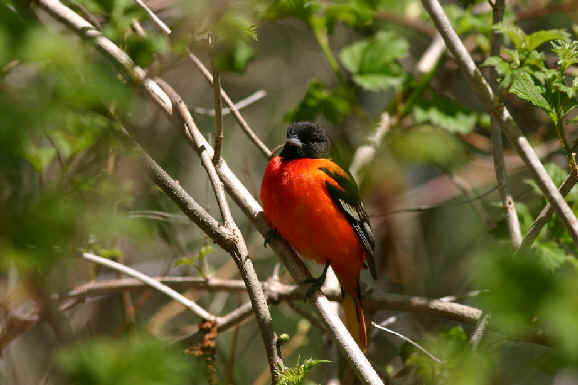
Even just 1 male Baltimore
Oriole is bright & colorful.
Migrating
Tanagers, with their red coloration, were both Scarlet and Summer.
Migrating Flycatchers were Great Crested and Eastern
Wood-Pewees.
Migrating Thrushes were Swainson's, Gray-cheeked,
Wood, and Veery. Incidentally, as we traveled west across Texas for 2
weeks, a thrush we never saw was the American Robin.
What we did see with all of the migrants just-mentioned were Dickcissels.
They, as well as Scissor-tailed Flycatchers, were evident in the east
Texan countryside. Both species, for those of us from elsewhere in the Country,
were nice to be seen as often as they were.
Swainson's Hawks (both the light & the dark morphs) were also
nice to be seen, as was a flock overhead of migrating Mississippi Kites,
on their way north.
A favorite among the many birds seen during our '05 Texas tour was the Painted
Bunting. The species was seen many times & many places across the state.
No matter how many times the colorful male is seen, however, it's still a
favorite.
Seemingly a bit out a place, and off schedule, along the Texan coast of the Gulf
of Mexico, very close to Mexico, one afternoon, there was an immature Glaucous
Gull along the beach. Also along that beach, we saw a Piping Plover (a
threatened species more apt to be there in the winter) in company with Wilson's
Plover. Also there were: Red Knot, Black Skimmer, and Terns
including Sandwich, Royal, and Caspian, in addition to other
coastal birds.
Shifting from the Texan coast, to the opposite end of the state, to the desert
and some other habitats of far-western Texas, some of the birds that we enjoyed
there included: both Scaled and Gambel's Quails, both Pyrrhuloxia
and Phainopepla, both Western and Clark's Grebes on the
same lake (more of the former), a large flock of Long-billed Curlews,
spinning Wilson's Phalaropes, the Greater Roadrunner, Vermilion
Flycatcher, Common Poorwill, lots of Lesser Nighthawks, White-throated
Swifts (doing their flights that aptly could be called
"swift"), Canyon Wren (with its beautiful song),
Varied Bunting, and Crissal Thrasher.
Of all the birds we encountered during our 14 days in Texas, there was only
one that got on our check-list every day. It was in the thrasher group. It's actually
the state bird of Texas, occurring in an assortment of habitats throughout the
state. We saw many, of course, and it could be said that we heard many more, by
day and by night. It was rare for a Northern Mockingbird not to be heard,
at any given time, somewhere near us.
The state bird of Texas, the Mockingbird, is one of about 625 species of
birds that have been recorded in the state. That's more than in any other US
state. There are so many species of birds in Texas that it was the only state
which had its own Peterson Field Guide.
We've seen many of the birds recorded in Texas during our tours there (nearly
half). But, with more yet to be seen, there will, of course, be future FONT
tours, for birds (& butterflies, and other nature) in
Texas!
Upcoming Texas Tour Itineraries
COLORADO
(& ADJACENT STATES)
April 2005
(The adjacent states are Kansas, Oklahoma, Nebraska, & Wyoming)
Links:
Lists of Birds & Other Wildlife during our Colorado Tour in Apr '05
Lists of Birds & Other Wildlife during previous Colorado Tours in April
Cumulative lists of Birds & Other Wildlife during previous Tours in Colorado & nearby states
A Photo Gallery of Birds & Other Wildlife during our April '05 Tour in Colorado & nearby States
A Feature - the Grouse of Colorado & Kansas
Upcoming Tour Itineraries for Colorado & nearby States
The following account written by Armas Hill, leader of the tour:
"A Tour for
Grouse & More"
Again, April 17-24, '05, we did
what's been, the last few years, our annual spring tour for grouse, and more, in
Colorado and nearby states. The grouse that we saw were the 2 Prairie-Chickens
(Lesser & Greater), the 2 Sage Grouse (Greater &
Gunnison), Sharp-tailed Grouse, and Blue Grouse. All of these were seen well. Only the endangered
Gunnison Sage Grouse was a bit far away . We saw all of the Grouse (including
the Blue) displaying.
The "more" were
numerous other birds, including specialties of the plains, and of the
mountains.
Although birding, of course, was
our primary emphasis, during the tour, it was not the only aspect of it. There
was also the spectacular scenery, especially in the various areas that we
visited in the high country of Colorado.
And also in the category of "more" were mammals. During the tour, we
saw 28 species. During one day in north-central Colorado, we saw is. There were
among the mammals: Beaver and Badger, Muskrat and Moose, Elk and
Deer. Coyote,
numerous Pronghorn, and an assortment of rabbits, squirrels, and prairie-dogs.
Our best was the Badger, that stared rather sternly at us, late one afternoon,
from the ridge of its hole. One of our moose sightings was also notable, of a
mother and an adolescent together.
Butterflies were not common (still, overall, too early), but we did see some particularly in eastern Colorado and Kansas. Notable among them was the orange-colored Goatweed Leafwing.
But back to the birds:
During our first full-day in southeastern Colorado, we were getting an impact of
the birding we would enjoy in the days that would follow. And that first impact
came on strong, with our initial looks at birds such as Swainson's Hawks,
Cinnamon Teal, and Yellow-headed Blackbirds. At one body of water, we
encountered a large flock of migrating Bonaparte's Gulls, with some in breeding
plumage, and some of them with a pink hue on their breasts. Western Meadowlark
sang. That song we would hear continuously throughout the tour. Avocets were in
breeding plumage. Burrowing Owls looked at us as we watched them. Their holes,
in the ground, were near those of Black-tailed Prairie Dogs. Walking on the
ground were Long-billed Curlews. We enjoyed good looks at them. Overhead, in the
blue sky, large American White Pelicans flew.
Those of us from other parts of the United States (from Florida, California, and
the Northeast U.S.), were quickly adapting to Colorado birding.
But as good as all that's been
described was, it was not the best that day, It was for us, a "plover
day". Among the best spotting my participants on the tour, that first
morning of the tour, was when a Mountain Plover was found on the ground in front
of us. How fortuitous! And in the scope, it was tremendous. Within an hour of
that bird (a threatened North American species, rather like a pale dotterel). 2
other rather special plovers were seen. Among a few Snowy Plovers, on an
alkaline shoreline of a lake, there was a single Piping Plover, (another
threatened species, and very rare in Colorado). So, we had, our first day. a
"5-plover day" with Mountain, Snowy, Piping, and Semipalmated
Plovers,
and Killdeer.
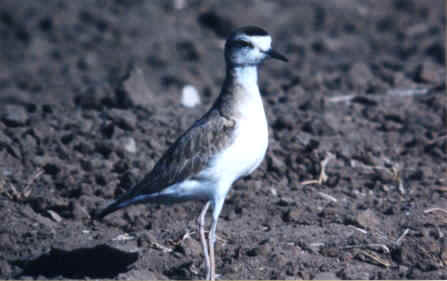
Mountain Plover
But, as noted, grouse were actually our primary objectives during the tour, and
our schedule was set so as to see them, particularly early in the mornings when
they were at their display grounds known as "leks".
The first of these we saw was the Lesser Prairie Chicken. We did so in
southwestern Kansas. Of all of the North American grouse, this is the species in
the most trouble, in that it has, during the last couple decades, suffered the
biggest decline. From an estimated 50,000 birds in about 1980, there are an estimated
10,000 to 20,000 today. Since the 19th Century, the species is said to have
declined about 90 per cent. During our early-morning visit to the lek, we saw
over a dozen of them well. There are photos, in a special feature about the
grouse elsewhere in this web-site, of this species and the Greater Prairie
Chicken (that we saw in northeast Colorado, later the same day, and the next
morning).
The experience we had with the Greater Prairie Chickens that next morning was, it could be said, a bit magical, a bit mystical. We saw and heard the birds, as they were displaying, in an early-morning ground-fog. Another unusual aspect of the occurrence was the rather odd setting. The displaying birds were on an alfalfa field. There were a few dozen of them at a place that seemed out-of-place. But it had been a traditional site for the birds for years (long before alfalfa was ever planted there). In that early-morning fog, the birds came closer and closer to us as we sat in our vehicle. As they approached, their eerie hollow moaning got louder and louder. Just yards away from us, as we were still and quiet, the birds became more preoccupied with their own business of displaying, and less concerned about us. Of course, quiet as we were, we too were preoccupied watching and listening them. That morning, it was as good an experience as we could have had with the Greater Prairie Chicken.
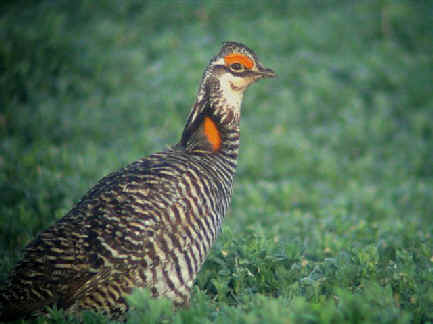
Greater Prairie Chicken
It's good to know
that the subspecies of the Greater Prairie Chicken in eastern
Colorado, Tympanuchus cupido pinnatus, is doing rather well at
least in the area where we were. Each year, we've had a kind host of large ranch
who cordially allows us onto his property to observe the birds at their leks. He
fills us in, when we meet with him prior to our first viewing of the birds, the
afternoon of our arrival, as to how the birds are doing. In that immediate area,
we're told they're doing well. The biggest threat they'd face there would be bad
weather, for example, a strong storm with hail, especially at the time of
nesting.
Two other subspecies of the Greater Prairie Chicken have
not done well. The eastern subspecies, T. c. cupido, known
as the "Heath Hen" became extinct in the first half of the 20th
Century. Another subspecies, in Texas, T. c. attwateri, the "Attwater's
Prairie Chicken" sadly seems now to be on its way to
extinction.
After the two species of Prairie-Chickens, that we observed in the open, vast
country of the prairies, we had yet another objective in that habitat, another
twosome. We saw them well - two species of Longspurs, the Chestnut-collared
and the McCown's. It was fun to watch them display, flying high into
the sky, and to listen to them sing. We were pleased in that all our
prairie-objectives were met. During our first day, we had already seen, as noted
above, the Mountain Plover, normally a challenge to find. And there was
another fine bird of that open country, not mentioned yet, that we enjoyed
seeing, the Ferruginous Hawk. The adult is one of the most attractive of
the raptors. We saw a few of them well, during the first couple days of our
tour. The Ferruginous Hawk, by the way, is one of the birds of the plains now
classified by Birdlife International as "near-threatened". The Long-billed
Curlew is another. The Mountain Plover is beyond that; it's
considered as "threatened".
I should mention that we made a
visit, when we were in eastern Colorado, near the Nebraska line, at a farm where
during previous tours, we've seen some "eastern" birds. The year
before, we encountered there (apparently due to weather, notably strong
winds) such unusual easterners as Worm-eating Warbler, Northern Parula,
and Brown Thrasher. We did see some "birds of the east" there
in '05 also, but not any as rare. We saw Cardinal, Red-bellied Woodpecker,
Eastern Phoebe, the "Myrtle" race of the Yellow-rumped
Warbler, and Blue Jay. Finding that jay there, this time, by the way,
enabled us, during the tour, to encounter every corvid possible in
Colorado.
At the farm, along a row of flowering bushes, there were a number of butterflies.
Most of them were Painted Ladies (incidentally, the most widespread
and most common butterfly in the world, but still nice to see as we did that
spring day). Some were Red Admirals. Elsewhere, we saw other
butterflies on the prairies. Some of them (such as some skippers)
were question marks to us, and there was one species we observed that was
actually named that, the Question Mark.
The prairies behind us, we found ourselves, on our way to Gunnison, spending a
night in a nice setting of coniferous forest in the Rocky Mountains. A treat,
there, at the end of the afternoon, was a pair of Dippers, or "Water
Ouzels", by a mountain stream in front of our hotel. I've never met
anyone who didn't like watching antics of Dippers.
Our travel to Gunnison continued with something so-named along the way: the Gunnison's
Prairie Dog.
A slight diversion enroute gave us our first encounters with high-elevation
birds: the Brown-capped Rosy Finch (a flock visiting a feeder), Cassin's
Finch, Pine Grosbeak, Mountain Bluebird, and Gray Jay. We would
see all of these again, but it was good to so the first time.
Gunnison, a college town in southern Colorado, seems removed from anywhere else.
It seems so because it is. It's isolated, more than an hour by car in either
direction from wherever (there's really one highway into & out of
Gunnison.) And so it is, there's also a bird there that's isolated. It was
formerly considered to be a subspecies of the Sage Grouse. It's now a
full species, the Gunnison Sage-Grouse. On the southern outskirt of town (and
that's even an area yet more "removed"), we met a man who said
that sometimes he sees the grouse when he mows his lawn. We saw the grouse,
early the following morning, the more traditional way, from an enclosed hide set
up for that purpose. We saw them fine, at one of their lekking sites, but at a
distance.
It was cold that morning, even though we were in southern Colorado. Actually, it
was the coldest we were during the tour, with the temperature dipping at
daybreak down into the teens. Gunnison is at a somewhat high elevation. During
the night, it had snowed in the surrounding elevations slightly higher yet. As
we drove, during the morning, with the rather spectacular Canyon of the Gunnison
(River) to our left, the terrain was made all the more beautiful with a light
covering of snow on the ground. And that provided a wonderful backdrop for an
adult Golden Eagle, nicely perched, to our left, on a dead tree, not far
away, at about our eye-level. We were to see a number of Golden Eagles during
the next few days, but what a nice sight that first one was.
Later during the day, in another high area, with more snow on the ground, our path crossed for the first time with that of a crossbill. We saw some Red Crossbills on the side of the lightly-traveled road. Further along the way, still in an area of snow, we stopped and fed (with seeds we purchased for the purpose) 3 species of corvids that came for the food nearly into our vehicle: the Clark's Nutcracker, Gray Jay, and Steller's Jay. A 4th corvid, the Raven, also came, but kept at a distance.
Another sidebar, before we get back to grouse (you may remember the primary objective of the tour!). We went through an area in the western shadow of the mountains, drier than elsewhere. In that area with junipers, during our '04 tour, we saw (sensibly) Juniper Titmouse. Not so sensibly in '05 we didn't see that species but we did see a number of others, such as: Virginia's Warbler, Black-throated Gray Warbler, Gray Flycatcher, Blue-gray Gnatcatcher, our first Brewer's Sparrow, Rock Wren, and both Pinyon and Western Scrub-Jays (and that completed our collection of corvids).
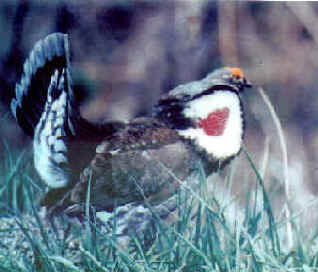
Blue Grouse
The next morning there was, for
us, a "Grouse Triple-header", as we saw, literally within moments: Blue
Grouse, Sharp-tailed Grouse, and Greater Sage-Grouse. The 3 species
were nearly within sight of each other. And our sightings of all of them were
great. The Blue Grouse does not display at a communal lek as the other
two species do. It simply walked close to us in its full breeding attire. The Sharp-tailed
Grouse, in a group atop a mound of a hill, were displaying as they're
programmed to do - like "wind-up dolls" stamping in circles, stopping
and starting in unison. The Greater Sage-Grouse, on their lekking site,
were doing their displays with expanded chests and spread tails. What a morning!
Other birds that morning included both Green-tailed and Spotted
Towhees, Sandhill Cranes, and a Bald Eagle sitting on its big nest.
The Greater Sage that morning, as good as they were, were not as close as
could have been. But later, at the other end of the day, in the evening, in
another area, they certainly were - as close to us, that is, as they could have
been. It was the "Grouse Highlight" of the tour, when about a hundred
of the large birds (the Greater Sage-Grouse) were
along an out-of-the-way dirt road, just outside our van, displaying against the
background of a red sky after sunset, and snow-capped mountains in the distance.
What was in the distance, however, may not have been noticed by all of us, as we
were so enthralled by the sights and sounds of so many grouse, so close.
Throughout Colorado, many of the areas we visited were enjoyable to be in. But a
region that has a lot of appeal, in terms of the nature to be experienced, is
the northwestern part of the state, near the border with Wyoming. In that state,
as well, again in '05, we had some of our best experiences. Birds that we saw
there will be mentioned shortly.
What draws us to northwestern Colorado, specifically, is the wonderful encounter
to be had with the Greater Sage-Grouse, already referred to. However, in
terms of birds & animals, the grouse are just one piece of the pie.
Mammals begin to be seen when we enter that region of northwest Colorado
known locally as "North Park Country". To start it off, there was,
along the road, our first of 7 Moose sightings. One sighting that was
particularly good was of an adult female with an adolescent. During one day, in
northwest Colorado, we saw 15 species of mammals. Here they are, not in any
particular order: Mule Deer, Pronghorn, Coyote, Elk, Mountain Cottontail,
Least Chipmunk, Golden-mantled Ground-Squirrel, Yellow-bellied Marmot, Wyoming
Ground-Squirrel, Moose, Muskrat, Striped Skunk, Shoeshoe Hare (in the
high coniferous forest), White-tailed Jackrabbit (in the open sage
country), American Badger, and White-tailed Prairie Dog. And
mostly we were looking for birds, rather than mammals!
We saw our last mammal of the tour, Bighorn Sheep, when we were crossing
the Rockies for the last time. When we watched the group of them on the slope,
we observed something interesting. Magpies would land on the backs of the
animals, picking out what appeared to be course fibers from their hides. The
Magpies, we assumed, were putting these materials into their
nests.
Our best mammal sighting of the tour, however, was of one of those in the
"North Park Country" of northwest Colorado. It was our sighting of a Badger,
as it sat still low to the ground outside its large hole, peering at us, as we
looked at it. In the wildlife refuge, where we saw the Badger, there were so
many mammals (maybe the most that most of us had seen anywhere). Most of
them were Wyoming Ground-Squirrels and White-tailed Prairie Dogs.
While driving along the dirt road within the refuge, the "wildlife
drive", we were constantly driving over the wildlife. No, we weren't
hitting any animals. But there were so many holes in the ground, with heads of
the rodents either popping up and down in the holes, or critters either running
into them or away from them.
So many rodents in the area
means that prey abounds there for raptors. As noted earlier, we saw a
good number of Golden Eagles during the tour. Many of them were in the
this area filled with running rodents. Also there were numerous Red-tailed
Hawks, Swainson's Hawks, and Northern Harriers. We had hoped for
Rough-legged Hawk. It can be common in that area during the winter, but we
didn't see any when we were there in April. We did see a "raptor of
interest" that turned out to be a juvenile Ferruginous Hawk. One of
our best raptor sightings was of a Prairie Falcon perched atop a fence
pole. Not far away, and lower than on a telephone pole, it was a nice sight.
Actually, any Prairie Falcon on a pole is good, as most that were seen
throughout the tour were either in a speedy flight, or perched at a distance.
Also in the sage country of raptors and rodents were other birds, and with the
habitat, the Sage Thrasher was one of them.
In a nearby area of aspen trees, we had a wonderful encounter with a group of Red-naped Sapsuckers. 4 of them were watched well at once.
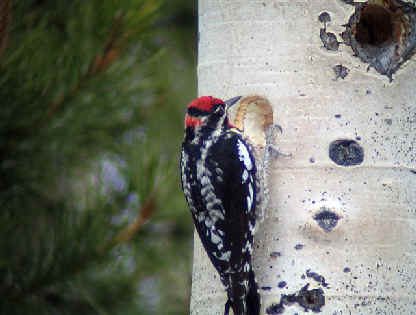
Red-naped Sapsucker
Earlier it was noted that we saw
a nice number of birds in Wyoming, just of the Colorado state line. That we did
in '05, as have other years previously.
There's an area of lakes near Laramie, an open where numerous birds can readily
be seen. Birds that we saw there included: Common Loon, 3 species of grebes
(Western, Eared, and Pied-billed), American
White Pelican (in breeding plumage, with a big knob on a big bill), Double-crested
Cormorant (in breeding plumage, that is with the double-crest - now who
pays attention to that?), Great Blue Heron, Black-crowned Hight-Heron,
White-faced Ibis, 14 species of waterfowl, among them: Cinnamon
Teal, Redhead, Canvasback, Bufflehead, Common Merganser, and Ruddy Duck.
Also, Coot. Overhead, there wre Bald Eagle, Golden Eagle, and an
assortment of hawks. Shorebirds were Avocets (in nice
breeding plumage), Killdeer, and Snipe. Boanparte's Gulls
were common. The Herring Gull we saw there is not. Along the shorelines
of the lakes, there were not just Red-winged Blackbirds, but groupings of
Yellow-headed Blackbirds that were fun to see and hear. On the bare
ground, near a lake, we had our closest encounter with McCown's Longspurs.
2 were virtually at our feet.
There was another place in Wyoming that we simply had to visit as we had during
tours in the past. It's a rather unassuming spot, near some homes, off the
highway and in the high country. With lots of conifers, and a bird feeder or two
by the homes, the spot has been productive for us. Other years, when there was
more snow, birding was good at those feeders. In '05, even with less snow, it
was still good, very good. Birds included: the 2 Chickadees (both Mountain
& Black-capped), Pine Grosbeaks (both male & female
seen nicely), Evening Grosbeak (at the only place we saw it during
the tour), Red Crossbill, and Cassin's Finch. On the top of a
conifer, nearby, there was a Townsend's Solitaire. A Gray Jay or
two was about.
It should be mentioned that the feeders were basic with such things as a bucket
and a tray on top of a stump. But there was a vast supply of sunflower seeds,
and an enthusiastic young boy who came out to keep us company as we watched the
avian visitors come and go between the feeders by the front door of the
house and the tall coniferous trees nearby. And yes, I should mention the dog
that loved to fetch whatever there was to fetch. All of that was during our
morning visit. In the afternoon (when we saw the Evening Grosbeak),
as we re-visited the site not just active for birds but also for people and
activity of various kinds, the father (of the young boy) was out and
about. He's a volunteer fireman, and that afternoon he and others were fixing
one of their vehicles that needed fixing, and happened to be right by the
bird feeders. Included in the activity was the testing of the siren. Even so,
the birds continued to come.
Some nice photos, taken during our tour at this Wyoming location, of, for
example, a Crossbill feeding from a bucket, and an Evening Grosbeak
in a conifer, is in a special Photo
Feature of Birds & some other Wildlife during our April '05 Tour in Colorado
& nearby States.
In all, we tallied 162
species of birds during our April 2005 Tour in Colorado, and adjacent
states, including Wyoming, Kansas, (and also Nebraska, and
Oklahoma).
The
following is the list of our "top birds" during the April 2005 FONT birding
tour in Colorado (& adjacent states), as voted by the participants, at the
end of the tour:
1 - Greater Sage Grouse
2 - Greater Prairie-Chicken
3- Lesser Prairie-Chicken
4- Mountain Plover
5- Sharp-tailed Grouse
6- Red-naped Sapsucker
7- Green-tailed Towhee
8- Evening Grosbeak
9- Golden Eagle
10- Pine Grosbeak
11- Brown-capped Rosy-Finch
12- Blue Grouse
13- Belted Kingfisher
14- Ferruginous Hawk
15- Gray Flycatcher
16- Mountain Chickadee
17- Red Crossbill
18- Cinnamon Teal
19- Eastern Bluebird
20- Piping Plover
21- Snowy Plover
22- Gunnison Sage-Grouse
23- Sage Thrasher
24- Mountain Bluebird
25- Swainson's Hawk
26- Red-breasted Nuthatch
27- Brewer's Sparrow
28- McCown's Longspur
29- Chestnut-collared Longspur
30- Yellow-headed Blackbird
Upcoming Colorado Tour Itineraries
Guatemala Birding & Nature Tour, in the "Highlands & Lowlands"
March-April 2005
Links:
List of Birds & Other Wildlife during our Mar/Apr '05 Guatemala Tour
Upcoming Guatemala Tour Itineraries
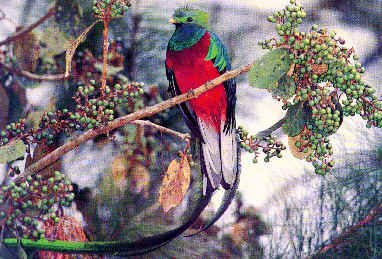
Here's
the list of our "top birds" during the March-April 2005 FONT birding
tour in Guatemala, as voted by the participants:
1 - RESPLENDENT QUETZAL
2 - Garnet-throated
Hummingbird
3 - Lesser Roadrunner
4 - Great Curassow
5 - Pink-headed Warbler
6 - Prevost's Ground-Sparrow
7 - Northern Bentbill
8 - Chestnut-sided Shrike-Vireo
9 - Crescent-chested Warbler
10 - Black-vented Oriole
11 - Purple-crowned Fairy
12 - Orange-breasted Falcon
13 - Fan-tailed Warbler
14 - Hooded Grosbeak
15 - Ocellated Turkey
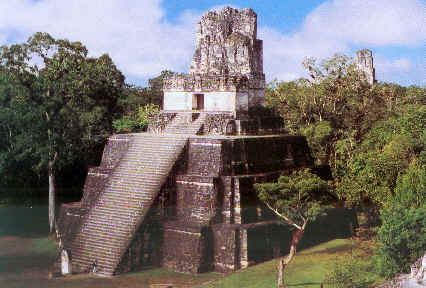
Japan Winter
Birding Tour
(to Honshu, Hokkaido, Kyushu, Amami, & Okinawa)
January-February 2005 (with some notes
relating to the previous tour in December 2004)
Links:
List of Birds & Other Wildlife during our Japan Winter Tours in '04 & '05
Upcoming
Japan Tour Itineraries
The following account written by Armas Hill, leader of the tour:
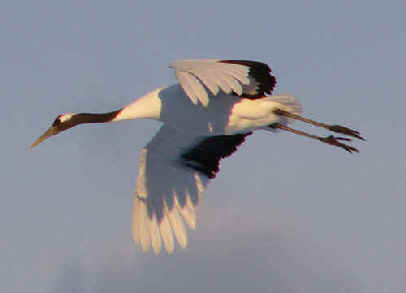
Flying Japanese Crane,
or "Tancho",
(photographed during FONT Feb '05 Japan Tour
by Martin Tribe of the UK)
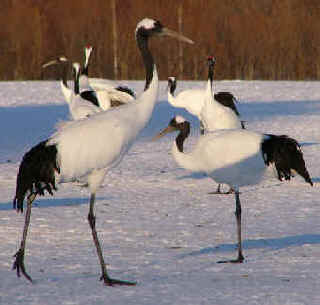
Japanese,
or Red-crowned , Cranes in Hokkaido, Japan
(photographed during FONT Feb '05 Japan Tour
by Martin Tribe of the UK)
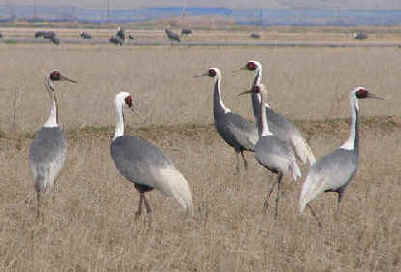
White-naped
Cranes in Kyushu, Japan
(photographed during FONT Feb '05 Japan Tour
by Martin Tribe of the UK)
Okinawa is one of the southernmost Japanese islands. Most of it is heavily populated, especially the southern and central portions. But the northern part of the island is not. And it was in that area, just over 20 years ago, that a bird became newly-known to science. That bird, with its striking pattern of black, white, and brown, and a bright red bill and red legs, spends most of its time on the ground, and in dense undercover. That bird, not known to science prior to 1981, is the Okinawa Rail.
That northern region of northern Okinawa has been known for years (and for years before 1981) as the only place in the world for one of the rarest birds in the world - the Pryer's (or Okinawa) Woodpecker. It was very close to extinction in the 1930's. Today, its population is still low. Estimates during recent years have ranged from 40 to 100 birds.
So, when we've done FONT birding tours in Okinawa, since the early 1990's, the two top targets have been, of course, the rare woodpecker and the rather newly-discovered rail.
The Pryer's Woodpecker we've seen during all of our Okinawa tours, although sometimes fleetingly and other times leisurely.
But the Okinawa Rail has, at times, proven to be elusive. It is, after all, a very shy bird. And, there's a reason why it wasn't known to ornithology until recently.
Oh yes, we've seen it over the years, in various ways. Sometimes, quickly, as it dashed across a path or a lightly-traveled small road. Overall, hearing it (at dawn, dusk, and after dark) has been easy. Seeing it has been hard.
A couple years ago, during one of our tours, we met a young lady in that part of Okinawa, who told us that she routinely saw the bird (that she called by its local name, "Agachi Kumira") as she walked to work in the morning. As unbelievable as that seemed, we went the following morning, to the area along the road that she suggested, and, wow, we saw maybe 10 of them, as we stayed quietly in our vehicle. The birds were walking along the side of the road, by the edge of the tall grass.
During our Feb '05 Okinawa tour, we were ready to see the Okinawa Rail again. This time, we learned from a man, of a place, an opening in a small field of otherwise tall grass, surrounded by brush, where he said the rail could appear. The first time when we went there to the edge of the field, and sat in our vehicle, it did not. We gave it a while, but no rail.
However, later in the day, we went back, and repeated our approach of sitting quietly, looking, and waiting. None of those things did we have to do for long. Within moments, at the edge of the grass, there it was, the Okinawa Rail! This normally-shy bird then walked out onto the low grass, to give a totally unobstructed view! It was in no hurry, as it either just stood, or walked slowly about. It even, at one point, walked directly toward our vehicle, to become too close (yes, too close!) for those on the opposite side to see it. Then, it drifted back, still not in a hurry. We were having a look of a life-time at a bird normally so hard to see. During all this, of course, photos were being taken. One of our tour participants, with his digital camera, got as many as 140 shots of the bird! Incredible. Here, now, is one of those many (140) photographs of this attractive and usually very shy bird, with an ornithological history of only just over 20 years.
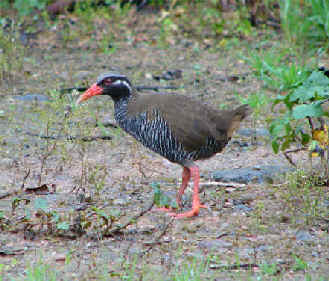
Our group of tour participants
in Japan was kind of interesting as to where they came from. The person who took
the 140 photos of the rail was from England (of course!). Others on the tour
were from Austria and the Netherlands. Another person scheduled to be with us
would have been from Guernsey, but he couldn't come due to a family illness. And
the two people who were with us from Texas were not with "tall hats"
and a drawl. No, they had previously resided in Canada, and prior to that, they
were from Northern Ireland.
And so it was that when, at the
appropriate time during the tour, I mentioned that there was a "Super
Bowl" going on in the States, with the Philadelphia Eagles, no one was
interested. It wasn't Philadelphia (or New England) that no one cared about,
Rather, it was just that it was an American game!
Most of the people that we encountered throughout our tour were Japanese, endemic to Japan. As were some of the birds, entitled "Japanese" that is. During the first part of the tour, for example, in the hills of Honshu, we saw Japanese Accentor, Japanese Grosbeak, and Japanese Green Woodpecker. All nice to see, Two of them, endemic to Japan. The grosbeak also occurs in eastern mainland Asia.
The Pryer's Woodpecker and Okinawa Rail were not the only two rare birds that we saw in Japan. Others included the very rare Black-faced Spoonbill, the Steller's Sea-Eagle, the big and rare Blakiston's Fish-Owl, the Amami Woodcock, and cranes. Among the 6 species of cranes that we saw, those classified as rarities were the Red-crowned (or Japanese) Crane, and the White-naped, and the Hooded Cranes.
Actually, regarding cranes, there was something unusual during our February '05 tour. Normally, we've seen the Red-crowned Crane only on the northern Japanese island of Hokkaido (where there is a resident population). But, this time, we saw one (from the Manchurian population) on the southern island of Kyushu, where it was wintering with the White-naped and Hooded Cranes. It was the first such occurrence there in 37 years! (Incidentally, we've been doing tours to Japan to see the cranes for 14 years.)
A comment needs to be made regarding one of the rarities just mentioned, the Blakiston's Fish-Owl, one of the rarest, and one of the largest owls in the world. In February '05, we saw two. And that kept the streak going. We've seen Blakiston's Fish-Owls during all 16 of our winter birding tours in Hokkaido.
There is now a new, and
informative, feature elsewhere in our website entitled "Rare
Birds of Japan", relating to birds that have been mentioned
here, and others.
Whether you've seen the birds or
not (or whether or not you ever will), it's interesting reading. And
particularly so, in the "further notes" section, are the narratives
regarding the Short-tailed Albatross (a bird that came back from very
brink of extinction), the Siberian Crane (one of the most threatened of
all birds), and the Blakiston's Fish-Owl (one of the most mysterious of
birds, as it lives secretly in a remote area).
Also new in our website,
there's another feature that's really worth a look. It's a "Photographic
Sampling of Japanese Culture & Scenery", a series of photos
taken by one of the Canadian participants on our December 2004 Japan tour. The
photographs are not only beautiful, but quite interesting.
That December '04 birding tour was another very good one for birds. Some of the highlights were on the southern island of Kyushu, where between 2 and 3 thousand exquisite Mandarin Ducks were seen, and where we had a good look at the Copper Pheasant (a Japanese endemic that can be hard to see!)
During the most-recent February '05, we went where that pheasant was. No, we didn't see it, but we did see, overhead, 3 Mountain (or Hodgson's) Hawk-Eagles. Two were soaring together in the blue sky, and then perched in trees, where they could be viewed in scopes. Another (the third) was seen later.
During the December '04 Japan tour, in addition to those birds just noted here, all of the rarities mentioned above were seen. That is, except for the Pryer's Woodpecker and Okinawa Rail, as that tour did not go to Okinawa.
Here's the list of our "top birds" during the January-February 2005 FONT birding tour in Japan, as voted by the participants:
1 - OKINAWA RAIL
2 - Steller's Sea-Eagle
3 - Pallas' Rosefinch
4 - Ryukyu Robin
5 - Grey Bunting
6 - Japanese Accentor
7 - White-naped Crane
8 - Blakiston's Fish-Owl
9 - Lidth's Jay
10 - Japanese Grosbeak
11 - Asian Rosy Finch
12 - Mountain (or Hodgson's) Hawk-Eagle
13 - Green Pheasant
14 - Grey-headed Lapwing
15 - Crested Kingfisher
Costa
Rica Birding & Nature Tour (in
Southern Costa Rica)
January 2005
Links:
List of Birds & Other Wildlife during our Costa Rica Tour in Jan '05
In cumulative list of Costa Rica birds, in this web-site, scientific names are given & subspecies are noted.
Upcoming Costa Rica Tour Itineraries
Our first birding tour of the new year,
in January 2005, was in Costa
Rica. It was a very good and enjoyable tour, with motmots and macaws,
and toucans, trogons, and tanagers (just to mention a few of the
colorful birds).
This week-long tour was in southern Costa Rica, and with a
small bit in adjacent Panama.
But, one doesn't have to go to Panama to see some
of the birds from that country that are now occurring further north, in Costa
Rica. Ones, in that category, that we saw in Costa Rica included Pearl Kite, Savanna Hawk,
Red-breasted Blackbird, and Grassland Yellow-Finch.
Here's
the list of our "top birds" during the January 2005 FONT Southern
Costa Rica Tour as voted by the participants at the end of the tour:
1 - BLUE-CROWNED
MOTMOT
2 - Scarlet Macaw
3 - Pygmy Kingfisher
4 - Pearl Kite
5 - Chestnut-mandibled Toucan
6 - Common Potoo
7 - Ocellated Piculet
8 - Fork-tailed Flycatcher
9 - Fiery-billed Aracari
10 - White-tailed Kite
11 - Green Violetear
12 - Yellow-billed Cotinga
13 - Red-legged Honeycreeper
14 - Laughing Falcon
15 - Purple Gallinule
Honorable
Mentions:
Baird's Trogon
Golden-naped Woodpecker
Black Guan
Volcano Junco