
PO Box 9021, Wilmington, DE 19809, USA
E-mail: font@focusonnature.com
Phone: Toll-free in USA, Canada, & Puerto Rico 1-800-721-9986
or 302/529-1876; Fax: 302/529-1085
PO Box 9021, Wilmington, DE
19809, USA
E-mail: font@focusonnature.com
Phone: Toll-free in USA, Canada, & Puerto Rico 1-800-721-9986
or 302/529-1876; Fax: 302/529-1085
HIGHLIGHTS
FROM FOCUS ON NATURE TOURS in 2006
With
tour narratives, photos, comments by participants, and links to lists of birds
& other nature during the tours.
INCLUDED BELOW ARE
BIRDING & NATURE TOURS
THAT WERE CONDUCTED IN:
ARIZONA, BRAZIL (2 tours: 1 in Sep, 1 in Oct), the
CAYMAN ISLANDS, COSTA RICA, the DOMINICAN REPUBLIC, GUATEMALA (3 tours: in January,
in March, & in Dec/Jan), ICELAND (2 tours: in June & in Sep/Oct), JAMAICA,
JAPAN, PANAMA, and SWEDEN.
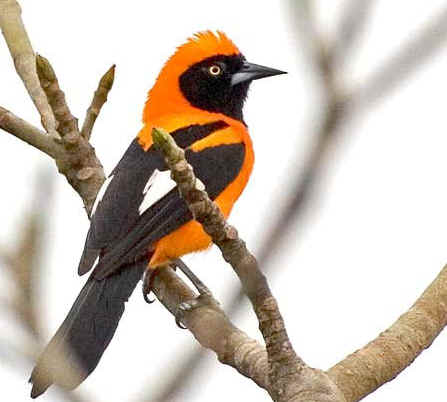
Orange-backed Troupial
(Photograph taken during the FONT tour in Brazil,
in September 2006, by Andy Smith)

The tour summaries here are given with the most-recent tours first.
For some tours there are links below for longer NARRATIVES. Also there are links
to UPCOMING TOUR ITINERARIES, and LISTS relating to BIRDS, MAMMALS, & OTHER
NATURE.
Links to tours:
GUATEMALA
(December 2006/January 2007)
BRAZIL (Minas Gerais & Rio Grande do Sul) (October 2006)
ICELAND (September/October 2006)
DOMINICAN REPUBLIC (& adjacent HAITI) (April 2006)
CAYMAN ISLANDS & JAMAICA (February/March 2006)
COSTA RICA (southern) & PANAMA (western) (February 2006)
PANAMA (central & eastern) (February 2006)
GUATEMALA (December 2005/January 2006)

Guatemala
- December 2006 / January 2007
Again, our annual
holiday tour was in Guatemala, a great destination not just for the festivities
of the season, but also for a nice assortment of birds and other nature. And
certainly not to be ignored is that the weather during the time of the tour was,
as usual, about perfect. Thus, there were the components for an enjoyable tour,
in each of the varied habitats that we visited, including the marshes near the
Pacific, the high mountain forests nestled between volcanic peaks, and during
our treks along rivers and forest trails by temples remaining from a
civilization that flourished over a thousand years ago. Collectively, we found
over 250 species of birds in these settings, where we also saw animals,
butterflies, and wonderful scenery, during this, the 13th FONT tour in
Guatemala.
Click the links below to a fine collection of photos taken
during the tour, and lists of birds and other wildlife during both this tour and
in Guatemala cumulatively during all of our tours there. About 550 birds are in
the cumulative list.
Links:
More about the FONT Guatemala Tour in Dec '06 / Jan '07
Photos of Nature & Scenery from our Guatemala Tour Dec '06/Jan '07
An
article in a Washington DC newspaper about our Dec 06/Jan
07 Holiday Tour in Guatemala
(with text & photos by our tour participants)
Birds & Other Wildlife during our
Guatemala Tour - Dec '06/Jan '07
Cumulative List of Birds during our Guatemala Tours (with photos)
Upcoming
FONT Birding & Nature Tours in Guatemala

Brazil
- October 2006 (in Minas Gerais & Rio Grande do Sul)
This was the 40th FONT birding
& nature tour in Brazil, during which we visited the state of Minas Gerais,
where the Swallow-tailed Cotinga was among the birds and Giant
Anteater & Maned Wolf were among the animals seen.
The second
part of the tour was in the southernmost Brazilian state of Rio Grande do Sul,
one of our favorite birding locales, as it is one of the birdiest places that we
visit. Some species we've seen there in the thousands, including ibises,
whistling-ducks and other waterfowl, and gulls and more.
Species in southern Rio Grande do Sul, include, on the whole, those common in
nearby Uruguay & Argentina, including 2 types of swans, various
ducks (with the Ringed Teal being common), 3
types of coots, and the Giant Wood-Rail.
In that area during one day, we
saw 7 species of Terns: Snowy-crowned, South American, Common,
Antarctic, Large-billed, Yellow-billed, Royal, & Cayenne.
Tyrants
in the region included: Spectacled, White-headed Marsh, Yellow-browed,
Cattle, Blue-billed Black, and Crested Black.
Blackbirds included: Chestnut-capped,
Yellow-winged, White-browed, Scarlet-headed (a beauty!), and Saffron-cowled
(a rarity!), in addition to 3 species of Cowbirds and 2 species of Marshbirds.
The Saffron-cowled Blackbird was one of the 3 notable rarities during the
tour. The others were the Black-and-White Monjita and the Canebrake
Groundcreeper.
In all, over 300 species of birds were seen, including some,
as noted, in spectacular
numbers.
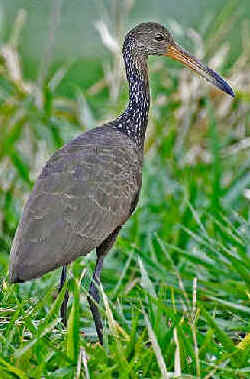
The Limpkin,
one of the common birds
in Rio Grande do Sul, Brazil
Links:
More about the FONT Brazil Tour in October 2006
Birds & Other Wildlife during the FONT Brazil Tour - October '06
Birds in Rio Grande do Sul, in far-southern Brazil (with photos)
Birds
in Minas Gerais (with
photos)
Mammals
& Other Wildlife during FONT Tours in Brazil (with photos)
Upcoming FONT Birding & Nature Tours in Brazil

Iceland
- September/October 2006
This was the 14th FONT
birding & nature tour in Iceland. In October, migrating birds from both
mainland Europe and North America can occur in Iceland. Among them, during this
tour, we saw from America: Sabine's Gull, Snow Goose, and Long-billed
Dowitcher, in addition to the birds of Europe, and those that are
specialties in Iceland, including: White-tailed Eagles (we saw 5),
Iceland Gull, Great Skua, and Harlequin Ducks.
Among the best of
the waterfowl was a large flock of dozens of Barrow's Goldeneyes (both
males & females) riding the rapids of a stream. Our waterfowl included 5
species of geese.
Non-avian fauna included a tremendous male Caribou,
with a huge rack of antlers.
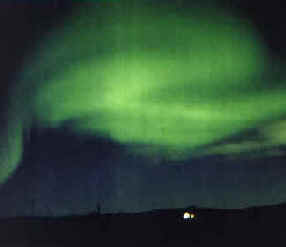
After dark, we saw a wonderful display of Northern
Lights, and one afternoon there was a
brilliant rainbow
over the beautiful volcanic countryside. The rainbow, as bright as
one can be, was complete, and partially double. It was one of the fine sights
that we had during the tour.
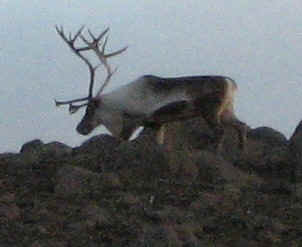
Above: A Reindeer
at Dusk
(Photograph taken during the FONT tour in Iceland,
in October 2006, by Claude Bloch)
Below: The Aurora Borealis, or Northern Lights
in the Icelandic Sky at Night.
Links:
More about the FONT Iceland Tour in September/October 2006
List of Birds during our Iceland Tour - September/October '06
Cumulative List of Birds during our Iceland Tours (with photos)
Complete List of the Birds of Iceland
Cumulative List of Birds during our European Tours (with photos)
Previous Iceland Tour Highlights
Upcoming FONT Birding & Nature Tours in Iceland
During this tour we experienced
the fall migration of birds - European birds, at two Swedish locations that are
outstanding for the phenomenon autumnal avian migration: Falsterbo, at the
southernmost tip of Sweden, and the long island of Öland in the Baltic.
Both of these are pleasant places to be, and some of our highlights included:
Steller's
Eider (from far-northern Europe), Red-breasted Flycatcher and Yellow-browed
Warbler (both from Russia), and a Pectoral Sandpiper (from
North America).
In flocks, there were Eurasian Cranes and Barnacle
Geese.
There were over a dozen raptor species. Particularly nice
among them was the Eurasian Hobby. A group of them were circling about in
the blue sky above us, catching insects.
In all, 110 species of birds were
tallied during the tour.
Links:
More about the FONT Sweden Tour in September 2006
List of Birds during our Sweden Tour - September '06
Cumulative List of Birds during our Sweden Tours (with photos)
Cumulative List of Birds during our European Tours (with photos)
Upcoming FONT Birding & Nature Tours in Sweden
Brazil
(& adjacent Paraguay & Bolivia) - September 2006
This tour, our 39th in Brazil, was dubbed the "J
& J Tour", for the Jabiru &
the Jaguar. And appropriately so, as we saw both. The Jabiru
is easy; the Jaguar is more of a challenge. During open-vehicle
excursions in the southern Pantanal, on two consecutive nights, the Jaguar
was one of a number of animals that we saw. Others were: 7 Ocelots, a Pampas
Cat, a Maned Wolf, 2 Brazilian Tapirs, 3 Giant Anteaters,
both Crab-eating Foxes & Crab-eating Raccoons, a dozen or so Marsh
Deer, the Tapiti (or Brazilian Rabbit),
and many Capybaras.
Also during those nocturnal jaunts, both Striped
& Barn Owls were nicely seen, as were Nightjars of various
species including the Scissor-tailed. Also heard those nights were Rufous
Nightjar and the Gray (formerly Common) Potoo.
Other animals during the tour in the Pantanal, in the daytime, included Giant
Otters, and Brocket Deer.
Many birds were seen in addition to the Jabiru.
Notable among them was the Hyacinth Macaw. But the most notable of
the birds of the tour was during our time in the region of Minas Gerais - the
extremely rare Brazilian Merganser. We enjoyed a pair of these birds in
our scope as they rested on and by streamside rocks.
During this tour, in the Brazilian areas of Iguazu Falls, Mato Grosso do Sul,
and Minas Gerais, with visits to parts of Paraguay and Bolivia, about 400
species of birds were found.
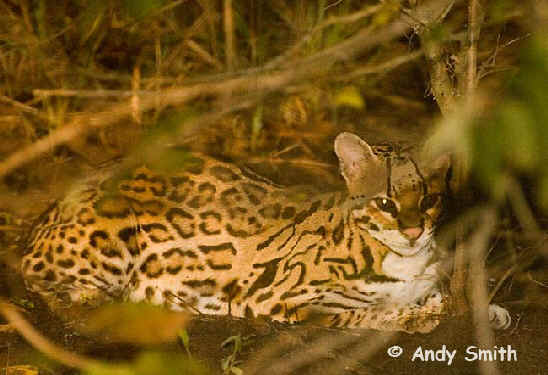
One of the 7 Ocelots seen
during the FONT Sept '06 Brazil Tour.
Links:
More about the FONT Brazil Tour in September 2006
Photos
of Birds & Animals from our Sep '06 Brazil Tour
Birds & Other
Wildlife during our Brazil Tour - September '06
Cumulative List of Birds during our Brazil Tours - Part 1 (Greater Rhea thru Eastern Streamcreeper)
Cumulative
List of Birds during our Brazil Tours - Part 2 (Fasciated Antshrike thru
Hooded Siskin)
Upcoming FONT Birding & Nature
Tours in Brazil
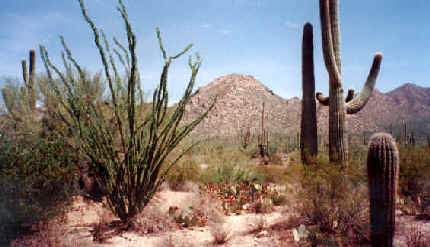
This tour, once again, was particularly good for hummingbirds with as many as 14
species seen, including Lucifer, Violet-crowned, White-eared, and Berylline
Hummingbirds (these 4 species primarily Mexican).
Another bird, primarily
Mexican, seen during the tour was the Rufous-capped Warbler.
Some Aztec Thrushes
(a species endemic to Mexico other than occurring in Arizona as a stray) had
been reported in areas that we visited, but we unfortunately did not encounter
any. We were, however, treated to a bird named after a particular Aztec, the
Montezuma Quail (both male and female) walking in front of us across a dirt
road.
In all, we saw nearly 200 species of birds during the tour, along with an
assortment of mammals (including coatis & coyotes), and
reptiles,
amphibians, and other wildlife (among them, a tortoise, toads
& tarantulas,
and a few rattlesnakes).
Links:
Birds & Other
Wildlife during our Arizona tour - August '06
Cumulative List of Birds during FONT Arizona Tours (with photos)
Mammals during FONT Arizona Tour s (with photos)
Upcoming
FONT Birding & Nature Tours in Arizona
During this, our 13th birding & nature tour in Iceland, there were a number a highlights, including: male and female Gyrfalcons seen cliff-side, a Yellow-billed Loon (unprecedented for Iceland) close to a ferry-boat, a White-tailed Eagle flying around us as we were on another boat, a male and a female King Eider on a beach along the Icelandic north-coast (as very unusual occurrence in Iceland), Red Phalaropes (3 breeding-plumaged females) near their nesting site, Snow Buntings feeding their young. These were in addition to lots of wonderful looks at the "regulars" including: Puffins on grassy cliff-tops and on the water (during the tour, there were many Puffins), other alcids including 2 species of Murres, Razorbills, and Black Guillemots, plus colorful Harlequin Ducks in rushing streams, pairs of Red-throated Loons in breeding attire, more Snipe winnowing in the sky than could be imagined, both light and dark Parasitic Jaegers, and as many as 100 Great Skuas during less than a half-hour as we traveled one evening along a highway. Iceland has its share also of "strays". The best of those that we saw was a drake Garganey. Birds are just one aspect of nature to be experienced in Iceland. There's also fascinating geology, wildflowers, and the largest glacier in Europe. Mammals during our tour included: a dark Arctic Fox, Minke Whales (from shore), and Harbor Seals. This was, as noted, our 13th Iceland Tour, but if there were "luck" with it, it was good.
Links:
More about the FONT Iceland Tour in June 2006
Photos of Icelandic Birds & Scenery from our June 2006 Iceland Tour
List of Birds during our Iceland Tour - June '06
Cumulative List of Birds during our Iceland Tours
Complete List of the Birds of Iceland
Upcoming FONT Birding & Nature Tours in Iceland
Japan
in the Spring - May 2006
This was the 26th FONT birding
& nature tour in Japan, the 10th in the Spring, and our 5th
to Hegura Island, a small island in
the Sea of Japan where there can be a big bird
migration. Again as we have previously, in 2006, we had some truly tremendous
birding on Hegura. One day, we saw 8 species of egrets, including the rare
Chinese
(or
Swinhoe's) Egret, the Asian race of the Purple Heron, and a fine
Chinese Pond Heron in breeding plumage. At that one corner of Hegura that day,
it was like a small piece of China, as all 3 of those species are of more normal
occurrence there. Other birds too, more common on the Asian mainland, migrate on
Hegura. In that category, we also saw the
Rufous-tailed (or Swinhoe's) Robin,
the Tristram's Bunting, and the Tricolored and Mugimaki Flycatchers. In all, we
enjoyed 90 species of birds on Hegura Island in May
'06.
Links:
More about the FONT Japan Tour in May 2006
List of Birds & Other Wildlife during our Japan Spring Tour - May '06
Cumulative List of Birds during our Japan Spring Birding Tours
Upcoming FONT Birding & Tours in Japan
Dominican
Republic (& adjacent Haiti) - April 2006
During this, our 14th tour on
the Caribbean island of Hispaniola, we did well with the interesting rare &
endemic birds of the island, including a number of them with the adjective
"Hispaniolan".
Notable among them was the Hispaniolan Quail-Dove (1 of
3 quail-doves during the tour).
On the rare Golden
Swallow, a fine sight was its
golden sheen in the sunlight.
As the sun was setting one day, from a small
boat with the motor off, on a lake, we looked at nicely-lit Caribbean Flamingos
walking in shallow water.
After dark, another day, we saw an
Ashy-faced Owl, and then, moments later, a rarely-seen creature also endemic to
Hispaniola, an odd mammal called the Hispaniolan Solenodon (over a foot-long,
with a long snout & long tail, as it passed in front of our vehicle)!
Links:
More about the FONT Dominican Republic Tour in April 2006
List of Birds during our Dominican Republic Tour - April '06
Cumulative list of Birds during our previous Dominican Republic Tours
List of Birds during FONT tours in the West Indies (with photos)
Upcoming FONT Birding & Nature Tours in the Caribbean, including the Dominican Republic
This was the 12th FONT tour
in Guatemala - it was in both the highlands and lowlands of the country. It was
different than our other previous Guatemala tours in that during it there as
many as 6 boat-trips. They were in areas of coastal mangroves & marshes and
along an inland river away from civilization and small clear-watered rivers
filled with little fish flowing into a large lake. Conducting so many boat trips
was certainly productive as among the many birds seen there were: Pinnated
Bittern, Agami Heron, Boat-billed Herons, and hundreds of Wood Storks and
American White Pelicans. During one day from a boat, all 5 species of North
American kingfishers were seen. There were also avian highlights away from water. In
the area of the Mayan ruins at Tikal, an
Orange-breasted Falcon was by a temple,
and a Pheasant Cuckoo was seen and heard doing its odd display on the ground.
Links:
More about the FONT Guatemala Tour in March 2006
List of Birds during our Guatemala Tour - March '06
A Cumulative List of Birds during FONT tours in Guatemala
Upcoming FONT Birding & Nature Tours in Guatemala
Cayman
Islands & Jamaica - February/March 2006
During these tours (done
either in combination or separately), a nice number of Caribbean endemic &
specialty birds were seen.
Highlights in the Caymans included well over a
hundred West Indian Whistling-Ducks and a colony of a couple thousand Red-footed
Boobies & Frigatebirds, in addition to "target birds" such as
Rose-throated Parrot, Yucatan Vireo, Cuban Bullfinch, and Vitelline Warbler.
Among the best in Jamaica, in addition to the endemics, were a pair of Masked
Ducks, a fine look at a Yellow-breasted
Crake, and about 20 White-tailed
Tropicbirds seen nicely as they flew close to us
cliff-side.
Links:
More about the FONT tours in the Cayman Islands & Jamaica in February/March 2006
List of Birds during our Cayman Islands & Jamaica - February/March '06
Cumulative list of Birds during FONT Cayman Island Tours
Cumulative list of birds during FONT Jamaica Tours
List of Birds during FONT tours in the West Indies (with photos)
Upcoming FONT Birding & Nature Tours in the Caribbean
Southern
Costa Rica & Western Panama - February 2006
During this tour, in the highlands
and on the Pacific side of southern Costa Rica
and in the
adjacent Chiriqui province of Panama, 267 species of birds were observed.
238 of
them were found in Costa Rica.
107 were found in Panama during only 2 days in
that country.
78 of the 267 species were found in both countries, while 29
species were found in Panama alone. In the last category were: the Veragua
Parakeet (an isolated population that has been considered a
subspecies of the Brown-throated Parakeet of northern South
America), the Veraguan Mango (which was considered part of the
Green-breasted Mango; we saw a female on a nest), and the White-throated
Mountain-gem (closely related to other mountain-gems,
particularly the Gray-tailed Mountain-gem that we also saw - in
Costa Rica).
This was the 27th FONT birding tour in Costa Rica. Prior to it, our cumulative
total of birds for CR was 684. During this tour, 1 new species was added to that
CR list, the Southern Lapwing. 2 of them were seen in a pasture south of
Golfito; they appeared to be on territory.
Other notable birds found during the
southern Costa Rica portion of this tour included: Masked Duck, Barred Hawk,
Sunbittern, Scarlet Macaw, Baird's Trogon, Chiriqui Yellowthroat (has
been considered part what has been the Masked Yellowthroat of
South America), Zeladonia, Black-cheeked Ant-Tanager, Red-breasted
Blackbird, Volcano Junco.
Also, in all there were a number (22 species) of
hummingbirds, and some notable Finches: the Peg-footed, the
Large-footed, and the Yellow-thighed.
Nature other than birds included some mammals (notably Mantled
Howler & White-faced Capuchin Monkeys, and a Kinkajou
in the daytime - in the photo below), and Morelet's Crocodile,
Spectacled Caiman, Green Iguana, and an assortment of butterflies.
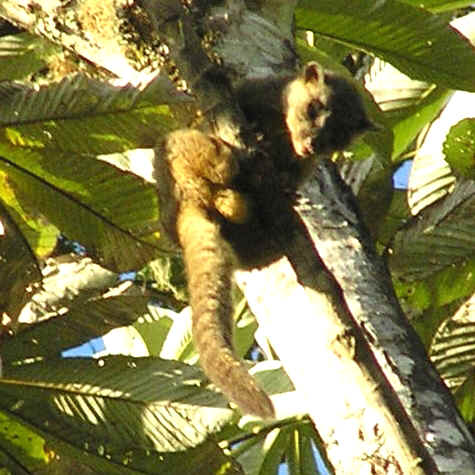
A Kinkajou
photographed in the forested mountains of southern Costa Rica
during the FONT tour in February 2006.
(Photo by Rosemary Lloyd)
Links:
More about the FONT tour in southern Costa Rica & western Panama in February 2006
List of Birds during our Costa Rica & Panama Tours - February '06
Cumulative list of Birds during FONT Costa Rica Tours
Upcoming
FONT Birding & Nature Tours in Costa Rica & Panama
Central
& Eastern Panama - February 2006
During this tour, we traveled
from the Canal Basin
and east into the lowlands and foothills of Darien province. The further east we
went , the "wilder" Panama got, in that the Pan American highway
dead-ends, the population dwindles, and that the habitats for birds, and the
numbers of birds, increase.
Among the birds were some more common in South
America than in Central America.
Birds in that category that we saw included: Capped
and Cocoi Herons, Pearl Kite, Red-throated Caracara, Red-and-green Macaw,
Golden-green Woodpecker, One-colored Becard, Pied Water-Tyrant,
Green-and-Rufous Kingfisher, and Orange-crowned Oriole.
Other
interesting birds, among the 200 or so species we saw in less than a week,
included some that are restricted to only eastern Panama and adjacent Colombia.
Among those birds were: Double-banded Graytail, Black Antshrike, White-headed
Wren, Black Oropendola, and the White-eared Conebill (a
favorite!).
A boat-ride along a river in the Darien foothills produced, in
addition to the Red-throated Caracara and Green-and-rufous Kingfisher,
some other good ones including Agami Heron, American Pygmy Kingfisher,
and some wonderful looks at Crane Hawks.
A rarity for Panama was a
Long-billed Curlew (and unusual for this tour as it's a bird mostly of
North
America!)
Links:
More about the FONT tour in central & eastern Panama in February 2006
List of Birds during our Panama Tours - February '06
Cumulative list of Birds during FONT Panama Tours
Upcoming FONT Birding & Nature Tours in Panama
Guatemala
- December 2005 / January 2006
This tour, in the highlands
& lowlands of Guatemala, was at a wonderful time of year to be there.
A
couple months earlier, in October 2005, particularly in the highlands, there had been
some destruction due to severe weather (Hurricane Stan).
But during our tour the
weather could not have been better. And the birds were fine too.
In the
highlands, among the best were the adult male Sparkling-tailed Woodstar, the
Prevost's Ground Sparrow, and the Pink-headed Warbler, a perennial favorite.
In
the area of the Mayan ruins of Tikal, birds ranged from the large, such as the
Great Curassow (great looks!), to the small & colorful, such as the
Manakins.
The males of the White-collared & the Red-capped were favorites.
Links:
More about the FONT Holiday Tour in Guatemala in December 2005/January 2006
List of Birds during our Guatemala Holiday Tour - December '05-January '06
Cumulative list of Birds during our previous Guatemala Tours