 |
PO Box 9021,
Wilmington, DE 19809, USA
E-mail: font@focusonnature.com
Phone: Toll-free in USA 1-888-721-3555
or 302/529-1876 |
 A
List and Photo Gallery
A
List and Photo Gallery
of selected
Butterflies
in Brazil, Argentina
and Paraguay
including the area of
Iguazu
Falls
and Mato Grosso in Brazil,
including the Pantanal,
and north to Alta Floresta
and the Rio Cristalino
and Southeast Brazil
With those seen during
Focus On Nature Tours
noted
with an (*)
This regional list of South American butterflies compiled by Armas Hill
The area of Iguazu Falls,
where the countries of Argentina, Brazil, and Paraguay meet, is one of the best
places in the world to see butterflies - with a large variety, and many of them
in large numbers.
In the following list, butterflies coded "ARne"
are those occurring at Iguazu Falls.
Also included in this list are butterflies in southeastern
Brazil, including the state of Rio de Janeiro. Butterflies in that area include
those of the Atlantic Forest, and places such as the Itatiaia & Serra dos
Orgaos National Parks, the Tres Picos State Park, and the area of "Regua",
the Reserva Ecologica de Guapiacu, a fine destination for butterfly & bird
tours north of the city of Rio de Janeiro.
Butterflies coded in this list with
"BRse" are from the 2011 listing
in the article "Preliminary Analysis of the Diurnal Lepidoptera of the
Tres Picos State Park, Rio de Janiero, Brazil", a collaboration by the
following people: A. Soares, J. Bizarro, C. Bastos, N. Tangerini, N. Silva, A.
da Silva, & G. Silva.
That list is one of the first extensive local Brazilian butterfly checklists,
resulting from considerable work, using data sorted, screen, and stored in
museum specimen labels, from the last 50 to 70
years.
Butterflies with the code "BRmg" occur
in Mato Grosso, Brazil, in either the Pantanal, Chapada dos Guimaraes, or
further north at Jardim de Amazonia, "Garden of the Amazon", or Alta
Floresta and by the Rio Cristalino.
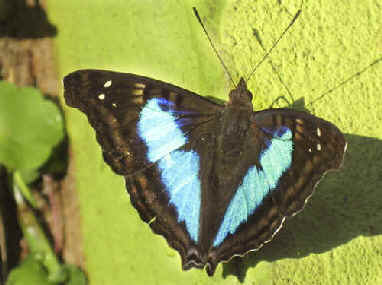
The two photos here
(above
& below) were both taken during the FONT tour at Iguazu in August 2008.
The upper right photo is of a butterfly with English names of either the
TURQUOISE EMPEROR or the SAPPHIRE. Its
scientific name is: Doxocopa laurentia.
The photo below is of Iguazu Falls on the Argentine side. The moisture in the
air near the falls is much to the liking of the butterflies.
Photos in this list include those
of these butterflies: Polydamas Swallowtail, Androgeus
Swallowtail, Southern Dogface, White-angled Sulphur, Cloudless Sulphur, Large Orange Sulphur,
Two-spotted Prepona, Turquoise Emperor, Small Beauty, Orion Cecropian, Red Rim, Red Cracker, Florida
Purplewing, Ruddy Daggerwing,
Spotlight Catone, the Widespread "88", Malachite, Rusty-tipped
Page, White Peacock, Bordered Patch,
Gulf Fritillary, Fine-lined Longwing, Banded Longwing, Julia, Crimson-patched Longwing, Zebra Longwing, Variegated Fritillary,
Monarch, Soldier, Tiger Mimic-Queen, Achilles Morpho, Helenor Morpho, Brazilian Owl

Among the Butterfly groupings in this list,
links to:
Swallowtails:
Family PAPILIONIDAE with
the genera: Battus (Pipevine
Swallowtails), Eurytides (Kite Swallowtails), Papilio (Fluted Swallowtails),
Parides (Cattlehearts)
Whites, Yellows, Sulphurs, and allies: Family PIERIDAE
Mimic-whites: Subfamily DISMORPHIINAE
with
the genera: Dismorphia, Enantia, Pseudopieris
Subfamily
PIERINAE,
TrIbe ANTHOCHARIDINI with
the genus Hesperocharis
Whites
and allies: Subfamily
PIERINAE, Tribe PIERINI with
the genera: Archonias, Ascia, Catasticta, Daptoneura, Ganyra, Glutophrissa,
Itaballia, Leptophobia, Melete, Pereute, Pieriballia
Sulphurs:
Subfamily COLIADINAE with
the genera: Anteos, Aphrissa, Colias, Eurema, Leucidia, Phoebis, Pyristia,
Rhabdodryas
Hairstreaks,
Blues: Family LYCAENIDAE
Hairstreaks:
Subfamily THECLINAE with
the genera: Allomaitia, Arawacus, Arcas, Arumecla, Atlides, Calycopis, Celmia,
Contrafacia, Chlorostrymon, Cyanophrys, Electrostrymon, Erora, Evenus, Iaspis,
Ignata, Lamprospilus, Laothus, Megathecla, Michaelus, Ministrymon, Ocaria, Oenomaus,
Ostrinotes, Panthiades, Parrhasius, Pseudolycaena, Rekoa, Siderus, Strephonota,
Strymon, Symbiopsis, Thepytus, Theritas, Thestius, Tmolus, Ziegleria
Blues: Subfamily POLYOMMATINAE
with the genera: Elkalyce,
Hemiargus, Leptotes, Zizula
Metalmarks:
Family RIODINIDAE, Subfamilies EUSELASLINAE & RIODININAE with
the genera: Adelotypa, Ancyluris, Anteros, Apodemia, Argyrogrammana, Audre,
Baeotis, Calephelis, Calydna, Caria, Catocyclotis, Chalodeta, Chamaelimnas,
Charis, Chorinea, Cremna,
Dachetola, Detritivora, Echydna, Emesis, Eurybia, Euselasia, Isapis, Juditha,
Lasaia, Lemonias, Leucochimona, Livendula, Melanis, Menander, Mesene, Mesosemia, Metacharis,
Monethe, Napaea, Notheme, Nymphidium, Panara, Parcella, Periplacis, Peropthalma, Pirascca,
Rhetus, Riodina, Sarota, Semomesia, Setabis, Stalachtis, Stichelia, Symmachia, Synargis, Syrmatia, Theope,
Thisbe
Brushfoots:
Family NYMPHALIDAE
Snout:
Subfamily LIBYTHEINAE
with the
genus: Libytheana
Preponas:
Subfamily
CHARAXINAE, Tribe PREPONINI
with the genera: Agrias, Archaeoprepona, Prepona
Leaf
Butterflies: Subfamily CHARAXINAE, Tribe ANAEINI with
the genera: Consul, Hypna, Fountainea, Siderine, Zaretis
Emperors: Subfamily APATURINAE with
the genus: Doxocopa
Beauties,
Lady Butterflies, Mapwings: Subfamily
NYMPHALINAE, Tribe NYMPHALINI with
the genera: Colobura, Hypanartia, Smyrna, Vanessa
Cecropians:
Subfamily NYMPHALINAE, Tribe Coeini with
the genus: Historis
Red
Rim: Subfamily
BIBLIDINAE, Tribe BIBLIDINI with
the genus: Biblis
Crackers
and allies: Subfamily BIBLIDINAE, Tribe AGERONIINI with
the genera: Ectima, Hamadryas
Purplewings and allies:
Subfamily BIBLIDINAE, Tribe EPICALLINI with
the genera: Catonephele, Cybdelis, Eunica, Myscella, Nessaea
Daggerwings: Subfamily CYRESTINAE with
the genus: Marpesia
Sailors: Subfamily BIBLIDINAE, Tribe
EUBAGINI with
the genus: Dynamine
Banners and allies: Subfamily
BIBLIDINAE, Tribe EPIPHILINI with
the genera: Epiphile, Nica, Pyrrhogyra, Sea, Temenis
Eighty-Eights:
Subfamily BIBLIDINAE, Tribe CALLICORINI with
the genera: Callicore, Diaethria, Haematera, Paulogramma
Sisters: Subfamily LIMENITIDINAE, Tribe LIMENITIDINI with
the genus: Adelpha
Malachite, Page,
Peacocks: Subfamily NYMPHALINAE, Tribe VICTORININI
with
the genera: Anartia, Metamorpha, Siproeta
Buckeye, Mimic:
Subfamily NYMPHALINAE, Tribe JUNONIINI with
the genera: Hypolimnas, Junonia
Patches, Checkerspots, Crescents: Subfamily NYMPHALINAE, Tribe
MELITAEINI with the
genera: Chlosyne, Eresia, Ortilia, Tegosa, Telenassa
Longwings: Subfamily
HELICONIINAE, Tribe HELICONIINI with
the genera: Agraulis, Dione, Dryadula, Dryas, Eueides, Heliconius, Philaethria
Fritillaries:
Subfamily HELICONIINAE, Tribe ARGYNNINI with
the genus: Euptoita
Subfamily HELICONIINAE, Tribe ACRAEINI
with
the genus: Actinote
Milkweed Butterflies:
Subfamily DANAINAE
with the genera: Danaus,
Ituna, Lycorea
Clearwings: Subfamily
Ithomiinae with
the genera: Aeria, Callithomia, Dircenna, Episcada, Epityches, Greta, Heterosais,
Hypoleria, Hypothyris, Ithomia, Mechanitis, Melinea, Methona, Napeogenes, Oleria,
Placidina, Pseudoscada, Pteronymia, Scada, Thyridia, Tithorea
Morphos: Subfamily Morphidae with
the genera: Antirrhea, Blepelenes, Morpho
Owls: Subfamily Brassolidae
with the genera:
Brassolis, Caligo, Catoblepia, Dasyophthalma, Dynastor, Eryphanis, Narope,
Opoptera, Opsiphanes
Satyrs: Subfamily Satyrinae with
the genera: Amphidecta, Archeuptychia, Capronnieria, Chloreuptychia, Cissia, Eteona,
Euptychia, Forsterinaria, Godartiana, Haetera, Hermeuptychia, Magneuptychia, Manataria,
Moneuptychia, Pareuptychia, Paryphthimoides, Pharneupytchia, Pierella,
Posttaygetis, Praepedaliodes, Splendeuptychia, Taygetis, Yphthimoides, Zischraia
Skippers: Family HESPERIIDAE
Open-winged
Skippers:
Subfamilies EUDAMINAE & PYRGINAE with
the genera in EUDAMINAE: Aguna, Astraptes (Flashers), Autochton, Bungalotis,
Chiodes, Cogia, Dyscophellus, Narcosius, Nascus, Phanus, Phocides, Polygonus,
Polythrix, Proteides, Ridens, Salatis, Samientola, Spathielpia, Telemiades
(Flats), Typhedanus, Urbanus (Long-tailed Skippers)
with the genera in
PYRGINAE: Achlyodes, Aethilla, Anastrus, Anisochoria, Antigonus, Bolla,
Carrhenes, Celaenorrhinus, Chiomara, Codatractus, Cycloglypha, Diacus, Ebrietas,
Elbella, Epargyreus, Erynnis (True Duskywings), Gesta, Gorgopas, Gorgythion,
Grais, Granilla, Helias, Heliopetes & Heliopyrgus (Large White Skippers),
Jemadia, Milanion, Minoniades, Mylon, Myscelus, Mysoria, Nisoniades, Noctuana, Oechydrus,
Ouleus, Pachyneuria, Pellicia, Pyrdalus, Pyrgus (Checkered Skippers), Pythonides,
Polyctor (Tufted Skippers), Pyrrhopyge, Quadrus, Sarbia, Sostrata, Staphylus, Theagenes,
Timochares, Trina, Viola, Xenophane, Zera
Branded
(or Grass) Skippers: Subfamily HESPERIINAE with
the genera: Aides, Anthoptus, Arita, Argon, Atalaopedes, Callimormus, Calpodes,
Carystoides, Carystus, Cobalopus, Cobalus, Conga, Corticea, Cymaenes, Cynea,
Decinea, Enosis, Eutychide, Evansiella, Hylephila, Justinia, Lento, Lerodea,
Levina, Ludens, Lycas, Lychnuchoides, Lychnuchus, Methionopsis, Miltomiges,
Mnasitheus, Moeris, Naevolus, Nicohiades, Nyctelius, Onophas, Orses, Panoquina,
Papias, Paracarystus, Parphorus, Perichares, Phanes, Pheraeus, Polities,
Pompeius, Propertius, Psoralis, Pyrrhopygopsis, Quasimellanus, Remella, Saliana,
Saniba, Saturnus, Sodalia, Synapte, Talides, Thespieus, Thracides, Tirynthia,
Tirynthoides, Tisias, Vacerra, Vehilius, Venas, Vertica, Vettius, Vinius, Virga, Wallengrenia,
Xeniades, Zariaspes, Zenis
Codes relating to illustrations in
various books:
Numbers noted as (BB:xx) refer to pages in "Butterflies
of Buenos Aires (Argentina)", by Gustavo Canals.
Numbers noted as (C:xx) refer to pages in "A World of Butterflies", with text by
Brian Cassie, and photographs (superb) by Kjell Sandved.
Numbers noted as (DA:xx) refer to pages in
"Butterflies of South
America", by Bernard D'Abrera.
Numbers noted as (DV1:xx) refer
to plates in "The Butterflies of Costa Rica and their Natural History (Volume 1):
Papilionidae, Pieridae, Nymphalidae", by Philip J. DeVries.
Numbers noted as (DV2:xx) refer to plates in
"The Butterflies of Costa Rica and
their Natural History (Volume 2): Riodinidae", by Philip J. DeVries.
Numbers noted as (F:xx) refer to pages in "The Illustrated Encyclopedia of
Butterflies", by Dr. John Feltwell.
Numbers noted as (K:xx) refer to pages in the
"Kaufman Focus Guide to Butterflies of North America", by Jim Brock & Kenn
Kaufman.
Numbers noted as (MB:xx) refer to pages in "Mariposas Bonaerenses"
("Butterflies of Buenos Aires"), in Argentina, by Gustavo
Canals.
Numbers noted as (MM:xx) refer to pages in
"Mariposas de Misiones" ("Butterflies of Misiones"), in
Argentina, by Gustavo Canals. (This book includes butterflies at Iguazu
Falls in Argentina & Brazil,
one of the prime locations for observing them in South
America.)
Numbers noted as (PE:xx) refer
to plates in "Eastern Butterflies, the Peterson Field Guides", the
1998 edition, by Paul Opler &
Vichai Malikul.
Numbers noted as (S:xx) refer to pages in the
"Smithsonian Handbook, Butterflies & Moths", by David Carter.
Additional Codes:
AR: in Argentina
ba: in the province of Buenos Aires
ne: in the northeast, particularly in the province of Misiones,
including IGUAZU FALLS
BR: in Brazil
am: in the Amazon basin
se: in the southeast, including the Atlantic Forest and
sometimes including IGUAZU FALLS
Argentine (AR) & some Brazilian (BR) common names are in the list beneath
the scientific names & those names that exist in English. English
translations of the Spanish & Portuguese names are also given (or will be
here later).
(ph): species with a photo in the FONT website
Links:
Information about upcoming FONT tours in:
Brazil Argentina & Chile
Or by month in: 2015
2016 or: by geographic locations worldwide
A List
and Photo Gallery of
Brazil Birds, in 4 parts:
Part #1: Tinamous to Doves Part #2: Macaws to Flycatchers
Part #3:
Antshrikes to Woodcreepers Part
#4: Vireos to Grosbeaks
A List and Photo Gallery of Argentina Birds, in 2 parts:
Part #1: Tinamous to Flycatchers Part #2: Antshrikes to Grosbeaks
Mammals & Other Wildlife in South
America (with some
photos)
Lists and Photo Galleries of South America Butterflies
and Moths, in 7 parts:
1: Swallowtails
2:
Whites, Sulphurs,
allies 3:
Hairsteaks, Blues, Metalmarks
4: Brushfoots 5: Clearwings and Satyrs
6:
Skippers 7: Moths
Other Lists & Photo Galleries
of Butterflies & Moths
Alphabetical Directory of Butterflies by
Genus with Photos in the FONT Website

List of selected Butterflies:
Family PAPILIONIDAE: SWALLOWTAILS (and allies):
Worldwide,
there are totally
about
700 known species of Swallowtails.
Genus BATTUS: the
PIPE-VINE SWALLOWTAILS
- Battus polydamas polydamas (ph) ______ ARne
BRse
(DA:19) (DV1:1)
(F:38) (K:37) (MM:140) (PE:5) (S:55)
subspecies
in the
mainland Americas (species described by Linnaeus in 1758)
POLYDAMAS SWALLOWTAIL (also
called
The Gold Rim, or
or
Black Page) (Note Polydamas was a Trojan
prince.)
AR common name: Polydamas
(Range: throughout the Americas & the Antilles)
In the tropics, Battus polydamas is continuously brooded. Butterflies live about a
week.
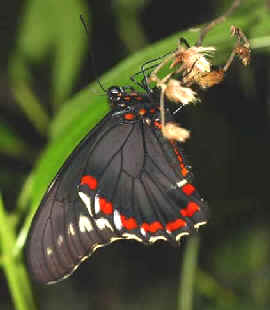
Battus polydamas, or the Polydamas Swallowtail
Battus polystictus galenus ______ BRse
(subspecies in southeast Brazil)
Battus polystictus polystictus ______ ARne
(MM:141) (subspecies in northeast Argentina)
AR common name: Polysticto
Battus crassus ______ BRmg
Battus crassus crassus ______ BRse
WHITE-RAYED SWALLOWTAIL
Battus belus ______ BRmg
BATTUS SWALLOWTAIL
Battus madyes ______ (DA:19)
(Range: Ecuador to Bolivia and northern Argentina)
Genus PARIDES: CATTLEHEARTS
Parides sesostris sesostris ______
BRam (DA:27) (DV1:2)
(F:70) subspecies in Amazonas
EMERALD-PATCHED CATTLEHEART
(Range: Mexico to Bolivia, possibly north-central Argentina, in Misiones)
Parides agavus ______ ARne
BRse (DA:23)
(MM:142)
AGAVUS CATTLEHEART
AR common name: Agavo
(Range: central Brazil to northeast Argentina & Paraguay)
Parides bunichus (ph) ______
Parides bunichus bunichus ______ BRse
Parides bunichus diodorus ______ BR
Parides bunichus perrhebus ______ ARne
(MM:143)
AR common name at Iguazu: Viudita del Norte (translates
to "Northern
Widow")
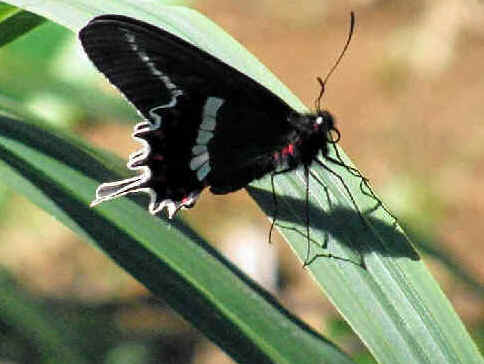
Parides bunichus diodorus photographed during a
FONT tour
in Minas Gerais, Brazil
(identification due to Fernando Penco)
Parides anchises nephalion ______ ARne
BRse (MM:144)
AR common name: Prudente (translates to
"Prudent") (name relates to nephalios, Greek for prudent)
Parides ascanius ______ BRse
Parides proneus ______
BRse
Parides tros tros ______ BRse
Parides zacynthus zacynthus ______
BRse (subspecies in southeast Brazil)
Parides neophilus eurybates ______ ARne
(MM:145) (subspecies in northeast Argentina)
AR common name: Escama Roja ("Red
Scale")
Parides aeneas
______ BRmg
AENEAS CATTLEHEART
Parides erlaces ______ (DA:29)
(Range: Ecuador & Peru to northern Argentina)
Genus EURYADES: species confined to middle
latitudes of South America. Apparently "primitive" butterflies,
closely related to the Australian CRESSIDA.
Euryades duponcheli ______
(DA:32)
(Range: southern Brazil to northern Argentina, Paraguay, and Uruguay)
Genera EURYTIDES, PROTESILAUS, NEOGRAPHIUM, MIMOIDES: the KITE SWALLOWTAILS:
About 50 species confined to the New
World.
Some mimic PARIDES and HELICONIUS butterflies.
Others have long tails,
hence the name "Kite Swallowtails".
They are fast-fliers, and engage in mud-puddling.
Eurytides bellerophon ______ BRse
Eurytides dolicaon deicoon ______ BRse
(subspecies in southeast Brazil)
Eurytides iphitas ______ BRse
Protesilaus (was Eurytides) stenodesmus
______ ARne BRse (MM:148)
AR common name: Espadachin Comun ("Common Swordsman")
BR common names: Veleiro, Argonauta, Pandorga
Protesilaus (was Eurytides) protesilaus
______ (DV1:3)
Protesilaus protesilaus protesilaus ______ BRse
subspecies in
southeast Brazil
Protesilaus protesilaus nigricornis ______
ARne BRse (MM:149)
subspecies in southeast Brazil & northeast
Argentina
GREAT KITE SWALLOWTAIL
AR common name: Espadachin ("Swordsman")
BR common names: Veleiro, Argonauta, Pandorga
(Range: Mexico to Paraguay & northern Argentina)
Protesilaus (was Eurytides) helios ______
ARne BRse (MM:150)
AR common name: Helios (Helios, in Greek mythology, was the god of the
sun.)
Protesilaus
(was Eurytides)
telesilaus
telesilaus ______ BRse (subspecies
in southeast Brazil)
Protesilaus (was Eurytides) glaucolaus
______ BRmg
GLAUCOLAUS KITE SWALLOWTAIL
Neographium
(was Eurytides)
asius ______ BRse
The genus for this and the following species has also been said to
Protographium.
Neographium (was Eurytides)
thyastes thyastes ______ BRse
subspecies in southeast Brazil
Mimoides lysithous lysithous
______ BRse subspecies in southeast
Brazil
Mimoides lysithous rurik ______ ARne (MM:146)
subspecies in northeast Argentina
AR common name: Rurik
(Rurik was the Scandinavian founder of the
Russian Empire, who became the Prince of Novgorod in 862.)
Mimoides protodamas
______ ARne BRse (MM:147)
AR common name: Falso Polysticto ("False Polysticto",
referring
to this butterfly's similarity with Battus polystictus, commonly called
Polysticto)
Mimoides ariarathes ______
Mimoides ariarathes gayi ______ BRmg subspecies in Mato
Grosso, Brazil
Genus: PAPILIO: the FLUTED SWALLOWTAILS: one of the most widespread of genera,
with over 200 species. Most are tropical. Most have tails. Many are
migratory.
"Papilio" is the Latin word for "butterfly".
Subgenus HERACLIDES: the GIANT SWALLOWTAILS
Subgenus PTEROURUS: the TIGER SWALLOWTAILS
Papilio thoas
nealces (ph) ______ (C:295) (DV1:4) (K:38
text) (PE:6) (subspecies from Nicaragua to
Brazil)
Papilio thoas brasiliensis ______ ARne
BRse (DA:34) (MM:151) (subspecies in
southeast Brazil & northeast Argentina)
THOAS SWALLOWTAIL
AR common name: Toas Grande (Toas in mythology was a Trojan hero.)
(Range: southern US thru Central & South America, also: Cuba, Jamaica, Trinidad)
Papilio thoas is in the Heraclides subgenus, in the
thoas species-group.
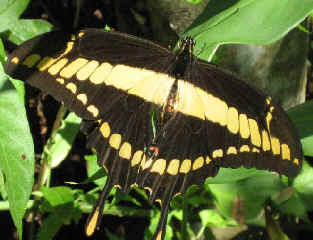
A Thoas Swallowtail photographed during a FONT tour
in Brazil
Papilio astyalus
(ph) ______ BRmg (C:299) (DV1:4) (F:54) (K:43) (PE:6)
Papilio astyalus astyalus ______ ARne BRse
(MM:152) subspecies in northeast Argentina
and southeast Brazil
BROAD-BANDED SWALLOWTAIL (also called
Astyalus, or Lycophron Swallowtail)
AR common name: Astyalos (Astyalos in mythology was the name of a Trojan.)
BR common names: Male: Pequeno Caixao de Deunto Female: Viuva
(Range: southern US to Argentina)
Papilio astyalus is found in areas forested with tropical hardwoods. Like many
Papilio, the
caterpillars breed on citrus.
Papilio astyalus is in the Heraclides subgenus, in the thoas
species-group.
Papilio androgeus (ph) ______
BRmg (DA:33) (DV1:4)
(F:52) (K:41) (PE:6)
Papilio androgeus laodocus ______ ARne
BRse (MM:153) subspecies
in southern Brazil, Paraguay, Argentina
ANDROGEUS SWALLOWTAIL
(or
Queen Page)
AR common name: Androgeo
(Range: Mexico to Argentina, also in the West Indies)
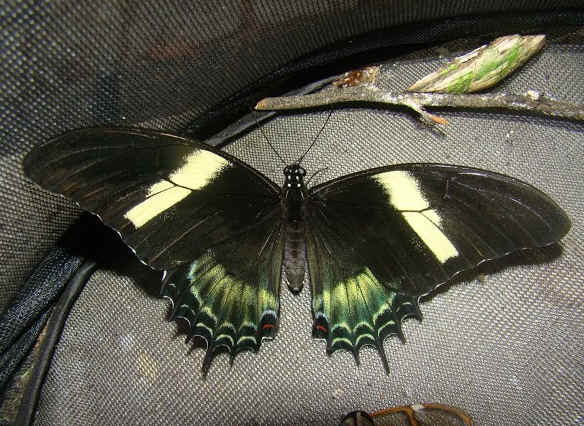
The female of Papilio androgeus tends to be reclusive, not often seen. The male is much of the
time in the forest canopy, occasionally coming down to mud-puddle.
Papilio androgeus is in the Heraclides subgenus, in the thoas
species-group.
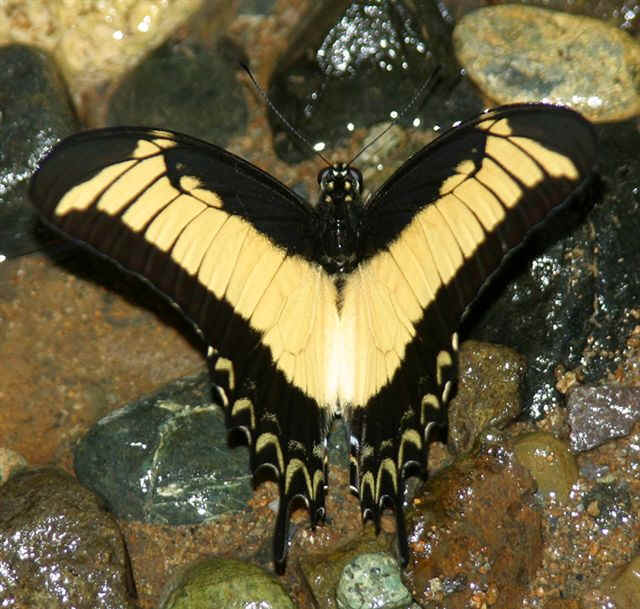
Above: the male Androgeus Swallowtail
Below: the female Androgeus Swallowtail
(lower photo by Jorge Bizarro)
Papilo
hectorides ______ ARne
BRse (MM:154)
AR common name: Hector
(Hector, in mythology, was a Trojan hero.)
BR common name of the dark female: Viuvinha
Papilio hectorides is in the Heraclides subgenus, in the torquatus
species-group.
Papilio himerus himerus ______
BRse
Papilio himerus is in the Heraclides subgenus, in the torquatus species-group.
Papilio torquatus
______ BRmg (DA:35) (DV1:4)
Papilio torquatus polybius ______ ARne
BRse (DA:35) (MM:155)
subspecies in southeast Brazil and northeast
Argentina
BAND-GAPPED SWALLOWTAIL (or TORQUATUS SWALLOWTAIL)
AR common name: Polibio (Polibio, who lived from 206-122 B.C., was a
Greek historian and politician.)
(Range: Mexico to Bolivia, Paraguay, and northeast Argentina)
The female of Papilio torquatus is polymorphic, with the white spot on the forewing & the
shape and color of the pink patch on the hindwing variable.
Papilio torquatus is in the Heraclides subgenus, in the
torquatus species-group.
Papilio scamander grayi ______ BRse
subspecies in southeast Brazil
Papilio scamander scamander ______ ARne
(MM:157) subspecies in northeast Argentina
AR common name: Escamandro (referring
to its scientific name, Escamandro is a river in Asia Minor, and the name of a
Greek god)
Papilio scamander is in the Pteroourus subgenus, in
the scamander species-group.
Papilio menatius cleotas ______ ARne
BRse (DA:37) (DV1:5) (MM:158)
subspecies in northeast Argentina
AR common name: Lunares Rojos (translates to
"Red Beauty Spots")
(Range: Costa Rica to Brazil, Paraguay, and northeast Argentina)
Papilio menatius is in the Pterourus subgenus, in the homerus
species-group.
Papilio anchisiades
(ph) ______ (DV1:6)
(F:52) (K:43) (MM:156) (PE:5) (S:48)
Papilio anchisiades capys ______ ARne
BRse subspecies in southeast Brazil and northeast Argentina
RUBY-SPOTTED (or
RED-SPOTTED) SWALLOWTAIL) (other names are
Anchisiades Swallowtail and
"Mourning Rose")
AR common name: Mancha Rubi (translates to
"Ruby-spotted")translates to
"Ruby-spotted")
(Range: Texas to Argentina)
The Ruby-spotted Swallowtail is often found at citrus trees.
Papilio anchisiades is in the Heraclides subgenus, in the anchisiades
species-group.
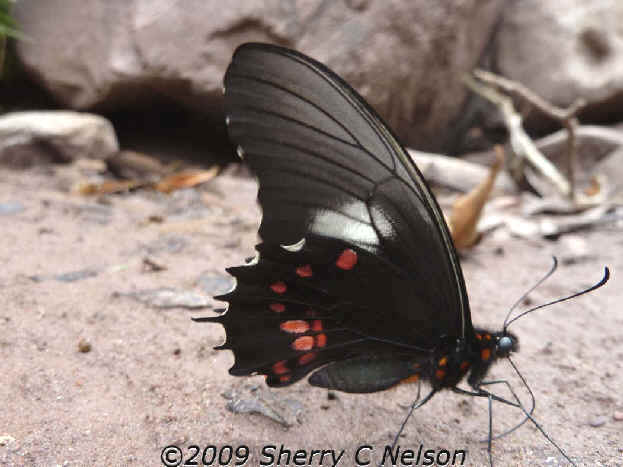
Ruby-spotted Swallowtail
(photo by Sherry Nelson)
Family PIERIDAE
most are predominantly white, yellow, or orange in color, and
are often referred to as WHITES, YELLOWS,
or SULPHURS
Worldwide, approximately 1,000 species of WHITES & SULPHURS have been
described.
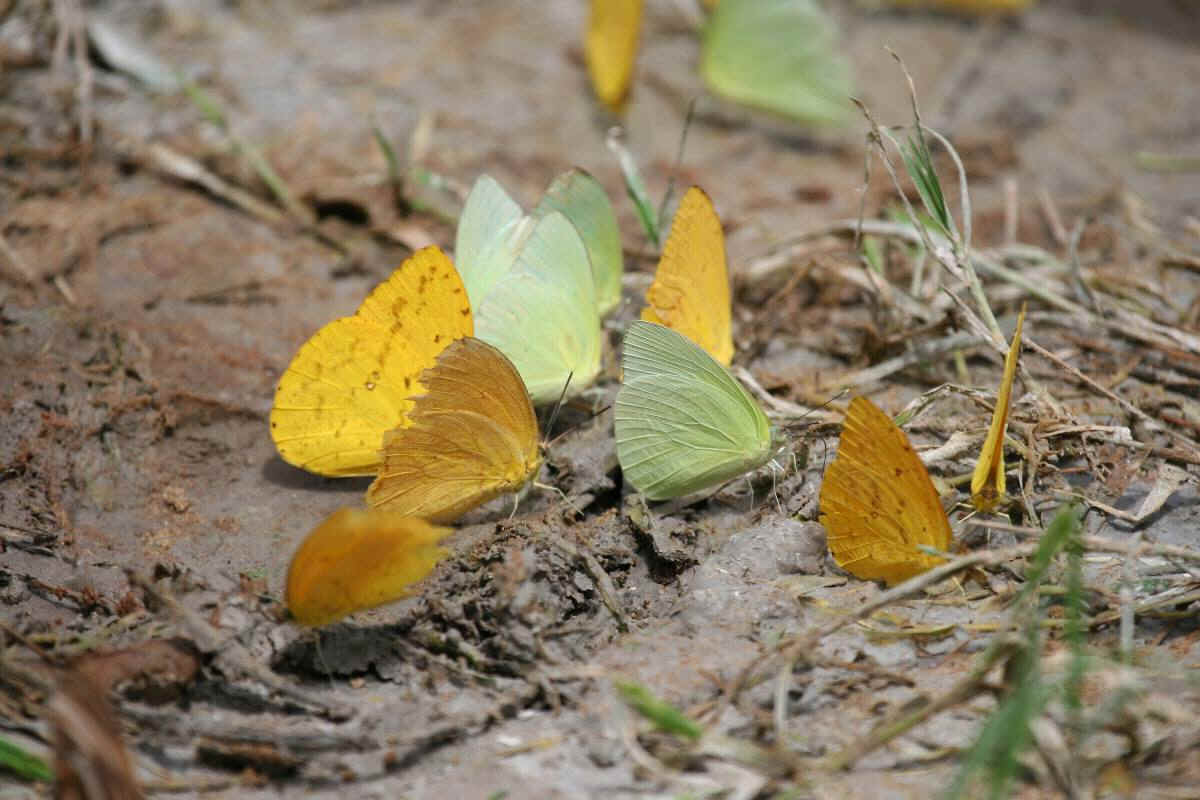
Group of Pieridae during a FONT
Brazil Tour
in Mato Grosso do Sul
(photo by Marie
Gardner)
Subfamily DISMORPHIINAE: MIMIC WHITES
A long-winged, tropical group.
Genus PSEUDOPIERIS: 2 species which can favor mountainous habitats, especially
in Peru and Ecuador on the western slopes of the Andes.
Pseudopieris nehemia ______ BRmg
(DV1:6)
Pseudopieris nehemia nehemia ______
ARne BRse
(DA:53) (MM:163) subspecies in southeast Brazil and northeast
Argentina
CLEAN MINIC-WHITE
AR common name: Nehemias
(Nehemias was a Jewish leader who lived in the
5th Century B.C. He had an honorary position in the Persian king's court
Artajerjes. In 444 B.C,, he was designated Judah's governor and was authorized
to reconstruct Jerusalem.)
BR common name: Floco de Neve ("Snowflake")
(Range: Mexico to southern Brazil)
Genus DISMORPHIA: With about 40 species that are remarkable mimics of various
distasteful butterflies. The patterning is variable. Sexual dimorphism is
marked in the species in this genus.
Dismorphia crisia crisia ______
BRse (DV1:6)
(subspecies in southeast
Brazil)
CLOUD-FOREST MIMIC-WHITE
(Range: southern Mexico to Brazil)
Dismorphia amphione astynome ______ BRse
(subspecies in southeast Brazil)
Dismorphia theucharila ______ (C:363)
(DV1:7)
PIERID MIMIC (this species looks like an
ithomiine clearwing -
D1:35)
(Range: Mexico to Brazil)
Dismorphia thermesia thermesia ______ ARne
BRse
(MM:161)
(subspecies in southeast Brazil & northeast
Argentina)
AR common name: Bonita Perlada (translates to
"Pearled
Pretty")
The coloring on the ventral surface and the stylized outline of Dismorphia
thermesia are unusual in
this family.
Dismorphia astyocha ______ ARne
BRse (MM:162)
AR common name: Bonita (translates to
"Pretty")
The bright coloring and the stylized outline of Dismorphia astyocha are uncommon in
its family.
Dismorphia melia ______ (DA:52)
(Range: southern Brazil)
Dismorphia melia is a mimic of the two ACRAEID species Actinote thalia &
Actinote parapheles, to which it bears a very strong resemblance.
Genus ENANTIA: closely related to DISMORPHIA, but not as strongly
sexually dimorphic. Sun-and-flower loving species, often encountered in
numbers on flowers, usually at the end of the rainy
season.
Enantia licinia ______ (DV1:7)
(Range: Mexico to Brazil)
Enantia melite ______
(DA:53) (DV1:7) (species described by Linnaeus in 1763)
Enantia melite melite ______ BRse
(subspecies in southeast
Brazil)
(Range: Mexico to Uruguay)
Enantia melite is a most variable butterfly.
Enantia lina ______ BRmg
Enantia lina psamathe ______ ARne
BRse
(MM:159) subspecies in southeast Brazil
and northeast Argentina
WHITE MIMIC-WHITE
AR common name: Bonita Blanca (translates to
"White Pretty")
translates to
"White Pretty")
Enantia clarissa ______ ARne
(MM:160)
AR common name: Clarisa
Enantia limnorina ______ BRse
(DA:52)
(Range: southern Brazil)
Subfamily PIERINAE, Tribe
ANTHOCHARIDINI
Genus HESPEROCHARIS
Hesperocharis anguitia anguitia ______ BRse (subspecies in southeast Brazil)
Hesperocharis emeris
______ BRse
Hesperocharis erota
______ BRse
Hesperocharis hirlanda fulvinota ______
(DA:55) (subspecies in southern Brazil)
(Range: Colombia to the Guianas, Ecuador, Peru, Bolivia, Brazil)
Subfamily PIERINAE, Tribe PIERINI:
Whites and allies
Genus ARCHONIAS: 3 species. A most interesting genus
of PIERIDS. Considered to be involved in mimetic associations with PAPILIONID
and HELICONID butterflies and with a species of ARCTIID day-flying moth.
Comparatively slow-flying, with a fondness for settling on leaves in the
sunshine or visiting flowering shrubs, where they spend substantial time &
effort on one or two blooms.
Archonias brassolis ______
Archonias brassolis negrina (formerly
A. bellona) ______
(DA:63) (DV1:7) (F:82) (subspecies in Ecuador - this race
said to resemble
a day-flying ARCTIID moth)
Archonias brassolis tereas ______ BRse (subspecies in
southern Brazil)
CRIMSON-PATCHED CATTLEHEART-MIMIC
(Range: Mexico to southern Brazil, in Sao Paulo and Rio Grande do Sul)
Archonias brassolis looks like a mimic of a female Parides swallowtail. It lives in
open parts of rainforests.
Archonias
monuste orseis ______ BRse (subspecies in southeast Brazil)
Genus CATASTICTA
Catasticta bithys
______ BRse
Catasticta huebneri
______ BRse
Genus PEREUTE: About 8 species of the most subtly beautiful PIERIDS from any region
of the world, with the outstanding colors being the soft rose-pinks,
blue-grays, and cadmium yellow streaks and patches.
They can be remindful of
the Indo-Australian DELIAS group (the JEZEBELS) in their appearance and
behavior.
Pereute antodyca ______ BRse
Pereute swainsoni ______ ARne
BRse (MM:164)
AR common name: Embustera (translates to "Lying")
(so-called because its dark coloration is uncommon in the PIERIDAE family;
this butterfly is more like a NYMPHALIDAE)
Genus
GLUTOPHRISSA: 2 species said now, for structural reasons, to be distinct
from the Oriental
APPIAS
(the
GULLS).
Glutophrissa drusilla
(ph) ______ BRmg (DV1:12) (K:53) (PE:7)
Glutophrissa drusilla drusilla ______ ARne
BRne (DA:67) (MM:167) subspecies in southeast Brazil
and northeast Argentina
TROPICAL WHITE (another names is FLORIDA
WHITE)
AR common name: Lechera Grande (translates to "Big Milky")
translates to "Big Milky")
(Range: southern US, Central & South America, also West Indies)
Genus LEPTOPHOBIA: 15-16 species whose general characteristic is the
silvery-white color of the hindwing underside. Found from moderate to high
elevations (to 9,000 ft. or 3,000 meters).
Leptophobia aripa balidia ______ ARne
BRse (DV1:12)
(MM:165) subspecies in southeast Brazil and northeast
Argentina
COMMON GREEN-EYED WHITE
AR common name: Blanquita (translates to
"Little White")
(Range: Mexico to Brazil and northern Argentina)
Leptophobia
eleusis eleusis ______ BRse subspecies in southeast
Brazil
Genus MELETE
Melete lycimnia (ph) ______ BRmg
Melete lycimnia paulista
______ ARne BRse (MM:166)
subspecies in southeast Brazil and northeast Argentina
Melete lycimnia flippantha ______ BRse
subspecies in
southeast Brazil
COMMON MELWHITE (or
Lycimnia White, or
"Creamy White")
AR common name: Manteca (translates to
"Butter", referring to the coloring on the
ventral hindwing)
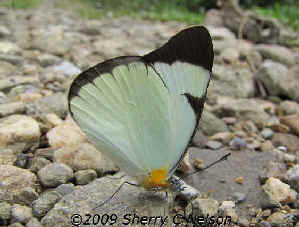
Melete lycimnia, or the Common Melwhite
(photo by Sherry Nelson)
Genus PIERIBALLIA
Pieriballia viardi molione
______ ARne (MM:169)
(subspecies in northeast Argentina)
PAINTED WHITE
AR common name: Sayju Manchada ("Spotted Sayju") (Sayju is a Guarani
word meaning "pale, yellowish".)
Genus ITABALLIA
Itaballia demophile ______ (DV1:12)
CROSS-BARRED WHITE
(Range: Mexico to Paraguay)
Genus DAPTONEURA: about 10 species of brightly-colored and strong-flying
PIERIDS, given to extraordinary seasonal and local variation, thus making it
difficult to determine precisely what are good species or races or even
aberrations.
Daptoneura lycimnia pantoporia ______ (DA:75)
subspecies in southern Brazil and Paraguay
(Range: Colombia, Venezuela, and the Guianas to Paraguay; also Trinidad)
Genera ASCIA and
GANYRA: Large plain white butterflies with some brown or
gray markings especially in the females.
Ganyra (was
Ascia)
josephina josephina (ph) ______
(DV1:12) (PE:8)
GIANT WHITE
(Range: Central and South America, also the West Indies)
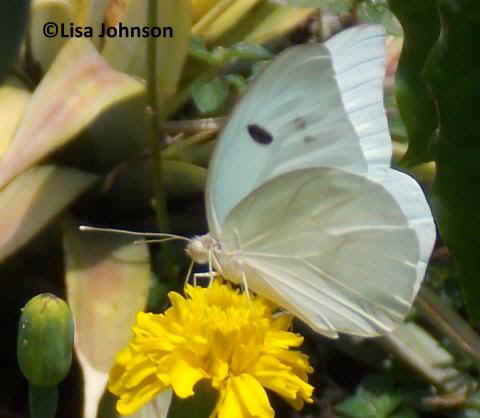
the Giant White
(copyrighted photo by Lisa Johnson)
Ascia monuste orseis ______
ARne
(DV1:12) (K:53) (MM:168) (PE:8) subspecies
in northeast Argentina
GREAT SOUTHERN WHITE
AR common name: Sayju (Sayju is a Guarani word meaning
"pale,
yellowish".)
BR common name: Borboleta da Couvre
(Range: southern US, Central and South America, also the Antilles)
The migrating females of Ascia monuste are almost totally gray in color, while non-migratory
females are largely yellowish-white with dark brown margins.
Ganyra phaloe endeis ______ BRse
(DA:68)
subspecies in southeast Brazil
(Range: Brazil to the Guianas, also to Peru and Paraguay)
The former Ascia buniae has been merged into Ganyra phaloe.
It occurs in northeast Brazil & northeast Argentina.
Southern Brazilian forms of Ganyra phaloe have strong
markings.
Subfamily COLIADINAE: SULPHURS
300 species worldwide
Genus LEUCIDIA
Leucidia elvina
______ BRse
Genus COLIAS: SULPHURS
This genus in South America tends to occupy
temperate and/or high altitude habitats. Essentially, this genus, of 10
species, is Holarctic (North American/Eurasian).
Colias lesbia lesbia ______ ARne BRse
(DA:56)
(MM:170)
LUCEN'S BUTTERFLY
AR common name: Isoca de la Alfalfa
BR common names: Borboletinha de Alfafa and Borboletinha Alaranjada
(Range: Bolivia to Tierra del Fuego)
Genus ANTEOS: ANGLED SULPHURS
often found flying high over the canopy or along rivers
Anteos clorinde (ph) ______ ARne
BRse
(DV1:8)
(F:78) (K:77)
(MM:171) (PE:10) (S:71)
WHITE-ANGLED SULPHUR (other names
are Clorinde or the Ghost Brimstone)
AR common name: Anteo (Anteo, in Greek
mythology, was a giant.)
(Range: Mexico to Paraguay and northeast Argentina and southern Brazil)
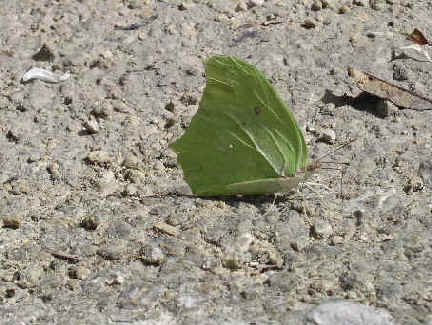
White-angled Sulphur
(photo by Doug Johnson)
Anteos
menippe ______ BRse BRmg
ORANGE-TIPPED ANGLED SULPHUR
Genus PHOEBIS: GIANT SULPHURS:
the most conspicuous tropical sulphurs,
common, and found in open areas & forest edges, adult males cluster on moist sand along rivers &
streams
Phoebis philea philea ______ ARne
BRse BRmg (DA:58)
(DV1:8) (F:105) (K:75) (MM:173) (PE:10) (S:70) (species
described by Linnaeus in 1763)
ORANGE-BARRED SULPHUR
(other
names are: Yellow Apricot and Morning)
AR common name: Mananita (referring to the color of the wings, the same as
that of a clear sky at daybreak)
(Range: southern United States to southern Brazil & ne Argentina)
In addition to visiting flowers, males of Phoebis philea visit wet sand and mud,
probably to obtain sodium. This general habit of many PIERIDS has been known
since Henry Walter Bates was on the Amazon.
Phoebis sennae (ph) ______ (C:247)
(DA:57) (DV1:9) (F:105) (K:75) (PE:10) (species described by
Linnaeus in 1758)
Phoebis sennae sennae ______ BRse
(subspecies in southeast
Brazil)
Phoebis sennae marcellina ______ ARne
(MM:172) (subspecies
in
northeast Argentina)
CLOUDLESS SULPHUR
AR common name: Febo
BR common name: Casca da Limao
(Range: southern US to Argentina, also in Antilles)
Phoebis sennae can be abundant in both lowlands & highlands. It prospers in open
land.
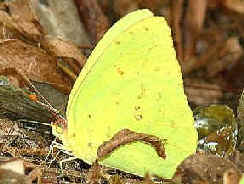
Phoebis sennae, the Cloudless Sulphur
Phoebis neocypris neocypris ______ ARne
(MM:175)
TAILED SULPHUR
AR common name: Ciprina (one of the names of the goddess Venus)
Phoebis argante argante ______ ARne
BRse BRmg
(DV1:9)
(F:104) (MM:174)
APRICOT SULPHUR (has been called the
Argante Giant Sulphur or
Argante)
AR common name: Yema (meaning the yolk of an egg)
BR common name: Gema de Ovo (also meaning yolk of an egg)
(Range: Mexico to Argentina) (there is another subspecies in the West Indies)
Phoebis agarithe (ph) ______
(DV1:9)
(F:104) (K:75) (PE:10)
LARGE ORANGE SULPHUR
(Range: southern US to Brazil)
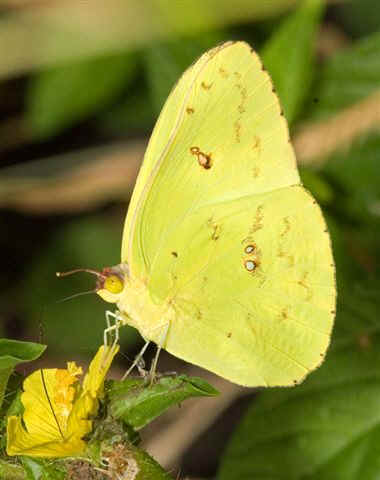
A female Large Orange Sulphur
Genus APHRISSA
Aphrissa (was
Phoebis)
statira ______ BRmg (DV1:9) (F:80) (PE:10)
Aphrissa statira statira ______ ARne
BRse (MM:177) subspecies in
southeast Brazil and northeast Argentina
STATIRA SULPHUR (other
names are Yellow Migrant and Migrant Sulphur)
AR name: Manifestante (referring to their habit of meeting in assemblies,
as do demonstrators)
(Range: Mexico to Brazil; there are several other subspecies in the West Indies)
Genus RHABDODRYAS
Rhabdodryas
(was Phoebis) trite
banksi ______ ARne BRse BRmg (DV1:8) (MM:176)
subspecies in southeast Brazil and northeast Argentina
STRAIGHT-LINED SULPHUR
AR common name: Hoja Amarilla (translates to "Yellow Leaf",
referring to the
coloration & pattern on the ventral side, similar to a leaf)
(Range: Mexico to Argentina; also in the West Indies)
When Rhabdodryas trite rests
with its wings folded, it blends into the vegetation background and becomes
invisible to predators.
Genera EUREMA
and PYRISITIA: SMALL YELLOWS
Eurema proterpia (ph) ______ (DA:61)
(DV1:10)
(F:97) (K:69) (PE:11)
TAILED ORANGE (or
Little Jaune)
(Range: southern US, thru Central and South America, also the Antilles)
There are seasonally different forms of Eurema proterpia of both sexes: wet season & dry
season forms.
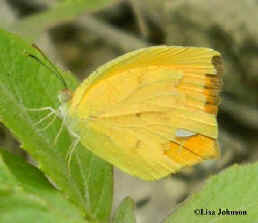
Tailed Orange
(copyrighted photo by Lisa Johnson)
Eurema mexicana ______ (DV1:10)
(F:97) (K:73)
(PE:11)
MEXICAN YELLOW
(Range: southern US, thru Central & South America)
Eurema albula albula ______ BRse
(subspecies in southeast Brazil)
Eurema albula sinoe ______ ARne
(DV1:10) (MM:179) (subspecies in
northeast Argentina)
WHITE YELLOW (has been called
GHOST YELLOW)
AR common name: Alba (translates to
"White")
(Range: Mexico to Brazil & ne Argentina, also West Indies)
Eurema arbela arbela ______ BRse
(subspecies in southeast Brazil)
DISJUNCT YELLOW
Eurema deva deva ______ ARne
BRse (MM:180) (subspecies
in southeast Brazil & northeast Argentina)
AR common name: Limoncito (translates to
"Small Lemon")
BR common name: Canarinho (translates to
"Small Canary")
Eurema nise tenella ______ ARne
BR:se
(DV1:10) (K:71) (MM:182) (PE:11)
(subspecies in southeast Brazil & northeast Argentina)
MIMOSA YELLOW (also called
Jamaican Sulphur)
AR common name at Iguazu: Limoncito del Nordeste (translates to
"Northeastern Small
Lemon")
translates to
"Northeastern Small
Lemon")
(Range: southern US to Argentina, also West Indies)
Eurema daira daira ______ (DA:60)
(DV1:10)
(F:96) (K:71)
(PE:11)
(subspecies in the mainland of
the Americas)
BARRED YELLOW
(also called
Barred Sulphur)
(Range; southern US to Uruguay, also West Indies)
Eurema daira is subject to seasonal dimorphism in both sexes.
Eurema elathea flavescens ______ ARne
BRse
(DV1:10)
(MM:178)
(subspecies in southeast Brazil & northeast
Argentina)
BANDED YELLOW
AR common name: Limoncito Adornado (translates
to
"Small Decorated Lemon")
translates
to
"Small Decorated Lemon")
(Range: Nicaragua to Brazil & northeast Argentina, also West Indies)
Pyrisitia (was Eurema) leuce
(ph) ______ BRmg
Pyrisitia leuce leuce ______
ARne BRse (DA:59)
(MM:181) subspecies in southeast Brazil and northeast
Argentina
LEUCE YELLOW
AR common names: Limoncito Manchado (translates to "Spotted Small Lemon") and Limoncito Dos
Puntos (translates to "Two-spotted Small Lemon")
(Range: Panama to Argentina; also the West Indies)
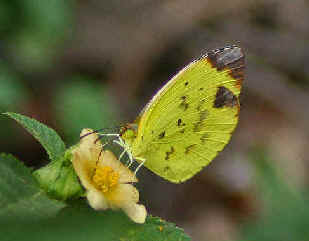
Leuce Yellow
Eurema phiale paula ______ BRse
(DA:60) (subspecies in southeast
Brazil)
(Range: in Colombia & Bolivia and east to southeast Brazil)
Eurema phiale is subject to seasonal dimorphism.
Family LYCAENIDAE (GOSSAMER WINGS) including:
HAIRSTREAKS, BLUES
Throughout the world but mostly in tropical and subtropical regions.
The sexes often differ in coloration, and the undersides usually differ from
the upper surfaces.
Among several distinct groups are the HAIRSTREAKS, with tails and bright
eyespot markings on the hindwings, creating a "false head" at the
rear, to divert attackers.
Thus far, worldwide, about 5,000 species in this family have been discovered
and named. Caterpillars of many of these species are closely associated with
ants.
Subfamily
THECLINAE:
HAIRSTREAKS
Genus ALLOMAITIA (genus created in 1964)
Allomaitia strophius
(formerly A. pion) ______
BRse (PE:text)
STROPHIUS HAIRSTREAK
(Range: Mexico to southern Brazil)
Genus ARAWACUS
Arawacus ellida
______ BRse
Arawacus meliboeus (ph)
______ BRse
MELIBOEUS STRIPESTREAK
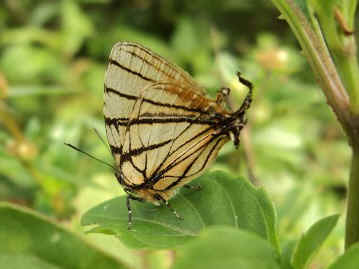
the Meliboeus Stripestreak, Arawacus meliboeus
(photo by Jorge Bizarro)
Genus ARCAS
Arcas ducalis
______ BRse
Arcas imperialis
______ BRse
Genus ARUMECLA genus created in 2004
Arumecla aruma
______ BRse
Genus ATLIDES
Atlides cosa
______ BRse
Atlides polybe
______ BRse (species described by Linnaeus in 1763)
Atlides zava
______ BRse
Genus CALYCOPIS
Calycopis caulonia
______ BRse
Calycopis gentilla
______ BRse
Genus CELMIA genus created in 1991
Celmia celmus
______ BRse BRmg
CELMUS HAIRSTREAK
Genus CONTRAFACIA genus created in
1989
Contrafacia imma ______ BRse
Genus REKOA: A small genus of blue-colored
hairstreak butterflies in Central & South
America.
Rekoa marius ______ BRse
(PE:text)
MARIUS HAIRSTREAK
(Range: Mexico to southern Brazil)
Rekoa palegon ______ ARne
BRse (MM:191)
(PE:text)
GOLD-BORDERED HAIRSTREAK
(other names have
been: Palegon Hairstreak or
Curved Band Blue)
AR common name: Azul Banda Curva (translates to
"Curve-banded Blue")
(Range: Mexico to Argentina)
Rekoa malina ______
ARne BRse
(MM:192)
AR common name: Azul Banda Recta (translates to "Straight-banded Blue")
Rekoa stagira ______ ARne
(MM:193)
SMUDGED HAIRSTREAK
AR common name: Aristolteles ("Aristotle") (re
the scientific name: Stagira is the city where Aristotle was born.)
Rekoa
meton ______ BRse
Genus CHLOROSTRYMON
Chlorostrymon telea (ph) ______ (PE:text)
TELEA HAIRSTREAK
(Range: Mexico to southern Brazil)
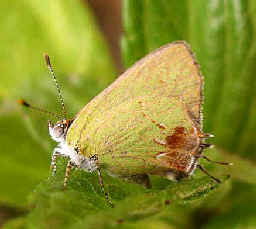
Telea Hairstreak
(photo courtesy of Michiel Koomen)
Chlorostrymon simaethis (ph)
______ (K:117) (PE:13)
Chlorostrymon simaethis sarita ______
ARne (MM:202) subspecies
in northeast Argentina
SILVER-BANDED HAIRSTREAK (or Simaethis Hairstreak)
AR common name: Banda de Plata (referring to the silver band on the
ventral surface)
(Range: southern US to Argentina, also in the West Indies)
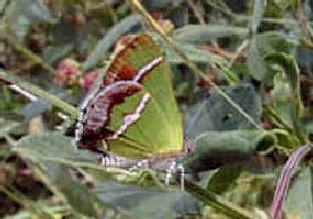
Silver-banded Hairstreak
(photo courtesy of Michiel Koomen)
Genus OCARIA
Ocaria ocrisia (ph) ______
ARne
BRse
(MM:199) (PE:text)
BLACK HAIRSTREAK (or
HEWITSON'S BLACKSTREAK)
AR
common name: Ocrisia from the scientific name. name. Ocrisia
was a noble Roman, Servio
Tulio's mother, the 6th Roman emperor.
(Range: Mexico to Argentina)
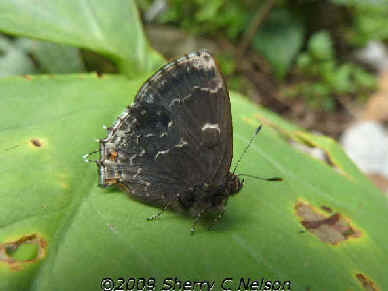
the Black Hairstreak (or Hewitson's
Blackstreak)
(photo by Sherry Nelson)
Ocaria
thales ______ BRse
Genus CYANOPHRYS: TROPICAL GREEN HAIRSTREAKS genus created in
1961
Cyanophrys acaste ______ ARne
BRse
(MM:194)
AR common name: Acasto (In Greek mythology,
Acasto was the son of Pelias.)
Cyanophrys herodotus ______ ARne
BRse
(K:117)
(MM:195) (PE:13)
TROPICAL GREENSTREAK (or Tropical Green
Hairstreak)
AR common name: Herodoto (referring to Herodoto, a Greek historian in the 5th Century BC)
(Range: Mexico to Brazil & northeast Argentina)
Cyanophrys remus ______ ARne
BRse
(MM:196)
DOUBLE-LINED EMERALD
AR common name: Remo
Cyanophrys amyntor ______ BRse
Genus ERORA
Erora campa
______ BRse
Genus EVENUS
Evenus batesii ______ BRse
Evenus regalis ______ BRse
Genus IASPIS
Iaspis talayra ______ BRse
Genus IGNATA
Ignata brasiliensis
______ BRmg
BRAZILIAN HAIRSTREAK
Genus LAMPROSPILUS
Lamprospilus badaca ______ BRse
Lamprospilus nubilum ______ BRse
Lamprospilus arza ______
BRse
Genus LAOTHUS genus created in 1997
Laothus phydela ______ BRse
Genus MEGATHECLA genus created in 2002
Megathecla cupentus ______ BRse
Genus MICHAELUS genus created in 1979
Michaelus jebus ______ BRse
Michaelus thordesa
______ BRmg
Genus PANTHIADES
Panthiades bitias
______ BRmg
Panthiades hebracus ______
BRse
Genus PARRHASIUS
Parrhasius orgia orgia ______ ARne
(MM:197) subspecies
in northeast Argentina
VARIABLE HAIRSTREAK
AR common name: Orgia
Parrhasius polibetes
______ BRse
Genus PSEUDOLYCAENA
Pseudolycaena marsyas ______ BRse
(species described by
Linnaeus in 1758)
Genus OENOMAUS:
Hairstreaks of North and South America, relatively large and
with iridescent colors. Live in lightly wooded areas.
Oenomaus ortygnus ______ (PE:text)
AQUAMARINE HAIRSTREAK
(Range: Mexico to Brazil)
Oenomaus rustan ______ (F:260)
(Range: Honduras to Brazil)
Genus TMOLUS:
Dimorphic tailed hairstreaks with dark uppers and light
undersides.
Tmolus echion ______ ARne
BRse (F:278)
(K: 119) (MM:206) (PE:13) (species described by Linnaeus in
1767)
RED-SPOTTED HAIRSTREAK (other names:
Echion Hairstreak, Four-spotted Hairstreak)
AR common name: Tmolos (Larger Lantana Butterfly)
(In mythology,
Tmolos
was the father of Tantalo.)
(Mexico to Brazil and northeast Argentina)
Tmolus cydrara
______ BRse
Genus MINISTRYMON: Hairstreaks of North
and South America that have
adaptations for living in deserts. Breed on mesquites, spiny trees, and shrubs
of the Proposis genus, which grow in deserts, especially by watercourses. The
colors of the butterflies are blue, gray, and black.
Ministrymon azia ______ (K:119) (PE:13)
GRAY MINISTREAK (or
Azia Hairstreak)
(Range: south Texas to southern Brazil, also West Indies)
Ministrymon una ______ ARne
BRse
(MM:204)
PALE HAIRSTREAK
AR common name: Frotadora Palida (translates to "Pale Rubber")
Ministrymon cleon
______ BRse
Genus OSTRINOTES genus created in 1997
Ostrinotes sophocles ______ ARne BRse
(MM:205) (was
Thecla sophocles)
AR common name: Sofocles (re the name: Sofocles
was 1 of 3 of the most important Greek playwrights 496-406 B.C.)
Ostrinotes tympania
______ BRse
Genus SIDERUS
Siderus tephraeus ______ (PE:text)
PEARLY-GRAY HAIRSTREAK
(Range: Mexico to Brazil)
Siderus
philmna ______ BRse
Genus STREPHONOTA genus created in 1997
Strephonota elika
______ BRse
Strephonota sphinx
______ BRse
Strephonota tephraeus
______ BRse
Genus ELECTROSTRYMON
Electrostrymon endymion ______ ARne
(MM:201)
ENDYMION HAIRSTREAK
(re the name:
Endymion in Greek mythology was a shepherd
who lulled in perpetual sleep.)
Genus STRYMON: SCRUB HAIRSTREAKS: In both North and South America. Butterflies
exhibit seasonal variation.
Strymon melinus ______ (C:181) (F:274)
(K:
93) (PE:15) (S:90)
GRAY HAIRSTREAK
The Gray Hairstreak is widely distributed, southern Canada to South
America, living in many different
types of open habitat. It has been recorded breeding on over 50 species of
plants.
Strymon rufofusca ______ (K:123)
(PE:15)
RED-CRESCENT
SCRUB-HAIRSTREAK (or Reddish Hairstreak)
(Range: south Texas to Argentina, also Grenada)
Strymon yojoa ______ BRse
(K:123)
(PE:15)
YOJOA SCRUB-HAIRSTREAK
(Range: Mexico to southern Brazil)
Strymon istapa (ph) ______ (K:121)
(PE:14)
Strymon istapa istapa ______ ARne
subspecies in northeast
Argentina
MALLOW SCRUB-HAIRSTREAK
(Range: southern US to South America)
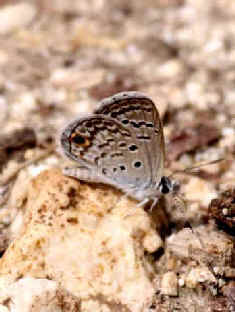
Strymon istapa, or the Mallow Scrub-Hairstreak
photographed during a FONT tour
(photo by Marie Gardner)
Strymon bazochii ______ ARne
(K:123)
(MM:207) (PE:15)
LANTANA SCRUB-HAIRSTREAK (or
Bazochii Hairstreak)
AR common name: Azul del Camara (translates to
"Smaller Lantana Butterfly", refers to one of the host plant,
Lantana camara)
(Range: south Texas to Paraguay and
northeast
Argentina, also in the Greater Antilles)
Strymon mulucha ______ ARne
BRse
(MM:208)
MOTTLED SCRUB-HAIRSTREAK
AR common name: Frotadora Linea Blanca (translates
to "White Line
Rubber", refers to the white hyphen on the forewings below)
Strymon astiocha ______ ARne
BRse
(MM:209)
GRAY-SPOTTED SCRUB-HAIRSTREAK
AR common name: Astiocha
Strymon eurytulus ______ ARne
(MM:210)
AR common name: Frotadora (translates to "Rubber",
refers to a
peculiar behavior as this butterfly drinks)
Strymon megarus ______ ARne
BRse
(MM:211)
MEGARUS SCRUB-HAIRSTREAK
AR common name: Taladro de la Pina (translates to "Pineapple Drill",
refers to the host plant)
Strymon ziba
______ BRse
Genus SYMBIOPSIS genus created in 1971
Symbiopsis strenua
______ BRse
Genus THEPYTUS
Thepytus thyrea
______ BRse
Genus THERITAS
Theritas deniva
______ BRse
Theritas hemon (ph)
______ BRse
HEMON BLUE HAIRSTREAK
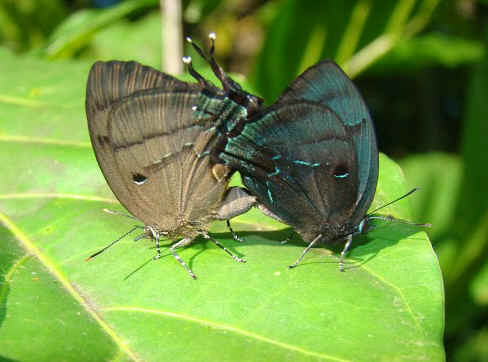
Hemon Blue Hairstreaks, female and male
(photo by Jorge Bizarro)
Theritas triquetra
______ BRse
Genus THESTIUS
Thestius azaria
______ BRse
Genus ZIEGLERIA genus crated in 1993
Ziegleria hesperitis
______ BRse
Subfamily POLYOMMATINAE: BLUES
Very small butterflies, mostly blue above. Females of many are browner.
Genus LEPTOTES
Leptotes cassius (ph) ______ BRmg
(K:127)
(PE:16) (S:99)
Leptotes cassius cassius ______ ARne BRse
(MM:215) subspecies in
southeast Brazil northeast Argentina
CASSIUS BLUE
AR common name: Azul Litacea
(Range: southern US to South America, also in the West Indies)
The males of Leptotes cassius are a light lilac-blue, the females are
mainly white.
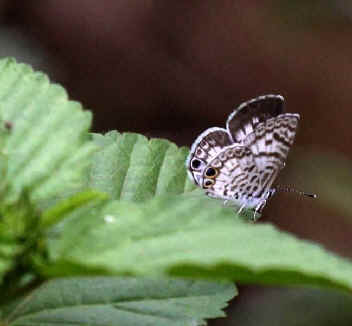
Leptotes cassius, or the Cassius Blue
(photos by Marie Gardner)
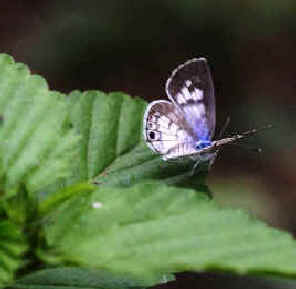
Genus ZIZULA: A genus of Blues
Zizula cyna ______ ARne
BRse (F:279)
(K:127) (MM:213) (PE:15)
CYNA BLUE
AR common name: Miri (a Guarani word meaning
"small")
(Range: south Texas to Argentina)
Zizula cyna occurs in dry and scrubby areas. It is one of the smallest butterflies.
It sways from
side to side when perched.
Genus HEMIARGUS: Commonly called "eyed blues", these butterflies occur
in both North & South America.
This common name is from 2 or 3 eye-spots on
the undersides of the hindwings.
They breed on a wide variety of members of the
pea family, Leguminosae.
Hemiargus ceraunus (ph) ______ (K:129)
(PE:15)
CERAUNUS BLUE
(Range: southern US to South America, also in the West Indies)
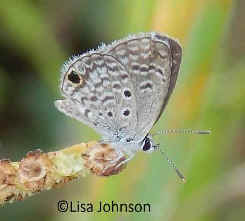
Ceraunus Blue
(copyrighted photo by Lisa Johnson)
Hemiargus hanno ______ BRmg
Hemiargus hanno hanno ______
ARne BRse
(MM:214) subspecies in southeast Brazil and northeast
Argentina
HANNO BLUE
AR common name: Miri Manchada (translates to
"Spotted Miri", the
spots are on the hind wings below)
Genus ELKALYCE (genus created in 1996)
Elkalyce cogina
______ BRse
Family RIODINIDAE, Subfamilies EUSELASIINAE and
RIODININAE: METALMARKS:
Named for the gold, silver, or copper-colored metallic scales on the wings of
many of the species
About 1,300 species are known, found mainly in the American tropics.
Habitually, these butterflies land on the undersides of foliage, with their
wings spread wide open.
Genus EUSELASIA: A large group of over 100 species of metalmarks in Central
and South America. They often sexually dimorphic, and often have a pattern of
lines and waves on their undersides.
Euselasia hygenius occulta ______ ARne
BRse (MM:216)
subspecies in southeast Brazil and northeast Argentina
AR common name: Simuladora (translates to
"Pretender") translates to
"Pretender") (name refers to similarity with some
SATYRINAE)
Euselasia utica ______ ARne
BRse (MM:217)
AR common name: Nemi Naranja (translates to
"Orange Nemi") (Nemi
translates to
"Orange Nemi") (Nemi
is a Guarani word meaning "hidden". The butterfly rests
on the underside of leaves, with wings folded.)
Euselasia eugeon ______ ARne
(MM:218)
AR common name: Patas Amarillas (translates to
"Yellow Legs")
Euselasia thucydides thucydides ______ BRse
subspecies in
southeast Brazil
Genus ADELOTYPA
Adelotypa bolena
______ BRse
Adelotypa leucophaea
______ BRse
Genus ANTEROS
Anteros renaldus notius ______ BRse
Genus APODEMIA
Apodemia castanea
______ BRse
Genus BAEOTIS
Baeotis melanis ______ BRse
Genus DACHETOLA
Dachetola azora (ph)
______ BRse
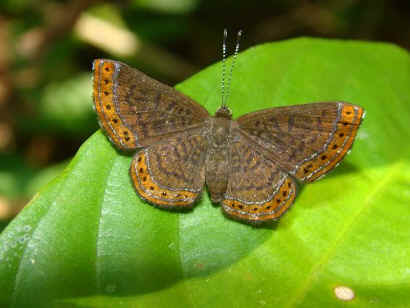
Dachetola azora
(photo by Jorge Bizarro)
Genus DETRITIVORA
genus created in 2002
Detritivora gynaea
______ BRse
Genus ECHYDNA genus created in 2002
Echydna chaseba
______ BRse
Echydna punctata
______ BRse
Genus PANARA
Panara phereclus
______ BRse (species described by Linnaeus in 1758)
Panara ovifera
______ BRse
Panara ovifera
is an endangered species.
Panara soana soana
______ BRse subspecies in southeast
Brazil
Genus PEROPTHALMA
Peropthalma tullius ______ (DV2:3)
TULLIUS METALMARK
(Range: Mexico to Brazil)
Genus PIRASCCA genus created in 1996
Pirascca sagaris satnius
______ BRse subspecies in southeast
Brazil
Genus LEMONIAS
Lemonias zygia zygia
______ BRse subspecies in southeast
Brazil
Genus LEUCOCHIMONA
Leucochimona icare matatha
______ BRse
subspecies in southeast Brazil
Genus MESOSEMIA: More than 60 species in mostly South America, characterized
by quite prominent eye-spots on the forewing, giving a face-like appearance.
Unusual for butterflies, they tend to hop through vegetation rather than fly.
Mesosemia odice odice ______ ARne
BRse
(MM:219) subspecies in southeast Brazil and northeast
Argentina
AR common name: Ojitos (translates to
"Little Eyes")
Mesosemia acuta
______ BRse
Mesosemia friburgensis
______ BRse
Mesosemia minos tetrophthalma
______ BRse subspecies in southeast
Brazil
Mesosemia nyctea fluminensis
______ BRse
subspecies in southeast Brazil
Genus SEMOMESIA
Semomesia croesus ______ BRmg
CROESUS EYEMARK
Genus METACHARIS
Metacharis lucius
______ BRse
Metacharis ptolomaeus
______ BRse
Genus NAPAEA
Napaea eucharila ______ (DV2:5)
WHITE-STITCHED METALMARK
(Range: Mexico to Brazil)
Napaea umbra ______ BRse
(DV2:5)
(Range: Mexico to Brazil)
Napaea
orpheus ______ BRse
Genus EURYBIA: dark-colored Neotropical metalmarks with a conspicuous eye-spot
on the forewing.
Eurybia unxia ______
(DV2:6)
(Range: Costa Rica to Bolivia & Brazil)
Eurybia elvina ______
(DV2:6)
BLIND SHEENMARK
(Range: Mexico to Brazil)
Eurybia tephrias ______ ARne
(MM:221)
AR common name: Goteada
(translates to
"Dripped", the name refers to the butterfly's white spots)
Eurybia molochina molochina
______ BRse subspecies in southeast
Brazil
Eurybia misellivestris
______ BRse
Eurybia pergaea
______ BRse
Genus CHORINEA
Chorinea octauius ______ (DV2:7)
(Range: Guatemala to Brazil)
Chorinea heliconides ______ ARne
BRse
(MM:224)
AR common name: Puntilla Negra (translates to
"Black
Lace")
Genus CREMNA
Cremna thasus ______ (DV2:7)
(Range: Mexico to Brazil)
Cremna alector
______ BRse
Genus NOTHEME
Notheme erota agathon (ph) ______ BRse
subspecies in southeast Brazil
Notheme erota angelius ______ ARne (DV:2:7) (MM:225)
subspecies in northeast Argentina
EROTA METALMARK
AR common name: Redondita (translates to
"Small
Round") (refers to the peculiar posture when at rest)
(Range: Mexico to Argentina)
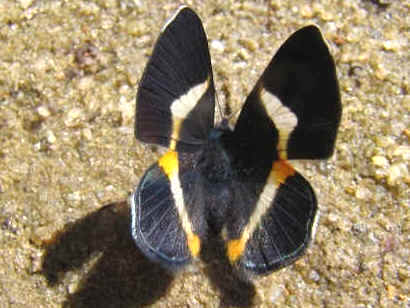
Erota Metalmark
(photo by Jorge Bizarro)
Genus ANCYLURIS: Mostly South American, up to 20 species.
Many are black with contrasting red or white bands on the upperwings.
Ancyluris aulestes (ph) ______
BRmg
AULESTES SWORDTAIL
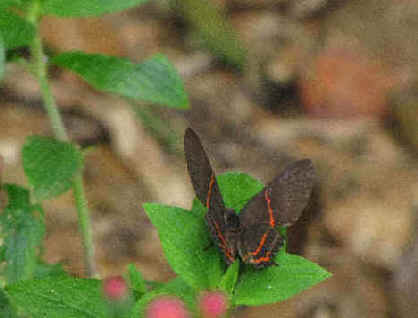
Aulestes Swordtail, Ancyluris aulestes
(copyrighted photo by Sherry
Nelson)
Ancyluris tedea ______ ARne
(MM:222)
AR common name: Cinta Roja (translates to
"Red
Ribbon")
In the book "Butterflies of Misiones",
in 2003: there was the first mention of Ancylurus tedcea in Argentina.
Genus RHETUS: 4 mostly South American species with long hindwings.
Rhetus dysonii ______ (DV2:8)
(Range: Costa Rica to Brazil)
Rhetus arcius ______ (DV2:8)
(F:268) (species described by Linnaeus in 1763)
Rhetus arcius arcius ______ BRse
subspecies
in southeast Brazil
SWORD-TAILED METALMARK
(Range: Mexico to Bolivia & Brazil)
Rhetus periander eleusinus (ph) ______ ARne
BRse (DV2:8) (MM:223) subspecies
in southeast Brazil and northeast Argentina
VARIABLE BEAUTYMARK (or
Periander Swordtail)
AR common name: Eleusinian (re the name:
Eleusinian
inhabited Eleusis,
an Attica port
northwest
of Athens)
(Range: Mexico to Argentina)
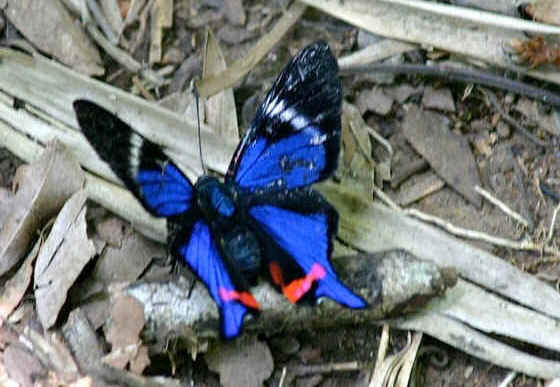
Variable Beautymark
(or Periander Swordtail)
(photo by Sherry Nelson)
Genus SYRMATIA: Mostly South American metalmarks, having an unmistakable shape
with incredibly long, drawn-out hindwings.
Syrmatia nyx ______ BRse
(DV2:9)
SPOTTED TAILWING
(Range: Costa Rica to Brazil, also Trinidad)
Syrmatia aethiops ______ (DV2:9)
WHITE-TIPPED TAILWING
(Range: Costa Rica to Brazil)
Genus ISAPIS
Isapis agyrtus ______ (DV2:9)
(Range: Mexico to Brazil)
Genus MELANIS : called
"Mulattos"
in Argentina
Melanis pixe ______ (C:327) (DV2:9)
(K:151) (PE:17)
RED-BORDERED PIXIE (or
Pixie)
(Range: Texas, in the lower Rio Grande valley, to Brazil)
Melanis xenia ______ ARne
(MM:234)
AR common name: Mulata Dentada (translates to
"Toothed
Mulatto") translates to
"Toothed
Mulatto") ("toothed" refers to the irregular bands on
the dorsal surface)
Melanis smithiae ______ ARne
(MM:235)
Melanis smithiae xarifa ______ BRse
subspecies in southeast Brazil
AR common name: Mulata Puntas Naranja (translates to
"Orange-tipped Mulatto")
Melanis aegates cretiplaga ______ ARne
(MM:236)
AR common name: Mulata Mancha Blanca
("White-spotted Mulatto")
Melanis unxia unxia
______ BRse subspecies in southeast
Brazil
Genus MONETHE
Monethe albertus
______ BRmg
YELLOW-PATCHED METALMARK ("the Alberta Clipper")
Genus CARIA
Caria castalia ______ BRse
Caria castalia marsyas ______ ARne
(MM:232)
subspecies in northeast Argentina
AR common name: Brillantina ("Brilliantine",
referring to its brilliant green coloration)
Caria plutargus ______ ARne
(MM:233)
AR common name: Brillantina y Naranja ("Brilliantine and Orange",
with orange spots)
Caria trochilus ______ BRmg
TROCHILUS METALMARK
Genus PARCELLA
Parcella amarynthina ______ (DV2:10)
(MM:226)
ORANGE-BANDED METALMARK
AR common name: Falsa Redondita ("False Small Round",
refers to its
similarity with
Notheme erota angellus)
(Range: Costa Rica to Argentina)
Genus CHAMAELIMNAS
Chamaelimnas tircis
______ BRmg
TIRCIS METALMARK
Genus CHARIS
Charis anius ______ BRmg
(DV2:11)
ANIUS SCINTILLANT
(Range: Costa Rica to Brazil)
Charis gynaea ______ (DV2:11)
(Range: Costa Rica to Brazil)
Genus CALEPHELIS: SCINTILLANT METALMARKS: only in the Americas, mostly in the tropics, many species bewilderingly
similar
Calephelis nilius ______ ARne
(MM:227)
AR common name: Lineas Celestes (translates to
"Sky-blue Lines")
Genus ARGYROGRAMMANA
Argyrogrammana venilia ______ (DV2:13)
(Range: Costa Rica to Brazil)
Genus RIODINA
Riodina lysippus
______ BRmg
LYSIPPUS METALMARK
Genus LIVENDULA
Livendula huebneri
______ BRmg
HUEBNER'S METALMARK
Genus MESENE:
mostly South American, about 20 species.
Mesene phareus ______
(DV2:13) (F:255) (S:102)
CELL-BARRED METALMARK
(or
CRAMER'S MESENE)
(Range: Mexico to Peru & Brazil)
Mesene phareus is strikingly beautiful, the male a deep red with black borders, the female a lighter
color and larger.
Mesene monostigma ______ ARne
(MM:250)
AR common name: Diminuta Manchada ("Spotted
Tiny")
Mesene pyrippe pyrippe ______ BRse
subspecies in southeast Brazil
Mesene pyrippe sanguilenta ______ ARne
(MM:251) subspecies
in northeast Argentina
AR common name: Diminuta Naranja y Parda
("Orange and Brown Tiny")
Mesene epaphus ______ ARne
BRmg
(MM:252)
Mesene epaphus epaphus ______ BRse
subspecies in southeast Brazil
EPAPHUS METALMARK
AR common name: Diminuta Narania (translates
to "Orange Tiny")
Mesene simplex celetes ______ ARne
(MM:253)
subspecies in northeast Argentina
AR common name: Diminuta Amarilla (translates
to "Yellow Tiny")
Mesene florus
______ BRse
subspecies in southeast Brazil
Genus SYMMACHIA
Symmachia accusatrix ______ (DV2:14)
FEATHERED FIESTAMARK
(Range: Mexico to Brazil)
Symmachia probetor ______ (DV2:14)
RED-LEAD FIESTAMARK
(Range: Mexico to Brazil)
Symmachia miron ______ BRmg
MIRON METALMARK
Symmachia menetas menetas ______ ARne
BRse
(MM:249)
subspecies in southeast Brazil and northeast Argentina
AR common name: Simaquia Meridional
(translates to
"Southern Simaquia")
("Simaquia" refers to the name of the genus)
In the book, "Butterflies of Missiones", 2003: the first
sighting was noted of Symmachia menetas in Argentina.
Genus SETABIS
Setabis plagiaria
______ BRmg
PLAGIARIA METALMARK
Genus STALACHTIS
Stalachtis calliope
______ BRmg
CALLIOPE METALMARK
Stalachtis susanna
______ BRse
Genus STICHELIA
Stichelia sagaris ______ (DV2:14)
(Range: Mexico to Brazil, also Trinidad)
Stichelia bocchoris suavis ______ BRse
subspecies in southeast Brazil
Genus SAROTA
Sarota myrtea ______ (DV2:15)
WHITE-CHEEKED JEWELMARK
(Range: Mexico to Brazil)
Sarota psaros ______ (DV2:15)
PEARLY JEWELMARK
(Range: Mexico to Brazil)
Sarota gyas ______ (DV2:15)
(Range: Honduras to Brazil)
Sarota chrysus ______ BRse
Genus CHALODETA
Chalodeta lypera ______ (DV2:15)
(Range: Guatemala to Brazil)
Chalodeta chaonitis ______ (DV2:15)
(Range: Mexico to Brazil, also Trinidad)
Chalodeta theodora (ph) ______
BRse
Chalodeta theodora theodora (ph) ______ ARne
(MM:231)
subspecies in northeast Argentina
THEODORA METALMARK
AR common name: Lineas Brilliantes (translates
to
"Shiny
Lines")
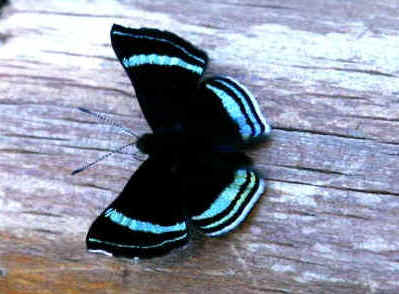
Theodora Metalmark
(photo by Sherry Nelson)
Chalodeta chelonis
______ BRse
Genus LASAIA
Lasaia oileus ______ (DV2:16)
(Range: Honduras to Peru and Brazil)
Lasaia agesilas ______
BRmg
Lasaia agesilas agesilas ______ BRse
subspecies in southeast Brazil
Lasaia agesilas esmeralda ______ ARne
(MM:229)
subspecies in northeast Argentina
BLACK-PATCHED METALMARK
AR common name: Hovy (the name is
a Guarani word meaning "blue", referring to the coloring of the
male)
Lasaia arsis ______ ARne
(MM:230)
AR common name: Hovy Salpicada ("Splashy Hovy")
(Hovy, as noted above, is a Guarani word meaning
"blue".)
Genus EMESIS: a complicated genus of
METALMARKS,
also known as
TANMARKS, that need further work
Emesis tenedia ______
(DV2:17) (K:151) (PE:text)
FALCATE EMESIS (or
Falcate Metalmark)
(Range: south Texas to Brazil)
Emesis ocypore zelotes ______ ARne
BRse
(DV2:16) (MM:239)
subspecies in southeast Brazil and northeast Argentina
DARK EMESIS (or
Dark Tanmark)
AR common name: Acrobata Morena ("Dark Acrobat")
(Range: Mexico to northern Argentina)
Emesis mandana (ph) ______
(DV2:17)
GREAT EMESIS (or
Great Tanmark)
(Range: Mexico to Brazil)
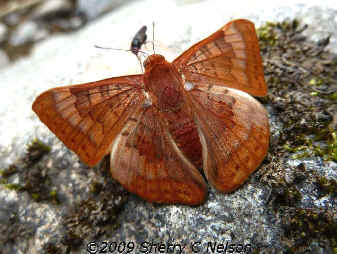
Great Emesis, or Great Tanmark
(photo by Sherry Nelson)
Emesis cypria ______
(DV2:17)
ORANGE-STRIPED EMESIS (or
Orange-striped Tanmark)
(Range: Mexico to Bolivia)
Emesis diogenia ______ ARne
(MM:237)
AR common name: Diogenia
(Diogenia, in mythology, was Celeo's
daughter.)
Emesis russula ______ ARne
BRse
(MM:238)
AR common name: Acrobata Rojiza (translates to
"Reddish
Acrobat")
Emesis neemias ______ ARne
(MM:240)
AR common name: Acrobata Brillantina (translates to
"Brilliant Acrobat")
Emesis fatimella
fatimella ______ BRse
subspecies in southeast Brazil
Emesis lupina melancholica
______ BRse subspecies in southeast
Brazil
Genus THISBE
Thisbe irenea ______
(DV2:18)
SAILOR'S LEMMARK
(or
IRENIA LEMMARK)
(Range: Mexico to Brazil)
Genus CALYDNA
Calydna caieta
______ BRmg
CAIETA METALMARK
Genus JUDITHA
Juditha molpe ______ BRmg
(DV2:18)
MOLPE METALMARK
(Range: Mexico to Brazil)
Juditha azon azon
______ BRse
subspecies in southeast Brazil
Genus CATOCYCLOTIS
Catocyclotis aemulius ______
BRse
(DV2:18)
(Range: Costa Rica to Brazil)
Genus SYNARGIS: Tailless mostly South American
LYCAENIDS,
often with an
interesting black and white coloration.
Synargis calyce ______
BRse
Synargis calyce brennus ______ ARne
(MM:241)
(subspecies in northeast Argentina)
AR common name: Nemi
subspecies in northeast Argentina
AR common name: Nemi (Nemi is a Guarani word meaning
"hidden")
Synargis victrix ______ ARne
(MM:242)
AR common name: Nemi Demarcada ("Demarcated
Nemi")
Synargis phliasus phliasus
______ BRse subspecies in southeast
Brazil
Synargis pittheus ______ BRmg
PITTHEUS METALMARK
Genus AUDRE
Audre gauchoana ______ ARne
(MM:244)
AR common name: Colage Parda (translates to
"Brown
Patchwork")
Audre notialis ______ ARne
(MM:245)
AR common name: Colage Irregular
(translates
to
"Irregular
Patchwork")
Audre chilensis ______ ARne
(MM:246)
AR common name: Colage Meridional (translates
to
"Southern
Patchwork")
Genus MENANDER
Menander menander nitida ______ BRse
(DV2:20)
subspecies in southeast Brazil
SHINING-BLUE GRAYLER
(Range: Costa Rica to Brazil)
Menander pretus pretus ______ BRse
(DV2:20) subspecies in southeast
Brazil
GREENISH GRAYLER
(Range: Guatemala to Brazil)
Genus PERIPLACIS: Mostly South American
LYCAENIDS
with strongly angled
wings, and with brown and blue coloration.
Periplacis glaucoma splendida ______ (DV2:20)
(F:262)
(Range: Costa Rica to Brazil)
Genus NYMPHIDIUM
Nymphidium mantus ______ (C:357)
(DV2:22)
MANTUS METALMARK (also called
BLUE NYMPHIDIUM)
(Range: Costa Rica to Brazil, also Trinidad)
Nymphidium azanoides ______ (DV2:22)
AZANOIDES METALMARK
(Range: Costa Rica and Panama, Ecuador and Brazil)
Nymphidium ascolia ______ (DV2:22)
CREAMY METALMARK
(Range: Guatemala to Bolivia and Brazil)
Nymphidium
lisimon ______ BRse
Genus THEOPE
Theope pedias ______ (DV2:24)
EXTROVERTED THEOPE (also called
YELLOW-BOTTOMED THEOPE)
(Range: Mexico to Brazil)
Theope lycaenina ______ (DV2:25)
GRAY THEOPE
(Range: Costa Rica to eastern Brazil)
Family NYMPHALIDAE: BRUSHFOOTS
Cosmopolitan, with subfamilies range from 8 to 25, depending upon taxonomic
treatment.
This is the most diverse family of butterflies, with approximately 6,000
known species worldwide. Brushfoot butterflies appear 4 rather than 6-legged
as their 2 front legs are much reduced.
Subfamily
LIBYTHEINAE: SNOUTS
Genus LIBYTHEANA
Libytheana carinenta ______
(C:281) (DV1:20) (F:175) (K:223) (PE:18) (S:146)
Libytheana carinenta carinenta
______ ARne
BRse (MM:255) subspecies
in southeast Brazil and northeast Argentina
AMERICAN
SNOUT (or
SOUTHERN SNOUT) (or SNOUT BUTTERFLY)
AR common name:
Picuda
(Range: southern US to Argentina)
Subfamily CHARAXINAE, Tribe
PREPONINI
Genus AGRIAS
Agrias claudina annetta
______ BRse subspecies in southeast
Brazil
Genus PREPONA
Prepona pylene ______ BRmg
Prepona pylene pylene ______ ARne
(MM:259) subspecies in northeast Argentina
MOTTLED PREPONA (or
Pylene)
Prepona deiphile deiphile
______ BRse subspecies in southeast
Brazil
Prepona laertes laertes
______ BRse subspecies in southeast
Brazil
Genus ARCHAEOPREPONA
Archaeoprepona amphimachus
amphimachus ______ BRse
subspecies in southeast Brazil
Archaeoprepona demophon ______
(C:347) (DV1:14) (species described by Linnaeus in 1758)
Archaeoprepona demophon demophon ______
ARne BRse (MM:256) (species described by Linnaeus in 1758)
Archaeoprepona demophon demophon ______
ARne BRse (MM:256) subspecies in
southeast Brazil and northeast Argentina
ONE-SPOTTED PREPONA
AR common name: Demofonte
(re the name: Demofonte
was a
fortune-teller consulted by Alexander the Great.)
(Range: Mexico to northern Argentina)
Archaeoprepona demophoon (ph) ______
Archaeoprepona demophoon antimache ______ BRse
subspecies
in southeast Brazil
Archaeoprepona demophoon demophoon ______ ARne (MM:257)
subspecies in northeast Argentina
TWO-SPOTTED PREPONA (or
Demophoon) (another name has been
Silver King
Shoemaker)
AR common name: Demophoon
(re the name, Demophoon
in mythology was Teseo's son)
(Range: southern Mexico to northern Argentina)
Archaeoprepona demophoon lives in the canopy of the rainforest. It is probably one of
the fastest-flying butterflies in its range (the American tropics). It is said
to have a smell like vanilla (maybe from its food source).
A photographer's account: "I have observed and photographed it, but always
from a great distance, and always as a solitary butterfly, sitting with its
wings open in the sun, like a drop of metallic blue paint on the green foliage
high in the trees."
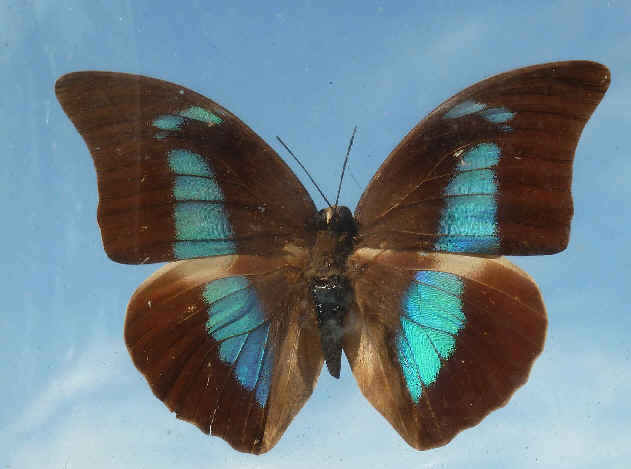
Two-spotted Prepona (or
Demophoon) (also called Silver King Shoemaker)
(photo courtesy of Junji Nakamura who sent us this picture of a
butterfly that had been her mother's since the 1950s)
Archaeoprepona meander castonna
______ BRse (S:119) (subspecies in
southeast Brazil)
THREE-TONED PREPONA (or
MEANDER PREPONA) (was called BANDED KING
SHOEMAKER)
In flight, Archaeoprepona meander makes a crackling sound.
Archaeoprepona chalciope ______ ARne
(MM:258)
AR common name: Calciope
Subfamily CHARAXINAE, Tribe ANAEINI : LEAF BUTTERFLIES
Genus SIDERONE
Siderone marthesis ______
(DV1:13)
(Range: Mexico to Brazil)
Siderone galanthis
galanthis ______ BRse subspecies in southeast
Brazil
Genus HYPNA
Hypna clytemnestra huebneri ______ ARne
BRse (DV1:15)
(MM:260)
subspecies in southeast Brazil and northeast Argentina
SILVER-STUDDED LEAFWING (another name
is
JAZZY LEAFWING)
AR common name: Clitemnestra (re the name:
Clitemnestra was Agamenon's wife.)
(Range: Mexico to southern Brazil)
Genus CONSUL
Consul fabius ______ BRmg
(DV1:15)
Consul fabius drurii ______ ARne
BRse
(MM:261) subspecies in southeast Brazil
and northeast Argentina
TIGER LEAFWING
AR common name: Mbopi (this name is Guarani word meaning
"bat", referring to
its peculiar shape when flying near the tops of trees)
(Range: Mexico to Amazon Basin)
Genera MEMPHIS and FOUNTAINEA:
About 100 species, which occur in Central
America. They resemble the genus ANAEA, to which they are closely related.
These butterflies are with crytic undersides that are leaf-like. They reside in the forest, and
are powerful fliers.
Memphis xenocles ______
(DV1:17)
Memphis xenocles marginalis ______ BRse
(subspecies in
southeast Brazil)
CAROLINA LEAFWING
(Range: Mexico to Brazil)
Memphis moruus (ph) ______
(DV1:18)
Memphis moruus stheno ______ BRse
(subspecies in southeast Brazil)
Memphis moruus coerulescens (ph) ______ ARne
(MM:265) (subspecies in northeast
Argentina)
BLUE LEAF (a northern subspecies
is called
BOISDUVAL'S LEAFWING)
(Range: Mexico to northern
Argentina)
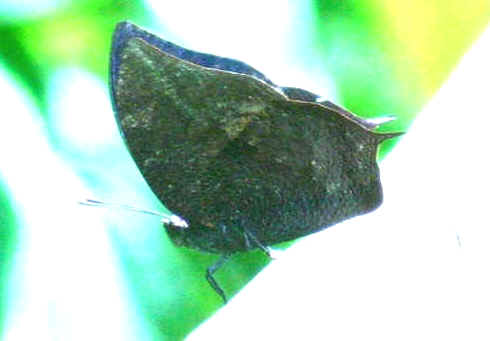
Memphis moruus, or the Blue Leaf
(photo by Sherry Nelson)
Memphis acidalia ______ BRmg
Memphis acidalia victoria ______ BRse
(subspecies in southeast Brazil)
Memphis appias ______ BRse
Memphis basilia drucei ______ BRse
Memphis leonida editha ______ BRse
(subspecies in southeast Brazil, described in 1961)
Memphis otrere ______ BRse
Memphis philumena corita ______ BRse
(subspecies in southeast Brazil)
There is at least one other species of Memphis in southeast Brazil.
Fountainea halice halice ______ BRse
(subspecies in southeast Brazil)
Fountainea ryphea (ph) ______
Fountainea ryphea phidile ______ BRse
(subspecies in
southeast Brazil)
RYPHEA LEAFWING
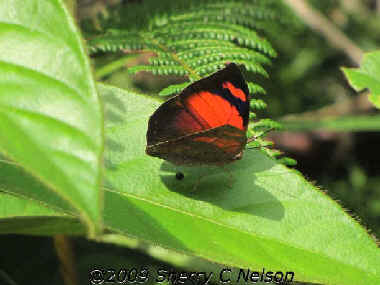
Fountainea ryphea, the Ryphea Leafwing
(photo by Sherry Nelson)
Genus POLYMORPHA
Polymorpha suprema
______ BRse local and rare in southeast Brazil
Polymorpha xenocrates
______ BRmg
XENOCRATES LEAFWING
Genus ZARETIS
Zaretis isidora isidora (ph)
______ BRse subspecies in southeast
Brazil
ISIDORA LEAFWING
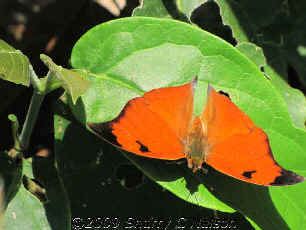
Above & below: the Isidora Leafwing,
showing upperwings & underwings
(photos by Sherry Nelson)
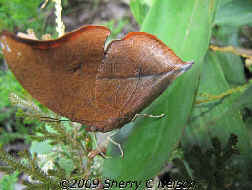
Zaretis itys itylus ______ BRse
subspecies in southeast Brazil
Subfamily
APATURINAE: EMPERORS
Genus DOXOCOPA
Doxocopa laure ______ (C:285)
(DV1:20)
(K:225) (PE:24)
SILVER EMPEROR (or LAURE)
(Range: Mexico to Brazil)
Doxocopa linda mileta ______ ARne (MM:266)
subspecies in northeast Argentina
RARE EMPEROR
AR common name: Linda (translates to
"Cute")
Doxocopa agathina ______ BRmg
Doxocopa agathina vacuna ______ ARne
BRse (MM:267) subspecies in
southeast Brazil and northeast Argentina
AGATHINA EMPEROR
AR common name: Turqui (translates to "Turquoise")
Doxocopa kallina ______ ARne
BRse
(MM:268)
AR common name: Indigo
Doxocopa laurentia laurentia
(ph)
(*) ______ ARne BRse (MM:269)
subspecies in southeast Brazil and northeast Argentina
TURQUOISE EMPEROR (or SAPPHIRE DOXOCOPA)
AR common name: Zafiro (translates to "Sapphire")
A Turquoise Emperor, or Sapphire Doxocopa, Doxocopa laurentia,
photographed during the FONT tour at Iguazu Falls in August 2008
(photo by Pamela Sims)
Doxocopa zunilda zunilda ______ ARne
BRse
(MM:270) subspecies in southeast
Brazil and northeast Argentina
DINGY EMPEROR
AR common name: Zunilda
Subfamily NYMPHALINAE,
Tribe NYMPHALINI
Genus COLOBURA
Colobura dirce (ph) ______
(C:291) (DV1:21) (S:114) (species described by Linnaeus in
1758)
Colobura dirce dirce ______ ARne BRse
(MM:271) subspecies
in southeast Brazil and northeast Argentina
SMALL BEAUTY (also called
The Mosaic or the DIRCE BEAUTY)
AR common name: Cebrita
(Range: Mexico thru Central & South America, also the West Indies)
Small Beauty
Genus SMYRNA
Smyrna blomfildia (ph)
______ (DV1:21) (K:225) (PE:26)
Smyrna blomfildia blomfilda ______ ARne
BRse (MM:273)
subspecies in southeast Brazil and northeast Argentina
BLOMFILD'S BEAUTY
AR common name: Dibujada
(Range: Mexico to Argentina)
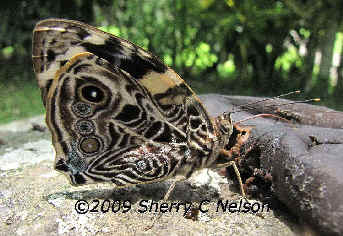
Smyrna blomfildia, or the Blomfild's Beauty
(photo by Sherry Nelson)
Genus HYPANARTIA
Hypanartia lethe (ph) ______
BRse (C:279)
(DV1:28) (MM:324)
ORANGE MAPWING
AR common name: Lete
(refers to the scientific name;
Lethe, in
mythology, was Oleno's wife who turned into a stone)
(Range: Mexico to Brazil)
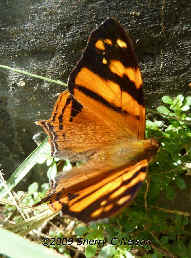
Above & below: Hypanartia lethe, or the Orange Mapwing
(upper photo by Sherry Nelson; lower photo by Jorge Bizarro)
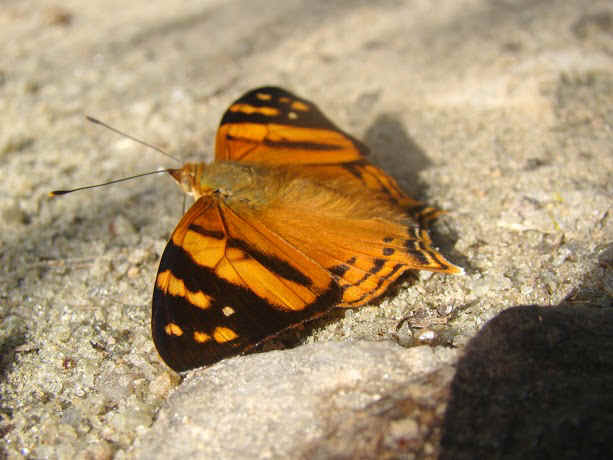
Hypanartia bella ______ BRse
(MM:325)
AR common name: Bella
(translates to "Beautiful")
Genus VANESSA: LADY BUTTERFLIES
Vanessa (or
Cynthia)
cardui (ph) ______ (DV1:28) (K:205) (PE:23) (S:141)
PAINTED LADY
(Range: worldwide, except for Australia and New Zealand)
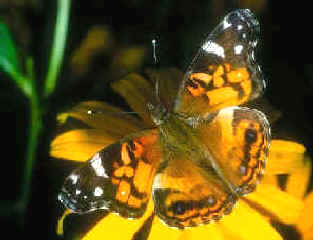
Painted Lady
Vanessa carye ______ ARne
(MM:321)
AR common name: Dama Cuatro Ojos (translates to
"Four-eyed
Lady")
Vanessa braziliensis ______ ARne
BRse (MM:322)
AR common name: Dama Dos Ojos (translates to "Two-eyed
Lady")
Vanessa myrinna ______ ARne
BRse (MM:323)
AR common name: Dama Fajada (translates to "Banded
Lady"
, referring to the postmedian band on the upper rear wings
Subfamily NYMPHALINAE,
Tribe COEINI
Genus HISTORIS
Historis odius (ph) ______ BRmg
(DV1:21)
(PE:text)
Historis odius odius ______ ARne
BRse (MM:272) subspecies in southeast Brazil
and northeast Argentina
ORION CECROPIAN (also called
Stinky Leaf Wing)
AR common name: Popeno:
(a Guarani word meaning
"gigantic")
(Range: throughout Central & South America; in North America, a rare
stray to Florida)
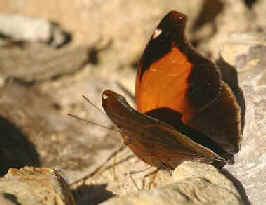
Historis odius, or the Orion Cecropian
Historis acheronta
acheronta ______ BRse
subspecies in southeast Brazil
Genus BAEOTUS
Baeotus aeilus ______ BRmg
AMAZON BEAUTY
Baeotus aeilus was Baeotus
amazonicus.
Subfamily BIBLIDINAE, Tribe
BIBLIDINI
Genus BIBLIS
Biblis hyperia (ph) ______ (C:319)
(DV1:21) (F:124) (K:215) (PE:25)
Biblis hyperia hyperia ______ BRse
subspecies in
southeast Brazil
Biblis hyperia nectanabis (ph) (*) ______
ARne (MM:291)
subspecies
in northeast Argentina
RED RIM
AR common name: Alas Sangrantes ("Crimson-banded
Black")
(Range: Mexico to the Argentina, also the West Indies)
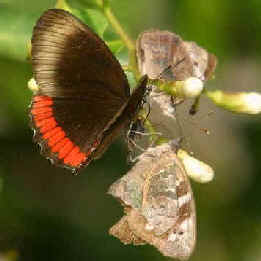
Red Rim
Subfamily BIBLIDINAE, Tribe
AGERONIINI: CRACKERS and allies
Genus HAMADRYAS: CRACKERS:
species in this genus are
called "crackers" because of the noise the males make in flight;
in
general
CRACKERS
are also called
CALICOS.
Hamadryas februa (ph) (*)
______ BRmg (DV1:21) (F:158) (K:217) (PE:26)
Hamadryas februa februa ______
ARne BRse (MM:284) subspecies in
southeast Brazil and northeast Argentina
GRAY CRACKER (or simply "The Cracker",
or the
Common Calico)
AR common name: Pororo Ocelos Rojos
("Red eye-spotted Pororo") ("Pororo"
is a Guarani word
meaning "that crackles" or "that sparkles".)
(Range: southern US to Argentina)
Hamadryas februa occurs along forest edges. Not at flowers, but at rotting fruit, dung,
and mud.
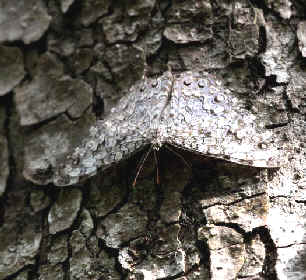
Hamadryas februa, or the Gray Cracker
Hamadryas feronia (ph) ______ (C:259)
(DV1:21) (K:217) (PE:26) (species described by Linnaeus in 1758)
Hamadryas feronia feronia ______ BRse
subspecies in
southeast Brazil
VARIABLE CRACKER (also called
Blue Cracker)
(Range: southern US to Brazil)
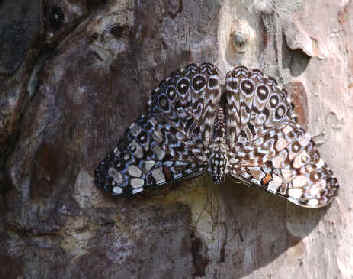
A Variable Cracker photographed during a FONT South
American tour
(photo by Marie Gardner)
Hamadryas ipthime ______ (DV1:21)
(PE:26)
Hamadryas ipthime ipthime ______ BRse
subspecies in
southeast Brazil
BROWNISH CRACKER (also called
Ringless Blue Cracker)
(Range: Mexico to Brazil)
Hamadryas fornax ______
(DV1:21) (F:158)
Hamadryas fornax fornax ______ ARne
BRse (MM:287) subspecies in
southeast Brazil and northeast Argentina
YELLOW CRACKER (or
Yellow-skirted Cracker)
AR common name: Pororo Mancha Ocre ("Ochre-spotted Pororo") ("Pororo"
is a Guarani word meaning "that crackles"
or "that sparkles")
(Range: Mexico to Argentina)
Hamadryas fornax is smaller than other crackers, and with a number of
subspecies. In moist rainforest, it occurs along trails and rivers.
Hamadryas amphinome (ph)
______ (DV1:22) (F:157) (PE:26)
(species described by Linnaeus
in 1767)
Hamadryas amphinome amphinome ______ ARne
BRse (MM:286) subspecies
in southeast Brazil and northeast
Argentina
RED CRACKER
AR common name: Pororo Mancha Roja ("Red-spotted Pororo") ("Pororo"
is a Guarani
word meaning "that crackles" or "that sparkles")
(Range: Mexico to northern
Argentina)
Hamadryas amphinome occurs in rainforests.
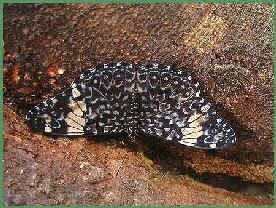
Red Cracker (red is on the other side of the wings)
Hamadryas epinome ______ ARne
BRse (MM:285)
AR common nmae: Pororo
(a Guarani word meaning "that crackles"
or "that sparkles")
Hamadryas arete (ph) ______
ARne
BRse
(MM:288)
AR common name: Pororo Azul ("Blue Pororo") ("Pororo"
is a Guarani word meaning "that
crackles" or "that sparkles")
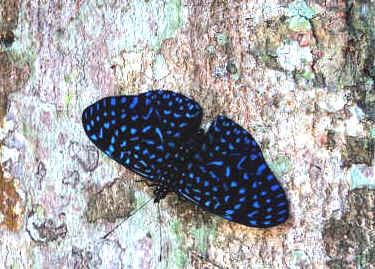
Hamadryas arete
(photo by Jorge Bizarro)
Hamadryas laodamia ______ BRmg
Hamadryas laodamia laodamia
______ BRse subspecies in southeast
Brazil
STARRY NIGHT CRACKER
Genus ECTIMA
Ectima thecla thecla
______ ARne (MM:289)
AR common name: Pororo Mini (referring to the similarity with the
butterflies of the genus HAMADRYAS called "Pororo";
"Mini" relates to its smaller size.)
Subfamily BIBLIDINAE,
Tribe EPICALLINI: PURPLEWINGS and allies
Genus EUNICA
60 species in Central & South America that live in primary forest
Eunica tatila (ph) ______
(DV1:22) (K:215) (PE:25)
Eunica tatila bellaria ______
ARne (MM:317) subspecies
in northeast Argentina
FLORIDA PURPLE WING
(or Large Purple Wing, or simply Purple
Wing)
AR common name: "Dulce" (translates to "Sweet") translates to "Sweet")
(Range: southern US to northern Argentina, also West Indies)
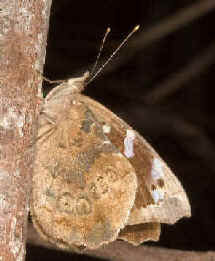
Eunica tatila, the Florida Purplewing
Eunica monima ______ (DV1:22)
(K:215) (PE:25)
DINGY PURPLE WING
(Range: US and Mexico thru Central and South America, also the Antilles and
the Bahamas)
Eunica alpais ______ BRmg
ALPAIS PURPLEWING
Eunica mygdonia ______ BRmg
MYGDONIA PURPLEWING
Eunica pusilla ______ BRmg
PUSILLA PURPLEWING
Eunica maja maja (ph) ______ ARne
BRse (MM:316) subspecies in
southeast Brazil and northeast Argentina
AR common name: Maja
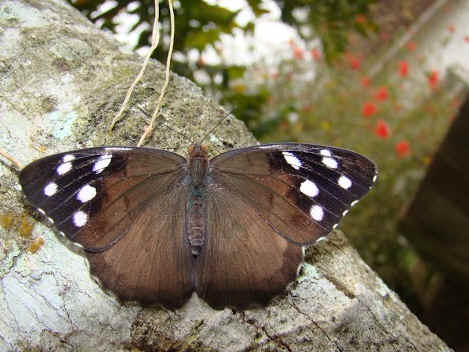
the female Maja Purplewing, Eunica maja maja
(photo by Jorge Bizarro)
Eunica eburnea ______ ARne
(MM:318)
AR common name: Marfil (translates to "Ivory")
(The
scientific name, eburnea, means "ivory, or like it")
Genus NESSAEA
Nessaea obrinus
______ BRmg
BLUE-AND-ORANGE OLIVEWING
Genus CYBDELIS
Cybdelis phaesyla ______ ARne
(MM:309)
AR common name:
Abanderada (translates to
"Standard-bearer", alluding
to the pattern on the upper fore wings, like Argentina's flag)
Genus CATONEPHELE
Catonephele numilia (ph)
______ (DV1:25) (S:139)
Catonephele numila penthia ______ BRse
subspecies in
southeast Brazil
Catonephele numila neogermanica ______ ARne
(MM:292) subspecies in northeast
Argentina
STOPLIGHT CATONE
(or
BLUE-FROSTED CATONE) (has also been called
Grecian Shoemaker)
AR common name: Terciopelo Manchado ("Spotted Velvet")
(Range: Mexico to southern Brazil and Argentina)
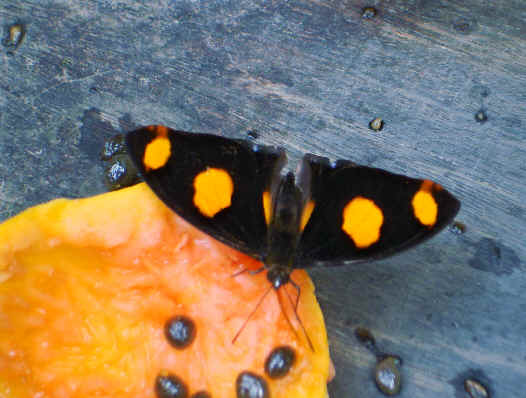
A Spotlight Catone, or Blue-frosted Catone,
or Grecian Shoemaker, or "Spotted Velvet"
(photographed during the FONT August 2009 tour in southeast Brazil)
Catonephele acontius caeruleus ______ ARne
BRse
(MM:293) subspecies
in southeast Brazil and northeast Argentina, described in 1985
AR common name: Terciopelo Fajado
(translates to
"Banded
Velvet")
Catonephele sabrina
______ BRse
Genus MYSCELIA
Myscelia orsis ______ ARne BRse
(MM:315)
AR common name: Yin-Yang
(This name is because the male & female are very different, but yet
they are of course complimentary, as in the universal principle of the yin
and the yang in Taoism.)
Subfamily
CYRESTINAE: DAGGERWINGS
Genus MARPESIA: DAGGERWINGS
A genus of mostly Central and South American butterflies, but also occurs
in Africa. Called "daggerwings" after the long tail on each
hindwing.
Marpesia coresia
(or
zerynthia) (ph) ______ (DV1:23)
(K:219) (PE:25)
Marpesia coresia zerynthia ______ BRse
subspecies in
southeast Brazil
WAITER DAGGERWING
(Range: southern US thru Central and South America)
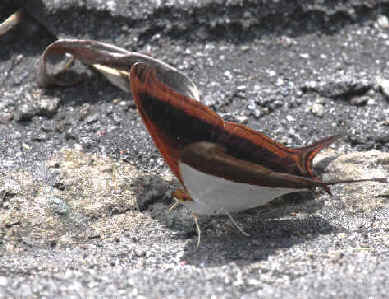
A Waiter Daggerwing photographed during a FONT South
American tour
(photo by Marie Gardner)
Marpesia merops ______ (DV1:23)
SPOT-BANDED
DAGGERWING
(Range: Guatemala to Brazil)
Marpesia petreus (ph) ______
BRmg
(DV1:23) (F:177) (K:219) (PE:25) (S:123)
Marpesia petreus petreus ______ ARne
BRse (MM:320) subspecies
in southeast Brazil and northeast
Argentina
RUDDY DAGGERWING (also
called
Southern Daggertail)
AR common name: Daga
(Range: southern US thru Central and South America)
Marpesia petreus visits flowers and mud-puddles.
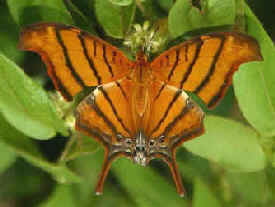
Ruddy Daggerwing
Marpesia berania ______ BRmg
TANGERINE DAGGERWING
Marpesia orsilochus ______ BRmg
WHITE-BANDED DAGGERWING
Marpesia chiron (ph) ______
BRmg
(C:273) (DV1:23) (K:219) (PE:25)
Marpesia chiron marius ______ ARne
BRse (MM:319)
subspecies in
southeast Brazil and northeast
Argentina
MANY-BANDED DAGGERWING
AR common name: Mario (refers
to the subspecific name; the only race found in Argentina)
BR common name: Cambaxirra
(Range: southern US, Central and South America, also West Indies)
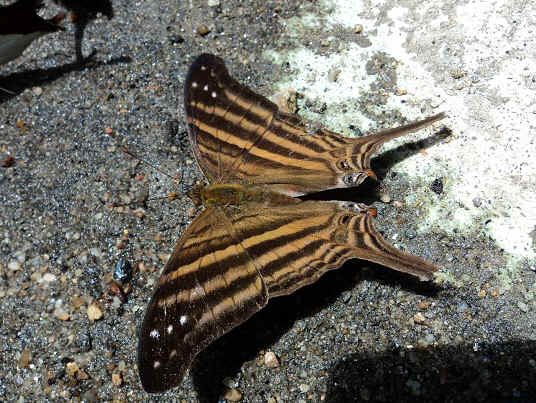
the Many-banded Daggerwing, Marpesia chiron
(photo by Jorge Bizarro)
Marpesia
themistocles narica ______ BRmg
subspecies in Mato
Grosso, Brazil
Marpesia themistocles themistocles ______ BRse
subspecies in southeast Brazil
NORICA DAGGERWING
Subfamily BIBLIDINAE,
Tribe EUBAGINI: SAILORS
Genus DYNAMINE
Dynamine agacles ______
(DV1:24)
Dynamine agacles agacles ______ ARne
BRse (MM:303)
subspecies in
southeast Brazil and northeast Argentina
PALE SAILOR
AR common name: Gota Ribeteada (translates to
"Edged Drop")
(Range: Costa Rica to Argentina)
Dynamine mylitta ______
(DV1:24)
(Range: Mexico thru Central and South America)
Dynamine artemisia ______ (C:289)
Dynamine artemisia artemisia ______ ARne
BRse (MM:308) subspecies in southeast Brazil
and northeast Argentina
SMALL-EYED SAILOR
AR common name: Gota de Monoculo (translates
to "Drop with Monocle", has a large "eyespot"
with a band, like a monocle)
(Range: Mexico to Argentina)
Dynamine glauce ______ (DV1:24)
(Range: Mexico thru Central and South America)
Dynamine myrrhina ______ ARne
(MM:301)
AR common name: Gota de Luz (translates to
"Light
Drop")
Dynamine coenus coenus ______ ARne
(MM:302)
subspecies in
northeast Argentina
AR common name: Gota Blanca (translates to
"White
Drop")
Dynamine athemon maeon ______ BRse
subspecies in southeast Brazil
Dynamine athemon athemaena ______ ARne
(MM:304)
subspecies in northeast Argentina
AR common name: Gota con Linea (translates
to
"Drop with
Line")
Dynamine tithia tithia (ph) ______
ARne BRse (MM:305)
subspecies in southeast Brazil and northeast Argentina
BLUE SAILOR
AR common name: Gota Ciega
(translates to
"Blind
Drop")
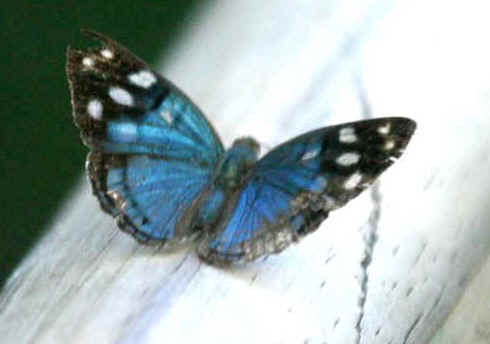
Above & below: the Blue Sailor
(photos courtesy of Sherry Nelson)
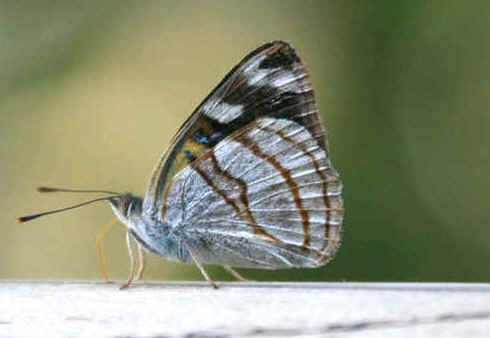
Dynamine postverta postverta ______
ARne BRse
(MM:306)
subspecies in southeast Brazil and northeast Argentina
FOUR-SPOTTED SAILOR (a northern
subspecies is called
MEXICAN SAILOR)
AR common name: Gota Ocelada (translates to
"Eye-spotted Drop")
Dynamine aerata ______ ARne
(MM:307)
AR common name: Gota de Anteokos
(translates to
"Drop with Glasses")
Subfamily BIBLIDINAE, Tribe
EPIPHILINI: BANNERS and allies
Genus PYRRHOGYRA
Pyrrhogyra amphira
______ BRmg
AMPHIRO REDRING
Pyrrhogyra neaerea ______
Pyrrhogyra neaerea ophni ______ BRse
subspecies in
southeast Brazil
Pyrrhogyra neaerea arge ______ ARne
(MM:310) subspecies in northeast
Argentina
AR common name: Pore
Pyta
Genus SEA genus created in 1950
Sea sophronia
______ BRse
Genus TEMENIS
Temenis laothoe ______
(DV1:24)
Temenis laothoe bahiana ______ BRse
subspecies in
southeast Brazil
Temenis laothoe santina ______ ARne
(MM:313) subspecies in
northeast Argentina
ORANGE BANNER
AR common name: Mocha (translates to
"Blunt")
(Range: Mexico to northern Argentina)
Genus NICA
Nica flavilla flavilla ______ ARne
(DV1:24)
(MM:314) subspecies in northeast Argentina
LITTLE BANNER
AR common name: Aritos (translates to
"Small Rings")
(Range: Mexico to northern Argentina)
Genus EPIPHILE
Epiphile orea orea ______ ARne
BRse
(DV1:24) (MM:311)
subspecies in southeast Brazil and northeast Argentina
AR common name: Marcada Azul (translates to
"Blue Marked")
(Range: Costa Rica to northern Argentina)
Epiphile hubneri ______ ARne
(MM:312)
AR common name: Marcada Anaranjada
(translates
to
"Orange
Marked")
Subfamily BIBLIDINAE, Tribe
CALLICORINI: "EIGHTY-EIGHT" BUTTERFLIES
Genus DIAETHRIA
Diaethria clymena ______
BRmg (C:317)
Diaethria clymena janeira (ph) (*) ______
ARne BRse (MM:294)
subspecies in
southern Brazil and northeast Argentina
WIDESPREAD EIGHTY-EIGHT
AR common name: Ochenta y Ocho (translates to
"Eighty-Eight")
(Range: subtropical & tropical Latin America)
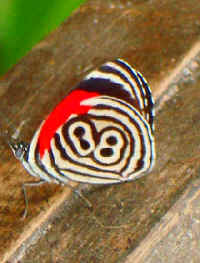
An "Eighty-eight Butterfly", Diaethria
clymena,
photographed during the FONT tour in southeast Brazil in August
2009
Diaethria eluina eluina (*) ______
ARne BRse
(MM:295)
subspecies in southeast Brazil and northeast Argentina
AR common name: Ochenta y Ocho Azul (translates
to
"Blue
Eighty-Eight")
Diaethria candrena candrena (ph) ______
ARne BRse (MM:296)
subspecies
in southeast Brazil and northeast Argentina
CANDRENA EIGHTY-EIGHT
AR common name: Ochenta
(translates to
"Eighty")
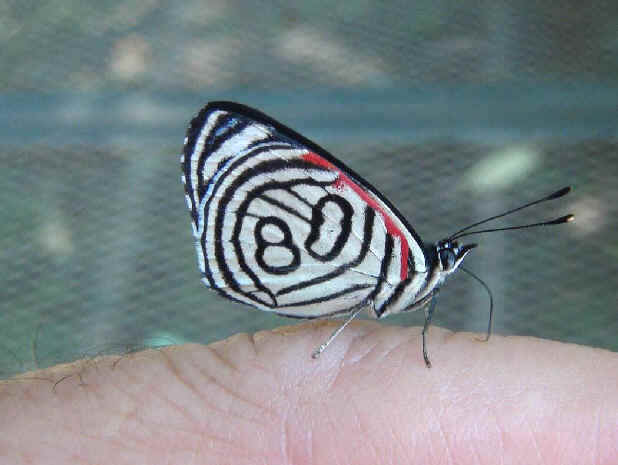
A Candrena Eighty-eight, or more
appropriately "Eighty"
Diaethria candrena
(photo by Sherry Nelson)
Diaethria marchalii ______
(DV1:25)
(Range: Nicaragua to Brazil)
Genus CALLICORE
Callicore pygas pygas ______ BRse
subspecies in southeast Brazil
Callicore pygas thamyras (ph) (*) ______ ARne
BRmg
(MM:297) subspecies in northeast Argentina and part of
Brazil
PYGAS EIGHTY-EIGHT
AR common name: Para Guasu (re the
name:
"Para" are
"Guasu" are
Guarani words meaning, respectively, "full of colors" and
"big")
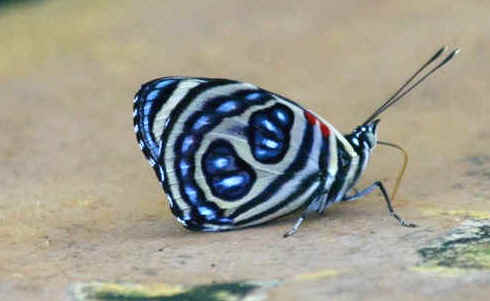
Pygas Eighty-eight, photographed at Iguazu Falls
(photo by Sherry Nelson)
Callicore hydaspes (ph) (*) ______
ARne BRse
(MM:298)
HYDASPES EIGHTY-EIGHT
AR common name: Para Mini
(re the name:
"Para" &
"Mini" are
Guarani words meaning, respectively, "full of colors" and
"small")
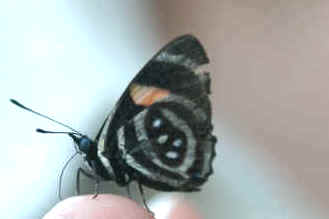
Hydaspes Eighty-eight, photographed at Iguazu
Falls
on a person's thumb
(photo by Sherry Nelson)
Callicore hystaspes ______
BRam
BRmg
HYSTASPES EIGHTY-EIGHT (or
HYSTASPES NUMBERWING)
(Range: parts of Brazil, Ecuador, Peru, in the upper Amazonian region)
Callicore texa ______
BRmg
TEXA EIGHTY-EIGHT
Callicore sorana sorana ______ ARne
BRse
(MM:299)
subspecies in southeast Brazil and northeast Argentina
AR common name: Para Zigzag ("Zigzag
Para")
Callicore astarte
codomannus ______ BRse
subspecies in southeast Brazil
Callicore hydarnis
______ BRse
Callicore hydarnis is an endangered species.
Genus PAULOGRAMMA
Paulogramma pyracmon ______ BRmg
Paulogramma pyracmon pyracmon ______ ARne (MM:300)
PYRACMON EIGHTY-EIGHT
AR common name: Para Mediana ("Medium Para")
Genus HAEMATERA
Haematera pyrame ______
(DV1:25)
Haematera pyrame pyrame ______ ARne BRse
(MM:290)
subspecies in southeast
Brazil and northeast Argentina
AR common name: Llamarada (translates to
"Blaze")
(Range: Nicaragua to northern Argentina)
Subfamily LIMENITIDINAE, Tribe LIMENITIDINI: SISTERS
Adults often characterized by flap-and-glide flight.
Genus ADELPHA
Adelpha zea ______ ARne
(DV1:27)
(MM:282)
AR common name: Zea
(Range: Mexico to the Argentina)
Adelpha lycorias lycorias (ph) ______
ARne BRse
(MM:274) subspecies in southeast Brazil
and northeast Argentina
PINK-BANDED SISTER
AR common name: Mancha Bermellon (translates
to
"Vermilion
Spot")
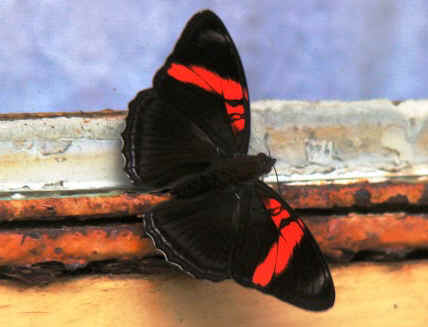
the Pink-banded Sister, but for this
subspecies Adelpha lycorias lycorias,
the name "Vermilion Spot" is appropriate.
That is the English translation of the Spanish name, Mancha Bermellon.
(photo by Jorge Bizarro)
Adelpha syma (*) ______ ARne
BRse
(MM:275)
AR common name: Syma
Adelpha mythra ______ ARne
BRse
(MM:276)
AR common name:
Mithra (re the name: Mithra was a Persian god.)
Adelpha malea goyama ______ ARne
BRse
(MM:277) subspecies in southeast Brazil and northeast
Argentina
AR common name: Goyama
Adelpha abia (ph) ______ ARne
(MM:278)
ABIA SISTER
AR common name: Abia
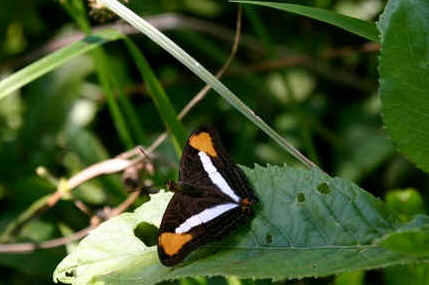
the Abia Sister, Adelpha abia
Adelpha mesentina ______ BRmg
ORANGE SISTER
Adelpha barnesia barnesia ______
BRse subspecies in southeast
Brazil
Adelpha cocala ______ BRmg
Adelpha cocaia didia ______ BRse
subspecies in southeast Brazil
COCALA SISTER
Adelpha cytherea aea ______ BRse
subspecies in southeast Brazil
Adelpha erotia erotia ______
BRse subspecies in southeast Brazil
Adelpha iphiclus (ph) ______
BRmg
Adelpha iphiclus ephesa ______ BRse
subspecies in
southeast Brazil
IPHICLUS SISTER (or
POINTER SISTER)
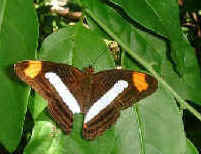
the Iphiclus Sister, Adelpha iphiclus
Adelpha plesaure ______ BRmg
Adelpha plesaure plesaure ______ BRse
subspecies in southeast Brazil
PLESAURE SISTER
Adelpha radiata radiata ______ BRse
subspecies in southeast Brazil
Adelpha serpa serpa (ph) ______ ARne
BRse
(MM:279) subspecies in
southeast Brazil and northeast Argentina
a northern subspecies, from Mexico to Venezuela, A. s.
celerio, is called CELERIO SISTER
CELADON SISTER
AR common name: Serpa
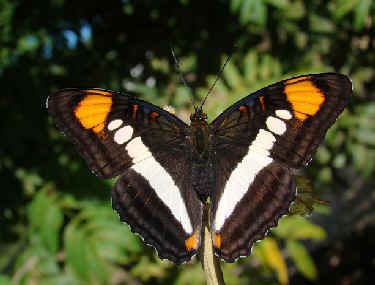
the Celadon Sister, Adelpha serpa serpa
(photo by Jorge Bizarro)
Adelpha falcipennis ______ ARne
(MM:280)
AR common name: Adelfa Ocre
Adelpha thessalia indefecta ______
ARne (MM:281)
subspecies in northeast Argentina
AR common name: Tesala del Nordeste
("Northeastern Tesela")
Adelpha melona pseudarete ______ ARne
(MM:283) subspecies
in northeast Argentina
MELLONA SISTER
AR common name: Melona
Subfamily NYMPHALINAE,
Tribe VICTORININI
Genus SIPROETA (or METAMORPHA)
Siproeta (or
Metamorpha)
stelenes (ph) ______ (DV1:28) (F:202)
(K:209) (PE:26)
Siproeta stelenes meridionalis (*) ______
ARne BRse (MM:329)
subspecies in
southeast Brazil and northeast Argentina
MALACHITE
an AR common name: Itaovy guasu (translates to
"Large Emerald")
(from Guarani
words, alluding to its color, size, and beauty)
(Range: southern US to northern Argentina, and in the West Indies)
The Malachite is on the wing all year in the tropics. It feeds on
fermenting fruit.
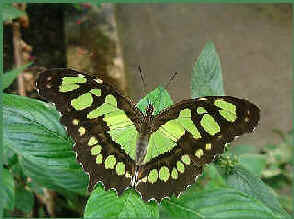
Above & below: Malachites
The photo below was taken during the FONT tour in Brazil in May 2011.
(photo by Patricia Yoder)
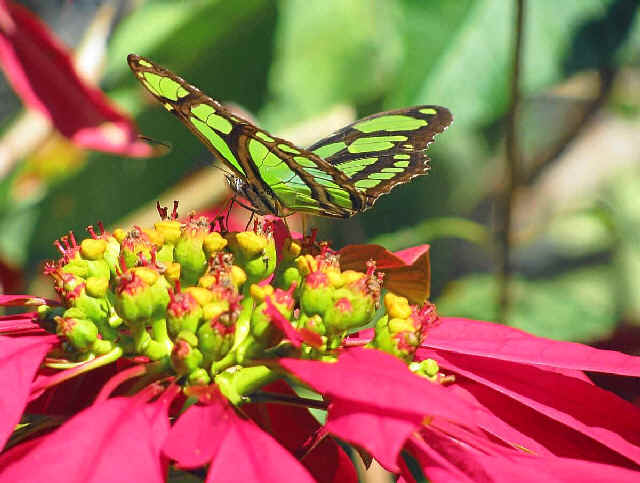
Siproeta epaphus trayja (ph) (*) ______
ARne BRse (DV1:28) (K:209) (MM:320) (S:136)
subspecies in southeast Brazil
and northeast Argentina
RUSTY-TIPPED PAGE (or
Brown Siproeta)
AR common name: Epafos Moreno ("Dark
Epafos") (referring to Epafos who in
mythology,
was Jupiter's son.)
(Range: Mexico to northern Argentina)
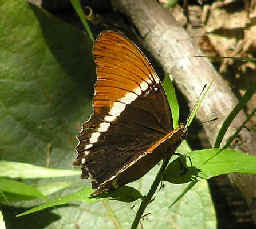
Siproeta epaphus, or the Rusty-tipped Page
(photo by Rosemary Lloyd during a FONT tour)
Genus ANARTIA
Anartia amathea (ph) ______ (C:311)
Anartia amathea roesella (*) ______ ARne
BRse (MM:327) subspecies
in southeast Brazil and northeast Argentina
RED PEACOCK
AR common name: Princesa Roja (translates to "Red Princess")
(Range: Panama to Argentina, also: Trinidad & Tobago, Grenada, Barbados,
Antigua)
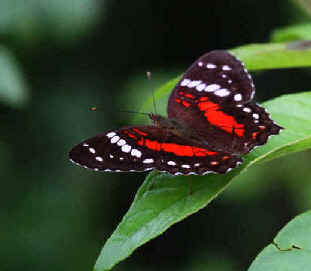
A Red Peacock photographed during a FONT tour
in Ecuador in April 2014
(photo by Marie Gardner)
Anartia jatrophae (ph)
______ (C:309) (DV1:28) (K:209) (PE:24) (S:107)
(species described by Linnaeus in 1763)
Anartia jatrophae jatrophae (*) ______ ARne
BRse (MM:326) subspecies
in southeast Brazil and northeast Argentina
WHITE PEACOCK
AR common name: Princesa Perlada (Princesa, or
Princess, is the
common Spanish name for the ANARTIA genus butterflies; "Perlada"
refers to the wing coloring.)
(Range: southern US thru Central
and South America, also West Indies)
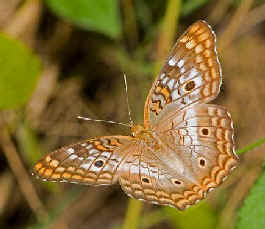
Anartia jatrophae, or the White Peacock
Subfamily
NYMPHALINAE, Tribe JUNONIINI
Genus JUNONIA: BUCKEYES
Junonia evarete (ph) ______
(K:207) (PE:23)
Junonia evarete evarete ______ BRse
subspecies in southeast Brazil
Junonia evarete hilaris ______
ARne (MM:328)
subspecies
in northeast Argentina
TROPICAL BUCKEYE
AR common name: Pavo Real ("Peacock") (another
name: Genoveva)
(Range: southern US to Argentina)
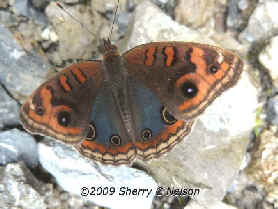
Junonia evarete, or the Tropical Buckeye
(photo by Sherry Nelson)
Genus HYPOLIMNAS
Hypolimnas misippus (ph) ______
(DV1:28)
(F:164)
THE MIMIC (other names:
Diadem Butterfly, Six-continent Butterfly, Danaid Butterfly)
(Range: distributed worldwide)
The
female of Hypolimnas misippus resembles
Danaus chrysippus of the Old World, with coloration similar to
Danaus glippus, the
Queen.
Subfamily NYMPHALINAE,
Tribe MELITAEINI
Genus CHLOSYNE: PATCHES
Chlosyne lacinia (ph) (*)
______ (C:265) (DV1:29) (K:189) (PE:21)
Chlosyne lacinia saundersi ______
ARne BRse (MM:337)
subspecies in southeast Brazil and northeast
Argentina
BORDERED PATCH
AR common name: Naranjita
(Range: US to northern Argentina)
Chlosyne lacinia has a very variable pattern. It prefers sunny places and feeds
on nectar.
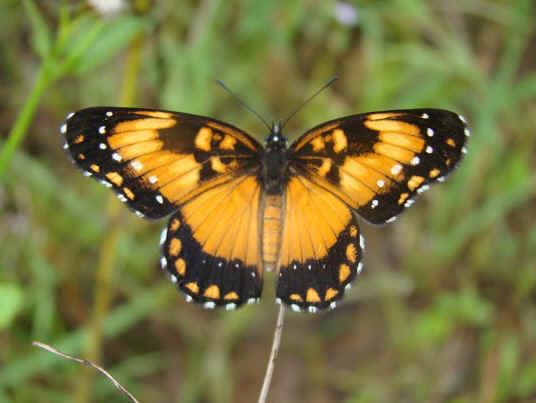
the Bordered Patch, the subspecies Chlosyne lacinia
saundersi
This subspecies, in southeast Brazil and the Iguazu area, has more orange in the
upperwings than other subspecies, hence the
common name there of "Naranjita".
(above photo by Jorge Bizarro)
Genus TEGOSA
Tegosa serpia
______ BRmg
SERPIA CRESCENT
Tegosa teletusa burchelli
______ BRmg subspecies in Mato Grosso, Brazil
BURCHELL'S CRESCENT
Tegosa frisia hermas ______ ARne
(MM:331)
AR common name: Salpicada (translates to
"Splashy")
Tegosa claudina ______ ARne
BRse (MM:332)
AR common name: Claudina
Genus TELENASSA genus created in
1981
Telenassa teletusa teletusa
______ BRse subspecies in southeast
Brazil
Genus ORTILIA: CRESCENTS
Ortilia ithra ______ ARne
BRse
(MM:333)
AR common name: Mbatara
(a Guarani word meaning "lead-colored, with short white lines")
Ortilia velica durnfordi ______ ARne
(MM:334)
AR common name: Marroncita
(translates to
"Small Brown")
Ortilia dicoma ______
ARne
(MM:335)
AR common name: Alitas
Largas (translates to
"Long Wings")
Genus ERESIA
Eresia clio
______ BRmg
CLIO CRESCENT
Eresia eunice eunice ______ BRse
subspecies in southeast Brazil
Eresia lansdorfi ______ ARne
BRse
(MM:336)
AR common name: Falsa Erato ("False Erato") (name refers to its resemblance to
Heliconius erato phyllis)
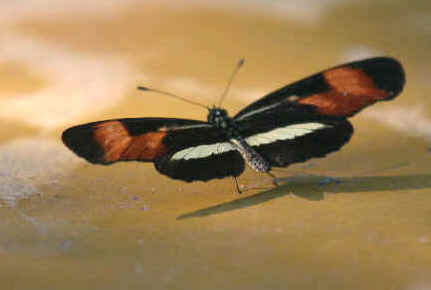
Above & below: Eresia lansdorfi. the "False
Erato",
photographed at Iguazu Falls
(photos by Sherry Nelson)
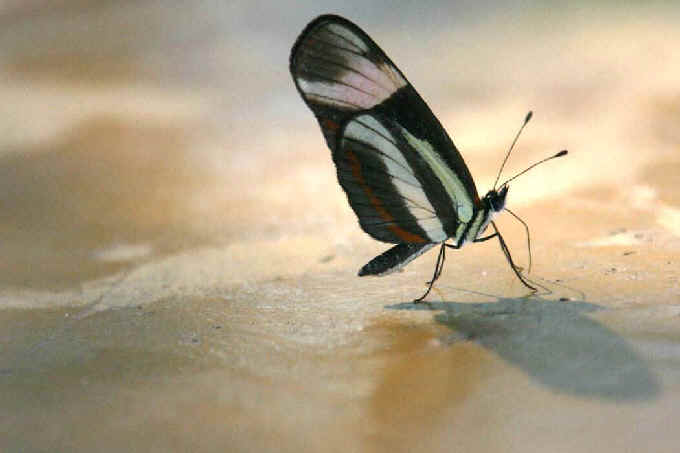
Subfamily HELICONIINAE: LONGWINGS
Mostly in the American tropics. Adults of some species are long-lived, and
several are distasteful. Various other species mimic the distasteful butterflies
of this group.
Genus PHILAETHRIA: 2 nearly identical species which may be differentiated only
by comparing their underwings.
Philaethria dido ______ (DA:92)
(Range: southern Mexico to Brazil; also Trinidad)
The costal margins and the transverse band of the hindwings of Philaethria
dido are chocolate-colored.
Philaethria wernickei
______ ARne (DA:text) (MM:340)
AR common name: Itaovy Rabona (translates to
"Tailess
Itaovy")
(Itaovy is a Guarani word meaning "emerald".)
(Range: southern Brazil, Paraguay, Uruguay, Argentina)
The costal margins and the transverse band of the hindwings of Philaethria
wernickei are gray.
Genus DIONE
Dione moneta (ph) ______
(C:267)
(DV1:31)
(F:143) (K:155) (PE:19)
MEXICAN SILVERSPOT (or
Mexican Silver-spotted Fritillary)
(Range: southern US thru Central and South America)
Dione juno ______
(DV1:31) (S:161)
Dione juno juno ______ BRse
subspecies in southeast Brazil
Dione juno suffumata ______ ARne
(MM:343) subspecies in northeast
Argentina
JUNO LONGWING (or SILVER SPOT)
AR common name: Juno Oscura (translates to
"Dark
Juno") (Juno
in mythology was a Greek goddess, and dark is in comparison with another
Argentine subspecies.)
(Range: thru Central and South
America, also the Lesser Antilles)
Dione juno is closely related to
Dryas iulia. It often occurs in the same places as the very similar Gulf
Fritillary, and is said to be attracted to red and blue flowers.
Genus AGRAULIS: a single well-known species which occurs in a number of races
throughout its vast range.
Agraulis vanillae (ph) ______ (C:269)
(DA:93) (DV1:31) (F:144) (K:157) (PE:19) (S:160)
Agraulis vanillae maculosa ______ ARne
BRse (MM:341)
subspecies in
southeast Brazil and northeast Argentina
GULF FRITILLARY (another
name, particularly in the West Indies:
Silver-spotted Flambeau)
AR common name: Espejitos (translates to
"Mirrors", referring to the silver spots
on the ventral side, that appear as fragments of a mirror)
BR common name: Pingos de Prata
(Range: southern US thru American
tropics to South America, also West Indies)
Agraulis vanillae is a widespread, familiar butterfly that visits gardens to drink
nectar.
Its fiery orange upperside is distinguished from Dryas iulia by the presence of numerous black dots
on the forewing and a silver spotted underside.
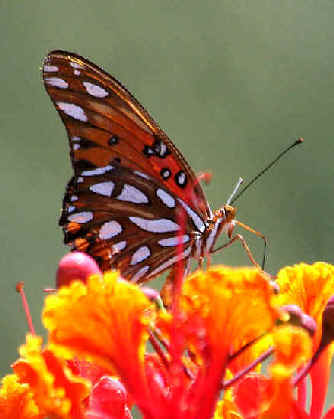
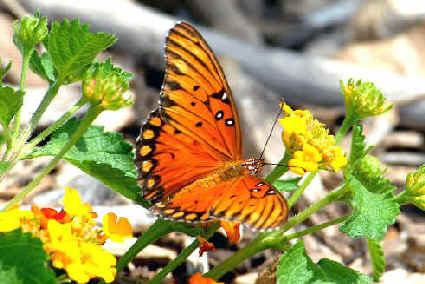
Two photographs of the Gulf Fritillary, with the upper photo showing the
"mirrors"
(upper photo by Doris Potter; lower photo by Howard Eskin)
Genus DRYADULA
Dryadula phaetusa (ph) ______ ARne
(DV1:31)
(K:155) (MM:344) (PE:19) (species described by Linnaeus in 1758)
BANDED LONGWING (or
BANDED ORANGE HELICONIAN, or
Banded Orange)
AR common name: Faetusa (referring to Phaetusa, who in mythology
was
the Sun's daughter, and Phaeton's sister.)
(Range: Mexico to northern Argentina)
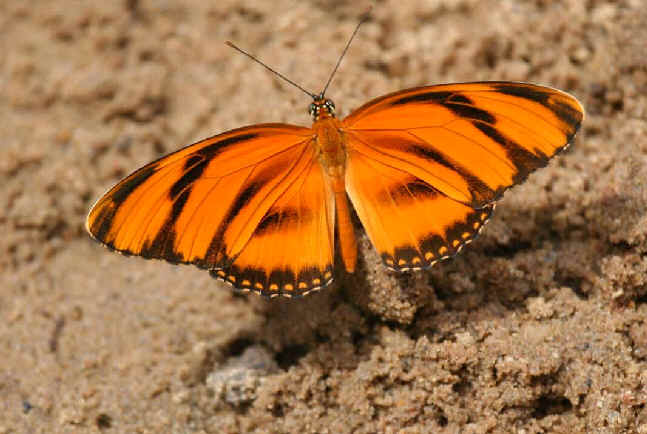
A Banded Longwing, or Banded Orange Heliconian photographed during a FONT
tour in Brazil
Genus DRYAS
Dryas iulia (ph) ______ BRmg(*)
(C:301)
(DA:94) (DV1:31) (F:145) (K:157) (PE:19) (S:159)
Dryas iulia alcionea ______
ARne(*) (MM:342) subspecies
in southeast Brazil and northeast Argentina
JULIA HELICONIAN (or
Julia)
AR common name: Julia
(Range: southern US thru American tropics to Brazil, also West Indies)
Dryas iulia visits open sunny and flowery areas, often wet ground. It
breeds on the passion flower.
Two photos of Julia Heliconians; the lower photo during
a FONT tour in Brazil
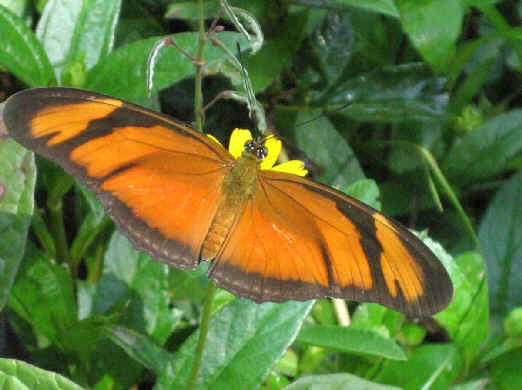
Genus EUEIDES: a genus of about a dozen species that's remarkable for the lack
of conformity of its members. Some resemble DANAIDAE (Ituna), ACRAEIDAE
(Actinote),
ITHOMIIDAE (Mechanitis) and the genus
HELICONIUS.
Eueides aliphera (ph) ______
BRmg
(DA:94) (DV1:31) (S:161)
Eueides aliphera aliphera ______ ARne
BRam BRse (MM:348) subspecies in
much of Brazil and in northeast Argentina
FINE-LINED LONGWING (or
LEAST HELICONIAN. or SMALL JULIA)
AR common name: Pequena Julia (translates to
"Small Julia") (A miniature of Dryas julia,
both in wing shape and the variations of
markings.)
(Range: Mexico to northern Argentina, including Trinidad & Tobago)
As indicated above, Eueides aliphera is a miniature replica of Dryas
iulia, and so is sometimes called the "Juliette".
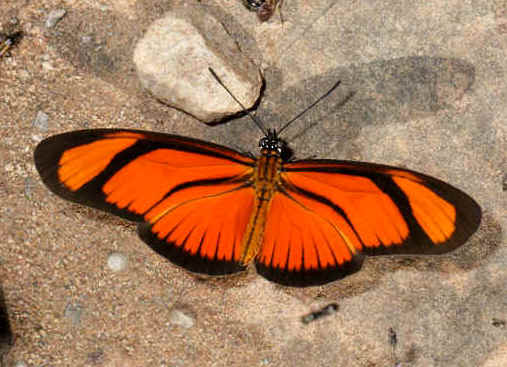
The Fine-lined Longwing, or Small Julia
Eueides isabella (ph) ______
(DV1:31) (K:155) (PE:20) (S:159)
Eueides isabella dianasa ______
ARne BRse (MM:349) (subspecies in
southeast Brazil and northeast Argentina)
ISABELLA'S LONGWING (or
ISABELLA'S HELICONIAN or
Isabella, or Isabella Tiger)
AR common name: Isabel Meridional
(translates to "Southern Isabel")
(Range: Mexico to northern Argentina, also West Indies)
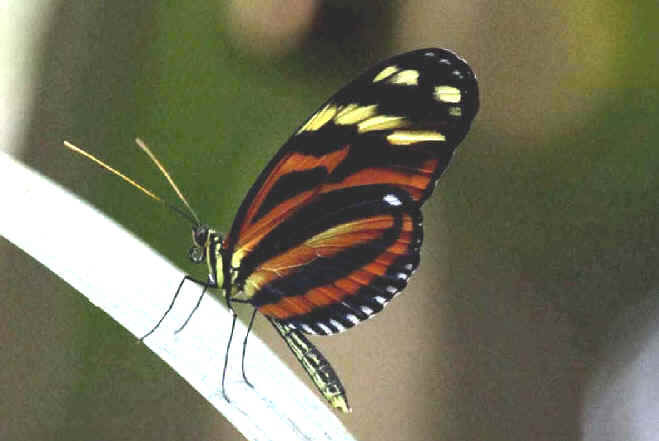
Isabella's Longwing
(photo by Marie Gardner)
Eueides pavana ______ BRse
Eueides vibilia ______ (DV1:31)
Eueides vibilia vibilia ______ BRse
(subspecies in southeast
Brazil)
VIBILIA LONGWING
(Range: Mexico to Brazil)
Genus HELICONIUS: LONGWINGS
Heliconius ricini ______ BRam
(S:163) (species described by
Linnaeus in 1758) (was thought fro a long time to belong in the genus Eueides)
RICINI LONGWING
(Range: the Amazon basin in northern Brazil, and in other nearby
countries)
Heliconius ricini is a relatively small Heliconius with short
antennae. It prefers more open, savanna-type habitats than most Heliconius
species.
Unlike many Heliconius species, H. ricini does not have any
sympatric congeners that closely resemble it, although it does have a
superficial resemblance to the allopatric Heliconius himera
and Heliconius
clysonymus.
Heliconius hecale ______ (DA:100)
(DV1:31)
(F:160)
HECALE LONGWING (also called
HEART-SPOTTED HELICONIAN)
(Range: Mexico to the Guianas,
Amazonas, & the eastern side of the Andes in Bolivia; throughout Central &
South America, with a number of races)
Members of a color/pattern mimicry system with Heliconius hecale
include: Charonias Eurytele (in the PIERIDAE), Dismorpha eunoe
(in the PIERIDAE), Napeogenes peredia (in ITHOMIINI in the NYMPHALIDAE),
Eresia coela (in the NYMPHALIDAE), and a diurnal moth.
Helcale Longwing
Heliconius melpomene ______ (C:307) (DA:101)
(DV1:32)
(F:161) (S:162)
MELPOMENE LONGWING (also
called
POSTMAN HELICONIAN or the
POSTMAN)
(Range: Mexico to Brazil)
Heliconius melpomene is slightly larger than its
close relative & nearly identical butterfly, Heliconius erato. Many species in this genus have
forms matching so closely that they very difficult to distinguish.
Heliconius melpomene flies with Heliconius
erato.
Parallel races of the two species Heliconius melpomene
and Heliconius erato mimic each other throughout the Neotropics, sharing the
same patterns in the same geographic areas.
The length of the yellow ray in the hindwing can be used to differentiate the
two species. It does not reach the edge of the wing in Heliconius melpomene.
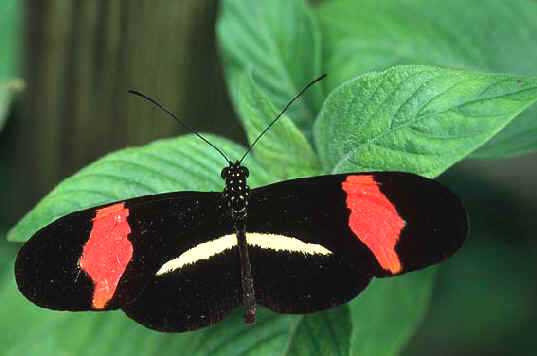
The Postman, or the Melpomene Longwing
Heliconius erato (ph)
______ (DA:103,104) (DV1:32) (F:160) (K:155) (PE:19)
Heliconius erato luscombei ______
BRmg subspecies
in Mato Grosso, Brazil
Heliconius erato phyllis ______
ARne(*) BRse (MM:345)
subspecies in southeast Brazil and northeast Argentina
CRIMSON-PATCHED LONGWING (also
called ERATO HELICONIAN, or the
SMALL POSTMAN)
AR common name: Erato (Erato was, in mythology,
one of the nine
muses;
she presided over erotic poetry.)
a BR common name: Castanha Vermelha
(Range: Mexico to Argentina)
Heliconius erato flies close to the ground, along forest margins and in open
areas. It roosts communally at night.
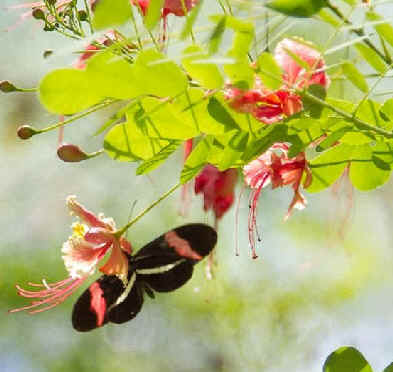
Crimson-patched Longwing
Heliconius charithonia (ph) ______
(C:303) (DA:105)
(DV1:32)
(F:160) (K:155) (PE:19) (S:160) (species described by
Linnaeus in 1767)
ZEBRA LONGWING (also called
ZEBRA HELICONIAN or the
ZEBRA)
(Range: southern US thru Central & South America, also the West Indies)
The Zebra Heliconian is a graceful butterfly is a common sight in gardens and at roadside flowers.
It roosts in small to large clusters, returning to the same roost night after
night. It is very familiar to visitors of butterfly houses as it is easy to
rear.
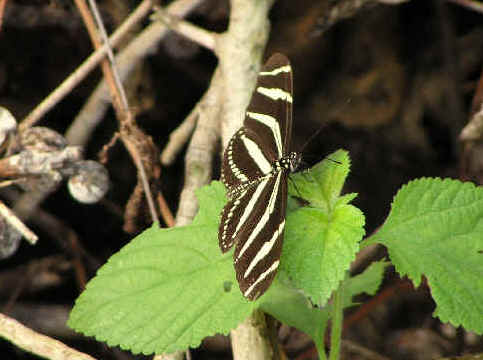
A Zebra Longwing photographed during a FONT tour
(photo by Doug Johnson)
Heliconius besckei ______ ARne
BRse
(MM:346)
TAWNY-STRIPED LONGWING
AR common name: Alemana (translates to
"German") translates to
"German") (in
that the coloring of the butterfly is like the German
flag)
Heliconius ethilla narcaea ______ ARne
BRse
(MM:347) subspecies in
southeast Brazil and northeast Argentina
ETHILIA LONGWING
AR common name: Arcoiris (translates
to
"Rainbow")
BR common name: Maria Boba
Heliconius numata robigus
______ BRse subspecies in southeast
Brazil
Heliconius sara apseudes
______ BRse
subspecies in southeast Brazil
Heliconius wallacei ______ BRmg
subspecies in Mato Grosso, Brazil
WALLACE'S LONGWING (or WALLACE'S HELICONIAN)
Heliconius doris (or now Laparus doris)
(ph) ______ BRmg
DORIS LONGWING (or RAYED HELICONIAN)
Subfamily HELICONIINAE,
Tribe ARGYNNINI: FRITILLARIES
Genus EUPTOIETA
Euptoieta claudia hortensia (ph) ______ ARne
(D1:32) (K:157) (MM:338) (PE:20)
VARIEGATED FRITILLARY
AR common name: Hortensia (the subspecific epithet)
(Range: Canada thru Central & South America, also the West Indies)
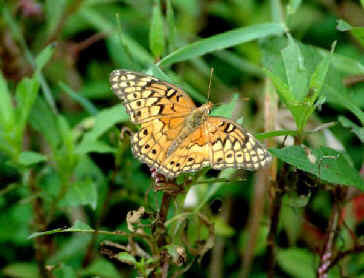
Variegated Fritillary
(photo by Howard Eskin)
Euptoieta hegesia (ph)
______ (DV1:32) (K:157) (PE:29) (PW:23)
Euptoieta hegesia meridiania ______ ARne BRse
(MM:339) (subspecies in southeast Brazil & northeast
Argentina)
MEXICAN FRITILLARY
AR common name: Falsa Hortensia
("False Hortensia") (alluding to its
resemblance to Euptoieta claudia hortensia, with the common name
Hortensia)
Subfamily HELICONIINAE,
Tribe ACRAEINI
Genus ACTINOTE
Actinote surima surima ______ ARne
(MM:350) (subspecies in northeast Argentina)
AR common name: Perezosa Anaranjada
(translates to "Orange Lazy") (name refers to its type of flight)
Actinote thalia pyrrha ______ ARne
BRse (MM:351)
(subspecies in southeast Brazil & northeast Argentina)
AR common name: Perezosa Base Amarilla
(translates to "Yellow Base Lazy") (name refers to its type of flight)
Actinote melanisans ______ ARne
BRse (MM:352)
AR common name: Perezosa Base Translucida
(translates to "Translucent Base Lazy") (name refers to its type of flight)
Actinote pellenea pellenea ______
BRse (subspecies in southeast Brazil)
Actinote pellenea calymma ______ ARne (MM:353)
(subspecies in northeast Argentina)
AR common name: Perezosa
(translates to "Lazy") (name refers to its type of flight)
Actinote mamita elena ______ ARne
(MM:354)
(subspecies in northeast Argentina)
AR common name: Perezosa de Elena
("Elena's Lazy") (name refers to its type of flight)
Actinote
carycina ______ BRse
Actinote conspicua
______ BRse
Actinote dalmeidai
______ BRse (species described in 1996)
Actinote parapheles
______ BRse
Actinote quadra
______ BRse
Actinote quadra
is an endangered species.
Actinote rhodope
______ BRse
There is at
least 1 undescribed species of Actinote in southeast Brazil.
Subfamily DANAINAE: MILKWEED BUTTERFLIES
Genus ITUNA: a single species, distinctive
Ituna ilione lamira ______ (DA:79)
(Range: Central America to northern Argentina)
The Ituna ilione sexes are similar. The semi-transparent wings are similar to
ITHOMIIDS,
but this species has a much greater size. It is often seen
floating effortlessly for long distances, at a uniform height above the
ground, until a shrub with flowers distracts it from its reverie. Then, it
becomes immediately ensconced, oblivious to all else, as it spends long
minutes refreshing itself.
Genus LYCOREA: Remarkable HELICONID
MIMICS. They resemble Heliconius ethilla,
but can be distinguished by their larger size in both sexes, and in the male,
the presence of a tuft of extrusible "hair-pencils" at the tip of
the abdomen.
Lycorea ilione ______ (DV1:33)
Lycorea ilione ilione ______
ARne BRse (MM:415)
(subspecies in southeast Brazil & northeast Argentina)
CLEARWING MIMIC-QUEEN
AR common name: Reina Cristalina
(translates to "Crystalline Queen")
BR common name: Grande Vitral
translates to "Crystalline Queen")
BR common name: Grande Vitral
(Range: Mexico to northern Argentina)
Lycorea halia (formerly cleobaea)
(ph) ______
Lycorea halia cinnamomea ______ BRam
subspecies in Amazonas, Brazil
Lycorea halia transiens ______ BRam
subspecies in Amazonas, Brazil
Lycorea halia pales ______ BRmg
subspecies in part of Brazil, and Peru
Lycorea halia discreta ______ ARne BRse (MM:414) subspecies
in southeast Brazil and northeast Argentina
TIGER MIMIC-QUEEN
AR common name at Iguazu: Halia del Noreste (translates to "Northeastern Halia",
in mythology, Halia was a Nereid.)
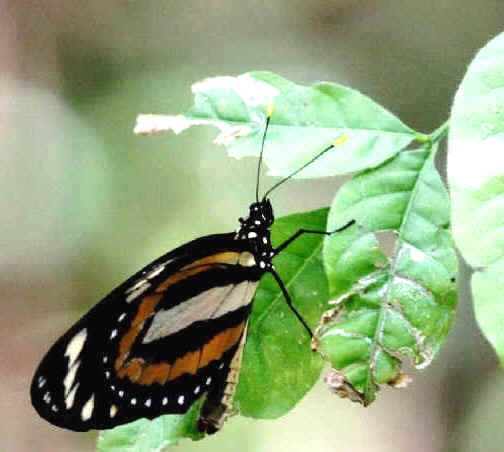
A Tiger Mimic-Queen photographed during a FONT
tour
(photo by Marie Gardner)
Genus DANAUS: ROYALTY
Danaus plexippus (ph) ______
(C:37) (DA:80) (DV1:33) (F:143) (K:227) (PE:27) (S:184)
Danaus plexippus erippus ______ ARne
BRse (MM:416)
subspecies in
southeast Brazil and northeast
Argentina
MONARCH
AR common name: Monarca (Another Spanish
common name is:
Oruga de las Asclepias)
(Another Spanish
common name is:
Oruga de las Asclepias)
(Range: a truly cosmopolitan species, occurring in North
and South America, Australia, and the East Indies.)
The Monarch is a very strong flier with
strong migratory tendencies in temperate regions, but not in the tropics where
it is usually a solitary flier.
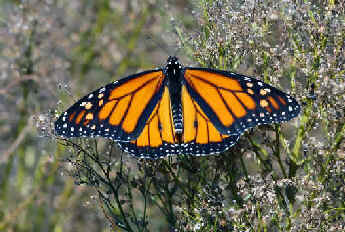
Monarch
(photo by Howard Eskin)
Danaus eresimus plexaure (ph) ______ ARne
(C:283) (DV1:33)
(F:142) (K:229) (MM:417) (PE:27)
subspecies
in northeast Argentina
SOLDIER
AR common name: Emperatriz
(translates to
"Empress")
(Range: southern US to northern Argentina, also in the Antilles)
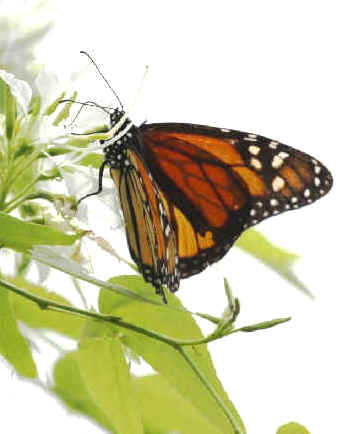
A Soldier photographed during a FONT tour
(photo by Marie Gardner)
Danaus gilippus (ph) ______
(D1:33) (F:143) (K:229) (PE:27) (S:183)
Danaus gilippus gilippus ______ ARne BRse
(MM:418) subspecies
in southeast Brazil and northeast Argentina
QUEEN
AR common name: Reina (translates to "Queen")
(Range: southern US to northern Argentina)
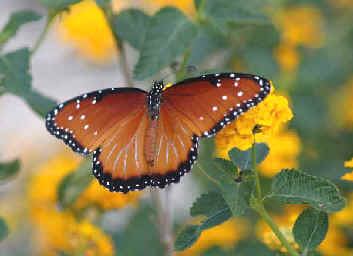
A Queen
(photo by Howard Eskin)
Subfamily ITHOMIINAE
this highly diverse group has been considered as a
separate family, or (now by most) as
a
subfamily of
NYMPHALIDAE.
Genus AERIA
Aeria olena
______ BRse
Genus CALLITHOMIA
Callithmia lenea methonela
______ BRse (subspecies in
southeast Brazil)
Genus TITHOREA: a Neotropical genus of about 15 species
Tithorea tarricina ______ (DV1:34)
(F:207)
CREAM-SPOTTED TIGER-CLEARWING (or
CREAM-SPOTTED TIGERWING)
(Range: Mexico to Brazil)
Tithorea harmonia ______
(C:367) (DV1:34) (S:180)
Tithorea harmonica pseudonyma ______ ARne
(MM:397) (subspecies in northeast Argentina)
HARMONIA TIGER-CLEARWING (also called
Tiger Butterfly,
or the
Tiger)
AR common name: Armoniosa
(Range: Mexico to Brazil)
Genus THYRIDIA: 4 species, 3 of which strongly resemble
species in the genus METHONA. These species are separated from those in
that genus by the presence of white marginal spots on both surfaces of the
hindwing. In METHONA they only occur on the underside. THYRIDA species are
generally larger than METHONA.
Thyridia hippodamia cetoides ______ (DA:85)
(Range: Peru, Brazil)
Thyridia hippodamia can be difficult to separate from
Methonia species.
Thyridia psidii ______ (DV1:34)
Thyridia psidii hippodamia ______ BRse
(subspecies in
southeast Brazil)
Thyridia psidii pallida ______ ARne (MM:401)
(subspecies in northeast Argentina)
AR common name: Palida (translates to
"Pale")
(Range: Mexico to northern Argentina)
Genus MECHANITIS: 8 to 10 species of distinctively
shaped ITHOMIIDS, some of which have extremely long wings and abdomens, making
them look rather like dragonflies.
Mechanitis isthmia ______ (S:180)
COMMON MECHANITIS
Mechanitis isthmia flies in bright sunlight,
attracted to flowers.
Mechanitis lysimnia ______
(DA:85)
(DV1:34)
Mechanitis lysimnia lysimnia ______ ARne
BRse (MM:399) (subspecies in northeast
Argentina & southeast Brazil)
LYSIMNIA TIGERWING
AR common name: Multicolor (translates to
"Multicolored")
translates to
"Multicolored")
(Range: Honduras to northern Argentina)
Mechanitis polymnia
casabranca ______ BRse subspecies in southeast
Brazil
Genus MELINEA
Melinea ethra
______ BRse
Melinea ludovica paraiya
______ BRse (subspecies in
southeast Brazil)
Genus METHONA
Methona themisto
______ BRse
Genus HETEROSAIS
Heterosais edessa
______ BRse
Genus HYPOLERIA
Hypoleria adasa adasa ______ BRse
subspecies in
southeast Brazil
Genus HYPOTHYRIS:
8 to 10 species of CLEARWINGS, with
some species showing delicate combinations of yellows & Orange-browns
especially at the anal angle of the hindwings.
Hypothyris euclea laphria ______
ARne (DV1:34) (MM:406)
(subspecies in northeast
Argentina)
EUCLEA TIGERWING
AR common name: Yvoty (a Guarani word for
"flower")
(Range: Mexico to northern Argentina)
Hypothyris ninonia daeta ______ ARne BRse (MM:407)
subspecies
in southeast Brazil and northeast Argentina
AR common name: Yvoty Moroti
(Guarani words are Yvorty meaning "flower" and Moroti
meaning "white")
Genus ITHOMIA: 40 to 45 species of clear-winged butterflies with the most
beautiful opalescent reflections when viewed in an oblique light.
Ithomia agnosia zikani ______ ARne
BRse (MM:404)
subspecies in
southeast Brazil and northeast Argentina
AR common name: Cristalina Mancha Blanca (translates to
"White-spotted Crystalline")
Ithomia drymo ______ ARne
BRse (MM:405)
AR common name: Cristalina Guion Negro (translates to
"Black Hyphen Crystalline")
Genus DIRCENNA
Dircenna dero ______ (DV1:35)
Dircenna dero rheo ______ BRse (subspecies in southeast
Brazil)
Dircenna dero celtina ______ ARne
(MM:409) (subspecies in northeast Argentina)
DERO CLEARWING
AR common name: Celtina (In
mythology, Celtina had a baby with Hercules called Celto, that gave rise to
the Celts)
(Range: Mexico to Brazil)
Genus EPITYCHES
Epityches eupompe ______ ARne BRse
(MM:403)
AR common name: Filigrana (translates
to "Watermark")
Genus EPISCADA: 15 to 18 species of mostly
clearwinged butterflies, with 1 or 2 with orange-brown and yellow colored
opaque qualities.
Episcada carcinia ______ (DA:89)
(Range: southern Brazil, Argentina, Paraguay, & Uruguay)
Episcada
hymenaea hymenaea ______ ARne BRse (MM:410)
(subspecies in southeast Brazil & northeast
Argentina)
AR common name: Cristalina (translates
to "Crystalline")
Episcada clausina striposis
______ BRse subspecies in southeast
Brazil
Episcada philoclea
______ BRse
Genus GRETA
Greta polissena (ph) ______
(DV1:36)
POLISSENA CLEARWING
(Range: Costa Rica to Brazil)
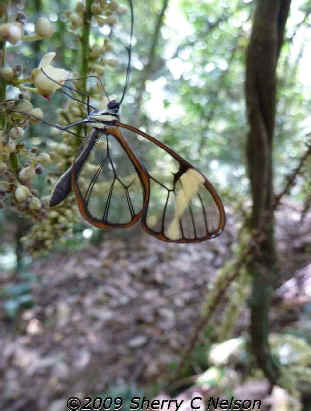
Polissena Clearwing
(photo by Sherry Nelson)
Genus NAPEOGENES
Napeogenes rhezia yanetta ______
BRse subspecies in southeast Brazil
Genus OLERIA
Oleria aquata ______
BRse
Genus PLACIDINA
Placidina euryanassa ______ BRse
Genus PTERONYMIA
Pteronymia euritea ______
BRse
Pteronymia sylvo ______ ARse
BRse (MM:411)
AR common name: Sylvo (referring to the
scientific name)
Genus PSEUDOSCADA
Pseudoscada erruca ______
ARba,ne BRse (BB:321) (MM:412)
AR common name: Cristalina Azulada
("Bluish Crystalline")
Near Buenos Aires, Argentina, Pseudoscada
erruca has been seen flying together with the similar Episcada
hymenaea.
Genus SCADA
Scada karschina karschina ______ BRse
(subspecies in southeast Brazil)
Subfamily MORPHIDAE:
there are about 150 species of this grouping in
tropical Central & South America
Genus MORPHO: about 80 showy species. These Central & South American species
have always drawn much attention,
as the large, obvious males are a very bright metallic blue.
Morpho achilles ______ BRam
BRmg
Morpho achilles achilles (ph) (*) ______ ARne
BRse(*)
(MM:355) subspecies in northeast
Argentina and southern Brazil
ACHILLES MORPHO (also called
Blue-banded Morpho, or
Banded Blue Morpho)
AR common name: Pora
(this name is a Guarani word meaning "beautiful".)
BR common name: Capitao do mato
(Range: in nearly all of Neotropical South America)
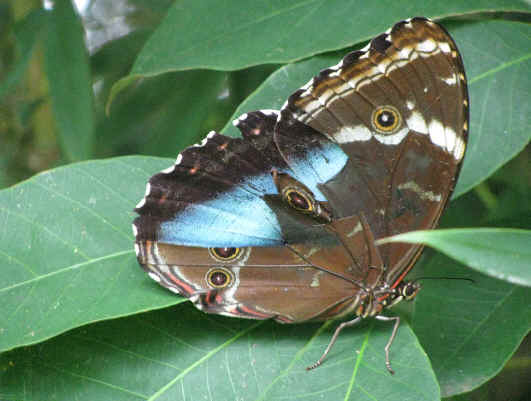
Morpho achilles, photographed during the FONT tour in
Brazil in March 2009.
(photo by Patricia Yoder)
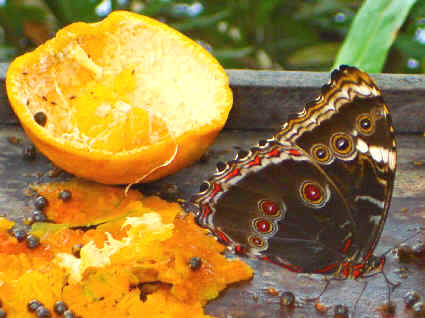
Another photo of Morpho achilles, taken during the FONT tour in southeast
Brazil in August 2009.
This time with a mango on which it had been feasting.
Morpho aega aega ______ ARne(*)
BRse
(MM:356)
subspecies in northeast Argentina
AEGA MORPHO (another name is
BLUE SILK)
AR common name: Vera
BR common names: Seda Azul, Corcovado, Telao de Seda,
Azulao
(Range: in Brazil, Argentina, and Paraguay)
Morpho epistrophus epistrophus
______ BRse
subspecies in southeast Brazil
Morpho epistrophus argentina ______ ARne
(MM:357) subspecies in northeast
Argentina
EPISTROPHUS WHITE MORPHO
AR common name: Moroti (this
name: is a Guarani word meaning "white".)
Morpho helenor (ph) ______
Morpho helenor achillaena ______ BRse
subspecies in
southeast Brazil
Morpho helenor violacea (ph) (*) ______
BRse subspecies in southern Brazil
COMMON MORPHO (also
called HELENOR MORPHO)
(Range: Mexico to southern Brazil)
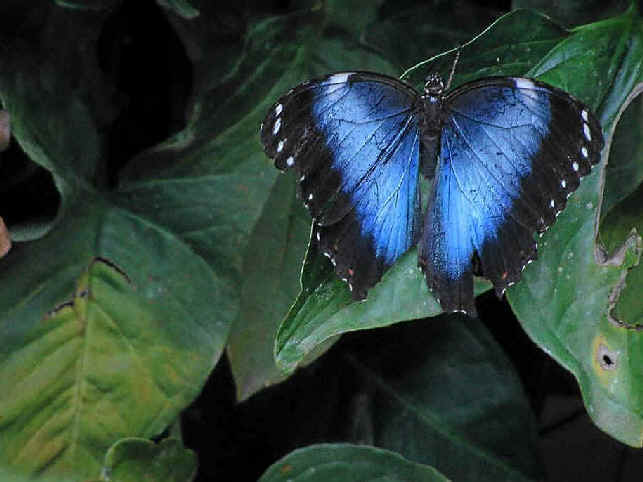
A Helenor, or
Common Morpho photographed during a
FONT tour in Brazil in May 2011
(photo by Patricia Yoder)
Morpho cisseis ______ BRmg
CISSEIS MORPHO
Morpho deidamia ______ BRmg
DEIDAMIA MORPHO
Morpho telemachus ______ BRmg
TELEMACHUS MORPHO
Morpho anaxiba
______ BRse
Morpho athena
______ BRse (species described in 1966)
Morpho hercules
______ BRse
Morpho menelaus ______ BRmg
Morpho menelaus coeruleus
______ BRse subspecies in southeast
Brazil
MENELAUS MORPHO
Morpho portis portis
______ BRe subspecies in southeast
Brazil
Genus ANTIRRHEA
Antirrhea archaea
______ BRse
Genus BLEPOLENIS
Blepolenis batea batea
______ BRse
subspecies in southeast Brazil
Subfamily BRASSOLIDAE
Genus BRASSOLIS (this genus & others that follow
here: "The OWLS")
Brassolis astyra astyra
______ BRse subspecies in southeast
Brazil
Brassolis sophorae vulpeculus
______ ARne (MM:360)
subspecies in northeast Argentina
AR common name: Zorra ("Fox",
derived from the scientific name
of the subspecies, vulpeculus)
BR common name: Borboleta do Coqueiro
Genus DYNASTOR: 3 magnificent species
Dynastor darius stygianus ______
(DV1:41) subspecies from Guatemala to Ecuador
Dynastor darius ictericus ______ ARne
(MM:361) subspecies in northeast
Argentina
DARING OWL-BUTTERFLY
AR common name: Dario (derived from the scientific name,
darius)
(Range: Mexico to the Amazon Basin)
Genus DASYOPHTHALMA: 3 species in central &
southern Brazil
Dasyophthalma creusa creusa ______
BRse
(DA:140) subspecies in southeast Brazil
(Range: central and southern Brazil, maybe adjacent Paraguay)
Dasyopthhalma creusa can only be encountered in the first few months of the year, in
the deepest forest. It is one of the most commonly taken butterflies on baits.
Moth collectors have reported it coming to bait even at night.
Dasyophthalma
delanira ______ BRse
Dasyophthalma delanira is an endangered species.
Dasyophthalma rusina
principesa ______ BRse
subspecies in southeast Brazil
Genus NAROPE
Narope cyllene ______ ARne
(MM:358)
AR common name: Cilenia (the
Cilenos, in mythology, were the inhabitants of Mount Cilene.)
Narope
cyllastros ______ BRse
Genus OPOPTERA
Opoptera syme
______ BRse
Genus OPSIPHANES: 13 species, all with stout bodies, and thick scaled wings.
Occur from Mexico to Paraguay (& in Trinidad). The male wingshape
reminiscent of the Afrotropical CHARAXES. The behavior is much like that of
other BRASSOLIDS. Most of the species in this genus strongly resemble each
other. Most of these species are not common.
Opsiphanes invirae ______ (DV1:42)
Opisphanes invirae pseudophilon ______ BRse
subspecies in
southeast Brazil
Opsiphanes invirae amplificatus ______ ARne
(MM:359)
subspecies in northeast Argentina
LOWLAND OWL-BUTTERFLY
AR common name: Fantasma (translates to
"Ghost")
(Range: Honduras to northern Argentina)
Opsiphanes cassiae crameri
______ BRse
subspecies in southeast Brazil
Opisiphanes quitera
meridionalis ______ BRse
subspecies in southeast Brazil
Genus CATOBLEPIA
Catoblepia berecynthia
______ BRmg
BERECYNTHIA OWLET
Catoblepia soranus
______ BRmg
SORANUS OWLET
Catoblepia amphirhoe ______
ARne BRse (MM:363)
AR common name: Fantasma Grande (translates
to "Big Ghost")
Genus ERYPHANIS: 6 species with "owl eyes" in Central & South America. Breeds on
bamboo.
Eryphanis reevesii ______ ARne
(MM:366)
Eryphanis reevesii reevesii ______ BRse
subspecies in
southeast Brazil
AR common name: Sombra Azul (translates to "Blue Shadow")
Eryphanis
automedom amphimedom ______ BRse
subspecies in southeast Brazil
Genus CALIGO: 20 to 30 species of among the
largest and most striking butterflies in the world. The species in this genus
can usually be distinguished from each other by the pattern and coloration of
the upper wings
Butterflies in the genus CALIGO avoid bright sunlight. They often fly
in the late afternoon and at dusk. They are attracted to fermenting
fruit.
Caligo eurilochus ______ BRam
BRmg
FOREST GIANT-OWL (or EURILOCHUS OWL-BUTTERFLY)
(Range: from Mexico to Brazil)
Caligo brasiliensis (ph)
______ BRse
Caligo brasiliensis brasiliensis ______ ARne
(DA:1430 (DV1:45) (MM:367)
subspecies in Brazil
BRAZILIAN OWL (or
ALMOND-EYED OWL)
AR common name: Lechucita de Brazil ("Brazilian Little
Owl")
(Range: Guatemala to northern Argentina)
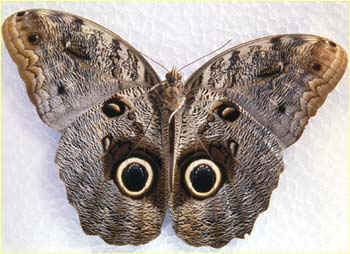
An Owl Butterfly in Brazil
Caligo illioneus ______ (DA:text)
(DV1:46)
Caligo illioneus illioneus ______ BRse
subspecies in
southeast Brazil
Caligo illioneus pampeiro ______ ARne (MM:368)
subspecies in
northeast Argentina
DUSKY OWL-BUTTERFLY
AR common name: Lechucita (translates to
"Little Owl")
(Range: Costa Rica to northern Argentina)
Caligo arisbe fulgens
______ BRse subspecies in southeast
Brazil
Subfamily
SATYRINAE: SATYRS
a large group represented strongly
in Central and
South America
Genus AMPHIDECTA
Amphidecta calliomma
______ BRmg
CALLIOMMA SATYR
Genus ARCHEUPTYCHIA
genus created in 1964
Archeuptychia cluena
______ BRse
Genus CAPRONNIERIA
genus created in 1964
Capronnieria galesus
______ BRse
Genus CHLOREUPTYCHIA
genus created in 1964
Chloreuptychia arnaca
______ BRse
Genus ETEONA
Eteona tisiphone
______ BRse
Genus EUPTYCHIA
Euptychia mollina
______ BRse
Genus FORSTERINARIA
genus created in 1973
Forsterinaria necys
______ BRse
Forsterinaria quantius
______ BRse
Forsterinaria stelligera
______ BRse
Genus GODARTIANA
genus created in 1964
Godartiana byses
______ BRse
Genus HAETERA
Haetera piera
______ BRmg
PIERA SATYR
Genus HERMEUPTYCHIA
Hermeuptychia hermes ______ ARne
BRse (D1:41: Cissia hermes)
(MM:385)
HERMES SATYR
AR common name: Hermes
The Hermes Satyr is closely related to the Carolina Satyr, of
North America, Hermeuptychia sosybius (K:231)
(PE:28)
Genus MAGNEUPTYCHIA (genus created in 1964)
Magneuptychia libye
______ BRse (species described by Linnaeus in 1767, in a different
genus)
Genus MANATARIA
Manataria maculata ______ (D1:47)
WHITE-SPOTTED SATYR
(Range: Mexico to Brazil)
Manataria hercyna hercyna ______ ARne
(MM:369)
subspecies
in northeast Argentina
AR common name: Franja Crema (translates to
"Cream Band")
Genus MONEUPTYCHIA genus created in 1964
Moneupychia griseldis
______ BRse
Moneupychia paeon
______ BRse
Moneupychia soter
______ BRse
Genus PARYPHTHIMOIDES genus created in 1964
Paryphthimoides undulata ______
BRmg
UNDULATA SATYR
Paryphthimoides phronius
______ BRse
Paryphthimoides poltys
______ BRse
Genus PHARNEUPYTCHIA
genus created in 1964
Pharneupytchia innocentia
______ BRse
Genus PIERELLA
Pierella lamia ______
BRmg
Pierella lamia lamia
______ BRse
subspecies in southeast Brazil
LAMIA SATYR
Pierella nereis
______ BRse
Genus PRAEPEDALIODES genus created in 1964
Praepedaliodes phanias
______ BRse
Genus SPLENDEUPTYCHIA genus created in 1964
Splendeuptychia ambra
______ BRse
Splendeuptychia doxes
______ BRse
Splendeuptychia hygina
______ BRse
A yet undescribed species of
Splendeuptychia has been found in southeast
Brazil.
Genus TAYGETIS: About 25 species of browns in Central
and South America.
With brown or gray upperparts, and with false eyes on the underside. Mostly,
they prefer shaded rainforest understory.
Taygetis mermeria ______ (D1:47)
GREAT SATYR
(Range: Mexico to Bolivia & Brazil)
Taygetis virgilia ______ BRse
(D1:47)
STUB-TAILED SATYR
(Range: Mexico to Brazil)
Taygetis celia ______ (D1:47)
(Range: Nicaragua to Bolivia & Brazil)
Taygetis kerea ______ (D1:47)
(Range: Guatemala to Paraguay)
Taygetis andromeda ______ (D1:48)
(Range: Mexico thru Central and South America)
Taygetis cleopatra ______ BRmg
CLEOPATRA SATYR
Taygetis sylvia ______ ARne
(MM:370)
SYLVIA'S SATYR
AR common name: Silvia
(referring to the
scientific name, sylvia)
Taygetis rufomarginata ______ ARne
(MM:371)
RUSTY-MARGINED SATYR
AR common name: Rojiza (translates to "Reddish")
(translates to "Reddish")
Taygetis acuta ______ ARne
(MM:372)
AR common name: Puntiguda (translates to "Pointed")
Taygetis ypthima ______ ARne
BRse (MM:373)
AR common name: Ganchuda
(translates to "Hook-shaped")
Taygetis laches marginata ______ ARne
BRse
(MM:374) (subspecies
in southeast Brazil & northeast Argentina)
AR common name: Andromeda (refers
to an erroneously applied scientific name)
Taygetis sosis
______ BRse
Genus POSTTAYGETIS
Posttaygetis penelea ______ BRmg
YELLOW-SPIKED SATYR
Genus CISSIA: butterflies in this genus were formerly all placed in
EUPTYCHIA
Cissia palladia ______ (D1:48)
PALLADIA SATYR (or
BUTLER'S SATYR)
(Range: Nicaragua to Brazil, also Trinidad)
Cissia terrestris ______ BRmg
CRYPTIC SATYR
Cissia thobiei ______ ARne
(MM:392)
(may be a subspecies of
Cissia myncea)
AR common name: Cisea
Genus PAREUPTYCHIA genus created in 1964
Pareuptychia (formerly Cissia)
metaleuca ______
(D1:48)
ONE-BANDED SATYR
(Range: Mexico to Brazil)
Pareuptychia ocirrhow interjecta
______ BRse subspecies in southeast Brazil, described in
1952
Genus YPHTHIMOIDES genus created in 1964
Yphthimoides borasta ______ BRse
Yphthimoides maepius maepius
______ BRse subspecies in southeast
Brazil
Genus ZISCHKAIA genus created in 1964
Zischkaia pronophila ______ BRse
Family HESPERIIDAE:
SKIPPERS
A very large family (3,000 species throughout the world) of stout-bodied
short-winged butterflies that resemble day-flying moths. The adult butterfly's
flight resembles a 'skipping' motion when going from flower to flower. Their
forewings are closed above their back when they are settled.
Subfamily EUDAMINAE
Genus PHOCIDES
Phocides pigmalion ______
(K:267)
(PE:30)
Phocides pigmalion hewitsonius ______ ARne
BRse (MM:37) subspecies in
southeast Brazil and northeast Argentina
MANGROVE SKIPPER
AR common name: Saltain de Hewitson ("Hewitson's
Skipper")
(Range: Mexico to Argentina, also Florida & West Indies)
Phocides palemon
(formerly
polybius)
______
(C:253) (K:267) (PE:30) (S:42)
GUAVA SKIPPER
Phocides palemon has a striking plumage. It feeds on Guava and
related species.
Phocides pialia pialia ______ BRse
(subspecies in southeast Brazil)
Phocides pialia maximus ______ BRse
(subspecies in southeast
Brazil)
Phocides charon ______ ARne
(MM:38)
AR common name: Charon
Phocides polybius polybias ______
BRse (subspecies in southeast Brazil)
Phocides polybius phanius ______ ARne
(MM:39)
(subspecies in northeast Argentina)
AR common name: Phanias
Genus PHANUS
Phanus australis ______ BRse
(species described in 1965)
Phanus vitreus ______ ARne
BRse
(MM:40)
AR common name: Vitrea
Genus POLYTHRIX
Polythrix octomaculata ______
(K:271) (PE:30)
Polythrix octomaculata octomaculata ______
ARne (MM:47) (subspecies
in northeast Argentina)
EIGHT-SPOTTED LONGTAIL
(or
Polythrix)
AR common name: Tuju (a Guarani
word, referring to the brown coloration of the butterfly, allowing it to be
camouflaged when it rests on mud)
(Range: Mexico to Argentina, also Haiti)
Polythrix
caunus ______ BRse
Genus PROTEIDES
Proteides mercurius (ph)
______ BRse (K:273) (PE:30)
Proteides mercurius mercurius ______
ARne (MM:41)
subspecies in northeast Argentina
MERCURIAL SKIPPER
AR common name: Mercurio
(Range: Mexico to Argentina, and West Indies. Strays north to the southern US.)
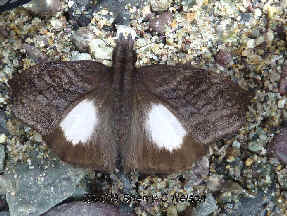
Mercurial Skipper
(photo by Sherry Nelson)
Genus EPARGYREUS
Epargyreus socus socus ______
BRse subspecies in southeast Brazil
Epargyreus clavicornis clavicornis
______ ARne (MM:42)
subspecies in northeast Argentina
SMALL-SPOTTED SILVERDROP
AR common name: Saltarin Coloso (translates to
"Colossus
Skipper")
Epargyreus edxadeus ______ (K:273)
(PE:text)
BROKEN SILVERDROP (or
Exadeus Skipper)
(Range: Mexico to Argentina)
Genus POLYGONUS
Polygonus leo ______
(K:267)
(PE:30)
Polygonus leo leo ______
ARne BRse (MM:43)
subspecies in southeast Brazil and northeast Argentina
HAMMOCK SKIPPER
AR common name: Leo
(Range: Mexico to Argentina, also Florida and the West Indies)
Polygonus manueli manueli ______ ARne
(MM:44) (PE:text) subspecies
in northeast Argentina
MANUEL'S SKIPPER
AR common name: Manuel
(Range: Mexico to Argentina, and West Indies)
Polygonus savigny savigny
______ BRse
subspecies in southeast Brazil
Genus CHIOIDES
Chioides catillus ______ (C:377) (K:271)
(PE:30)
Chioides catillus catillus ______ BRse
subspecies in
southeast Brazil
WHITE-STRIPED LONGTAIL
(Range: south Texas to Argentina, and West Indies, in Jamaica)
Genus AGUNA
Aguna asander ______
(K:273)
(PE:30)
Aguna asander asander ______ ARne BRse
(MM:45) subspecies in
southeast Brazil and northeast Argentina
GOLD-SPOTTED AGUNA
AR common name: Asander
(Range: Mexico to Argentina, and West Indies)
Aguna metophis ______
(K:273) (PE:30)
TAILED AGUNA
(Range: Mexico to southern Brazil)
Aguna williamsi ______
ARne (MM:46)
WILLIAM'S LONGTAIL
AR common name: Coludo de Williams
Genus ANASTRUS
Anastrus ulpianus ______ BRse
Genus TYPHEDANUS
Typhedanus undulatus ______ BRse
(K:271)
(PE:30)
MOTTLED LONGTAIL
(Range: Mexico to Argentina)
Genus CODATRACTUS
Codatractus aminias ______ ARne
(MM:48)
AR common name: Jetapa
(a Guarrani word,
meaning "scissors", referring to the tails)
Genus URBANUS: LONG-TAILED SKIPPERS
Urbanus proteus (ph)
______ BRmg (K:269) (PE:30) (S:36)
(species described by Linnaeus
in 1758)
Urbanus proteus proteus ______ ARne
BRse (MM:49) subspecies in
southeast Brazil and northeast Argentina
(COMMON) LONG-TAILED SKIPPER
AR common name: Coludo Verdoso (translates to
"greenish-tailed")
(Range: south Texas to Argentina, also Florida & West Indies)
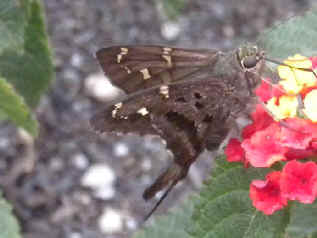
Above & below: the Common Long-tailed Skipper.
The lower photo is the nominate subspecies, Urbanus proteus proteus
(upper photo by Rise Hill; lower photo by Jorge Bizarro)
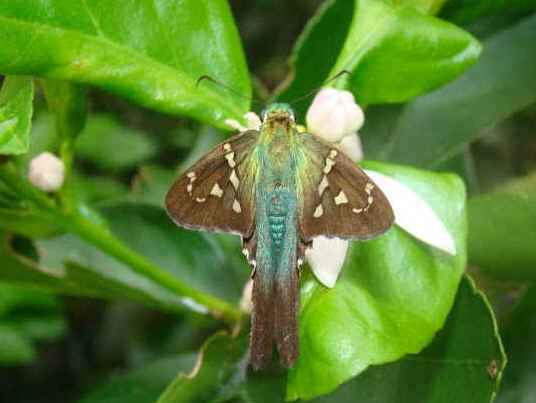
Urbanus pronus ______ (PE:text)
PRONUS LONGTAIL
(Range: Mexico to southern Brazil)
Urbanus esmeraldus ______ ARne
BRse
(MM:50) (PE:text)
ESMERALDA LONGTAIL
AR common name: Coludo Esmeralda (translates to
"Emerald Longtail")
(Range: Mexico to southern Brazil)
Urbanus dorantes (ph) ______
(K:269) (PE:30)
Urbanus dorantes dorantes ______ ARne
BRse (MM:51) subspecies in southeast
Brazil and northeast Argentina
DORANTES LONGTAIL (or
Skipper)
AR common name: Coludo Manchas Doradas (translates to "Lilac-banded Longtail")
(Range: south Texas to Argentina, also Florida & West Indies)
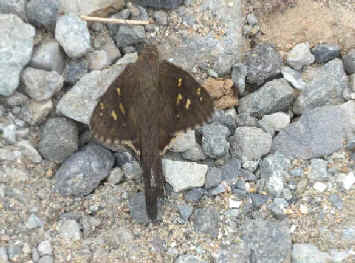
A Dorantes Longtail photographed during a FONT
tour
(photo by Rise Hill)
Urbanus teleus (ph) ______ ARne
BRse (K:269) (MM:53) (PE:30)
TELEUS LONGTAIL
AR common name: Coludo Linea Blanca (referring
to the white line on the forewings)
(Range: south Texas to Argentina)
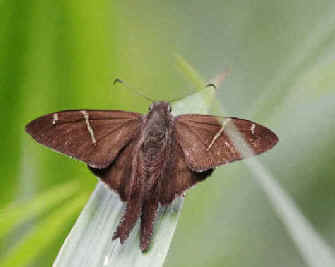
A Teleus Longtail photographed during a FONT
tour
(photo by Marie Gardner)
Urbanus simplicius (ph) ______ ARne
BRse
(MM:52) (PE:text)
PLAIN LONGTAIL
AR common name: Coludo Simple (translates
to
"Simple
Longtail")
(Range: Mexico to Argentina)
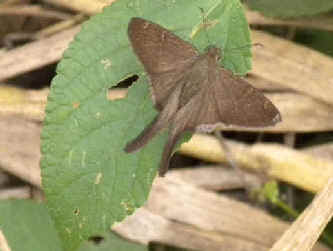
A Plain Longtail photographed during a FONT tour
(photo by Rise Hill)
Urbanus procne ______ BRse
(K:269)
(PE:30)
BROWN LONGTAIL
(Range: south Texas to Argentina, strays elsewhere in the southwest US)
Urbanus doryssus albicuspis ______ ARne
BRse (MM:54) (PE:30) subspecies in
southeast Brazil and northeast Argentina
WHITE-TAILED SKIPPER
AR common name: Punta Blancas (translates to
"White
Tips")
(Range: Mexico to Argentina)
Urbanus tanna ______ BRmg
TANNA LONGTAIL
Urbanus belli
______ BRse
Urbanus esta ______ BRse (species described in 1952)
Genus ASTRAPTES: FLASHERS
Astraptes fulgerator (ph)
______ (K:279) (PE:30)
Astraptes fulgerator fulgerator ______
ARne BRse (MM:55) subspecies
in southeast Brazil and northeast Argentina
TWO-BARRED FLASHER (or
Flashing Astraptes)
AR common name: Relampagueante
(meaning "he who throws out light",
referring to the bright blue
coloration)
(Range: south Texas to Argentina)
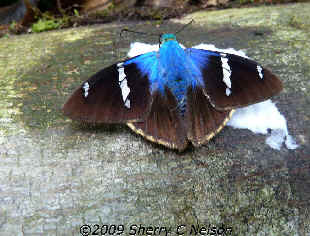
The Two-barred Flasher, Astraptes fulgerator
(photo by Sherry Nelson)
Astraptes alardus ______
(K:279) (PE:text)
Astraptes alardus alardus ______ BRse
subspecies in
southeast Brazil
FROSTED
(or
WHITE)
FLASHER
(Range: Mexico to Argentina, also Cuba, rarely north to southern Texas)
Astraptes anaphus ______ (K:279) (PE:text)
Astraptes anaphus anaphus ______ ARne
BRse (MM:59)
subspecies in southeast
Brazil and northeast Argentina
YELLOW-TIPPED
(or
YELLOW)
FLASHER
AR common name: Cola Amarilla (translates to
"Yellow
Tail")
(Range: Mexico to Argentina, rarely north to southern Texas)
Astraptes naxus ______
BRse
Astraptes talus ______ BRse
Astraptes fulviluna ______ ARne
(MM:56)
AR common name: Brillante (translates to "Flashy")
Astraptes creteus siges ______ ARne
BRse (MM:57) subspecies in
southeast Brazil and northeast Argentina
WHITENED FLASHER
AR common name: Mancha de Tiza (translates to "Chalk
Spot")
Astraptes elorus ______
ARne BRse (MM:58)
AR common name: Elorus
Genus AUTOCHTON
Autochton bipunctatus
______ BRse
Autochton longipennis
______ BRse
Autochton neis
______ BRse
Autochton reflexus
______ BRse
Autochton sulfureolus
______ BRse
Autochton zarex
______ ARne BRse (MM:60)
SHARP BANDED-SKIPPER
AR common name: Saltarin Franja Blanca
(translates
to "White-banded Skipper")
Genus SARMIENTOLA
Sarmientoia haywardi
______ ARne (MM:61)
(species described in 1967)
AR common name: Dormilona Zigzag (translates to "Zigzag Sleepyhead")
Sarmientola phaselis ______ BRse
Genus NASCUS
Nascus phocus
______ ARne BRse (MM:62)
AR common name: Foco (from the scientific name)
Genus BUNGALOTIS
Bungalotis astylos ______ BRse
Bungalotis midax ______ BRse
Genus CELAENORRHINUS
Calaenorrhinus similis ______ BRse
Calaenorrhinus similis similis ______ ARne
(MM:63) (subspecies in northeast
Argentina)
AR common name: Terca (meaning "obstinate",
referring to the "obstinate habit" of always resting in
the same places that are used to sunbathe)
Genus TELEMIADES: the FLATS
Telemiades laogonus laogonus
______ ARne (MM:64)
(subspecies in northeast Argentina)
AR common name: Laogono (from the scientific name)
Telemiades amphion marpesus
______ ARne (MM:65)
(subspecies in northeast Argentina)
AR common name: Anfion
Genus DYSCOPHELLUS
Dyscophellus euribates ______
(PE:text)
EURIBATES SKIPPER
(Range: Costa Rica to Brazil, rarely north to Texas)
Dyscophellus ramusis damias
______ BRse
Genus SPATHILEPIA
Spathilepia clonius ______ BRse
(K:277)
(PE:31)
FALCATE SKIPPER
(Range: south Texas & Mexico to Argentina)
Genus COGIA
Cogia calchas ______ BRse
BRmg (K:265)
(PE:31)
MIMOSA (or
CALCHAS)
SKIPPER
(Range: south Texas to Argentina)
Cogia hippalus______ (K:259)
(PE: text)
ACACIA SKIPPER
(Range: southwest US to Brazil)
Genus RIDENS
Ridens fulima ______ BRse
Genus SALATIS
Salatis salatis ______ BRse
Subfamily
PYRGINAE
Genus PYRRHOPYGE
Pyrrhopyge thericles rileyi
______ BRse subspecies in southeast
Brazil
Pyrrhopyge charybdis charybdis
_____ ARne (MM:32)
subspecies
in northeast Argentina
AR common
name: Diablito (translates to "Little Devil")
BR common name: Diabinho
Pyrrhopyge pelota
______ ARne (MM:33)
AR common name: Monsenor (translates to "Monsignor")
Genus SARBIA
Sarbia damippe ______ BRse
DAMIPPE FIRETIP
Sarbia xanthippe spixii ______ BRse
XANTHIPPE FIRETIP
Genus JEMADIA
Jemadia fallax
______ BRmg
FALLAX SKIPPER
Jemadia gnetus
______ BRmg
GNETUS SKIPPER
Jemadia hewitsonii
(ph) ______ BRmg
HEWITSON'S SKIPPER (or HEWITSON'S SABRE-WING)
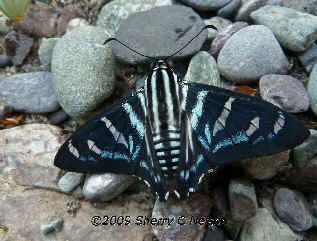
the Hewitson's
Skipper (photo
by Sherry Nelson)
Jemadia hospita
______ BRmg
HOSPITA SKIPPER
Genus ELBELLA
genus created in 1951
Elbella intersecta losca ______ BRse
subspecies in
southeast Brazil
Genus MIMONIADES
Mimoniades montana
______ BRse
Mimoniades ocyalus
______ BRse
Mimoniades versicolor
versicolor ______ BRse
Genus MYSORIA
Mysoria sejanus
______ BRmg
BLACK-VEINED FIRETIP
Mysoria barcastus barta
______ ARne (MM:34)
subspecies in northeast Argentina
AR common name: Obispo (translates to
"Bishop")
Genus MYSCELUS
Myscelus epimachia epimachia (ph)
______ BRse
EPIMACHIA GLORY
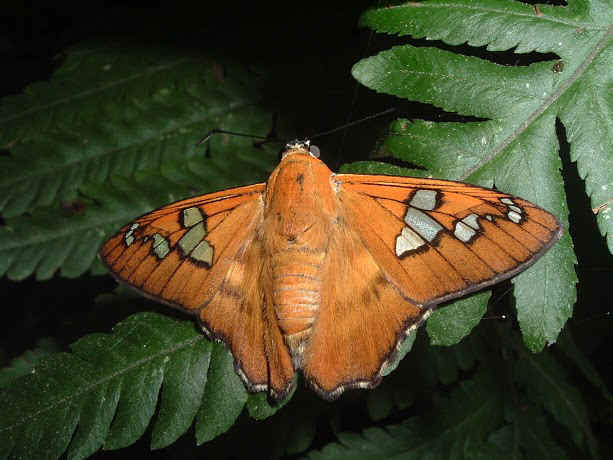
The Epimachia Glory, or Myscelus epimachia
(photo by Jorge Bizarro)
Myscelus santhilarius
______ BRse
Myscelus amystis epigona
______ ARne (MM:35)
subspecies in northeast Argentina
AR common name: Epigono
BR common name: Leque (translates to "Fan")
Genus GRANILLA
Granilla paseas paseas ______
ARne (MM:36)
subspecies
in northeast Argentina
AR common name:
Paseas
Genus POLYCTOR
Polyctor polyctor polyctor (ph)
______ BRse
subspecies in
southeast Brazil
POLYCTOR
TUFTED SKIPPER
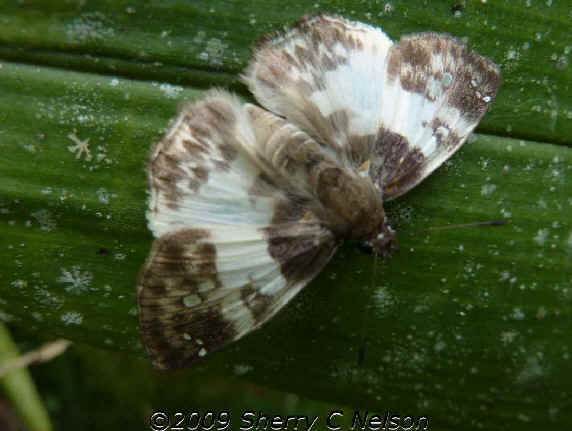
The Polyctor Tufted Skipper. Polyctor polyctor
(photo by Sherry Nelson)
Genus CYCLOGLYPHA
Cycloglypha enega ______ BRse
Cycloglypha thrasibulus thrasibulus
______ BRse subspecies in
southeast Brazil
Cycloglypha tisias ______ BRse
Genus DIACUS
Diacus lacaena ______ BRse
Genus NISONIADES
Nisoniades rubescens ______ (K:275)
(PE:text)
PURPLISH-TUFTED SKIPPER (or
Purplish-black Skipper)
(Range: northern Mexico to Brazil)
Nisoniades bipuncta ______
BRse
Nisoniades macarius ______
ARne (MM:66)
MACARIUS TUFTED-SKIPPER
AR common name: Macario
Genus NARCOSIUS
Narcosius colossus granadensis
______ BRse subspecies in
southeast Brazil
Genus NOCTUANA
Noctuana diurna ______ BRse
Genus OECHYDRUS
Oechydrus chersis evelinda ______
BRse
subspecies in southeast Brazil
Genus PACHYNEURIA
Pachyneuria inops ______ BRse
Genus PELLICIA
Pellicia dimidiata ______
(PE:text)
MORNING GLORY TUFTED-SKIPPER
(or
MORNING GLORY PELLICIA)
(Range: north Mexico to Argentina)
Pellicia costimacula costimacula
______ BRse subspecies in southeast
Brazil
Pellicia vecina ______ BRmg
Pellicia vecina vecina ______ ARne (MM:67)
subspecies in northeast Argentina
VECINA TUFTED-SKIPPER
AR common name: Vecina
Genus VIOLA
Viola violella ______ ARne
BRse (MM:68)
AR common name: Manchadita (translates to "Little Spotted")
Genus BOLLA
Bolla catharina ______ BRse
Bolla atahualpai ______ ARne
(MM:69)
ATAHUALPAI SOOTYWING
AR common name: Atahualpa
(Range: Panama to Argentina)
Genus SOSTRATA
Sostrata bifasciata bifasciata ______
ARne BRse (MM:81) (PE:text)
subspecies in southeast Brazil and northeast Argentina
METAL-STUDDED SKIPPER (another names is
BLUE-STUDDED SKIPPER)
AR common name: Saltarin Lavanda (translates to
"Lavander
Skipper")
(Range: Mexico to Argentina, rare stray to far-southern Texas)
Genus STAPHYLUS
Staphylus ascalon ______ ARne
(MM:70)
AR common name: Ascalonita
Staphylus melaina ______ ARne
(MM:71)
AR common name: Oscura (translates to "Dark")
Staphylus incisus ______ ARne
BRse
(MM:72)
AR common name: Saltarin Ocraceo (translates to "Ochraceus
Skipper")
Genus THEAGENES
Theagenes dichrous ______ BRse
Genus TRINA
Trina geometrina geometrina
______ ARne BRse (MM:73)
subspecies in northeast Argentina
AR common name: Geometrica (translates to "Geometrical")
Genus GORGOPAS
Gorgopas petale ______ BRse
Genus GORGYTHION
Gorgythion begga begga ______ ARne
BRse
(K:275) (MM:74) (PE:text)
subspecies in northeast Argentina
VARIEGATED
(or
BEGGA)
SKIPPER
AR common name: Beggina
(Range: Mexico to Argentina, strays to far-southern Texas)
Gorgythion beggina escalophoides
______ ARne (MM:75)
subspecies in northeast Argentina
BEGGINA SKIPPER
AR common name: Beggina
Genus OULEUS
Ouleus fridericus riona ______ ARne
BRse
(MM:76) subspecies in northeast Argentina
AR common name: Kamba
(a Guarani word meaning "a dark-skinned
person")
Genus ZERA
Zera zera zera
______ BRse subspecies in southeast
Brazil
Zera tetrastigma erisichthon
______ BRse subspecies in southeast
Brazil
Zera hyacinthinus servius ______ ARne
(MM:77) subspecies in northeast Argentina
BRUISED SKIPPER
AR common name: Jacinto
Genus QUADRUS
Quadrus cerialis ______ ARne
BRse (MM:78)
COMMON BLUE-SKIPPER
AR common name: Saltarin de Ceres ("Ceres'
Skipper")
Genus PYRDALUS
Pyrdalus corbulo corbulo ______
BRse subspecies in southeast Brazil
Genus PYTHONIDES
Pythonides jovianus fabricii
______ BRse
Pythonides lancea ______ ARne
BRse
(MM:79)
AR common name: Lanza (translates to "Lance")
Genus MILANION
Milanion leucaspis ______ ARne
BRse
(MM:80)
AR common name: Escudo Blanco (translates to "White Shield")
Genus MYLON
Mylon simplex
______ BRmg
UNADORNED MYLON
Mylon pelopidas (ph)
______ BRse
PALE MYLON
Pale Mylon
(photo by Sherry Nelson)
Mylon menippus ______ ARne
(MM:82)
AR common name: Menipo
Genus CARRHENES
Carrhenes canescens pallida ______ ARne
(K:295) (MM:83) (PE:31)
subspecies
in northeast Argentina
HOARY SKIPPER
AR common name: Encanecida
(Range: south Texas to Argentina)
Genus XENOPHANES
Xenophanes tryxus (ph) ______
ARne BRse (K:295)
(MM:84) (PE:32)
GLASSY-WINGED SKIPPER
AR common name: Jenofanes
(Range: north Mexico to Argentina, periodically in far-south Texas)
The Glassy-winged Skipper, Xenophanes tryxus
(photo by Sherry Nelson)
Genus ANASTRUS
Anastrus neaeris (ph)
______ BRmg
BRILLIANT ANASTRUS
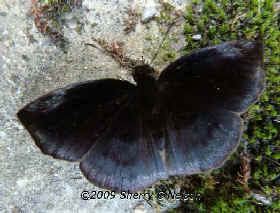
Brilliant Anastrus
(photo by Sherry Nelson)
Genus ANTIGONUS
Antigonus erosus (ph)
______ BRse
COMMON SPURWING
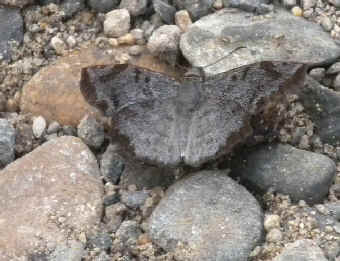
A Common Spurwing photographed during a FONT
tour
(photo by Rise Hill)
Antigonus liborius areta ______ ARne
(MM:85) subspecies in northeast
Argentina
AR common name: Areta
Genus AETHILLA
Aethilla eschina coracina ______ ARne
(MM:86) subspecies in
northeast Argentina
AR common name:
Coracina (a word meaning "a small reinforcement covering the
heart on the left-side of an armor")
Genus ANISOCHORIA
Anisochoria sublimbata ______ ARne
(MM:87)
AR common name: Ala Cortada
(translates to "Cut Wing",
referring to shape of the forewing
apex)
Genus ACHLYODES (or now EANTIS)
Achlyodes (or now Eantis)
busirur rioja ______ ARne
BRse (MM:88) subspecies in
northeast Argentina
AR common name: Busiris
Achlyodes (or now Eantis)
thraso ______ ARne BRse BRmg
(C:251) (K:275) MM:89) (PE:31) (formerly Achlyodes
mithridates)
SOUTHERN SICKLEWING
AR common name: Saltarin Gancho (translates to "Hooked Skipper",
referring
to the shape of the forewing apex)
(Range: south Texas to Argentina; also West Indies)
Genus GRAIS
Grais stigmaticus stigmaticus ______
ARne (K:277) (MM:90) (PE:32) (subspecies
in northeast Argentina)
HERMIT SKIPPER
AR common name: Ermitano (translates to
"Hermit")
(Range: Mexico to Argentina, periodic stray into North America)
Genus TIMOCHARES
Timochares trifascita trifasciata
______ ARne (MM:91)
subspecies in northeast Argentina
MANY-BANDED SKIPPER
AR common name: Tres Franjas (translates
to "Three Bands")
Genus CYCLOGLYPHA
Cycloglypha enega ______ BRmg
ENEGA BENT-SKIPPER
Cycloglypha thrasibulus ______ BRmg
WIDESPREAD BENT-SKIPPER
Genus EBRIETAS
Ebrietas infanda ______ BRse
Ebrietas anacreon ______ BRmg
Ebrietas anacreon anacreon ______
ARne BRse (MM:92)
subspecies in
southeast Brazil and northeast Argentina
COMMON BENT-SKIPPER
AR common name: Anacreonte
Genus HELIAS
Helias phalaenoides ______ BRmg
Helias phalaenoides phalaenoides
______ BRse subspecies in southeast
Brazil
Helias phalaenoides palpalis
______ ARne (MM:93)
subspecies in northeast Argentina
FABRICUS' BENT-SKIPPER
AR common name: Falsa Polilla ("False Moth") (the scientific
name "phalaenoides" means "like a moth")
Genus CHIOMARA
Chiomara asychis (ph) ______
(K:295)
(PE:32)
WHITE-PATTERNED SKIPPER (or
Asychis Skipper)
(Range: south Texas to Argentina, also West Indies)
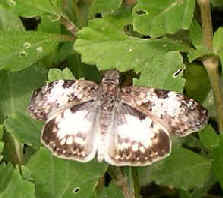
White-patterned Skipper
(photo courtesy of Michiel Koomen)
Chiomara mithrax
______ BRse BRmg
MITHRAX DUSKYWING
Genus GESTA
Gesta gesta ______
BRse (K:287) (PE:32)
(formerly Erynnis gesta)
IMPOSTOR DUSKYWING
(Range: south Texas to Argentina, also West Indies)
Genus ERYNNIS: TRUE DUSKYWINGS
Erynnis funeralis (ph) ______ ARne
(K:281)
(MM:94) (PE:32)
FUNEREAL DUSKYWING
AR common name: Saltarin Funebre
(Range: southwest US to Argentina, wanders further north)
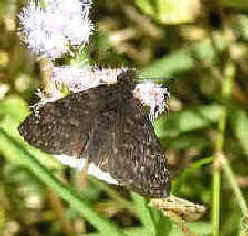
A Funereal Duskywing photographed during a FONT tour
(photo by Rosemary Lloyd)
Genus PYRGUS: CHECKERED SKIPPERS
Pyrgus orcynoides ______
(Range: Argentina)
Pyrgus orcas (ph) ______ ARse
BRse
(MM:96)
ORCAS CHECKERED-SKIPPER
AR common name: Cuadriculada de Pluton ("Pluto's Checkered
Skipper")
(Range: southern US to Argentina)
The Orcas Checkered Skipper was a subspecies of the now
more-northerly Tropical Checkered Skipper.
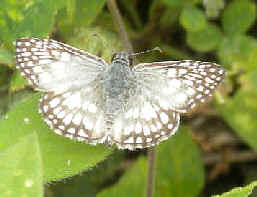
Above & below: Orcas Checkered Skippers
photographed during a FONT tour
Above: a male; below: a female
(photos by Rise Hill)
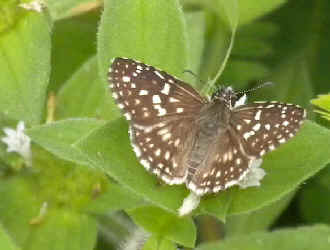
Genera HELIOPYRGUS & HELIOPETES: LARGE WHITE SKIPPERS
Heliopyrgus americanus bellatrix
______ ARne (MM:95)
subspecies in northeast Argentina
AR common name:
Cuadriculada Belicosa (translates to "Checkered Warrior")
Heliopyrgus (formerly Heliopetes) domicella
______ (K:293) (PE:33)
ERICHSON'S WHITE-SKIPPER
(Range: northern Mexico to Argentina, strays north into the US)
Heliopetes laviana libra ______ ARne
(K:293) (MM:98) (PE:33)
LAVIANA WHITE-SKIPPER
AR common name: Libra
(Range: south Texas to Argentina)
Heliopetes macaira ______ (K:293)
(PE:33)
TURK'S-CAP WHITE-SKIPPER
(or Macaira
Skipper)
(Range: south Texas to Paraguay)
Heliopetes arsalte (ph) ______ BRse
BRmg (species described by Linnaeus in 1758)
Heliopetes arsalte arsalte ______
ARne (MM:97)
subspecies in northeast Argentina
VEINED WHITE-SKIPPER
AR common name: Arsalte ("Arsalte Skipper")
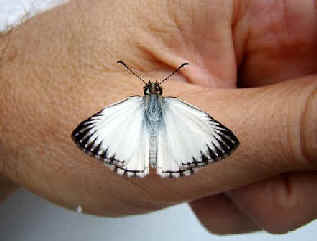
The Veined White-Skipper, Heliopetes arsalte
(photo by Jorge Bizarro)
Heliopetes alana ______ ARne
BRse
(MM:99)
ALANA WHITE-SKIPPER
AR common name: Alano
Heliopetes randa ______ ARne
(MM:100)
AR common name: Randa (translates to "Lace Trimming")
Heliopetes omrina ______
ARne BRse (MM:101)
STAINED WHITE-SKIPPER
AR common name: Omrina
Subfamily HESPERIINAE: BRANDED SKIPPERS
This group is comprised of more than 2,000 species worldwide.
Genus ARITA genus created in 1955
Arita epictetus ______ BRse
Genus CALLIMORMUS
Callimormus corades ______ BRse
Genus CARYSTOIDES
Carystoides basoches
______ BRse
Carystoides noseda
______ BRse
Genus CARYSTUS
Carystus phorcus claudianus
______ BRse subspecies in southeast
Brazil
Genus COBALOPUS
Cobalopus miaba
______ BRse
Genus COBALUS
Cobalus virbius hersilia
______ BRse
Genus CYMAENES
Cymaenes tripunctus theogenus ______
BRse (K:309)
(PE:34) subspecies in southeast Brazil
THREE-SPOTTED SKIPPER
(Range: central Mexico to Paraguay, also south Florida & West Indies)
Cymaenes odilia ______ (K:309)
(PE:34)
FAWN-SPOTTED SKIPPER
(Range: north Mexico to Argentina, rarely strays in the US to south Texas)
Cymaenes uruba uruba ______ BRse
subspecies in southeast Brazil
There is another yet unidentified species of
Cymaenes in southeast Brazil.
Genus CYNEA genus created in 1955
Cynea bistrigula
______ BRse
Cynea diluta
______ BRse
Cynea trimaculata
______ BRse
Genus SYNAPTE
Synapte malitiosa ______ (K:309)
(PE:33)
MALICIOUS (SHADY) SKIPPER
(Range: far-southern Texas to southern Brazil and Paraguay, also Cuba)
Synapte silius ______ ARne
BRse (MM:102)
RAIN-FOREST FACETED-SKIPPER
AR common name: Silius
Genus LENTO
Lento krexoides krexoides ______ ARne
(MM:103) subspecies in northeast
Argentina
AR common name:
Saltarin Anaranjado (translates to "Orange Skipper")
Genus LEVINA genus created in 1955
Levina levina
______ BRse
Genus ZARIASPES
Zariaspes mys ______ ARne
BRse
(MM:104)
MYS SKIPPER
AR common name: Amarillita
(translates to "Small Yellow")
Genus ANTHOPTUS
Anthoptus epictetus ______
ARne BRse (MM:105)
TRAILSIDE SKIPPER
AR common name: Epicteto
Genus CORTICEA
Corticea corticea ______ BRse
(K:311) (PE:33)
Corticea corticea noctis ______ ARne
(MM:106) subspecies in northeast Argentina
REDUNDANT SKIPPER
AR common name: Manchas Amarillas (translates to "Yellow Spots")
(Range: Mexico to southern Brazil)
Genus VINIUS
Vinius pulcherrimus ______ ARne
(MM:107)
AR common name: Saltarin Bello (translates to "Beautiful Skipper")
Genus VIRGA
Virga austrinus ______ ARne
(MM:108)
AR common name: Orias Manchadas (translates to "Spotted Fringes")
Genus LUDENS
Ludens ludens ______
ARne (MM:109)
LUDENS SKIPPER
AR common name: Aranada (translates to "Clawed",
referring to the yellow
lines on the hindwings)
Genus SODALIA
Sodalia dimassa ______ BRse
Sodalia coler ______ ARne
(MM:110)
AR common name: Saltarin Pardo (translates to "Brown Skipper")
Genus PARPHORUS
Parphorus decora ______ ARne
(MM:111)
AR common name: Elegante (translates to "Elegant")
Genus VEHILIUS
Vehilius clavicula ______ BRse
Vehilius inca ______
BRse
Vehilius stictomenes stictomenes
______ ARne BRse (MM:112)
subspecies in southeast Brazil and northeast Argentina
PASTURE SKIPPER
AR common name: Nervaduras Amarillas (translates to "Yellow Veins")
Vehilius vetula
______ BRse
There is another yet
unidentified species of Vehilius in southeast Brazil.
Genus VETTIUS
Vettius fantasos ______
(PE:text)
FANTASTIC SKIPPER
(Range: north Mexico to Paraguay, strays to far-southern Texas)
Vettius diversa lyrcea ______ BRse
subspecies in southeast Brazil
Vettius phyllus prona ______ BRse
(subspecies described in 1955)
Vettius triangularis ______ BRse
Vettius umbrata ______
BRse
Vettius marcus marcus ______
ARne BRse (MM:113)
MARCUS SKIPPER
AR common name: Marcos
Vettius artona ______ ARne
(MM:114)
WHITE-VEINED SKIPPER
AR common name: Grisacea (tanslates to "Grayish")
Genus PARACARYSTUS
Paracarystus hypargyra ______ ARne
(MM:115)
HYPARGYRA SKIPPER
AR common name: Hombro Naranja (translates to "Orange Shoulder")
Genus JUSTINIA
Justinia kora ______ ARne
(MM:116)
AR common name: Kora
Genus ENOSIS
Enosis schausi
______ BRse (species described in 2002)
Genus EUTYCHIDE
Eutychide physcella ______ ARne
BRse
(MM:117)
AR common name: Saltarin Punto Blanco (translates to "White Dot Skipper")
Genus EVANSIELLA
Evansiella cordela ______ ARne
(MM:119)
AR common name: Saltarin Ocre (translates to "Ochre Skipper")
Genus ARGON
Argon lota (or argus) ______ ARne
(MM:120)
ARGON SKIPPER
AR common name: Argos
Genus LYCHNUCHOIDES
Lychnuchoides ozias ozias ______ ARne
BRse
(MM:121)
AR common name: Franja Ambar (translates to "Amber Bend")
Genus LYCHNUCHUS
Lychnuchus celsus ______ BRse
Genus METHIONOPSIS
Methionopsis ina
______ BRse
Genus MILTOMIGES
Miltomiges cinnamomea ______ ARne BRse
(MM:118)
AR common name: Saltarin Bermejo (translates to
"Reddish
Skipper")
Genus MNASITHEUS
Mnasitheus ritans
______ BRse
Genus MOERIS
Moeris striga striga ______
BRse subspecies in southeast Brazil
Genus NAEVOLUS
Naevolus orius orius ______ BRse
subspecies in southeast Brazil
Genus ONOPHAS
Onophas columbaria columbaria
______ BRse subspecies in
southeast Brazil
Genus ORSES
Orses itea ______
BRse
Genus PAPIAS
Papias phainis ______
BRse
Genus PERICHARES
Perichares philetes adela ______
BRse
(K:357) (PE:text) subspecies in
southeast Brazil
Perichares philetes aurina ______ BRse
subspecies in
southeast Brazil
GREEN-BACKED RUBY-EYE
(Range: north Mexico to Paraguay, also West Indies, and strays north to the US
in far-southern Texas)
Perichares seneca seneca ______ ARne
BRse (MM:122) subspecies in
southeast Brazil and northeast Argentina
SENECA RUBY-EYE
AR common name: Seneca
Perichares lotus ______ ARne
(MM:123)
LOTUS RUBY-EYE
AR common name: Ojos Rojos
(translates to "Red Eyes")
Genus PHANES
Phanes aletes ______ BRse
Genus PHERAEUS
Pheraeus unia ______ BRse
Genus LYCAS
Lycas argentea ______ ARne
BRse (MM:124)
SILVERED RUBY-EYE
AR common name: Saltarin Plateado (translates to "Silvery Skipper")
Genus TALIDES
Talides sinois ______ BRmg
SINOIS RUBY-EYE
Genus DECINEA
Decinea dama
______ BRse
Decinea mubevensis ______ ARne
(MM:125)
AR common name: Perforada (translates to "Perforated",
referring to
the hyaline spots on the forewing)
Genus CONGA
Conga chydaea ______ (K:311)
(PE:text)
HIDDEN-RAY SKIPPER (or
CHYDEA SKIPPER)
(Range: Mexico to Argentina, as a stray to far-southern Texas)
Genus HYLEPHILA
Hylephila phylaeus phylaeus (ph) ______
ARne BRse (K:303) (MM:126) (PE:35)
subspecies in southeast Brazil and northeast Argentina
FIERY SKIPPER
AR common name: Saltarin Leonado
(Range: southern US to Argentina, wanders north in the US)
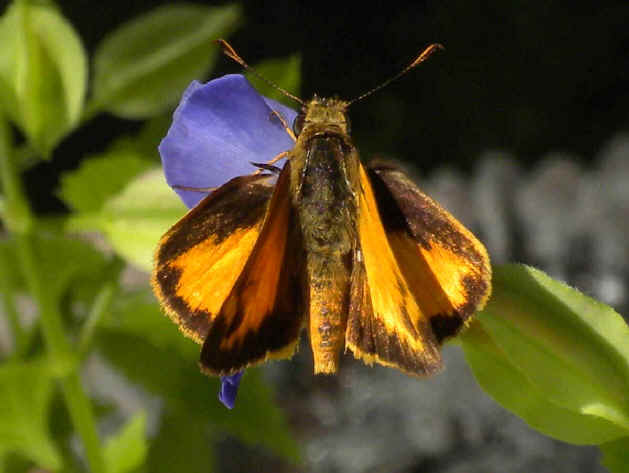
Fiery Skipper
(photo by Rise Hill)
Genus POLITIES
Polites vibex catilina ______ ARne
BRse (K:303) (MM:127) (PE:35) (subspecies
in southeast Brazil and northeast Argentina)
WHIRLABOUT
AR common name: Saltarin Dorado
(Range: southeast US to Argentina)
Genus WALLENGRENIA
Wallengrenia otho ______ (K:327)
(PE:36)
SOUTHERN BROKEN-DASH
(Range: southeast US to Argentina, also West Indies)
Wallengrenia premnas ______
ARne BRse (MM:128)
AR common name: Saltarin Mancha Roja (translates
to "Red
Spot Skipper")
Genus VACERRA
Vacerra evansi ______ ARne
(MM:129)
AR common name: Saltarin de Evans ("Evans'
Skipper")
Genus PROPERTIUS
Propertius propertius ______ ARne
(MM:130)
AR common name: Franjas Amarillas Grande (translates to "Big Yellow Bands")
Genus ZENIS
Zenis jebus jebus ______ ARne
BRse
(MM:131) subspecies in southeast Brazil and northeast
Argentina
AR common name: Jebuseo
Genus TIRYNTHIA
Tirynthia conflua ______
ARne BRe (MM:132)
CONFLUA SKIPPER
AR common name: Linea Blanca (translates to "White
Line")
Genus ATALOPEDES
Atalopedes campestris (ph) ______ (K:303)
(PE:37)
SACHEM
(Range: southern US to Brazil)
Genus QUASIMELLANUS
Quasimellanus eulogius ______ (PE:46)
(formerly Mellana eulogius)
MEXICAN MELLANA
(Range: north Mexico to Paraguay, periodically strays to far-south Texas)
Genus LERODEA
Lerodea eufala (ph) ______ (K:353)
(PE:39)
Lerodea eufala eufala ______ BRse
subspecies in southeast Brazil
EUFALA SKIPPER
(Range: southern US to southern Argentina, also Cuba)
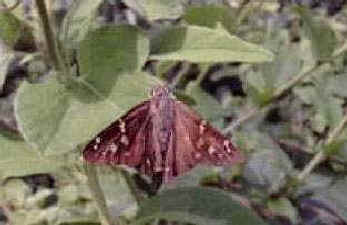
Above & below: the Eufala Skipper
Above, the butterfly; below, the caterpillar
(these three photos courtesy of Michiel
Koomen)
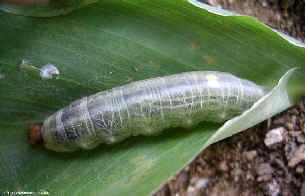
Below, again the butterfly of the Eufala Skipper
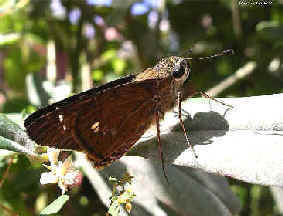
Genus CALPODES
Calpodes ethlius ______ BRmg
(K:357) (PE:39) (S:44)
BRAZILIAN SKIPPER
(Range: southern US to Argentina, also West Indies)
Calpopes ethlius is also called the
CANNA
SKIPPER, as it is common in gardens where Cannas are grown, on
which the larva feeds.
Genus AIDES
Aides aegita ______ BRmg
AEGITA SILVERPATCH
Genus PANOQUINA
Panoquina ocola ______ (K:355)
(PE:39)
Panoquina ocola ocola ______ BRse
(subspecies in southeast
Brazil)
OCOLA SKIPPER
(Range: southern US to Paraguay, also West Indies)
Panoquina hecebola ______ (K:355)
(PE:39)
HECEBOLUS SKIPPER
(Range: north Mexico to Paraguay, regular stray to far-southern Texas)
Panoquina sylvicola ______ (K:357)
(PE:39)
PURPLE-WASHED (or
Sylvicola)
SKIPPER
(Range: north Mexico to Argentina, also West Indies, and regular stray to south
Texas)
Panoquina fusina ______ (K:357)
(PE:39)
WHITE-BARRED SKIPPER (another name has been
Evan's Skipper)
(Range: central Mexico to Paraguay, also Jamaica; periodic stray to far-southern
Texas)
Panoquina lucas lucas ______
BRse (subspecies in southeast Brazil)
Genus NYCTELIUS
Nyctelius nyctelius ______ (K:357)
(PE:39)
Nyctelius nyctelius nyctelius ______
ARne BRse (MM:133)
(subspecies in southeast Brazil & northeast Argentina)
VIOLET-BANDED (or
Nyctelius)
SKIPPER
AR common name: Nyctelios
(Range: Mexico to Argentina, also West Indies)
Genus POMPEIUS (genus created in 1955)
Pompeius amblyspila ______ BRse
Pompeius pompeius ______ BRse
Genus PSORALIS
Psoralis stacara ______ BRse
Genus REMELLA
Remella remus ______ BRse
Genus SALIANA (genus created in 1955)
Saliana esperi esperi ______ BRse
(subspecies in southeast Brazil, described in 1955)
Saliana longirostris ______ BRse
Saliana mamurra ______ BRse
Saliana salius ______
BRse
Saliana salona ______ BRse
(species described in 1955)
Saliana triangularis ______ BRse
Genus SANIBA genus created in 2003
Saniba sabina ______ BRse
Genus SATURNUS
Saturnus reticulata conspicuus
______ BRse subspecies in
southeast Brazil
Genus TALIDES
Talides sinois ______
BRse
Genus THESPIEUS
Thespieus dalmon
______ BRse
Thespieus ethemides ______ ARne
(MM:134)
AR common name: Tespio
Punta Oscura (translates to "Dark-tipped Tespio")
Thespieus aspernatus ______ ARne
(MM:135)
ASPERNATUS SKIPPER
AR common name: Tespio
Punta Clara (translates to "Light-tipped Tespio")
Genus TIRYNTHOIDES
Tirynthoides virilis ______ BRmg
VIRILIS SKIPPER
Genus TISIAS
Tisias lesueur lesueur ______ BRse
Genus NICONIADES
Niconiades cydia
______ BRse
Niconiades merenda ______ ARne
(MM:136)
AR common name: Cuatro
(translates to "Four")
Genus VENAS genus created in 1955
Venas caerulans ______ BRse
Genus VERTICA genus created in 1955
Vertica verticalis verticalis
______ BRse subspecies in
southeast Brazil
Genus XENIADES
Xeniades chalestra chalestra
______ BRse subspecies in southeast
Brazil
Xeniades orchamus orchamus ______
ARne (MM:137)
subspecies in northeast Argentina
SMEAR-SPOTTED SKIPPER
AR common name: Orchamus
Genus THRACIDES
Thracides phidon ______ BRse
Thracides cleanthes cleanthes
______ ARne BRse (MM:138)
subspecies in southeast Brazil and northeast
Argentina
AR common name: Cleanto
Genus PYRRHOPYGOPSIS
Pyrrhopygopsis socrates socrates
______ ARne
(MM:139) subspecies in
northeast Argentina
AR common name: Socrates
A Moth:
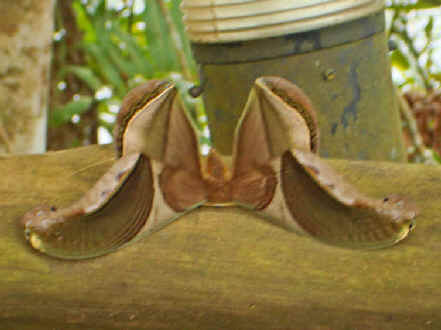
This photograph of a large moth taken during the FONT tour in southeast Brazil in August
2009.
To
Top of Page.