PO Box 9021, Wilmington, DE
19809, USA
E-mail: font@focusonnature.com
Phone: Toll-free in USA, Canada, & Puerto Rico 1-800-721-9986
or 302/529-1876; Fax: 302/529-1085
HIGHLIGHTS
FROM OUR PAST BIRDING & NATURE TOURS in 2008
INCLUDED HERE ARE TOURS CONDUCTED IN: BRAZIL, the DOMINICAN REPUBLIC, JAPAN, and the LESSER ANTILLES
(DOMINICA).

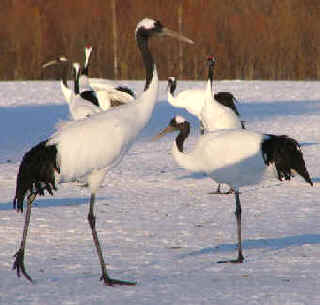
Red-crowned
Cranes, as seen during
the FONT January 2008 Japan Tour in Hokkaido.
The
following tour summaries are given with the most-recent tours first.
Click links below for
particular tours for longer NARRATIVES and then
there will be further links to UPCOMING TOUR ITINERARIES, CUMULATIVE LISTS relating to BIRDS,
ANIMALS, & OTHER NATURE.
Dominican Republic - March/April 2008
During this,
the 17th FONT birding & nature tour on the Caribbean
island of Hispaniola, we had the best look we've ever had of the Western
Chat-Tanager, - a wonderful look of a bird that's normally a skulker, very
hard to see. Another nice sight for us a line of about a dozen Hispaniolan
Crossbills, drinking at the edge of a pool of water
in a pine forest. These 2 rare species were among about 120 different birds that
we saw during our tour. Many of them were interesting in not only being
rarities, but also as either endemic species or subspecies found nowhere else in
the world other than on that single Caribbean island.
Our travel, and our quest for birds, on the island took us from the sea coast, and a
desert even below sea level, to an elevation as high as 7,000 feet up in the mountains,
including the area in the pines where we watched the crossbills.
Brazil (Southeast, Minas Gerais, & Mato Grosso) - March 2008
During this, the
42nd FONT birding & nature tour in Brazil,
again, as during our tours there in the past, wonderful birds and animals were
seen.
Such tours in Brazil usually bring to mind notable birds as the Hyacinth
Macaw and the Jabiru. These we saw, but also there were so many other
birds, and among them highlights including the very rare Brazilian Merganser,
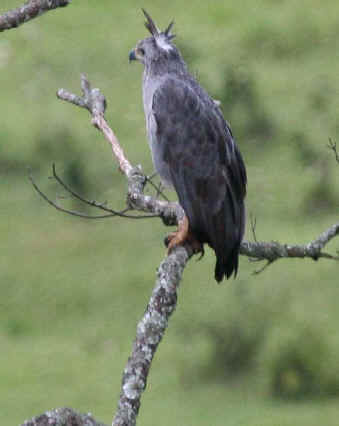
a pair of Crowned Solitary Eagles, the Cock-tailed Tyrant, and the
tiny & very localized Buff-throated Purpletuft.
This was the 6th FONT
tour with the Brazilian Merganser, one of the rarest birds in the world.
(That's 6 times out of 7 tries for that bird.)
Among the mammals during the tour, an Ocelot was seen so nicely as
it walked backed & forth on a dirt road ahead of us, and a Maned
Three-toed Sloth was seen, in an area where not expected - in
lowland Atlantic Forest near the Brazilian Seacoast. But see it we did, and so very
well, as it so very slowly, made its way down a tree in front of
us.
Other animals that we saw included: Six-banded Armadillo, Tapiti (or
Forest Rabbit), Paca, Capybara, the cat known as the Jaguarundi,
Crab-eating and Hoary Foxes, Crab-eating Raccoon, Neotropical River
Otter, and 3 species of deer.
Back again to the Maned Three-toed
Sloth, it's a rare and endangered mammal, and was a "new one" for FONT in Brazil, being the 69th
species of mammal for us there (excluding bats - and we saw
a few of them too).
Also during our March '08 Brazil tour, a nice assortment of butterflies was seen.
A listing of the birds (with a number of photographs of them, and the mammals
& butterflies) is with the longer tour narrative reached from the above
link.
This was the 30th
FONT birding & nature tour in Japan. Highlights, as
usual, during our tours there in the winter, included: cranes and eagles
and the Blakiston's Fish-Owl.
We saw both Steller's Sea Eagles and White-tailed
Eagles on the northern Japanese island of Hokkaido.
There were good numbers of each, and we saw both species well. We also saw a
third species of eagle during the tour, a single Greater Spotted Eagle on
the southern Japanese island of Kyushu.
5 of the 15 species of the world's cranes were seen during the tour. The
Red-crowned, or Japanese, Cranes were seen in Hokkaido, while
numerous Hooded and White-naped Cranes were seen in Kyushu, along
with two stragglers there, the Common and the Sandhill Cranes.
We had the very good good
fortune, to see, one evening, two large and rare Blakiston's
Fish-Owls, a pair that we watched close to us, and that we heard calling in
duet! With this tour, we've now seen that special bird during ALL of our 19 late-fall or winter birding
tours in Japan.
On Kyushu, in addition to thousands of cranes, we saw hundreds of
Mandarin Ducks along one particular river. Where that river meets the sea, on a
mudbar, we were treated to Spoonbills - both the rare Black-faced, and the Eurasian.
Nearby, we encountered a rarity for Japan, a Pied Avocet. With it was a
similar bird, also unusual for Kyushu, a Black-winged Stilt.
The Mandarin Ducks were not the only attractive waterfowl during the tour. We
also enjoyed, on Hokkaido, the equally attractive Smews and Harlequin
Ducks.
Birds mentioned here were just some of those that we enjoyed during this,
another fine Japanese tour.
Lesser Antilles (Dominica) - January 2008
During this tour,
where the year for FONT began, there were both "Parrots & Pirates of the Caribbean".
On the lush, green Caribbean island
of Dominica, we saw endemic, rare Amazon parrots (2 species)
as well as the filming locations of the 2nd & 3rd "Pirates of the
Caribbean" movies.
In all, during this, our annual "holiday tour", which also included St.
Lucia & St. Vincent in December '07, we saw 80 species of
birds, most of which were Caribbean specialties, and many them were
island-endemics, rarities, or birds that were just-plain nice to
see.
![]()
Dominican
Republic
March-April 2008
Links:
List of Birds during our Dominican Republic Tour - March/April 2008
Cumulative List of Birds during our Dominican Republic Tours
Birds during previous FONT Tours in the Caribbean (with photos)
Rare
Birds of the Caribbean
Upcoming FONT Birding & Nature Tours in the Caribbean
The following narrative was written by Armas Hill, leader of the tour:
The "Top Birds" of our March/April 2008 Dominican Republic Tour, as voted for by
the participants after the tour, were:
1 - Western Chat-Tanager
2 - Broad-billed Tody
3 - White-tailed Tropicbird
4 - Hispaniolan Trogon
5 - Golden Swallow
6 - Hispaniolan Crossbill
7 - American Flamingo
8 - Northern Potoo
9 - Antilean Piculet
10 - Least Poorwill
11 - Hispaniolan Lizard Cuckoo
![]()
Brazil
(Minas
Gerais, Mato Grosso do Sul, & Southeast Brazil)
March 2008
Links:
List of Birds & Other Wildlife during our Brazil Tour - March '08
Cumulative
List of Birds during FONT Brazil Tours:
Part
1: Tinamous to Flycatchers
Part 2: Antshrikes to Grosbeaks
Birds in Minas Gerais (with photos)
Birds in Mato Grosso do Sul (with photos)
Birds in Southeast Brazil (with photos)
Rare Birds during FONT Tours in Brazil
Mammals & Other Wildlife during FONT Brazil Tours
Upcoming FONT Birding & Nature Tours in Brazil

The FONT Brazil March '08 Tour
Group
having dinner one evening during the tour
The following narrative was written by Armas Hill, leader of the tour:
"In Brazil, with
Bobolinks, and many, many other birds
- and especially notable for us: a merganser, an eagle, and a non-bird, a
sloth"
We were in Brazil
when Bobolinks were, during our tour of March
6-18, 2008. Prior to the tour, a total of 1,031 different birds had
cumulatively been seen during FONT birding & nature tours in Brazil. The Bobolink
was our only "new" species for the country during our March '08 tour,
which was the 42nd FONT tour in Brazil.
During the tour, we traveled in the southeast Brazil
(Sao Paulo state), Minas
Gerais, and Mato Grosso do Sul.
Our last few days were back in Sao Paulo state,
mostly along the beautiful seacoast, in the area of Ubatuba.
Bobolinks, when they are in North America, are sometimes called "Ricebirds",
as when they're migrating south from where they breed, they are fond of rice
fields in southern US. Where they breed are grassy fields in the northern US and
Canada. Where we saw some, during our March 2008 tour in Brazil, was in an area
of rice fields in Mato Grosso do Sul, in a
general area known as the Pantanal. The Bobolinks,
when in Brazil, have another name there, being called locally "Triste-pia".
The species arrives in Brazil late in the year in its non-breeding plumage,
looking somewhat like a sparrow. During its stay in Brazil, it undergoes a full
molt from January to March, before the male acquires its nuptial dress of black,
white, and yellow. Some Bobolinks that we saw in the Brazilian fields in
March were fairly well along into that plumage.
The Bobolink makes one of the longest annual migrations of any American
landbird, covering over 20,000 kilometers during its yearly round-trip. That's
somewhat similar to the distance that most of us, in our group, traveled to and
from Brazil. A participant from Florida traveled a bit less; another, from
Alaska, traveled more.
Of the many bird species that we saw during our March '08 tour in Brazil, there
were just 5 that traveled from North America, as we and the Bobolinks did,
and that would soon leave Brazil to return to North America. The other 4 species
that we saw, in that select group, were: Solitary Sandpiper, Spotted
Sandpiper, Osprey, and Barn Swallow. None of these species nest
anywhere in South America.
The Bobolinks do not appear on the North American scene until May. But, Ospreys
would start to arrive at their nesting sites in North America at about the time
that we would return home from the tour. Barn Swallows and the two sandpipers
would soon follow.
As we were observing the Bobolinks in Brazil in March, the sky in that
area above the water and fields was filled with Barn Swallows, flying
about catching insects. There were hundreds of them. On reeds they gathered,
with their rich orange coloration as they were into their breeding plumage. The
next day, in that same area, there were no Barn Swallows to be seen. The
groups of them that we had seen the previous day apparently continued further north
catching insects someplace else. Brazil is a very big country, and there's a
large area for migrating birds to cover.
But even with the swallows missing, there were many, many birds where we
were in the Pantanal. We had never seen, during any tour previously, for
example, so many Picazuro Pigeons. Late in the afternoon, huge flocks of
them, generally heading in one direction, flowed as if they were a river in the
sky above us. They were quiet, but the flocks of mostly parakeets and
also some parrots, of various kinds, that flew in that late afternoon sky
were certainly noisy indeed.
The pigeons and parakeets were going from one grove of trees to
another. As we traveled along a dirt road, each of the single big trees ahead of
us would "explode" with birds bursting out - again, pigeons,
parakeets, and parrots.
There were so many birds, of various kinds, where we were in Mato Grosso do Sul.
Not only as just described in the air and the trees, but also on fields and on
and by bodies of water. One time, during one of our morning excursions (as we
routinely did on a
high, open vehicle), we could see that a green field ahead of us was filled
with big white birds. They were Jabirus, large storks as tall as people. In that
field, there were about 300 of them! Most were adults, but some we could see
were young birds of the year. We stopped and watched, as the big birds either
stood or walked about. Sprinkled in with them were the two other American
members of that family, both Maguari and Wood Storks. They were also large, but
not as big as the Jabirus.
After Greater Rheas, that we also saw when we were in Mato Grosso do Sul,
Jabirus are the largest American birds. The Greater Rhea, from the tip of its
bill to that of its tail, averages a length of 170 centimeters. For the Jabiru,
that length is 140 centimeters. For the other two Storks, the Maguari
and the Wood, that length is about 120 and 100 centimeters, respectively. Another large
bird was in the area, the Cocoi Heron. It's a cousin of the Great Blue
Heron of North America and the Grey Heron of Eurasia. Its length, from the bill
to the tail, is about 125 centimeters.
Not factored in the figures just given are the long legs had by all of the birds
just noted: the Rhea, the Jabiru, the other storks, and the
Cocoi. When they are
on the ground, these birds are tall. And, thus, they are among a number of
Brazilian birds that are "big", including, for example, the Hyacinth
Macaw (the largest parrot in the world), and the Toco Toucan
(the largest in its
family). The big macaw and the large toucan were also seen during our time in
Mato Grosso do Sul (but elsewhere, just over a hundred miles to the east of the
field of Jabirus).
We were never without birds, during day or night, when we were on the large
property of the ranch, where we were with the Jabirus, Pigeons, Parakeets,
Swallows, and Bobolinks. In all, we saw well over a hundred species of birds
during our time there.
In addition to the storks, herons, and egrets, there were large flocks of
Whistling-Ducks (Black-bellied & White-Faced), and
Ibises (mostly Bare-faced, but also both Buff-necked
and Plumbeous). The Southern Screamer was
about, another big bird related to waterfowl (thus appearing rather like an odd
fat goose), as were Limpkins. There were lots of them. We saw them, of course,
but at night (all night) we could hear them, even from our rooms, constantly
wailing in the distance. As just noted, we were never "without birds",
either by day or night.
We did night-time excursions on the high, open vehicles, referred to earlier. On
two nights, we were out from two to three hours. Our weather was always good.
One night, the sky was so clear, as we were not near any light pollution, that
the stars were absolutely brilliant dazzling above us in the sky. We could
nicely see Orion (without being cold!) and an assortment of southern
constellations never visible from our homes in the Northern Hemisphere.
Closer to the ground, during the first of our two nights (the one without
clouds) we had a tremendous venture with birds. The next night, the birds were
good again, but the mammals were better.
As we traveled on dirt tracks in the dark, either by waterways, or fields, or
forest edge, continually there were nightjars. Some stayed on the ground ahead
of us to be observed as a light was shone on them. Others were flying about.
Again and again, we saw Little and Scissor-tailed Nightjars, and
Pauraques. A
couple times, we stopped to observe Common Potoos that sat still on exposed
branches. One, close to us, was at about our eye level, and its large eyes took
notice of us as ours watched it. We saw owls, nicely, notably Striped
and Barn Owls.
Whistling Ducks actively feed at night. We heard them whistling, as we heard the
Limpkins, already referred to, wailing.
A couple Brazilian Teals, one night, were crouched down on the dirt road.
Reluctantly they moved, keeping low to the ground, as our vehicle approached
them.
During the day, we saw, of course, some Southern Lapwings here and there. After
dark, however, along the dirt roads, a few times, we encountered large flocks of
them roosting, with what seemed to be more a hundred birds at once. As the
vehicle got near them, they lifted up into the air, flying about like light, but
noisy, ghosts. In fact, they raucously called as they flew about. Such a flock
of Lapwings sounds rather like a colony of North American Laughing Gulls when
they're at their noisiest.
And there were mammals seen during our excursions after dark on the high, open
vehicles. During our tours in previous years, at the same ranch, we've seen a
great assortment of animals, with looks, twice in the past, at Jaguar. Two were
seen a day or two before our March '08 visit.
Unfortunately, we did not encounter a Jaguar during either night in March '08.
But that's OK. A great effort was made in that regard, and we did see some other
nice mammals and, as noted, many birds. It should be noted that the spotters who
look, with their lights, for the animals and birds, are very, very good, and
thus, where we were has been one of the best places of any that we go, to see
the creatures of the night.
During both nights, in March '08, we saw Ocelots. The first night we saw one -
quickly. The second night we saw 3. Seeing one of them, in particular, was a
wonderful sighting as the beautiful animal walked back and forth, a few times,
on the road just ahead of us. Other mammals that we saw after dark were two with
the adjective "Crab-eating", the Fox and the Raccoon. We also saw a
couple Tapitis (or Forest Rabbits), an animal not commonly seen, and deer: the
Red Brocket Deer, and the Marsh Deer. And, of course, there were Capybaras.
They, and the Marsh Deer, we also saw during the day, along with the Gray
Brocket Deer. At dusk, we saw the Six-banded Armadillo. Among the
bats, during
our nocturnal excursions, the most obvious were the reddish-colored Lesser
Fishing Bats, flying about with the nightjars. It was that those night-time
fliers never collided. There were so many.
While on the subject of mammals, mention should be made, now, that elsewhere
during our tour, we encountered 2 Jaguarundis (another species of wild cat),
and
a Paca (an agouti-like animal, but with spots, and active only at night).
The Ocelots, just noted, were tremendous. But, before we were to go home, the
mammal of the tour that was the most unexpected was one that found during the
day, in the Atlantic Forest of Coastal Brazil. It was the rare and endangered
Maned Three-toed Sloth. More will be said about it later in this narrative.
But let's go back now to Mato Grosso do Sul, as some more needs to be said about
what we saw there.
Reference has already been made to "big birds". There were others in
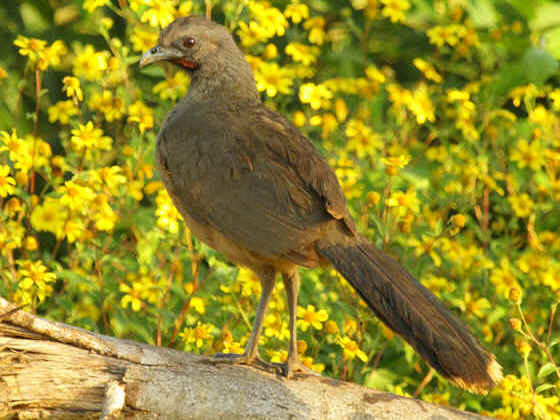
that department. One morning, not far from a river, were saw Bare-faced
Curassow, Rusty-margined Guan, and Chaco Chachalaca, all of them big enough. The
last of these can also be noisy.
It's more usual for tinamous to be heard during a tour than seen. During our
March 2008 Brazil tour, we did hear Undulated Tinamou in Mato Grosso do Sul and
Spotted Nothura in Minas Gerais, and later, in the Atlantic Forest, the Brown
Tinamou.
But also, in Mato Grosso do Sul, we SAW a tinamou that we never did hear.
As we were driving along a dirt side-road, one afternoon, a Small-billed Tinamou
walked, slowly but with some determination, across the road in front of us.
Why did it "cross the road"? Apparently, we figured, simply to get to
the other side.
Nearly always, during our tours in Brazil, we see the Squirrel Cuckoo, and
usually if we don't see a Striped Cuckoo, we hear one (or more often, more than
one). But, during our March '08 Brazil tour, oddly, we never encountered either,
but both the Little Cuckoo and the Ash-colored Cuckoo were seen, both during one
morning in Mato Grosso do Sul. The Little Cuckoo was our first since 2005, and
the Ash-colored our first since 2000.
Nothing has been said yet about raptors. We saw many. Caracaras were seen many
places. In Mato Grosso do Sul, numerous Lesser Yellow-headed Vultures were at
the ranch, where also there were numbers of Snail Kites, Savanna and
Black-collared Hawks, Great Black Hawks, and a couple Aplomado Falcons.
Other Falcons that we came across elsewhere in Mato Grosso do Sul (further
east), were the Laughing and the Bat. They were perched, for us, in an area that
we visited in order to see the Hyacinth Macaw.
In fact, the pair of Bat Falcons that were there stayed tamely on snags near us,
rather unaffected by our presence, during our entire time in the area.
We were at a place with high cliffs where, in the past, we've seen Hyacinth
Macaws, a species that is, of course, one of our prime targets during a tour
in that part of Brazil. It's a spectacular bird, the largest of the world's
parrots,
and an endangered species. Nesting on the cliffs occurs, according to the books,
from July to December. Yes, we were there in March, but the birds do stay in
that general area, according to the locals, year-round.
We did not see the spectacular and sought macaw at the cliff.
But we did meet one of "those locals" who was anxious to take us to a
"secret spot of sorts", where he liked to fish on a riverbank. He told
us that later in the afternoon, Macaws, including the Hyacinth,
would fly by in the sky.
We accompanied him to that spot by the river, going past a locked gate, parking
the vehicle, and then walking down to the riverside. And so that nice afternoon,
we found ourselves at a rather beautiful and wild place. Our new local friend
told us that there were Jaguars on the other side of the river. There
probably were. We did see a Blue-crowned Trogon on the other side sitting
stoically in a tree, and an Amazon Kingfisher and White-winged
Swallows flew back and forth above the water.
Then, against the backdrop of a blue sky, that afternoon, the big macaws
did fly, as promised, calling loudly as they did, either in pairs or in small
groups. Thus, we had wonderful looks at both Blue-and-yellow and Red-and-green
Macaws. In all, our count of those macaws in flight that afternoon
was about 20.
But we didn't see the Hyacinth. As we were leaving the place, there was a
different loud call of a macaw. Some of us then saw a big blue Hyacinth
fly by over the trees.
A bit later, further down the highway, 3 more Hyacinth Macaws flew by in
front of us, on their way into a large tree out in a big field to spend the
night. As that day was ending, all of us had seen our targeted bird, the big,
rare Hyacinth Macaw!
Before the portion of our tour in Mato Grosso do Sul, we were in the Brazilian
state of Minas Gerais. Over the years, that
has been one of our favorite regions of Brazil in which to travel and bird. As
good as Mato Grosso, and the Pantanal is (and it is good!), Minas Gerais
can be just as good, especially some extraordinary areas that we visit, with not
many people, and particularly for some very special birds, such as the extremely
rare Brazilian Merganser. An effort to see it is always what can be
described as a quest!
And that we did again during our March '08 Brazilian Tour.
Prior to March 2008, we had seen the rare Brazilian Merganser during 5
FONT tours, having tried for it during 6. It has been stated here twice that the
bird is rare. It is. In fact, it is one of the rarest birds in the world. Some
say that the total population of the species is about 100 pairs. Some say,
however, that number is too high.
In the mid-20th Century, the bird was thought to be extinct. It was re-found in
1948.
Why the Brazilian Merganser even exists is a bit of a mystery. All of the other members of the Mergus
genus are far away from Brazil, and well north of the Equator.
The Common
Merganser is common, across much of the Northern Hemisphere, as is the Red-breasted
Merganser.
The Chinese, or Scaly-sided Merganser is rare, but
not as rare as the Brazilian Merganser.
There was another member of the Mergus genus in the Southern
Hemisphere that is presumed to be extinct. It is (or more aptly was) the Auckland
Island Merganser of that island in New Zealand. It was rare when it was
"discovered" by naturalists in 1839, having suffered at the hands of
the Maoris who hunted it. The last of 20 existing specimens was collected in
1902. Several searches have been conducted since, with no positive results.
But as to the Brazilian Merganser, some things need to be taken into
account when searches, such as ours, are made for it. Firstly, it is very
localized, occurring only where the water of streams is clear. In those waters,
the bird feeds on small fish. Secondly, it is shy. The bird is not easily seen
where there is human disturbance.
We went to one the right places along a river, near the Serra
da Canastra National Park. One of us, when on a large rock by the
river, quickly saw one bird, gray, with white on its wings, fly rapidly
downriver from below the boulder.
Later, after a nice lunch of local food at a small country restaurant, we went
to a private spot elsewhere along the river, well away from the road, where, we
were told that late in the afternoon, the merganser would come. It did, but only a
glimpse was had as it rapidly flew, as it was getting dark, to where it would spend
the night, apparently in trees hanging over the river's edge.
We were, that day, along a stretch of river below a high cliff. Above, on a very
large plateau, there was the national park, which was an extensive area of
natural grassland.
The river spilled over the edge of the plateau in a spectacular high waterfall,
one of 26 waterfalls around the periphery of the park. The region is about as
wild and remote as just about any in Brazil, and it is beautiful.

One of the
waterfalls in the wild and scenic area of Serra da Canastra National Park.
We saw Brazilian Mergansers both above and below this waterfall.
(Photographed during the March '08 FONT Brazil Tour by Sally Brady)
We spent the next day atop the plateau in the park, but that day, even though we
saw a number of birds, there were, for us, no merganser sightings.
So, the following morning, we went early, back up into the park, to a spot with
pools of clear water and little fish, where the small river is about to spill
down into that waterfall above where we had been, and quickly saw the mergansers,
a couple days earlier. We sat in the vehicle, and waited, watching the water. It
was yet another beautiful, and a very quiet spot. Only we were there. But
unfortunately, a wall of fog came up from the waterfall and shrouded the area.
We continued to wait, but unable to see the pool that had become invisible in
the fog. The fog drifted away, but it soon came back. In the interim, the water
was still and empty. The fog then slipped away again, and then, swimming in the
water, the birds were there! Like gray phantoms, on the surface of the water,
they dove, coming up a bit later to left of where they had been. There were
two.
There was one more similar look of what was either a third bird, or one of the
two just seen.
Then the fog rolled in again. Before it left, the birds must have swam up the
narrow river and around the bend. When the fog lifted at last, the still water
was empty and continued to be until we left.
But we had seen, in a mystical sort of way, the rare and cryptic bird that we
had endeavored to
see.
Earlier here, mention was made of the Greater Rhea, a large ostrich-like bird.
In Brazil, the local name of hat flightless bird is the "Ema".
When we were in Minas Gerais, we had a number of nice encounters with another
bird that's usually on the ground. It can fly, but rarely does. That bird is the
Seriema. Or, "half an Ema". With a length of 90 centimeters, from the
tip of the bill to that of the tail, the name is appropriate, as the
corresponding length for the "Ema" is, as noted earlier, 170
centimeters.
The full name of the smaller, and odd, mostly terrestrial bird is the Red-legged
Seriema. There's another species in Argentina, with black legs.
The Seriemas are unusual birds, in their own unique family. On the ground, they
feed on lizards, grasshoppers, and the like. They often make a rowdy call that
carries far. As just indicated, rather than fly they prefer to run, and
can do so up to 40 kilometers (some say 70 kilometers) an hour. They only fly
into a tree where they may roost or nest. In that sense, they are convergent
with raptors. Actually, they appear and act rather like the Secretarybird of
Africa, which is a raptor.
Ancestors of Seriemas were around in South America a long time ago. In Brazil,
their fossils have been found from about 55 million years ago, a long time
indeed!
In another aspect, the Red-legged Seriema is unusual. It are one of only a few
birds with eyelashes.
We enjoyed our good looks at Seriemas in Minas Gerais, Brazil, in March '08 -
looks that were good enough to see those eyelashes!
In addition to the merganser, and the seriemas, there was another outstanding
species, that we saw well, during our time in Minas
Gerais, near Canastra.
When we stopped along a country road in an area with nothing but scenery and
birds, to observe and photograph some Toco Toucans on treetops and White
Woodpeckers (5 of them together), clinging to a tree trunk, we happened to
notice, a large raptor perched in another nearby tree. It was as gray as the
merganser that had occupied us the previous couple days. It had a tuft, on its
head, that was blowing in the breeze. And, yes, it was large. The observation
and the photography shifted to the big raptor. Not expected, and certainly not
as close as it was, the bird was a Crowned Solitary Eagle.
Shortly later, we realized that there were actually two of them in trees in
front of us, a pair. One, then the other, after a while, flew, with their big
wings, to trees a bit further away.
Yes, the Crowned Solitary Eagle is large. In South America, only 3 species of
raptors have larger wing spans, the Andean Condor, the Harpy Eagle, and the
King Vulture. For 93 species of raptors, through the Americas, wingspans are smaller.
The Crowned Solitary Eagle is about twice as big as the Plumbeous
Kite.
The bird as been called simply the Crowned Eagle, but there's another raptor
with that name in Africa. So, the Crowned Solitarty Eagle it now is, with the
other more-northerly member of that genus, that has been known as the Solitary
Eagle, now called the Montane Solitary Eagle.
The Crowned Solitary Eagle is rare, and classified by Birdlife International as
"vulnerable". They estimate the total population of the species to be
from 2,500 to 10,000 individuals. But others say that the lower of those two
numbers is realistic.
At the end of our tour, the Crowned Solitary Eagle was voted, by the
participants, as the "top bird" of the trip. It was the only species
that received votes from every participant.
We had spent a day, as already mentioned, in the Serra da Canastra National
Park, with natural grasslands on a large plateau. The place, there, is rather
special, being, one could imagine, the ways things were before the spread of
"civilization" and widespread agriculture.
In those grasslands, where the Giant Anteater and the Maned Wolf roam, the
birding is quite different than it is other places. We watched Aplomado Falcons
fly fast, as they were meant to. At the end of the day, an Aplomado Falcon was
seen harassing a Short-eared Owl. In the twilight sky, late that day, Least
Nighthawks were observed flying about.
Probably the most notable of the grassland species that we saw was the
Cock-tailed Tyrant. We saw a few of these distinctive flycatchers. The species
has, during recent years, declined considerably, as it does best in such natural
grassland habitat unaltered by man. Many places where it used to be, it no
longer is.
The Cock-tailed Tyrant was just one of a number of birds that we saw, in Minas
Gerais and elsewhere, with the "tail" noted in its name. Others, in
the grasslands, were the Sharp-tailed Grass-Tyrant, the Stripe-tailed Yellow
Finch, and the Wedge-tailed Grass Finch.
Nearby, also in Minas Gerais, we saw the striking Streamer-tailed Tyrant.
Later, in southeast Brazil, there were the Fork-tailed Flycatcher and the
Long-tailed Tyrant.
A notable bird during our tour that seemed to be without a tail (it's actually
very short) was seen in southeast Brazil, near Ubatuba. It's a bird that itself
is very short - although its name is a bit long.
It's the Buff-throated Purpletuft. The bird, a little member of the cotinga
family, is just over 3 inches in length. We saw it perched on a tree-top snag,
as the species tends to do. Its buffy throat was quite visible as the bird
turned its small head one way, then the other, as it looked about.
That little bird is classified as "endangered", occurring at only a
very few places in a small fragmented range, only in Brazil. Literally, its
range is "a dot on a big map".
We were glad to see it, during a day when we were also glad to see some colorful
tanagers and a nifty hummingbird, also notable - known as the Saw-billed
Hermit.
As we sat on the porch of an old fazenda building on the Tropic of Capricorn, we
watched the hermits feed on heliconia and other plants in bloom. When they
weren't feeding, or sitting still somewhere else, they were chasing each other.
The Saw-billed Hermit is one of the largest of the South American hummingbirds.
Another large Hummingbird that we enjoyed seeing, whenever we did during the
tour, was the Swallow-tailed, with is long, blue tail. And, yes, it was another
one of our nice birds with "tailed" in its name.
And yet another bird that was great to see during our March '08 Brazil tour was
one that's about as brightly-colored as a bird can be. The bird, in southeast
Brazil near the South Atlantic coast, was the Scarlet Ibis, known locally as the
"Guara".
Not only was that bird, by whichever name, great to see, it's interesting that
it's even there, in that area of mangroves in Sao Paulo state.
Further north, much more close to the Equator than to the Tropic of Capricorn, the
Scarlet Ibis occurs in Venezuela, Trinidad, and Guianas, most often near the
coast. In northern Brazil, it ranges in similar coastal habitat north of, and
just south of, the mouth of the Amazon.
That's a long distance from the coastal marshes of Sao Paulo, where there's an
isolated population of Scarlet Ibis, and where we saw them during our tour.
Apparently, they've been there, in those Sao Paulo marshes, for a long time.
Back in about 1552, the German explorer, Hans Staden, took note of them there,
as he traveled along a coastal river at Bertioga. During our tour in 2008, we
crossed that river on a passenger-car ferry at Bertioga. Earlier in the day, we
had seen Scarlet Ibis just a few kilometers away - as the ibis would fly.
Just over 20 years ago, in 1986, a census of Scarlet Ibis in that region found a
total of 82. About 10 years later, in 1997, and after some conservation efforts,
the total of Scarlet Ibis found in that region had increased to 575 birds, and
the number has continued to be about the same since.
That's it here for the birds. Now, reference will be made to what was certainly
the most unexpected sighting of our March 2008 tour in Brazil. It was when a
Maned Three-toed Sloth was found in lowland Atlantic Forest, near Ubatuba, in
Sao Paulo state, during the last day of our tour.
That mammal is a rarity, classified as "endangered". It is the rarest
of the 5 species of sloths in the Americas, and it only occurs in eastern
Brazil, in the Atlantic Forest.
Its scientific name is Bradypus torquatus. And the rare creature was found by a
lady whose last name is Brady! (Her first name is Sally.)
Not only is the species very rarely seen (it has declined considerably in recent
decades), but it was also unexpected because, according to the range maps in
books and on the internet, it occurs in lowland Atlantic Forest north of where
we saw it.
The given range is in the states of Bahia, Espirito Santo, and Rio de Janeiro,
with the stronghold of the small population said to be in Bahia (the
northernmost of those 3 states).
We saw it in Sao Paulo state, south of the state of Rio de Janeiro.
The habitat, where we saw the sloth, was right. It's said, in tropical coastal
forests, to favor Cecropia trees, and it was in one. In such a tree, the sloth,
a solitary animal, eats leaves, buds, and soft twigs. It only comes to the
ground to defecate. On the ground, it can not stand or walk. It can only drag
itself by its larger and stronger front-leg
talons.
When we first saw the sloth, it was in the crown of the Cecropia tree. Then, it
slowly, yes, slowly, descended the trunk, stopping about half-way down. That's
where it was when we left it.

A rare Maned
Three-toed Sloth.
Bradypus torquatus,
clinging on the trunk of a Cecropia Tree
(photographed by Sally Brady
during the FONT March '08 Brazil Tour)
There have been, historically, more than 5 species of sloths throughout the
Americas. They were, at one time, in North America.
For example, the Giant Ice Age Sloth, Megalonyx jeffersoni, lived in what's now
Iowa, in the United States, where its claw was "discovered" by the
early US President, Thomas Jefferson. That animal was said to stand 10 feet
tall, weighing as much as 2 or 3 tons.
Finding a creature like that would have been even more unexpected for us, for
sure, but coming across a rare Maned Three-toed Sloth was exciting enough!
The anteaters, sloths, and armadillos were previously called
"Edentates". Now, they're known collectively as "Xenarthrans".
That name means "strange joint", referring to unusual joints in
backbones.
The Maned Three-toed Sloth has what could be called "wrong-way fur",
with outer hairs angled UP - the opposite direction of most animals, so that
they hang down when the sloth is in an inverted position.
A number of "Xenarthrans" - anteaters, sloths, and
armadillos - have
been seen during FONT nature tours in Brazil over the years, but the Maned
Three-toed Sloth was "new" for us, being the 69th species of mammal
(excluding bats) seen during our tours in that big, interesting, and exciting
country for nature
travel.

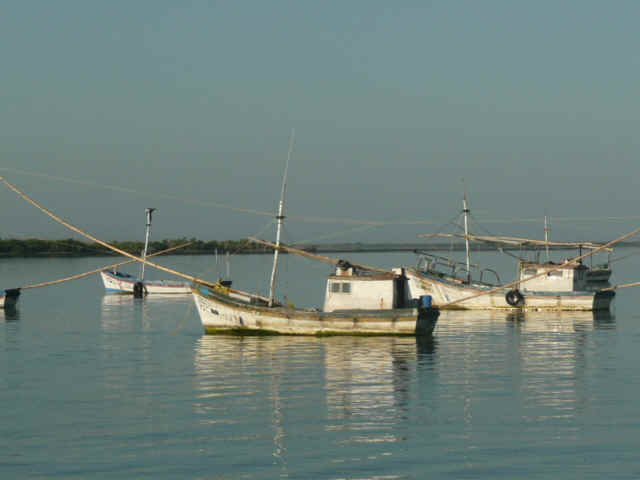
The bay,
with fishing boats, at Ubatuba. along the southern coast of Brazil.
The last place where we stayed during our March '08 Brazil Tour.
(Photo during the tour by Sally Brady)
******************************************
The following birds, from the portions
of our tour in Minas Gerais & Mato Grosso do Sul, were voted by the tour
participants as the "Top Birds" of our March '08 Brazil Tour. Most
have been mentioned in the preceding narrative.
1 - Crowned Solitary Eagle
2 - Brazilian Merganser
3 - Cock-tailed Tyrant
4 - Red & Green Macaw
5 - White Woodpecker
6 - Toco Toucan
7 - Southern Lapwing (voted for the noisy big flocks that rose up
from dirt road at night in the Pantanal)
8 - Short-eared Owl
9 - Guira Cuckoo
10 - Blue-and-yellow Macaw
11 - Jabiru
12 - Red-legged Seriema
13 - Blue-black Grassquit (voted for as the "Jumper", doing its
display on fence wires)
14 - White-rumped Tanager (a specialty of the grasslands, at Canastra)
15 - Greater Rhea (or the "Ema")
The Crowned Solitary
Eagle,
seen during our March 2008 Brazil Tour,
the "top bird" of the tour.
One of a pair of eagles we saw together.
(photo by Marie Gardner)
![]()
Links:
List of Birds during our Japan Tour - January '08
List of Birds during FONT Japan Tours in 2008
Cumulative List of Birds during our Japan Tours
Rare Birds during FONT Tours in Japan
Upcoming FONT Japan Birding & Nature Tours
The following account was written by Armas Hill, leader of the tour:
"Our Tour with Blakiston's Fish Owl, Eagles, Cranes, Mandarins, &
More"
Our 30th FONT birding & nature tour in
Japan took place
January 8-21, 2008. During that tour, again, as there have been during such
tours in the past, a number of nice birds were seen, and memorable experiences
were had, as we traveled about the
countryside. Those travels were on the three main Japanese island of Honshu,
Hokkaido, and Kyushu.
Highlights were many. Foremost among them were, as always, the cranes and the
eagles on both the northern island of Hokkaido and the southern island of
Kyushu. Many Steller's and White-tailed
Eagles, and the Japanese, or Red-crowned
Cranes were enjoyed by our group on Hokkaido. On Kyushu, we were treated to 4
species of Cranes (White-naped, Hooded, Common, & Sandhill) and a single
rare Eagle for Japan, a Greater Spotted.
But tour highlight that was probably the best of them all was our experience on
Hokkaido with the very big & very rare Blakiston's Fish Owl.
At dusk, one day, we were where we should have been to see this owl named after
Captain Thomas Wright Blakiston. We were ready.
Mr. Blakiston was a consul and a businessman from England who went to Japan,
specifically southwest Hokkaido, in the mid-1800's, immediately after the
"opening" of Japan to foreigners. During about 20 years that he was
there, Blakiston enthusiastically pursued an interest in describing the avifauna
and the zoological features of that northernmost Japanese island of Hokkaido. In
Japan, the owl named after Blakiston, only occurs on Hokkaido, where, due to its
habits and habitat, it is very rare. Another population, also small, occurs on
mainland Asia in Siberia.
The Blakiston's Fish Owl is very large, with a wingspan of about 2 meters
(that's 6 feet). It's been said that the female is the largest of the world's
owls. As big as 71 centimeters in length, it's larger than the Eurasian Eagle
Owl. And bigger than these other large owls elsewhere in the world:
the Verreaux's Eagle Owl, of Africa, up to 65 centimeters,
the Pel's Fishing Owl, of Africa, up to 61 centimeters,
the Shelley's Eagle Owl, also of Africa, also up to 61 centimeters,
and the Tawny Fish Owl of southern Asia, up to 58 centimeters.
As noted, the huge Blakiston's Fish Owl is also very rare. In Japan (Hokkaido
only), there may be population of 100 to 120 birds. On mainland Asia, there may
just be a few hundred.
So, as I said, late that day on Hokkaido, as darkness was falling, we were ready
to see it. We had already experienced, the previous day, a flock of over a
hundred Red-crowned Cranes walking about in stately fashion on the snow.
Earlier, during the same day that we were in place to see the owl, we had seen
some magnificent Steller's Sea Eagles. That is certainly an appropriate adjective for
that huge and striking bird that comes to Hokkaido during the winter from the
Siberian wilderness to the north. And so, yes, even we had already seen some
wonderful sights, we were ready for the third part of the Hokkaido "Avian Big 3", the owl.
As ready as we were, however, that day it was not to be. As we waited, and as
the sky got darker, a Ural Owl flew by us. And it was the only owl that we saw
that day.
Therefore, we opted to stay an extra day on Hokkaido, which was fine as that
island does offer some of the best wintertime birding anywhere. During our
additional day, we continued to have good experiences, again with Steller's and
White-tailed Eagles, and with a fine assortment of waterbirds (such as
Whooper Swans, various ducks, and gulls). The settings in which we saw these birds added
to the experience. The winter scenery was superb.
As the day ended, we were back again at the same place where we had hoped to see
the Blakiston's Owl the previous day. Would it be different?
Even though we stuck with pretty much the same strategy, it was quite different.
All of a sudden, a big Blakiston's Owl appeared, near us, on the top of a
utility pole. Then, there was another! A pair of the owls was with us, a female
and a male (the male is large, but female is larger). We got out of our vehicle
and stood quietly outside. Both of the owls flew right above us, with their big
forms against the beautiful twilight sky. The owls, though, to us, were more
beautiful. To be by such creatures was a thrill. Like the eagles, they were also
magnificent! But, the experience was all the more outstanding, as we had missed
the bird the day before.
The owls stayed with us, as they were perched nearby on posts and branches. We
could see well their features - their feathers, their tufts, their eyes, their
talons. And we heard them too. The pair called in duet, with the voice of one
deeper than than that of the other.
We were so glad that we had opted to stay that extra day on
Hokkaido.

Blakiston's Fish Owl
With our January '08 experience, the Blakiston's Fish Owl has continued to be
found during every late-fall & winter FONT Japan tour. Our record is now 19
sightings during 19 such tours.
Seen during every FONT tour in Hokkaido, Japan, has been the
Red-crowned Crane, the second rarest of the 15 species of the world's
cranes, after the Whooping Crane of North America. Mention has already been made that we saw over a hundred of these tour and
elegant birds during our stay in Hokkaido, as they walked about on the snow. We
also observed them as they flew and as they fed. We watched and listened as they
made their loud calls, as cranes do. We saw them occasionally dance about on the
snow. Although during winter the cranes form flocks at places where they feed,
it was apparent that in the group of birds, as we watched, that there were
paired adults and some adults still with their young birds of the year.
We had a very nice afternoon with the cranes.
A young man at the "crane
interpretive center" gave us (in English) a tremendous amount of
information about the birds.
An older man, at about 2pm, wandered out on the snow among the cranes, and as
he's done for years, he threw small fish onto the ground. The cranes there also
feed on some grain, but it was apparent that they looked forward to the man's
daily walk with the fish. Prior to it, there was, among those birds, notable
anticipation (even though none of the older birds were wearing a watch, and none
of the younger birds had a mobile phone with a digital clock!).
Other birds in the area also anticipated the afternoon feeding. White-tailed
Eagles appeared, as if on cue. They swooped down to the ground, snatching up
some of the fish. Black Kites did as well. Whooper Swans, that
were on the
snowy ground near the cranes, flew away when the man, with the bucket of fish,
entered the field.
The cranes, by the way, held their own, with the eagles. Both
of them, of course, are large birds, but we could see that the cranes were not
intimidated by the eagles.
No Steller's Sea Eagles came in to the afternoon
spectacle of birds at feeding time, but both adult and juvenile birds were seen, as
they flew by.
Large-billed Crows, when seen on their own, appear large - not only their bills
being so, but overall. However, when in the company of eagles, cranes, kites,
and swans, the crows that were on the scene seemed rather small.
It was a wonderful afternoon for us, during that day in Hokkaido, at the crane
site.
And it was particularly nice when we reflected that the beautiful creature that
we were seeing, the Japanese Crane, was at one time so very close to
extinction. Back in the 1920's, the total population of Red-crowned, or
Japanese, Cranes in Japan was only about 20 individuals, all of them in
southeastern Hokkaido. Today, in Japan, they are still only in that one part of
the country, but now the population numbers about 1,000 birds. They are Hokkaido
residents, that throughout much of the year occur mostly in marshy places where
they breed. Pairs have their sizable territories. In the winter, they form
flocks (as we saw during our tour) at a few (3 or 4) particular places. It has
been the winter-time feeding, over the years, of grain and fish, as noted above,
that has caused the increase in the population, also just noted, during recent
decades. Another significant factor has been the removal of high tension lines
in areas frequented by the cranes.
Just over 15 years ago, at the time of the first FONT tour in Hokkaido, Japan,
in 1992, the total number of Japanese, or Red-crowned, Cranes was 557. As of
this year, that population has nearly doubled. In 2006, the number of these
cranes counted in Hokkaido was 1,013. When I first visited Hokkaido in 1982, and
saw my first Japanese Cranes, the population was a mere 320 birds. How good it's
been that the bird's numbers have increased since! And, for me, personally, each
time that I've seen them since, it's really been a
thrill.
Also thrilling, during each visit to Japan, has been every encounter with cranes
in the winter at the opposite end of country, on the southerly island of
Kyushu.
Again, in January 2008, we had a good day there with the thousands of cranes
that come each winter from mainland
Asia. It's about 12,000 cranes that come annually. Of them, just over 10,000 are
Hooded Cranes. About 2,000 of them are White-naped Cranes. Both are nice to see,
but with their elegant appearance, the White-naped Cranes are especially so.
During the one census conducted of the Kyushu cranes during the '07-'08 winter,
10,973 Hooded Cranes were tallied. That's up a bit - and that's good, as nearly
all the world's Hooded Cranes winter in that one portion of Kyushu.
The tally of White-naped Cranes, during that census, was 1,019. That's a bit
down. But a few more may have come after that count done in December. A second
and third winter census was not conducted in early '08 due to bad weather. But
during the day that we were there, in January '08, the weather was wonderful -
as was our day.

During our
January '08 Japan tour, we had a good group,
with tour participants from California USA & Australia,
and we also met, as we have previously during our tours in Japan,
some nice local people along the way.
One such person is the man (in the photo above)
who feeds the Red-crowned Cranes in Hokkaido (in the photo below).

Another such
person is the man (at left, in the photo below)
who operates a restaurant in Kyushu
where the cranes are there (in the bottom photo).
FONT tour leader, Armas Hill (at right, in the photo below)
has been to that restaurant numerous times.

A group of White-naped Cranes on Kyushu.
During our time
with the cranes on Kyushu, we saw 4 species in that family. In addition to the
Hooded and the White-naped, we saw a Common Crane and 2 Sandhill
Cranes. Every
year, during the decade and a half that we've been seeing cranes on Kyushu, a
few stragglers of these two species have been present. Both species come
with the Hooded and White-naped Cranes from mainland Asia.
The Common Crane breeds at various places across the wide land expanse of
Eurasia. There are two subspecies, basically one westerly, in Europe, and
another further east, in eastern Asia. The second of these is the subspecies
that occurs in Japan. It was described as a subspecies in 1894, over a hundred
years after the nominate, or western, race was described by Linnaeus in Sweden,
when the modern-day system of avian classification began in 1758.
The Sandhill Crane is thought of as a North American bird, and that it is, but a
fairly sizable do nest each year in Asia, in eastern Siberia. Nearly all of
those birds, after breeding, fly eastward to North America. Actually, in
general, those that nest the furthest west in Eurasia migrate the furthest south
in North America, even as far south as Mexico. Every year, however, a couple
Sandhill Cranes come south to Japan to spend their winter - not quite as
"outcasts", but usually toward the edge of the large crane flocks.
The Japanese name for the Sandhill Crane is "Kanada-zuru".
"Zuru"
is a word for "crane". Of course, Sandhill Cranes are quite numerous
in Canada, during their nesting season. However, those Sandhill Cranes seen
about annually in Japan have most likely never been in that North American
country. Two Sandhill Cranes were present with the other cranes in Kyushu in
January 2008. We saw both. They were not together.
Not in Kyushu, Japan, during the winter of '07-'08, were either the rare
Siberian Crane or the Demoiselle Crane. Both have occurred, and have been seen
during FONT tours, in recent years. But not this
time.
After we enjoyed most of a day with the masses of cranes on Kyushu, we traveled
a few kilometers south with the intention of seeing a rarity in Japan, a Greater
Spotted Eagle. We had learned, at lunch, from the man in the photo above, at the
restaurant, that a single bird was present there again, having been seen just a
day or two earlier. From him, we got directions, and even though we didn't have
much time, we were on our way.
The plan was to drive the 40 or so kilometers to the appropriate place and,
during a short allocation of time, see the bird.
The Greater Spotted Eagle is a globally threatened species, classified as
"vulnerable" by the Birdlife International. Its range is vast, across
Eurasia, but there are not many birds. A recent estimate is of less than 10,000
adults. The breeding range is large, but highly fragmented. The species winters
in over 30 countries, and occurs as a vagrant in another 20 countries, including
Japan.
The single, wintering bird which we sought in Kyushu may well have been the only
Greater
Spotted Eagle existing in Japan when we saw
it!
But I'm getting ahead of myself. Yes, we did see the eagle. After the drive, we
were nearly sure that we were at the right place, but we wanted, as the
afternoon was waning, to be absolutely sure. So we stopped at the post office,
in the little town, to ask (bearing in mind, of course, that I speak mostly
English, and the postal employees there speak mostly Japanese). But it was
"no problem", as "they say", in that regard. When I
inquired, with a bird book and body language, they immediately said "Washi",
the Japanese word for eagle. All of the postal employees knew about the
bird.
As I was in the post office, a car pulled up next to our vehicle in the parking
lot. The people in the car also knew about the "Washi", and they told
us to follow them to the proper spot to observe it. And that we did, and then
within seconds, we saw the large bird, soaring about in the sky above a wooded
ridge.
Actually, some of our group, had already spotted it from the post office parking
lot, but from there it was further away. Thus, the Greater Spotted Eagle was
just that - "spotted" - and it was one that was "greater" as
well, as we only had but a few minutes. Being late in the afternoon, after 3:30,
with the thermals over the hills disappearing, it was good fortune to have the
fine look that we did of the rare raptor for about 10 minutes, as flew about in
the sky.
During two previous FONT tours, we had seen the Greater Spotted Eagle, actually
at the same place. But that was back in the 1990's. Yes, the place was the same,
but was it the same individual bird? For a few years, it's been said that a
single bird has wintered there. But how long does it live? In a nice new
Japanese bird book (in English), there are photos of the Greater Spotted
Eagle,
both adult and immature birds, and both said to have been photographed at the
place where we were in Kyushu.
Our quick visit was fun - to the little town where "everyone" knew of
the eagle from Asia that comes each winter to the nearby hills. Again, it's
known there as the "Washi". The complete Japanese name of the bird is
"Karafuto-washi".
That of the White-tailed Eagle that we saw well in
good number on Hokkaido is "Ojiro-washi". That of the
Steller's Sea Eagle, that was so great for us to see on Hokkaido as we did, is
"O-washi".
I think that's because whenever one sees that species well, one can't help but
utter "O" something - usually "Oh, my!"
"O-washi" is a great name for a great bird. Steller's Sea Eagles are
magnificent and impressive creatures to watch. Not only are they very big, and
with a striking plumage, and with a huge yellow bill, they are truly symbols of
the wild north. All of those that come to Hokkaido in Japan in the winter are
from a rather restricted area of eastern Siberia, where they breed. Overall, the
species is not common, as its estimated total population is said to be only
about 5,000 birds and declining.
It was nice during our January '08 tour, to see 3 species of eagles, or
"Washi"s,
once again, as we did in Japan twice before, back in the last decade, when we
also then saw the Greater Spotted.
(A note: During the FONT tour in Japan, just prior to Jan '08, in Dec 2007, we
were fortunate to see 3 "big raptors" all on Hokkaido: the 2 Eagles,
the White-tailed and the Steller's, and another large perched bird - a
Mountain Hawk-Eagle.
The female that we saw, of the latter, was big. Females are about 20 per cent larger
than males. And the Japanese race is about 10 per cent larger than the race on
mainland Asia.
The length of the female Mountain Hawk-Eagle, in the same genus
as the Ornate Hawk-Eagle in Latin America. is as much as 84 centimeters. That of
the female White-tailed Eagle is 92 centimeters. That of the Steller's Sea Eagle
is up to 105 centimeters. The length of the Greater Spotted Eagle, by the way,
is as much as 71 centimeters.)

A Steller's Sea Eagle, out on the ice, in Hokkaido
Many of the birds
already noted in this narrative have been the "big ones", such as the eagles,
cranes, and the owl. But during our January '08 Japan Tour, more of
the smaller birds were seen than usual during on time on the northern island of Hokkaido.
Generally, not many such nor many individuals are seen there in the winter,
particularly away from the coast. But in the "Passerine department", aside from the Corvids (the 2 species of crows,
the Raven, and the Eurasian Jay), we encountered
over 20 species of smaller birds as we traveled about Hokkaido.
Notable among them were some flocks of Bohemian Waxwings, along with more
Dusky Thrushes than usual, Asian Rosy Finches (at a few
places), and a large flock of Common Redpolls, with about 200 of them
in that one flock in some bushes and trees at the edge of a large farm
field.
Also notable, and unexpected, was a single Eurasian Skylark with that
flock of Redpolls. It was first Eurasian Skylark ever for us in
the winter in Hokkaido. We assume that one bird came from further north, in
Siberia, and that it was not a bird of the Japanese race.
Also, among the smaller birds for us in Hokkaido, was a single White Wagtail
at a rivermouth along the coast, and a flock or two of Grey-capped
Greenfinches (a bit unusual) on a coastal barrier island, where also, by
some homes, there was a single Rustic Bunting. The Rustic Bunting,
by the way, during our tour was therefore one of handful of birds seen on all
three of the islands that we visited: Honshu, Kyushu, and Hokkaido. That's
happened for us before with that species, but it's unusual.
Also in the small-bird category, the Brown Dippers that we saw on
Hokkaido were expected, as were the various Tits: the Great, Marsh,
and Varied, along with the Eurasian Nuthatch (a pale race on
Hokkaido), and the Brown-eared Bulbul. The last of these (like the
Rustic Bunting) was seen during our tour on "all 3
islands" as were the Dusky Thrush and Eurasian Tree Sparrow.
But that's to be expected.
In the woods, not really unexpected, but nice to see, were a number of Hawfinches
and Bramblings.
Hokkaido is a good place for woodpeckers. It's the only island in Japan
with the Grey-headed Woodpecker that we saw. Also seen were the Great
Spotted Woodpecker and the Japanese Pygmy Woodpecker. The Black
Woodpecker (only in Japan on Hokkaido) was
heard.
Japan, in the winter, is a wonderful place for waterbirds, one of the
best anywhere in the world. About 30 species of waterfowl winter in
Japan, totaling several million birds. During our January '08 tour, we saw most
of the species, and, indeed, many individuals.
Reference has already been made here to the winter-time feeding of the cranes
in Hokkaido, with some other bird species also partaking in the banquet. Such
feeding of birds has, for years, been a rather characteristic Japanese feature,
and continues so today.
On the main Japanese island of Honshu, at
the beginning of our tour, we visited a small pond in the countryside that in
the winter is filled with waterfowl, mostly ducks, but also some Whooper
Swans. During previous FONT tours, we had seen a few Baikal Teal there,
but there was no such good luck for us there this time. Years ago, the Baikal
Teal was a common winter visitor in Japan. During recent decades, however,
that species has drastically declined in Japan, with it now being in just a few
favored areas.
At the small pond, however, we did have the good fortune to see closely some Falcated
Ducks, another species of waterfowl with the drake being a beautiful
creature.
The feeding of birds just alluded to a moment ago takes place at that pond every
afternoon. The feeding-time is 3pm, and, at that time, we were there. When those
who throw the grain onto the water do so, there was bedlam among the birds,
including not only noisy swans, but an assortment of ducks. In
addition to the Falcated Ducks, there were many Northern Pintails
and Eurasian Wigeon, along with some Tufted Ducks and Common
Pochards. There were some other species too, and 3 drakes that appeared to
be American-Eurasian Wigeon hybrids.
Some of this mass of ducks were so enthusiastic about eating, that they
literally, and quickly, flew around us and other people at the edge of the pond
in their fervor.
And it's interesting that these are really wild ducks - having come from
places to the north, mostly in Siberia, that are truly quite wild, and where
there are very few people. During most of their year, they probably encounter
nearly no humans, and when they do, in Japan in the winter, they are people who
feed them - every day at 3pm.
Another thing interesting, that we couldn't help but notice there at the pond,
when the birds were being fed, was that the large number of Mallards
there kept their distance, out on the water. They did not join in the feeding
frenzy. Those Mallards appeared to be more "on the wild side" than
many seen at other places in the world.
Further north, on colder Hokkaido, there
were other places where we visited that bird-feeding was a daily activity.
On a large lake, away from the coast, there were dozens of Whooper Swans.
As just noted, Hokkaido is colder than Honshu, but it (Hokkaido that is)
can be even colder than it was for us in January '08.
It was a beautiful day for us at that lake with the Whooper Swans, with a blue
sky, and nearly no ice. The lake can be (and has been for us during other tours)
nearly completely frozen.
Famous photographs of the Whooper Swans on open water, in the mist, and with the
snow, have been taken at that lake. Those hearty swans are only there in the
winter. Their nesting grounds are in Siberia, as are those of so many of the
birds that we see in Japan during our winter tours.
When the swans at the lake are fed, they call. And they call loudly. I guess,
more aptly, they "whoop", as, after all, they are "Whoopers".
When I hear them, I wonder (as odd it may be to do so) how it is that the
swans of Eurasia are called "Whooper", while the cranes in North
America, that give their loud call, are called "Whooping".

Whooper Swans
At another
bird-feeding spot in Hokkaido that we visited along the eastern seacoast, there
were also Whooper Swans, also loudly calling, and a number of ducks.
The composition of the waterfowl was different than what there was at the small
pond on Honshu. At the Hokkaido spot, there were, in closely, Common
Goldeneye and Greater Scaup, in addition to Northern
Pintails and Mallards.
The spot for popular for parents, bundled in clothing, to bring their children,
smaller people also bundled in clothing, on a holiday, actually "Children's
Day". As the bird-feeding was going on (it seemed continuous at
this cold Hokkaido location), there was constant commotion among the birds.
In addition to the swans and the ducks, there were Gulls,
with Glaucous, Slaty-backed, and Vegas close at hand. I couldn't
help but think of how in North America, birders would travel to get a look, even
at a distance, of these birds, and that there, at this birdy Hokkaido spot, we
could nearly touch them.
Nearby, on branches in some bare trees (and not within touching-distance), there
were some White-tailed Eagles. Again, for us, we were at quite a place.
Some species of ducks just don't come in to the feeding - ever. Along
that eastern coast of Hokkaido, always in the surf, there were Harlequin
Ducks. Really no species of waterfowl is as boldly and colorfully patterned
as the male Harlequin, That day, we saw many - scores of them.
Beyond the surf, we saw numerous scoters. Most were American Scoters,
with the males having an all-black plumage, and an orange bill. Some were White-winged
Scoters. It's interesting that while most of the Japanese waterfowl are
of the Eurasian ilk, the two species of scoters are, instead, those of
North America. The White-winged Scoter is a regional subspecies of the North
American bird, called the "Stejneger's White-winged Scoter",
named after one of the first western ornithologists to study Japanese birds,
back in the nineteenth century.
Like the Harlequins and the Scoters, the Mergansers never
come in to where the people feed the birds. Along the eastern Hokkaido coast,
there were both Common and Red-breasted Mergansers.
At a particular place I knew to be good for another merganser, the Smew,
we saw a pair. But it took some doing. The river where I've seen them in the
past was frozen solid, all the way to the ocean. But nearby, on the ocean itself,
in the surf, the bright, mostly white, with some black, male was seen riding the
waves with the red-capped female by his side. The pair was among a group other
mergansers. When a White-tailed Eagle flew by in the sky above, the two Smews
were the first ducks to fly away.
Many of the waterfowl species during our tour have now been noted. But a
couple more notable species remain to be mentioned, one on Hokkaido, and one on
Kyushu.
Probably the most exquisite of all the ducks we saw was the Long-tailed
Duck. At a Hokkaido harbor, and with beautiful afternoon light shining upon
it, a male Long-tailed Duck, close to us on still water, was superb. Even though
there were so many extraordinary sightings during the tour, it was thought, at
the time, that this was one of the best. What a brilliantly beautiful bird it
was!
That late afternoon light in that part of Hokkaido was truly wonderful. It's a
place on this Earth where the air is really so clean, being as far as it is from
any pollution. And so, in that cold and clear environment, the features of the sky,
both by day and night, can be vivid. In between, at twilight, the colors
above us and around us were marvelous.
On the southernmost Japanese island that we visited, Kyushu,
there was the other notable species of waterfowl of our tour. Along a
particular river there, we saw, and yes - we enjoyed seeing, the Mandarin
Ducks. All of the adjectives that have already been used in this narrative,
in relation to waterfowl, can be used again pertaining to the Mandarin:
"brilliantly beautiful; boldly and colorfully patterned; and
exquisite".
"Mandarin", itself, is from the Sanskrit word
"mantrin", meaning "counselor".
In the mid-1500's, that word was applied to Chinese officials, as a term used by
foreigners to describe the handsomely attired senior officers of the Chinese
government.
The duck, itself, is truly of the "Far East". Its native range
is only in easternmost Asia: in not just China, but further north, breeding in
the Russian Ussurland and Kuril Islands, and in northern Japan.
The Mandarin Duck has been known as the "pearl of
Manchuria". In Russia, it's known as "Manadarinka".
It's called "Yuen Yang" in
Chinese, while in Japanese it's called "Oshidori".
In Japanese art, as early as the 8th Century, the Mandarins were depicted, as
they have been since on screen paintings, showing faithful males and females
together.
While the Japanese, or Red-crowned, Crane in Japan symbolizes
happiness and longevity, the Mandarin in Japan represents the enduring
qualities of loyalty and fidelity. The Mandarin drake and hen have been believed
to be strongly monogamous.

A Mandarin drake & hen
In China, nowadays, very few Mandarin Ducks are to be found in the
winter. But, that's not the case in southern Japan, and particularly on
Kyushu.
A few years ago I found that during the winter along the particular river,
referred to above, in southeastern Kyushu, there were a least a few thousand Mandarin
Ducks, along the upper reaches of that river in the wooded hills. The
species was the prevalent, and, at some places, the only species of duck along
that stretch of the river. And I found that those Mandarin Ducks were about as
"wild" as ducks could be. The small groups of ducks, along that river,
would immediately fly away, as people got out of a vehicle, on the road at a
long distance from the ducks that were either swimming on the river or tucked on
and under the branches by its edge. It happened every time, and the birds give
would their distinctive calls as they flew.
These were not birds such as those in city parks. We used to visit the Mejii
Shrine in Tokyo to see the Mandarins
there at a pond in the park. But seeing the "wilder Mandarins", in
large numbers, along the Kyushu river, has
been so much more of an experience.
Those ducks in Kyushu may come each winter from the wilder areas of mainland
Asia - in Ussurland, or from those northerly Kuril Islands. Or, maybe, they come
from northern Japan. Wherever, they come from, there are many.
A census of Mandarin Ducks wintering in Japan in 1992 tallied a total of
about 20,000 birds. The figures from that annual census in 1995 give the number
of wintering Mandarins in the Miyazaki Prefecture of Kyushu as 796 birds.
The Kyushu river we've visited for the Mandarins is in that Miyazaki Prefecture. (A
Japanese prefecture is rather like a US state.)
But the 800 or so birds just
given for the entire prefecture must be a low figure, as along that one river,
during one afternoon, during one of our tours, we counted about 3,000 Mandarin
Ducks - and that was without doing, in any way, what would be a proper census.
It was wonderful to see Mandarin Ducks, along that Kyushu river, again,
during our January 2008 tour! We didn't tally as many as 3,000, but we saw quite
a few. Due to some construction along the riverside road, that would have caused
us a significant delay, we didn't go as far upriver as we normally have.
Downriver, along that river in southeastern Kyushu. however, we saw, during our
January 2008 tour, some other wonderful birds. Near where the river flows into
the Pacific Ocean, there were both Black-faced and Eurasian Spoonbills.
The combined flock, with both species, was about 10 birds. Both Spoonbills
occur in Japan only in the winter. The Black-faced Spoonbill is one of
the rarest birds in the world, with a total estimated population of about 700
individuals.
A bird rare for Japan was also seen during our January 2008 tour by the mouth of
that Kyushu river. A single Pied Avocet was there, and with it, there was
a single Black-winged Stilt. Both the Avocet and the Stilt
were "new birds" for FONT for Kyushu, being numbers #196 & #197
for us for that island.
That was how we ended our tour. At the beginning of it, back on the main
Japanese island of Honshu, we birded one day
along another river. That day was a good one for us, there, for raptors.
We saw a nice number of Harriers, of 2 species: the Eastern Marsh,
and the Northern.
They were in addition to numbers of Osprey, Black
Kites, a Peregrine Falcon, Common Buzzards (the endemic Japanese
subspecies, japonicus), and a single hovering Rough-legged Buzzard
(as it's been known in the Old World). The Rough-legged Hawk (as
it's been known in the New World) was a "new bird" for FONT for
Honshu, #302 for us for that island.
Near where that river in Honshu flows into the Pacific Ocean, a small Japanese
city is a major fishing port. And during the winter, by where the fishing boats
dock riverside, there are huge numbers of gulls. We could get close to
them there, as, in addition to being on the water, on long concrete walls, and
in the air, the gulls were near us on boats, the payment, and rooftops. We saw,
during our afternoon there, 7 species of Gulls in an variety of plumages:
Vega, Black-tailed, Common Black-headed, Common (or Mew),
Slaty-backed, Glaucous, and Glaucous-winged. Perhaps the most
interesting observation was of a group of about 20 Common Gulls (of
the "Kamchatka race") in a tight flock, as they
floated in the air just above the river (so low to the water in fact that
their dangling feet were touching it). When doing so, the birds dipped their
bills into the water as they fed apparently on very small fish. The gulls
appeared, in unison, to be walking on the water much as storm-petrels appear to
do.
Not storm-petrels, but some gulls were seen during our pelagic trip
onboard a large ferry-boat from Honshu to Hokkaido. It was an overnight
trip, continuing as we traveled north on the Pacific Ocean during much of the
next day. We've done such a trip many times, often seeing numerous seabirds, but
unfortunately this time, there were not many birds. The boat itself was fine,
and it really was nice experience to ride on the ocean toward Hokkaido.
But, just a few gulls of various species were to be seen, along with the most
pelagic of gulls, the Black-legged Kittiwake. We saw a couple hundred of
them. The previous month, during our December '07 tour, from the ferry we saw
some Laysan Albatrosses. Not so, for us, in January '08.
The previous year, in January '07, from
the ferry we saw numerous alcids: murres, murrelets, auklets, guillemots, and
the like. Again, it was not so, for us. In fact, in January '08, not a single alcid was to be
seen, even though we looked and looked.
But we were able to look ahead - to our good birding, that we certainly were to
have, on the island of Hokkaido, with the cranes,
eagles, and the owl.
It was on Hokkaido where we saw the 4 mammals of the tour: Red Fox, Red
Squirrel, Sika Deer, and Harbor Seal.
For sure, it wasn't just the birds, told of here, that made our January '08 the
good tour that it was. The tour was also as enjoyable and interesting as it was
due to our contact with the Japanese people and their culture.
At night, we either slept on a bed, or on a tatami,
a mat on the floor.
In our hotels, we could wear a robe known as a yukata.
When we bathed, we used the O-furo, or
"hot bath".
Our traditional Japanese towel was known as a tenugi.
At meals, we ate either with western utensils, or with O'hashi,
chopsticks.
Sometimes we had our meals at a general-menu restaurant, known as a shokudo,
with either Japanese or Western style dishes. Japanese food included various
noodles, and those of us who wished to do so had raw fish and other fresh
seafoods.
Other Japanese food included:
tempura (seafood and vegetables dipped in
a batter, and deep-fried in vegetable oil),
yakitori (chunks of chicken and onion
charcoal broiled on skewers and dipped in sauce),
tonkatsu (pork or other meat, breaded and
deep-fried)
katsudon (cutlet with egg over rice in a bowl)
kamameshi (steamed rice in fish bouillon,
seasoned with soy sauce, and laced with some bits of chicken, beef, or pork, and
mushrooms, bamboo shoots, peas).
Bowls of rice were topped with such things as pork, beef stew, curry-flavored
stew, and eggs were cooked with a slice of chicken, onions, and other vegetable
tidbits.
Among the specialties we ate there were: Sweet potatoes, rice crackers (senbei),
and chicken on a stick (yaki tori).
And of course, there was tofu and tea (green tea, that is).
And, lastly, it was how we traveled, on "back roads" into the towns,
villages, and in the countryside, more often than not away from the cities, that
made the tour for our group, very much the all-encompassing experience that it
was.
![]()
Lesser
Antilles (Saint Lucia, Saint Vincent, & Dominica)
December 2007 / January 2008
Links:
List of Birds during our Lesser Antilles Tour - Dec '07 / Jan '08
Cumulative List of Birds during our Lesser Antilles Tours
Rare
Birds of the Caribbean today & those that have gone extinct
Upcoming
FONT Caribbean Birding & Nature Tours
The following account was written by Armas Hill, leader of the tour:
This was the FONT Annual Holiday
Tour for Dec/Jan 2007/2008, to the Caribbean islands of Saint Lucia, Saint
Vincent, and Dominica.
During the last days of 2007, we were in Saint Lucia
& Saint Vincent.
The year 2008 began for FONT on the island of Dominica.
Each of the three Lesser Antillean islands just mentioned has, in relation to
birds, something in common. And that is that Parrots, in particular Amazons,
endemic to those islands, continue to live there.
At the time of Columbus's voyages in the Caribbean, there were, on various
islands, 11 species of Amazon parrots, and even on some islands, macaws, larger
than parrots. No macaws exist any longer on any Caribbean island. They were on
various islands in both the Lesser and the Greater Antilles. The last of the
Caribbean macaws disappeared in Cuba in the mid-1800s. Of the 11 species
of Amazons that existed in Columbus's time, 2 are now extinct (one each on the
two French islands of Guadeloupe and Martinique), and 1 is severely endangered
(on Puerto Rico).
Overall, however, (aside from the Puerto Rican Amazon), the species that have
been in the most peril have been those in the Lesser
Antilles.
The rare Imperial Parrot, Amazona imperialis, of Dominica
(known there as
"the Sisserou") has a plumage that resembled the Amazon now extinct on
the nearby island of Guadeloupe. It's the largest of all the Amazon parrots. In
the Western Hemisphere, there are 31 species of Amazons in the Caribbean and in
Central & South America. The Imperial Parrot was one of the last Amazons
described to science, and one of the last birds to be described in the
Nineteenth Century, in 1899.
Dominica's Imperial Parrot is rare. Not ever common, it was declining
until the 1990s. At the beginning of that decade, the total population was said
to be 50 birds. Through the 1990s, there was an increase, until today, when it's
said that are about 250 individuals.
The other Amazon that's endemic to Dominica is the Red-necked Parrot,
Amazona arausiaca. That attractive parrot is also called the
"Bouquet's
Amazon". In Dominica, it's known, by the local people, as either the "Jaco"
or the "Perroquet". It was described to science as early as 1776.
Today, the population of Red-necked Parrots is said to be between 500 and 1,000
birds.
During our Dec 07/Jan 08 tour in the Lesser Antilles we saw both the Imperial
and the Red-necked Parrots when we were in Dominica (in January), and both the
Saint Lucia and the Saint Vincent Parrots when we were on those islands
(in
December).
The Saint Lucia Parrot, Amazona versicolor, is known to the people on that
island as the "Jacquot". It is the national bird of that island
country. The children are taught about it in school, and nearly all of the
people with whom we spoke on the island knew of the bird. The educational
program in the schools was initially carried out by a friend of ours that we
used to meet during our St. Lucia tours in the 1990s, when he lived in that
country. He no longer does, but we have good memories of Paul Butler, who, for
years, was affiliated with the conservation organization known as RARE.
Even though we weren't able to see Paul, during this our 15th FONT tour on Saint
Lucia, we saw, once again, as we always have, the Saint Lucia Parrot
flying
about late in the day in the forested hills.
The total population of the Saint Lucia Parrot is now said to be between 350 and
500 birds. It can safely be said that conservation efforts, as those just
alluded to, have saved this species from extinction.
Maybe the Amazon that we enjoyed the most during our 07/08 Holiday Tour was the
Saint Vincent Parrot, Amazona guildingii. Another name for it has been the
"Guilding's Amazon".
Whatever it's called, it's a brilliantly colorful bird with some white, yellow,
blue, and bright orange-yellow in its plumage. Its habitat is moist forest in
the hills.
During most of the 20th Century, the population of the bird declined. In the
1980's, it was as low as about 400 birds. Since then, with conservation efforts,
the population has increased to now maybe about 800 individuals.


The colorful Saint Vincent
Amazon,
photographed during the FONT tour in December 2007.
Above: a captive bird in the botanical garden.
Below: in the wild, in the forest.
(photos by tour participant, Marie Z. Gardner)
While in Saint Vincent, we visited a places called
Vermont and Montreal. No,
Vermont wasn't a place with maple syrup and ski slopes. And no, Montreal was not
a large city.
Vermont (or "Green Mountain") was where we saw the parrots, and some
other birds too, in what was a moist forest when we were there. But, yes, we did
enjoy seeing those parrots flying about in the wild, and even perched closely in
a nearby tree, after the rain stopped and as the late-afternoon sun brilliantly
shone on the birds.
Montreal was not really too far from Vermont. It was actually on the "other
side" of the hills from the parrot. I say "Montreal", but it was
actually Montreal Gardens, a nice place with some nice birds including the
Lesser Antillean Tanager (a species restricted to only the two Lesser Antillean
islands of Saint Vincent & Grenada), and rare Whistling Warbler (endemic
to Saint Vincent), and the Brown Trembler (an aberrant thrasher
with yellow eyes
and a long bill that appears to "tremble" as it continually shakes its
wings).
Some other places where we were on St. Vincent are worth a mention. Our
overnights were in the largest town on the island (but not really large) -
Kingstown. The neat old cobblestone building near the port was, years ago, a
sugar warehouse. In the 1970s it was made into a nice hotel. We were there on
New Year's Eve, and even though we were in town, it was about as quiet a place
for New Year's Eve as there could be.
Nearby, earlier on New Year's Eve, we had an evening bite to eat at an outside
courtyard of another hotel, the Heron Hotel. As we ate, a Green Heron walked by,
next to us, in what was not much more than a little drainage ditch. Across the
street, a Little Blue Heron flew into a tree. Evidently, that hotel, in the
middle of Kingstown, was aptly named.
A day or so earlier, there was still an air of Christmas, as we went about.
Again in Kingstown, outside an old church, in the churchyard, as we observed a
few species of birds, the congregation, inside the church, beautifully sang a
Christmas hymn. It was a nice touch during our annual "Holiday Tour".
At the already-mentioned Montreal Gardens, and growing wild elsewhere as well,
there were bright red Poinsettia plants, adding even more to the season, even
though we were far away from winter, on a tropical island.
On the other tropical island where we stayed, St.
Lucia, there were some notable
settings and sights. Of course, the two tall Pitons (or peaks) were
overwhelmingly scenic. And the Saint Lucia Oriole (an endemic) was also a nice
sight.
For some, maybe the best setting of the tour, was atop a particular high cliff
by a lighthouse. In hefty winds at that place, there were as many as 50
Red-billed Tropicbirds in fast flight, both above us and below us by the cliff.
Noisy they were, calling as they flew. Being with those extraordinary birds,
that are often far out at sea, was certainly one of tour's highlights.
At another point during our tour, as we were in the van on St.
Vincent, the
subject somehow came up of the movies "The Pirates of the Caribbean".
Apparently, there were 3 such movies, and they were filmed on St. Vincent and
Dominica (two of the islands included in the itinerary of our tour).
Anyway, our
driver then told us that we were in the same van, and the same seats, used by
the cast of the movie. One of us was where Johnny Depp sat. Another was in the
sea where Keira Knightley was, and another in the one used by Orlando Bloom.
Of course, a name for our tour was close to that of the movie. We came to see
"The Parrots of the Caribbean", and that we did.
And it was wonderful
doing so, as it was seeing others of the avian cast - the hummingbirds, the
thrashers & tremblers, the solitaire (with its beautiful song),
the Warblers (Whistling, Plumbeous, & St.
Lucia) the frigatebirds & boobies (that
were flying about by the "Pirates of the Caribbean" movie set that we
visited ), and the bananaquits and bullfinches that would fly into our rooms
when we'd leave the doors open.
In all, we had a enjoyable tour, during which we saw some birds that are rare,
and others with a restricted range that's just a small dot on the global map.